tow HYUNDAI KONA EV 2021 Owner's Guide
[x] Cancel search | Manufacturer: HYUNDAI, Model Year: 2021, Model line: KONA EV, Model: HYUNDAI KONA EV 2021Pages: 478, PDF Size: 32.83 MB
Page 370 of 478
6-11
What to do in an emergency
6
The TPMS Malfunction Indicator
may illuminate after blinking for
one minute if the vehicle is near
electric power supply cables or
radio transmitters such as police
stations, government and public
offices, broadcasting stations,
military installations, airports,
transmitting towers, etc.
Additionally, the TPMS Malfunction
Indicator may illuminate if snow
chains are used or electronic
devices such as computers, charg-
ers, remote starters, navigation,
etc. This may interfere with normal
operation of the TPMS.
Changing a Tire with TPMS
If you have a flat tire, the Low Tire
Pressure and LCD position indicator
will come on. Have the flat tire
repaired by an authorized HYUNDAI
dealer as soon as possible.Once the original tire equipped with
a tire pressure monitoring sensor is
reinflated to the recommended pres-
sure and reinstalled on the vehicle,
the Low Tire Pressure LCD position
indicator and TPMS Malfunction
Indicator will go off within a few min-
utes of driving.
If the indicators do not disappear
after a few minutes, please visit an
authorized HYUNDAI dealer.
Each wheel is equipped with a tire
pressure sensor mounted inside the
tire behind the valve stem. You must
use TPMS specific wheels. It is rec-
ommended that you always have
your tires serviced by an authorized
HYUNDAI dealer.
NOTICE
Never use a puncture-repairing
agent not approved by a
HYUNDAI dealer to repair and/or
inflate a low pressure tire. Tire
sealant not approved by a
HYUNDAI dealer may damage
the tire pressure sensor.
CAUTION
Page 378 of 478
6-19
What to do in an emergency
6
5. Adjust the tire inflation pressure to
the recommended tire inflation.
With the vehicle ON ( indica-
tor ON), proceed as follows.
- To increase the inflation pres-
sure :Switch on the compressor.
To check the current inflation
pressure setting, briefly switch off
the compressor.
- To reduce the inflation pres-
sure:Press the button (9) on the
compressor.
Information
The pressure gauge may show higher
than actual reading when the com-
pressor is running. To get an accurate
tire pressure, the compressor needs to
be turned off.
Do not let the compressor run for
more than 10 minutes, otherwise
the device will overheat and may
be damaged.
Information
When reinstalling the repaired or
replaced tire and wheel on the vehicle,
tighten the wheel lug nut to 79~94
lbf·ft (11~13kgf·m).
i
NOTICE
i
When you use the Tire Mobility Kit
including sealant not approved by
HYUNDAI, the tire pressure sen-
sors may be damaged by sealant.
The sealant on the tire pressure
sensor and wheel should be
removed when you replace the
tire with a new one and inspect
the tire pressure sensors at an
authorized dealer.
CAUTION
The tire inflation pressure must
be at least 32 psi (220 kPa). If it
is not, do not continue driving.
Call for road side service or
towing.
WARNING
Page 379 of 478
6-20
What to do in an emergency
Towing Service
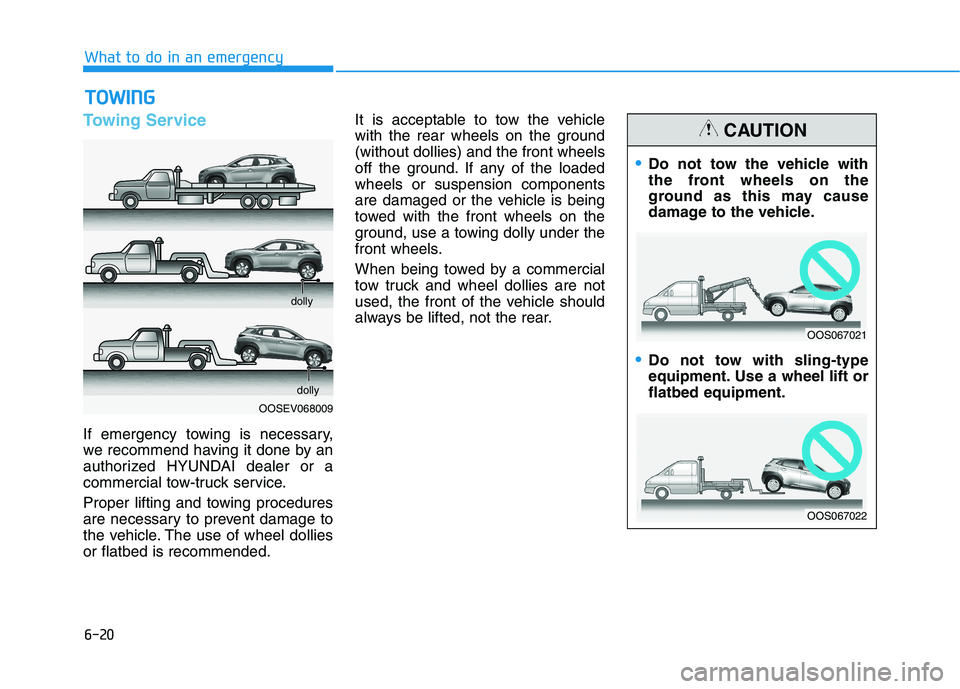
If emergency towing is necessary,
we recommend having it done by an
authorized HYUNDAI dealer or a
commercial tow-truck service.
Proper lifting and towing procedures
are necessary to prevent damage to
the vehicle. The use of wheel dollies
or flatbed is recommended.It is acceptable to tow the vehicle
with the rear wheels on the ground
(without dollies) and the front wheels
off the ground. If any of the loaded
wheels or suspension components
are damaged or the vehicle is being
towed with the front wheels on the
ground, use a towing dolly under the
front wheels.
When being towed by a commercial
tow truck and wheel dollies are not
used, the front of the vehicle should
always be lifted, not the rear.
T TO
OW
WI
IN
NG
G
OOSEV068009dolly dolly
Do not tow the vehicle with
the front wheels on the
ground as this may cause
damage to the vehicle.
Do not tow with sling-type
equipment. Use a wheel lift or
flatbed equipment.
CAUTION
OOS067021
OOS067022
Page 380 of 478
6-21
What to do in an emergency
6
When towing your vehicle in an
emergency without wheel dollies:
1. While depressing the brake pedal
shift to the N (Neutral) position
and turn the vehicle off. The
POWER button will be in the ACC
position.
2. Release the parking brake.
Failure to shift to N (Neutral) may
cause internal damage to the vehi-
cle.
Flat Towing is Not
Recommended
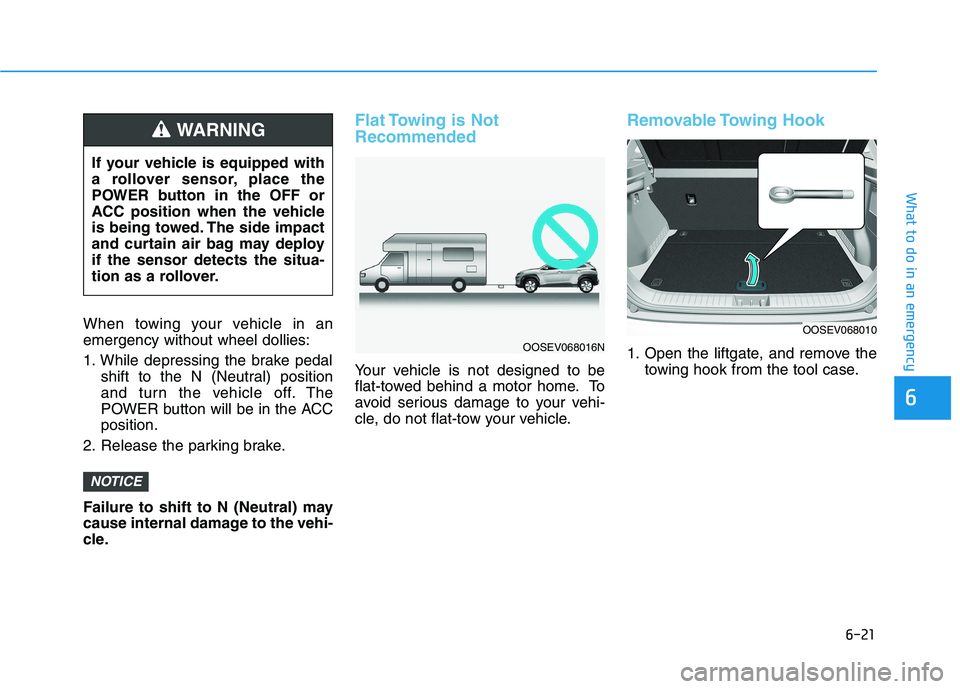
Your vehicle is not designed to be
flat-towed behind a motor home. To
avoid serious damage to your vehi-
cle, do not flat-tow your vehicle.
Removable Towing Hook
1. Open the liftgate, and remove the
towing hook from the tool case.
NOTICE
If your vehicle is equipped with
a rollover sensor, place the
POWER button in the OFF or
ACC position when the vehicle
is being towed. The side impact
and curtain air bag may deploy
if the sensor detects the situa-
tion as a rollover.
WARNING
OOSEV068010
OOSEV068016N
Page 381 of 478
6-22
What to do in an emergency
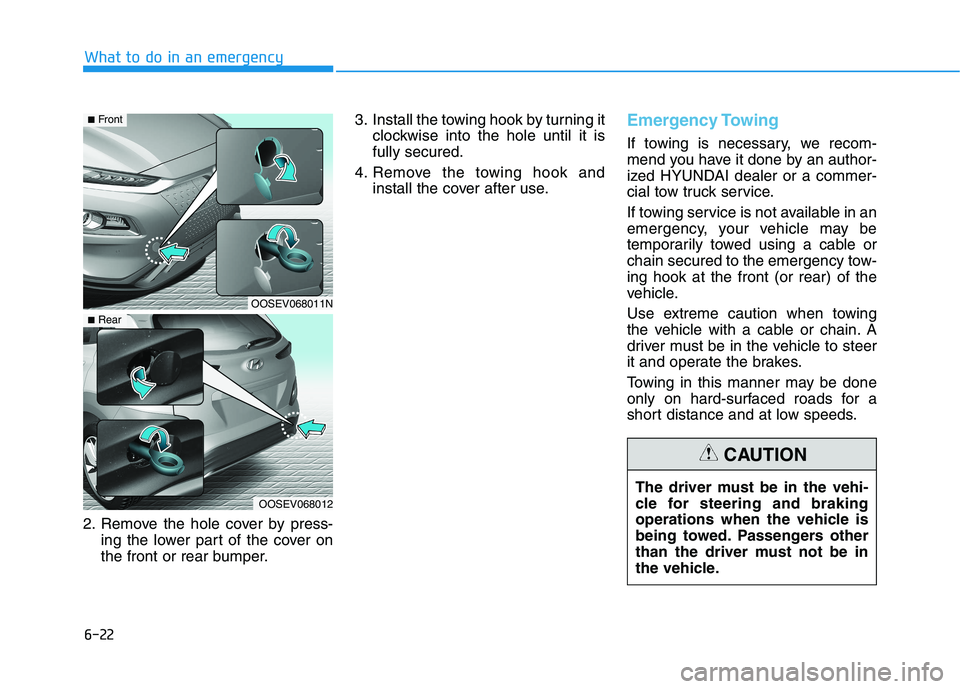
2. Remove the hole cover by press-
ing the lower part of the cover on
the front or rear bumper.3. Install the towing hook by turning it
clockwise into the hole until it is
fully secured.
4. Remove the towing hook and
install the cover after use.
Emergency Towing
If towing is necessary, we recom-
mend you have it done by an author-
ized HYUNDAI dealer or a commer-
cial tow truck service.
If towing service is not available in an
emergency, your vehicle may be
temporarily towed using a cable or
chain secured to the emergency tow-
ing hook at the front (or rear) of the
vehicle.
Use extreme caution when towing
the vehicle with a cable or chain. A
driver must be in the vehicle to steer
it and operate the brakes.
Towing in this manner may be done
only on hard-surfaced roads for a
short distance and at low speeds.
OOSEV068011N
OOSEV068012
■Front
■Rear
The driver must be in the vehi-
cle for steering and braking
operations when the vehicle is
being towed. Passengers other
than the driver must not be in
the vehicle.
CAUTION
Page 382 of 478
6-23
What to do in an emergency
6
Always follow these emergency tow-
ing precautions:
While depressing the brake pedal
shift to the N (Neutral) position and
turn the vehicle off. The POWER
button will be in the ACC position.
Release the parking brake.
Depress the brake pedal with more
force than normal since you will
have reduced braking perform-
ance.
More steering effort will be
required because the power steer-
ing system will be disabled.
Use a vehicle heavier than your
own to tow your vehicle.
The drivers of both vehicles should
communicate with each other fre-
quently.
Before emergency towing, check
that the hook is not broken or dam-
aged.
Fasten the towing cable or chain
securely to the hook.
Do not jerk the hook. Apply steady
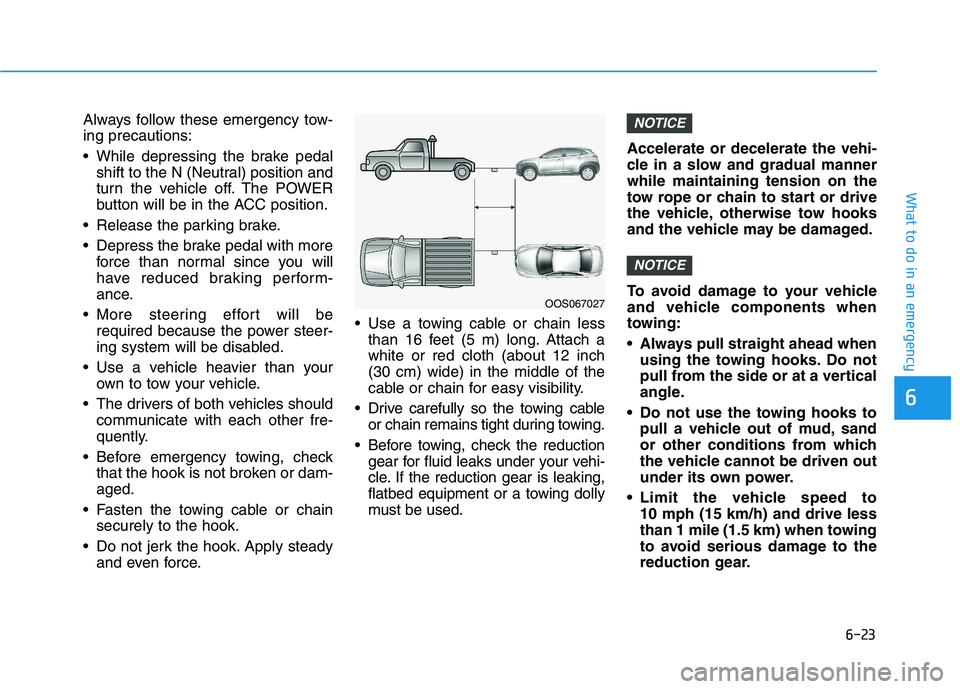
and even force. Use a towing cable or chain less
than 16 feet (5 m) long. Attach a
white or red cloth (about 12 inch
(30 cm) wide) in the middle of the
cable or chain for easy visibility.
Drive carefully so the towing cable
or chain remains tight during towing.
Before towing, check the reduction
gear for fluid leaks under your vehi-
cle. If the reduction gear is leaking,
flatbed equipment or a towing dolly
must be used.Accelerate or decelerate the vehi-
cle in a slow and gradual manner
while maintaining tension on the
tow rope or chain to start or drive
the vehicle, otherwise tow hooks
and the vehicle may be damaged.
To avoid damage to your vehicle
and vehicle components when
towing:
Always pull straight ahead when
using the towing hooks. Do not
pull from the side or at a vertical
angle.
Do not use the towing hooks to
pull a vehicle out of mud, sand
or other conditions from which
the vehicle cannot be driven out
under its own power.
Limit the vehicle speed to
10 mph (15 km/h) and drive less
than 1 mile (1.5 km) when towing
to avoid serious damage to the
reduction gear.
NOTICE
NOTICE
OOS067027
Page 392 of 478
7-10
Maintenance
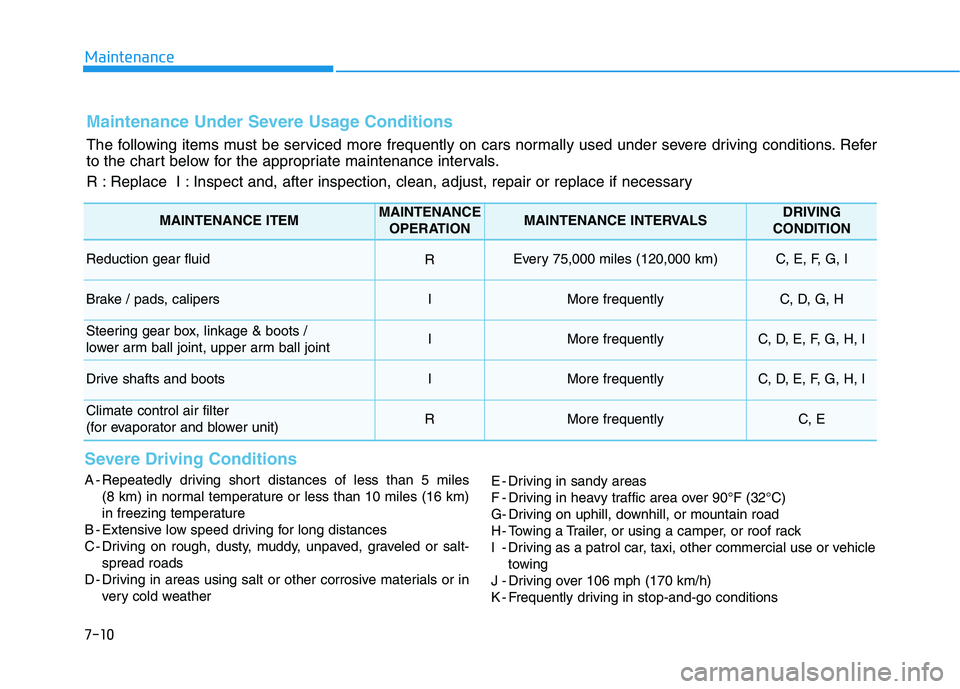
Maintenance Under Severe Usage Conditions
The following items must be serviced more frequently on cars normally used under severe driving conditions. Refer
to the chart below for the appropriate maintenance intervals.
R : Replace I : Inspect and, after inspection, clean, adjust, repair or replace if necessary
Severe Driving Conditions
A - Repeatedly driving short distances of less than 5 miles
(8 km) in normal temperature or less than 10 miles (16 km)
in freezing temperature
B - Extensive low speed driving for long distances
C - Driving on rough, dusty, muddy, unpaved, graveled or salt-
spread roads
D - Driving in areas using salt or other corrosive materials or in
very cold weatherE - Driving in sandy areas
F - Driving in heavy traffic area over 90°F (32°C)
G- Driving on uphill, downhill, or mountain road
H - Towing a Trailer, or using a camper, or roof rack
I - Driving as a patrol car, taxi, other commercial use or vehicle
towing
J - Driving over 106 mph (170 km/h)
K - Frequently driving in stop-and-go conditions
MAINTENANCE ITEMMAINTENANCE
OPERATIONMAINTENANCE INTERVALSDRIVING
CONDITION
Reduction gear fluid REvery 75,000 miles (120,000 km) C, E, F, G, I
Brake / pads, calipersIMore frequentlyC, D, G, H
Steering gear box, linkage & boots /
lower arm ball joint, upper arm ball jointIMore frequentlyC, D, E, F, G, H, I
Drive shafts and bootsIMore frequentlyC, D, E, F, G, H, I
Climate control air filter
(for evaporator and blower unit)RMore frequentlyC, E
Page 447 of 478
7-65
7
Maintenance
Matte paint finish vehicle
(if equipped)
Automatic car wash which uses
rotating brushes should not be
used as this can damage the sur-
face of your vehicle. A steam
cleaner which washes the vehicle
surface at high temperature may
result the oil to adhere and leave
stains that is difficult to remove.
Use a soft cloth (e.g. microfiber
towel or sponge) when washing
your vehicle and dry with a
microfiber towel. When you hand
wash your vehicle, you should not
use a cleaner that finishes with
wax. If the vehicle surface is too
dirty (sand, dirt, dust, contami-
nant, etc.), clean the surface with
water before washing the car.
Waxing
A good coat of wax provides a barri-
er between your paint and environ-
mental contamination.
Keeping a good coat of wax on your
vehicle will help protect it.
Wax the vehicle when water will no
longer bead on the paint.
Always wash and dry the vehicle
before waxing. Use a good quality
liquid or paste wax, and follow the
manufacturer’s instructions. Wax all
metal trim to protect it and to main-
tain its luster.
Removing oil, tar, and similar materi-
als with a spot remover will usually
strip the wax from the finish. Be sure
to re-wax these areas even if the rest
of the vehicle does not yet need wax-
ing. Wiping dust or dirt off the body
with a dry cloth will scratch the
finish.
Do not use steel wool, abrasive
cleaners, or strong detergents
containing highly alkaline or
caustic agents on chrome-plat-
ed or anodized aluminum parts.
This may result in damage to the
protective coating and cause
discoloration or paint deteriora-
tion.
Matte paint finish vehicle
(if equipped)
Do not use any polish protector
such as a detergent, an abrasive
and a polish. In case wax is
applied, remove the wax immedi-
ately using a silicon remover and
if any tar or tar contaminant is on
the surface use a tar remover to
clean. However, be careful not to
apply too much pressure on the
painted area.
NOTICE
NOTICENOTICE
Page 468 of 478
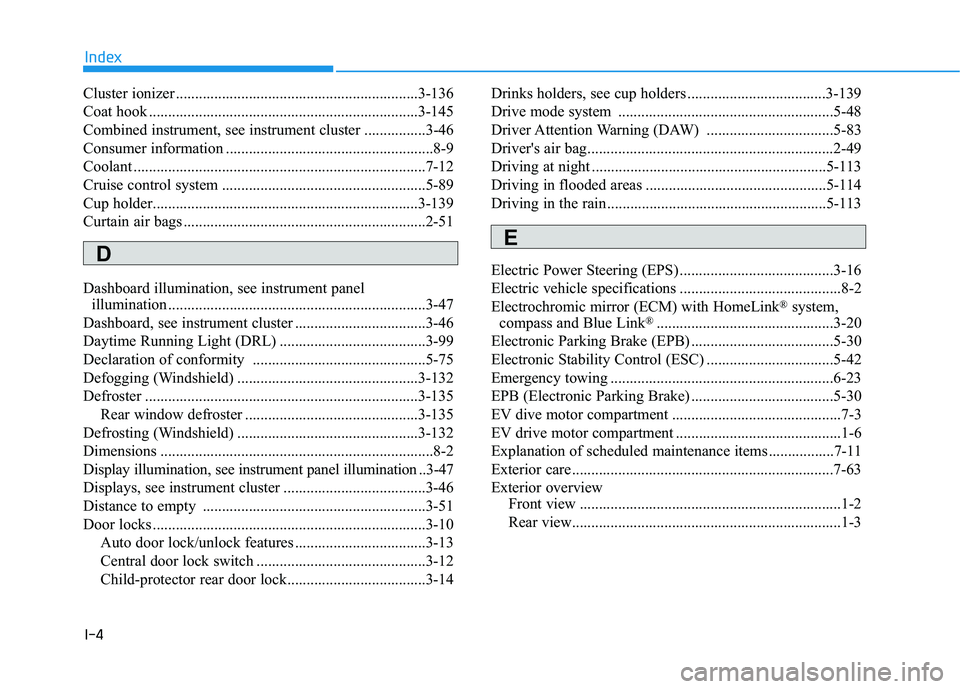
I-4
Cluster ionizer ...............................................................3-136
Coat hook ......................................................................3-145
Combined instrument, see instrument cluster ................3-46
Consumer information ......................................................8-9
Coolant ............................................................................7-12
Cruise control system .....................................................5-89
Cup holder.....................................................................3-139
Curtain air bags ...............................................................2-51
Dashboard illumination, see instrument panel
illumination ...................................................................3-47
Dashboard, see instrument cluster ..................................3-46
Daytime Running Light (DRL) ......................................3-99
Declaration of conformity .............................................5-75
Defogging (Windshield) ...............................................3-132
Defroster .......................................................................3-135
Rear window defroster .............................................3-135
Defrosting (Windshield) ...............................................3-132
Dimensions .......................................................................8-2
Display illumination, see instrument panel illumination ..3-47
Displays, see instrument cluster .....................................3-46
Distance to empty ..........................................................3-51
Door locks .......................................................................3-10
Auto door lock/unlock features ..................................3-13
Central door lock switch ............................................3-12
Child-protector rear door lock....................................3-14Drinks holders, see cup holders ....................................3-139
Drive mode system ........................................................5-48
Driver Attention Warning (DAW) .................................5-83
Driver's air bag................................................................2-49
Driving at night .............................................................5-113
Driving in flooded areas ...............................................5-114
Driving in the rain .........................................................5-113
Electric Power Steering (EPS) ........................................3-16
Electric vehicle specifications ..........................................8-2
Electrochromic mirror (ECM) with HomeLink
®system,
compass and Blue Link®..............................................3-20
Electronic Parking Brake (EPB) .....................................5-30
Electronic Stability Control (ESC) .................................5-42
Emergency towing ..........................................................6-23
EPB (Electronic Parking Brake) .....................................5-30
EV dive motor compartment ............................................7-3
EV drive motor compartment ...........................................1-6
Explanation of scheduled maintenance items .................7-11
Exterior care....................................................................7-63
Exterior overview
Front view ....................................................................1-2
Rear view......................................................................1-3
Index
D
E
Page 474 of 478
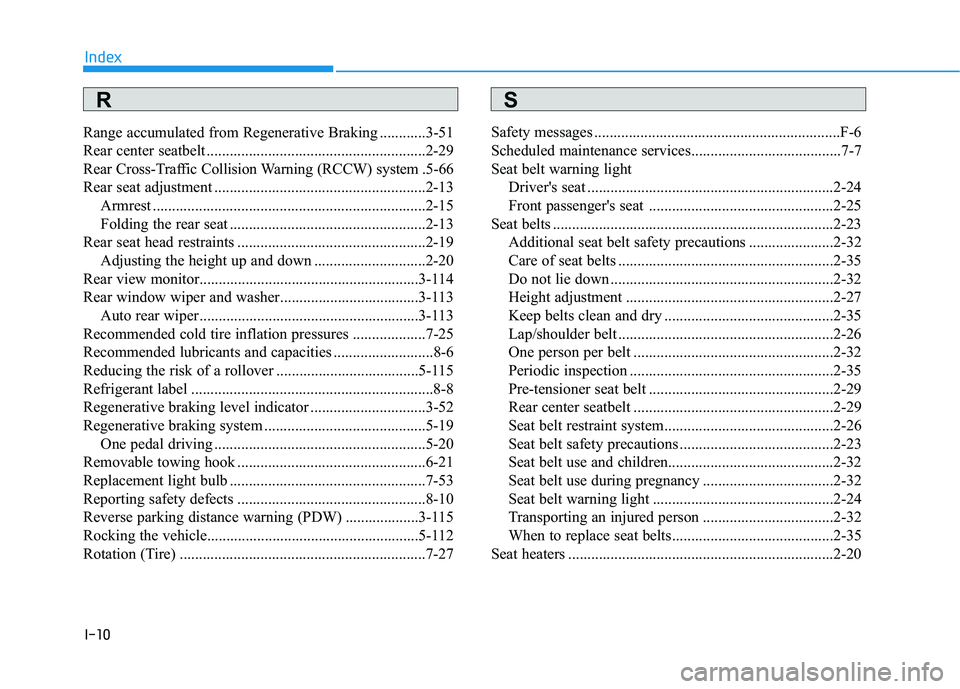
I-10
Range accumulated from Regenerative Braking ............3-51
Rear center seatbelt .........................................................2-29
Rear Cross-Traffic Collision Warning (RCCW) system .5-66
Rear seat adjustment .......................................................2-13
Armrest .......................................................................2-15
Folding the rear seat ...................................................2-13
Rear seat head restraints .................................................2-19
Adjusting the height up and down .............................2-20
Rear view monitor.........................................................3-114
Rear window wiper and washer....................................3-113
Auto rear wiper.........................................................3-113
Recommended cold tire inflation pressures ...................7-25
Recommended lubricants and capacities ..........................8-6
Reducing the risk of a rollover .....................................5-115
Refrigerant label ...............................................................8-8
Regenerative braking level indicator ..............................3-52
Regenerative braking system ..........................................5-19
One pedal driving .......................................................5-20
Removable towing hook .................................................6-21
Replacement light bulb ...................................................7-53
Reporting safety defects .................................................8-10
Reverse parking distance warning (PDW) ...................3-115
Rocking the vehicle.......................................................5-112
Rotation (Tire) ................................................................7-27Safety messages ................................................................F-6
Scheduled maintenance services.......................................7-7
Seat belt warning light
Driver's seat ................................................................2-24
Front passenger's seat ................................................2-25
Seat belts .........................................................................2-23
Additional seat belt safety precautions ......................2-32
Care of seat belts ........................................................2-35
Do not lie down ..........................................................2-32
Height adjustment ......................................................2-27
Keep belts clean and dry ............................................2-35
Lap/shoulder belt ........................................................2-26
One person per belt ....................................................2-32
Periodic inspection .....................................................2-35
Pre-tensioner seat belt ................................................2-29
Rear center seatbelt ....................................................2-29
Seat belt restraint system............................................2-26
Seat belt safety precautions ........................................2-23
Seat belt use and children...........................................2-32
Seat belt use during pregnancy ..................................2-32
Seat belt warning light ...............................................2-24
Transporting an injured person ..................................2-32
When to replace seat belts..........................................2-35
Seat heaters .....................................................................2-20
Index
RS