wheel HYUNDAI KONA EV 2021 Manual Online
[x] Cancel search | Manufacturer: HYUNDAI, Model Year: 2021, Model line: KONA EV, Model: HYUNDAI KONA EV 2021Pages: 478, PDF Size: 32.83 MB
Page 417 of 478
7-35
7
Maintenance
Maximum Inflation Pressure
The maximum air pressure to which
a cold tire may be inflated. The max-
imum air pressure is molded onto the
sidewall.
Maximum Load Rating
The load rating for a tire at the maxi-
mum permissible inflation pressure
for that tire.
Maximum Loaded Vehicle
Weight
The sum of curb weight; accessory
weight; vehicle capacity weight; and
production options weight.
Normal Occupant Weight
The number of occupants a vehicle
is designed to seat multiplied by 150
pounds (68 kg).
Occupant Distribution
Designated seating positions.
Outward Facing Sidewall
An asymmetrical tire has a particular
side that faces outward when mount-
ed on a vehicle. The outward facing
sidewall bears white lettering or
bears manufacturer, brand, and/or
model name molding that is higher or
deeper than the same moldings on
the inner facing sidewall.
Passenger (P-Metric) tire
A tire used on passenger cars and
some light duty trucks and multipur-
pose vehicles.
Ply
A layer of rubber-coated parallel
cords.
Pneumatic tire
A mechanical device made of rubber,
chemicals, fabric and steel or other
materials, that, when mounted on an
automotive wheel provides the trac-
tion and contains the gas or fluid that
sustains the load.
Pneumatic options weight
The combined weight of installed
regular production options weighing
over 5 lb. (2.3 kg) in excess of the
standard items which they replace,
not previously considered in curb
weight or accessory weight, includ-
ing heavy duty breaks, ride levelers,
roof rack, heavy duty battery, and
special trim.
Recommended Inflation
Pressure
Vehicle manufacturer's recommend-
ed tire inflation pressure as shown
on the tire placard.
Page 419 of 478
7-37
7
Maintenance
All Season Tires
HYUNDAI specifies all season tires
on some models to provide good
performance for use all year round,
including snowy and icy road condi-
tions. All season tires are identified
by ALL SEASON and/or M+S (Mud
and Snow) on the tire sidewall. Snow
tires have better snow traction than
all season tires and may be more
appropriate in some areas.
Summer Tires
HYUNDAI specifies summer tires on
some models to provide superior
performance on dry roads. Summer
tire performance is substantially
reduced in snow and ice. Summer
tires do not have the tire traction rat-
ing M+S (Mud and Snow) on the tire
side wall. If you plan to operate your
vehicle in snowy or icy conditions,
HYUNDAI recommends the use of
snow tires or all season tires on all
four wheels.
Snow Tires
If you equip your car with snow tires,
they should be the same size and
have the same load capacity as the
original tires. Snow tires should be
installed on all four wheels; other-
wise, poor handling may result. Snow
tires should carry 4 psi (28 kPa)
more air pressure than the pressure
recommended for the standard tires
on the tire label on the driver’s side of
the center pillar, or up to the maxi-
mum pressure shown on the tire
sidewall, whichever is less. Do not
drive faster than 75 mph (120 km/h)
when your vehicle is equipped with
snow tires.
Radial-Ply Tires
Radial-ply tires provide improved
tread life, road hazard resistance and
smoother high speed ride. The radi-
al-ply tires used on this vehicle are of
belted construction, and are selected
to complement the ride and handling
characteristics of your vehicle.
Radial-ply tires have the same load
carrying capacity, as bias-ply or bias
belted tires of the same size, and use
the same recommended inflation
pressure. Mixing of radial-ply tires
with bias-ply or bias belted tires is
not recommended. Any combina-
tions of radial-ply and bias-ply or bias
belted tires when used on the same
vehicle will seriously deteriorate
vehicle handling. The best rule to fol-
low is: Identical pairs of radial-ply
tires should always be used as a set
for the front tires and a set for the
rear tires.
Page 448 of 478
7-66
Maintenance
Repairing your vehicle’s finish
Deep scratches or stone chips in the
painted surface must be repaired
promptly. Exposed metal will quickly
rust and may develop into a major
repair expense.
If your vehicle is damaged and
requires any metal repair or
replacement, be sure the body
shop applies anti-corrosion mate-
rials to the parts repaired or
replaced.
Matte paint finish vehicle
(if equipped)
In case of matte paint finish vehi-
cles, it is impossible to modify
only the damaged area and repair
of the whole part is necessary. If
the vehicle is damaged and paint-
ing is required, we recommend
that you have your vehicle main-
tained and repaired by an author-
ized HYUNDAI dealer. Take
extreme care, as it is difficult to
restore the quality after the repair.
Bright-metal maintenance
To remove road tar and insects,
use a tar remover, not a scraper or
other sharp object.
To protect the surfaces of bright-
metal parts from corrosion, apply a
coating of wax or chrome preser-
vative and rub to a high luster.
During winter weather or in coastal
areas, cover the bright metal parts
with a heavier coating of wax or
preservative. If necessary, coat the
parts with non-corrosive petroleum
jelly or other protective compound.
Underbody maintenance
Corrosive materials used for ice and
snow removal and dust control may
collect on the underbody. If these
materials are not removed, acceler-
ated rusting can occur on underbody
parts such as the fuel lines, frame,
floor pan and exhaust system, even
though they have been treated with
rust protection.Thoroughly flush the vehicle under-
body and wheel openings with luke-
warm or cold water once a month,
after off-road driving and at the end
of each winter. Pay special attention
to these areas because it is difficult
to see all the mud and dirt. It will do
more harm than good to wet down
the road grime without removing it.
The lower edges of doors, rocker
panels, and frame members have
drain holes that should not be
allowed to clog with dirt; trapped
water in these areas can cause rust-
ing.
NOTICE
NOTICE
After washing the vehicle, test
the brakes while driving slowly
to see if they have been affected
by water. If braking performance
is impaired, dry the brakes by
applying them lightly while
maintaining a slow forward
speed.
WARNING
Page 449 of 478
7-67
7
Maintenance
Aluminum wheel maintenance
The aluminum wheels are coated
with a clear protective finish.
Do not use abrasive cleaner, pol-
ishing compound, solvent, or
wire brushes on aluminum
wheels.
Clean the wheel when it has
cooled.
Use only a mild soap or neutral
detergent, and rinse thoroughly
with water. Also, clean the
wheels after driving on salted
roads.
Do not wash the wheels with
high-speed car wash brushes.
Do not use any cleaners con-
taining acid or alkaline deter-
gents.
Corrosion protection
Protecting your vehicle from corro-
sion
By using the most advanced design
and construction practices to combat
corrosion, HYUNDAI produces cars
of the highest quality. However, this is
only part of the job. To achieve the
long-term corrosion resistance your
vehicle can deliver, the owner’s
cooperation and assistance is also
required.
Common causes of corrosion
The most common causes of corro-
sion on your vehicle are:
Road salt, dirt and moisture that is
allowed to accumulate underneath
the vehicle.
Removal of paint or protective
coatings by stones, gravel, abra-
sion or minor scrapes and dents
which leave unprotected metal
exposed to corrosion.
High-corrosion areas
If you live in an area where your vehi-
cle is regularly exposed to corrosive
materials, corrosion protection is
particularly important. Some of the
common causes of accelerated cor-
rosion are road salts, dust control
chemicals, ocean air and industrial
pollution.
Moisture breeds corrosion
Moisture creates the conditions in
which corrosion is most likely to
occur. For example, corrosion is
accelerated by high humidity, partic-
ularly when temperatures are just
above freezing. In such conditions,
the corrosive material is kept in con-
tact with the car surfaces by moisture
that is slow to evaporate.+
Mud is particularly corrosive
because it is slow to dry and holds
moisture in contact with the vehicle.
Although the mud appears to be dry,
it can still retain the moisture and
promote corrosion.
NOTICE
Page 451 of 478
7-69
7
Maintenance
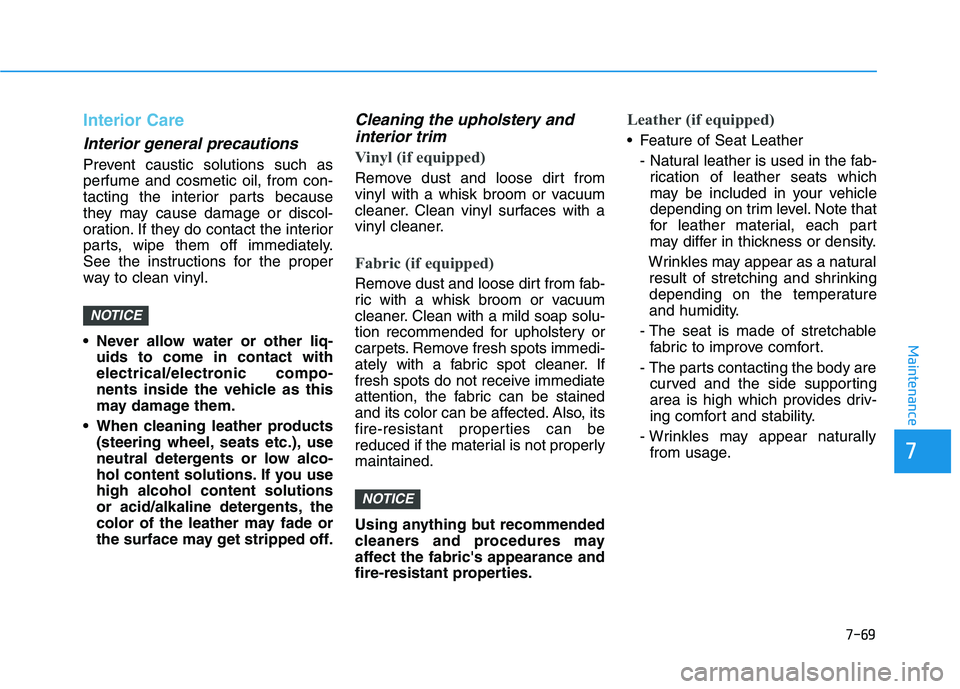
Interior Care
Interior general precautions
Prevent caustic solutions such as
perfume and cosmetic oil, from con-
tacting the interior parts because
they may cause damage or discol-
oration. If they do contact the interior
parts, wipe them off immediately.
See the instructions for the proper
way to clean vinyl.
Never allow water or other liq-
uids to come in contact with
electrical/electronic compo-
nents inside the vehicle as this
may damage them.
When cleaning leather products
(steering wheel, seats etc.), use
neutral detergents or low alco-
hol content solutions. If you use
high alcohol content solutions
or acid/alkaline detergents, the
color of the leather may fade or
the surface may get stripped off.
Cleaning the upholstery and
interior trim
Vinyl (if equipped)
Remove dust and loose dirt from
vinyl with a whisk broom or vacuum
cleaner. Clean vinyl surfaces with a
vinyl cleaner.
Fabric (if equipped)
Remove dust and loose dirt from fab-
ric with a whisk broom or vacuum
cleaner. Clean with a mild soap solu-
tion recommended for upholstery or
carpets. Remove fresh spots immedi-
ately with a fabric spot cleaner. If
fresh spots do not receive immediate
attention, the fabric can be stained
and its color can be affected. Also, its
fire-resistant properties can be
reduced if the material is not properly
maintained.
Using anything but recommended
cleaners and procedures may
affect the fabric's appearance and
fire-resistant properties.
Leather (if equipped)
Feature of Seat Leather
- Natural leather is used in the fab-
rication of leather seats which
may be included in your vehicle
depending on trim level. Note that
for leather material, each part
may differ in thickness or density.
Wrinkles may appear as a natural
result of stretching and shrinking
depending on the temperature
and humidity.
- The seat is made of stretchable
fabric to improve comfort.
- The parts contacting the body are
curved and the side supporting
area is high which provides driv-
ing comfort and stability.
- Wrinkles may appear naturally
from usage.
NOTICE
NOTICE
Page 455 of 478
888
Specifications & Consumer information
8
Specifications, Consumer information and Reporting safety defects
8
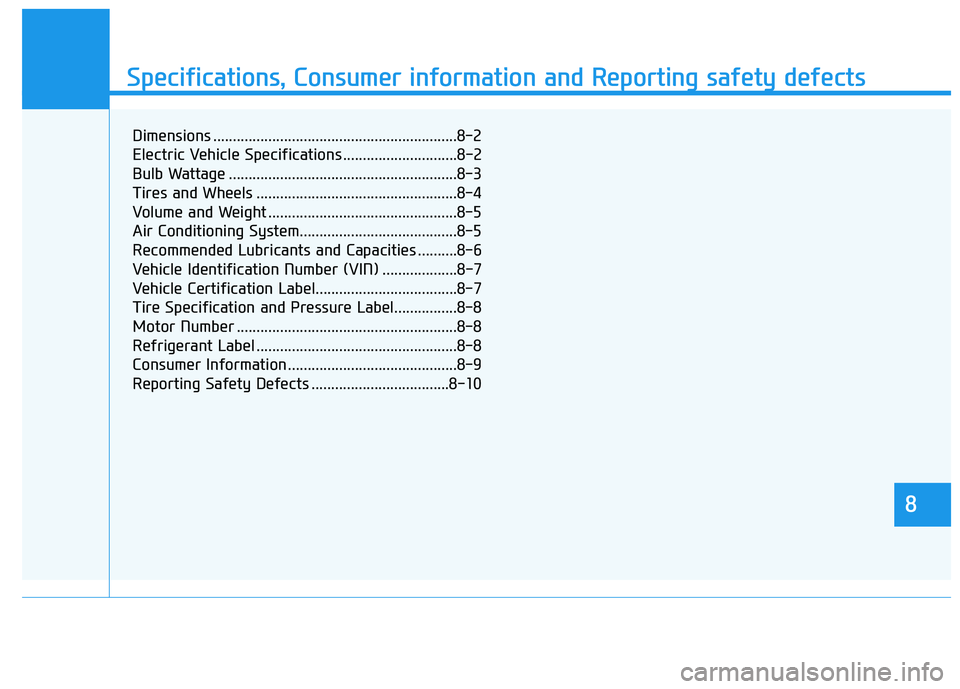
Dimensions ..............................................................8-2
Electric Vehicle Specifications .............................8-2
Bulb Wattage ..........................................................8-3
Tires and Wheels ...................................................8-4
Volume and Weight ................................................8-5
Air Conditioning System........................................8-5
Recommended Lubricants and Capacities ..........8-6
Vehicle Identification Number (VIN) ...................8-7
Vehicle Certification Label....................................8-7
Tire Specification and Pressure Label................8-8
Motor Number ........................................................8-8
Refrigerant Label ...................................................8-8
Consumer Information ...........................................8-9
Reporting Safety Defects ...................................8-10
Page 456 of 478
D DI
IM
ME
EN
NS
SI
IO
ON
NS
S
8-2
Specifications, Consumer information and Reporting safety defects
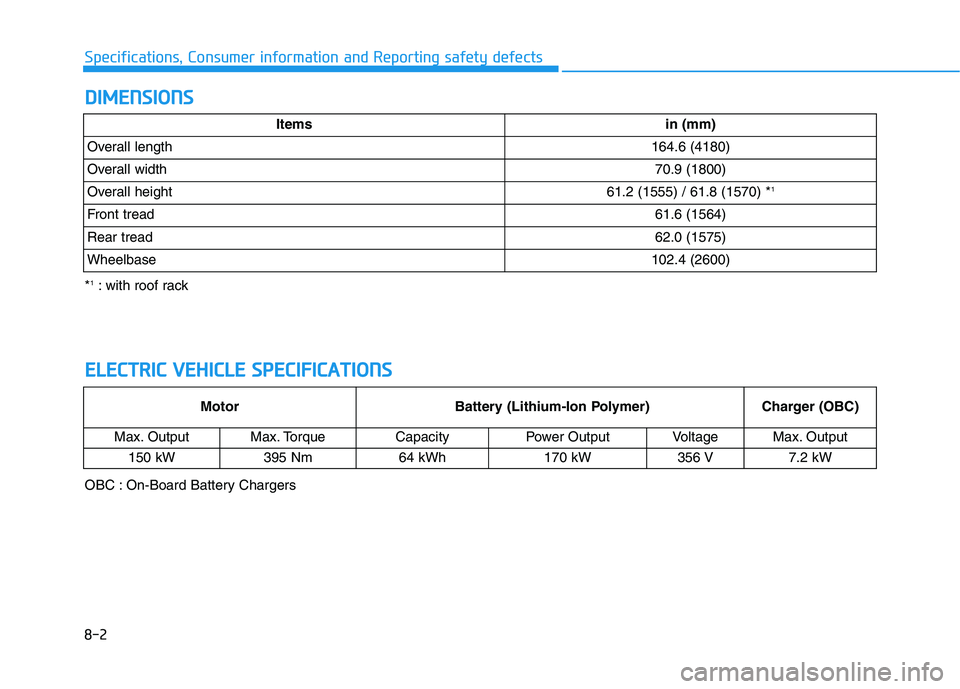
Itemsin (mm)
Overall length164.6 (4180)
Overall width70.9 (1800)
Overall height61.2 (1555) / 61.8 (1570) *1
Front tread61.6 (1564)
Rear tread 62.0 (1575)
Wheelbase102.4 (2600)
E
EL
LE
EC
CT
TR
RI
IC
C
V
VE
EH
HI
IC
CL
LE
E
S
SP
PE
EC
CI
IF
FI
IC
CA
AT
TI
IO
ON
NS
S
Motor Battery (Lithium-Ion Polymer)Charger (OBC)
Max. Output
Max. Torque CapacityPower OutputVoltageMax. Output
150 kW
395 Nm 64 kWh170 kW356 V7.2 kW
OBC : On-Board Battery Chargers *
1: with roof rack
Page 458 of 478
8-4
Specifications, Consumer information and Reporting safety defects
T TI
IR
RE
ES
S
A
AN
ND
D
W
WH
HE
EE
EL
LS
S
When replacing tires, use the same size originally supplied with the vehicle.
Using tires of a different size can damage the related parts or not work properly.
CAUTION
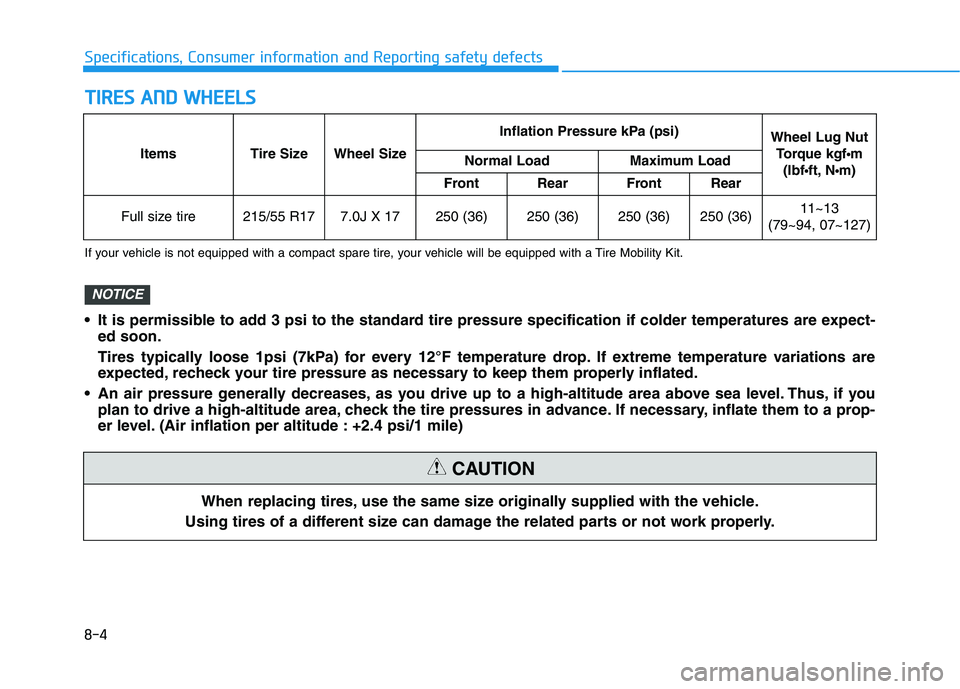
If your vehicle is not equipped with a compact spare tire, your vehicle will be equipped with a Tire Mobility Kit.
Items Tire SizeWheel Size
Inflation Pressure kPa (psi)Wheel Lug Nut
Torque kgf
•m
(lbf
ft, Nm)Normal LoadMaximum Load
FrontRearFrontRear
Full size tire215/55 R177.0J X 17250 (36)250 (36)250 (36)250 (36)11~13
(79~94, 07~127)
It is permissible to add 3 psi to the standard tire pressure specification if colder temperatures are expect-
ed soon.
Tires typically loose 1psi (7kPa) for every 12°F temperature drop. If extreme temperature variations are
expected, recheck your tire pressure as necessary to keep them properly inflated.
An air pressure generally decreases, as you drive up to a high-altitude area above sea level. Thus, if you
plan to drive a high-altitude area, check the tire pressures in advance. If necessary, inflate them to a prop-
er level. (Air inflation per altitude : +2.4 psi/1 mile)
NOTICE
Page 469 of 478
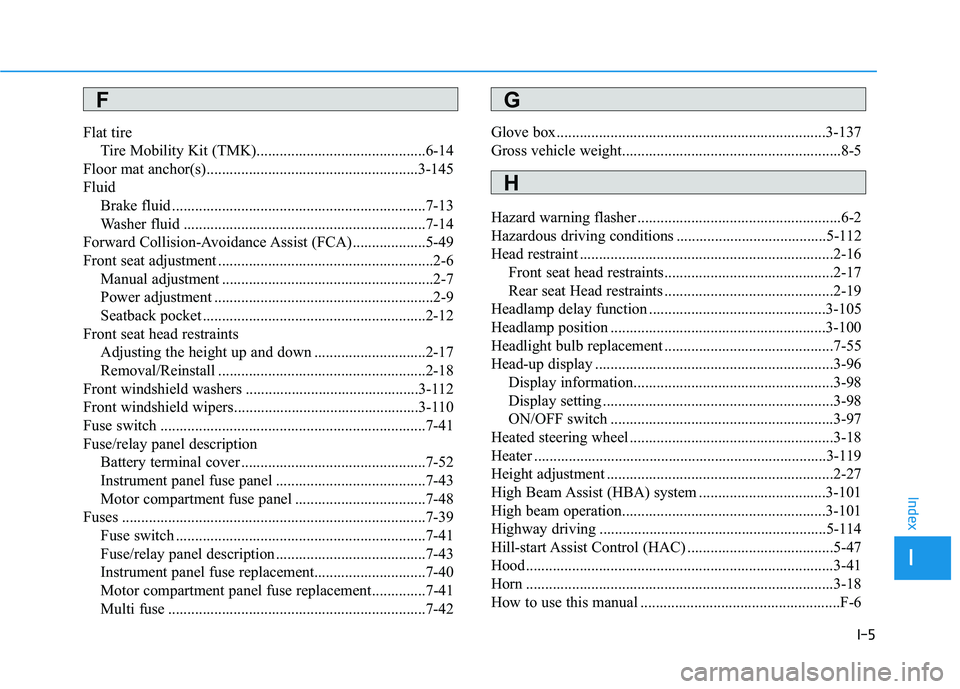
I-5
Flat tire
Tire Mobility Kit (TMK)............................................6-14
Floor mat anchor(s).......................................................3-145
Fluid
Brake fluid ..................................................................7-13
Washer fluid ...............................................................7-14
Forward Collision-Avoidance Assist (FCA)...................5-49
Front seat adjustment ........................................................2-6
Manual adjustment .......................................................2-7
Power adjustment .........................................................2-9
Seatback pocket ..........................................................2-12
Front seat head restraints
Adjusting the height up and down .............................2-17
Removal/Reinstall ......................................................2-18
Front windshield washers .............................................3-112
Front windshield wipers................................................3-110
Fuse switch .....................................................................7-41
Fuse/relay panel description
Battery terminal cover ................................................7-52
Instrument panel fuse panel .......................................7-43
Motor compartment fuse panel ..................................7-48
Fuses ...............................................................................7-39
Fuse switch .................................................................7-41
Fuse/relay panel description .......................................7-43
Instrument panel fuse replacement.............................7-40
Motor compartment panel fuse replacement..............7-41
Multi fuse ...................................................................7-42Glove box......................................................................3-137
Gross vehicle weight.........................................................8-5
Hazard warning flasher .....................................................6-2
Hazardous driving conditions .......................................5-112
Head restraint ..................................................................2-16
Front seat head restraints............................................2-17
Rear seat Head restraints ............................................2-19
Headlamp delay function ..............................................3-105
Headlamp position ........................................................3-100
Headlight bulb replacement ............................................7-55
Head-up display ..............................................................3-96
Display information....................................................3-98
Display setting ............................................................3-98
ON/OFF switch ..........................................................3-97
Heated steering wheel .....................................................3-18
Heater ............................................................................3-119
Height adjustment ...........................................................2-27
High Beam Assist (HBA) system .................................3-101
High beam operation.....................................................3-101
Highway driving ...........................................................5-114
Hill-start Assist Control (HAC) ......................................5-47
Hood................................................................................3-41
Horn ................................................................................3-18
How to use this manual ....................................................F-6
I
Index
F
H
G
Page 471 of 478
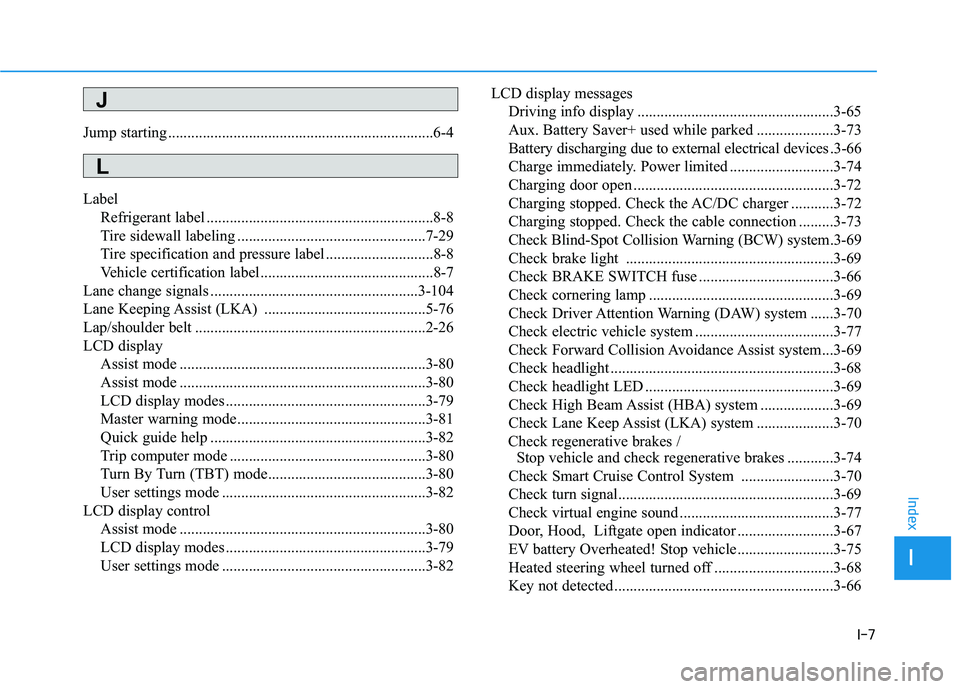
I-7
Jump starting .....................................................................6-4
Label
Refrigerant label ...........................................................8-8
Tire sidewall labeling .................................................7-29
Tire specification and pressure label ............................8-8
Vehicle certification label .............................................8-7
Lane change signals ......................................................3-104
Lane Keeping Assist (LKA) ..........................................5-76
Lap/shoulder belt ............................................................2-26
LCD display
Assist mode ................................................................3-80
Assist mode ................................................................3-80
LCD display modes ....................................................3-79
Master warning mode .................................................3-81
Quick guide help ........................................................3-82
Trip computer mode ...................................................3-80
Turn By Turn (TBT) mode.........................................3-80
User settings mode .....................................................3-82
LCD display control
Assist mode ................................................................3-80
LCD display modes ....................................................3-79
User settings mode .....................................................3-82LCD display messages
Driving info display ...................................................3-65
Aux. Battery Saver+ used while parked ....................3-73
Battery discharging due to external electrical devices .3-66
Charge immediately. Power limited ...........................3-74
Charging door open ....................................................3-72
Charging stopped. Check the AC/DC charger ...........3-72
Charging stopped. Check the cable connection .........3-73
Check Blind-Spot Collision Warning (BCW) system.3-69
Check brake light ......................................................3-69
Check BRAKE SWITCH fuse ...................................3-66
Check cornering lamp ................................................3-69
Check Driver Attention Warning (DAW) system ......3-70
Check electric vehicle system ....................................3-77
Check Forward Collision Avoidance Assist system...3-69
Check headlight ..........................................................3-68
Check headlight LED .................................................3-69
Check High Beam Assist (HBA) system ...................3-69
Check Lane Keep Assist (LKA) system ....................3-70
Check regenerative brakes /
Stop vehicle and check regenerative brakes ............3-74
Check Smart Cruise Control System ........................3-70
Check turn signal........................................................3-69
Check virtual engine sound ........................................3-77
Door, Hood, Liftgate open indicator .........................3-67
EV battery Overheated! Stop vehicle.........................3-75
Heated steering wheel turned off ...............................3-68
Key not detected .........................................................3-66
I
Index
J
L