lock HYUNDAI KONA EV 2023 User Guide
[x] Cancel search | Manufacturer: HYUNDAI, Model Year: 2023, Model line: KONA EV, Model: HYUNDAI KONA EV 2023Pages: 548, PDF Size: 49.14 MB
Page 65 of 548
Foreword / Electric Vehicle System Overview
1-60
Additional Precautions
• When you paint or apply heat
treatment to the vehicle as a result of
an accident, the performance of the
high voltage battery can be reduced.
If heat treatment is required, contact
an authorized HYUNDAI dealer.
• When you clean the motor
compartment, do not use high
pressure water to wash. This may
cause an electric shock due to a
discharge in high voltage electricity,
or damage the vehicle’s electric
system.
• Do not use, remodel, or install non-
genuine parts. This may damage the
electric power system.
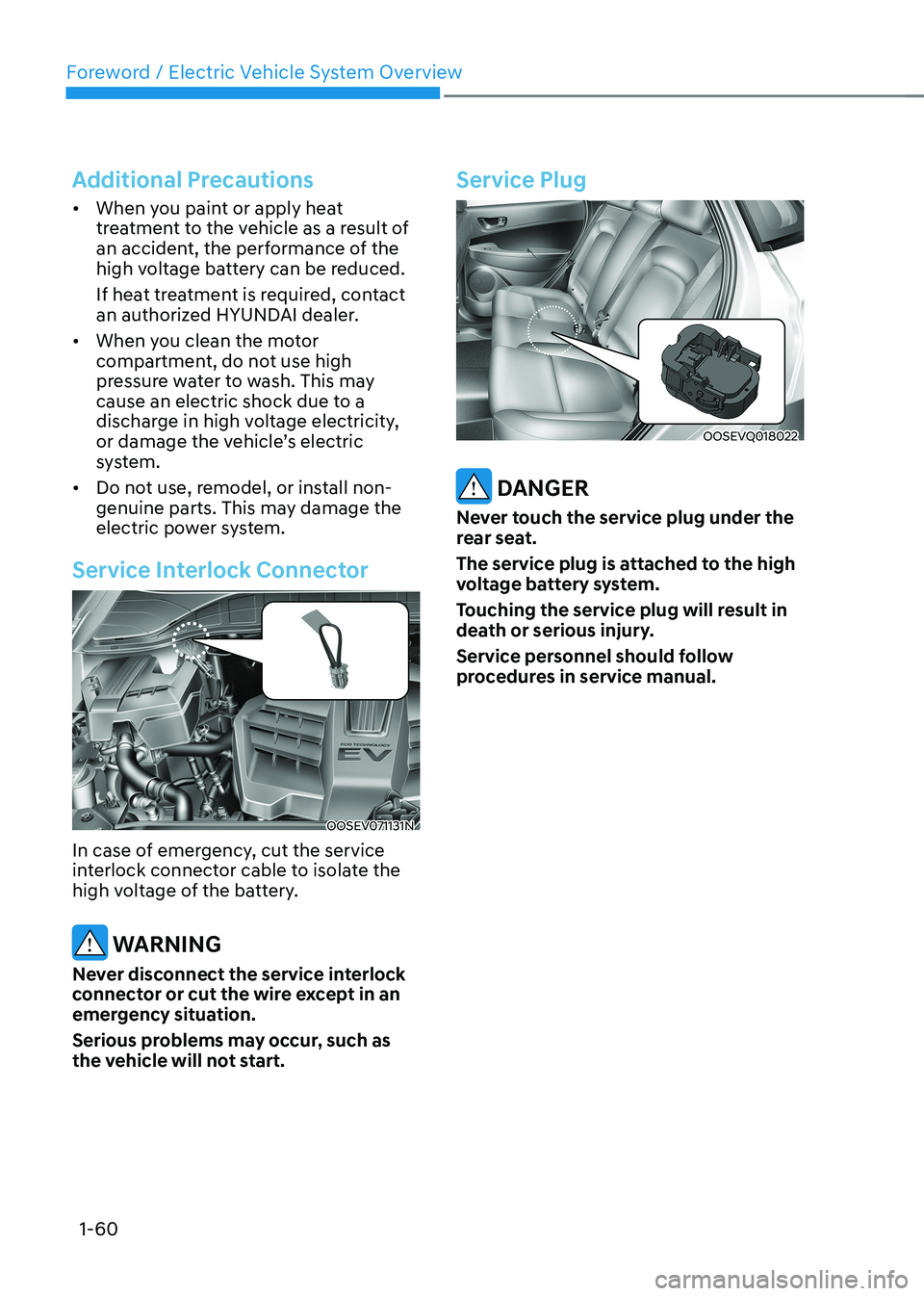
Service Interlock Connector
OOSEV071131N
In case of emergency, cut the service
interlock connector cable to isolate the
high voltage of the battery.
WARNING
Never disconnect the service interlock
connector or cut the wire except in an
emergency situation.
Serious problems may occur, such as
the vehicle will not start.
Service Plug
OOSEVQ018022
DANGER
Never touch the service plug under the
rear seat.
The service plug is attached to the high
voltage battery system.
Touching the service plug will result in
death or serious injury.
Service personnel should follow
procedures in service manual.
Page 69 of 548
2-4
Vehicle information
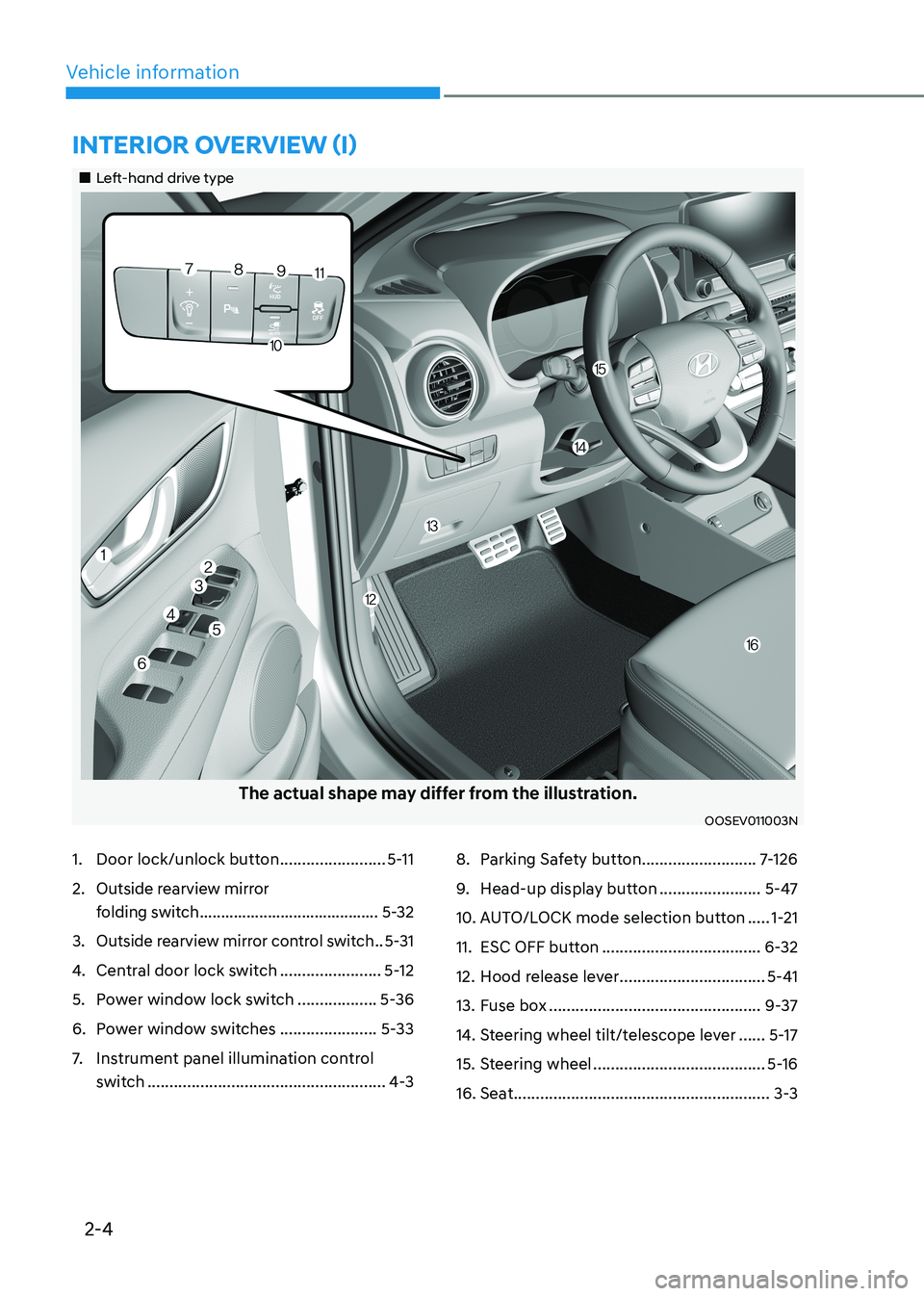
1. Door lock/unlock button ........................5-11
2. Outside rearview mirror
folding switch .......................................... 5-32
3. Outside rearview mirror control switch ..5-31
4. Central door lock switch .......................5-12
5. Power window lock switch ..................5-36
6. Power window switches ......................5-33
7. Instrument panel illumination control
switch ...................................................... 4-38. Parking Safety button
..........................7-126
9. Head-up display button .......................5-47
10. AUTO/LOCK mode selection button .....1-21
11. ESC OFF button .................................... 6-32
12. Hood release lever .................................5-41
13. Fuse box ................................................ 9-37
14. Steering wheel tilt/telescope lever ......5-17
15. Steering wheel ....................................... 5-16
16. Seat .......................................................... 3-3
intErior ovErviEw (i)
„„Left-hand drive type
The actual shape may differ from the illustration.
OOSEV011003N
Page 78 of 548
02
2-13
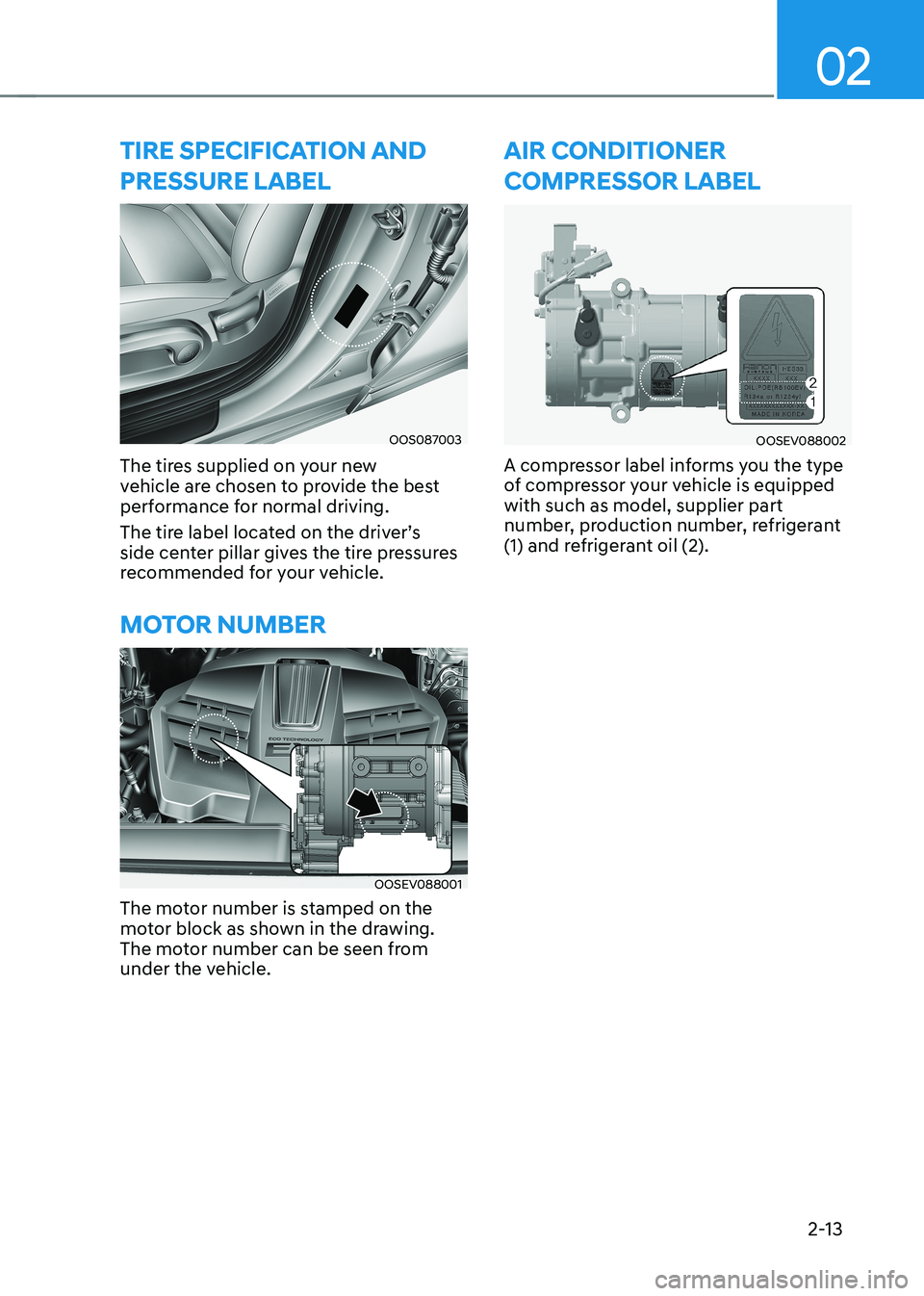
tire speciFication anD pressure LaBeL
OOS087003
The tires supplied on your new
vehicle are chosen to provide the best
performance for normal driving.
The tire label located on the driver’s
side center pillar gives the tire pressures
recommended for your vehicle.
Motor nuMBer
OOSEV088001
The motor number is stamped on the
motor block as shown in the drawing.
The motor number can be seen from
under the vehicle.
air conDitioner
coMpressor LaBeL
OOSEV088002
A compressor label informs you the type
of compressor your vehicle is equipped with such as model, supplier part
number, production number, refrigerant
(1) and refrigerant oil (2).
Page 83 of 548
Safety system
3-4
Safety precautions
Adjusting the seats so that you are sitting
in a safe, comfortable position plays an
important role in driver and passenger
safety, together with seat belts and air
bags, in an accident.
WARNING
Do not use a cushion that reduces
friction between the seat and the
passenger. The passenger’s hips may
slide under the lap portion of the seat
belt during an accident or a sudden
stop.
Serious or fatal internal injuries could
result because the seat belt cannot
operate properly. Air bags
You can take steps to reduce the risk
of being injured by an inflating air bag.
Sitting too close to an air bag greatly
increases the risk of injury in the event
the air bag inflates. Move your seat as
far back as possible from front air bags,
while still maintaining control of the
vehicle.
WARNING
To reduce the risk of serious injury or
death from an inflating air bag, take the
following precautions: • Adjust the driver’s seat as far to the
rear as possible while maintaining
the ability to control the vehicle.
• Adjust the front passenger seat as far
to the rear as possible.
• Hold the steering wheel by the rim
with hands at the 9 o’clock and 3
o’clock positions to minimize the risk
of injuries to your hands and arms.
• NEVER place anything or anyone
between you and the air bag.
• Do not allow the front passenger to
place feet or legs on the dashboard
to minimize the risk of leg injuries.
Page 84 of 548
03
3-5
Seat belts
Always fasten your seat belt before
starting any trip. At all times, passengers
should sit upright and be properly
restrained. Infants and small children
must be restrained in appropriate Child
Restraint Systems. Children who have
outgrown a booster seat and adults must
be restrained using the seat belts.
WARNING
Take the following precautions when
adjusting your seat belt: • NEVER use one seat belt for more
than one occupant.
• Always position the seatback upright
with the lap portion of the seat belt
snug and low across the hips.
• NEVER allow children or small infants
to ride on a passenger’s lap.
• Do not route the seat belt across your
neck, across sharp edges, or reroute
the shoulder strap away from your
body.
• Do not allow the seat belt to become
caught or jammed.
Front seats
The front seat can be adjusted by using
the control lever (or knob) or switches
located on the outside of the seat
cushion. Before driving, adjust the seat
to the proper position so that you can
easily control the steering wheel, foot
pedals and controls on the instrument panel.
WARNING
Take the following precautions when
adjusting your seat: • NEVER attempt to adjust the seat
while the vehicle is moving. The seat
could respond with unexpected
movement and may cause loss
of vehicle control resulting in an
accident.
• Do not place anything under the
front seats. Loose objects in the
driver’s foot area could interfere
with the operation of the foot pedals,
causing an accident.
• Do not allow anything to interfere
with the normal position and proper
locking of the seatback.
• Do not place a cigarette lighter on
the floor or seat. When you operate
the seat, gas may exit out of the
lighter causing a fire.
• Use extreme caution when picking
up small objects trapped under the
seats or between the seat and the
center console. Your hands might be
cut or injured by the sharp edges of
the seat mechanism.
• If there are occupants in the rear
seats, be careful while adjusting the
front seat position.
• Make sure that the seat is locked in
place after the adjustment. If not,
the seat might move unexpectedly
resulting in an accident.
Page 85 of 548
Safety system
3-6
CAUTION
To prevent injury: • Do not adjust your seat while
wearing your seat belt.
Moving the seat cushion forward
may cause strong pressure on your abdomen.
• Do not allow your hands or fingers to
get caught in the seat mechanisms
while the seat is moving.
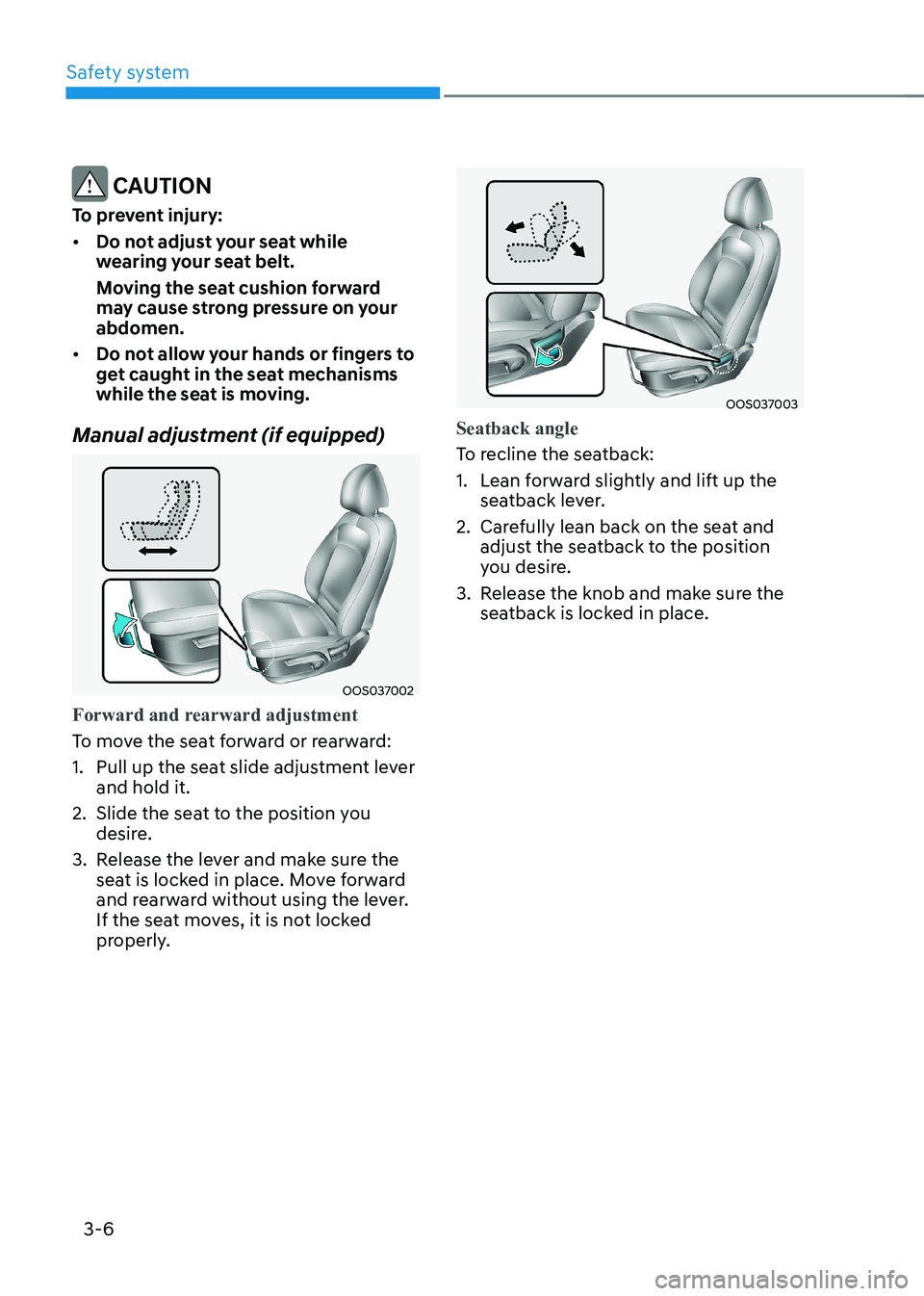
Manual adjustment (if equipped)
OOS037002
Forward and rearward adjustment
To move the seat forward or rearward:
1. Pull up the seat slide adjustment lever and hold it.
2. Slide the seat to the position you desire.
3. Release the lever and make sure the seat is locked in place. Move forward
and rearward without using the lever.
If the seat moves, it is not locked
properly.
OOS037003
Seatback angle
To recline the seatback:
1. Lean forward slightly and lift up the seatback lever.
2. Carefully lean back on the seat and adjust the seatback to the position
you desire.
3. Release the knob and make sure the seatback is locked in place.
Page 90 of 548
03
3-11
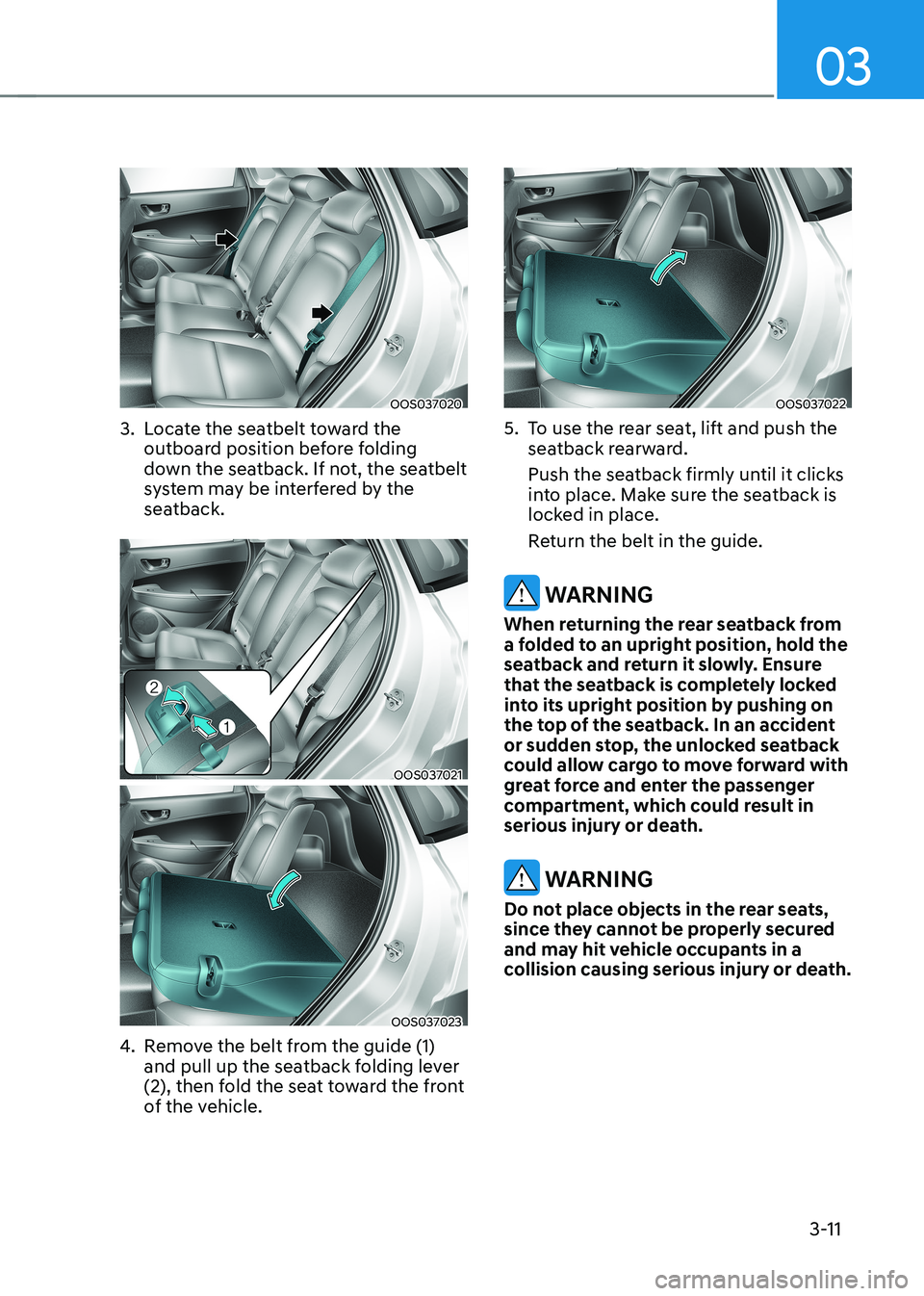
OOS037020
3. Locate the seatbelt toward the outboard position before folding
down the seatback. If not, the seatbelt
system may be interfered by the
seatback.
OOS037021
OOS037023
4. Remove the belt from the guide (1)
and pull up the seatback folding lever
(2), then fold the seat toward the front
of the vehicle.
OOS037022
5. To use the rear seat, lift and push the seatback rearward.
Push the seatback firmly until it clicks
into place. Make sure the seatback is
locked in place.
Return the belt in the guide.
WARNING
When returning the rear seatback from
a folded to an upright position, hold the
seatback and return it slowly. Ensure
that the seatback is completely locked
into its upright position by pushing on
the top of the seatback. In an accident
or sudden stop, the unlocked seatback
could allow cargo to move forward with
great force and enter the passenger
compartment, which could result in
serious injury or death.
WARNING
Do not place objects in the rear seats,
since they cannot be properly secured
and may hit vehicle occupants in a
collision causing serious injury or death.
Page 92 of 548
03
3-13
Headrest
The vehicle’s front and rear seats have
adjustable headrests. The headrests
provide comfort for passengers, but
more importantly they are designed to
help protect passengers from whiplash
and other neck and spinal injuries during
an accident, especially in a rear impact collision.
WARNING
To reduce the risk of serious injury or
death in an accident, take the following
precautions when adjusting your
headrests: • Always properly adjust the headrests
for all passengers BEFORE starting
the vehicle.
• NEVER let anyone ride in a seat with
the headrest removed or reversed.
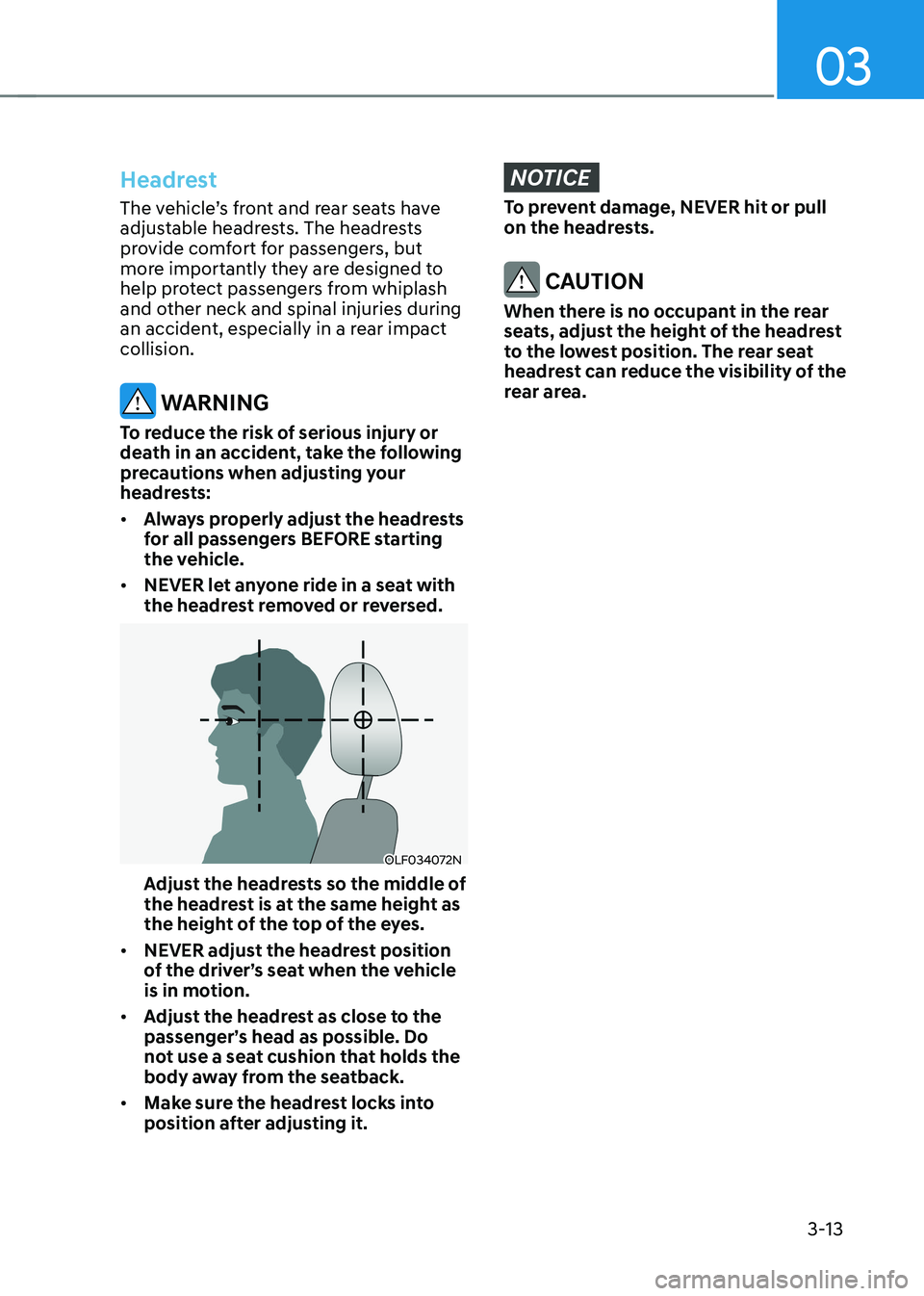
OLF034072N
Adjust the headrests so the middle of
the headrest is at the same height as
the height of the top of the eyes.
• NEVER adjust the headrest position
of the driver’s seat when the vehicle
is in motion.
• Adjust the headrest as close to the
passenger’s head as possible. Do
not use a seat cushion that holds the
body away from the seatback.
• Make sure the headrest locks into
position after adjusting it.
NOTICE
To prevent damage, NEVER hit or pull
on the headrests.
CAUTION
When there is no occupant in the rear
seats, adjust the height of the headrest
to the lowest position. The rear seat
headrest can reduce the visibility of the
rear area.
Page 95 of 548
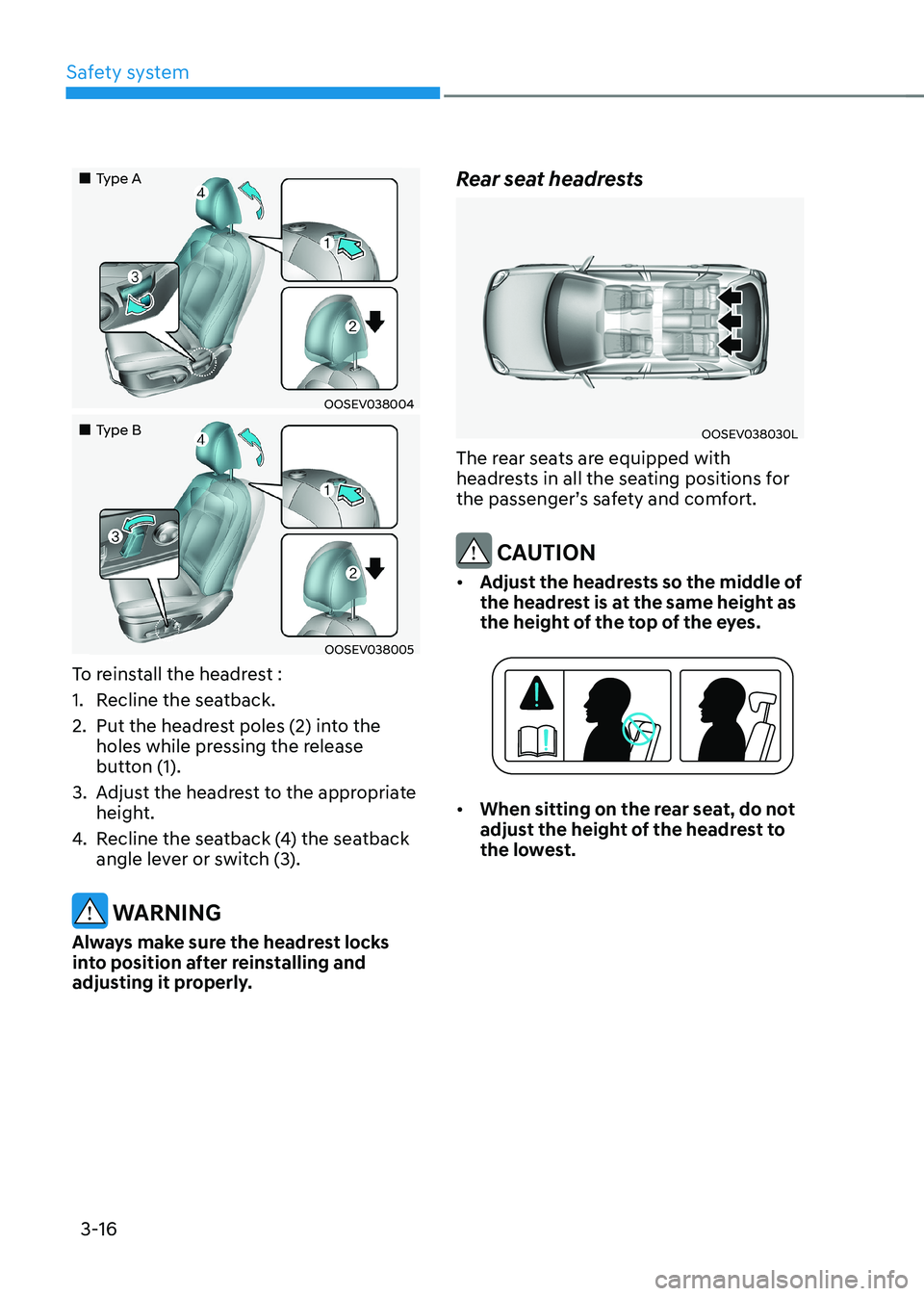
Safety system
3-16
„„Type A
OOSEV038004
„„Type B
OOSEV038005
To reinstall the headrest :
1. Recline the seatback.
2. Put the headrest poles (2) into the holes while pressing the release
button (1).
3. Adjust the headrest to the appropriate height.
4. Recline the seatback (4) the seatback
angle lever or switch (3).
WARNING
Always make sure the headrest locks
into position after reinstalling and
adjusting it properly. Rear seat headrests
OOSEV038030L
The rear seats are equipped with
headrests in all the seating positions for
the passenger’s safety and comfort.
CAUTION
• Adjust the headrests so the middle of
the headrest is at the same height as
the height of the top of the eyes.
• When sitting on the rear seat, do not
adjust the height of the headrest to
the lowest.
Page 96 of 548
03
3-17
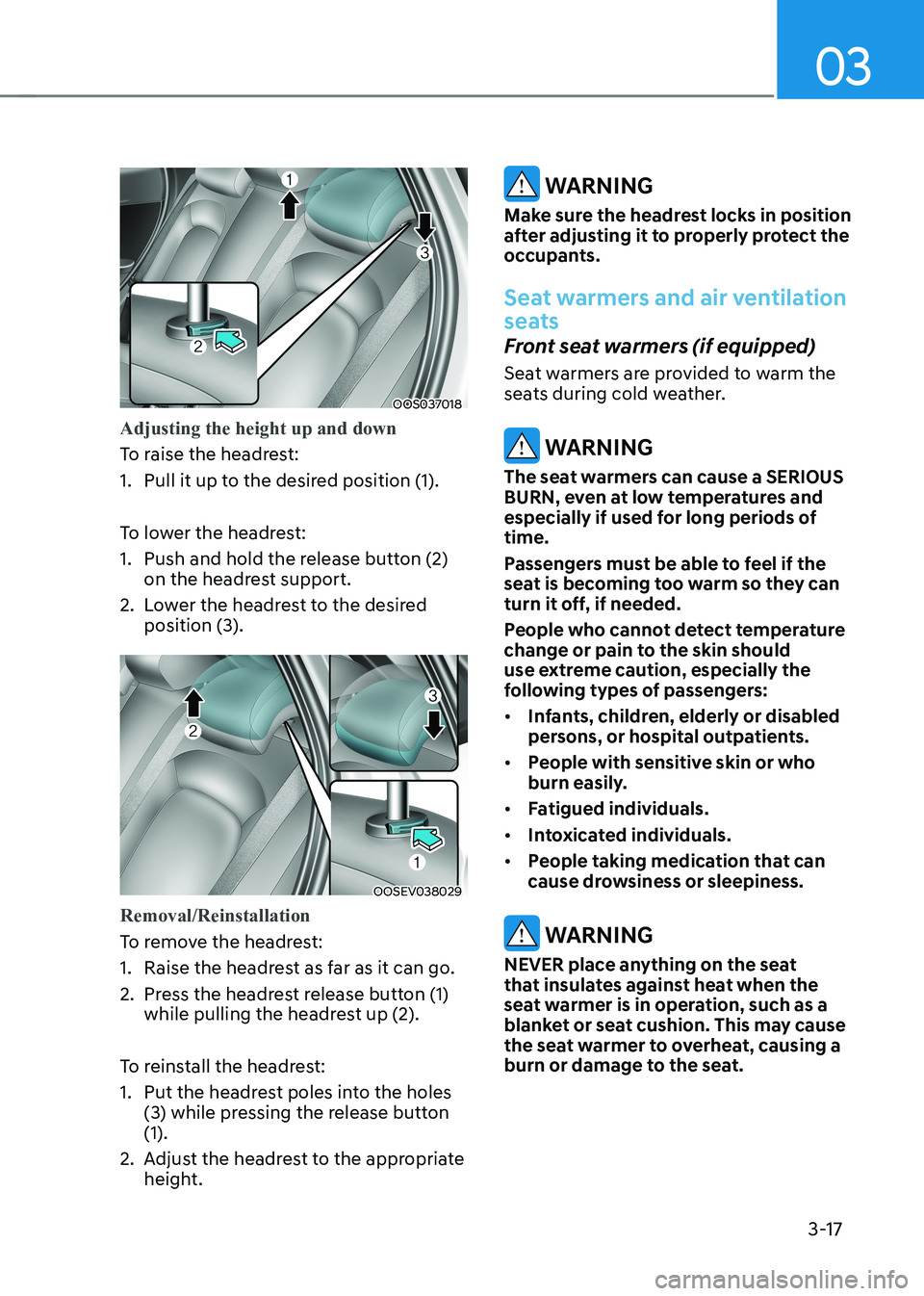
OOS037018
Adjusting the height up and down
To raise the headrest:
1. Pull it up to the desired position (1).
To lower the headrest:
1. Push and hold the release button (2) on the headrest support.
2. Lower the headrest to the desired position (3).
OOSEV038029
Removal/Reinstallation
To remove the headrest:
1. Raise the headrest as far as it can go.
2. Press the headrest release button (1) while pulling the headrest up (2).
To reinstall the headrest:
1. Put the headrest poles into the holes (3) while pressing the release button (1).
2. Adjust the headrest to the appropriate height.
WARNING
Make sure the headrest locks in position
after adjusting it to properly protect the
occupants.
Seat warmers and air ventilation
seats
Front seat warmers (if equipped)
Seat warmers are provided to warm the
seats during cold weather.
WARNING
The seat warmers can cause a SERIOUS
BURN, even at low temperatures and
especially if used for long periods of time.
Passengers must be able to feel if the
seat is becoming too warm so they can
turn it off, if needed.
People who cannot detect temperature
change or pain to the skin should
use extreme caution, especially the
following types of passengers: • Infants, children, elderly or disabled
persons, or hospital outpatients.
• People with sensitive skin or who
burn easily.
• Fatigued individuals.
• Intoxicated individuals.
• People taking medication that can
cause drowsiness or sleepiness.
WARNING
NEVER place anything on the seat
that insulates against heat when the
seat warmer is in operation, such as a
blanket or seat cushion. This may cause
the seat warmer to overheat, causing a
burn or damage to the seat.