engine overheat Hyundai Matrix 2003 User Guide
[x] Cancel search | Manufacturer: HYUNDAI, Model Year: 2003, Model line: Matrix, Model: Hyundai Matrix 2003Pages: 312, PDF Size: 4.1 MB
Page 171 of 312
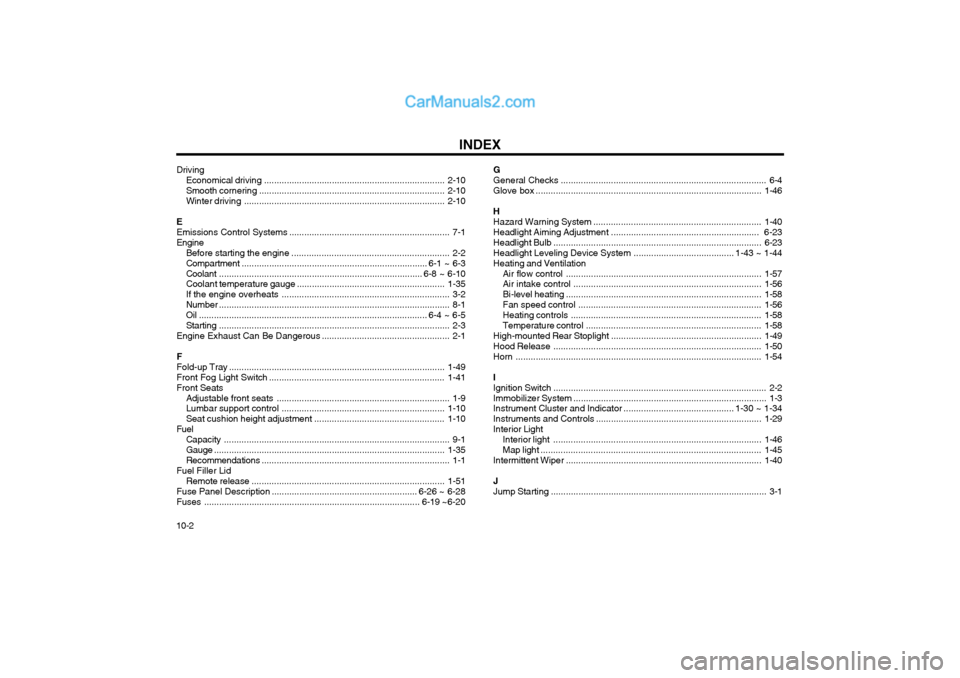
INDEX
10-2 Driving
Economical dr iving ........................................................................ 2-10
Smooth cornering .......................................................................... 2-10
Winter driving ................................................................................ 2-10
E Emissions Control Systems ................................................................ 7-1
Engine Before starting the engine ............................................................... 2-2Compartment .......................................................................... 6-1 ~ 6-3
Coolant ................................................................................. 6-8 ~ 6-10
Coolant temperature gauge ........................................................... 1-35
If the engine overheats ................................................................... 3-2
Number ............................................................................................ 8-1
Oil ........................................................................................... 6-4 ~ 6-5Starting ............................................................................................ 2-3
Engine Exhaust Can Be Dangerous ................................................... 2-1
FFold-up Tray ...................................................................................... 1-49
Front Fog Light Sw itch ...................................................................... 1-41
Front Seats Adjustable front seats ..................................................................... 1-9
Lumbar support control ................................................................. 1-10
Seat cushion height adjustment .................................................... 1-10
Fuel Capacity .......................................................................................... 9-1
Gauge ............................................................................................ 1-35
Recommendations ........................................................................... 1-1
Fuel Filler Lid
Remote release ............................................................................. 1-51
Fuse Panel Description .......................................................... 6-26 ~ 6-28
Fuses ...................................................................................... 6-19 ~6-20 GGeneral Checks
.................................................................................. 6-4
Glove box .......................................................................................... 1-46
H Hazard Warning System ................................................................... 1-40
Headlight Aiming Adjustment ........................................................... 6-23
Headlight Bulb ................................................................................... 6-23
Headlight Leveling Device System ........................................ 1-43 ~ 1-44
Heating and Ventilation
Air flow control .............................................................................. 1-57
Air intake control ........................................................................... 1-56
Bi-level heating .............................................................................. 1-58
Fan speed control ......................................................................... 1-56
Heating controls ............................................................................ 1-58
Temperature control ...................................................................... 1-58
High-mounted Rear Stoplight ............................................................ 1-49
Hood Release ................................................................................... 1-50
Horn .................................................................................................. 1-54
IIgnition Switch ..................................................................................... 2-2
Immobilizer System ............................................................................. 1-3
Instrument Cluster and Indicator ............................................ 1-30 ~ 1-34
Instruments and Controls .................................................................. 1-29
Interior Light Interior light ................................................................................... 1-46
Map light ........................................................................................ 1-45
Intermittent Wiper .............................................................................. 1-40
JJump Starting ...................................................................................... 3-1
Page 211 of 312
CONTROLS AND EQUIPMENT
1- 30 circuits becoming defective, approximately fifty per cent of the normal braking perfor-mance will be available.
If failure of one of the circuits occurs, the
required amount of pedal effort, pedal traveland stopping distance will be increased. Useof the gearbox is recommended to assist inbringing the vehicle to rest. The vehicle mustnot be driven once brake failure has occurreduntil the system has been repaired and isfunctioning normally.
The braking system employs a vacuum servo
in order that the pedal efforts are reduced.Power for the servo is derived from the engineand therefore, in the event of the enginestopping or the vehicle being towed, pedalefforts will be substantially increased.
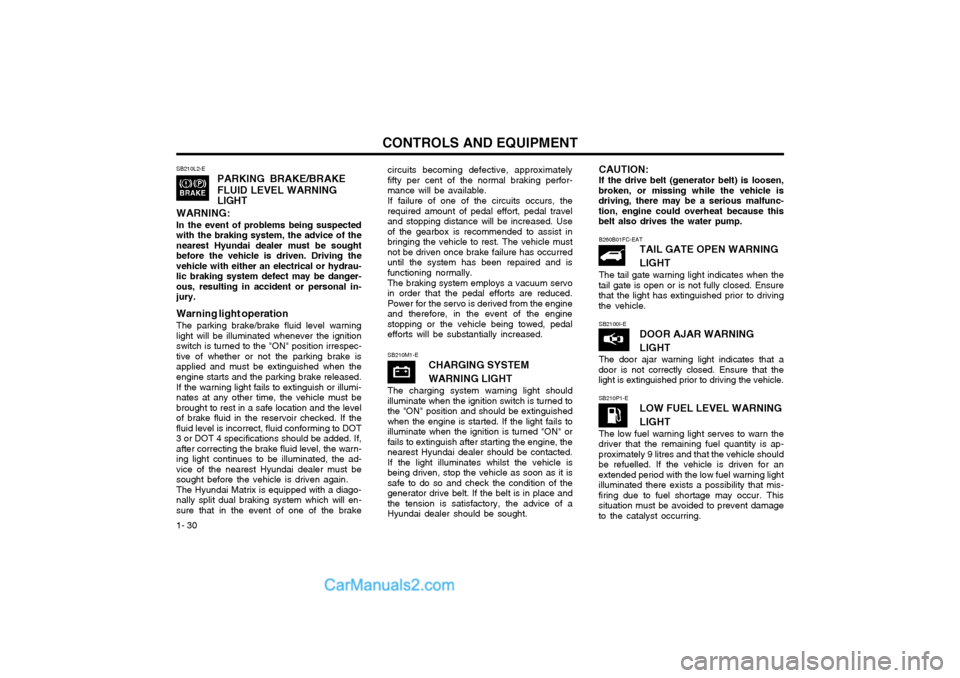
SB210L2-E
PARKING BRAKE/BRAKE FLUID LEVEL WARNING LIGHT
WARNING: In the event of problems being suspected with the braking system, the advice of thenearest Hyundai dealer must be soughtbefore the vehicle is driven. Driving thevehicle with either an electrical or hydrau-lic braking system defect may be danger-ous, resulting in accident or personal in-jury. Warning light operation The parking brake/brake fluid level warning light will be illuminated whenever the ignitionswitch is turned to the "ON" position irrespec-tive of whether or not the parking brake isapplied and must be extinguished when theengine starts and the parking brake released. If the warning light fails to extinguish or illumi- nates at any other time, the vehicle must bebrought to rest in a safe location and the levelof brake fluid in the reservoir checked. If thefluid level is incorrect, fluid conforming to DOT3 or DOT 4 specifications should be added. If,after correcting the brake fluid level, the warn-ing light continues to be illuminated, the ad-vice of the nearest Hyundai dealer must besought before the vehicle is driven again.The Hyundai Matrix is equipped with a diago-nally split dual braking system which will en-sure that in the event of one of the brake
CAUTION: If the drive belt (generator belt) is loosen,
broken, or missing while the vehicle is driving, there may be a serious malfunc-tion, engine could overheat because thisbelt also drives the water pump.
SB210M1-E CHARGING SYSTEM WARNING LIGHT
The charging system warning light should
illuminate when the ignition switch is turned to the "ON" position and should be extinguishedwhen the engine is started. If the light fails toilluminate when the ignition is turned "ON" orfails to extinguish after starting the engine, thenearest Hyundai dealer should be contacted.If the light illuminates whilst the vehicle isbeing driven, stop the vehicle as soon as it issafe to do so and check the condition of thegenerator drive belt. If the belt is in place andthe tension is satisfactory, the advice of aHyundai dealer should be sought.
B260B01FC-EAT
TAIL GATE OPEN WARNING LIGHT
The tail gate warning light indicates when the
tail gate is open or is not fully closed. Ensure that the light has extinguished prior to drivingthe vehicle.
SB2100I-E DOOR AJAR WARNING LIGHT
The door ajar warning light indicates that a
door is not correctly closed. Ensure that the light is extinguished prior to driving the vehicle.
SB210P1-E
LOW FUEL LEVEL WARNING LIGHT
The low fuel warning light serves to warn the
driver that the remaining fuel quantity is ap- proximately 9 litres and that the vehicle shouldbe refuelled. If the vehicle is driven for anextended period with the low fuel warning lightilluminated there exists a possibility that mis-firing due to fuel shortage may occur. Thissituation must be avoided to prevent damageto the catalyst occurring.
Page 213 of 312
CONTROLS AND EQUIPMENT
1- 32
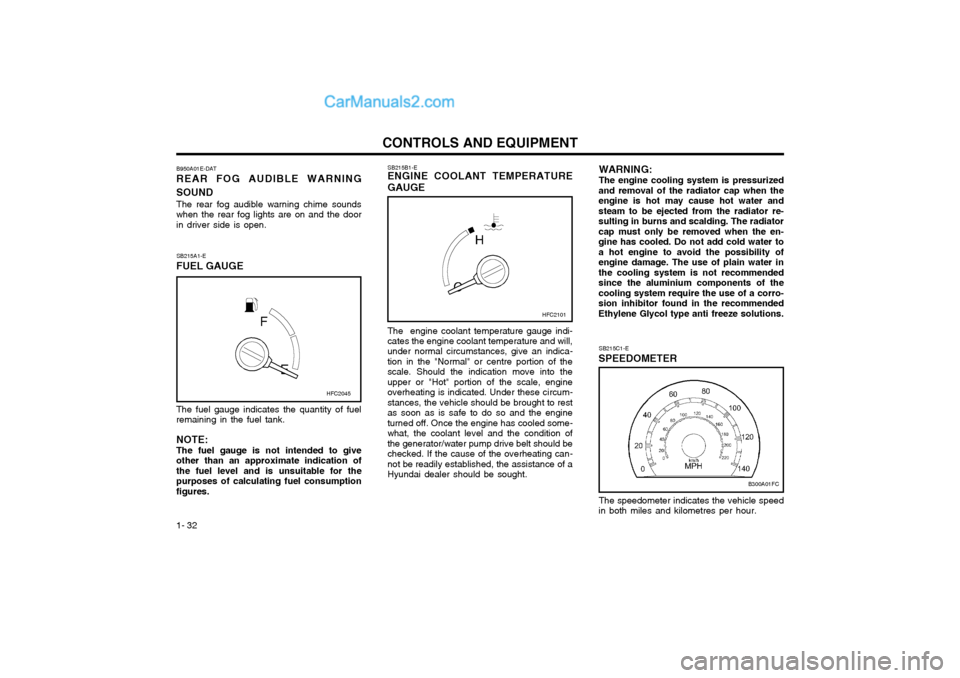
The fuel gauge indicates the quantity of fuel remaining in the fuel tank. NOTE: The fuel gauge is not intended to giveother than an approximate indication ofthe fuel level and is unsuitable for thepurposes of calculating fuel consumptionfigures. SB215B1-E
ENGINE COOLANT TEMPERATURE GAUGE
The engine coolant temperature gauge indi-
cates the engine coolant temperature and will, under normal circumstances, give an indica-tion in the "Normal" or centre portion of thescale. Should the indication move into theupper or "Hot" portion of the scale, engineoverheating is indicated. Under these circum-stances, the vehicle should be brought to restas soon as is safe to do so and the engineturned off. Once the engine has cooled some-what, the coolant level and the condition ofthe generator/water pump drive belt should bechecked. If the cause of the overheating can-not be readily established, the assistance of aHyundai dealer should be sought.
SB215A1-E
FUEL GAUGE
B950A01E-DAT REAR FOG AUDIBLE WARNING SOUND The rear fog audible warning chime sounds when the rear fog lights are on and the doorin driver side is open.
HFC2101
HFC2045
WARNING: The engine cooling system is pressurized
and removal of the radiator cap when the engine is hot may cause hot water andsteam to be ejected from the radiator re-sulting in burns and scalding. The radiatorcap must only be removed when the en-gine has cooled. Do not add cold water toa hot engine to avoid the possibility ofengine damage. The use of plain water inthe cooling system is not recommendedsince the aluminium components of thecooling system require the use of a corro-sion inhibitor found in the recommendedEthylene Glycol type anti freeze solutions.
B300A01FC
SB215C1-E
SPEEDOMETER
The speedometer indicates the vehicle speed
in both miles and kilometres per hour.
Page 251 of 312

DRIVING YOUR HYUNDAI 2- 9
SC130A1-E
OVERDRIVE SWITCH
The overdrive switch prevents the transaxle
upshifting higher than third gear when the switch is turned "OFF". The transaxle will startfrom rest in first gear and upshift to secondand third gear depending upon the roadspeedand throttle opening but will not upshift tofourth gear. When the overdrive switch isturned "ON", the transaxle will start from restin first gear and will upshift, depending uponroadspeed and throttle opening to second,third and fourth gear. Therefore, when theoverdrive switch is turned "OFF", the transaxleperforms as a three speed unit and the over-drive warning light located in the instrumentcluster will be illuminated. When the overdriveswitch is turned "ON", the transaxle functionsas a fully automatic four speed unit with themaximum fuel economy potential of the ve-hicle being realized. o Do not hold the vehicle on the upgrade
with the accelerator pedal. This can causethe transmission to overheat. Always usethe brake pedal or parking brake.
SC140A1-E EFFECTIVE BRAKING Braking system performance and friction ma- terial life are greatly affected by the drivingstyle adopted. The following suggestions aremade to assist in achieving the best resultsfrom the braking system.
o Anticipate the road and conditions ahead
in order that heavy braking may be avoided.
o When descending long gradients, use the engine to assist in retarding the vehicle to minimize the possibility of brake fade oc-curring.
o When trailer towing, ensure that the trailer brakes function correctly and use enginebraking to assist the vehicle braking system.
o Use only genuine Hyundai replacement brake pads and shoes to ensure consis-tent friction characteristics and wear rates.
o After driving through deep water (e.g. fording), the brakes may become wet andperformance reduced. Always check brakeefficiency after emerging from the waterand dry the brakes by lightly depressingthe brake pedal several times whilst driv-ing slowly.
o Apply the parking brake only when the vehicle is at rest.
o Since the power assistance provided by the brake servo is derived from the engine,coasting with the engine turned off or tow-ing of the vehicle with the engine turned offwill result in greatly increased pedal pres-sures being required to stop the vehicle. SC140B1-E
ANTI-LOCK BRAKE SYSTEM (Not all models)
The Anti-Lock Brake System (ABS) is de-
signed to prevent wheel lock-up during sud- den braking or on hazardous road surfaces.The ABS control module monitors the wheelspeed and controls the pressure applied toeach brake. Thus, in emergency situations oron slick roads, ABS will increase vehicle con-trol during braking.
NOTE: During ABS operation, a slight pulsation
may be felt in the brake pedal when the brakes are applied. Also, a noise may beheard in the engine compartment whilstbraking. These conditions are normal andindicate that the anti-lock brake system isfunctioning properly.
WARNING:ABS will not prevent accidents due to im-
proper or dangerous driving maneuvers.Even though vehicle control is improvedduring emergency braking, always maintaina safe distance between you and objectsahead. Vehicle speeds should always bereduced during extreme road conditions.
HFC3023-D
Page 253 of 312

DRIVING YOUR HYUNDAI 2- 11
o Don't "lug" or "over-rev" the engine. Lug-
ging is driving too slowly in too high a gear resulting in the engine bucking. If thishappens to you, shift to a lower gear. Over-revving is racing the engine beyond its safe limit. This can be avoided byshifting at the recommended speeds.
o Use your air conditioning sparingly. The air conditioning system is operated by theengine power so your fuel economy isreduced when you use it.
SC150A1-F
DRIVING FOR ECONOMY
You can save fuel and get more miles fromyour car if you follow these suggestions:
o Drive smoothly. Accelerate at a moderate rate. Don't make "jack-rabbit" starts or full-throttle shifts and maintain a steady cruis-ing speed. Don't race between stoplights.Try to adjust your speed to that of the othertraffic so you don't have to change speedsunnecessarily. Avoid heavy traffic whenever possible. Al- ways maintain a safe distance from othervehicles so you can avoid unnecessarybraking. This also reduces brake wear.
o Drive at a moderate speed. The faster you drive, the more fuel your car uses. Drivingat a moderate speed, especially on thehighway, is one of the most effective waysto reduce fuel consumption.
o Don't "ride" the brake or clutch pedal. This can increase fuel consumption and alsoincrease wear on these components. Inaddition, driving with your foot resting onthe brake pedal may cause the brakes tooverheat, which reduces their effective-ness and may lead to more serious con-
sequences.
o Take care of your tyres. Keep them inflated to the recommended pressure. Incorrectinfla-tion, either too much or too little, re-sults in unnecessary tyre wear. Check thetyre pres-sures at least once a month. o Be sure that the wheels are aligned cor-
rectly. Improper alignment can result fromhitting curbs or driving too fast over irregu-lar surfaces. Poor alignment causes fastertyre wear and may also result in otherproblems as well as greater fuel consump-tion.
o Keep your car in good condition. For better fuel economy and reduced maintenancecosts, maintain your car in accordancewith the maintenance schedule in Section5. If you drive your car in severe condi-tions, more frequent maintenance is re-quired (see Section 5 for details).
o Keep your car clean. For maximum ser- vice, your car should be kept clean andfree of corrosive materials. It is especiallyimportant that mud, dirt, ice, etc. not beallowed to accumulate on the underside ofthe car. This extra weight can result inincreased fuel consumption and also con-tribute to corrosion.
o Travel lightly. Don't carry unnecessary weight in your car. Weight is an enemy ofgood fuel economy.
o Don't let the engine idle longer than neces- sary. If you are waiting (and not in traffic),turn off your engine and restart only whenyou're ready to go.
o Remember, your car does not require extended warm-up. As soon as the engineis running smoothly, you can drive away.In very cold weather, however, give yourengine a slightly longer warm-up period. SC160A1-F SMOOTH CORNERING Avoid braking or gear changing in corners, especially when roads are wet. Ideally, cor-ners should always be taken under gentleacceleration. If you follow these suggestions,tyre wear will be held to a minimum. SC170A1-E WINTER MOTORING The onset of winter conditions subject motor vehicles to greater operating demands. There-fore, the following suggestions will assist inmaintaining peak performance and reliabilityduring these periods:
Page 257 of 312
DRIVING YOUR HYUNDAI 2- 15
5. Always secure items in the trailer to pre-
vent load shift while driving.
6. Check the condition and air pressure of all tyres on the trailer and your car. Low tyre pressure can seriously affect the handling.Also check the spare tyre.
7. The vehicle/trailer combination is more af- fected by crosswind and buffeting. When being passed by a large vehicle, keep a constant speed and steer straightahead. If there is too much wind buffetingslow down to get out of the other vehicle'sair turbulence.
8. When parking your car and trailer, espe- cially on a hill, be sure to follow all thenormal precautions. Turn your front wheelinto the curb, set the parking brake firmly,and put the transaxle in 1st or Reverse(manual) or Park (automatic). In addition,place wheel chocks at each of the trailer'styres.
9. If the trailer has electric brakes, start your vehicle and trailer moving, and then applythe trailer brake controller by hand to besure the brakes are working. This lets youcheck your electrical connection at thesame time.
10.During your trip, check occasionally to be sure that the load is secure, and that thelights and any trailer brakes are still work-ing. 11.Avoid jerky starts, sudden acceleration or
sudden stops.
12.Avoid sharp turns and rapid lane changes.
13.Avoid holding the brake pedal down too long or too frequently. This could cause the brakes to overheat, resulting in re-duced braking efficiency.
14.When going down a hill, shift into a lower gear and use the engine braking effect. When ascending a long grade, downshift the transaxle to a lower gear and reducespeed to reduce chances of engine over-loading and/or overheating.
15.If you have to stop while going uphill, do not hold the vehicle in place by pressing onthe accelerator. This can cause the auto-matic transaxle to overheat. Use the park-ing brake or footbrake.
NOTE: When towing check transaxle fluid more frequently. CAUTION: If overheating should occur when towing,(temperature gauge reads near red zone),taking the following action may reduce oreliminate the problem.
1. Turn off the air conditioner.
2. Reduce highway speed.
3. Select a lower gear when going uphill.
4. While in stop and go traffic, place the gear selection in park or neutral and idle the engine at a higher speed.
Page 259 of 312
IN CASE OF EMERGENCY
3-2
CAUTION:
Personal injury and damage to the vehicle
may occur if jump starting is not per- formed correctly. If any doubt exists as tohow this operation should be performed,seek assistance from qualified personnel. WARNING:
Motor vehicle batteries contain sulphuric
acid and emit hydrogen gas. Protective clothing should be worn and care exer-cised to prevent the acid from coming intocontact with skin or clothing and the ve-hicle. Naked lights should not be permittedin the vicinity of the battery. Care shouldbe exercised to prevent sparks occurringduring connection. If acid accidentallycomes into contact with skin or eyes, theaffected area should immediately be flushed ponents such as the Fuel Injection system
computer and the Automatic Transaxlecomputer. The battery must never be dis-connected whilst the engine is running. SD040A2-E IF THE ENGINE OVERHEATS If the temperature gauge indicates overheat- ing:
1. Pull off the road and stop as soon as it is
safe to do so.
2. Place the gear selector lever in "P" (auto- matic), or neutral (manual transaxle) and set the parking brake. If the air condition-ing is on, turn it off.
3. If coolant is running out under the car or steam is coming out from under the bonnetstop the engine. Do not open the bonnetuntil the coolant has stopped running orthe steaming has stopped. If there is novisible loss of coolant and no steam, leavethe engine running and check to be surethe engine cooling fan is operating. If the fan is not running, turn the engine off.
4. Check to see if the water pump drive belt is missing. If it is not missing, check to see that it is tight. If the drive belt seems to besatisfactory, check for coolant leaking fromthe radiator, hoses or under the car. (If theair conditioning had been in use, it isnormal for cold water to be draining fromit).
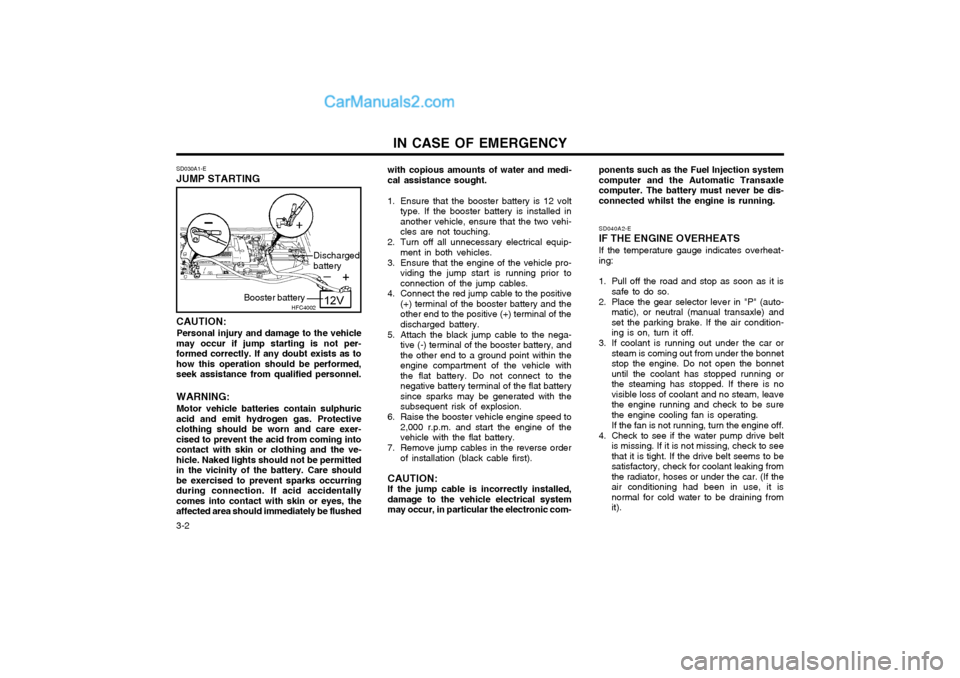
SD030A1-E JUMP STARTING
with copious amounts of water and medi- cal assistance sought.
1. Ensure that the booster battery is 12 volt type. If the booster battery is installed inanother vehicle, ensure that the two vehi-cles are not touching.
2. Turn off all unnecessary electrical equip- ment in both vehicles.
3. Ensure that the engine of the vehicle pro- viding the jump start is running prior toconnection of the jump cables.
4. Connect the red jump cable to the positive (+) terminal of the booster battery and theother end to the positive (+) terminal of thedischarged battery.
5. Attach the black jump cable to the nega- tive (-) terminal of the booster battery, andthe other end to a ground point within theengine compartment of the vehicle withthe flat battery. Do not connect to thenegative battery terminal of the flat batterysince sparks may be generated with thesubsequent risk of explosion.
6. Raise the booster vehicle engine speed to 2,000 r.p.m. and start the engine of thevehicle with the flat battery.
7. Remove jump cables in the reverse order of installation (black cable first).
CAUTION:If the jump cable is incorrectly installed,damage to the vehicle electrical systemmay occur, in particular the electronic com-
HFC4002
Booster battery Discharged battery
Page 260 of 312
3-3
IN CASE OF EMERGENCY
WARNING: While the engine is running, keep hands
and clothing away from moving parts such as the fan and drive belts to preventinjury.
WARNING (Diesel only): Never work on injection system with en-
gine running or within 30 seconds after shutting off engine. High pressure pump,rail, injectors and high pressure pipes aresubject to high pressure even after theengine stopped. The fuel jet produced byfuel leaks may cause serious injury, if ittouch the body. People using pacemak-ers should not move than 30cm closer tothe ECU or wiring harness within theengine room while engine is running,since the high currents in the CommonRail system produce considerable mag-netic fields.
5. If the water pump drive belt is broken or coolant is leaking out, stop the engine immediately and call the nearest Hyundaidealer for assistance.
WARNING: Do not remove the radiator cap when the
engine is hot since steam and boiling wa- ter may be ejected from the radiator result-ing in burns or scalding. D040A01FC-EAT TEMPORARY SPARE TYREThe following instructions for the temporary spare tyre should be observed:
1. Check inflation pressure as soon as pos-
sible after installing the spare tyre, and adjust to the specified pressure. The tyrepressure should be periodically checkedand maintained at the specified pressurewhile the tyre is stored. 2. The spare tyre should only be used tem-
porarily and should be returned to theluggage compartment as soon as the origi-nal tyre can be repaired or replaced.
3. Continuous use at speeds of over 80 km/h (50 mph) is not recommended.
4. As the temporary spare tyre is specifically designed for your car, it should not beused on any other vehicle.
5. The temporary spare tyre should not be used on any other wheels, nor shouldstandard tyre, snow tyre, wheel covers ortrim rings be used with the temporaryspare wheel. If such use is attempted,damage to these items or other car com-ponents may occur.
6. The temporary spare tyre pressure should be checked once a month while the tyre isstored.
CAUTION:
o Do not use snow chains with your tem- porary spare tyre.
o Do not use more than one temporary spare tyre at a time.
Spare Tyre Pressure
Type Size Inflation Pressure T115/70R(D)15420 kPa (60 psi)6. If the cause of the overheating cannot be
found, wait until the engine temperature has returned to normal. Then, if coolanthas been lost, carefully remove the radia-tor cap and add water to bring the fluid levelin the reservoir up to the base of theradiator fill opening. Fill the coolant expan-sion tank to the halfway mark.
7. Proceed with caution until it is established that the engine is operating normally. If theengine overheats repeatedly, the advice ofa Hyundai dealer should be sought.
CAUTION: Serious loss of coolant indicates there is a leak in the cooling system and thisshould be checked as soon as possibleby a Hyundai dealer.
Page 282 of 312

OWNER MAINTENANCE 6-7
SG050A1-E
ENGINE COOLANT CHECKING AND REPLACING WARNING: Do not remove the radiator cap when the
engine is hot, since the system is pressur- ized and coolant may be ejected from theradiator resulting in scalding.
SG050B1-E
Coolant recommendations
G050B01FC
G050B02FC
Gasoline engine Diesel engine
Only ethylene glycol based coolant with a
corrosion inhibitor suited to aluminium alloy engine components should be used in thecooling system. No further additives or inhibi- tors should be used. The coolant specific gravity should be checked as prescribed inthe maintenance schedule to ensure adequatefrost and corrosion protection. In addition, theengine coolant must be replaced at the speci-fied interval since the corrosion inhibitor prop-erties deteriorate with time.
It is important to note that whilst an increase
in the concentration of anti freeze gives anincrease in the level of frost protection, asolution which is in excess of 65% anti freezewill result in reduced frost protection andengine overheating. Therefore the recom-mended concentration of 50% should not beexceeded for general use.
The use of methanol based anti freeze com-
pounds may result in engine overheating andwill invalidate the vehicle warranty.
4. When the oil has drained from the sump,
replace the drain plug using a new washerensuring that the plug is not over tight-ened.
5. Remove the oil filter by rotating counter- clockwise, using a proprietary oil filter re-moval tool if necessary. Note that the oilfilter will contain approximately 0.5 litres ofoil and this should be collected in a suit-able receptacle.
6. Install a new oil filter having smeared the sealing ring with clean oil and rotatingclockwise until the filter contacts the mount-ing and then a further one half turn. Do notover-tighten Tightening torque: 2.3 ~ 2.5 kgf.m
7. Pour the specified quantity of the recom- mended oil into the engine and replace the filler cap. Start the engine and ensure thatno oil leaks exist. Turn off the engine andafter a couple minutes, recheck the oillevel.
WARNING:Prolonged and repeated contact with used
engine oils may result in serious skin dis-orders including dermatitis and cancer.Avoid contact with skin as far as possibleand always wash thoroughly after any con-tact. Keep used oils out of reach of chil-dren. It is illegal to pollute drains, watercourses and soil. Use only authorized wastecollection facilities including civic amenity sites and garages for the disposal of usedoil and oil filters. If in doubt, contact thelocal authority for disposal instructions.
Page 303 of 312

CONSUMER INFORMATION 8-1
SI010B1-E
Engine Number
SI000A1-E
8. CONSUMER
INFORMATION
I010A01FC-EAT
VEHICLE IDENTIFICATION
NUMBER (VIN) The vehicle identification number (VIN) is
unique to each individual vehicle and is the number (sometimes referred to as chassisnumber) used upon the vehicle registrationdocument to identify the vehicle.
It can be found on the identification plate
attached to apron panel located on the driver'sside of the engine compartment. The engine number is stamped on the engine
block as shown in the drawing. I030A01FC-EAT
TYRE PRESSURES
In modern high-speed motoring, correct tyre
pressures are vitally important. Incorrect tyrepressures can affect vehicle safety by caus-ing reduced adhesion, steering response andtyre failure through overheating. The tyrepressure must only be checked when thetyres are cold. The correct tyre pressuresare indicated on the label affixed to the driver'sside "C" piller outer panel and below.
Diesel engine
I010B01B8
HFC6001
EADA010C
Gasoline engine
5.5Jx14 5.5Jx15 6.0Jx15 3.5Jx153.5Jx15
TYRE
SIZE
RIM
SIZE PRESSURE, kPa (PSI)
185/65R14195/55R15 205/55R15
T115/70D15 T115/70R15 REAR
210(30)210(30)210(30)420(60)420(60) FRONT
250(36)250(36) 250(36) 420(60)420(60)
UP TO 2
PERSONS UP TO
MAX. LOAD
REAR
250(36)250(36) 250(36) 420(60)420(60)
FRONT210(30)210(30)210(30) 420(60) 420(60)
I030A01FC-D