radiator cap Hyundai Matrix 2003 User Guide
[x] Cancel search | Manufacturer: HYUNDAI, Model Year: 2003, Model line: Matrix, Model: Hyundai Matrix 2003Pages: 312, PDF Size: 4.1 MB
Page 149 of 312
DO-IT-YOURSELF MAINTENANCE
6-16 G140B01A-AAT Checking the Air Conditioning Operation
1. Start the engine and let it run at a fast idle for
several minutes with the air conditioning set at the maximum cold setting.
2. If the air coming out of the in-dash vents is not cold, have the air conditioning systeminspected by your Hyundai dealer.
CAUTION: Running the air conditioning system for extended periods of time with a low refriger-ant level may damage the compressor. G140C01A-AAT LubricationTo lubricate the compressor and the seals in the system, the air conditioning should be runfor at least 10 minutes each week. This isparticularly important during cool weather whenthe air conditioning system is not otherwise inuse.
G130B02A-AAT
To Replace the Fluid
Recommended brake fluid conforming to DOT
3 or DOT 4 specification should be used. Thereservoir cap must be fully tightened to avoidcontamination from foreign matter or moisture.
NOTE:Do not allow any other liquids to contami-
nate the brake fluid. Seal damage will result.
WARNING: Use caution when handling brake fluid. It
can damage your vision if you get it in your eyes. It will also damage your vehicle’s paintif spilled on it and not removed immediately.
G140A01A-AAT
AIR CONDITIONING CARE Keeping the Condenser Clean
The air conditioning condenser (and engine
radiator) should be checked periodically for accumulation of dirt, dead insects, leaves, etc.These can interfere with maximum cooling effi-ciency. When removing such accumulations,brush or hose them away carefully to avoidbending the cooling fans.
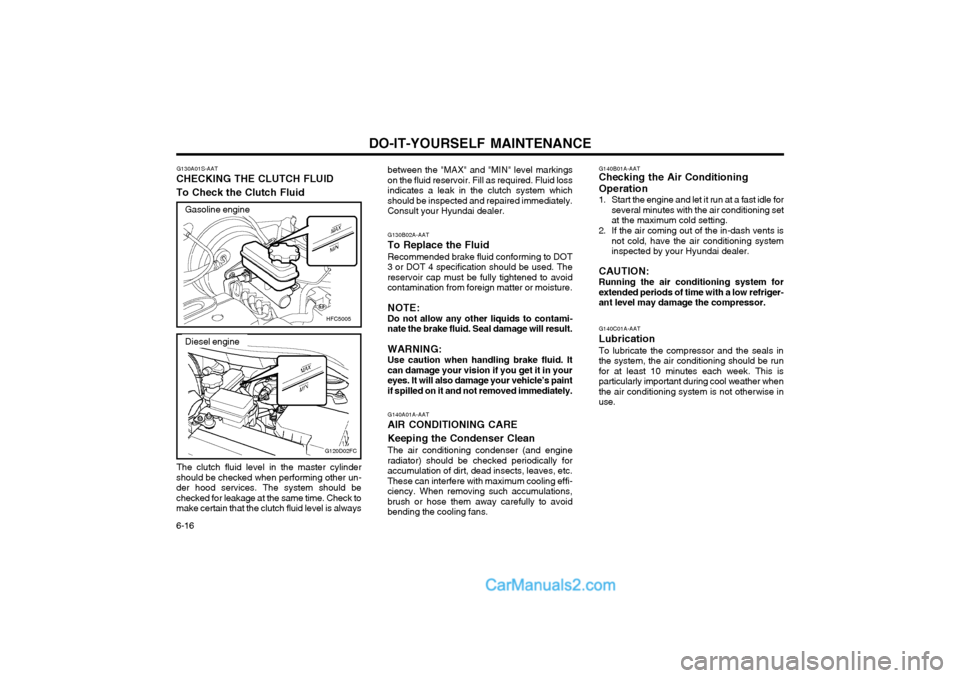
The clutch fluid level in the master cylinder
should be checked when performing other un- der hood services. The system should bechecked for leakage at the same time. Check tomake certain that the clutch fluid level is always
G120D02FC
Diesel engine
G130A01S-AAT
CHECKING THE CLUTCH FLUID To Check the Clutch Fluid
HFC5005
Gasoline engine
between the "MAX" and "MIN" level markings on the fluid reservoir. Fill as required. Fluid lossindicates a leak in the clutch system whichshould be inspected and repaired immediately.Consult your Hyundai dealer.
Page 213 of 312
CONTROLS AND EQUIPMENT
1- 32
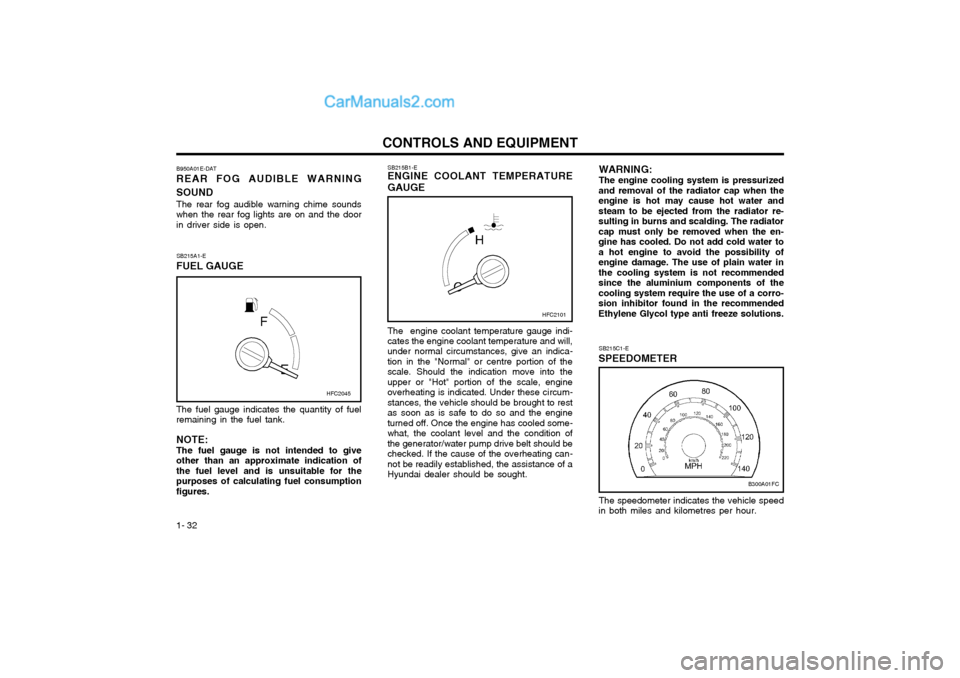
The fuel gauge indicates the quantity of fuel remaining in the fuel tank. NOTE: The fuel gauge is not intended to giveother than an approximate indication ofthe fuel level and is unsuitable for thepurposes of calculating fuel consumptionfigures. SB215B1-E
ENGINE COOLANT TEMPERATURE GAUGE
The engine coolant temperature gauge indi-
cates the engine coolant temperature and will, under normal circumstances, give an indica-tion in the "Normal" or centre portion of thescale. Should the indication move into theupper or "Hot" portion of the scale, engineoverheating is indicated. Under these circum-stances, the vehicle should be brought to restas soon as is safe to do so and the engineturned off. Once the engine has cooled some-what, the coolant level and the condition ofthe generator/water pump drive belt should bechecked. If the cause of the overheating can-not be readily established, the assistance of aHyundai dealer should be sought.
SB215A1-E
FUEL GAUGE
B950A01E-DAT REAR FOG AUDIBLE WARNING SOUND The rear fog audible warning chime sounds when the rear fog lights are on and the doorin driver side is open.
HFC2101
HFC2045
WARNING: The engine cooling system is pressurized
and removal of the radiator cap when the engine is hot may cause hot water andsteam to be ejected from the radiator re-sulting in burns and scalding. The radiatorcap must only be removed when the en-gine has cooled. Do not add cold water toa hot engine to avoid the possibility ofengine damage. The use of plain water inthe cooling system is not recommendedsince the aluminium components of thecooling system require the use of a corro-sion inhibitor found in the recommendedEthylene Glycol type anti freeze solutions.
B300A01FC
SB215C1-E
SPEEDOMETER
The speedometer indicates the vehicle speed
in both miles and kilometres per hour.
Page 260 of 312
3-3
IN CASE OF EMERGENCY
WARNING: While the engine is running, keep hands
and clothing away from moving parts such as the fan and drive belts to preventinjury.
WARNING (Diesel only): Never work on injection system with en-
gine running or within 30 seconds after shutting off engine. High pressure pump,rail, injectors and high pressure pipes aresubject to high pressure even after theengine stopped. The fuel jet produced byfuel leaks may cause serious injury, if ittouch the body. People using pacemak-ers should not move than 30cm closer tothe ECU or wiring harness within theengine room while engine is running,since the high currents in the CommonRail system produce considerable mag-netic fields.
5. If the water pump drive belt is broken or coolant is leaking out, stop the engine immediately and call the nearest Hyundaidealer for assistance.
WARNING: Do not remove the radiator cap when the
engine is hot since steam and boiling wa- ter may be ejected from the radiator result-ing in burns or scalding. D040A01FC-EAT TEMPORARY SPARE TYREThe following instructions for the temporary spare tyre should be observed:
1. Check inflation pressure as soon as pos-
sible after installing the spare tyre, and adjust to the specified pressure. The tyrepressure should be periodically checkedand maintained at the specified pressurewhile the tyre is stored. 2. The spare tyre should only be used tem-
porarily and should be returned to theluggage compartment as soon as the origi-nal tyre can be repaired or replaced.
3. Continuous use at speeds of over 80 km/h (50 mph) is not recommended.
4. As the temporary spare tyre is specifically designed for your car, it should not beused on any other vehicle.
5. The temporary spare tyre should not be used on any other wheels, nor shouldstandard tyre, snow tyre, wheel covers ortrim rings be used with the temporaryspare wheel. If such use is attempted,damage to these items or other car com-ponents may occur.
6. The temporary spare tyre pressure should be checked once a month while the tyre isstored.
CAUTION:
o Do not use snow chains with your tem- porary spare tyre.
o Do not use more than one temporary spare tyre at a time.
Spare Tyre Pressure
Type Size Inflation Pressure T115/70R(D)15420 kPa (60 psi)6. If the cause of the overheating cannot be
found, wait until the engine temperature has returned to normal. Then, if coolanthas been lost, carefully remove the radia-tor cap and add water to bring the fluid levelin the reservoir up to the base of theradiator fill opening. Fill the coolant expan-sion tank to the halfway mark.
7. Proceed with caution until it is established that the engine is operating normally. If theengine overheats repeatedly, the advice ofa Hyundai dealer should be sought.
CAUTION: Serious loss of coolant indicates there is a leak in the cooling system and thisshould be checked as soon as possibleby a Hyundai dealer.
Page 276 of 312

OWNER MAINTENANCE 6-1
SG000A1-E
6. OWNER MAINTENANCE
6
HFC5001
1. Air filter element
2. Engine oil filler cap
3. Brake fluid and clutch fluid reservoir
4. Auto fuel cut switch 5. Relay box
6. Power steering fluid reservoir
7. Engine oil level dipstick
8. Engine cover
9. Engine coolant reservoir10.Radiator cap
11.Automatic transaxle fluid level dipstick
(Not all models)
12.Battery
13.Windscreen washer fluid reservoir cap CAUTION:When inspecting or servicing the engine, you should handle toolsand other heavy objects carefullyso that the plastic rocker cover ofthe engine is not damaged.
G010B01FC-EAT ENGINE COMPARTMENT (1.6 DOHC)
12
34 5
6 7 8 9 10 11 12 13
Page 277 of 312

OWNER MAINTENANCE
6-2 HFC003
CAUTION: When inspecting or servicing the engine, you should handle toolsand other heavy objects carefullyso that the plastic rocker cover ofthe engine is not damaged.
G010C01FC-EAT ENGINE COMPARTMENT (1.8 DOHC)
1. Air filter element
2. Engine oil filler cap
3. Brake fluid and clutch fluid reservoir
4. Auto fuel cut switch
5. Relay box
6. Power steering fluid reservoir
7. Engine oil level dipstick
8. Engine cover
9. Engine coolant reservoir10.Radiator cap
11.Automatic transaxle fluid level dipstick
(Not all models)
12.Battery
13.Windscreen washer fluid reservoir cap
1 2 345
6 7 8 9 10 11 12 13
Page 278 of 312
OWNER MAINTENANCE 6-3
G010E01FC-GAT
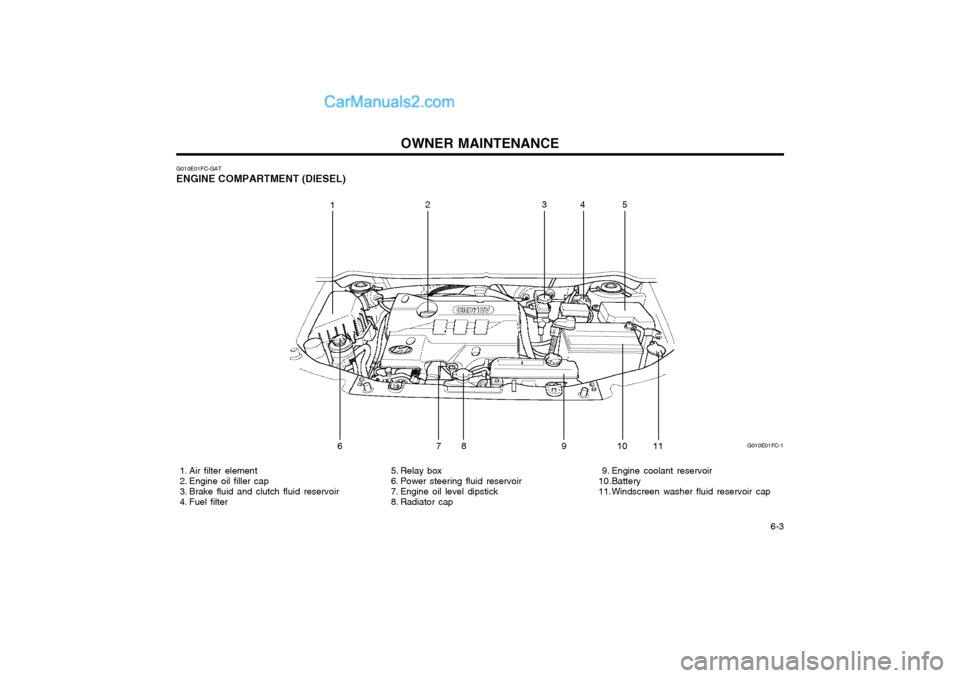
ENGINE COMPARTMENT (DIESEL)
1. Air filter element
2. Engine oil filler cap
3. Brake fluid and clutch fluid reservoir
4. Fuel filter 5. Relay box
6. Power steering fluid reservoir
7. Engine oil level dipstick
8. Radiator cap
9. Engine coolant reservoir
10.Battery
11.Windscreen washer fluid reservoir cap
G010E01FC-1
1
2
345
6 7 8 9 10 11
Page 282 of 312

OWNER MAINTENANCE 6-7
SG050A1-E
ENGINE COOLANT CHECKING AND REPLACING WARNING: Do not remove the radiator cap when the
engine is hot, since the system is pressur- ized and coolant may be ejected from theradiator resulting in scalding.
SG050B1-E
Coolant recommendations
G050B01FC
G050B02FC
Gasoline engine Diesel engine
Only ethylene glycol based coolant with a
corrosion inhibitor suited to aluminium alloy engine components should be used in thecooling system. No further additives or inhibi- tors should be used. The coolant specific gravity should be checked as prescribed inthe maintenance schedule to ensure adequatefrost and corrosion protection. In addition, theengine coolant must be replaced at the speci-fied interval since the corrosion inhibitor prop-erties deteriorate with time.
It is important to note that whilst an increase
in the concentration of anti freeze gives anincrease in the level of frost protection, asolution which is in excess of 65% anti freezewill result in reduced frost protection andengine overheating. Therefore the recom-mended concentration of 50% should not beexceeded for general use.
The use of methanol based anti freeze com-
pounds may result in engine overheating andwill invalidate the vehicle warranty.
4. When the oil has drained from the sump,
replace the drain plug using a new washerensuring that the plug is not over tight-ened.
5. Remove the oil filter by rotating counter- clockwise, using a proprietary oil filter re-moval tool if necessary. Note that the oilfilter will contain approximately 0.5 litres ofoil and this should be collected in a suit-able receptacle.
6. Install a new oil filter having smeared the sealing ring with clean oil and rotatingclockwise until the filter contacts the mount-ing and then a further one half turn. Do notover-tighten Tightening torque: 2.3 ~ 2.5 kgf.m
7. Pour the specified quantity of the recom- mended oil into the engine and replace the filler cap. Start the engine and ensure thatno oil leaks exist. Turn off the engine andafter a couple minutes, recheck the oillevel.
WARNING:Prolonged and repeated contact with used
engine oils may result in serious skin dis-orders including dermatitis and cancer.Avoid contact with skin as far as possibleand always wash thoroughly after any con-tact. Keep used oils out of reach of chil-dren. It is illegal to pollute drains, watercourses and soil. Use only authorized wastecollection facilities including civic amenity sites and garages for the disposal of usedoil and oil filters. If in doubt, contact thelocal authority for disposal instructions.
Page 283 of 312

OWNER MAINTENANCE
6-8 SG050C1-E
Engine Coolant Level
SG050D1-E
To Change the Engine Coolant The engine coolant should be changed at
those intervals specified in the vehicle main- tenance schedule in Section 5.
NOTE:Care should be taken to ensure that cool-
ant is not allowed to spill onto thepaintwork since the finish may becomedamaged. If coolant spillage occurs, theaffected area should be rinsed thoroughlywith water. The engine coolant level may be observed
through the side of the plastic coolant reservoir(expansion tank) when the engine is cold. If thelevel is below the "LOW" mark, add coolant ofthe correct concentration until the level is be-tween the "LOW" and "Full" marks. If the levelfalls below the "LOW" mark on a regular basisdespite being topped up, consult a Hyundaidealer. 1. Park the vehicle on level ground and en-
sure that the parking brake is firmly ap-plied, and the engine allowed to cool. DO NOT ATTEMPT THIS OPERATION WHILST THE ENGINE IS HOT SINCEBURNING OR SCALDING MAY RESULT.
2. Prepare a suitable receptacle to collect the displaced coolant and position this under theradiator drain tap.
3. With the heater temperature control set to the "HOT" position, remove the radiator capand open the radiator drain tap.
4. When the engine coolant has drained com- pletely, close the drain tap ensuring that thisis not over tightened.
5. Prepare a suitable quantity of new engine coolant (refer to section 9) and pour thisinto the radiator.
6. Start the engine with the radiator cap still removed and continue to add coolant as thelevel decreases as air is expelled from thesystem. When the level remains constant,replace the radiator cap and replenish thecoolant reservoir.
7. When the engine is hot, check to ensure that no coolant leaks are present.
WARNING: The cooling fan is controlled by engine coolant temperature and may sometimesoperate even when the engine is not run-ning. Use extreme caution when workingnear the blades of the cooling fan so that
G050C01FC
G050C02FC
Diesel engine
Gasoline engine
NOTE: It is imperative that vehicles fitted with an
air conditioning system have a coolant concentration of the recommended strengthat all times. The use of the air conditioningsystem when the cooling system is filledwith water only will result in the heatermatrix freezing and subsequently bursting.