oil filter Hyundai Matrix 2003 Owner's Guide
[x] Cancel search | Manufacturer: HYUNDAI, Model Year: 2003, Model line: Matrix, Model: Hyundai Matrix 2003Pages: 312, PDF Size: 4.1 MB
Page 271 of 312

VEHICLE MAINTENANCE REQUIREMENTS
5- 4 F030C01E-EAT
R : REPLACE I : INSPECT AND, AFTER INSPECTION, CLEAN, ADJUST, REPAIR OR REPLACE IF NECESSARY
GENERAL MAINTENANCE COOLING SYSTEMCOOLANT GASOLINE ENGINEDIESEL ENGINE
ENGINE COOLANT SPECIFIC GRAVITYMANUAL TRANSAXLE OILAUTOMATIC TRANSAXLE FLUIDBRAKE PIPES, HOSES, AND CONNECTIONSBRAKE FLUIDCLUTCH FLUIDREAR BRAKE LININGS AND CYLINDERSBRAKE PADSSUSPENSION AND STEERING SYSTEMFRONT SUSPENSION BALL JOINTSPOLLEN FILTER (IN FRONT OF BLOWER UNIT)REAR WHEEL BEARINGSTYRE CONDITION AND PRESSURE (incl. Spare)LUBRICATE LOCKS AND HINGESCHECK ALL ELECTRICAL SYSTEMSROAD TESTCHECK ALL SYSTEMS WITH HI-SCAN
60 72
50 60
4048
I
R R
I I
R I
R R I I II
R
IIIII I
I I IIII I I I I
R I III I I
I
R IIII
R R I I I I
R I III I I
30 36
2024
I
R
I IIII I I II
R IIIIII
I
R IIII
R R I I I I
R I III I I
10 12
I I IIII I I I I
R I III I I
MILES X 1,000 MONTHS
NO. DESCRIPTION
1 2 3 456789
10111213141516171819
Page 272 of 312
VEHICLE MAINTENANCE REQUIREMENTS 5-5
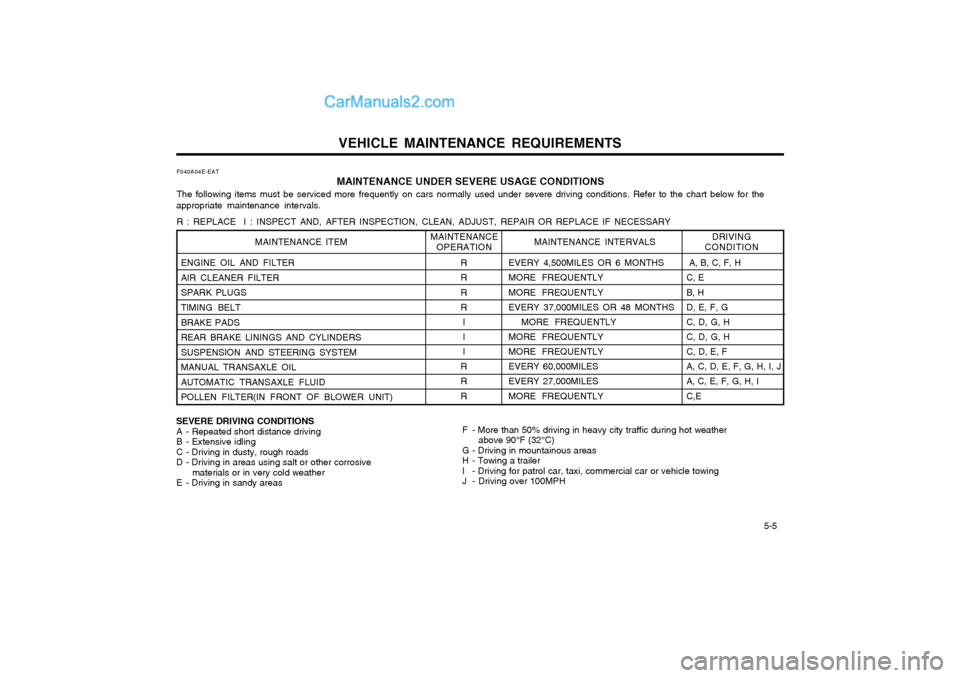
MAINTENANCE UNDER SEVERE USAGE CONDITIONS
The following items must be serviced more frequently on cars normally used under severe driving conditions. Refer to the chart below for the
appropriate maintenance intervals.
R : REPLACE I : INSPECT AND, AFTER INSPECTION, CLEAN, ADJUST, REPAIR OR REPLACE IF NECESSARY
F040A04E-EAT
SEVERE DRIVING CONDITIONS
A - Repeated short distance driving
B - Extensive idling
C - Driving in dusty, rough roads
D - Driving in areas using salt or other corrosive materials or in very cold weather
E - Driving in sandy areas ENGINE OIL AND FILTER AIR CLEANER FILTERSPARK PLUGSTIMING BELT BRAKE PADS REAR BRAKE LININGS AND CYLINDERSSUSPENSION AND STEERING SYSTEMMANUAL TRANSAXLE OILAUTOMATIC TRANSAXLE FLUIDPOLLEN FILTER(IN FRONT OF BLOWER UNIT)
EVERY 4,500MILES OR 6 MONTHS MORE FREQUENTLY MORE FREQUENTLY EVERY 37,000MILES OR 48 MONTHS
MORE FREQUENTLY
MORE FREQUENTLY MORE FREQUENTLY EVERY 60,000MILESEVERY 27,000MILES MORE FREQUENTLY
MAINTENANCE OPERATIONMAINTENANCE ITEM
R R R RII I
R R R A, B, C, F, H C, E B, H D, E, F, GC, D, G, HC, D, G, H C, D, E, F A, C, D, E, F, G, H, I, JA, C, E, F, G, H, I C,E
MAINTENANCE INTERVALS
DRIVING
CONDITION
F - More than 50% driving in heavy city traffic during hot weather above 90°F (32°C)
G - Driving in mountainous areas
H - Towing a trailer
I - Driving for patrol car, taxi, commercial car or vehicle towing
J - Driving over 100MPH
Page 273 of 312
VEHICLE MAINTENANCE REQUIREMENTS
5- 6 6ZF060D2-A
o Fuel lines, fuel hoses and
connections
Check the fuel lines, fuel hoses and connec- tions for leakage and damage. Replace anydamaged or leaking parts immediately.
WARNING (Diesel only): Never work on injection system with en-gine running or within 30 seconds aftershutting off engine. High pressure pump,rail, injectors and high pressure pipes aresubject to high pressure even after theengine stopped. The fuel jet produced byfuel leaks may cause serious injury, if ittouch the body. People using pacemak-ers should not move than 30cm closer tothe ECU or wiring harness within theengine room while engine is running,since the high currents in the CommonRail system produce considerable mag-netic fields. 6ZF060E1-A
o Timing belt Replace timimg belt and inspect all associated parts related for damage and deformation.Replace any damaged parts immediately. 6ZF060G1-A
o Vapour hose and fuel filler cap The vapour hose and fuel filler cap should be inspected at those intervals specified in themaintenance schedule. Make sure that a newvapour hose or fuel filler cap is correctlyreplaced. 6ZF060F1-A
o Vacuum, crankcase
ventilation hoses
Inspect the surface of hoses for evidence of heat and/or mechanical damage. Hard andbrittle rubber, cracking, tears, cuts, abra-sions, and excessive swelling indicate dete-rioration. Particular attention should be paid toexamining those hose surfaces nearest tohigh heat sources, such as the exhaustmanifold.Inspect the hose routing to assure that thehoses do not come in contact with any heatsource, sharp edges or moving componentwhich might cause heat damage or mechani-cal wear. Inspect all hose connections, suchas clamps and couplings, to make sure theyare secure, and that no leaks are present.Hoses should be replaced immediately if thereis any evidence of deterioration or damage.
6ZF060A1-A
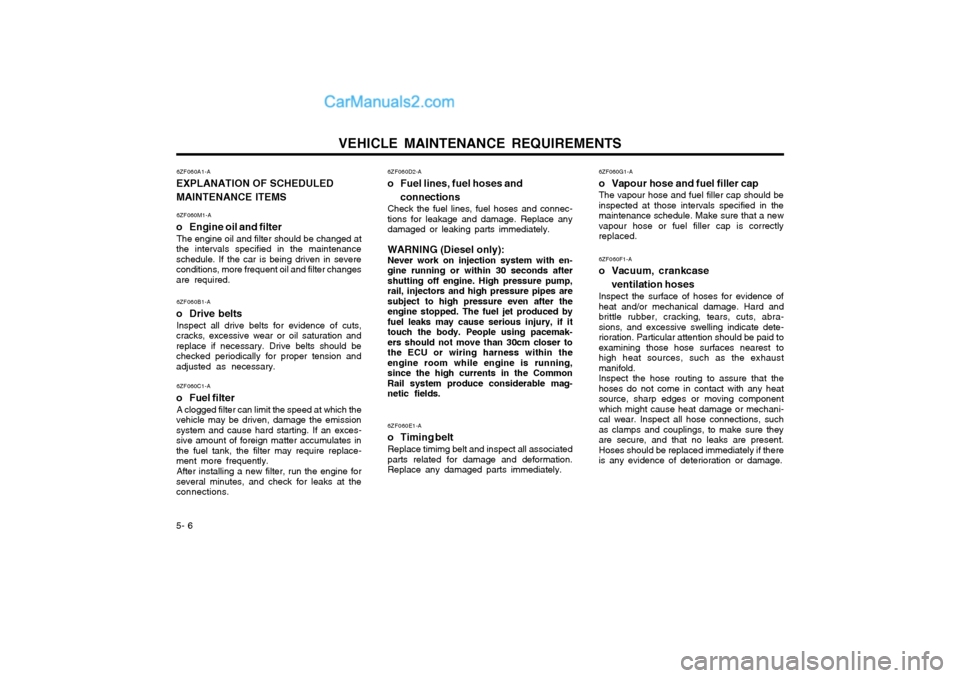
EXPLANATION OF SCHEDULED MAINTENANCE ITEMS
6ZF060M1-A
o Engine oil and filter The engine oil and filter should be changed at
the intervals specified in the maintenance schedule. If the car is being driven in severeconditions, more frequent oil and filter changesare required.
6ZF060B1-A
o Drive belts Inspect all drive belts for evidence of cuts,
cracks, excessive wear or oil saturation andreplace if necessary. Drive belts should bechecked periodically for proper tension andadjusted as necessary.
6ZF060C1-A
o Fuel filter A clogged filter can limit the speed at which the
vehicle may be driven, damage the emissionsystem and cause hard starting. If an exces-sive amount of foreign matter accumulates inthe fuel tank, the filter may require replace-ment more frequently.
After installing a new filter, run the engine for
several minutes, and check for leaks at theconnections.
Page 274 of 312
VEHICLE MAINTENANCE REQUIREMENTS 5-7
6ZF070D1-A
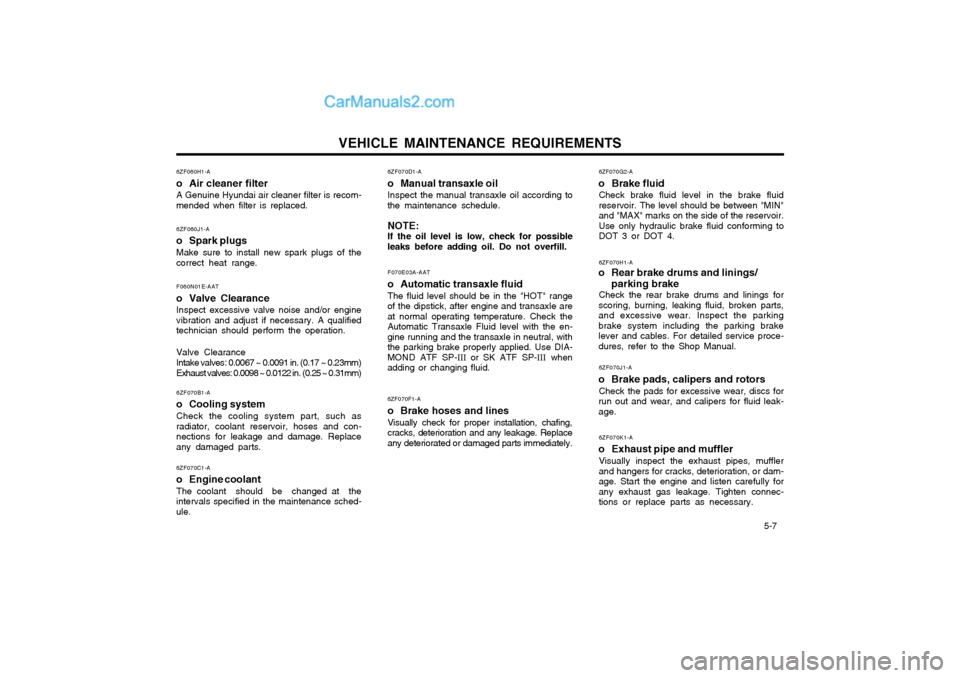
o Manual transaxle oil Inspect the manual transaxle oil according to
the maintenance schedule. NOTE: If the oil level is low, check for possible
leaks before adding oil. Do not overfill.
6ZF070H1-A
o Rear brake drums and linings/ parking brake
Check the rear brake drums and linings for
scoring, burning, leaking fluid, broken parts, and excessive wear. Inspect the parkingbrake system including the parking brakelever and cables. For detailed service proce-dures, refer to the Shop Manual.
6ZF070J1-A
o Brake pads, calipers and rotors Check the pads for excessive wear, discs for
run out and wear, and calipers for fluid leak-age.
6ZF070K1-A
o Exhaust pipe and muffler Visually inspect the exhaust pipes, mufflerand hangers for cracks, deterioration, or dam-age. Start the engine and listen carefully forany exhaust gas leakage. Tighten connec-tions or replace parts as necessary.
F070E03A-AAT
o Automatic transaxle fluid The fluid level should be in the "HOT" range
of the dipstick, after engine and transaxle areat normal operating temperature. Check theAutomatic Transaxle Fluid level with the en-gine running and the transaxle in neutral, withthe parking brake properly applied. Use DIA-MOND ATF SP- III or SK ATF SP- III when
adding or changing fluid. 6ZF070F1-A
o Brake hoses and lines Visually check for proper installation, chafing, cracks, deterioration and any leakage. Replaceany deteriorated or damaged parts immediately.
6ZF060H1-A
o Air cleaner filter A Genuine Hyundai air cleaner filter is recom-
mended when filter is replaced.
6ZF060J1-A
o Spark plugs Make sure to install new spark plugs of the
correct heat range.
6ZF070B1-A
o Cooling system Check the cooling system part, such asradiator, coolant reservoir, hoses and con-nections for leakage and damage. Replaceany damaged parts. 6ZF070G2-A
o Brake fluid Check brake fluid level in the brake fluidreservoir. The level should be between "MIN"and "MAX" marks on the side of the reservoir.Use only hydraulic brake fluid conforming toDOT 3 or DOT 4.
6ZF070C1-A
o Engine coolant The coolant should be changed at theintervals specified in the maintenance sched-ule.
F060N01E-AAT
o Valve Clearance Inspect excessive valve noise and/or enginevibration and adjust if necessary. A qualifiedtechnician should perform the operation.
Valve Clearance
Intake valves: 0.0067 ~ 0.0091 in. (0.17 ~ 0.23mm)
Exhaust valves: 0.0098 ~ 0.0122 in. (0.25 ~ 0.31mm)
Page 276 of 312

OWNER MAINTENANCE 6-1
SG000A1-E
6. OWNER MAINTENANCE
6
HFC5001
1. Air filter element
2. Engine oil filler cap
3. Brake fluid and clutch fluid reservoir
4. Auto fuel cut switch 5. Relay box
6. Power steering fluid reservoir
7. Engine oil level dipstick
8. Engine cover
9. Engine coolant reservoir10.Radiator cap
11.Automatic transaxle fluid level dipstick
(Not all models)
12.Battery
13.Windscreen washer fluid reservoir cap CAUTION:When inspecting or servicing the engine, you should handle toolsand other heavy objects carefullyso that the plastic rocker cover ofthe engine is not damaged.
G010B01FC-EAT ENGINE COMPARTMENT (1.6 DOHC)
12
34 5
6 7 8 9 10 11 12 13
Page 277 of 312

OWNER MAINTENANCE
6-2 HFC003
CAUTION: When inspecting or servicing the engine, you should handle toolsand other heavy objects carefullyso that the plastic rocker cover ofthe engine is not damaged.
G010C01FC-EAT ENGINE COMPARTMENT (1.8 DOHC)
1. Air filter element
2. Engine oil filler cap
3. Brake fluid and clutch fluid reservoir
4. Auto fuel cut switch
5. Relay box
6. Power steering fluid reservoir
7. Engine oil level dipstick
8. Engine cover
9. Engine coolant reservoir10.Radiator cap
11.Automatic transaxle fluid level dipstick
(Not all models)
12.Battery
13.Windscreen washer fluid reservoir cap
1 2 345
6 7 8 9 10 11 12 13
Page 278 of 312
OWNER MAINTENANCE 6-3
G010E01FC-GAT
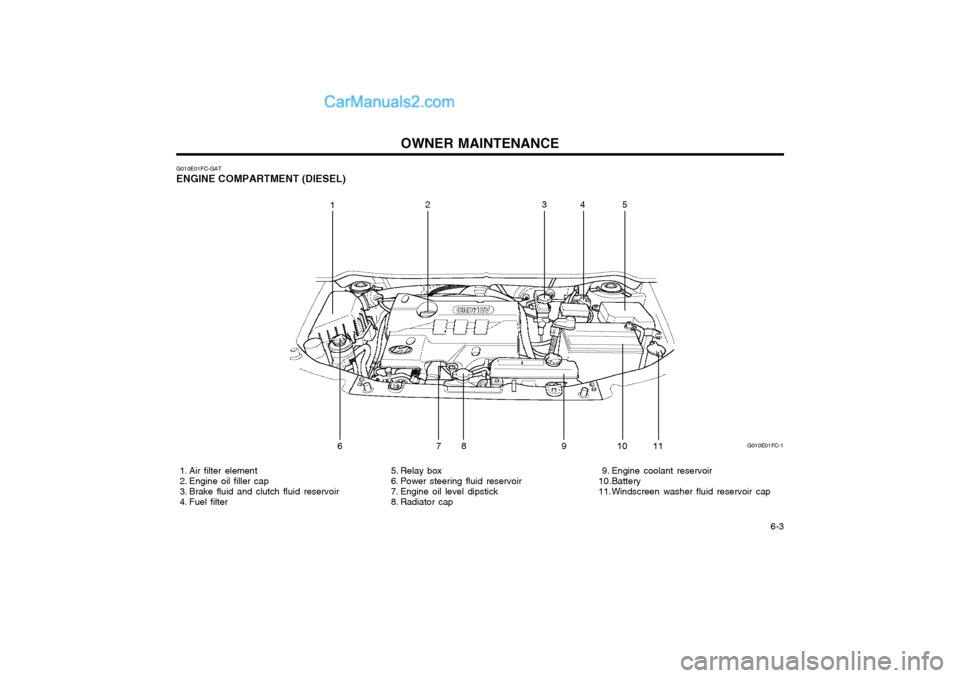
ENGINE COMPARTMENT (DIESEL)
1. Air filter element
2. Engine oil filler cap
3. Brake fluid and clutch fluid reservoir
4. Fuel filter 5. Relay box
6. Power steering fluid reservoir
7. Engine oil level dipstick
8. Radiator cap
9. Engine coolant reservoir
10.Battery
11.Windscreen washer fluid reservoir cap
G010E01FC-1
1
2
345
6 7 8 9 10 11
Page 281 of 312

OWNER MAINTENANCE
6-6 the level again, allow several minutes for the oil to drain into the sump. Replace the oil fillercap rotating it in a clockwise direction untiltight. The quantity of oil required to raise the level from the minimum to maximum level is approx-imately 1 litre. The distance between the "F" and "L" marks is equal to about 1 liter(Gasoline Engine)/1.2liter(Diesel Engine) of oil.
o The engine oil consumption is strongly
effected by the viscosity and quality of oil,engine rpm and driving condition etc. The engine oil is more consumed under severe driving conditions such as highspeeds and frequent acceleration and de-celeration than normal driving condition.
ZG030E1-A
ENGINE OIL CONSUMPTION Function of engine oil
Engine oil has the primary function of lubricat-
ing and cooling the inside of the engine. Engine oil consumption
It is normal that an engine should consume
some engine oil while normal driving. The cause of oil consumption in a normal engine are asfollows;
o Engine oil is used to lubricate pistons, piston rings and cylinders. A thin film of oil is left on the cylinder wallwhen a piston moves downwards in thecylinder. High negative pressure generatedduring engine operation sucks some of theoil into the combustion chamber. This oil with some oil of the cylinder wall is burned by the high temperature combustiongases during the combustion process. SG040A1-E
ENGINE OIL AND FILTER
REPLACEMENT
SSA6040A
Oil filler cap
Drain plug
Oil filter The engine oil and filter must be changed at
the time or mileage interval specified in the maintenance schedule. If the vehicle is oper-ated under severe or adverse conditions, theoil and filter must be replaced more frequently.
To replace the oil and filter, proceed as fol-
lows:
1. Ensure that the engine is at normal operat- ing temperature and park the vehicle on level ground with the parking brake se-curely applied and the engine turned off.
2. Open the bonnet and remove the oil filler cap.
3. Prepare a suitable receptacle to collect the displaced oil and remove the drain plugfrom the sump.
CAUTION: The oil being drained from the engine will
be hot. Care should be exercised to pre- vent scalding.
Diesel engine
Gasoline engine Drain plug
Oil filter
KCHB001A-1
Page 282 of 312

OWNER MAINTENANCE 6-7
SG050A1-E
ENGINE COOLANT CHECKING AND REPLACING WARNING: Do not remove the radiator cap when the
engine is hot, since the system is pressur- ized and coolant may be ejected from theradiator resulting in scalding.
SG050B1-E
Coolant recommendations
G050B01FC
G050B02FC
Gasoline engine Diesel engine
Only ethylene glycol based coolant with a
corrosion inhibitor suited to aluminium alloy engine components should be used in thecooling system. No further additives or inhibi- tors should be used. The coolant specific gravity should be checked as prescribed inthe maintenance schedule to ensure adequatefrost and corrosion protection. In addition, theengine coolant must be replaced at the speci-fied interval since the corrosion inhibitor prop-erties deteriorate with time.
It is important to note that whilst an increase
in the concentration of anti freeze gives anincrease in the level of frost protection, asolution which is in excess of 65% anti freezewill result in reduced frost protection andengine overheating. Therefore the recom-mended concentration of 50% should not beexceeded for general use.
The use of methanol based anti freeze com-
pounds may result in engine overheating andwill invalidate the vehicle warranty.
4. When the oil has drained from the sump,
replace the drain plug using a new washerensuring that the plug is not over tight-ened.
5. Remove the oil filter by rotating counter- clockwise, using a proprietary oil filter re-moval tool if necessary. Note that the oilfilter will contain approximately 0.5 litres ofoil and this should be collected in a suit-able receptacle.
6. Install a new oil filter having smeared the sealing ring with clean oil and rotatingclockwise until the filter contacts the mount-ing and then a further one half turn. Do notover-tighten Tightening torque: 2.3 ~ 2.5 kgf.m
7. Pour the specified quantity of the recom- mended oil into the engine and replace the filler cap. Start the engine and ensure thatno oil leaks exist. Turn off the engine andafter a couple minutes, recheck the oillevel.
WARNING:Prolonged and repeated contact with used
engine oils may result in serious skin dis-orders including dermatitis and cancer.Avoid contact with skin as far as possibleand always wash thoroughly after any con-tact. Keep used oils out of reach of chil-dren. It is illegal to pollute drains, watercourses and soil. Use only authorized wastecollection facilities including civic amenity sites and garages for the disposal of usedoil and oil filters. If in doubt, contact thelocal authority for disposal instructions.
Page 294 of 312

OWNER MAINTENANCE 6-19
G270A02A-GAT
HEADLIGHT BULB Replacement instructions:
G270A01FC
1. Allow the bulb to cool. Wear eye protection.
2. Always grasp the bulb by its plastic base, avoid touching the glass.
3. Disconnect the power cord from the bulb
1. Loosen the drain plug at the bottom of the fuel filter.
2. Tighten the drain plug when water no longer comes out.
3. Check to be sure that the warning lamp illuminates when the ignition key is turned to "ON", and that it goes off when theengine is started. If in doubt, consult your nearest authorized HYUNDAI dealer.
WARNING: Be sure to carefully wipe away any water
drained out in this manner, because thefuel mixed in the water might be ignitedand result in a fire.
G300B01FC
SG250A1-E
REPLACING LIGHT BULBS
In the event of bulb failure being experienced, ensure that the relative lighting circuit is turnedoff prior to attempting to replace the bulb. Theillustrations on the following page will assist inlocating and removing the various bulbs. En-sure that the replacement bulb has the samecap configuration and wattage as the original. CAUTION: Keep the lamps out of contact with petro- leum product, such as oil, gasoline, etc.
G300A01B-GAT
REMOVAL OF WATER FROM THE FUEL FILTER (DIESEL ENGINE)
If the fuel filter warning lamp illuminates during
driving, it indicates that water has accumu- lated in the fuel filter. If this occurs, remove thewater as described.
G300A01FC
SG230B1-E
POWER STEERING HOSES Power steering hoses should be checked for
damage, deterioration and leakage at each ser- vice.
FLUID RECOMMENDATION
Only automatic transmission fluid meeting the
specification of PSF-3 should be used in thepower steering system.