radio Hyundai Matrix 2003 Owner's Guide
[x] Cancel search | Manufacturer: HYUNDAI, Model Year: 2003, Model line: Matrix, Model: Hyundai Matrix 2003Pages: 312, PDF Size: 4.1 MB
Page 240 of 312

1- 59
CONTROLS AND EQUIPMENT
FM broadcasts are transmitted at high fre- quency and do not bend to follow the earth'ssurface. Because of this, FM broadcasts gen-erally begin to fade at short distances from thestation. Also, FM signals are easily affected bybuildings, mountains, or other obstructions.These can result in certain listening conditionswhich might lead you to believe a problemexists with your radio. The following conditionsare normal and do not indicate radio trouble:
Buildings
Obstructed area
Unobstructed area
FM radio station
SSAR012A
Mountains
Iron bridges
B750A02A-AAT
STEREO SOUND SYSTEM How Car Audio Works
IonosphereFM reception
SSAR010A
AM and FM radio signals are broadcast from transmitter towers located around your city.They are intercepted by the radio antenna onyour car. This signal is then received by theradio and sent to your car speakers.When a strong radio signal has reached yourvehicle, the precise engineering of your audiosystem ensures high quality reproduction. How-ever, in some cases the signal coming to yourvehicle is not strong and clear. This can be dueto factors such as the distance from the radiostation, closeness of other strong radio stationsor the presence of buildings, bridges and otherlarge obstructions in the area.
Ionosphere
SSAR011A
AM reception
AM broadcasts can be received at greater distances than FM broadcasts. This is becauseAM radio waves are transmitted at low fre-quency. These long, low frequency radio wavescan follow the curvature of the earth rather thantravelling straight out into the atmosphere. Inaddition, they curve around obstructions sothat they can provide better signal coverage.
Page 241 of 312
CONTROLS AND EQUIPMENT
1- 60 B750B02Y-AAT
Using a cellular phone or a two-way radio
When a cellular phone is used inside the
vehicle, noise may be produced from the audio equipment. This does not mean thatsomething is wrong with the audio equipment.In such a case, use the cellular phone at aplace as far as possible from the audio equip-ment.
CAUTION: When using a communication system such
as a cellular phone or a radio inside the vehicle, a separate external antenna mustbe fitted. When a cellular phone or a radio set is
used with an internal antenna alone, it mayinterfere with the vehicle's electrical sys-tem and adversely affect safe operation ofthe vehicle.
WARNING: Don't use a cellular phone when you are
driving, you must stop at a safe place to use a cellular phone.
SSAR014A
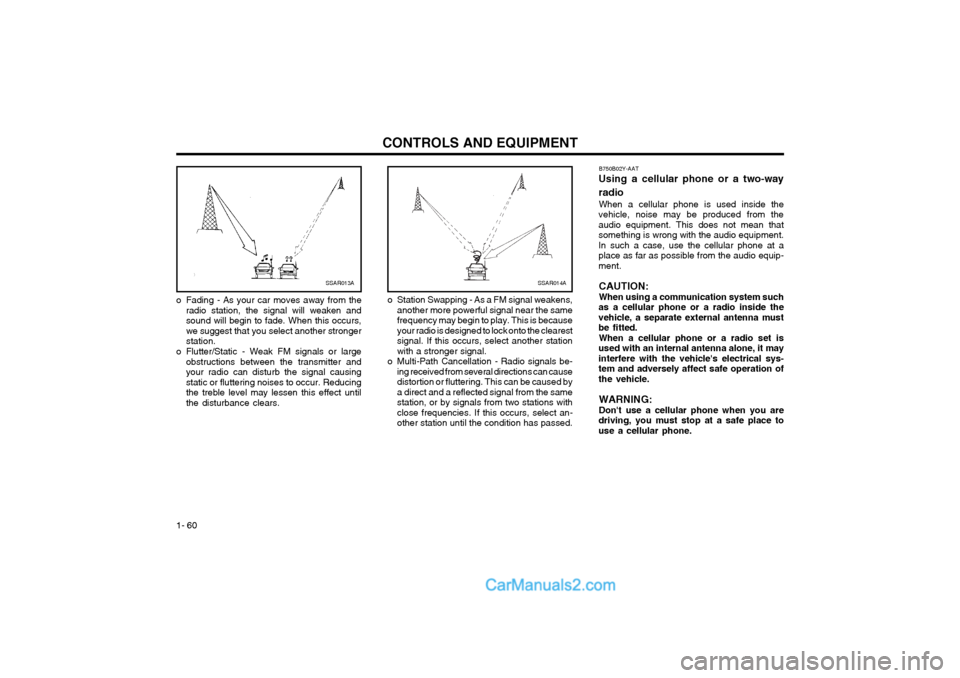
o Station Swapping - As a FM signal weakens, another more powerful signal near the same frequency may begin to play. This is becauseyour radio is designed to lock onto the clearestsignal. If this occurs, select another stationwith a stronger signal.
o Multi-Path Cancellation - Radio signals be- ing received from several directions can causedistortion or fluttering. This can be caused bya direct and a reflected signal from the samestation, or by signals from two stations withclose frequencies. If this occurs, select an-other station until the condition has passed.SSAR013A
o Fading - As your car moves away from the radio station, the signal will weaken and sound will begin to fade. When this occurs,we suggest that you select another strongerstation.
o Flutter/Static - Weak FM signals or large obstructions between the transmitter andyour radio can disturb the signal causingstatic or fluttering noises to occur. Reducingthe treble level may lessen this effect untilthe disturbance clears.
Page 245 of 312

DRIVING YOUR HYUNDAI 2- 3
SB050B1-E
STEERING WHEEL LOCK When the key is removed, the steering col-
umn lock will be activated and will engage when the steering wheel is turned to theappropriate position. It is not necessary toturn the wheel until locked each time the keyis removed since in the event of any unautho-rized attempt at removal, the lock will becomeeffective as soon as the steering wheel isturned. To unlock the steering, insert the keyand turn to the "ACC" position. If the steeringis locked, it may be necessary to rock thesteering wheel slightly to facilitate turning thekey. Under no circumstances should the keybe forced since breakage of the key will occur. SC060A1-E
STARTING THE GASOLINE ENGINE
1. Ensure that the transaxle is in neutral and that the clutch pedal is held depressed (manual transaxle) or the transaxle selec-tor is at the "P" position (automatic transaxlevehicle).
2. Turn the ignition key to and hold at the "Start" position until the engine starts.When the engine has started, release thekey.
NOTE: Do not operate the starter for more than 15
seconds continuously or continue to oper- ate the starter after the engine has startedto avoid damaging the starter motor. If theengine makes a false start, allow it and thestarter motor to come to rest before at-tempting to start the engine again. Neverattempt to start the engine with thetransaxle in gear. Do not depress the ac-
C050A01E
should not be left at this position since the battery will become discharged and damageto the ignition system may also result. Forinformation regarding engine starting, refer to"STARTING THE ENGINE". "ACC"
When the ignition key is at the "ACC" position,
the radio and other accessories may be used."LOCK"
The ignition key may only be inserted or
removed at this position. celerator pedal whilst starting the engine. Allow the engine to idle for 20 seconds orso before driving the vehicle.
CAUTION: Do not leave the vehicle unattended whilst
idling. Never allow the vehicle to idle or warm up in a confined space (ie garage)longer than is necessary to move the vehi-cle into an open area.
C051A01O-EAT
STARTING THE DIESEL ENGINE
ENGINE COLD
o Turn the ignition key to position "ON" and wait for the pre-heat indicator light to goout.
o Operate the starter until the engine runs. ENGINE WARM Operate the starter. If the engine does not respond on the first attempt, wait severalseconds and try again using the pre-heat.