fuel pump Hyundai Matrix 2003 Owner's Manual
[x] Cancel search | Manufacturer: HYUNDAI, Model Year: 2003, Model line: Matrix, Model: Hyundai Matrix 2003Pages: 312, PDF Size: 4.1 MB
Page 9 of 312
FEATURES OF YOUR HYUNDAI 1- 1
1. FEATURES OF
YOUR HYUNDAI
B010A01FC-1
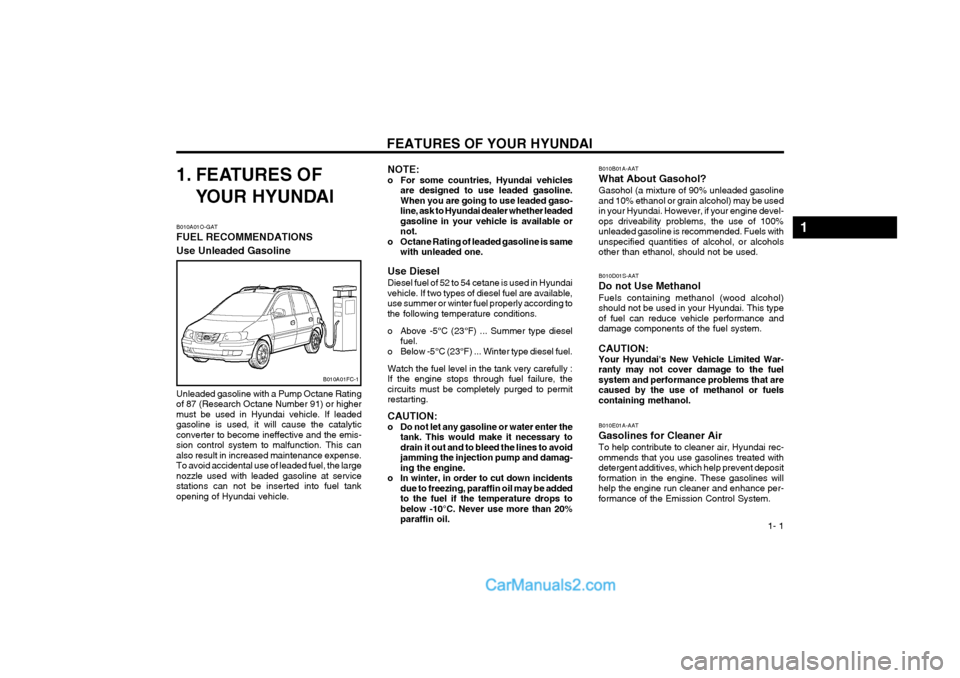
B010A01O-GAT FUEL RECOMMENDATIONS Use Unleaded Gasoline Unleaded gasoline with a Pump Octane Rating of 87 (Research Octane Number 91) or highermust be used in Hyundai vehicle. If leadedgasoline is used, it will cause the catalyticconverter to become ineffective and the emis-sion control system to malfunction. This canalso result in increased maintenance expense.To avoid accidental use of leaded fuel, the largenozzle used with leaded gasoline at servicestations can not be inserted into fuel tankopening of Hyundai vehicle. NOTE:
o For some countries, Hyundai vehicles
are designed to use leaded gasoline.When you are going to use leaded gaso-line, ask to Hyundai dealer whether leadedgasoline in your vehicle is available ornot.
o Octane Rating of leaded gasoline is same with unleaded one.
Use Diesel Diesel fuel of 52 to 54 cetane is used in Hyundai vehicle. If two types of diesel fuel are available,
use summer or winter fuel properly according tothe following temperature conditions.
o Above -5°C (23°F) ... Summer type diesel fuel.
o Below -5°C (23°F) ... Winter type diesel fuel.Watch the fuel level in the tank very carefully : If the engine stops through fuel failure, thecircuits must be completely purged to permitrestarting. CAUTION:
o Do not let any gasoline or water enter the tank. This would make it necessary todrain it out and to bleed the lines to avoidjamming the injection pump and damag-ing the engine.
o In winter, in order to cut down incidents due to freezing, paraffin oil may be addedto the fuel if the temperature drops tobelow -10°C. Never use more than 20%paraffin oil. B010B01A-AAT What About Gasohol?Gasohol (a mixture of 90% unleaded gasoline and 10% ethanol or grain alcohol) may be usedin your Hyundai. However, if your engine devel-ops driveability problems, the use of 100%unleaded gasoline is recommended. Fuels withunspecified quantities of alcohol, or alcoholsother than ethanol, should not be used. B010E01A-AAT Gasolines for Cleaner Air To help contribute to cleaner air, Hyundai rec- ommends that you use gasolines treated withdetergent additives, which help prevent depositformation in the engine. These gasolines willhelp the engine run cleaner and enhance per-formance of the Emission Control System.
B010D01S-AAT Do not Use Methanol Fuels containing methanol (wood alcohol) should not be used in your Hyundai. This typeof fuel can reduce vehicle performance anddamage components of the fuel system. CAUTION: Your Hyundai's New Vehicle Limited War-
ranty may not cover damage to the fuelsystem and performance problems that are
caused by the use of methanol or fuelscontaining methanol.
1
Page 41 of 312
FEATURES OF YOUR HYUNDAI 1- 33
B260J01S-GAT
Charging System Warning Light
The charging system warning light should come on when the ignition is turned on, then go outwhen the engine is running. If the light stays onwhile the engine is running, there is a malfunc-tion in the electrical charging system. If the lightcomes on while you are driving, stop, turn offthe engine and check under the hood. First,make certain the generator drive belt is inplace. If it is, check the tension of the belt.And then, have the system checked by yourHyundai dealer.
CAUTION: If the drive belt (generator belt) is loosen,broken, or mission while the vehicle is driv-ing, there may be a serious malfunction,engine could overheat because this beltalso drives the water pump. B260L01A-GAT Door Ajar Warning Light
The door ajar warning light warns you that a door is not completely closed.B260H03A-AAT Parking Brake/Low Brake Fluid Level Warning Light
WARNING: If you suspect brake trouble, have your brakes checked by a Hyundai dealer assoon as possible. Driving your car with aproblem in either the brake electrical sys-tem or brake hydraulic system is danger-ous, and could result in a serious injury ordeath. Warning Light Operation The parking brake/brake fluid level warning light should come on when the parking brake isapplied and the ignition switch is turned to "ON"or "START". After the engine is started, the lightshould go out when the parking brake is re-leased.If the parking brake is not applied, the warninglight should come on when the ignition switch isturned to "ON" or "START", then go out whenthe engine starts. If the light comes on at anyother time, you should slow the vehicle andbring it to a complete stop in a safe location offthe roadway.The brake warning light indicates that the brakefluid level in the brake master cylinder is lowand hydraulic brake fluid conforming to DOT 3or DOT 4 specifications should be added. Afteradding fluid, if no other trouble is found, the carshould be immediately and carefully driven to a Hyundai dealer for inspection. If further troubleis experienced, the vehicle should not be drivenat all but taken to a dealer by a professionaltowing service or some other safe method.Your Hyundai is equipped with dual-diagonalbraking systems. This means you still havebraking on two wheels even if one of the dualsystems should fail. With only one of the dualsystems working, more than normal pedal traveland greater pedal pressure are required to stopthe car. Also, the car will not stop in as short adistance with only half of the brake systemworking. If the brakes fail while you are driving,shift to a lower gear for additional engine brak-ing and stop the car as soon as it is safe to doso.
B260K01B-GAT
Tail Gate Open Warning Light
This light remains on unless the tail gate is completely closed.
B260M01A-AAT Low Fuel Level Warning Light
The low fuel level warning light comes on whenthe fuel tank is approaching empty. When itcomes on, you should add fuel as soon aspossible. Driving with the fuel level warninglight on or with the fuel level below "E" cancause the engine to misfire and damage thecatalytic converter.
Page 43 of 312
FEATURES OF YOUR HYUNDAI 1- 35
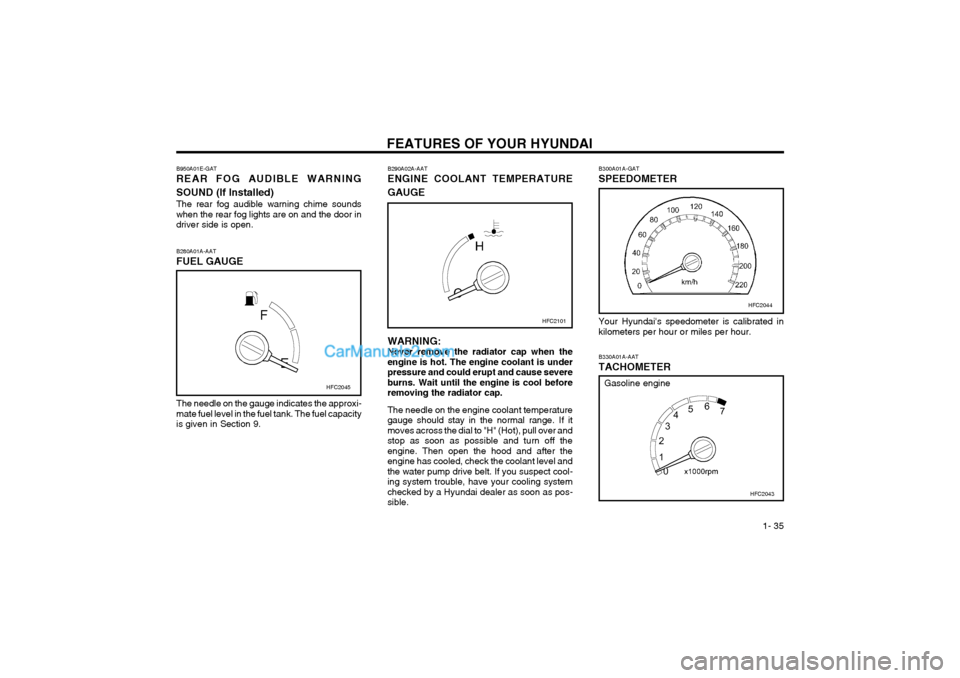
Your Hyundai's speedometer is calibrated in
kilometers per hour or miles per hour. B330A01A-AAT TACHOMETER
HFC2043
HFC2101
B290A02A-AAT ENGINE COOLANT TEMPERATURE GAUGE
B300A01A-GAT SPEEDOMETER
HFC2044
WARNING: Never remove the radiator cap when theengine is hot. The engine coolant is underpressure and could erupt and cause severeburns. Wait until the engine is cool beforeremoving the radiator cap. The needle on the engine coolant temperature gauge should stay in the normal range. If itmoves across the dial to "H" (Hot), pull over andstop as soon as possible and turn off theengine. Then open the hood and after theengine has cooled, check the coolant level andthe water pump drive belt. If you suspect cool-ing system trouble, have your cooling systemchecked by a Hyundai dealer as soon as pos-sible.
The needle on the gauge indicates the approxi-mate fuel level in the fuel tank. The fuel capacityis given in Section 9.
B950A01E-GAT REAR FOG AUDIBLE WARNING SOUND (If Installed) The rear fog audible warning chime sounds
when the rear fog lights are on and the door indriver side is open. B280A01A-AAT FUEL GAUGE
HFC2045Gasoline engine
Page 114 of 312
WHAT TO DO IN AN EMERGENCY 3-3
WARNING: While the engine is running, keep hair, hands, and clothing away from moving parts such as the fan and drive belts to prevent injury.
5. If the water pump drive belt is broken or
coolant is leaking out, stop the engine im- mediately and call the nearest Hyundai deal- er for assistance.
WARNING: Do not remove the radiator cap when the engine is hot. This can allow coolant to be blown out of the opening and cause serious burns. WARNING (Diesel only): Never work on injection system with engine running or within 30 seconds after shutting off engine. High pressure pump, rail, injec- tors and high pressure pipes are subject to high pressure even after the engine stopped. The fuel jet produced by fuel leaks may cause serious injury, if it touch the body. People using pacemakers should not move than 30cm closer to the ECU or wiring harness within the engine room while engine is running, since the high currents in the Common Rail system produce considerable magnetic fields. 2. The spare tire should only be used temporari-
ly and should be returned to the luggage compartment as soon as the original tire can be repaired or replaced.
3. Continuous use at speeds of over 80 km/h (50 mph) is not recommended.
4. As the temporary spare tire is specifically designed for your car, it should not be used on any other vehicle.
5. The temporary spare tire should not be used
on any other wheels, nor should standard tires, snow tires, wheel covers or trim rings be used with the temporary spare wheel. If such use is attempted, damage to these items or other car components may occur.
6. The temporary spare tire pressure should be
checked once a month while the tire is stored.
CAUTION:
o Do not use snow chains with your tempo- rary spare tire.
o Do not use more than one temporary spare tire at a time.
D040A01FC-GAT TEMPORARY SPARE TIRE The following instructions for the temporary spare tire should be observed:
1. Check inflation pressure as soon as possible
after installing the spare tire, and adjust to the specified pressure. The tire pressure should be periodically checked and maintained at the specified pressure while the tire is stored.
Inflation Pressure
Tire Size
T115/70R(D)15 420 kPa (60 psi)
Spare Tire Pressure
6. If you cannot find the cause of the overheat-
ing, wait until the engine temperature has returned to normal. Then, if the engine cool- ant has been lost, carefully remove the radia- tor cap and add engine coolant to bring the fluid level in the reservoir up to the halfway mark.
7. Proceed with caution, keeping alert for fur- ther signs of overheating. If overheating hap- pens again, call a Hyundai dealer for assis- tance.
CAUTION: Serious loss of engine coolant indicates there is a leak in the cooling system and this should be checked as soon as possible by a Hyundai dealer.
Page 127 of 312
VEHICLE MAINTENANCE REQUIREMENTS
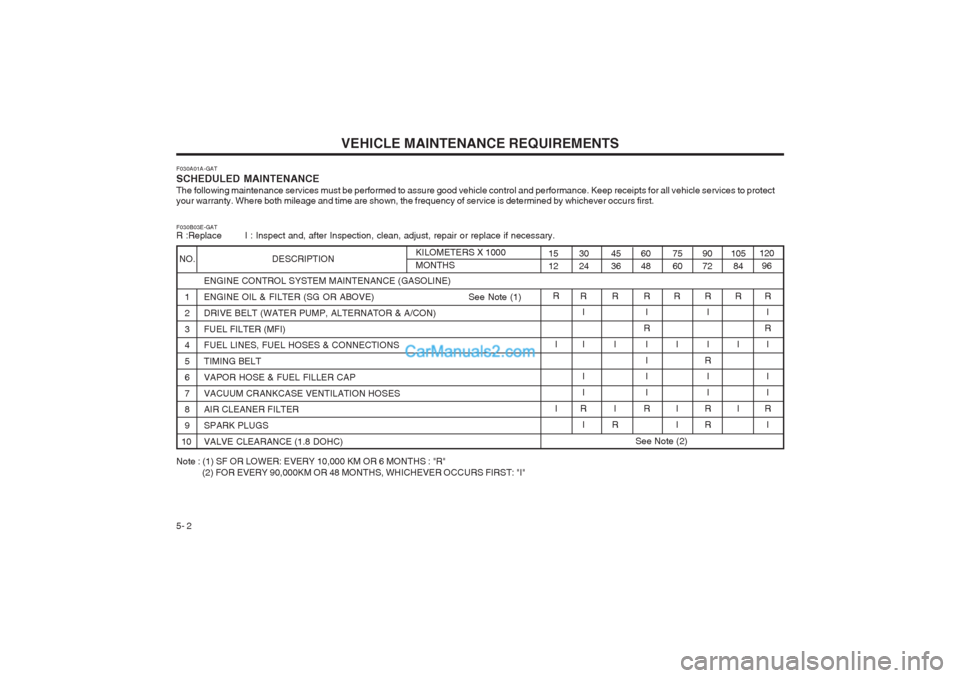
5- 2 ENGINE CONTROL SYSTEM MAINTENANCE (GASOLINE)
1 ENGINE OIL & FILTER (SG OR ABOVE) See Note (1)
2 DRIVE BELT (WATER PUMP, ALTERNATOR & A/CON)
3 FUEL FILTER (MFI)
4 FUEL LINES, FUEL HOSES & CONNECTIONS
5 TIMING BELT
6 VAPOR HOSE & FUEL FILLER CAP
7 VACUUM CRANKCASE VENTILATION HOSES
8 AIR CLEANER FILTER
9 SPARK PLUGS
10 VALVE CLEARANCE (1.8 DOHC)
F030A01A-GAT SCHEDULED MAINTENANCE The following maintenance services must be performed to assure good vehicle control and performance. Keep receipts for all vehi
cle services to protect
your warranty. Where both mileage and time are shown, the frequency of service is determined by whichever occurs first. F030B03E-GAT R :Replace I : Inspect and, after Inspection, clean, adjust, repair or replace if necessary.
NO. DESCRIPTION105
84 120
96
90 72
7560
6048
4536
3024
1512
KILOMETERS X 1000 MONTHS
R
I
R I I I
R
I
R
I I
R
I I
R I I
RR
R
I I I
R
I
R II I I
R
R
I I
R
R
I I I I
R I
R
I I
Note : (1) SF OR LOWER: EVERY 10,000 KM OR 6 MONTHS : "R" (2) FOR EVERY 90,000KM OR 48 MONTHS, WHICHEVER OCCURS FIRST: "I"
See Note (2)
Page 128 of 312
VEHICLE MAINTENANCE REQUIREMENTS 5-3
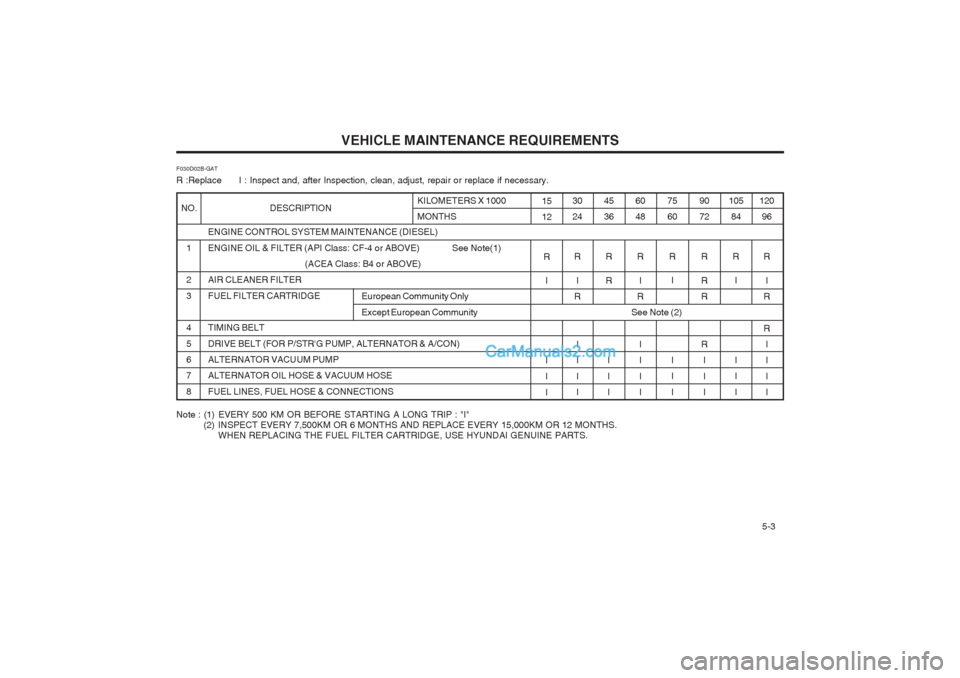
F030D02B-GAT R :Replace I : Inspect and, after Inspection, clean, adjust, repair or replace if necessary.
ENGINE CONTROL SYSTEM MAINTENANCE (DIESEL) ENGINE OIL & FILTER (API Class: CF-4 or ABOVE) See Note(1)
(ACEA Class: B4 or ABOVE)
AIR CLEANER FILTERFUEL FILTER CARTRIDGE TIMING BELT DRIVE BELT (FOR P/STR'G PUMP, ALTERNATOR & A/CON) ALTERNATOR VACUUM PUMPALTERNATOR OIL HOSE & VACUUM HOSE FUEL LINES, FUEL HOSE & CONNECTIONS
NO. DESCRIPTION
1 2 3 4 5 67 8 120
96
R I
R R I I I I105 84
R I I I I90 72
R R R R I I I75 60
R I I I I60 48
R I
R
II I I45 36R R
I I I30 24R I
R
II I I
1512
R I I I IKILOMETERS X 1000 MONTHS
Note : (1) EVERY 500 KM OR BEFORE STARTING A LONG TRIP : "I" (2) INSPECT EVERY 7,500KM OR 6 MONTHS AND REPLACE EVERY 15,000KM OR 12 MONTHS.
WHEN REPLACING THE FUEL FILTER CARTRIDGE, USE HYUNDAI GENUINE PARTS.
European Community Only Except European Community
See Note (2)
Page 131 of 312
VEHICLE MAINTENANCE REQUIREMENTS
5- 6
F060A01A-AAT EXPLANATION OF SCHEDULED MAINTENANCE ITEMS F060M01A-AAT o Engine Oil and FilterThe engine oil and filter should be changed at
the intervals specified in the maintenance sched- ule. If the car is being driven in severe condi- tions, more frequent oil and filter changes are required. F060B01A-AAT
o Drive BeltsInspect all drive belts for evidence of cuts, cracks, excessive wear or oil saturation and replace if necessary. Drive belts should be checked periodically for proper tension andadjusted as necessary. F060C01A-AAT
o Fuel FilterA clogged filter can limit the speed at which the vehicle may be driven, damage the emission system and cause hard starting. If an exces- sive amount of foreign matter accumulates in the fuel tank, the filter may require replacement more frequently. After installing a new filter, run the engine for several minutes, and check for leaks at the connections. Fuel filters should be installed by trained technicians.
F060D02A-AAT
o Fuel Lines, Fuel Hoses and
Connections
Check the fuel lines, fuel hoses and connec- tions for leakage and damage. Have a trained technician replace any damaged or leaking parts immediately. WARNING (Diesel only): Never work on injection system with engine running or within 30 seconds after shutting off engine. High pressure pump, rail, injec- tors and high pressure pipes are subject to high pressure even after the engine stopped. The fuel jet produced by fuel leaks may cause serious injury, if it touch the body. People using pacemakers should not move than 30cm closer to the ECU or wiring har- ness within the engine room while engine is running, since the high currents in the Com- mon Rail system produce considerable mag- netic fields. F060E01A-AAT
o Timing BeltInspect all parts related to the timing belt for damage and deformation. Replace any dam- aged parts immediately. F060G01A-AAT
o Vapor Hose and Fuel Filler Cap The vapor hose and fuel filler cap should be
inspected at those intervals specified in themaintenance schedule. Make sure that a new vapor hose or fuel filler cap is correctly re- placed.
F060F01A-AAT
o Vacuum, Crankcase Ventilation
Hoses
Inspect the surface of hoses for evidence of
heat and/or mechanical damage. Hard and brit-tle rubber, cracking, tears, cuts, abrasions, and excessive swelling indicate deterioration. Par- ticular attention should be paid to examining those hose surfaces nearest to high heat sourc- es, such as the exhaust manifold.
Inspect the hose routing to assure that the
hoses do not come in contact with any heatsource, sharp edges or moving component which might cause heat damage or mechanical wear. Inspect all hose connections, such as clamps and couplings, to make sure they are secure, and that no leaks are present. Hoses should be replaced immediately if there is any evidence of deterioration or damage.
Page 147 of 312

DO-IT-YOURSELF MAINTENANCE
6-14 While the engine is idling, apply the brakes and move the gear selector lever from "P" to eachof its other positions -- "R", "N", "D", "2", "L" -- and then return to "N" or "P". With the enginestill idling:
1. Open the hood, being careful to keep hands,
long hair and clothing clear of any moving parts.
2. Remove the transaxle dipstick, wipe it clean, reinsert the dipstick as far as it will go, thenremove it again. Now check the fluid level onthe dipstick. It should be in the "HOT" rangeon the dipstick.
3. If the transaxle fluid level is low, use a funnel to add transaxle fluid through the dipsticktube until the level reaches the "HOT" range.Do not overfill.Fluid level should be within this range
C090A03FC
ÎÎ
WARNING: The cooling fan is controlled by engine cool- ant temperature and may sometimes oper-ate even when the engine is not running.Use extreme caution when working near theblades of the cooling fan, so that you are notinjured by a rotating fan blade. As the en-gine coolant temperature decreases, the fanwill automatically shut off. This is a normalcondition. WARNING (Diesel only): Never work on injection system with engine running or within 30 seconds after shuttingoff engine. High pressure pump, rail, injec-tors and high pressure pipes are subject tohigh pressure even after the engine stopped.The fuel jet produced by fuel leaks maycause serious injury, if it touch the body.People using pacemakers should not movethan 30cm closer to the ECU or wiring har-ness within the engine room while engine isrunning, since the high currents in the Com-mon Rail system produce considerable mag-netic fields.
HFC5008
G110D03A-GAT
To Check the Transaxle Fluid Level
Park the car on level ground with the parking brake engaged. When the transaxle fluid levelis checked, the transaxle fluid should be atnormal operating temperature and the engineidling.
C090A01FC
Page 155 of 312
DO-IT-YOURSELF MAINTENANCE
6-22 G260A03A-GAT
REPLACING HEADLIGHT BULBS Before attempting to replace a headlight bulb, be sure the switch is turned to the "OFF"position. The next paragraph shows how to reach the headlight bulbs so they may be changed. Besure to replace the burned-out bulb with one ofthe same number and wattage rating. CAUTION: Keep the lamps out of contact with petro- leum products, such as oil, gasoline, etc.
G240A01A-AAT
POWER STEERING HOSES
It is suggested that you check the power steer-
ing hose connections for fluid leakage at regular intervals. The power steering hoses should bereplaced if there is severe surface cracking,scuffing or worn spots. Deterioration of thehose could cause premature failure. NOTE: Grinding noise from the power steering
pump may be heard immediately after the engine is started in extremely cold condi-tions (below - 20°C). If the noise stops dur-ing warm up, there is no abnormal functionin the system. It is due to a power steeringfluid characteristic in extremely cold condi-tions.
Recommended Fluid Use PSF-3 type fluid NOTE: Do not start the engine when the power
steering oil reservoir is empty. G300A01B-GAT
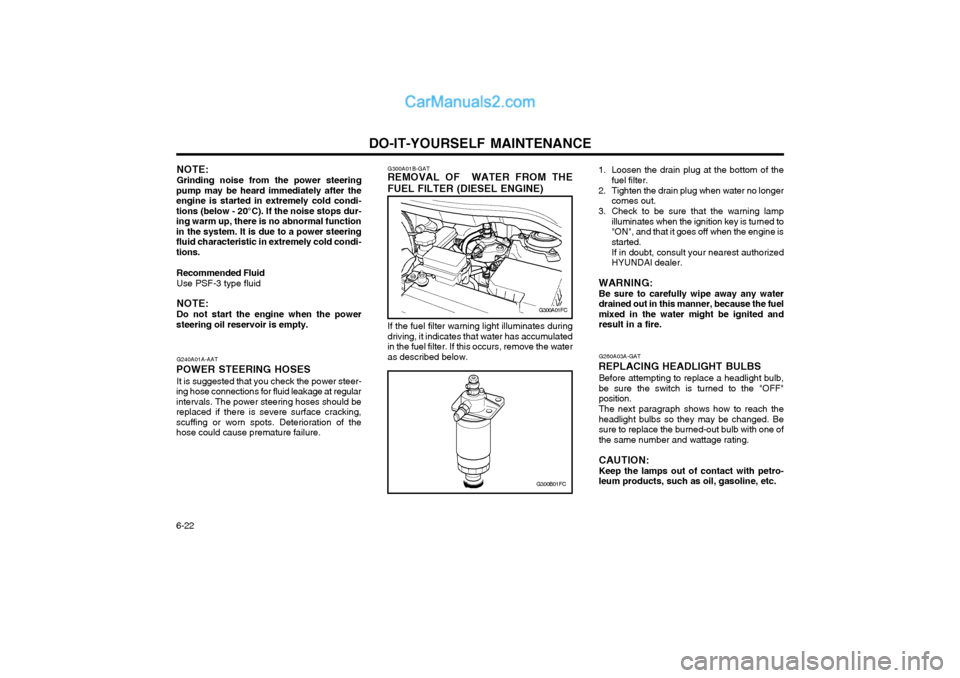
REMOVAL OF WATER FROM THE FUEL FILTER (DIESEL ENGINE)
If the fuel filter warning light illuminates during driving, it indicates that water has accumulatedin the fuel filter. If this occurs, remove the wateras described below. 1. Loosen the drain plug at the bottom of the
fuel filter.
2. Tighten the drain plug when water no longer comes out.
3. Check to be sure that the warning lamp illuminates when the ignition key is turned to"ON", and that it goes off when the engine isstarted. If in doubt, consult your nearest authorized HYUNDAI dealer.
WARNING: Be sure to carefully wipe away any waterdrained out in this manner, because the fuelmixed in the water might be ignited andresult in a fire.
G300A01FC
G300B01FC
Page 159 of 312

DO-IT-YOURSELF MAINTENANCE
6-26
G200C02FC-GAT
FUSE PANEL DESCRIPTION Engine Compartment (GASOLINE)
HFC4004
PROTECTED COMPONENTS Generator (A/CON, RR HTD, STOP, D/LOCK, HAZARD) Fuse Generator, Engine control relay, ECM Radiator fan relay Start relay, Ignition switch Blower relay Power window relay Condenser fan relay #1 ABS control module, ABS bleeding connector ABS control module, ABS bleeding connector Fuel pump relay Injector, lgnition coilMAP sensor, Oxygen sensor, CP sensor, Knock sensor, Throttle position sensor Audio, Room lamp, Overhead console lamp, lnstrument cluster DRL control module Horn relay A/C relay Front fog lamp relay ECM, TCM Tail lamp relay Left rear combi lamp, Left position lamp, Left License lamp Right rear combi lamp, Right position lamp, Right License lamp Left head lamp Right head lamp, (H/LP IND) Fuse
FUSE RATING
120A40A30A 20A 40A 40A 30A 20A 30A 30A 10A 15A 10A 10A 15A 10A 10A 15A 10A 20A 10A 10A 15A 15A
DESCRIPTION
ALTB+
ECU RAD IGN
BLR
P/WINCOND ABSABS
F/PUMP INJ
SNSR
ROOM LP DRL
HORN
A/CON
FR FOG ECU
LP
TAIL LH
TAIL RH H/LP LH
H/LP RH
NOTE:
Not all fuse panel descriptions in this manual may be applicable
to your vehicle. It is accurate at the time of printing. When you inspect the fuse box on your vehicle, refer to the fuse box label.