wheel torque Hyundai Matrix 2003 Owner's Manual
[x] Cancel search | Manufacturer: HYUNDAI, Model Year: 2003, Model line: Matrix, Model: Hyundai Matrix 2003Pages: 312, PDF Size: 4.1 MB
Page 118 of 312

WHAT TO DO IN AN EMERGENCY 3-7
STA3071H
WARNING: Wheel and wheel covers may have sharp edges. Handle them carefully to avoid pos- sible severe injury. Before putting the wheel into place, be sure that there is nothing on the hub or wheel (such as mud, tar, gravel, etc.) that interferes with the wheel from fitting solidly against the hub. If there is, remove it. If there is not good contact on the mounting surface between the wheel and hub, the wheel nuts could loosen and cause the loss of a wheel. Loss of a wheel may result in loss of control of the vehicle. This may cause serious injury or death. D060H02A-AAT 7. Re-install Wheel Nuts To reinstall the wheel cover, hold it on the studs, put the wheel nuts on the studs and tighten them finger tight. The nuts should be installed with their small diameter ends directed inward. Jiggle the tire to be sure it is completely seated, then tighten the nuts as much as possible with your fingers again.
Lower the car to the ground by turning the wheel nut wrench counterclockwise. Then position the wrench as shown in the drawing and tighten the wheel nuts. Be sure the socket is seated com- pletely over the nut. Do not stand on the wrench handle or use an extension pipe over the wrench handle. Go around the wheel tightening every other nut until they are all tight. Then double-check each nut for tightness. After changing wheels, have a technician tighten the wheel nuts to their proper torque as soon as possible. Wheel nut tightening torque: Steel wheel & aluminium alloy wheel: 900-1,100 kg.cm (65-80 lb.ft)
D060H01FCD060I01E-GAT 8. Lower Vehicle and Tighten NutsD060I01FC
Page 133 of 312
VEHICLE MAINTENANCE REQUIREMENTS
5- 8 F070L01A-AAT
o Suspension Mounting Bolts Check the suspension connections for loose-
ness or damage. Retighten to the specified torque. F070M01A-AAT
o Steering Gear Box, Linkage & Boots/
Lower arm Ball Joint
With the vehicle stopped and engine off, check for excessive free-play in the steering wheel. Check the linkage for bends or damage. Check the dust boots and ball joints for deterioration, cracks, or damage. Replace any damaged parts. F070N01A-AAT o
Power Steering Pump, Belt and HosesCheck the power steering pump and hoses for leakage and damage. Replace any damaged or leaking parts immediately. Inspect the power steering belt for evidence of cuts, cracks, ex- cessive wear, oiliness and proper tension. Re- place or adjust it if necessary. F070P01A-AAT o Driveshafts and Boots Check the drive shafts, boots and clamps for cracks, deterioration, or damage. Replace any damaged parts and, if necessary, repack the grease. F070Q01A-AAT
o Air Conditioning Refrigerant Check the air conditioning lines and connec- tions for leakage and damage. Check air condi- tioning performance according to the relevant shop manual if necessary.
Page 137 of 312
DO-IT-YOURSELF MAINTENANCE
6-4
G020A01A-AAT
GENERAL CHECKS Engine Compartment
The following should be checked regularly:
o Engine oil level and condition
o Transaxle fluid level and condition
o Brake fluid level
o Clutch fluid level
o Engine coolant level
o Windshield washer fluid level
o Accessory drive belt condition
o Engine coolant hose condition
o Fluid leaks (on or below components)
o Power steering fluid level
o Battery condition
o Air filter condition
G020B01A-AAT
Vehicle Exterior The following should be checked monthly:
o Overall appearance and condition
o Wheel condition and wheel nut torque
o Exhaust system condition
o Light condition and operation
o Windshield glass condition
o Wiper blade condition
o Paint condition and body corrosion
o Fluid leaks
o Door and hood lock condition
o Tire pressure and condition (including spare tire) G020C01A-AAT
Vehicle Interior
The following should be checked each time when the vehicle is driven:
o Lights operation
o Windshield wiper operation
o Horn operation
o Defroster, heating system operation (and air conditioning, if installed)
o Steering operation and condition
o Mirror condition and operation
o Turn signal operation
o Accelerator pedal operation
o Brake operation, including parking brake
o Manual transaxle operation, including clutch operation
o Automatic transaxle operation, including "Park" mechanism operation
o Seat control condition and operation
o Seat belt condition and operation
o Sunvisor operation
If you notice anything that does not operate correctly or appears to be functioning incorrect-ly, inspect it carefully and seek assistance fromyour Hyundai dealer if service is needed. G030A01FC-GAT
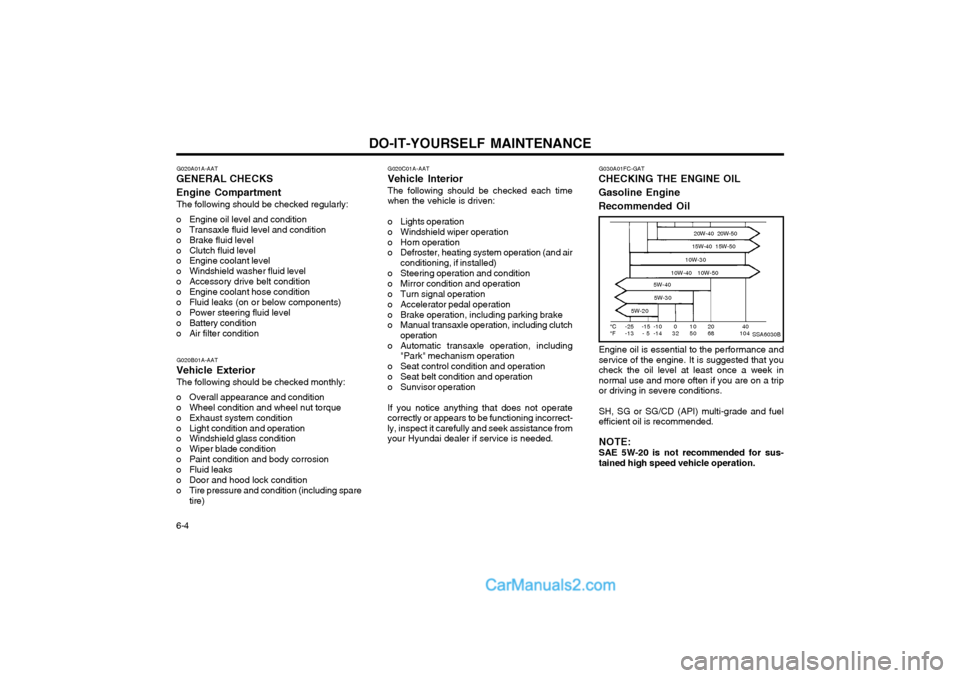
CHECKING THE ENGINE OIL Gasoline EngineRecommended Oil
SSA6030B
20W-40 20W-50
10W-30 15W-40 15W-50
10W-40 10W-50
°C °F -25-13 2068 40104
-15
- 5 -10-14 0
32 1050
5W-40
5W-30
5W-20
Engine oil is essential to the performance and service of the engine. It is suggested that youcheck the oil level at least once a week innormal use and more often if you are on a tripor driving in severe conditions. SH, SG or SG/CD (API) multi-grade and fuel efficient oil is recommended. NOTE: SAE 5W-20 is not recommended for sus- tained high speed vehicle operation.
Page 165 of 312
CONSUMER INFORMATION
8-2 I050A01S-GAT
TIRE CHAINS
Tire chains, if necessary should be installed on
the front wheels. Be sure that the chains are installed in accordance with the manufacturer'sinstructions.
To minimize tire and chain wear, do not contin-
ue to use tire chains when they are no longerneeded.
WARNING: When driving on roads covered with snow
or ice, drive at less than 30 km/h (20 mph). I060A01FC-GAT
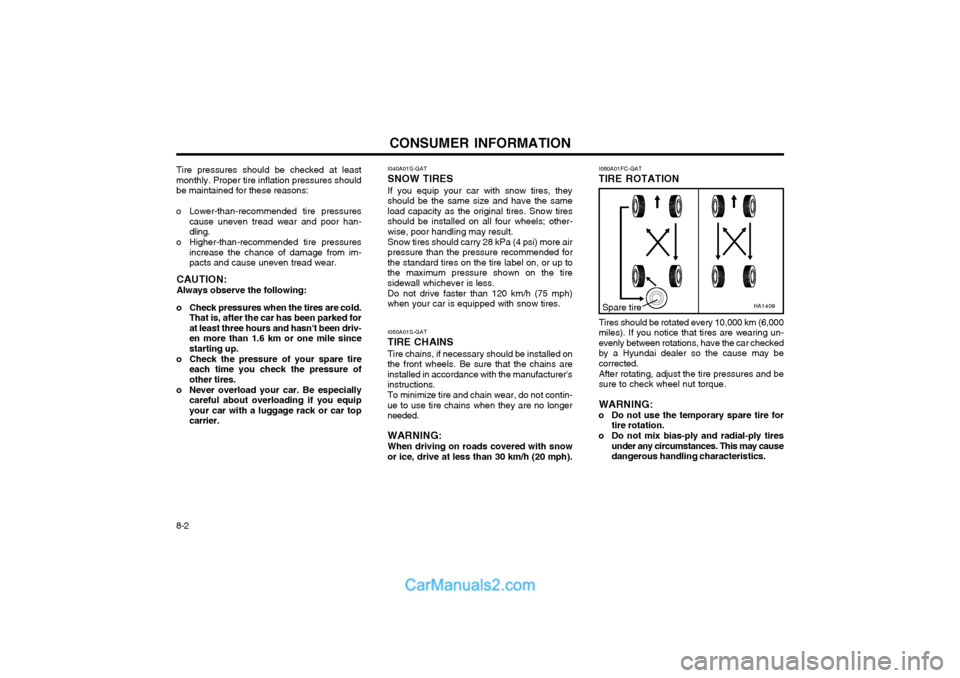
TIRE ROTATION
Tires should be rotated every 10,000 km (6,000 miles). If you notice that tires are wearing un-evenly between rotations, have the car checkedby a Hyundai dealer so the cause may becorrected. After rotating, adjust the tire pressures and be sure to check wheel nut torque. WARNING:
o Do not use the temporary spare tire for tire rotation.
o Do not mix bias-ply and radial-ply tires under any circumstances. This may cause dangerous handling characteristics.
I040A01S-GAT
SNOW TIRES
If you equip your car with snow tires, theyshould be the same size and have the sameload capacity as the original tires. Snow tiresshould be installed on all four wheels; other-wise, poor handling may result. Snow tires should carry 28 kPa (4 psi) more air pressure than the pressure recommended forthe standard tires on the tire label on, or up tothe maximum pressure shown on the tiresidewall whichever is less. Do not drive faster than 120 km/h (75 mph) when your car is equipped with snow tires.
Tire pressures should be checked at leastmonthly. Proper tire inflation pressures shouldbe maintained for these reasons:
o Lower-than-recommended tire pressures
cause uneven tread wear and poor han- dling.
o Higher-than-recommended tire pressures increase the chance of damage from im-pacts and cause uneven tread wear.
CAUTION: Always observe the following:
o Check pressures when the tires are cold. That is, after the car has been parked for at least three hours and hasn't been driv-en more than 1.6 km or one mile sincestarting up.
o Check the pressure of your spare tire each time you check the pressure ofother tires.
o Never overload your car. Be especially careful about overloading if you equipyour car with a luggage rack or car topcarrier.
HA1409Spare tire
Page 255 of 312
DRIVING YOUR HYUNDAI 2- 13
SC200B3-E TOWING ATTACHMENTS It is strongly recommended that only an Hyundai Approved towing attachment is usedto ensure that the loads placed upon the bodystructure are correctly distributed. The use ofa non approved attachment will result in theinvalidation of the vehicle warranty. Hyundaitowing attachments are designed and con-structed to ensure maximum towing perfor-mance and ease of fitment. A range of acces-sories including electrical kits are availablethrough the Hyundai dealer network. It is of the utmost importance that those areas of the vehicle which are subjected to greaterstress during towing are maintained in accor-dance with the recommendations given at theend of this book. In addition, the daily operatingchecks relating to engine oil, transmission oiland tyres must be performed at each refuellingto ensure maximum reliability and safety. The use of a proprietary stabiliser will assist in achieving an inherently stable outfit but whilstthe use of such equipment will improve thecharacteristics of a balanced outfit, it will notcompensate for a badly loaded and thereforeunstable outfit. The tyres and braking equipment fitted to the trailer or caravan must be maintained in ac-cordance with the recommendations of themanufacturer. Special attention should be paidto tyres which deteriorate through time and
WARNING:
It is not recommended that the vehicle be
used for towing until the first 1,000 milesof Running In has been completed. AllHyundai MATRIX models are suited to tow-ing trailers and caravans up to the limitsindicated below. MATRIX models fitted withautomatic transaxle have a transaxle oilcooler and further transaxle cooling shouldnot be required. C190E01FC-EAT
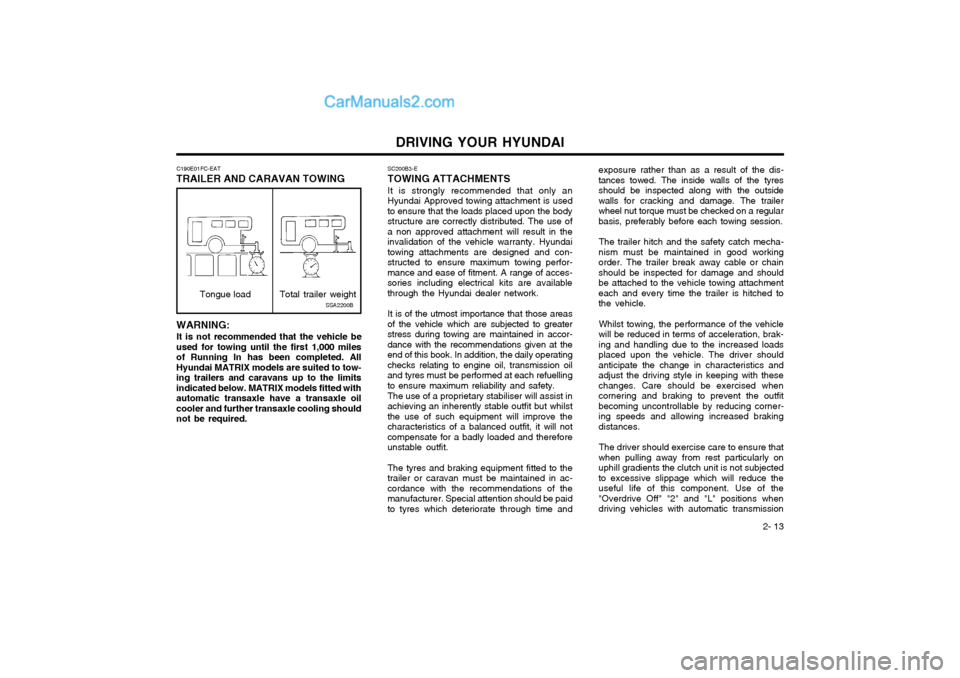
TRAILER AND CARAVAN TOWING
Tongue loadSSA2200B
Total trailer weight
exposure rather than as a result of the dis- tances towed. The inside walls of the tyresshould be inspected along with the outsidewalls for cracking and damage. The trailerwheel nut torque must be checked on a regularbasis, preferably before each towing session.
The trailer hitch and the safety catch mecha-
nism must be maintained in good workingorder. The trailer break away cable or chainshould be inspected for damage and shouldbe attached to the vehicle towing attachmenteach and every time the trailer is hitched tothe vehicle.
Whilst towing, the performance of the vehicle
will be reduced in terms of acceleration, brak-ing and handling due to the increased loadsplaced upon the vehicle. The driver shouldanticipate the change in characteristics andadjust the driving style in keeping with thesechanges. Care should be exercised whencornering and braking to prevent the outfitbecoming uncontrollable by reducing corner-ing speeds and allowing increased brakingdistances.
The driver should exercise care to ensure that
when pulling away from rest particularly onuphill gradients the clutch unit is not subjectedto excessive slippage which will reduce theuseful life of this component. Use of the"Overdrive Off" "2" and "L" positions whendriving vehicles with automatic transmission
Page 264 of 312

3-7
IN CASE OF EMERGENCY
SD070J1-E
8. Lower Vehicle and Tighten Nuts
Lower the car to the ground turning the wheel
nut wrench counterclockwise. When the ve- hicle is firmly on the ground, remove the jackand tighten the wheel nuts securely. At thefirst available opportunity, the wheel nut torqueshould be checked with a suitable torquewrench.
Wheel nut tightening torque Steel wheel & aluminium alloy wheel:900-1,100 kg.cm (65-80 lb.ft) SD070K1-E AFTER CHANGING WHEELS
SD080A1-E
VEHICLE TOWING OR RECOVERY
The pressure of the spare tyre should be checked at the first available opportunity. Ifany doubt exists as to the tyre pressure, thevehicle should be driven slowly to the nearestservice station and the tyre pressure checkedand adjusted as required. If the valve cap is lost from any of the valves, a replacement should be obtained and fittedat the first available opportunity. The valvecap prevents the ingress of dirt which maycause the valve to stick and therefore leakand is part of the valve sealing function. Ensure that the spare wheel, jack and wheel nut wrench as well tools are correctly locatedin the boot of the vehicle to prevent damageand noise. CAUTION:
An incorrect tow or recovery could result
in serious damage to the vehicle. If anydamage to the suspension, steering ortransaxle is apparent or suspected, a tow-ing ambulance must be used.
D060I01FC-DD060B01FC
o OK FOR AUTOMATIC OR MANUAL
TRANSAXLE EQUIPPED VEHICLE D080A01FC
Page 275 of 312
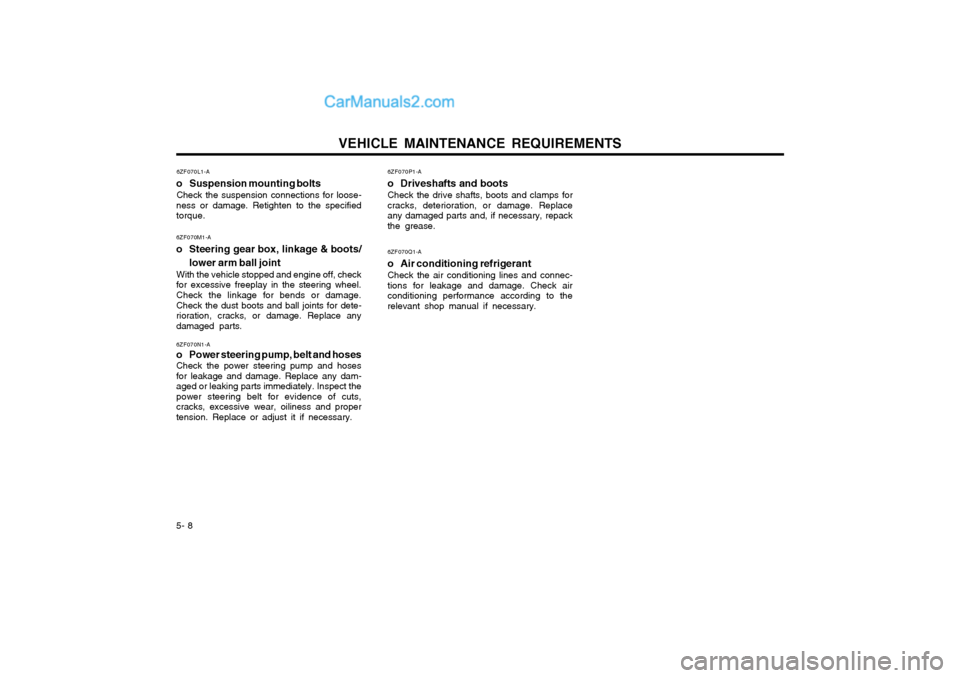
VEHICLE MAINTENANCE REQUIREMENTS
5- 8 6ZF070P1-A
o Driveshafts and boots Check the drive shafts, boots and clamps for cracks, deterioration, or damage. Replaceany damaged parts and, if necessary, repackthe grease. 6ZF070Q1-A
o Air conditioning refrigerant Check the air conditioning lines and connec- tions for leakage and damage. Check airconditioning performance according to therelevant shop manual if necessary.
6ZF070L1-A
o Suspension mounting bolts Check the suspension connections for loose-
ness or damage. Retighten to the specifiedtorque. 6ZF070M1-A
o Steering gear box, linkage & boots/
lower arm ball joint
With the vehicle stopped and engine off, check for excessive freeplay in the steering wheel. Check the linkage for bends or damage. Check the dust boots and ball joints for dete-rioration, cracks, or damage. Replace anydamaged parts. 6ZF070N1-A
o Power steering pump, belt and hoses Check the power steering pump and hoses for leakage and damage. Replace any dam-aged or leaking parts immediately. Inspect thepower steering belt for evidence of cuts,cracks, excessive wear, oiliness and propertension. Replace or adjust it if necessary.