ECU Hyundai Matrix 2004 User Guide
[x] Cancel search | Manufacturer: HYUNDAI, Model Year: 2004, Model line: Matrix, Model: Hyundai Matrix 2004Pages: 317, PDF Size: 5.12 MB
Page 31 of 317
FEATURES OF YOUR HYUNDAI 1- 23
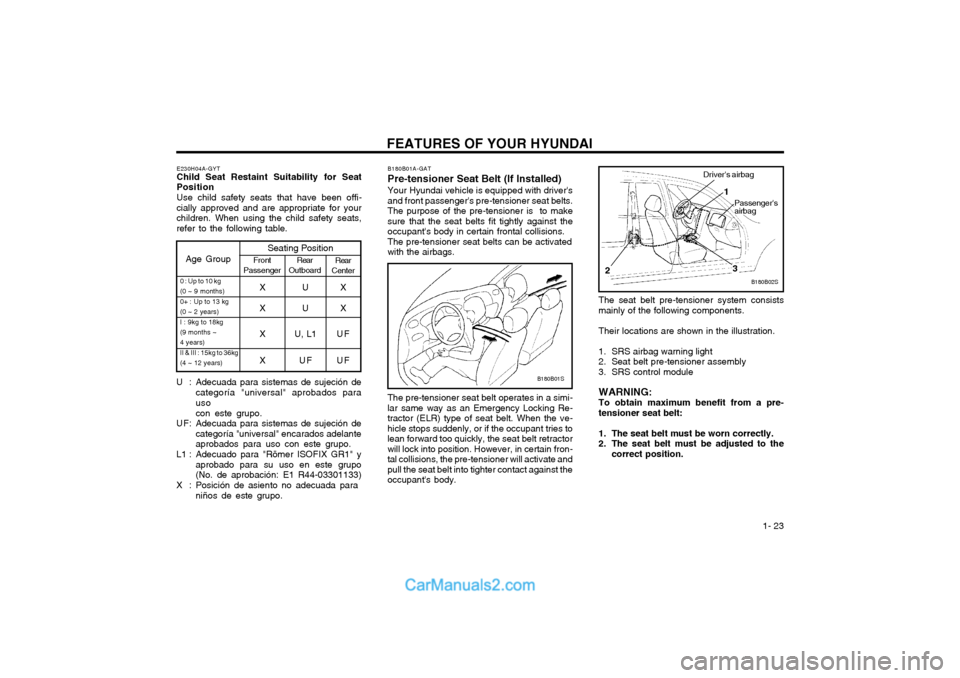
B180B01A-GAT Pre-tensioner Seat Belt (If Installed)Your Hyundai vehicle is equipped with driver's and front passenger's pre-tensioner seat belts.The purpose of the pre-tensioner is to makesure that the seat belts fit tightly against theoccupant's body in certain frontal collisions.The pre-tensioner seat belts can be activatedwith the airbags.
B180B01S
B180B02S
Driver's airbag
1
2
3
Passenger's airbag
The seat belt pre-tensioner system consists mainly of the following components. Their locations are shown in the illustration.
1. SRS airbag warning light
2. Seat belt pre-tensioner assembly
3. SRS control module WARNING: To obtain maximum benefit from a pre-tensioner seat belt:
1. The seat belt must be worn correctly.
2. The seat belt must be adjusted to the correct position.
The pre-tensioner seat belt operates in a simi-lar same way as an Emergency Locking Re-tractor (ELR) type of seat belt. When the ve-hicle stops suddenly, or if the occupant tries tolean forward too quickly, the seat belt retractorwill lock into position. However, in certain fron-tal collisions, the pre-tensioner will activate andpull the seat belt into tighter contact against theoccupant's body.
Age Group
Seating PositionFront
Passenger Rear
Outboard Rear
Center
0 : Up to 10 kg (0 ~ 9 months)0+ : Up to 13 kg(0 ~ 2 years)I : 9kg to 18kg(9 months ~ 4 years) II & III : 15kg to 36kg(4 ~ 12 years)XUX
XUX
X U, L1 U F XU FUF
E230H04A-GYT Child Seat Restaint Suitability for Seat
Position
Use child safety seats that have been offi-
cially approved and are appropriate for your children. When using the child safety seats,refer to the following table.
U : Adecuada para sistemas de sujeción de categoría "universal" aprobados parauso con este grupo.
U F: Adecuada para sistemas de sujeción de categoría "universal" encarados adelante aprobados para uso con este grupo.
L1 : Adecuado para "Römer ISOFIX GR1" y aprobado para su uso en este grupo(No. de aprobación: E1 R44-03301133)
X : Posición de asiento no adecuada para
niños de este grupo.
Page 62 of 317
FEATURES OF YOUR HYUNDAI
1- 54 B560B01O-GAT AUTO FUEL CUT SWITCH (GASOLINE ENGINE)
HFC4001
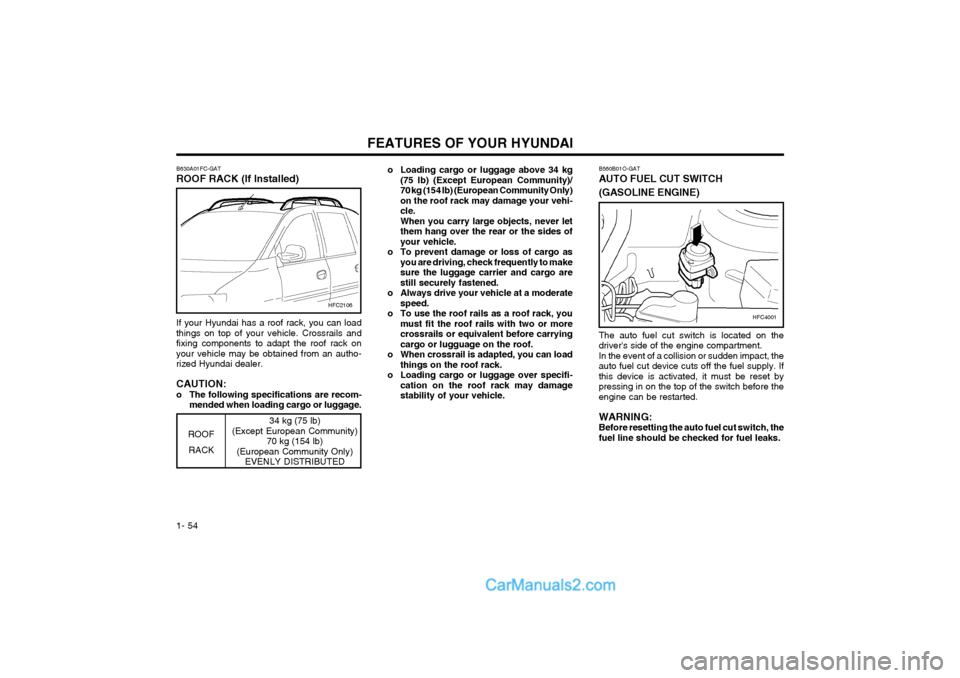
The auto fuel cut switch is located on the driver's side of the engine compartment.In the event of a collision or sudden impact, theauto fuel cut device cuts off the fuel supply. Ifthis device is activated, it must be reset bypressing in on the top of the switch before theengine can be restarted. WARNING: Before resetting the auto fuel cut switch, thefuel line should be checked for fuel leaks.
34 kg (75 lb)
(Except European Community) 70 kg (154 lb)
(European Community Only) EVENLY DISTRIBUTED
HFC2106
B630A01FC-GAT ROOF RACK (If Installed) If your Hyundai has a roof rack, you can load things on top of your vehicle. Crossrails andfixing components to adapt the roof rack onyour vehicle may be obtained from an autho-rized Hyundai dealer. CAUTION:
o The following specifications are recom-
mended when loading cargo or luggage.
ROOF RACK
o Loading cargo or luggage above 34 kg (75 lb) (Except European Community)/
70 kg (154 lb) (European Community Only)on the roof rack may damage your vehi-cle.When you carry large objects, never letthem hang over the rear or the sides ofyour vehicle.
o To prevent damage or loss of cargo as you are driving, check frequently to makesure the luggage carrier and cargo arestill securely fastened.
o Always drive your vehicle at a moderate speed.
o To use the roof rails as a roof rack, you must fit the roof rails with two or morecrossrails or equivalent before carryingcargo or lugguage on the roof.
o When crossrail is adapted, you can load things on the roof rack.
o Loading cargo or luggage over specifi- cation on the roof rack may damagestability of your vehicle.
Page 63 of 317
FEATURES OF YOUR HYUNDAI 1- 55
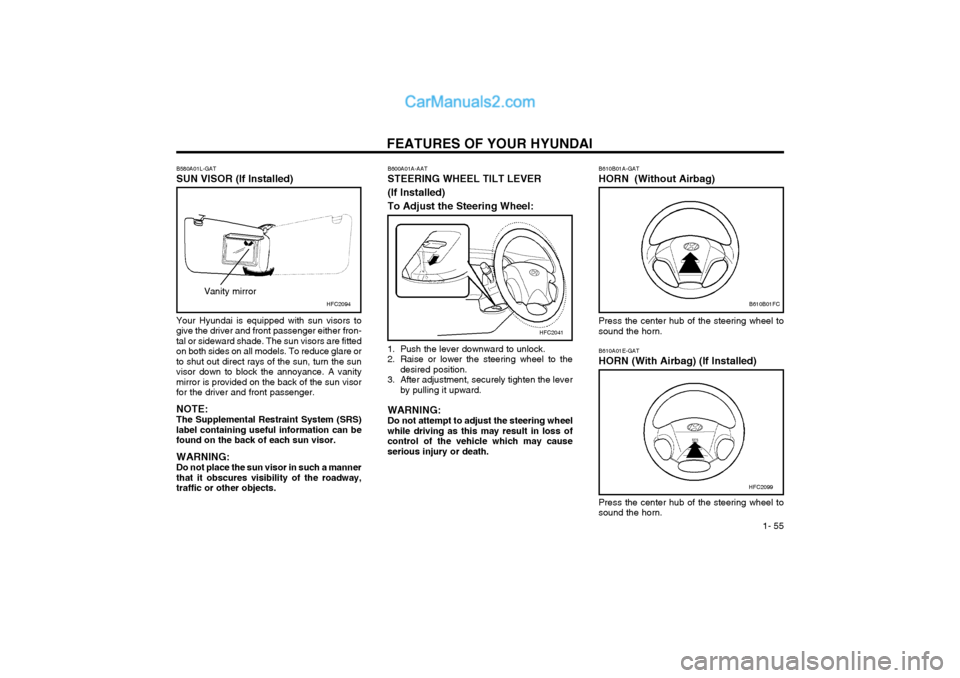
B610B01A-GAT HORN (Without Airbag)B610B01FC
Press the center hub of the steering wheel to sound the horn.
1. Push the lever downward to unlock.
2. Raise or lower the steering wheel to the desired position.
3. After adjustment, securely tighten the lever by pulling it upward.
WARNING:Do not attempt to adjust the steering wheelwhile driving as this may result in loss ofcontrol of the vehicle which may causeserious injury or death.
B600A01A-AAT STEERING WHEEL TILT LEVER (If Installed)To Adjust the Steering Wheel:
HFC2041
B610A01E-GAT HORN (With Airbag) (If Installed)
HFC2099
Press the center hub of the steering wheel to sound the horn.
B580A01L-GAT SUN VISOR (If Installed)
HFC2094
Your Hyundai is equipped with sun visors to give the driver and front passenger either fron-tal or sideward shade. The sun visors are fittedon both sides on all models. To reduce glare orto shut out direct rays of the sun, turn the sunvisor down to block the annoyance. A vanitymirror is provided on the back of the sun visorfor the driver and front passenger. NOTE: The Supplemental Restraint System (SRS)label containing useful information can befound on the back of each sun visor. WARNING: Do not place the sun visor in such a mannerthat it obscures visibility of the roadway,traffic or other objects.
Vanity mirror
Page 110 of 317
DRIVING YOUR HYUNDAI
2- 12 The hitch should be bolted securely to the car and installed by a qualified technician. DO NOT USE A HITCH DESIGNED FOR TEMPORARY INSTALLATION AND NEVER USE ONE THAT ATTACHES ONLY TO THE BUMPER. C190C03S-GAT Trailer Brakes If your trailer is equipped with a braking system, make sure it conforms to federal and/or local regulations and that it is properly installed and operating correctly. NOTE: If you tow a trailer or vehicle, your car will require more frequent maintenance due to the additional load. See "Maintenance Under Severe Usage Conditions" on page 5-5. CAUTION:
o Never connect a trailer brake system di-
rectly to the vehicle brake system.
o When towing a trailer on steep grades (in excess of 12%) pay close attention to theengine coolant temperature gauge to en- sure the engine does not overheat. If the needle of the coolant temperature gauge moves across the dial towards "H" (HOT), pull over and stop as soon as it is safe to do so, and allow the engine to idle until it cools down. You may proceed once the engine has cooled sufficiently.
C180A01A-AAT USE OF LIGHTS Check your lights regularly for correct operation and always keep them clean. When driving dur- ing the day in conditions of poor visibility, it is helpful to drive with headlights on low beam. This enables you to be seen as well as to see. C190A02A-GAT TRAILER OR VEHICLE TOWINGIf you are considering towing with your car, you should first check with your Province Depart- ment of Motor Vehicles to determine their legal requirements. Since laws vary from province to province, the requirements for towing trailers, cars, other types of vehicles, or apparatus may differ. Ask your Hyundai dealer for further details before towing. CAUTION Do not do any towing with your car during its first 2,000 km (1,200 miles) in order to allow the engine to properly break in. Failure to heed this caution may result in serious en- gine or transaxle damage. C190B01S-AAT Trailer Hitches Select the proper hitch and ball combination, making sure that it’s location is compatible with that of the trailer or vehicle being towed. Use a quality non-equalizing hitch which distrib- utes the tongue load uniformly throughout the chassis.
C160K01A-AAT Carry Emergency Equipment Depending on the severity of the weather where you drive your car, you should carry appropriate emergency equipment. Some of the items you may want to carry include tire chains, tow straps or chains, flashlight, emergency flares, sand, a shovel, jumper cables, a window scraper, gloves, ground cloth, coveralls, a blanket, etc. C170A01A-AAT HIGHER SPEED MOTORING Pre-Trip Inspections 1. Tires: Adjust the tire inflation pressures to specifica- tion. Low tire inflation pressures will result in overheating and possible failure of the tires. Avoid using worn or damaged tires which may result in reduced traction or tire failure. NOTE: Never exceed the maximum tire inflation pres- sure shown on the tires. 2. Fuel, engine coolant and engine oil: High speed travel consumes 1.5 times more fuel than urban motoring. Do not forget to check both engine coolant and engine oil. 3. Drive belt: A loose or damaged drive belt may result in overheating of the engine.
Page 112 of 317
DRIVING YOUR HYUNDAI
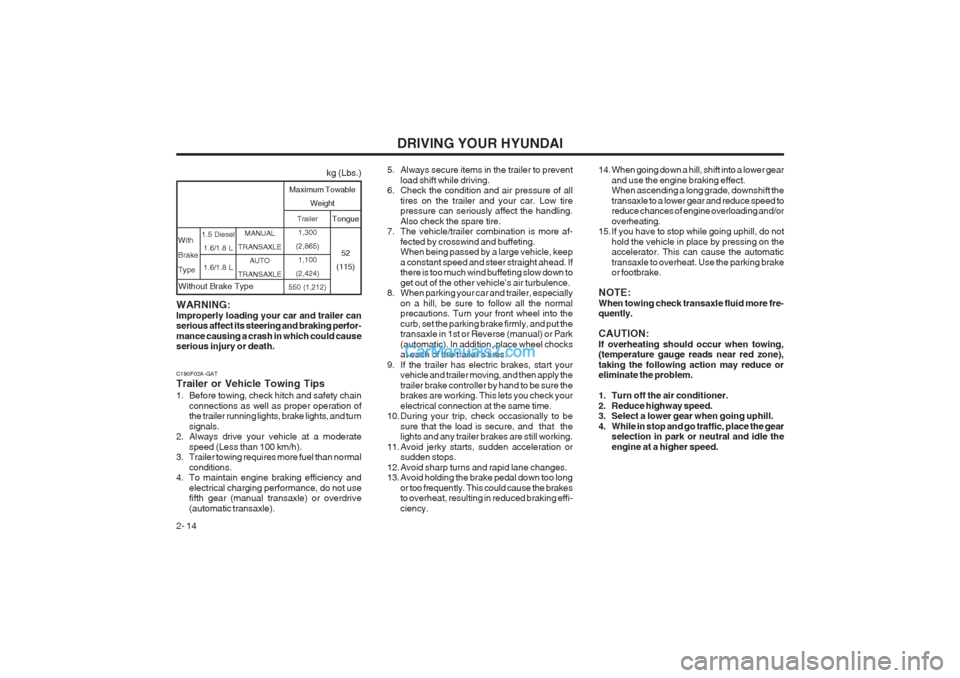
2- 14 MANUAL
TRANSAXLE AUTO
TRANSAXLE Trailer
1,300
(2,865) 1,100
(2,424)
550 (1,212) Tongue
52
(115)
kg (Lbs.)
Maximum Towable Weight
With BrakeType
1.5 Diesel 1.6/1.8 L 1.6/1.8 L
WARNING: Improperly loading your car and trailer can serious affect its steering and braking perfor- mance causing a crash in which could cause serious injury or death.
Without Brake Type
5. Always secure items in the trailer to prevent load shift while driving.
6. Check the condition and air pressure of all
tires on the trailer and your car. Low tire pressure can seriously affect the handling. Also check the spare tire.
7. The vehicle/trailer combination is more af-
fected by crosswind and buffeting. When being passed by a large vehicle, keep a constant speed and steer straight ahead. If there is too much wind buffeting slow down to get out of the other vehicle’s air turbulence.
8. When parking your car and trailer, especially
on a hill, be sure to follow all the normal precautions. Turn your front wheel into the curb, set the parking brake firmly, and put the transaxle in 1st or Reverse (manual) or Park (automatic). In addition, place wheel chocks at each of the trailer’s tires.
9. If the trailer has electric brakes, start your vehicle and trailer moving, and then apply the trailer brake controller by hand to be sure the brakes are working. This lets you check your electrical connection at the same time.
10. During your trip, check occasionally to be
sure that the load is secure, and that the lights and any trailer brakes are still working.
11. Avoid jerky starts, sudden acceleration or sudden stops.
12. Avoid sharp turns and rapid lane changes.
13. Avoid holding the brake pedal down too long or too frequently. This could cause the brakesto overheat, resulting in reduced braking effi- ciency. 14. When going down a hill, shift into a lower gear
and use the engine braking effect. When ascending a long grade, downshift the transaxle to a lower gear and reduce speed to reduce chances of engine overloading and/or overheating.
15. If you have to stop while going uphill, do not
hold the vehicle in place by pressing on the accelerator. This can cause the automatic transaxle to overheat. Use the parking brake or footbrake.
NOTE: When towing check transaxle fluid more fre- quently. CAUTION: If overheating should occur when towing, (temperature gauge reads near red zone), taking the following action may reduce or eliminate the problem.
1. Turn off the air conditioner.
2. Reduce highway speed.
3. Select a lower gear when going uphill.
4. While in stop and go traffic, place the gear selection in park or neutral and idle theengine at a higher speed.
C190F02A-GAT Trailer or Vehicle Towing Tips
1. Before towing, check hitch and safety chain
connections as well as proper operation of the trailer running lights, brake lights, and turn signals.
2. Always drive your vehicle at a moderate
speed (Less than 100 km/h).
3. Trailer towing requires more fuel than normal
conditions.
4. To maintain engine braking efficiency and
electrical charging performance, do not use fifth gear (manual transaxle) or overdrive (automatic transaxle).
Page 113 of 317
WHAT TO DO IN AN EMERGENCY 3-1
3. WHAT TO DO IN ANEMERGENCY
D010A01A-AAT IF THE ENGINE WILL NOT START WARNING If the engine will not start, do not push or pull the car to start it. This could result in a collision or cause other damage. In addition, push or pull starting may cause the catalytic converter to be overloaded and create a fire hazard. D010B02A-AAT If Engine Doesn’t Turn Over or Turns Over Slowly
D010B01FC
1. If your car has an automatic transaxle, be sure the gear selector lever is in "N" or "P" and the emergency brake is set. 2. Check the battery connections to be sure
they are clean and tight.
3. Turn on the interior light. If the light dims or
goes out when you operate the starter, the battery is discharged.
4. Check the starter connections to be sure they are securely tightened.
5. Do not push or pull the vehicle to start it. See instructions for "Jump Starting".
SSA3020C
D010C01A-AAT If Engine Turns Over Normally but Does Not Start
1 Check fuel level.
2 Check all connectors at ignition, coil and
spark plugs. Reconnect any that may bedisconnected or loose.
3 Check the fuel line in the engine room.
4 If engine still refuses to start, call a Hyundai dealer or seek other qualified assistance. D010D01A-AAT If the Engine Stalls While Driving
1. Reduce your speed gradually, keeping a
straight line. Move cautiously off the road to a safe place.
2. Turn on your emergency flashers.
3. Try to start the engine again. If your vehicle will not start, contact a Hyundai dealer or seekother qualified assistance.
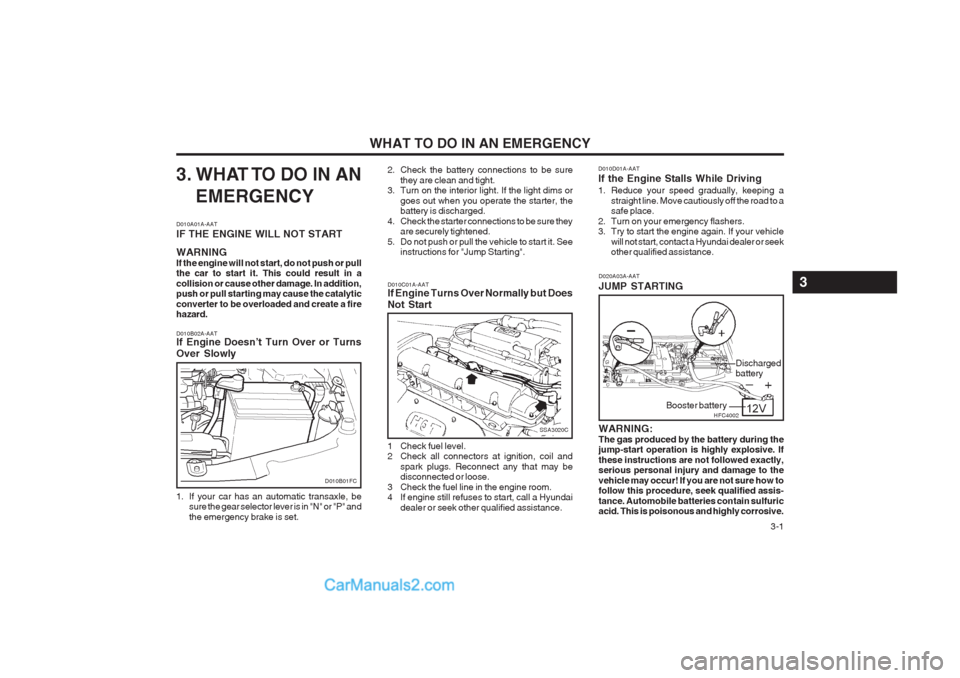
D020A03A-AAT JUMP STARTING
HFC4002
WARNING: The gas produced by the battery during the jump-start operation is highly explosive. If these instructions are not followed exactly, serious personal injury and damage to the vehicle may occur! If you are not sure how to follow this procedure, seek qualified assis- tance. Automobile batteries contain sulfuric acid. This is poisonous and highly corrosive.
Booster battery Discharged battery
3
Page 115 of 317
WHAT TO DO IN AN EMERGENCY 3-3
WARNING: While the engine is running, keep hair, hands, and clothing away from moving parts such as the fan and drive belts to prevent injury. WARNING (Diesel only): Never work on injection system with engine running or within 30 seconds after shutting off engine. High pressure pump, rail, injec- tors and high pressure pipes are subject to high pressure even after the engine stopped. The fuel jet produced by fuel leaks may cause serious injury, if it touch the body. People using pacemakers should not move than 30cm closer to the ECU or wiring harness within the engine room while engine is running, since the high currents in the Common Rail system produce considerable magnetic fields.
5. If the water pump drive belt is broken or
coolant is leaking out, stop the engine im- mediately and call the nearest Hyundai deal- er for assistance.
WARNING: Do not remove the radiator cap when the engine is hot. This can allow coolant to be blown out of the opening and cause serious burns. 2. The spare tire should only be used temporari-
ly and should be returned to the luggage compartment as soon as the original tire can be repaired or replaced.
3. Continuous use at speeds of over 80 km/h (50 mph) is not recommended.
4. As the temporary spare tire is specifically designed for your car, it should not be used on any other vehicle.
5. The temporary spare tire should not be used
on any other wheels, nor should standard tires, snow tires, wheel covers or trim rings be used with the temporary spare wheel. If such use is attempted, damage to these items or other car components may occur.
6. The temporary spare tire pressure should be
checked once a month while the tire is stored.
CAUTION:
o Do not use snow chains with your tempo- rary spare tire.
o Do not use more than one temporary spare tire at a time.
D040A01FC-GAT TEMPORARY SPARE TIRE The following instructions for the temporary spare tire should be observed:
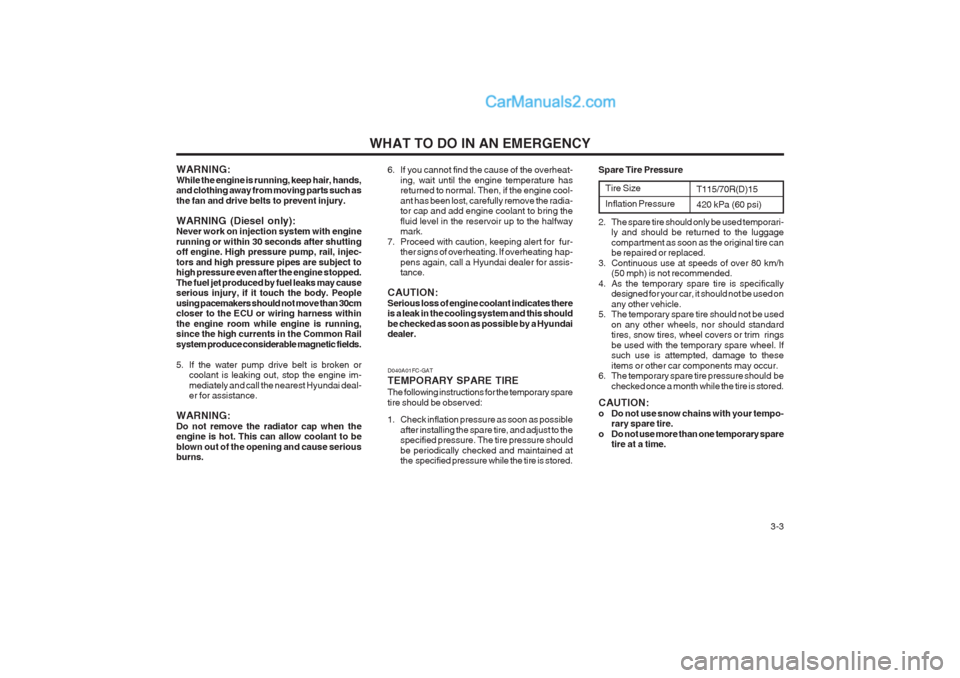
1. Check inflation pressure as soon as possible
after installing the spare tire, and adjust to the specified pressure. The tire pressure should be periodically checked and maintained at the specified pressure while the tire is stored.
Inflation Pressure
Tire Size
T115/70R(D)15 420 kPa (60 psi)
Spare Tire Pressure
6. If you cannot find the cause of the overheat-
ing, wait until the engine temperature has returned to normal. Then, if the engine cool- ant has been lost, carefully remove the radia- tor cap and add engine coolant to bring the fluid level in the reservoir up to the halfway mark.
7. Proceed with caution, keeping alert for fur- ther signs of overheating. If overheating hap- pens again, call a Hyundai dealer for assis- tance.
CAUTION: Serious loss of engine coolant indicates there is a leak in the cooling system and this should be checked as soon as possible by a Hyundai dealer.
Page 120 of 317
WHAT TO DO IN AN EMERGENCY
3-8 D080A02A-GAT IF YOUR CAR MUST BE TOWED CAUTION: Your car can be damaged if towed incorrect- ly! If your car has to be towed, it should be done by your Hyundai dealer or a commercial tow truck service. This will help assure that your car is not damaged in towing. Also, professionals are gen- erally aware of local laws governing towing. In any case, rather than risk damage to your car, it is suggested that you show this information to the tow truck operator. Be sure that a safety chain system is used and that all local laws are ob- served.
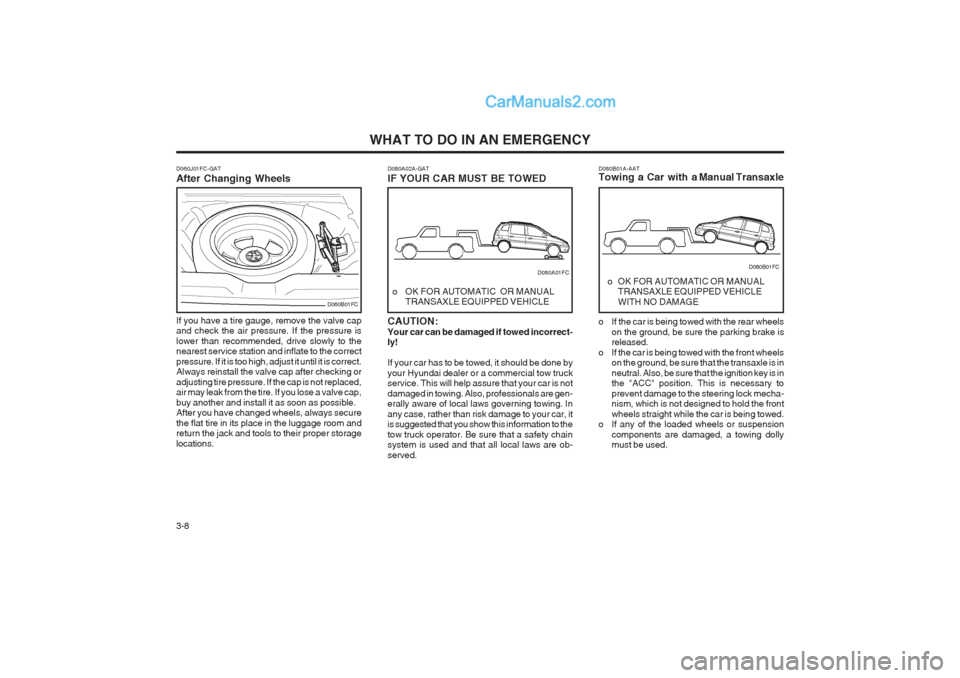
D080B01A-AAT Towing a Car with a Manual Transaxle
o If the car is being towed with the rear wheels
on the ground, be sure the parking brake is released.
o If the car is being towed with the front wheels on the ground, be sure that the transaxle is in neutral. Also, be sure that the ignition key is in the "ACC" position. This is necessary to prevent damage to the steering lock mecha- nism, which is not designed to hold the front wheels straight while the car is being towed.
o If any of the loaded wheels or suspension
components are damaged, a towing dolly must be used.
o OK FOR AUTOMATIC OR MANUALTRANSAXLE EQUIPPED VEHICLE D080A01FC o OK FOR AUTOMATIC OR MANUAL
TRANSAXLE EQUIPPED VEHICLE WITH NO DAMAGE D080B01FC
D060J01FC-GAT After Changing Wheels If you have a tire gauge, remove the valve cap and check the air pressure. If the pressure is lower than recommended, drive slowly to the nearest service station and inflate to the correct pressure. If it is too high, adjust it until it is correct. Always reinstall the valve cap after checking or adjusting tire pressure. If the cap is not replaced, air may leak from the tire. If you lose a valve cap, buy another and install it as soon as possible. After you have changed wheels, always secure the flat tire in its place in the luggage room and return the jack and tools to their proper storage locations.
D060B01FC
Page 132 of 317
VEHICLE MAINTENANCE REQUIREMENTS
5- 6
F060A01A-AAT EXPLANATION OF SCHEDULED MAINTENANCE ITEMS F060M01A-AAT o Engine Oil and FilterThe engine oil and filter should be changed at
the intervals specified in the maintenance sched- ule. If the car is being driven in severe condi- tions, more frequent oil and filter changes are required. F060B01A-AAT
o Drive BeltsInspect all drive belts for evidence of cuts, cracks, excessive wear or oil saturation andreplace if necessary. Drive belts should be checked periodically for proper tension and adjusted as necessary. F060C01A-AAT
o Fuel FilterA clogged filter can limit the speed at which the vehicle may be driven, damage the emission system and cause hard starting. If an exces- sive amount of foreign matter accumulates in the fuel tank, the filter may require replacement more frequently. After installing a new filter, run the engine forseveral minutes, and check for leaks at the connections. Fuel filters should be installed by trained technicians.
F060D01TB-AAT
o Fuel Lines, Fuel Hoses and
Connections
Check the fuel lines, fuel hoses and connec- tions for leakage and damage. Replace any damaged or leaking parts immediately. WARNING (Diesel only): Never work on injection system with engine running or within 30 seconds after shutting off engine. High pressure pump, rail, injec- tors and high pressure pipes are subject to high pressure even after the engine stopped. The fuel jet produced by fuel leaks may cause serious injury, if it touch the body. People using pacemakers should not move than 30cm closer to the ECU or wiring har- ness within the engine room while engine is running, since the high currents in the Com- mon Rail system produce considerable mag- netic fields. F060E01A-AAT
o Timing BeltInspect all parts related to the timing belt for damage and deformation. Replace any dam- aged parts immediately. F060G01A-AAT
o Vapor Hose and Fuel Filler Cap The vapor hose and fuel filler cap should be
inspected at those intervals specified in themaintenance schedule. Make sure that a new vapor hose or fuel filler cap is correctly re- placed.
F060F01A-AAT
o Vacuum, Crankcase Ventilation
Hoses
Inspect the surface of hoses for evidence of
heat and/or mechanical damage. Hard and brit-tle rubber, cracking, tears, cuts, abrasions, and excessive swelling indicate deterioration. Par- ticular attention should be paid to examining those hose surfaces nearest to high heat sourc- es, such as the exhaust manifold.
Inspect the hose routing to assure that the
hoses do not come in contact with any heatsource, sharp edges or moving component which might cause heat damage or mechanical wear. Inspect all hose connections, such as clamps and couplings, to make sure they are secure, and that no leaks are present. Hoses should be replaced immediately if there is any evidence of deterioration or damage.
Page 143 of 317
DO-IT-YOURSELF MAINTENANCE 6-9
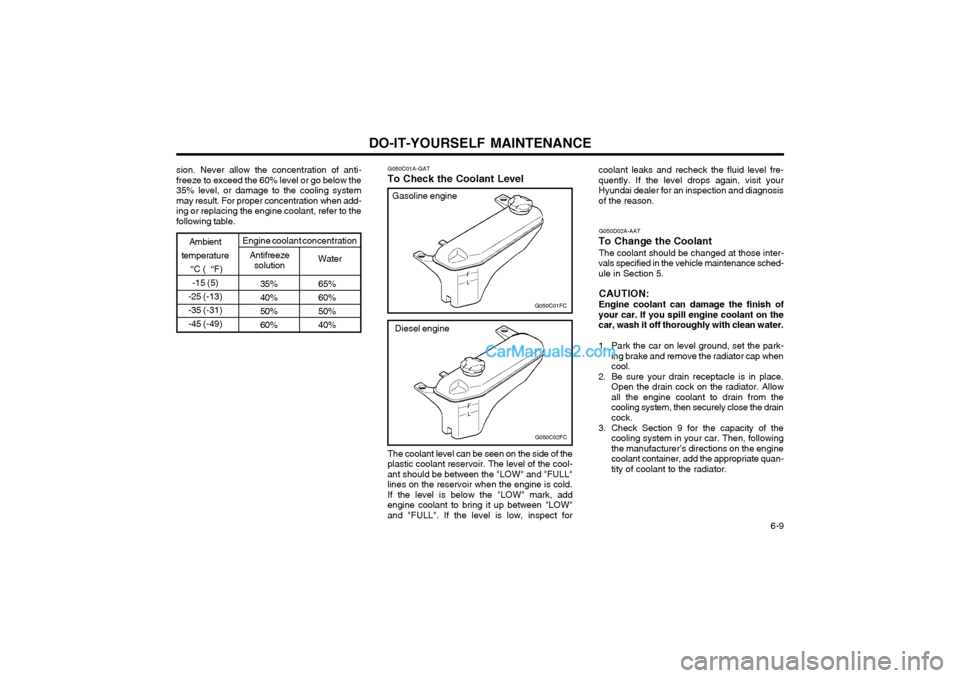
35% 65%
40% 60%
50% 50%
60% 40%
Ambient
temperature °C ( °F)-15 (5)
-25 (-13) -35 (-31)-45 (-49)
Antifreeze solution Water
Engine coolant concentration G050C01A-GAT
To Check the Coolant Level
G050C01FC
The coolant level can be seen on the side of the
plastic coolant reservoir. The level of the cool- ant should be between the "LOW" and "FULL"lines on the reservoir when the engine is cold.If the level is below the "LOW" mark, addengine coolant to bring it up between "LOW"and "FULL". If the level is low, inspect for G050D02A-AAT
To Change the Coolant The coolant should be changed at those inter-
vals specified in the vehicle maintenance sched-ule in Section 5.
CAUTION: Engine coolant can damage the finish of
your car. If you spill engine coolant on the car, wash it off thoroughly with clean water.
1. Park the car on level ground, set the park- ing brake and remove the radiator cap when cool.
2. Be sure your drain receptacle is in place. Open the drain cock on the radiator. Allowall the engine coolant to drain from thecooling system, then securely close the draincock.
3. Check Section 9 for the capacity of the cooling system in your car. Then, followingthe manufacturer’s directions on the enginecoolant container, add the appropriate quan-tity of coolant to the radiator.
G050C02FC
Diesel engine
Gasoline engine
sion. Never allow the concentration of anti- freeze to exceed the 60% level or go below the35% level, or damage to the cooling systemmay result. For proper concentration when add-ing or replacing the engine coolant, refer to thefollowing table.
coolant leaks and recheck the fluid level fre-quently. If the level drops again, visit yourHyundai dealer for an inspection and diagnosisof the reason.