air conditioning Hyundai Matrix 2004 Owner's Guide
[x] Cancel search | Manufacturer: HYUNDAI, Model Year: 2004, Model line: Matrix, Model: Hyundai Matrix 2004Pages: 317, PDF Size: 5.12 MB
Page 262 of 317
3-3
IN CASE OF EMERGENCY
satisfactory, check for coolant leaking from the radiator, hoses or under the car. (If the air conditioning had been in use, it is normal for cold water to be draining from it).
WARNING: While the engine is running, keep hands and clothing away from moving parts such as the fan and drive belts to prevent injury. WARNING (Diesel only): Never work on injection system with en-gine running or within 30 seconds after shutting off engine. High pressure pump, rail, injectors and high pressure pipes are subject to high pressure even after the engine stopped. The fuel jet produced by fuel leaks may cause serious injury, if it touch the body. People using pacemak- ers should not move than 30cm closer to the ECU or wiring harness within the engine room while engine is running, since the high currents in the Common Rail system produce considerable mag- netic fields.
5. If the water pump drive belt is broken or coolant is leaking out, stop the engine immediately and call the nearest Hyundai dealer for assistance. WARNING:Do not remove the radiator cap when theengine is hot since steam and boiling water may be ejected from the radiator resulting in burns or scalding.
6. If the cause of the overheating cannot be found, wait until the engine temperature has returned to normal. Then, if coolant has been lost, carefully remove the radia- tor cap and add water to bring the fluid level in the reservoir up to the base of the radiator fill opening. Fill the coolant expan- sion tank to the halfway mark.
7. Proceed with caution until it is established that the engine is operating normally. If theengine overheats repeatedly, the advice of a Hyundai dealer should be sought.
CAUTION: Serious loss of coolant indicates there isa leak in the cooling system and this should be checked as soon as possible by a Hyundai dealer. D040A01FC-EAT
TEMPORARY SPARE TYRE The following instructions for the temporary
spare tyre should be observed:
1. Check inflation pressure as soon as pos-
sible after installing the spare tyre, and adjust to the specified pressure. The tyre pressure should be periodically checked and maintained at the specified pressure while the tyre is stored.
2. The spare tyre should only be used tem- porarily and should be returned to the luggage compartment as soon as the origi- nal tyre can be repaired or replaced.
3. Continuous use at speeds of over 80 km/h
(50 mph) is not recommended.
4. As the temporary spare tyre is specifically designed for your car, it should not beused on any other vehicle.
5. The temporary spare tyre should not be used on any other wheels, nor shouldstandard tyre, snow tyre, wheel covers or trim rings be used with the temporary spare wheel. If such use is attempted, damage to these items or other car com- ponents may occur.
6. The temporary spare tyre pressure should be checked once a month while the tyre isstored.
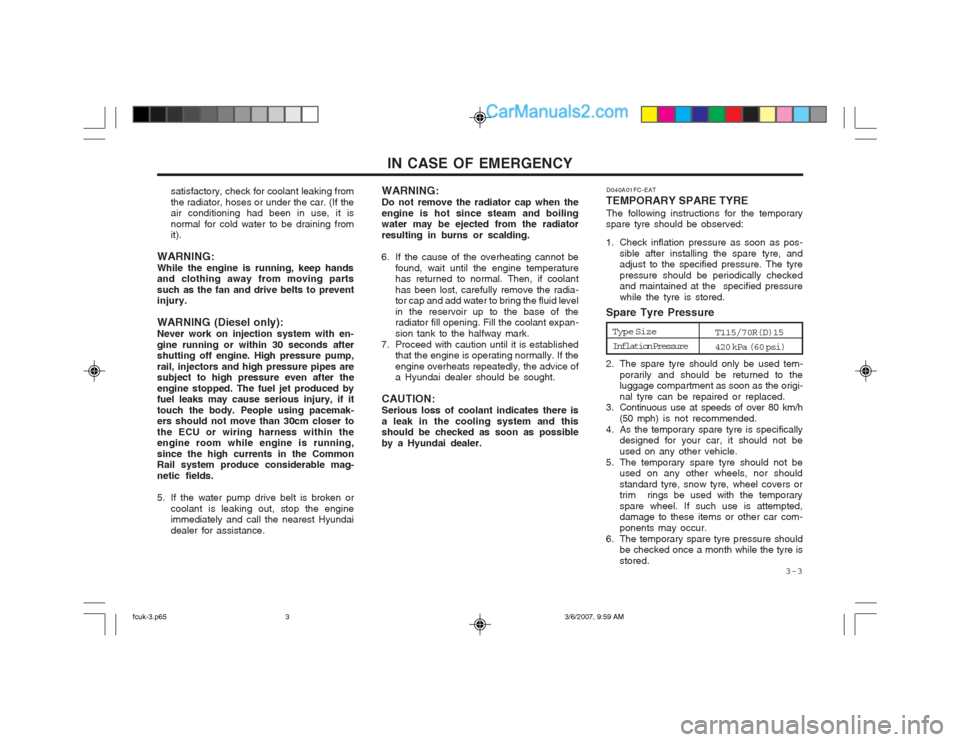
Spare Tyre Pressure
Type Size
Inflation Pressure T115/70R(D)15
420 kPa (60 psi)
fcuk-3.p65
3/6/2007, 9:59 AM
3
Page 278 of 317
VEHICLE MAINTENANCE REQUIREMENTS
5- 8 6ZF070P1-A
o Driveshafts and Boots Check the drive shafts, boots and clamps for cracks, deterioration, or damage. Replaceany damaged parts and, if necessary, repackthe grease. 6ZF070Q1-A
o Air conditioning Refrigerant Check the air conditioning lines and connec- tions for leakage and damage. Check airconditioning performance according to therelevant shop manual if necessary.
6ZF070L1-A
o Suspension Mounting Bolts Check the suspension connections for loose-
ness or damage. Retighten to the specifiedtorque. 6ZF070M1-A
o Steering Gear Box, Linkage & Boots/
Lower arm Ball Joint
With the vehicle stopped and engine off, check for excessive freeplay in the steering wheel. Check the linkage for bends or damage. Check the dust boots and ball joints for dete-rioration, cracks, or damage. Replace anydamaged parts. 6ZF070N1-A
o Power Steering Pump, Belt and Hoses Check the power steering pump and hoses for leakage and damage. Replace any dam-aged or leaking parts immediately. Inspect thepower steering belt for evidence of cuts,cracks, excessive wear, oiliness and propertension. Replace or adjust it if necessary.
fcuk-5.p65 3/6/2007, 10:01 AM
8
Page 286 of 317
OWNER MAINTENANCE
6-8 SG050C1-E
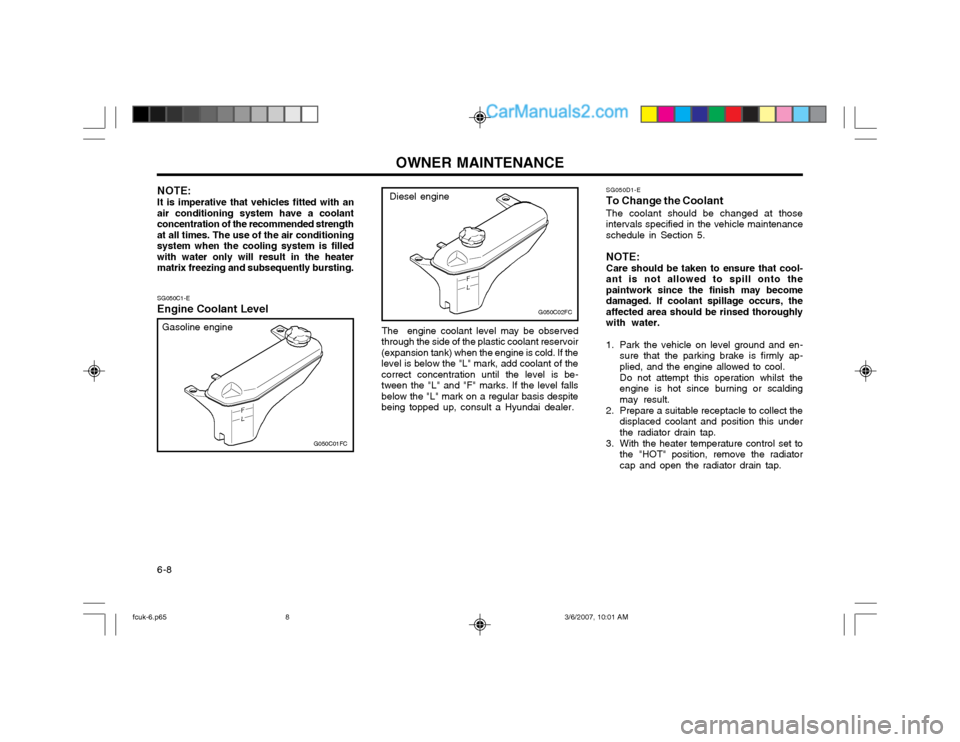
Engine Coolant Level
The engine coolant level may be observed
through the side of the plastic coolant reservoir (expansion tank) when the engine is cold. If thelevel is below the "L" mark, add coolant of thecorrect concentration until the level is be-tween the "L" and "F" marks. If the level fallsbelow the "L" mark on a regular basis despitebeing topped up, consult a Hyundai dealer.
G050C01FC
G050C02FC
Diesel engine
Gasoline engine
NOTE: It is imperative that vehicles fitted with an
air conditioning system have a coolant concentration of the recommended strengthat all times. The use of the air conditioningsystem when the cooling system is filledwith water only will result in the heatermatrix freezing and subsequently bursting. SG050D1-E
To Change the Coolant
The coolant should be changed at thoseintervals specified in the vehicle maintenanceschedule in Section 5. NOTE: Care should be taken to ensure that cool- ant is not allowed to spill onto thepaintwork since the finish may becomedamaged. If coolant spillage occurs, theaffected area should be rinsed thoroughlywith water.
1. Park the vehicle on level ground and en- sure that the parking brake is firmly ap-plied, and the engine allowed to cool. Do not attempt this operation whilst the engine is hot since burning or scaldingmay result.
2. Prepare a suitable receptacle to collect the displaced coolant and position this underthe radiator drain tap.
3. With the heater temperature control set to the "HOT" position, remove the radiatorcap and open the radiator drain tap.
fcuk-6.p65 3/6/2007, 10:01 AM
8
Page 294 of 317
OWNER MAINTENANCE
6-16 SG140C1-E
Checking the Refrigerant
1. Start the engine and run at idle for several minutes with the refrigeration system run- ning at the coldest setting.
2. Open the bonnet and inspect the sight glass on the top of the receiver dryer.
3. If the refrigerant charge is insufficient, a flow of bubbles will be observed through the sightglass.
4. If the refrigerant charge is satisfactory, no bubbles will be observed through the sightglass.
CAUTION: Running the air conditioning system with a low refrigerant level may damage the com-pressor. SG140D1-E
Off Season Maintenance The air conditioning must be run for ten minutes or so weekly during periods when the systemwould not normally be used to ensure that thecompressor and seals are lubricated. If thisprecaution is not observed the compressor sealsmay become stuck to the compressor shaft anddamaged when the system is next used result-ing in a loss of refrigerant and damage to thecompressor. SG150A1-E STEERING WHEEL FREEPLAY
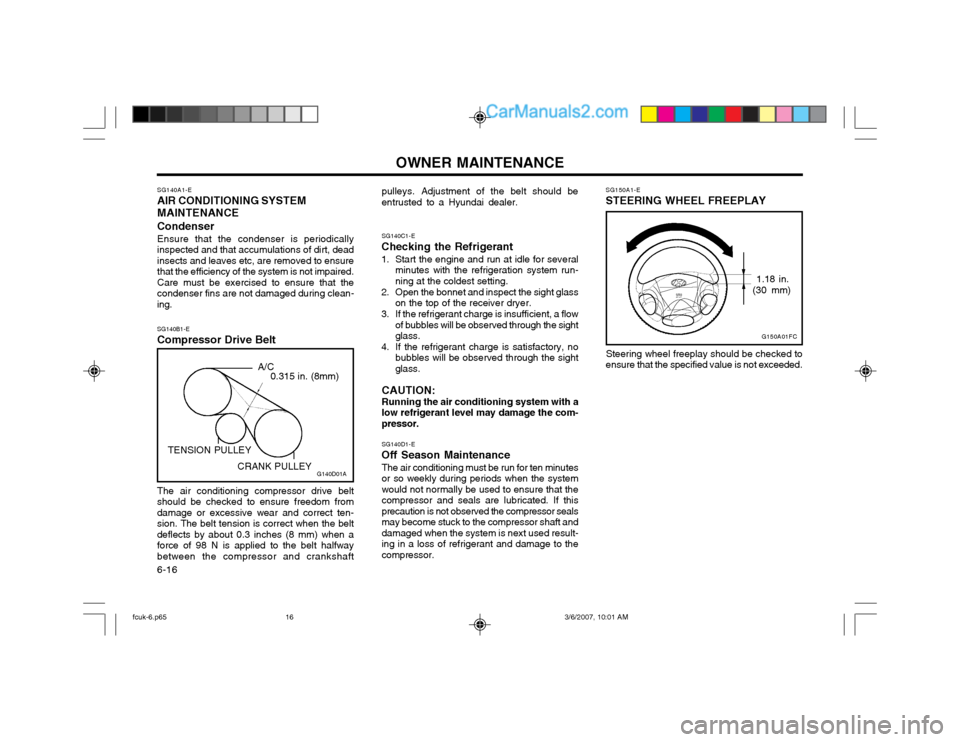
Steering wheel freeplay should be checked to
ensure that the specified value is not exceeded.
SG140B1-E
Compressor Drive Belt
The air conditioning compressor drive belt
should be checked to ensure freedom from damage or excessive wear and correct ten-sion. The belt tension is correct when the beltdeflects by about 0.3 inches (8 mm) when aforce of 98 N is applied to the belt halfwaybetween the compressor and crankshaft SG140A1-E
AIR CONDITIONING SYSTEM
MAINTENANCE
Condenser Ensure that the condenser is periodicallyinspected and that accumulations of dirt, deadinsects and leaves etc, are removed to ensurethat the efficiency of the system is not impaired.Care must be exercised to ensure that thecondenser fins are not damaged during clean-ing.
G150A01FC
G140D01A
A/C
CRANK PULLEY
TENSION PULLEY
1.18 in. (30 mm)
0.315 in. (8mm) pulleys. Adjustment of the belt should be entrusted to a Hyundai dealer.
fcuk-6.p65
3/6/2007, 10:01 AM
16
Page 298 of 317
OWNER MAINTENANCE
6-20 SG230A1-E
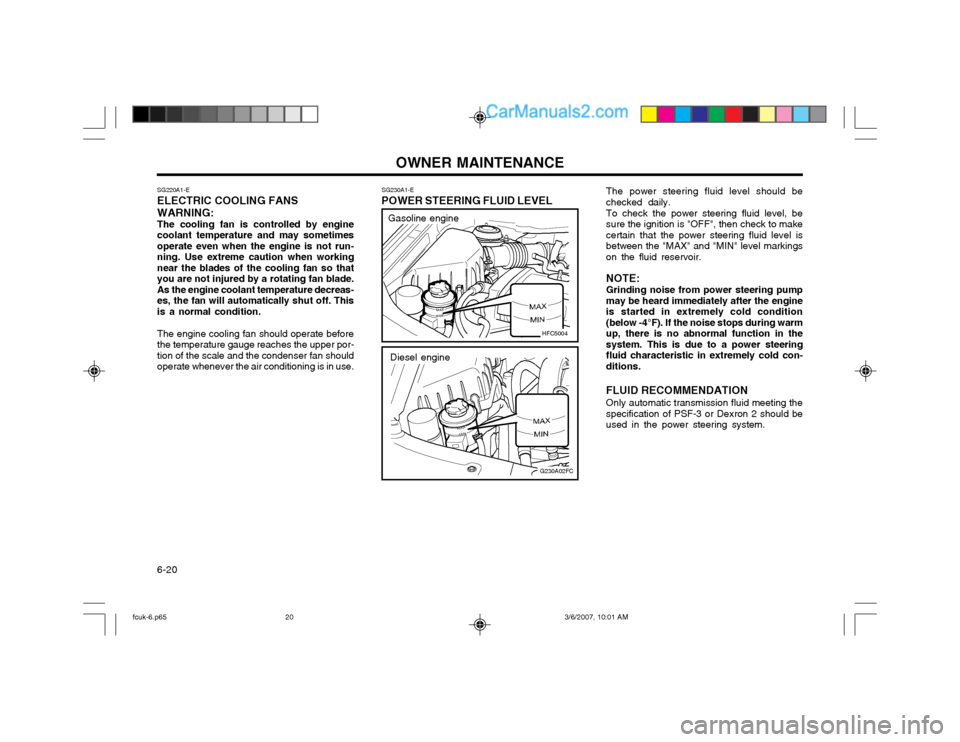
POWER STEERING FLUID LEVEL
SG220A1-E
ELECTRIC COOLING FANS
WARNING: The cooling fan is controlled by engine coolant temperature and may sometimesoperate even when the engine is not run-ning. Use extreme caution when workingnear the blades of the cooling fan so thatyou are not injured by a rotating fan blade.As the engine coolant temperature decreas-es, the fan will automatically shut off. Thisis a normal condition. The engine cooling fan should operate before the temperature gauge reaches the upper por-tion of the scale and the condenser fan shouldoperate whenever the air conditioning is in use. The power steering fluid level should bechecked daily. To check the power steering fluid level, be sure the ignition is "OFF", then check to makecertain that the power steering fluid level isbetween the "MAX" and "MIN" level markingson the fluid reservoir. NOTE: Grinding noise from power steering pump may be heard immediately after the engineis started in extremely cold condition(below -4°F). If the noise stops during warmup, there is no abnormal function in thesystem. This is due to a power steeringfluid characteristic in extremely cold con-ditions. FLUID RECOMMENDATION Only automatic transmission fluid meeting the specification of PSF-3 or Dexron 2 should beused in the power steering system.
HFC5004
G230A02FC
Gasoline engine
Diesel engine
fcuk-6.p65 3/6/2007, 10:01 AM
20
Page 314 of 317
INDEX10-1
A
ACCESSORY TRAY ..
...................................................................... 1-48
AIR CONDITIONING SWITCH ........................................................ 1-57
AIR CONDITIONING SYSTEM MAINTENANCE ........................... 6-16
AIR CLEANER ELEMENT REPLACEMENT .................................. 6-11
ANTENNA ......................................................................................... 1-62
ANTI-THEFT ALARM SYSTEM .............................................. 1-5 ~ 1-7
AUTO FUEL CUT SWITCH ............................................................. 1-51
AUTOMATIC TRANSAXLE ..................................................... 2-6 ~ 2-9
AUTOMATIC TRANSAXLE FLUID ..................................... 6-12 ~ 6-13
BBATTERY MAINTENANCE ............................................................. 6-19
BEFORE STARTING THE ENGINE ................................................. 2-2
BONNET RELEASE ......................................................................... 1-49
BRAKE PEDAL FREEPLAY ..................... ....................................... 6-17
BRAKE TRACTION CONTROL SYSTEM ...................................... 2-10
BRAKE SYSTEM CHECKING ........................................................ 6-14 CCARE OF SEAT
BELTS ................................................................. 1-14
CARGO AREA COVER ................................................................... 1-51
CATALYTIC CONVERTOR OPERATING PRECAUTIONS ............. 7-1
CENTRE VENTILATOR ................................................................... 1-53
CENTRAL DOOR LOCKS ................................................................. 1-5
CHANGING A FLAT TYRE . .............................................................. 3-4
CHECKING THE CLUTCH FLUID .................................................. 6-15
CHILD-PROOF REAR DOOR LOCK ................................................ 1-4
CHILD RESTRAINT SYSTEM ............................................. 1-16 ~ 1-20
CIGAR LIGHTER ............................................................................. 1-40
CLUTCH PEDAL FREEPLAY ......................................................... 6-17
COMBINATION IGNITION SWITCH AND STEERING LOCK ........ 2-2
COOLANT TEMPERATURE GAUG E ............................................. 1-33
DDAILY OPERATING CHECKS .......................................................... 6-4
DIGITAL CLOCK .............................................................................. 1-40
DOOR LOCKS ................................................................................... 1-3
DOOR WINDOWS ............................................................................. 1-7
DRINK HOLDER .............................................................................. 1-41
DRIVE BELTS .................................................................................. 6-17
DRIVING FOR ECONOMY ............................................................. 2-11
JK000A1-A 10. INDEX
10
fcuk-10.p65
3/6/2007, 10:03 AM
1