brake Hyundai Matrix 2004 Repair Manual
[x] Cancel search | Manufacturer: HYUNDAI, Model Year: 2004, Model line: Matrix, Model: Hyundai Matrix 2004Pages: 317, PDF Size: 5.12 MB
Page 258 of 317
DRIVING YOUR HYUNDAI
2- 14 YC200E2-E
Trailer or Vehicle Towing Tips
1. Before towing, check towbar hitch and safety cable connections as well as proper operation of the trailer running lights, brake lights, and turn signals.
2. Always drive your vehicle at a moderate speed (Less than 60 MPH)
3. Trailer towing requires more fuel than nor- mal conditions.
4. To maintain engine braking efficiency and electrical charging performance, do not usefifth gear (manual transaxle) or overdrive (automatic transaxle). Towing BracketAttachment Location
NOTE:
o The total gross vehicle weight with
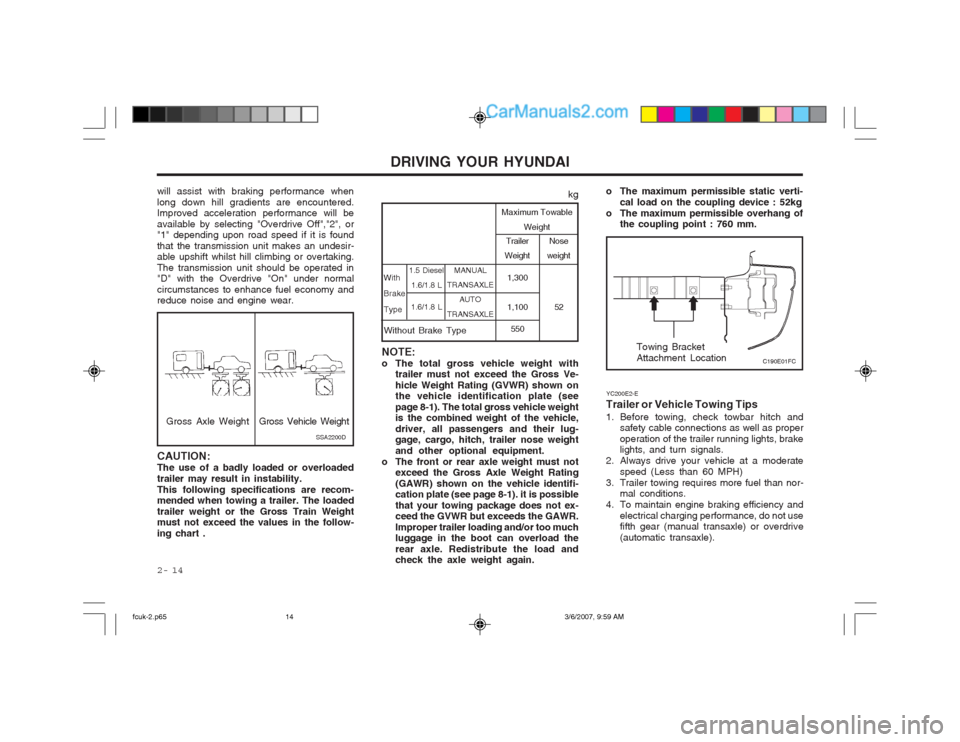
trailer must not exceed the Gross Ve-hicle Weight Rating (GVWR) shown on the vehicle identification plate (see page 8-1). The total gross vehicle weight is the combined weight of the vehicle, driver, all passengers and their lug- gage, cargo, hitch, trailer nose weight and other optional equipment.
o The front or rear axle weight must not exceed the Gross Axle Weight Rating(GAWR) shown on the vehicle identifi- cation plate (see page 8-1). it is possible that your towing package does not ex- ceed the GVWR but exceeds the GAWR. Improper trailer loading and/or too much luggage in the boot can overload the rear axle. Redistribute the load and check the axle weight again. MANUAL
TRANSAXLE AUTO
TRANSAXLE Trailer
Weight
1,300 1,100 550 Nose
weight
52
kg
Maximum Towable Weight
With Brake Type
1.5 Diesel 1.6/1.8 L
1.6/1.8 L
Without Brake Type
o The maximum permissible static verti- cal load on the coupling device : 52kg
o The maximum permissible overhang of the coupling point : 760 mm.
C190E01FC
will assist with braking performance when long down hill gradients are encountered. Improved acceleration performance will be available by selecting "Overdrive Off","2", or "1" depending upon road speed if it is found that the transmission unit makes an undesir- able upshift whilst hill climbing or overtaking. The transmission unit should be operated in "D" with the Overdrive "On" under normal circumstances to enhance fuel economy and reduce noise and engine wear.
Gross Axle Weight
CAUTION: The use of a badly loaded or overloadedtrailer may result in instability.This following specifications are recom- mended when towing a trailer. The loaded trailer weight or the Gross Train Weight must not exceed the values in the follow- ing chart . SSA2200DGross Vehicle Weight
fcuk-2.p65
3/6/2007, 9:59 AM
14
Page 259 of 317
DRIVING YOUR HYUNDAI 2- 15
5. Always secure items in the trailer to pre-
vent load shift while driving.
6. Check the condition and air pressure of all tyres on the trailer and your car. Low tyre pressure can seriously affect the handling. Also check the spare tyre.
7. The vehicle/trailer combination is more af- fected by crosswind and buffeting. When being passed by a large vehicle,keep a constant speed and steer straight ahead. If there is too much wind buffeting slow down to get out of the other vehicle's air turbulence.
8. When parking your car and trailer, espe- cially on a hill, be sure to follow all thenormal precautions. Turn your front wheel into the curb, set the parking brake firmly, and put the transaxle in 1st or Reverse (manual) or Park (automatic). In addition, place wheel chocks at each of the trailer's tyres.
9. If the trailer has electric brakes, start your vehicle and trailer moving, and then applythe trailer brake controller by hand to be sure the brakes are working. This lets you check your electrical connection at the same time.
10.During your trip, check occasionally to be sure that the load is secure, and that thelights and any trailer brakes are still work- ing. 11.Avoid jerky starts, sudden acceleration or
sudden stops.
12.Avoid sharp turns and rapid lane changes.
13.Avoid holding the brake pedal down too long or too frequently. This could causethe brakes to overheat, resulting in re- duced braking efficiency.
14.When going down a hill, shift into a lower gear and use the engine braking effect.When ascending a long grade, downshiftthe transaxle to a lower gear and reduce speed to reduce chances of engine over- loading and/or overheating.
15.If you have to stop while going uphill, do not hold the vehicle in place by pressing onthe accelerator. This can cause the auto- matic transaxle to overheat. Use the park- ing brake or footbrake.
NOTE: When towing check transaxle fluid more frequently. CAUTION: If overheating should occur when towing,(temperature gauge reads near red zone), taking the following action may reduce or eliminate the problem.
1. Turn off the air conditioner.
2. Reduce highway speed.
3. Select a lower gear when going uphill.
4. While in stop and go traffic, place the gear selection in park or neutral andidle the engine at a higher speed.
fcuk-2.p65 3/6/2007, 9:59 AM
15
Page 261 of 317
IN CASE OF EMERGENCY
3-2
CAUTION: Personal injury and damage to the vehicle may occur if jump starting is not per- formed correctly. If any doubt exists as to how this operation should be performed, seek assistance from qualified personnel. WARNING: Motor vehicle batteries contain sulphuric acid and emit hydrogen gas. Protective clothing should be worn and care exer- cised to prevent the acid from coming into contact with skin or clothing and the ve- hicle. Naked lights should not be permitted in the vicinity of the battery. Care should be exercised to prevent sparks occurring during connection. If acid accidentally comes into contact with skin or eyes, the affected area should immediately be flushed CAUTION: If the jump cable is incorrectly installed,
damage to the vehicle electrical system may occur, in particular the electronic components such as the Fuel Injection system computer and the Automatic
Transaxle computer. The battery must never be disconnected whilst the engine is running. SD040A2-E IF THE ENGINE OVERHEATS
If the temperature gauge indicates overheat- ing:
1. Pull off the road and stop as soon as it is safe to do so.
2. Place the gear selector lever in "P" (auto- matic), or neutral (manual transaxle) and set the parking brake. If the air condition- ing is on, turn it off.
3. If coolant is running out under the car or
steam is coming out from under the bonnet stop the engine. Do not open the bonnet until the coolant has stopped running or the steaming has stopped. If there is no visible loss of coolant and no steam, leave the engine running and check to be sure the engine cooling fan is operating.If the fan is not running, turn the engine off.
4. Check to see if the water pump drive belt is missing. If it is not missing, check to seethat it is tight. If the drive belt seems to be
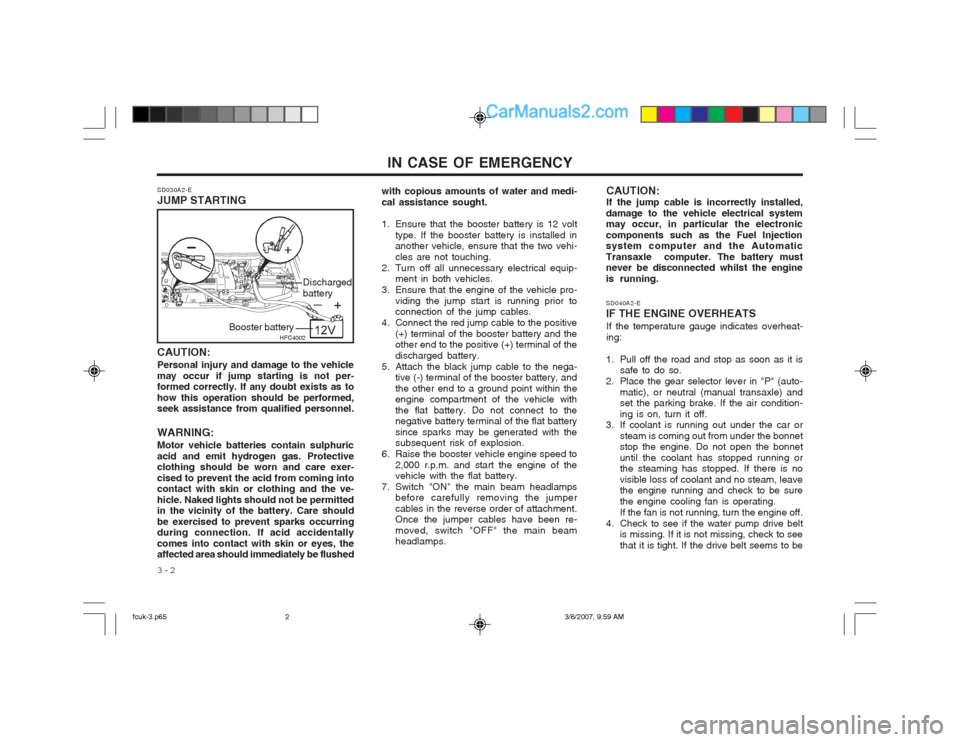
SD030A2-E JUMP STARTING
with copious amounts of water and medi- cal assistance sought.
1. Ensure that the booster battery is 12 volt
type. If the booster battery is installed in another vehicle, ensure that the two vehi- cles are not touching.
2. Turn off all unnecessary electrical equip- ment in both vehicles.
3. Ensure that the engine of the vehicle pro- viding the jump start is running prior to connection of the jump cables.
4. Connect the red jump cable to the positive (+) terminal of the booster battery and theother end to the positive (+) terminal of the discharged battery.
5. Attach the black jump cable to the nega- tive (-) terminal of the booster battery, andthe other end to a ground point within the engine compartment of the vehicle with the flat battery. Do not connect to the negative battery terminal of the flat battery since sparks may be generated with the subsequent risk of explosion.
6. Raise the booster vehicle engine speed to 2,000 r.p.m. and start the engine of thevehicle with the flat battery.
7. Switch "ON" the main beam headlamps before carefully removing the jumper cables in the reverse order of attachment. Once the jumper cables have been re- moved, switch "OFF" the main beam headlamps.
HFC4002
Booster battery Discharged battery
fcuk-3.p65
3/6/2007, 9:59 AM
2
Page 263 of 317
IN CASE OF EMERGENCY
3-4
SD070A1-E
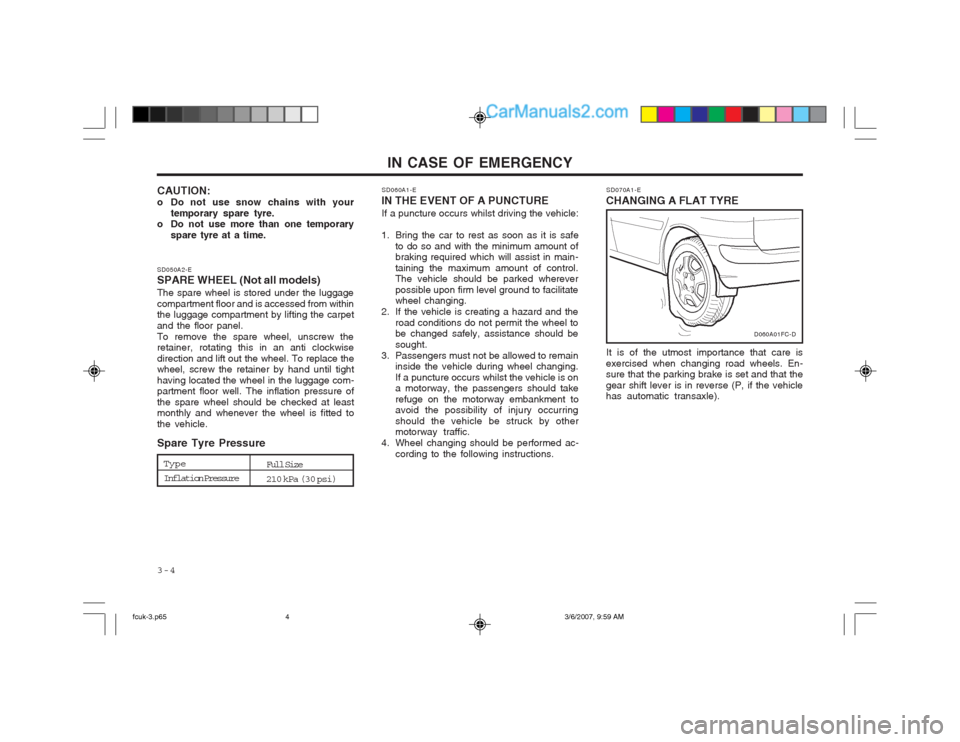
CHANGING A FLAT TYRE
It is of the utmost importance that care is
exercised when changing road wheels. En- sure that the parking brake is set and that the gear shift lever is in reverse (P, if the vehicle has automatic transaxle).
D060A01FC-D
SD050A2-E SPARE WHEEL (Not all models) The spare wheel is stored under the luggage compartment floor and is accessed from within the luggage compartment by lifting the carpet and the floor panel.To remove the spare wheel, unscrew the retainer, rotating this in an anti clockwise direction and lift out the wheel. To replace the wheel, screw the retainer by hand until tight having located the wheel in the luggage com- partment floor well. The inflation pressure of the spare wheel should be checked at least monthly and whenever the wheel is fitted to the vehicle. Spare Tyre Pressure
CAUTION:
o Do not use snow chains with your
temporary spare tyre.
o Do not use more than one temporary
spare tyre at a time. SD060A1-E
IN THE EVENT OF A PUNCTURE If a puncture occurs whilst driving the vehicle:
1. Bring the car to rest as soon as it is safe to do so and with the minimum amount of braking required which will assist in main- taining the maximum amount of control. The vehicle should be parked wherever possible upon firm level ground to facilitate wheel changing.
2. If the vehicle is creating a hazard and the road conditions do not permit the wheel tobe changed safely, assistance should be sought.
3. Passengers must not be allowed to remain inside the vehicle during wheel changing.If a puncture occurs whilst the vehicle is on a motorway, the passengers should take refuge on the motorway embankment to avoid the possibility of injury occurring should the vehicle be struck by other motorway traffic.
4. Wheel changing should be performed ac- cording to the following instructions.
Type
Inflation Pressure Full Size
210 kPa (30 psi)
fcuk-3.p65
3/6/2007, 9:59 AM
4
Page 267 of 317
IN CASE OF EMERGENCY
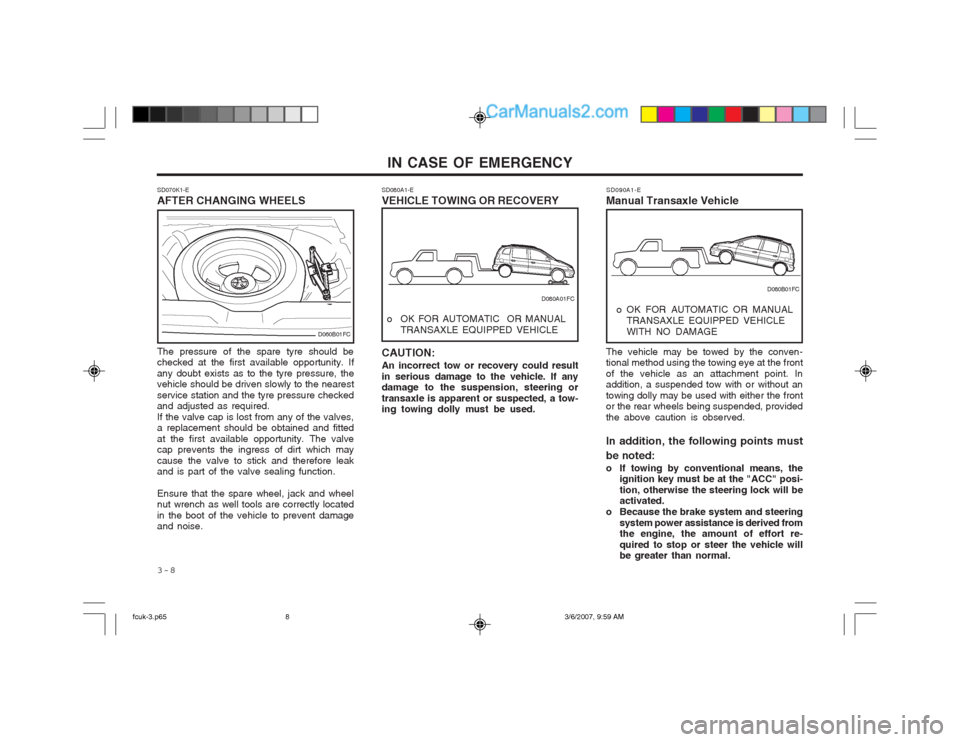
3-8 The vehicle may be towed by the conven- tional method using the towing eye at the front of the vehicle as an attachment point. In addition, a suspended tow with or without an towing dolly may be used with either the front or the rear wheels being suspended, provided the above caution is observed. In addition, the following points must be noted:
o If towing by conventional means, the
ignition key must be at the "ACC" posi- tion, otherwise the steering lock will be activated.
o Because the brake system and steering system power assistance is derived fromthe engine, the amount of effort re- quired to stop or steer the vehicle will be greater than normal.
SD090A1-E
Manual Transaxle Vehicle
o OK FOR AUTOMATIC OR MANUAL TRANSAXLE EQUIPPED VEHICLE WITH NO DAMAGE D080B01FC
SD070K1-E AFTER CHANGING WHEELS
SD080A1-EVEHICLE TOWING OR RECOVERY
The pressure of the spare tyre should be checked at the first available opportunity. If any doubt exists as to the tyre pressure, the vehicle should be driven slowly to the nearest service station and the tyre pressure checked and adjusted as required. If the valve cap is lost from any of the valves, a replacement should be obtained and fitted at the first available opportunity. The valve cap prevents the ingress of dirt which may cause the valve to stick and therefore leak and is part of the valve sealing function. Ensure that the spare wheel, jack and wheel nut wrench as well tools are correctly located in the boot of the vehicle to prevent damage and noise. CAUTION: An incorrect tow or recovery could result in serious damage to the vehicle. If any damage to the suspension, steering or transaxle is apparent or suspected, a tow- ing towing dolly must be used.
D060B01FC
o OK FOR AUTOMATIC OR MANUAL
TRANSAXLE EQUIPPED VEHICLE D080A01FC
fcuk-3.p65
3/6/2007, 9:59 AM
8
Page 270 of 317
APPEARANCE CARE
4-2
Plastic wheel covers should be cleaned using a sponge and water. Cast alloy wheels should be cleaned using a mild soap or neutral deter- gent. Abrasive compounds must not be used since in the event of these damaging the lac- quer coating, oxidization of the aluminium wheel will occur, spoiling the appearance. The use of an a toothbrush will facilitate cleaning between the wheel "spokes".
ensure that accidental spillages are immediately flushed with water. Do not use abrasive cleaning materials which may damage the bumpers. Avoid subjecting the bumpers to high tempera- tures such as may be encountered in high bake paint ovens.
SE040B1-E STAIN/SPOT REMOVAL Should tree sap, dead insects or tar prove to be difficult to remove from the paint film, turpentine or a proprietary paint cutting compound may be used. Ensure that the area to be cleaned is not rubbed intensively to prevent breaking through the colour coat and exposing the under coat. SE040C1-E POLISHINGThe exterior paint work should be polished with a proprietary wax polish when water no longer collects in bead form on the paint work. The instructions of the product manufacturer should be adhered to. SE040E1-E BUMPER MAINTENANCEThe special material from which the bumpers are manufactured warrants special attention to pre- serve the appearance of the bumpers. Avoid contact with battery electrolyte or brake fluid and SE040F1-E ACCIDENT REPAIRSIn the event of the body work sustaining damage, the following points should be noted prior to repairs being undertaken. If body panels are replaced or repaired, anti corrosion treatment must be applied to the repair area. The product used must be compatible withthose used in manufacture. It is recommended that repairs are entrusted to a Hyundai dealer to ensure that replacement parts used are of the same high quality as those used in manufacture of the vehicle and that the correct repair methods and materials will ensure adequate levels of corrosion protection and the continued validity of the Anti Perforation Warranty. SE050A1-E INTERIORDuring the winter period, it is possible that the passenger compartment flooring may become wet from damp footwear or quantities of snow adhering to footwear. The carpet should not be allowed to remain in this condition since the carpet may begin to create musty smells and will
SE050D1-E SEAT BELTS Seat belts should be cleaned only with a mild soap solution. Strong detergents, solvens or bleaches may damage the belt webbing and therefore reduce the effectiveness of the belt. Belts which display signs of fraying, wear of cut should be replaced. SE050E1-E WINDOWS A proprietary glass cleaner should be used to clean the inside of the windows. However, the rear heated windshield must only be cleaned using a light horizontal cleaning action. Care should be exercised to avoid the use of abrasive cleaners or contact with items of jewellery which may damage the heating elements.
promote corrosion of the floor pan in addition tothe carpet and under felt beginning to rot. SE050C1-E INTERIOR VALETING The soft trim and carpets should be maintained with the regular use of a vacuum cleaner. Heavy soiling should be removed with a dry cleaning agent recommended for this purpose following the instructions of the product manufacturer. Paint thinner, solvents or other such cleaning materials should not be used since damage to the upholstery may result.
fcuk-4.p65
3/6/2007, 10:00 AM
2
Page 271 of 317
VEHICLE MAINTENANCE REQUIREMENTS 5-1
SF020A1-E
MAINTENANCE AND SERVICING REQUIREMENTS To ensure the continued reliability and safety
of the vehicle, certain routine maintenance operations are required at specific mileage ortime intervals.
It is the responsibility of the vehicle owner to
ensure that the maintenance schedules shownin both this Owners Manual and the Warrantyand Service Passport are adhered to.
The new vehicle warranty may be invalidated
if the routine maintenance operations are notperformed in line with the recommendationsoutlined and the safety and durability of thevehicle adversely affected.
It is recommended that all maintenance op-
erations with the exception of the daily oper-ating checks are entrusted to a Hyundaidealer to ensure that the latest repair and maintenance procedures and specializedservicing tools are employed. In addition, theuse of genuine Hyundai replacement parts willensure that the vehicle safety and perfor-mance will not be compromised. NOTE:
The inspection and testing of certain elec-
tronic fuel injection/engine management and automatic transmission control sys-tems require specialised electronic equip-ment specifically designed for Hyundaivehicles. The use of general purpose elec-trical test equipment may result in dam-age to the control unit microprocessors.
SF000A1-E
5. VEHICLE
MAINTENANCE REQUIREMENTS
SF020C1-E
Specified Scheduled Procedures The Specified scheduled procedures are listed
in the maintenance charts beginning at page 5-2. The operations specified must be per-formed at the time or mileage intervals shownirrespective of whether the mileage intervalhas been reached before the specified timeinterval.
Certain lubricants and components degrade
with both time and mileage (e.g. engine oil andbrake fluid) and therefore it is not permissableto base the maintenance schedule upon mile-age alone. It is strongly recommended thatthe maintenance operations are performed bythe factory-trained or distributor-trained tech-nicians at your Hyundai dealer because of the need for specialized knowledge and toolingand to ensure that no possibility of invalidatingthe manufacturers warranty exists.
The maintenance schedules relate to ve-
hicles operated under normal conditions, ve-hicles which are operated under adverseconditions will require more frequent mainte-nance which is described at page 5-5.
SF030B1-E
SERVICE HISTORY It is important that all scheduled maintenance
services are recorded in the warranty andservice passport to ensure that proof of main-tenance is available when warranty service isrequired.
5
fcuk-5.p65 3/6/2007, 10:01 AM
1
Page 274 of 317
VEHICLE MAINTENANCE REQUIREMENTS
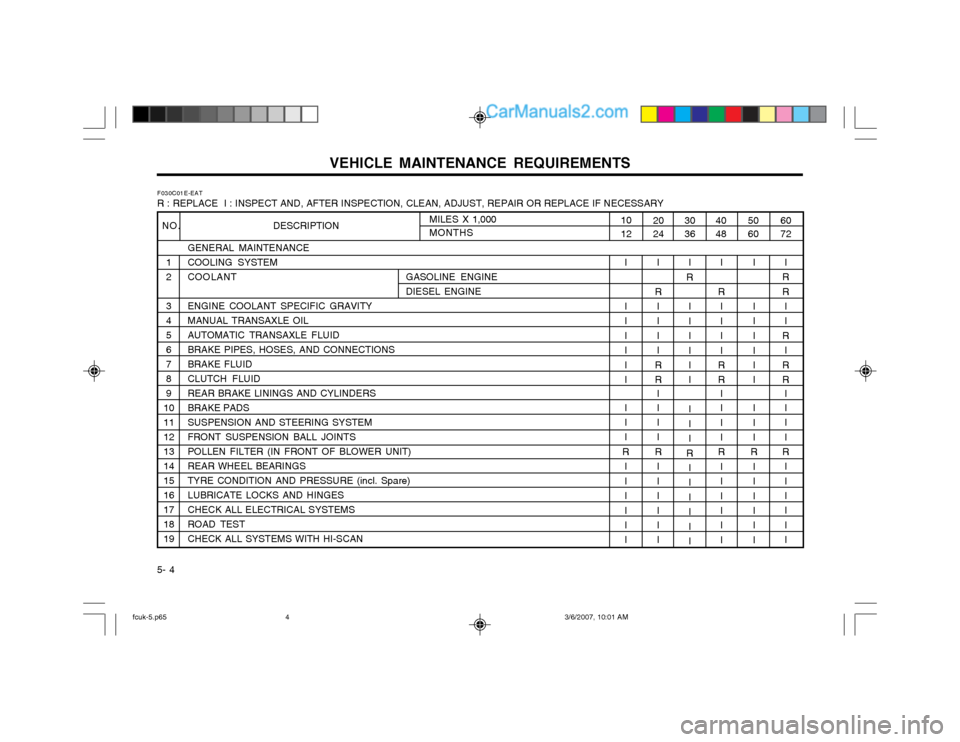
5- 4 F030C01E-EAT
R : REPLACE I : INSPECT AND, AFTER INSPECTION, CLEAN, ADJUST, REPAIR OR REPLACE IF NECESSARY
GENERAL MAINTENANCE COOLING SYSTEMCOOLANT GASOLINE ENGINEDIESEL ENGINE
ENGINE COOLANT SPECIFIC GRAVITYMANUAL TRANSAXLE OILAUTOMATIC TRANSAXLE FLUIDBRAKE PIPES, HOSES, AND CONNECTIONSBRAKE FLUIDCLUTCH FLUIDREAR BRAKE LININGS AND CYLINDERSBRAKE PADSSUSPENSION AND STEERING SYSTEMFRONT SUSPENSION BALL JOINTSPOLLEN FILTER (IN FRONT OF BLOWER UNIT)REAR WHEEL BEARINGSTYRE CONDITION AND PRESSURE (incl. Spare)LUBRICATE LOCKS AND HINGESCHECK ALL ELECTRICAL SYSTEMSROAD TESTCHECK ALL SYSTEMS WITH HI-SCAN
60 72
50 60
4048
I
R R
I I
R I
R R I I II
R
IIIII I
I I IIII I I I I
R I III I I
I
R IIII
R R I I I I
R I III I I
30 36
2024
I
R
I IIII I I II
R IIIIII
I
R IIII
R R I I I I
R I III I I
10 12
I I IIII I I I I
R I III I I
MILES X 1,000 MONTHS
NO. DESCRIPTION
1 2 3 456789
10111213141516171819
fcuk-5.p65 3/6/2007, 10:01 AM
4
Page 275 of 317
VEHICLE MAINTENANCE REQUIREMENTS 5-5
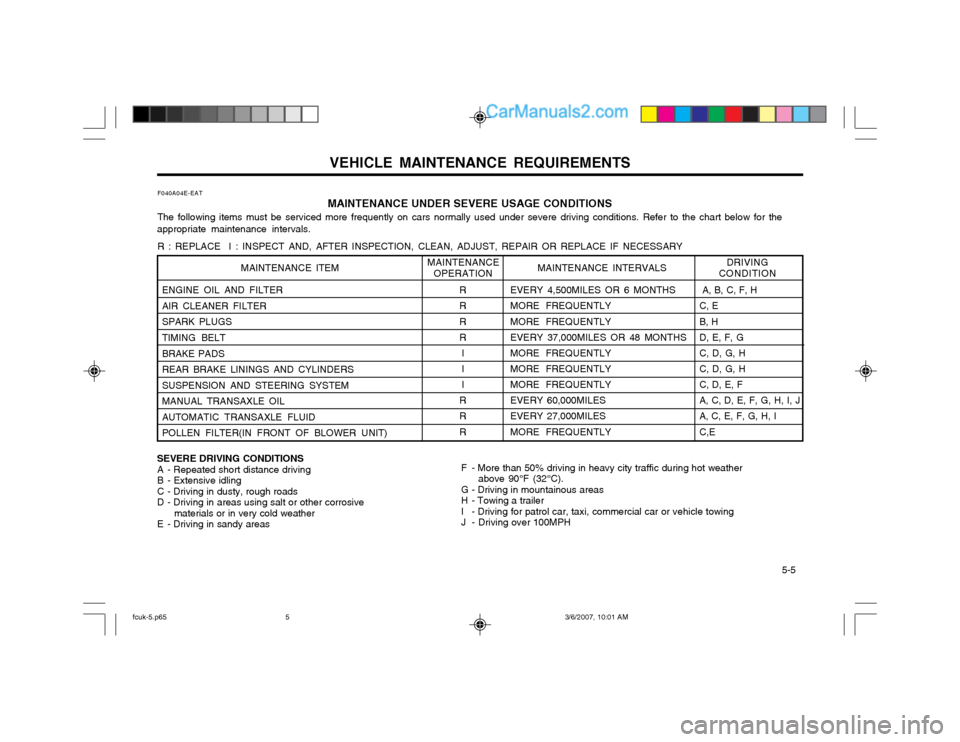
MAINTENANCE UNDER SEVERE USAGE CONDITIONS
The following items must be serviced more frequently on cars normally used under severe driving conditions. Refer to the chart below for the
appropriate maintenance intervals.
R : REPLACE I : INSPECT AND, AFTER INSPECTION, CLEAN, ADJUST, REPAIR OR REPLACE IF NECESSARY
F040A04E-EAT
SEVERE DRIVING CONDITIONS
A - Repeated short distance driving
B - Extensive idling
C - Driving in dusty, rough roads
D - Driving in areas using salt or other corrosive materials or in very cold weather
E - Driving in sandy areas ENGINE OIL AND FILTER AIR CLEANER FILTERSPARK PLUGSTIMING BELT BRAKE PADS REAR BRAKE LININGS AND CYLINDERSSUSPENSION AND STEERING SYSTEMMANUAL TRANSAXLE OILAUTOMATIC TRANSAXLE FLUIDPOLLEN FILTER(IN FRONT OF BLOWER UNIT)
EVERY 4,500MILES OR 6 MONTHS MORE FREQUENTLY MORE FREQUENTLY EVERY 37,000MILES OR 48 MONTHSMORE FREQUENTLYMORE FREQUENTLY MORE FREQUENTLY EVERY 60,000MILESEVERY 27,000MILES MORE FREQUENTLY
MAINTENANCE
OPERATIONMAINTENANCE ITEM
R R R RII I
R R R A, B, C, F, H C, E B, H D, E, F, GC, D, G, HC, D, G, H C, D, E, F A, C, D, E, F, G, H, I, JA, C, E, F, G, H, I C,E
MAINTENANCE INTERVALS
DRIVING
CONDITION
F - More than 50% driving in heavy city traffic during hot weather above 90°F (32°C).
G - Driving in mountainous areas
H - Towing a trailer
I - Driving for patrol car, taxi, commercial car or vehicle towing
J - Driving over 100MPH
fcuk-5.p65 3/6/2007, 10:01 AM
5
Page 277 of 317
VEHICLE MAINTENANCE REQUIREMENTS 5-7
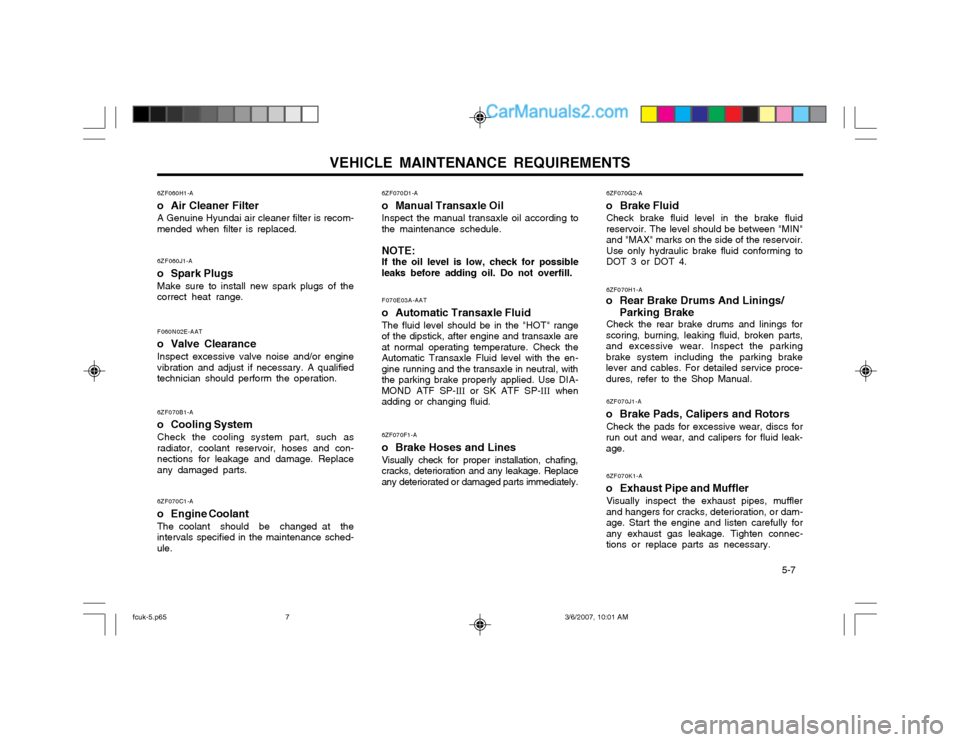
6ZF070D1-A
o Manual Transaxle Oil Inspect the manual transaxle oil according to
the maintenance schedule. NOTE: If the oil level is low, check for possible
leaks before adding oil. Do not overfill.
6ZF070H1-A
o Rear Brake Drums And Linings/ Parking Brake
Check the rear brake drums and linings for
scoring, burning, leaking fluid, broken parts, and excessive wear. Inspect the parkingbrake system including the parking brakelever and cables. For detailed service proce-dures, refer to the Shop Manual.
6ZF070J1-A
o Brake Pads, Calipers and Rotors Check the pads for excessive wear, discs for
run out and wear, and calipers for fluid leak-age.
6ZF070K1-A
o Exhaust Pipe and Muffler Visually inspect the exhaust pipes, mufflerand hangers for cracks, deterioration, or dam-age. Start the engine and listen carefully forany exhaust gas leakage. Tighten connec-tions or replace parts as necessary.
F070E03A-AAT
o Automatic Transaxle Fluid The fluid level should be in the "HOT" range
of the dipstick, after engine and transaxle areat normal operating temperature. Check theAutomatic Transaxle Fluid level with the en-gine running and the transaxle in neutral, withthe parking brake properly applied. Use DIA-MOND ATF SP- III or SK ATF SP- III when
adding or changing fluid. 6ZF070F1-A
o Brake Hoses and Lines Visually check for proper installation, chafing, cracks, deterioration and any leakage. Replaceany deteriorated or damaged parts immediately.
6ZF060H1-A
o Air Cleaner Filter A Genuine Hyundai air cleaner filter is recom-
mended when filter is replaced.
6ZF060J1-A
o Spark Plugs Make sure to install new spark plugs of the
correct heat range.
6ZF070B1-A
o Cooling System Check the cooling system part, such asradiator, coolant reservoir, hoses and con-nections for leakage and damage. Replaceany damaged parts. 6ZF070G2-A
o Brake Fluid Check brake fluid level in the brake fluidreservoir. The level should be between "MIN"and "MAX" marks on the side of the reservoir.Use only hydraulic brake fluid conforming toDOT 3 or DOT 4.
6ZF070C1-A
o Engine Coolant The coolant should be changed at theintervals specified in the maintenance sched-ule.
F060N02E-AAT
o Valve Clearance Inspect excessive valve noise and/or enginevibration and adjust if necessary. A qualifiedtechnician should perform the operation.
fcuk-5.p65 3/6/2007, 10:01 AM
7