change wheel Hyundai Matrix 2005 User Guide
[x] Cancel search | Manufacturer: HYUNDAI, Model Year: 2005, Model line: Matrix, Model: Hyundai Matrix 2005Pages: 407, PDF Size: 10.31 MB
Page 305 of 407

2 DRIVING YOUR HYUNDAI
16DRIVING FOR ECONOMY
C140A01A-GAT You can save fuel and get more kilo- meters from your car if you follow these suggestions:
o Drive smoothly. Accelerate at a moderate rate. Don't make "jack- rabbit" starts or full-throttle shiftsand maintain a steady cruising speed. Don't race between stop- lights. Try to adjust your speed tothat of the other traffic so you don't have to change speeds unneces- sarily. Avoid heavy traffic wheneverpossible. Always maintain a safe distance from other vehicles so you can avoidunnecessary braking. This also re- duces brake wear.
o Drive at a moderate speed. The faster you drive, the more fuel yourcar uses. Driving at a moderate speed, especially on the highway, isone of the most effective ways to reduce fuel consumption.
o Don't "ride" the brake or clutch pedal. This can increase fuel consumptionand also increase wear on these components. In addition, driving with
gear (manual transaxle). If your caris facing downhill, turn the frontwheels into the curb to help keep the car from rolling. If your car is facing uphill, turn the front wheels awayfrom the curb to help keep the car from rolling. If there is no curb or if it is requiredby other conditions to keep the car from rolling, block the wheels.
o Under some conditions your park- ing brake can freeze in the engagedposition. This is most likely to hap- pen when there is an accumulationof snow or ice around or near the rear brakes or if the brakes are wet. If there is a risk that the parkingbrake may freeze, apply it only tem- porarily while you put the gear se- lector lever in "P" (automatic) or infirst or reverse gear (manual transaxle) and block the rear wheels so the car cannot roll. Then releasethe parking brake.
o Do not hold the vehicle on the up-
grade with the accelerator pedal.This can cause the transmission to overheat. Always use the brake pedal or parking brake.
o Don't coast down hills with the car
out of gear. This is extremely haz-ardous. Keep the car in gear at all times, use the brakes to slow down, then shift to a lower gear so thatengine braking will help you main- tain a safe speed.
o Don't "ride" the brake pedal. Rest- ing your foot on the brake pedalwhile driving can be dangerous be- cause it can result in the brakesoverheating and losing their effec- tiveness. It also increases the wear of the brake components.
o If a tire goes flat while you are driving, apply the brakes gently andkeep the car pointed straight aheadwhile you slow down. When you are moving slowly enough for it to be safe to do so, pull off the road andstop in a safe place.
o If your car is equipped with an auto-
matic transaxle, don't let your carcreep forward. To avoid creeping forward, keep your foot on the brake pedal when the car is stopped.
o Use caution when parking on a hill. Engage the parking brake and placethe gear selector lever in "P" (auto-matic transaxle) or in first or reverse
Page 308 of 407

2
DRIVING YOUR HYUNDAI
19
C160H01A-AAT Use Approved Anti-Freeze in Window Washer System To keep the water in the window washer system from freezing, add an approvedanti-freeze solution in accordance with instructions on the container. Window washer anti-freeze is available fromHyundai dealers and most auto parts outlets. Do not use engine coolant or other types of anti-freeze as thesemay damage the finish.
C160G02A-GAT To Keep Locks from Freezing To keep the locks from freezing, squirt an approved de-icer fluid or glycerineinto the key opening. If a lock is cov- ered with ice, squirt it with an approved de-icing fluid to remove the ice. If thelock is frozen internally, you may be able to thaw it out by using a heated key. Handle the heated key with careto avoid injury. NOTE: The proper temperature for using the immobilizer key is from -40°C (-40°F) to 80°C(176°F). If you heat the immobilizer key over 80°C toopen the frozen lock, it may cause damage to the transponder in its head.
C160D01A-AAT Check Battery and Cables Winter puts additional burdens on the battery system. Visually inspect thebattery and cables as described in Section 6. The level of charge in your battery can be checked by your Hyundaidealer or a service station.
C160F01A-AAT Check Spark Plugs and Ignition System Inspect your spark plugs as described in Section 6 and replace them if neces-sary. Also check all ignition wiring and components to be sure they are not cracked, worn or damaged in any way.
C160E01A-AAT Change to "Winter Weight" Oil if Necessary In some climates it is recommended that a lower viscosity "winter weight" oil be used during cold weather. See Section 9 for recommendations. If youaren't sure what weight oil you should use, consult your Hyundai dealer.
C160I01A-AAT Don't Let Your Parking Brake Freeze Under some conditions your parking brake can freeze in the engaged posi- tion. This is most likely to happenwhen there is an accumulation of snow or ice around or near the rear brakes or if the brakes are wet. If there is a riskthe parking brake may freeze, apply it only temporarily while you put the gear selector lever in "P" (automatic) or infirst or reverse gear (manual transaxle) and block the rear wheels so the car cannot roll. Then release the parkingbrake.
Page 313 of 407

2 DRIVING YOUR HYUNDAI
24
CAUTION:
If overheating should occur when towing, (temperature gauge reads near red zone), taking the following action may reduce or eliminate theproblem.
1. Turn off the air conditioner.
2. Reduce highway speed.
3. Select a lower gear when going uphill.
4. While in stop and go traffic, place the gear selection in park or neu- tral and idle the engine at a higherspeed.
!
8. When parking your car and trailer,
especially on a hill, be sure to follow all the normal precautions. Turn your front wheel into the curb, set the parking brake firmly, and putthe transaxle in 1st or Reverse (manual) or Park (automatic). In addition, place wheel chocks ateach of the trailer's tires.
9. If the trailer has electric brakes,
start your vehicle and trailer mov-ing, and then apply the trailer brake controller by hand to be sure the brakes are working. This lets youcheck your electrical connection at the same time.
10.During your trip, check occasion- ally to be sure that the load issecure, and that the lights and any trailer brakes are still working.
11.Avoid jerky starts, sudden accel- eration or sudden stops.
12.Avoid sharp turns and rapid lane changes.
13.Avoid holding the brake pedal down
too long or too frequently. This couldcause the brakes to overheat, re- sulting in reduced braking efficiency. 14.When going down a hill, shift into a
lower gear and use the engine brak- ing effect. When ascending a long grade, downshift the transaxle to a lowergear and reduce speed to reduce chances of engine overloading and/ or overheating.
15.If you have to stop while going uphill, do not hold the vehicle inplace by pressing on the accelera-tor. This can cause the automatic transaxle to overheat. Use the park- ing brake or footbrake.
NOTE: When towing check transaxle fluid more frequently.
Page 321 of 407
3 WHAT TO DO IN AN EMERGENCY
8
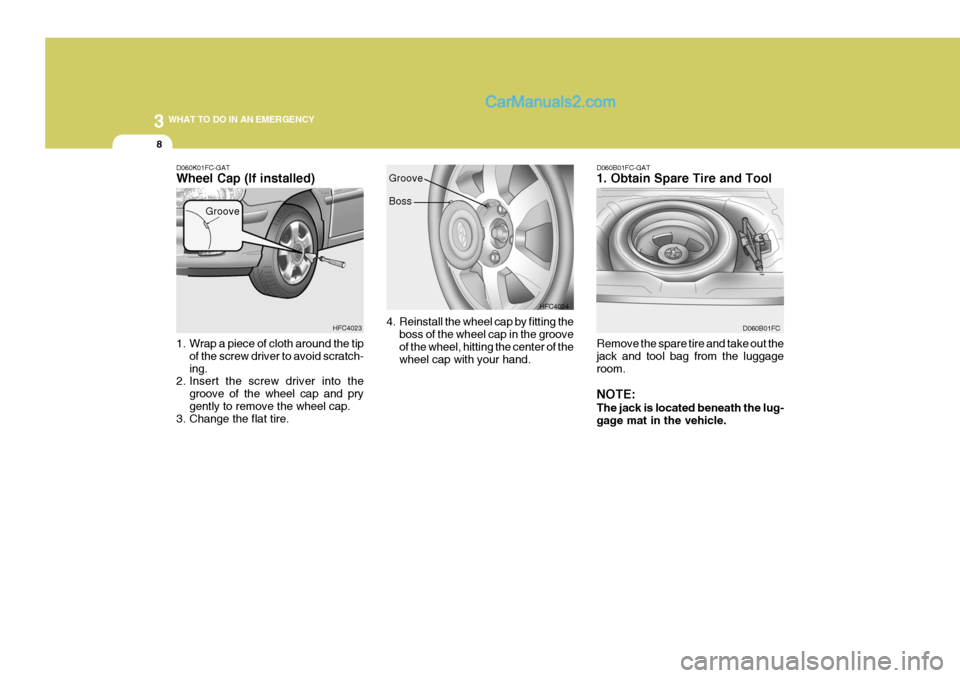
1. Wrap a piece of cloth around the tip
of the screw driver to avoid scratch- ing.
2. Insert the screw driver into the
groove of the wheel cap and prygently to remove the wheel cap.
3. Change the flat tire.
D060K01FC-GAT Wheel Cap (If installed)
HFC4023
Groove
4. Reinstall the wheel cap by fitting theboss of the wheel cap in the groove of the wheel, hitting the center of the wheel cap with your hand. HFC4024D060B01FC-GAT 1. Obtain Spare Tire and Tool Remove the spare tire and take out the jack and tool bag from the luggageroom. NOTE: The jack is located beneath the lug- gage mat in the vehicle.
D060B01FC
Boss
Groove
Page 325 of 407

3 WHAT TO DO IN AN EMERGENCY
12
air may leak from the tire. If you lose a valve cap, buy another and install it assoon as possible. After you have changed wheels, al- ways secure the flat tire in its place inthe luggage room and return the jack and tools to their proper storage loca- tions.
Wheel nut tightening torque: Steel wheel & aluminium alloy wheel: 900-1,100 kg.cm (65-80 lb.ft)
D060J01FC-GAT After Changing Wheels If you have a tire gauge, remove the valve cap and check the air pressure. If the pressure is lower than recom-mended, drive slowly to the nearest service station and inflate to the cor- rect pressure. If it is too high, adjust ituntil it is correct. Always reinstall the valve cap after checking or adjusting tire pressure. If the cap is not replaced, D060B01FC
IF YOUR VEHICLE MUST BE TOWED
D080A01O-GAT If your vehicle has to be towed, it should be done by your Hyundai dealeror a commercial tow truck service. This will help assure that your vehicle is not damaged in towing. Also, profes-sionals are generally aware of local laws governing towing. In any case, rather than risk damage to your car, itis suggested that you show this infor- mation to the tow truck operator. Be sure that a safety chain system is usedand that all local laws are observed. It is recommended that your vehicle be towed with a wheel lift and dollies orflatbed equipment with all the wheels off the ground.
! CAUTION:
o Your vehicle can be damaged if towed incorrectly!
o Be sure the transaxle is in neu-
tral.
o When the engine will not start, be
sure the steering is unlocked by placing the key in the "ACC" po- sition.
Page 372 of 407

6
DO-IT-YOURSELF MAINTENANCE
27CHECKING THE FREEPLAY
G160A01A-GAT
Clutch pedal
G160A01E
6 ~ 13 mm (0.24 ~ 0.51 in.)
With the engine off, press lightly onthe clutch pedal until you feel a change in resistance. This is the clutch pedalfreeplay. The freeplay should be within the limits specified in the illustration. If it is not, have it inspected by yourHyundai dealer and adjusted or re- paired if necessary.
G150A01A-GAT
Steering wheel
G150A01FC
To check the steering wheel freeplay,
stop the car with the wheels pointed straight ahead and gently move the steering wheel back and forth. Use very light finger pressure and be sen-sitive to changes in resistance that mark the limits of the freeplay. If the freeplay is greater than specified, haveit inspected by your Hyundai dealer and adjusted or repaired if neces- sary. 30 mm (1.18 in.)
3. Replace the air conditioner filter with a new one.
4. Installation is the reverse order of disassembly.
CAUTION:
Be sure to install the air condi- tioner filter in the direction of thearrow sign. Otherwise, it may cause noise or deterioration.
! KQNA020B
Page 397 of 407
8CONSUMER INFORMATION
6SPARE TIRE AND TOOLS
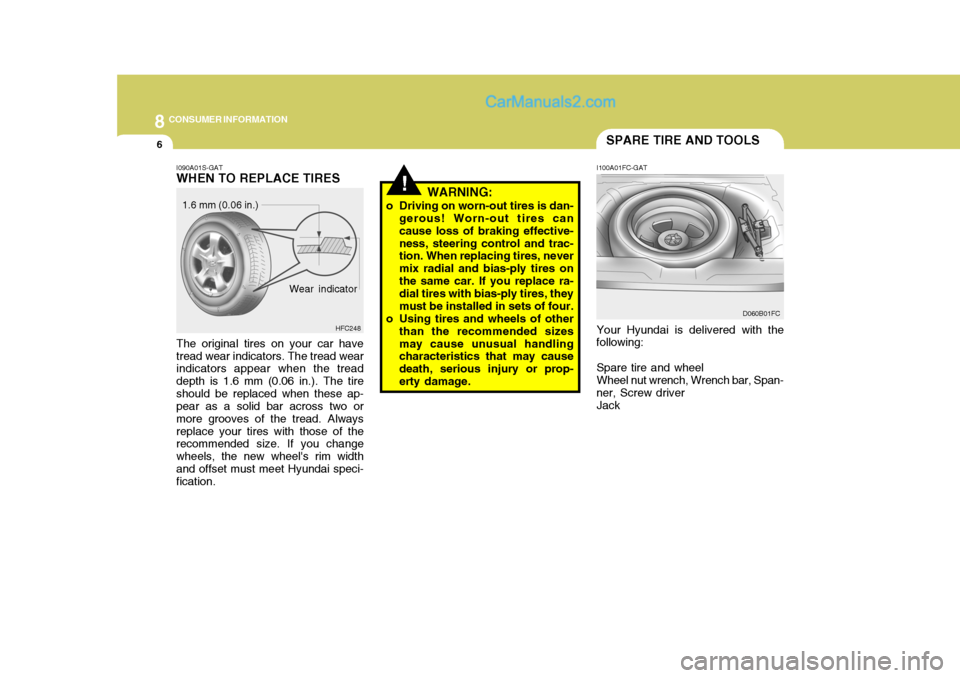
I100A01FC-GAT Your Hyundai is delivered with the
following:
Spare tire and wheel Wheel nut wrench, Wrench bar, Span-
ner, Screw driver
Jack D060B01FC
!WARNING:
o Driving on worn-out tires is dan- gerous! Worn-out tires can cause loss of braking effective-ness, steering control and trac- tion. When replacing tires, never mix radial and bias-ply tires onthe same car. If you replace ra- dial tires with bias-ply tires, they must be installed in sets of four.
o Using tires and wheels of other than the recommended sizesmay cause unusual handling characteristics that may cause death, serious injury or prop-erty damage.
I090A01S-GAT WHEN TO REPLACE TIRES
1.6 mm (0.06 in.)
The original tires on your car have tread wear indicators. The tread wear indicators appear when the tread depth is 1.6 mm (0.06 in.). The tireshould be replaced when these ap- pear as a solid bar across two or more grooves of the tread. Alwaysreplace your tires with those of the recommended size. If you change wheels, the new wheel's rim widthand offset must meet Hyundai speci- fication. Wear indicator
HFC248