radiator cap Hyundai Matrix 2005 User Guide
[x] Cancel search | Manufacturer: HYUNDAI, Model Year: 2005, Model line: Matrix, Model: Hyundai Matrix 2005Pages: 407, PDF Size: 10.31 MB
Page 240 of 407

1FEATURES OF YOUR HYUNDAI
76
!WARNING:
Fuel vapors are dangerous. Before refueling, always stop the engineand never allow sparks or open flames near the filler area. If you need to replace the filler cap, use agenuine Hyundai replacement part. If you open the fuel filler cap during high ambient temperatures, a slight"pressure sound" may be heard. This is normal and not a cause for concern.Whenever you open the fuel filler
cap, turn it slowly. HFC2016
REMOTE FUEL-FILLER LID RELEASE
B560A02A-AAT The fuel-filler lid may be opened from inside the vehicle by pulling up on the fuel-filler lid opener located on the frontfloor area on the left side of the car. NOTE: If the fuel-filler lid will not open because ice has formed around it, tap lightly or push on the lid to break the ice and release the lid. Donot pry on the lid. If necessary, spray around the lid with an ap- proved de-icer fluid (do not useradiator anti-freeze) or move the vehicle to a warm place and allow the ice to melt. HFC2015
!WARNING:
o Always double check to be sure that the hood is firmly latched before driving away. If it is notlatched, the hood could open while the vehicle is being driven, causing a total loss of visibility,which might result in an acci- dent.
o The support rod must be inserted completely into the hole providedin the hood whenever you in- spect the engine compartment.This will prevent the hood from falling and possibly injuring you.
o Do not move the vehicle with the hood in the raised position, asvision is obstructed and the hood could fall or be damaged.
Page 318 of 407

3
WHAT TO DO IN AN EMERGENCY
5
!
!
!
check for coolant leaking from the radiator, hoses or under the car. (Ifthe air conditioning had been in use, it is normal for cold water to be draining from it when you stop).
WARNING (Diesel only):
Never work on injection system with engine running or within 30 sec- onds after shutting off engine. Highpressure pump, rail, injectors and high pressure pipes are subject to high pressure even after the enginestopped. The fuel jet produced by fuel leaks may cause serious in- jury, if it touch the body. Peopleusing pacemakers should not move than 30cm closer to the ECU or wiring harness within the engine 5. If the water pump drive belt is bro-
ken or coolant is leaking out, stopthe engine immediately and call the nearest Hyundai dealer for assis- tance. CAUTION:
Serious loss of engine coolant indi- cates there is a leak in the cooling system and this should be checkedas soon as possible by a Hyundai dealer.
room while engine is running, since the high currents in the CommonRail system produce considerable magnetic fields.
6. If you cannot find the cause of the
overheating, wait until the engine temperature has returned to nor- mal. Then, if the engine coolant hasbeen lost, carefully add coolant to the reservoir (page 6-14) to bring the fluid level in the reservoir up tothe halfway mark.
WARNING:
While the engine is running, keephair, hands, and clothing away from moving parts such as the fan and drive belts to prevent injury.
WARNING:
Do not remove the radiator cap whenthe engine is hot. This can allowcoolant to be blown out of the open- ing and cause serious burns. 7. Proceed with caution, keeping alert
for further signs of overheating. If overheating happens again, call a Hyundai dealer for assistance.
!
Page 343 of 407

5
VEHICLE MAINTENANCE REQUIREMENTS
9
F060H01A-AAT o Air Cleaner Filter A Genuine Hyundai air cleaner filter is recommended when the filter is re- placed. F060J01A-AAT o Spark Plugs Make sure to install new spark plugs of the correct heat range. F070B01A-GAT o Cooling System Check the cooling system part, such as radiator, coolant reservoir, hosesand connections for leakage and dam- age. Replace any damaged parts.
F060E01A-AAT
o Timing Belt
Inspect all parts related to the timing belt for damage and deformation. Re- place any damaged parts immediately. F060G01A-AAT
o Vapor Hose and Fuel Filler Cap
The vapor hose and fuel filler cap should be inspected at those intervals specified in the maintenance sched-ule. Make sure that a new vapor hose or fuel filler cap is correctly replaced. F060F01A-AAT
o Vacuum, Crankcase
Ventilation Hoses
Inspect the surface of hoses for evi-
dence of heat and/or mechanical dam-age. Hard and brittle rubber, cracking, tears, cuts, abrasions, and excessiveswelling indicate deterioration. Particu- lar attention should be paid to examin- ing those hose surfaces nearest tohigh heat sources, such as the ex- haust manifold.
Inspect the hose routing to assure that
the hoses do not come in contact withany heat source, sharp edges or mov- ing component which might cause heatdamage or mechanical wear. Inspect all hose connections, such as clamps and couplings, to make sure they aresecure, and that no leaks are present. Hoses should be replaced immedi- ately if there is any evidence of dete-rioration or damage. F060N02E-GAT
o Valve Clearance
Inspect excessive valve noise and/or engine vibration and adjust if neces- sary. A qualified technician shouldperform the operation.
Page 347 of 407
6 DO-IT-YOURSELF MAINTENANCE
2
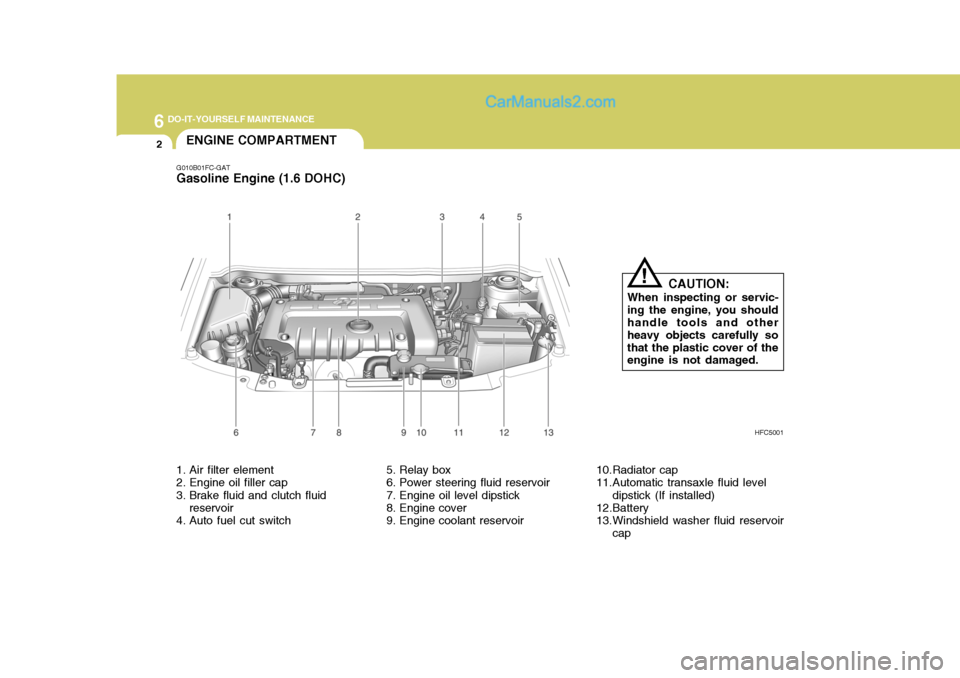
1. Air filter element
2. Engine oil filler cap
3. Brake fluid and clutch fluid
reservoir
4. Auto fuel cut switch 5. Relay box
6. Power steering fluid reservoir
7. Engine oil level dipstick
8. Engine cover
9. Engine coolant reservoir10.Radiator cap
11.Automatic transaxle fluid level
dipstick (If installed)
12.Battery
13.Windshield washer fluid reservoir cap HFC5001
G010B01FC-GAT Gasoline Engine (1.6 DOHC)
CAUTION:
When inspecting or servic-
ing the engine, you should handle tools and other heavy objects carefully sothat the plastic cover of the engine is not damaged.
!
ENGINE COMPARTMENT
Page 348 of 407
6
DO-IT-YOURSELF MAINTENANCE
3
G010C01FC-GAT
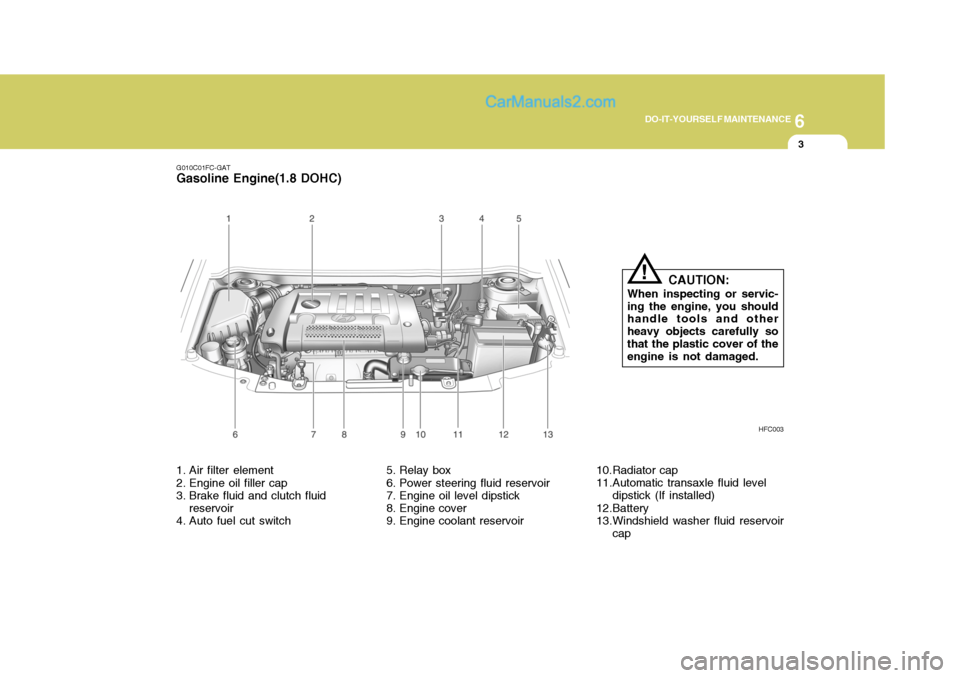
Gasoline Engine(1.8 DOHC)
HFC003
1. Air filter element
2. Engine oil filler cap
3. Brake fluid and clutch fluid reservoir
4. Auto fuel cut switch 5. Relay box
6. Power steering fluid reservoir
7. Engine oil level dipstick
8. Engine cover
9. Engine coolant reservoir10.Radiator cap
11.Automatic transaxle fluid level
dipstick (If installed)
12.Battery
13.Windshield washer fluid reservoir cap CAUTION:
When inspecting or servic-ing the engine, you should handle tools and other heavy objects carefully so that the plastic cover of the engine is not damaged.
!
Page 349 of 407

6 DO-IT-YOURSELF MAINTENANCE
4
1. Air filter element
2. Engine oil filler cap
3. Brake fluid and clutch fluidreservoir
4. Fuel filter 5. Relay box
6. Power steering fluid reservoir
7. Engine oil level dipstick
8. Engine coolant reservoir
9. Radiator cap
10.Battery
11.Windshield washer fluid reservoir
cap G010E02FC
G010E02FC-GAT
Diesel Engine (1.5 CRDi)
CAUTION:
When inspecting or servic-
ing the engine, you shouldhandle tools and otherheavy objects carefully so that the plastic cover of the engine is not damaged.
!
Page 357 of 407

6 DO-IT-YOURSELF MAINTENANCE
12
!
!
CHECKING AND CHANGING THE ENGINE COOLANT
G050B01A-AAT
Recommended Engine Coolant
G050B01FC
G050A01A-AAT
WARNING:
Do not remove the radiator cap
when the engine is hot. When the engine is hot, the engine coolant is under pressure and may eruptthrough the opening if the cap is removed. You could be seriously burned if you do not observe thisprecaution. Do not remove the radiator cap until the radiator is cool to the touch.
G050B02FC
Gasoline engine
Diesel engine
Use a high quality ethylene-glycol
coolant in a 50/50 mix with water.
10.Start the engine and check to be
sure no oil is leaking from thedrain plug or oil filter.
11.Shut off the engine and recheck
the oil level.
NOTE:
o It is recommended that the en- gine oil and filter should be changed by an authorized Hyundai dealer.
o Always dispose of used engine oil in an environmentally accept-able manner. It is suggested that it be placed in a sealed container and taken to a service station formaybe reclaimation. Do not pour the oil on the ground or put it into the household trash.
WARNING:
Used motor oil may cause irrita- tion or cancer of the skin if left in contact with the skin for prolongedperiods of time. Wash your hands thoroughly with soap and warm water as soon as possible afterhandling used oil.
Page 359 of 407

6 DO-IT-YOURSELF MAINTENANCE
14
4. Turn the radiator cap counterclock-
wise without pressing down on it, until it stops. This relieves any pres- sure remaining in the cooling sys-tem. And remove the radiator cap by pushing down and turning coun- terclockwise.Fill the radiator with clean deminer-alized or distilled water. Continueto add clean demineralized or dis- tilled water in small quantities until the fluid level stays up in the radia-tor neck. G050D01FC
G050D02FC
5. Start the engine, top off the radia- tor with water and then add engine coolant to the reservoir until the level is between "L" and "F".
6. Replace the radiator and reservoir caps and check to be sure thedrain cocks are fully closed and not leaking.
G050D02A-AAT
To Change the Coolant
The coolant should be changed at
those intervals specified in the ve-hicle maintenance schedule in Sec- tion 5.
! CAUTION:
Engine coolant can damage the
finish of your car. If you spill en- gine coolant on the car, wash it off thoroughly with clean water.
1. Park the car on level ground, set the park-ing brake and remove the radiator cap when cool.
2. Be sure your drain receptacle is in
place. Open the drain cock on theradiator. Allow all the engine cool- ant to drain from the cooling sys- tem, then securely close the draincock.
3. Check Section 9 for the capacity of the cooling system in your car.Then, following the manufacturer's directions on the engine coolant container, add the appropriatequantity of coolant to the radiator.
Page 364 of 407

6
DO-IT-YOURSELF MAINTENANCE
19
!
CHECKING THE TRANSAXLE OIL
!
CAUTION:
o Radiator antifreeze (engine cool- ant) should not be used in the washer system because it will damage the car's finish.
o The washer should not be oper- ated if the washer reservoir isempty. This can damage the washer fluid pump.
G100A01A
G100A01FC-GAT
MANUAL TRANSAXLE
Transaxle lubricant in the manual
transaxle should be checked at those intervals specified in the vehicle main- tenance schedule in Section 5. Recommended Oil
Use only HYUNDAI GENUINE
PARTS MTF 75W/85 (API GL-4) in the manual transaxle. Manual Transaxle Oil Capacity
The oil capacity of the manual
transaxle is 2.15 liters (2.3 U.S. quarts)/ (2.0 liters, (2.11 U.S. quarts) -1.5 CRDi). Drain plug
Filler plug WARNING:
It is always better to check thetransaxle oil level when the engine is cool or cold. If the engine is hot, you should exercise great cautionto avoid burning yourself on hot engine or exhaust parts.
Page 366 of 407
6
DO-IT-YOURSELF MAINTENANCE
21
C090A01FC
G110D03A-GAT
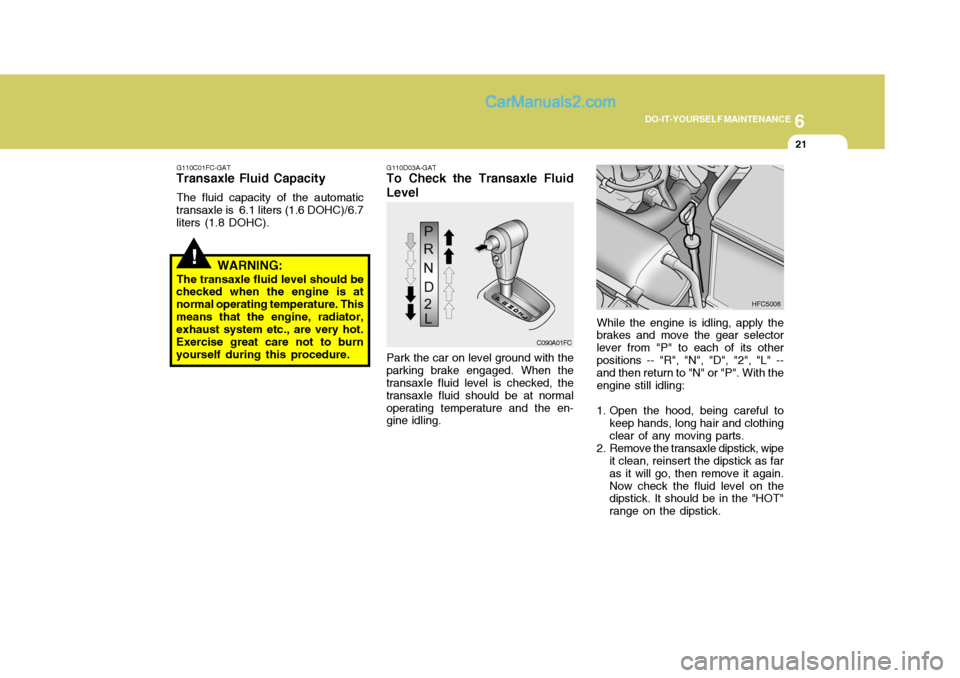
To Check the Transaxle Fluid Level
Park the car on level ground with the
parking brake engaged. When the transaxle fluid level is checked, the transaxle fluid should be at normaloperating temperature and the en- gine idling. While the engine is idling, apply thebrakes and move the gear selector lever from "P" to each of its other positions -- "R", "N", "D", "2", "L" -- and then return to "N" or "P". With theengine still idling:
1. Open the hood, being careful to
keep hands, long hair and clothing clear of any moving parts.
2. Remove the transaxle dipstick, wipe it clean, reinsert the dipstick as faras it will go, then remove it again.Now check the fluid level on the dipstick. It should be in the "HOT" range on the dipstick. HFC5008
!
G110C01FC-GAT
Transaxle Fluid Capacity
The fluid capacity of the automatic
transaxle is 6.1 liters (1.6 DOHC)/6.7 liters (1.8 DOHC).
WARNING:
The transaxle fluid level should be
checked when the engine is at normal operating temperature. Thismeans that the engine, radiator, exhaust system etc., are very hot. Exercise great care not to burnyourself during this procedure.