trailer Hyundai Matrix 2005 User Guide
[x] Cancel search | Manufacturer: HYUNDAI, Model Year: 2005, Model line: Matrix, Model: Hyundai Matrix 2005Pages: 407, PDF Size: 10.31 MB
Page 311 of 407
2 DRIVING YOUR HYUNDAI
22
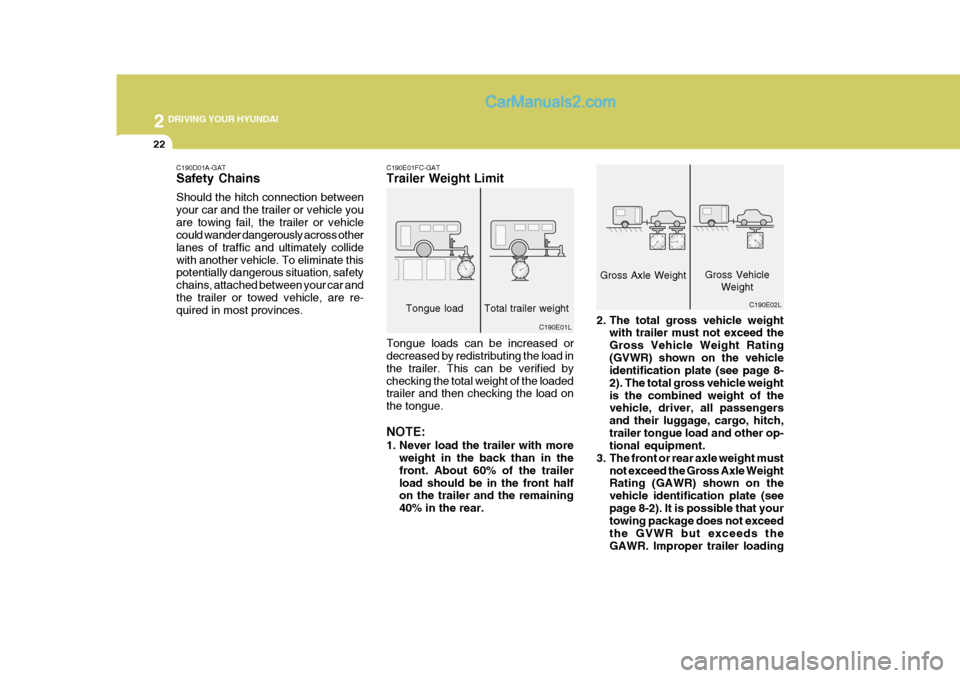
C190E02L
Gross Axle Weight
Gross Vehicle
Weight
2. The total gross vehicle weight with trailer must not exceed the Gross Vehicle Weight Rating(GVWR) shown on the vehicle identification plate (see page 8- 2). The total gross vehicle weightis the combined weight of the vehicle, driver, all passengers and their luggage, cargo, hitch,trailer tongue load and other op- tional equipment.
3. The front or rear axle weight must not exceed the Gross Axle WeightRating (GAWR) shown on the vehicle identification plate (seepage 8-2). It is possible that your towing package does not exceed the GVWR but exceeds theGAWR. Improper trailer loading
C190D01A-GAT Safety Chains Should the hitch connection between your car and the trailer or vehicle youare towing fail, the trailer or vehicle could wander dangerously across other lanes of traffic and ultimately collidewith another vehicle. To eliminate this potentially dangerous situation, safety chains, attached between your car andthe trailer or towed vehicle, are re- quired in most provinces. C190E01FC-GAT Trailer Weight Limit
Tongue load Total trailer weight C190E01L
Tongue loads can be increased or decreased by redistributing the load in the trailer. This can be verified bychecking the total weight of the loaded trailer and then checking the load on the tongue. NOTE:
1. Never load the trailer with more weight in the back than in the front. About 60% of the trailerload should be in the front half on the trailer and the remaining 40% in the rear.
Page 312 of 407

2
DRIVING YOUR HYUNDAI
23
!
kg
!
Coupling point C190E01FC MANUAL
TRANSAXLE AUTO
TRANSAXLE Trailer
1,300
(2,865) 1,100
(2,424)
550 (1,212) Tongue
52
(115)
Maximum Towable Weight
With BrakeType
1.5 Diesel 1.6/1.8 L 1.6/1.8 L
Without Brake Type
and/or too much luggage in the trunk can overload the rear axle.Redistribute the load and check the axle weight again.
4. The maximum permissible static
vertical load on the coupling de-vice ; 52kg CAUTION:
The following specifications are recommended when towing a trailer. The loaded trailer weigh can- not safely exceed the values in thefollowing chart.
5. The maximum permissible over- hang of the coupling point : 760mm
WARNING:
Improperly loading your car andtrailer can serious affect its steer-ing and braking performance caus- ing a crash in which could cause serious injury or death. C190F02A-GAT Trailer or Vehicle Towing Tips
1. Before towing, check hitch and
safety chain connections as well as proper operation of the trailer run- ning lights, brake lights, and turn signals.
2. Always drive your vehicle at a mod- erate speed (Less than 100 km/h).
3. Trailer towing requires more fuel than normal conditions.
4. To maintain engine braking effi-
ciency and electrical charging per-formance, do not use fifth gear (manual transaxle) or overdrive (au- tomatic transaxle).
5. Always secure items in the trailer to prevent load shift while driving.
6. Check the condition and air pres- sure of all tires on the trailer and your car. Low tire pressure can seriously affect the handling. Alsocheck the spare tire.
7. The vehicle/trailer combination is
more affected by crosswind andbuffeting. When being passed by a large vehicle, keep a constant speed and steer straight ahead. If there istoo much wind buffeting, slow down to get out of the other vehicle's air turbulence.
Page 313 of 407

2 DRIVING YOUR HYUNDAI
24
CAUTION:
If overheating should occur when towing, (temperature gauge reads near red zone), taking the following action may reduce or eliminate theproblem.
1. Turn off the air conditioner.
2. Reduce highway speed.
3. Select a lower gear when going uphill.
4. While in stop and go traffic, place the gear selection in park or neu- tral and idle the engine at a higherspeed.
!
8. When parking your car and trailer,
especially on a hill, be sure to follow all the normal precautions. Turn your front wheel into the curb, set the parking brake firmly, and putthe transaxle in 1st or Reverse (manual) or Park (automatic). In addition, place wheel chocks ateach of the trailer's tires.
9. If the trailer has electric brakes,
start your vehicle and trailer mov-ing, and then apply the trailer brake controller by hand to be sure the brakes are working. This lets youcheck your electrical connection at the same time.
10.During your trip, check occasion- ally to be sure that the load issecure, and that the lights and any trailer brakes are still working.
11.Avoid jerky starts, sudden accel- eration or sudden stops.
12.Avoid sharp turns and rapid lane changes.
13.Avoid holding the brake pedal down
too long or too frequently. This couldcause the brakes to overheat, re- sulting in reduced braking efficiency. 14.When going down a hill, shift into a
lower gear and use the engine brak- ing effect. When ascending a long grade, downshift the transaxle to a lowergear and reduce speed to reduce chances of engine overloading and/ or overheating.
15.If you have to stop while going uphill, do not hold the vehicle inplace by pressing on the accelera-tor. This can cause the automatic transaxle to overheat. Use the park- ing brake or footbrake.
NOTE: When towing check transaxle fluid more frequently.
Page 341 of 407
5
VEHICLE MAINTENANCE REQUIREMENTS
7
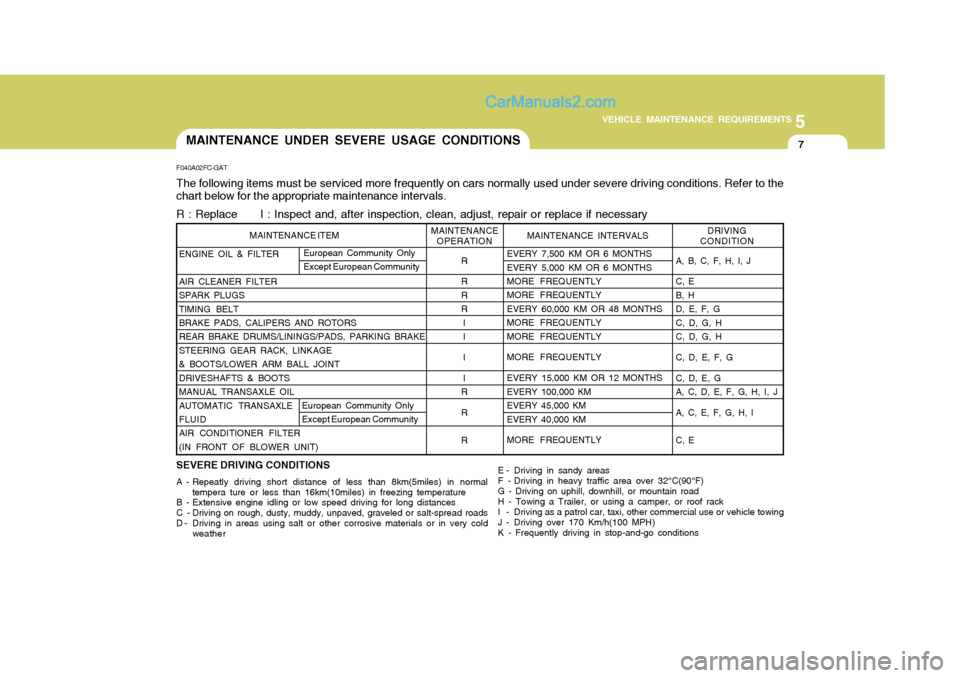
ENGINE OIL & FILTER AIR CLEANER FILTER SPARK PLUGSTIMING BELTBRAKE PADS, CALIPERS AND ROTORS REAR BRAKE DRUMS/LININGS/PADS, PARKING BRAKE STEERING GEAR RACK, LINKAGE& BOOTS/LOWER ARM BALL JOINTDRIVESHAFTS & BOOTSMANUAL TRANSAXLE OILAUTOMATIC TRANSAXLE FLUID AIR CONDITIONER FILTER(IN FRONT OF BLOWER UNIT) A, B, C, F, H, I, J C, E B, HD, E, F, GC, D, G, HC, D, G, H C, D, E, F, G C, D, E, G A, C, D, E, F, G, H, I, J A, C, E, F, G, H, I C, E
R R RR
II I I
R R R DRIVING
CONDITION
EVERY 7,500 KM OR 6 MONTHS EVERY 5,000 KM OR 6 MONTHS MORE FREQUENTLY MORE FREQUENTLYEVERY 60,000 KM OR 48 MONTHSMORE FREQUENTLYMORE FREQUENTLY MORE FREQUENTLY EVERY 15,000 KM OR 12 MONTHS EVERY 100,000 KMEVERY 45,000 KMEVERY 40,000 KM MORE FREQUENTLY MAINTENANCE INTERVALS
European Community Only Except European Community
F040A02FC-GAT The following items must be serviced more frequently on cars normally used under severe driving conditions. Refer to the chart below for the appropriate maintenance intervals. R : Replace I : Inspect and, after inspection, clean, adjust, repair or replace if necessary
SEVERE DRIVING CONDITIONS
A - Repeatly driving short distance of less than 8km(5miles) in normal
tempera ture or less than 16km(10miles) in freezing temperature
B - Extensive engine idling or low speed driving for long distances
C - Driving on rough, dusty, muddy, unpaved, graveled or salt-spread roads
D - Driving in areas using salt or other corrosive materials or in very cold weather
MAINTENANCEOPERATION
MAINTENANCE ITEM
E - Driving in sandy areas
F - Driving in heavy traffic area over 32°C(90°F)G - Driving on uphill, downhill, or mountain road H - Towing a Trailer, or using a camper, or roof rack
I - Driving as a patrol car, taxi, other commercial use or vehicle towing
J - Driving over 170 Km/h(100 MPH)K - Frequently driving in stop-and-go conditions
MAINTENANCE UNDER SEVERE USAGE CONDITIONS
European Community Only Except European Community
Page 407 of 407

10INDEX
6
TowingA trailer (or vehicle) ............................................... 2-21
Emergency ............................................................. 3-14
If your car must be towed .....................................3-12
Transaxle
Automatic ................................................................. 2-9
Automatic transaxle fluid checkin g ........................6-20
Manual ........................................................................ 2-7
Manual transaxle oil checki ng ...............................6-19
Trip Computer ........................................................... 1-56
Trip Odometer ........................................................... 1-55
U Under T ray ................................................................ 1-17
V Vehicle Identification Number (VIN) ........................... 8-2
Vehicle Specifi cation................................................... 9-2
Ventilation
Center ventilator ..................................................... 1-82
Side ventilator ........................................................ 1-82
W Warning and Indicator Light ...................................... 1-48
Windows
Manual ................................................................... 1-13
Power ..................................................................... 1-13
Windshield Wiper and Washer Switc h .....................1-60
Windshield Wiper Blades ................... ....................... 6-18