cooling Hyundai Matrix 2005 Owner's Guide
[x] Cancel search | Manufacturer: HYUNDAI, Model Year: 2005, Model line: Matrix, Model: Hyundai Matrix 2005Pages: 407, PDF Size: 10.31 MB
Page 247 of 407
1
FEATURES OF YOUR HYUNDAI
83
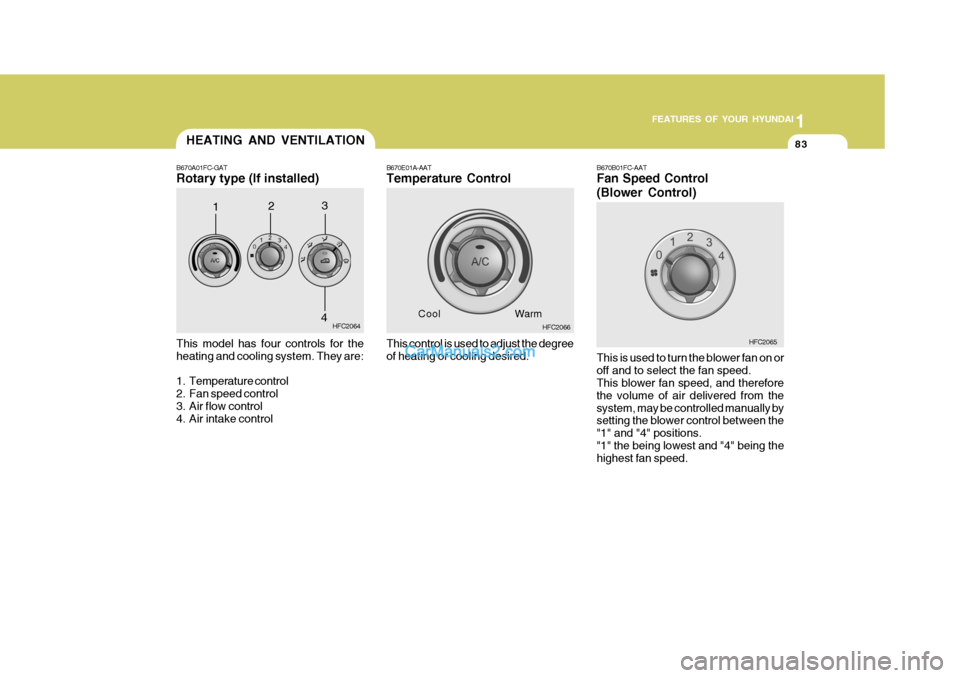
B670A01FC-GAT Rotary type (If installed) This model has four controls for the heating and cooling system. They are:
1. Temperature control
2. Fan speed control
3. Air flow control
4. Air intake control HFC2064
HEATING AND VENTILATION
1
2
3
4 B670B01FC-AAT Fan Speed Control (Blower Control) This is used to turn the blower fan on or off and to select the fan speed. This blower fan speed, and therefore the volume of air delivered from thesystem, may be controlled manually by setting the blower control between the "1" and "4" positions."1" the being lowest and "4" being the highest fan speed.
HFC2065
B670E01A-AAT Temperature Control This control is used to adjust the degree of heating or cooling desired.
HFC2066
Cool
Warm
Page 252 of 407
1FEATURES OF YOUR HYUNDAI
88
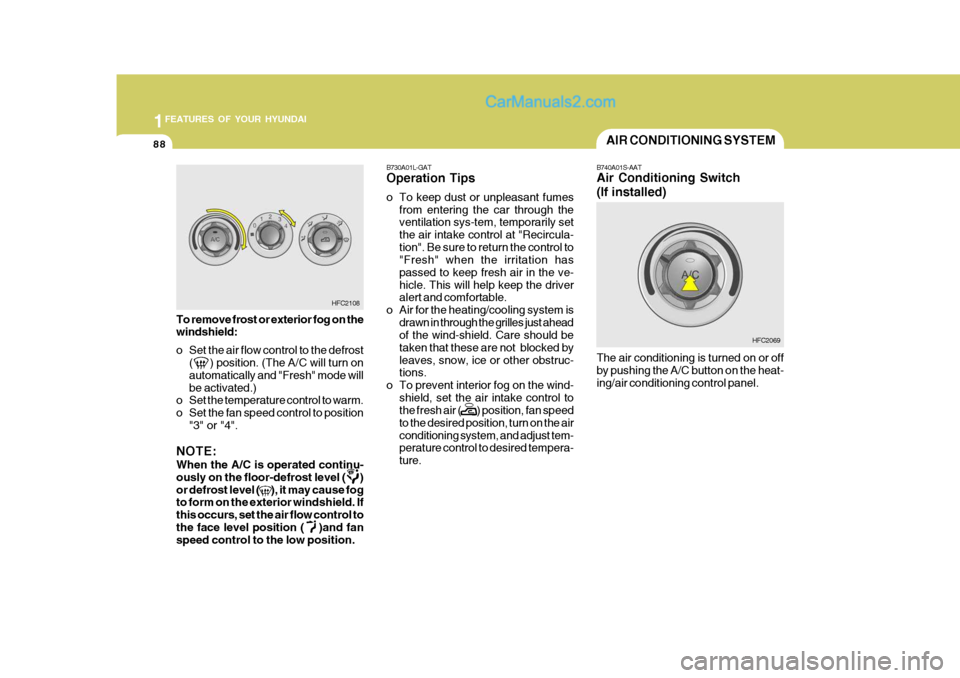
To remove frost or exterior fog on the windshield:
o Set the air flow control to the defrost
( ) position. (The A/C will turn on automatically and "Fresh" mode willbe activated.)
o Set the temperature control to warm.
o Set the fan speed control to position
"3" or "4".
NOTE: When the A/C is operated continu- ously on the floor-defrost level ( )or defrost level ( ), it may cause fog to form on the exterior windshield. If this occurs, set the air flow control tothe face level position ( )and fan speed control to the low position. B730A01L-GAT Operation Tips
o To keep dust or unpleasant fumes
from entering the car through the ventilation sys-tem, temporarily set the air intake control at "Recircula-tion". Be sure to return the control to "Fresh" when the irritation has passed to keep fresh air in the ve-hicle. This will help keep the driver alert and comfortable.
o Air for the heating/cooling system is
drawn in through the grilles just aheadof the wind-shield. Care should be taken that these are not blocked byleaves, snow, ice or other obstruc- tions.
o To prevent interior fog on the wind-
shield, set the air intake control tothe fresh air ( ) position, fan speed to the desired position, turn on the airconditioning system, and adjust tem- perature control to desired tempera- ture.
HFC2108
AIR CONDITIONING SYSTEM
B740A01S-AAT Air Conditioning Switch (If installed) The air conditioning is turned on or off by pushing the A/C button on the heat- ing/air conditioning control panel. HFC2069
Page 253 of 407
1
FEATURES OF YOUR HYUNDAI
89
For dehumidified heating:
o Turn on the fan control switch.
o Turn on the air conditioning switch.
The air conditioning indicator light should come on at the same time.
o Set the air intake control to the "Fresh" mode ( ).
o Set the air flow control to the desired
position.
o Adjust the fan control to the desired speed.
o For more rapid action, set the fan at one of the higher speeds.
o Adjust the temperature control to
provide the desired amount of warmth.
B740C01FC-GAT Dehumidified Heating
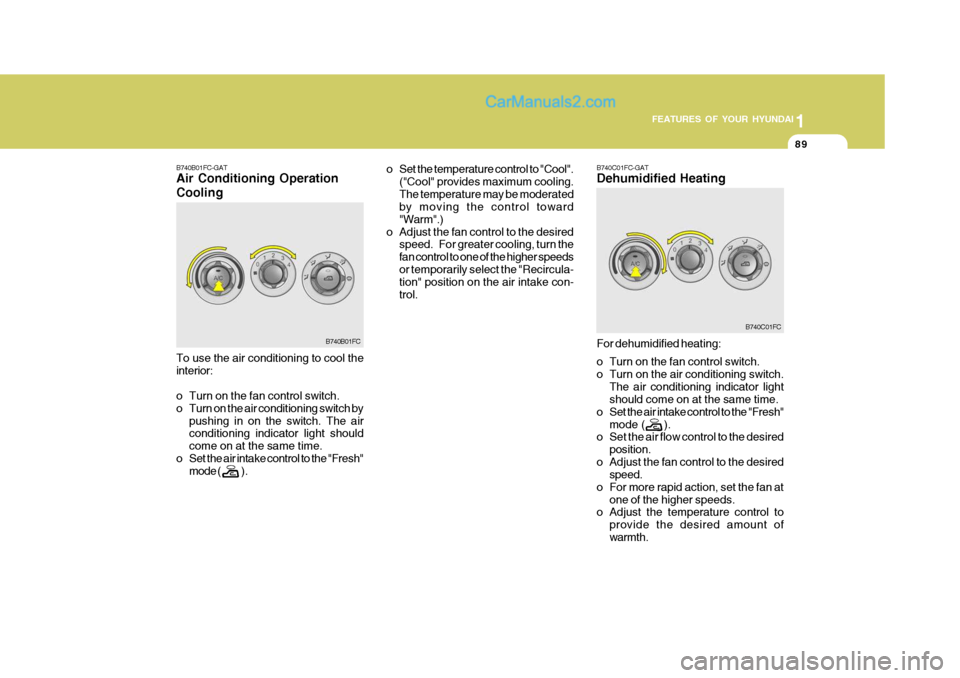
o Set the temperature control to "Cool".
("Cool" provides maximum cooling. The temperature may be moderated by moving the control toward "Warm".)
o Adjust the fan control to the desired speed. For greater cooling, turn thefan control to one of the higher speedsor temporarily select the "Recircula- tion" position on the air intake con- trol.
B740C01FC
B740B01FC-GAT Air Conditioning Operation Cooling To use the air conditioning to cool the interior:
o Turn on the fan control switch.
o Turn on the air conditioning switch bypushing in on the switch. The air conditioning indicator light should come on at the same time.
o Set the air intake control to the "Fresh" mode( ). B740B01FC
Page 307 of 407
2 DRIVING YOUR HYUNDAI
18SMOOTH CORNERINGWINTER DRIVING
C160A01A-AAT The more severe weather conditions of winter result in greater wear and other problems. To minimize the prob- lems of winter driving, you should fol-low these suggestions:
C150A01A-AAT Avoid braking or gear changing in cor- ners, especially when roads are wet. Ideally, corners should always be taken under gentle acceleration. If you followthese suggestions, tire wear will be held to a minimum. should be noted that installing tire chains on the tire will provide a greaterdriving force, but will not prevent side skids. NOTE: Tire chains are not legal in all prov- inces. Check province laws before fitting tire chains.
C160B01A-GAT Snowy or Icy Conditions To drive your vehicle in deep snow, it may be necessary to use snow tires or to install tire chains on your tires. Ifsnow tires are needed, it is necessary to select tires equivalent in size and type to the original equipment tires.Failure to do so may adversely affect the safety and handling of your car. Speeding, rapid acceleration, suddenbrake applications, and sharp turns are potentially very hazardous prac- tices. During deceleration, use enginebraking to the fullest extent. Sudden brake applications on snowy or icy roads may cause skids to occur. Youneed to keep sufficient distance be- tween the vehicle in front and your vehicle. Also, apply the brake gently. It C160C01A-AAT Use High Quality Ethylene Glycol Coolant Your Hyundai is delivered with high quality ethylene glycol coolant in thecooling system. It is the only type of coolant that should be used because it helps prevent corrosion in the coolingsystem, lubricates the water pump and prevents freezing. Be sure to replace or replenish your coolant in accor-dance with the maintenance schedule in Section 5. Before winter, have your coolant tested to assure that its freez-ing point is sufficient for the tempera- tures anticipated during the winter.
Page 317 of 407
3 WHAT TO DO IN AN EMERGENCY
4IF THE ENGINE OVERHEATS
D030A02A-AAT If your temperature gauge indicates overheating, you experience a loss of power, or hear loud pinging or knock- ing, the engine is probably too hot. Ifthis happens to you, you should:
1. Pull off the road and stop as soon as it is safe to do so.
2. Place the gear selector lever in "P"
(auto-matic), or neutral (manual transaxle) and set the parking brake. If the air conditioning is on, turn it off.
3. If engine coolant is running out un- der the car or steam is coming outfrom the hood, stop the engine. Donot open the hood until the engine coolant has stopped running or the steaming has stopped. If there is novisible loss of engine coolant and no steam, leave the engine running and check to be sure the enginecooling fan is operating. If the fan is not running, turn the engine off.
4. Check to see if the water pump drive belt is missing. If it is not missing,check to see that it is tight. If the drive belt seems to be satisfactory,
3. Attach the clamps of the jumper
cable in the exact location shown.First, attach one clamp of the jumper cable to the positive (+) post or cable of the discharged battery. Thenattach the other end of the same cable to the positive (+) post or cable of the booster battery. Next,using the other cable, attach one clamp to the negative (-) post or cable of the booster battery. Thenattach the other end of that cable to a solid metal part of the engine away from the battery. Do not con-nect the cable to any moving part.
4. Start the engine in the car with the
booster battery and let it run for afew minutes. This will help to as- sure that the booster battery is fully charged. During the jumping opera-tion, run the engine in this vehicle at about 2,000 rpm.
5. Start the engine in the car with the discharged battery using the nor-mal starting procedure. After the engine starts, leave the jumpercables connected and let the engine run at fast idle or about 2,000 rpm for several minutes. 6. Carefully remove the jumper cables
in the reverse order of attachment.
If you do not know why your batterybecame discharged (because the lightswere left on, etc.), have the charging system checked by your Hyundai dealer.
Page 318 of 407

3
WHAT TO DO IN AN EMERGENCY
5
!
!
!
check for coolant leaking from the radiator, hoses or under the car. (Ifthe air conditioning had been in use, it is normal for cold water to be draining from it when you stop).
WARNING (Diesel only):
Never work on injection system with engine running or within 30 sec- onds after shutting off engine. Highpressure pump, rail, injectors and high pressure pipes are subject to high pressure even after the enginestopped. The fuel jet produced by fuel leaks may cause serious in- jury, if it touch the body. Peopleusing pacemakers should not move than 30cm closer to the ECU or wiring harness within the engine 5. If the water pump drive belt is bro-
ken or coolant is leaking out, stopthe engine immediately and call the nearest Hyundai dealer for assis- tance. CAUTION:
Serious loss of engine coolant indi- cates there is a leak in the cooling system and this should be checkedas soon as possible by a Hyundai dealer.
room while engine is running, since the high currents in the CommonRail system produce considerable magnetic fields.
6. If you cannot find the cause of the
overheating, wait until the engine temperature has returned to nor- mal. Then, if the engine coolant hasbeen lost, carefully add coolant to the reservoir (page 6-14) to bring the fluid level in the reservoir up tothe halfway mark.
WARNING:
While the engine is running, keephair, hands, and clothing away from moving parts such as the fan and drive belts to prevent injury.
WARNING:
Do not remove the radiator cap whenthe engine is hot. This can allowcoolant to be blown out of the open- ing and cause serious burns. 7. Proceed with caution, keeping alert
for further signs of overheating. If overheating happens again, call a Hyundai dealer for assistance.
!
Page 340 of 407

5VEHICLE MAINTENANCE REQUIREMENTS
6
F030C04E-GAT R : Replace I : Inspect and, after inspection, clean, adjust, repair or replace if necessary
DESCRIPTION
GENERAL MAINTENANCE COOLING SYSTEMCOOLANT MANUAL TRANSAXLE OIL AUTOMATIC TRANSAXLEFLUIDBRAKE HOSES AND LINESBRAKE FLUIDREAR BRAKE DRUMS/LININGS, PARKING BRAKEBRAKE PADS, CALIPERS AND ROTORSEXHAUST PIPE AND MUFFLERSUSPENSION MOUNTING BOLTSSTEERING GEAR BOX, LINKAGE & BOOTS/LOWER ARM BALL JOINTPOWER STEERING PUMP, BELT AND HOSESDRIVE SHAFTS AND BOOTSAIR CONDITIONING REFRIGERANTAIR CONDITIONER FILTER (IN FRONT OF BLOWER UNIT)
NO.
12 3 4 5 6789
101112131415
120 96
I
R I IIIIIIIIIIII
105
84
I I III I IIII I
90 72
I
R I
R IIIIIIIIIII
7560
I I III I IIII I
60 48
I
R IIIIIIIIIIIII
4536
I I III I IIII I
30 24
I
R IIIIIIIIIIIII
1512
I I III I IIII I
KILOMETERS X 1000 MONTHS
European Community Only Except European Community
See Note (2)
See Note (1)
GASOLINE ENGINE DIESEL ENGINE
Note : (1) FOR EVERY 24 MONTHS OR 45,000 KM, WHICHEVER OCCURS FIRST : "R"
(2) FOR EVERY 12 MONTHS OR 20,000 KM, WHICHEVER OCCURS FIRST : "R"
Page 343 of 407

5
VEHICLE MAINTENANCE REQUIREMENTS
9
F060H01A-AAT o Air Cleaner Filter A Genuine Hyundai air cleaner filter is recommended when the filter is re- placed. F060J01A-AAT o Spark Plugs Make sure to install new spark plugs of the correct heat range. F070B01A-GAT o Cooling System Check the cooling system part, such as radiator, coolant reservoir, hosesand connections for leakage and dam- age. Replace any damaged parts.
F060E01A-AAT
o Timing Belt
Inspect all parts related to the timing belt for damage and deformation. Re- place any damaged parts immediately. F060G01A-AAT
o Vapor Hose and Fuel Filler Cap
The vapor hose and fuel filler cap should be inspected at those intervals specified in the maintenance sched-ule. Make sure that a new vapor hose or fuel filler cap is correctly replaced. F060F01A-AAT
o Vacuum, Crankcase
Ventilation Hoses
Inspect the surface of hoses for evi-
dence of heat and/or mechanical dam-age. Hard and brittle rubber, cracking, tears, cuts, abrasions, and excessiveswelling indicate deterioration. Particu- lar attention should be paid to examin- ing those hose surfaces nearest tohigh heat sources, such as the ex- haust manifold.
Inspect the hose routing to assure that
the hoses do not come in contact withany heat source, sharp edges or mov- ing component which might cause heatdamage or mechanical wear. Inspect all hose connections, such as clamps and couplings, to make sure they aresecure, and that no leaks are present. Hoses should be replaced immedi- ately if there is any evidence of dete-rioration or damage. F060N02E-GAT
o Valve Clearance
Inspect excessive valve noise and/or engine vibration and adjust if neces- sary. A qualified technician shouldperform the operation.
Page 346 of 407

Engine Compartment ................................................... 6-2
General Checks ........................................................... 6-5
Checking the Engine Oil .............................................. 6-6
Changing the Oil and Filter ......................................... 6-9
Checking and Changing the Engine Coolant ...........6-12
Spark Plugs ................................................................ 6-15
Changing the Air Cleaner Filter ................................ 6-17
Checking the Transaxle Oil (Manual) ....................... 6-19
Checking the Transaxle Fluid (Automatic) ................ 6-20
Checking the Brakes ................................................. 6-22
Checking the Clutch Fluid ......................................... 6-24
Air Conditioning Care ................................................ 6-25
Changing the Air Conditioner Filter
(In Front of Blower Unit) .......................................... 6-26
Checking Drive Belts ................................................. 6-28
Checking and Replacing Fuses ................................ 6-29
Checking The Battery ................................................ 6-31
Checking The Eclectric Cooling Fans ....................... 6-32
Power Steering Fluid Level ....................................... 6-32
Headlight Aiming Adjustment .................................... 6-35
Replacing headlight Bulbs ......................................... 6-36
Bulb Wattage ............................................................. 6-38
Fuse Panel Description ............................................. 6-39
DO-IT-YOURSELF MAINTENANCE
6
6
Page 353 of 407

6 DO-IT-YOURSELF MAINTENANCE
8
G350A01A-GAT
ENGINE OIL CONSUMPTION Function of Engine Oil
Engine oil has the primary function of
lubricating and cooling the inside of the engine. Engine oil consumption
It is normal that an engine should
consume some engine oil while nor- mal driving. The cause of oil con- sumption in a normal engine are asfollows;
o Engine oil is used to lubricate pis- tons, piston rings and cylinders. A thin film of oil is left on the cylinder wall when a piston moves downwards in the cylinder. High negative pressure generated dur-ing engine operation sucks some of the oil into the combustion cham- ber.This oil with some oil of the cylin-der wall is burned by the high tem-perature combustion gases during the combustion process. o The engine oil consumption is
strongly effected by the viscosity and quality of oil, engine rpm and driving condition etc. The engine oil is more consumed under severedriving conditions such as high speeds and frequent acceleration and deceleration than normal driv-ing condition.
1. Remove the oil filler cap by turning
it counter-clockwise.
2. Add oil, then check the level again. Do not overfill.
3. Replace the cap by turning it clock- wise.
The distance between the "F" and "L"marks is equal to about 1 liter(GasolineEngine)/1.2 liter(Diesel Engine) of oil.