wheel Hyundai Matrix 2005 Owner's Guide
[x] Cancel search | Manufacturer: HYUNDAI, Model Year: 2005, Model line: Matrix, Model: Hyundai Matrix 2005Pages: 407, PDF Size: 10.31 MB
Page 94 of 407

3-7
IN CASE OF EMERGENCY
WARNING: It is important that the faces of the wheeland hub are clean prior to installing the wheel. The prescence of dirt or other mat- ter in the wheel or hub faces could result in the wheel nuts becoming loose whilst the vehicle is being driven. SD070I1-E
7. Re-install Wheel Nuts
Fit the wheel nuts onto the studs and tighten with the wheel brace.
SD070H1-E 6. Changing Wheels Using the wheel brace, remove the nuts and slide the wheel off the hub and wheel studs. Lie the wheel flat to prevent it from rolling. Ensure that the faces of the wheel and hub are clean. Position the spare wheel over the studs and slide it up to the hub.
STA3071H
D060H01FC-D
D060G01FC
SD070J1-E
8. Lower Vehicle and Tighten Nuts
Lower the car to the ground turning the wheel
nut wrench counterclockwise. When the ve- hicle is firmly on the ground, remove the jack and tighten the wheel nuts securely. At the first available opportunity, the wheel nut torque should be checked with a suitable torque wrench.
Wheel nut tightening torqueSteel wheel & aluminium alloy wheel: 90-110 Nm (65-80 lb.ft)
D060I01FC-D
Page 95 of 407

IN CASE OF EMERGENCY
3-8
SD070K1-E AFTER CHANGING WHEELS The pressure of the spare tyre should be checked at the first available opportunity. If any doubt exists as to the tyre pressure, the vehicle should be driven slowly to the nearest service station and the tyre pressure checked and adjusted as required. If the valve cap is lost from any of the valves, a replacement should be obtained and fitted at the first available opportunity. The valve cap prevents the ingress of dirt which may cause the valve to stick and therefore leak and is part of the valve sealing function. Ensure that the spare wheel, jack and wheel nut wrench as well tools are correctly located in the boot of the vehicle to prevent damage and noise.
D060B01FC
HFC01
D080A01O-GAT
IF YOUR VEHICLE MUST BE TOWED If your vehicle has to be towed, it should be done by your Hyundai authorised repairer or a commercial tow truck service. This will help assure that your vehicle is not damaged in towing. Also, professionals are generally aware of local laws governing towing. In any case, rather than risk damage to your car, it is suggested that you show this information to the tow truck operator. Be sure that a safety chain system is used and that all local laws are observed. It is recommended that your vehicle be towed with a wheel lift and dollies or flatbed equip- ment with all the wheels off the ground. CAUTION:
o Your vehicle can be damaged if towed incorrectly!
o Be sure the transaxle is in neutral.
o When the engine will not start, be sure the steering is unlocked by placing thekey in the "ACC" position. D080B01O-GAT
Towing the Vehicle
Your vehicle can be towed by wheel lift typetruck (1), (2) or flatbed equipment (3).
dolly
(1)
(2)
(3)
Page 96 of 407
3-9
IN CASE OF EMERGENCY
CAUTION:
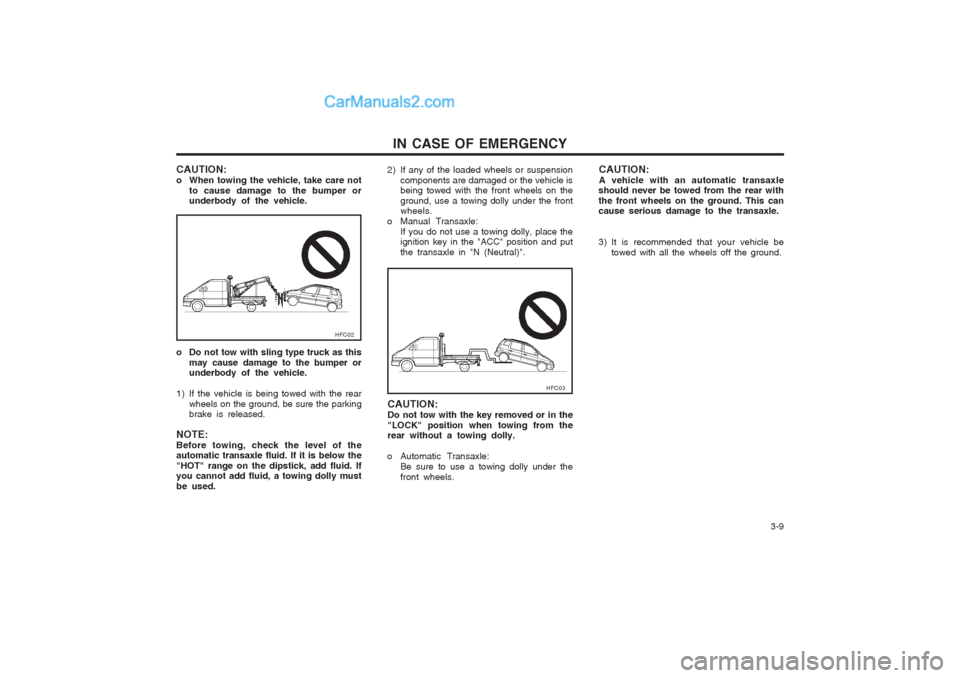
o When towing the vehicle, take care not to cause damage to the bumper or underbody of the vehicle.
o Do not tow with sling type truck as this may cause damage to the bumper orunderbody of the vehicle.
1) If the vehicle is being towed with the rear wheels on the ground, be sure the parkingbrake is released.
NOTE: Before towing, check the level of the automatic transaxle fluid. If it is below the "HOT" range on the dipstick, add fluid. If you cannot add fluid, a towing dolly must be used.
HFC02
2) If any of the loaded wheels or suspension components are damaged or the vehicle is being towed with the front wheels on the ground, use a towing dolly under the front wheels.
o Manual Transaxle:
If you do not use a towing dolly, place theignition key in the "ACC" position and put the transaxle in "N (Neutral)".
HFC03
CAUTION: Do not tow with the key removed or in the"LOCK" position when towing from the rear without a towing dolly.
o Automatic Transaxle: Be sure to use a towing dolly under the front wheels. CAUTION:A vehicle with an automatic transaxle
should never be towed from the rear withthe front wheels on the ground. This can cause serious damage to the transaxle.
3) It is recommended that your vehicle be
towed with all the wheels off the ground.
Page 97 of 407
IN CASE OF EMERGENCY
3-10 D120A01A-EAT
IF YOU LOSE YOUR KEYS Information about the key of immobiliser sys-
tem will be found on page 1-2.
NOTE: Before towing, check the level of theautomatic transaxle fluid. If it is below the "HOT" range on the dipstick, add fluid. If you cannot add fluid, a towing dolly must be used. CAUTION: If the car is being towed with all four wheels on the ground, it can be towed only from the front. Be sure that the transaxle is in neutral. Do not tow at speeds greater than 30 mph (50 km/h) and for more than 15 miles (25 km). Be sure the steering is unlocked by plac-ing the key in the "ACC" position. A driver must be in the towed vehicle to operate the steering and brakes
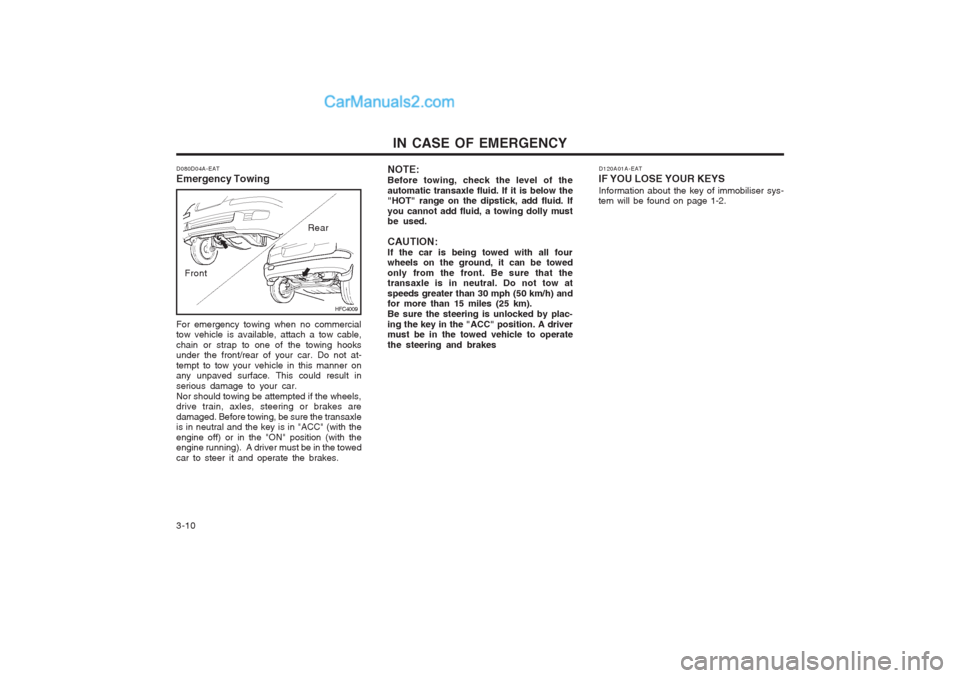
D080D04A-EAT Emergency Towing
HFC4009
Front
Rear
For emergency towing when no commercial tow vehicle is available, attach a tow cable, chain or strap to one of the towing hooks under the front/rear of your car. Do not at- tempt to tow your vehicle in this manner on any unpaved surface. This could result in serious damage to your car.Nor should towing be attempted if the wheels, drive train, axles, steering or brakes are damaged. Before towing, be sure the transaxle is in neutral and the key is in "ACC" (with the engine off) or in the "ON" position (with the engine running). A driver must be in the towed car to steer it and operate the brakes.
Page 98 of 407
APPEARANCE CARE 4-1
garding the retreatment programme must be observed in accordance with the Terms and Conditions outlined in the separate Anti Per- foration Warranty Booklet. NOTE: The underbody should never be steamcleaned since the underbody coating may be removed by this process. During the interim period between powerwashing the underbody, the more vulnera- ble areas such as wheel arches should be hosed off particularly during the winter sea- son to prevent prolonged contact with road salts.Ensure that the various drain points located at the bottom of the door panels and sills are kept clear to prevent water from becom- ing trapped within the cavities. Wherever possible, the parking of the vehicle in a confined, poorly ventilated location (a ga- rage for example) should be avoided when the vehicle is wet or is covered with snow or ice. Under these conditions, the internal cavities of the vehicle will remain damp for prolonged periods of time which will en- courage corrosion. Parking the vehicle where good ventilation exists (outside for example) is preferable.
SE040A1-E VALETING Regular cleaning of the exterior paintwork serves two important functions. Firstly, the removal of abrasive dirt and contaminants will maintain the lustre of the paintwork and will prevent discolouration and dulling due to prolonged con- tact. Secondly, the presence of damage through im- pact or abrasion will be apparent allowing early rectification to be made thus preventing corro- sion from becoming established and spreading beneath the paint film. To avoid "water spotting" the vehicle should not be washed in direct sun- light particularly in the case of vehicles having dark body colours. The heat from the sun rays is absorbed by the paint film increasing the surface temperature. This action causes water used for washing to evaporate quickly leaving behind the deposits from the water and the shampoo used. Use only a shampoo intended for the purpose and ensure that the body work is thoroughly wetted to soften the dirt film prior to attempting to remove this. After removing the dirt film with a soft sponge, the body work should be thoroughly rinsed and then dried with a good quality chamois leather to prevent streaking or spotting of the paint work. Household detergents, solvents and abrasive cleaning materials should not be used in order to avoid damaging the paint film.
SE030A1-E UNDERBODY COATINGSEvery Hyundai passenger car receives a full underbody and cavity injection treatment during production. In order that this treatment may retain maximum effectiveness it is recommend- ed that the underbody receives a power wash and a thorough inspection after each winter season. In doing so any accumulations of mud, which act as moisture traps and com- bine with road salts to accelerate corrosion will be removed. In order to maintain the Anti Perforation Warranty, the requirements re-
SE000A1-E
4. APPEARANCE
CARE
SE020A1-E PROTECTING YOUR HYUNDAI FROM CORROSION By using the most advanced design and con- struction practices, every Hyundai is built to retain the original factory finish for many years. However, long term durability is also greatly dependant upon maintaining the various protec- tion systems and coatings used in manufacture since constant, exposure to the elements will result in a breakdown and loss of effectiveness. The following suggestions are made to assist in the maintenance of the vehicle bodywork.
4
Page 99 of 407
APPEARANCE CARE
4-2
Plastic wheel covers should be cleaned using a sponge and water. Cast alloy wheels should be cleaned using a mild soap or neutral deter- gent. Abrasive compounds must not be used since in the event of these damaging the lac- quer coating, oxidization of the aluminium wheel will occur, spoiling the appearance. The use of an a toothbrush will facilitate cleaning between the wheel "spokes".
ensure that accidental spillages are immediately flushed with water. Do not use abrasive cleaning materials which may damage the bumpers. Avoid subjecting the bumpers to high tempera- tures such as may be encountered in high bake paint ovens.
SE040B1-E STAIN/SPOT REMOVAL Should tree sap, dead insects or tar prove to be difficult to remove from the paint film, turpentine or a proprietary paint cutting compound may be used. Ensure that the area to be cleaned is not rubbed intensively to prevent breaking through the colour coat and exposing the under coat. SE040C1-E POLISHINGThe exterior paint work should be polished with a proprietary wax polish when water no longer collects in bead form on the paint work. The instructions of the product manufacturer should be adhered to. SE040E1-E BUMPER MAINTENANCEThe special material from which the bumpers are manufactured warrants special attention to pre- serve the appearance of the bumpers. Avoid contact with battery electrolyte or brake fluid and SE040F1-E ACCIDENT REPAIRSIn the event of the body work sustaining damage, the following points should be noted prior to repairs being undertaken. If body panels are replaced or repaired, anti corrosion treatment must be applied to the repair area. The product used must be compatible withthose used in manufacture. It is recommended that repairs are entrusted to a Hyundai authorised repairer to ensure that replacement parts used are of the same high quality as those used in manufacture of the vehicle and that the correct repair methods and materials will en- sure adequate levels of corrosion protection and the continued validity of the Anti Perforation Warranty. SE050A1-E INTERIORDuring the winter period, it is possible that the passenger compartment flooring may become wet from damp footwear or quantities of snow adhering to footwear. The carpet should not be allowed to remain in this condition since the carpet may begin to create musty smells and will
SE050D1-E SEAT BELTS Seat belts should be cleaned only with a mild soap solution. Strong detergents, solvents or bleaches may damage the belt webbing and therefore reduce the effectiveness of the belt. Belts which display signs of fraying, wear of cuts should be replaced. SE050E1-E WINDOWS A proprietary glass cleaner should be used to clean the inside of the windows. However, the rear heated windshield must only be cleaned using a light horizontal cleaning action. Care should be exercised to avoid the use of abrasive cleaners or contact with items of jewellery which may damage the heating elements.
promote corrosion of the floor pan in addition tothe carpet and under felt beginning to rot. SE050C1-E INTERIOR VALETING The soft trim and carpets should be maintained with the regular use of a vacuum cleaner. Heavy soiling should be removed with a dry cleaning agent recommended for this purpose following the instructions of the product manufacturer. Paint thinner, solvents or other such cleaning materials should not be used since damage to the upholstery may result.
Page 103 of 407
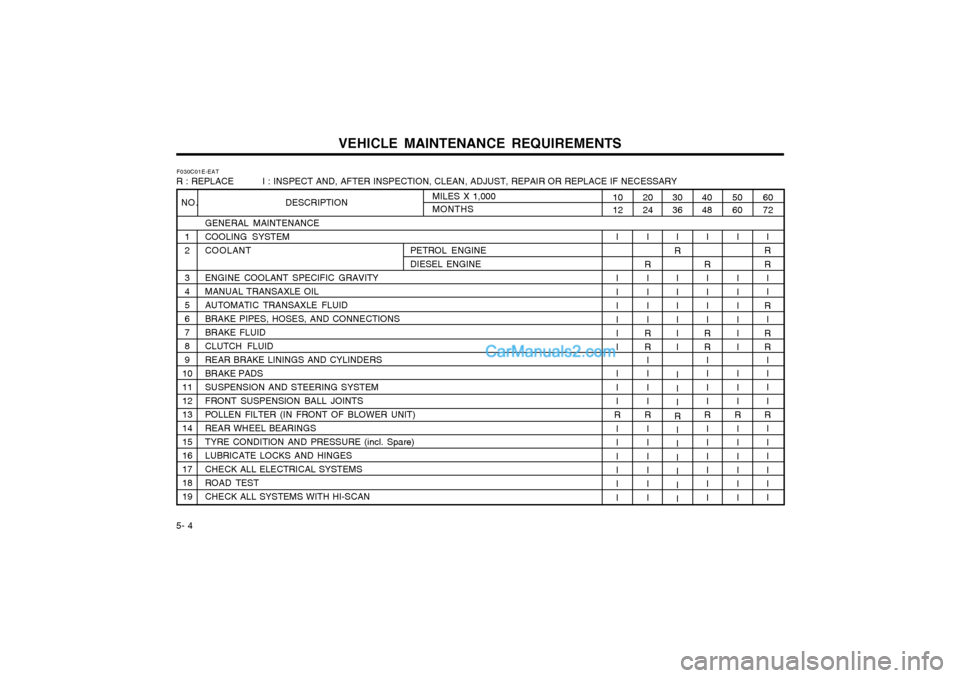
VEHICLE MAINTENANCE REQUIREMENTS
5- 4 F030C01E-EAT
R : REPLACE I : INSPECT AND, AFTER INSPECTION, CLEAN, ADJUST, REPAIR OR REPLACE IF NECESSARY
GENERAL MAINTENANCE COOLING SYSTEMCOOLANT PETROL ENGINEDIESEL ENGINE
ENGINE COOLANT SPECIFIC GRAVITYMANUAL TRANSAXLE OILAUTOMATIC TRANSAXLE FLUIDBRAKE PIPES, HOSES, AND CONNECTIONSBRAKE FLUIDCLUTCH FLUIDREAR BRAKE LININGS AND CYLINDERSBRAKE PADSSUSPENSION AND STEERING SYSTEMFRONT SUSPENSION BALL JOINTSPOLLEN FILTER (IN FRONT OF BLOWER UNIT)REAR WHEEL BEARINGSTYRE CONDITION AND PRESSURE (incl. Spare)LUBRICATE LOCKS AND HINGESCHECK ALL ELECTRICAL SYSTEMSROAD TESTCHECK ALL SYSTEMS WITH HI-SCAN
60 72
50 60
4048
I
R R
I I
R I
R R I I II
R
IIIII I
I I IIII I I I I
R I III I I
I
R IIII
R R I I I I
R I III I I
30 36
2024
I
R
I IIII I I II
R IIIIII
I
R IIII
R R I I I I
R I III I I
10 12
I I IIII I I I I
R I III I I
MILES X 1,000 MONTHS
NO. DESCRIPTION
1 2 3 456789
10111213141516171819
Page 107 of 407

VEHICLE MAINTENANCE REQUIREMENTS
5- 8 6ZF070P1-A
o Driveshafts and Boots Check the drive shafts, boots and clamps for cracks, deterioration, or damage. Replaceany damaged parts and, if necessary, repackthe grease. 6ZF070Q1-A
o Air conditioning Refrigerant Check the air conditioning lines and connec- tions for leakage and damage. Check airconditioning performance according to therelevant shop manual if necessary.
6ZF070L1-A
o Suspension Mounting Bolts Check the suspension connections for loose-
ness or damage. Retighten to the specifiedtorque. 6ZF070M1-A
o Steering Gear Box, Linkage & Boots/
Lower arm Ball Joint
With the vehicle stopped and engine off, check for excessive freeplay in the steering wheel. Check the linkage for bends or damage. Check the dust boots and ball joints for dete-rioration, cracks, or damage. Replace anydamaged parts. 6ZF070N1-A
o Power Steering Pump, Belt and Hoses Check the power steering pump and hoses for leakage and damage. Replace any dam-aged or leaking parts immediately. Inspect thepower steering belt for evidence of cuts,cracks, excessive wear, oil contaminationand proper tension. Replace or adjust it ifnecessary.
Page 126 of 407

OWNER MAINTENANCE 6-19
SG150A1-E STEERING WHEEL FREEPLAY
Steering wheel freeplay should be checked to
ensure that the specified value is not exceeded.
G150A01FC
1.18 in. (30 mm)
The clutch pedal freeplay should be checked
against the specified value. If the freeplay is not correct, the clutch should be adjusted by aHyundai authorised repairer. SG160A1-E
CLUTCH PEDAL FREEPLAY
G160A01E
0.24 ~ 0.51 in. (6 ~ 13 mm)
SG170A1-E
BRAKE PEDAL FREEPLAY
SSA6170A
0.12 ~ 0.31 in. (3 ~ 8 mm)
The brake pedal freeplay should be checked
with the engine turned off. The pedal to floor clearance should be checked with the enginerunning and a load of 490 N applied to thepedal. If either value is incorrect, the necessaryadjustment should be performed by a Hyundaiauthorised repairer. Pedal to floor clearance:1.97 in. (50 mm)
Page 142 of 407

CONSUMER INFORMATION
8-2 NOTE:
o Do not use the temporary spare tyre for tyre rotation.
o Aluminium wheels which are not sup- plied as Original Equipment should not be mixed on the same vehicle withthe original steel wheels. However, it isacceptable that the steel spare wheelbe used in conjunction with OriginalEquipment aluminium wheels since theoffset of both wheels is compatible.Radial and cross ply tyres should notbe mixed on the same vehicle.
I060A01FC-EAT
TYRE ROTATION
The tyre wear characteristics will vary be-
tween each tyre dependant upon the condi-tions of use. It is normal for the front tyres towear more rapidly than those fitted to the rearof the vehicle and therefore tyre rotation willprovide a means of helping to ensure an evenwear rate across the tyre set. For vehiclesfitted with radial ply tyres, rotation should beconfined to front to rear tyre alternation. It isnot recommended that radial ply tyres berotated from side to side. SI060A1-E
TYRE BALANCING Incorrect tyre balance will cause steering
vibration and uneven tyre wear. The vehicletyres are balanced during production but mayneed further balancing throughout the life ofthe tyres.
It is recommended that the tyres be balanced
on the car for best results and that the tyres arebalanced whenever they have been removedfrom the wheel for repair.
SI030A2-E
SNOW TYRES If it is desired to fit snow tyres to the vehicle,
it must be ascertained that the original sizeand load carrying capacity are met by thereplacement tyres. When using snow tyres,the vehicle should not be driven at speeds inexcess of 60 MPH.
SI040A1-E
TYRE CHAINS
Tyre chains, when included, should be in-
stalled on the front wheels. Be sure that thechains are the proper size and that they areinstalled in accordance with themanufacturer's instructions.
To minimise tyre and chain wear, do not
continue to use tyre chains when they are nolonger needed.
CAUTION:When driving on roads covered with snow
or ice, drive at less than 20 mph (30 km/h). Tyre pressures should be increased by 3 psi
when the vehicle is driven fully laden or underconditions of sustained high speed motoring.
HA1409Spare tyre