maintenance Hyundai Matrix 2005 Workshop Manual
[x] Cancel search | Manufacturer: HYUNDAI, Model Year: 2005, Model line: Matrix, Model: Hyundai Matrix 2005Pages: 407, PDF Size: 10.31 MB
Page 139 of 407
EMISSION CONTROL SYSTEM 7-1
SH000A1-E
7. EMISSION
CONTROL SYSTEM
SH010A1-E EMISSION CONTROL SYSTEMS (Not all models) Depending upon the market for which the ve-hicle is destined, the emission control systemwill comprise one or more of the followingemission control devices. (1) Crankcase emission control system (2) Evaporative emission control system (3) Exhaust emission control system In order that the proper functioning of the emis- sion control systems may be ensured, it isrecommended that the vehicle is inspected andmaintained by an Hyundai authorised repairerin accordance with the maintenance schedulein this manual. SH010B1-E 1. CRANKCASE EMISSION CONTROL SYSTEM
The positive crankcase ventilation system is employed to prevent air pollution caused byblow-by gases being emitted from the crank-case by introducing fresh air to the crankcase through the air cleaner where this mixes withblow-by gases and then passes through thePCV valve into the intake manifold from whereit subsequently enters the combustion cham-ber and is burned.
SH010D1-E 3. EXHAUST EMISSION CONTROL SYSTEM The exhaust emission control system is a highlyeffective system which controls exhaust emis-sion whilst maintaining good vehicle perfor-mance.
SH010C1-E
2. EVAPORATIVE EMISSION
CONTROL SYSTEM
The Evaporative Emission Control System is designed to prevent fuel vapours from escap-ing into the atmosphere through the fuel tankventilation system.Whilst the engine is not running, fuel vapoursgenerated inside the fuel tank are absorbedand stored in a charcoal canister. When theengine is started, the vapours stored in thecanister are drawn into the induction systemthrough the purge control solenoid valve andare subsequently burned.The purge control solenoid valve is controlledby the ECU; when the engine coolant tempera-ture is low or the engine is idling, the purgecontrol valve is closed and fuel vapours remainstored in the canister. Under normal runningconditions when the engine is warm, the valveopens and the vapours are drawn into the inlettract and subsequently burned in the combus-tion chamber. SH020A1-E
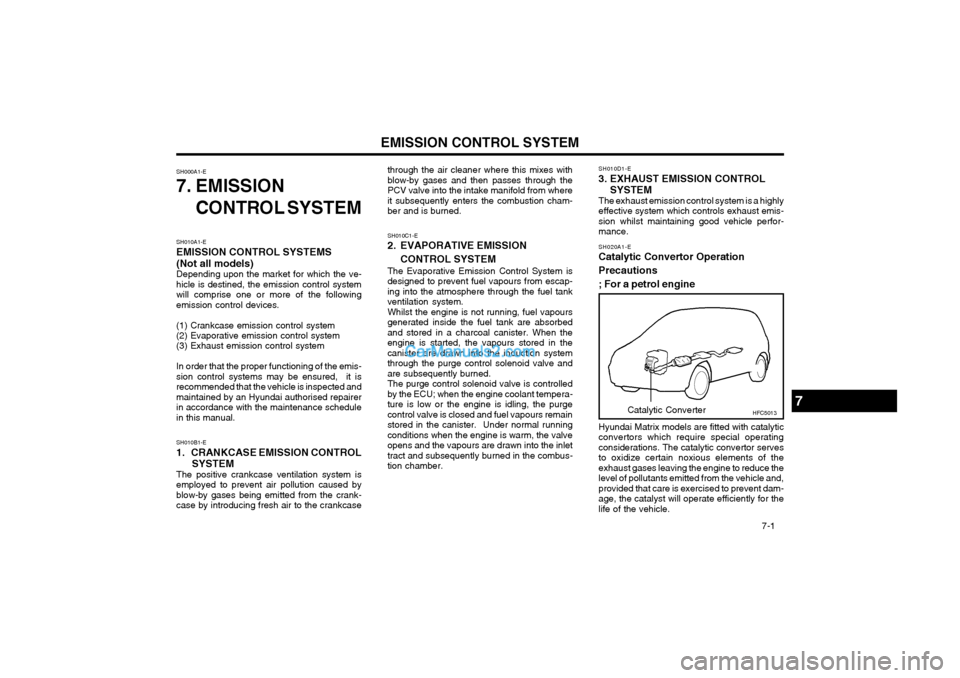
Catalytic Convertor Operation Precautions; For a petrol engine Hyundai Matrix models are fitted with catalytic convertors which require special operatingconsiderations. The catalytic convertor servesto oxidize certain noxious elements of theexhaust gases leaving the engine to reduce thelevel of pollutants emitted from the vehicle and,provided that care is exercised to prevent dam-age, the catalyst will operate efficiently for thelife of the vehicle.
7HFC5013
Catalytic Converter
Page 147 of 407

INDEX10-1
A ACCESSORY TRAY
........................................................................ 1-50
AIR CONDITIONING SWITCH ........................................................ 1-60
AIR CONDITIONING SYSTEM MAINTENANCE ...........................6-18
AIR CLEANER ELEMENT REPLACEMENT ..................................6-12
ANTENNA ......................................................................................... 1-64
ANTI-THEFT ALARM SYSTEM .... .......................................... 1-5 ~ 1-7
AUTO FUEL CUT SWITCH ............................................................. 1-53
AUTOMATIC TRANSAXLE ............................................................... 2-6
AUTOMATIC TRANSAXLE FLUID ................................................ 6-14
B BATTERY MAINTENANCE ............................................................. 6-21
BEFORE STARTING THE ENGINE ................................................. 2-2
BLEEDING THE FUEL SYSTEM ....................................................6-23
BONNET RELEASE ......................................................................... 1-51
BRAKE PEDAL FREEPLAY .................................... ........................ 6-19
BRAKE TRACTION CONTROL SYSTEM ................... ................... 2-10
BRAKE SYSTEM CHECKING ........................................................ 6-16CCARE OF SEAT
BELTS ................................................................. 1-14
CARGO AREA COVER ................................................................... 1-53
CATALYTIC CONVERTOR OPERATING PRECAUTIONS ............. 7-1
CENTRE VENTILATOR ................................................................... 1-55
CENTRAL DOOR LOCKS ................................................................. 1-5
CHANGING A FLAT TYRE ............................................................... 3-4
CHECKING THE CLUTCH FLUID.................................................. 6-17
CHILD-PROOF REAR DOOR LOCK ................................................ 1-4
CHILD RESTRAINT SYSTEM ............................................. 1-17 ~ 1-22
CIGAR LIGHTER ............................................................................. 1-42
CLUTCH PEDAL FREEPLAY ......................................................... 6-19
COMBINATION IGNITION SWITCH AND STEERING LOCK ........ 2-2
COOLANT TEMPERATURE GAUGE .............................................1-35
D DAILY OPERATING CHECKS .......................................................... 6-4
DIGITAL CLOCK .............................................................................. 1-42
DOOR LOCKS ................................................................................... 1-3
DOOR WINDOWS ............................................................................. 1-7 DRINK HOLDER .............................................................................. 1-43
DRIVE BELTS .................................................................................. 6-20
DRIVING FOR ECONOMY ............................................................. 2-11
JK000A1-A 10. INDEX
10
Page 149 of 407
INDEX10-3
J JUMP STARTING
.............................................................................. 3-1
K KEY POSITIONS ............................................................................... 2-2
LLIGHTING SWITCH ......................................................................... 1-38
LUGGAGE NET ............................................................................... 1-52
LUMBAR SUPPORT ADJUSTMENT ................................................ 1-9
M
MAINTENANCE AND SERVICING REQUIREMENTS .................... 5-1
MAINTENANCE UNDER SEVERE USAGE CONDITIONS ............ 5-5
MANUAL TRANSAXLE ...................................................................... 2-5
MANUAL TRANSAXLE LUBRICANT ..............................................6-14
MAP LIGHT ...................................................................................... 1-46
MULTI BOX .............................. ........................................................ 1-47
MULTI FUNCTION SWITCH ........................................................... 1-38
OOVERDRIVE SWITCH ....................................................................... 2-9 P PARKING BRAKE
............................................................................ 1-49
POWER OUTLET ............................................................................ 1-50
POWER STEERING FLUID LEVEL ............................................... 6-22
POWER STEERING HOSES .......................................................... 6-23
POWER WINDOW ............................................................................. 1-7
PROTECTING YOUR HYUNDAI FROM CORROSION .................. 4-1
R
REAR FOG AUDIBLE WARNING SOUND ....................................1-35
REAR FOG LIGHT SWITCH ........................................................... 1-41
REAR SEAT ARM REST ................................................................ 1-43
REAR SEAT WARNING .................................................................. 1-13
RECOMMENDED SHIFT SPEEDS .................................................. 2-6
REMOTE FUEL FILLER LID RELEASE ........................................ 1-51
REMOVAL OF WATER FROM THE FUEL FILTER ...................... 6-24
REPLACING LIGHT BULBS ........................................................... 6-24
ROOF RACK .................................................................................... 1-53
RUNNING IN ...................................................................................... 1-2
Page 150 of 407
INDEX
10-4
S SCHEDULED MAINTENANCE
.......................................................... 5-2
SEAT ADJUSTMENT .. .......................................................... 1-8 ~ 1-12
SEAT BELT PRECAUTIONS .......................................................... 1-13
SEAT BELTS ....................................................................... 1-14 ~ 1-17
SEAT CUSHION HEIGHT ADJUSTMENT .....................................1-10
SEAT WARMER .............................................................................. 1-12
SERVICE HISTORY .......................................................................... 5-1
SIDE VENTILATOR ......................................................................... 1-55
SMOOTH CORNERING ............. .....................................................2-12
SNOW TYRES ................................................................................... 8-1
SPARE WHEEL ................................................................................. 3-3
SPARKING PLUG REPLACEMENT ...............................................6-11
SPECTACLE CASE ......................................................................... 1-46
SUPPLEMENTAL RESTRAINT (AIRBAG) SYSTEM ......... 1-24 ~ 1-28
STARTING THE ENGINE ................................................................. 2-3
STEERING WHEEL FREEPLAY ....................................................6-19
STEERING WHEEL TILT LEVER ...................................................1-54
STEREO SOUND SYSTEM ................................................ 1-61 ~ 1-63
SUN-VISOR ...................................................................................... 1-54
SUNROOF ........................................................................................ 1-44TTAIL GATE
....................................................................................... 1-52
TOWING ATTACHMENTS .............................................................. 2-13
TRAILER AND CARAVAN TOWING ..............................................2-13
TRIP COMPUTER ........................................................................... 1-37
TYPE PRESSURES .......................................................................... 8-1
TYRE BALANCING ............................................................................ 8-2
TYRE CHAINS ................................................................................... 8-2
TYRE REPLACEMENT ..................................................................... 8-3
TYRE ROTATION .............................................................................. 8-2
U UNDER TRAY .................................................................................. 1-10
VVEHICLE IDENTIFICATION NUMBER ............................................. 8-1
VEHICLE TOWING OR RECOVERY ............................................... 3-8
WWHEEL REPLACEMENT .................................................................. 8-3
WINDSHIELD WASHER OPERATION ...........................................1-39
WINDSCREEN WASHER RESERVOIR REPLENISHMENT ...................................................................... 6-13
WINDSCREEN WIPER BLADES ................................................... 6-13
WINDSHIELD WIPER/WASHER SWITCH .....................................1-39
WINTER MOTORING ...................................................................... 2-12
Page 153 of 407
OWNER'S MANUAL A030A01FC-GAT Operation MaintenanceSpecifications All information in the Owner's Manual is current at the time of publication. Hyundai reserves the right to make changes at any time as part of our policy of continual product improvement may be carried out. This manual applies to current Hyundai models and explanations of optional as well as standard equipment are included. As a result, you may find material in this manual that does not apply to your specific vehicle. Please note that some models are equipped with Right-Hand Drive (RHD). The explanations and illustrations for some operations in RHD models are opposite of those written in this manual.
HFC2072
Page 154 of 407
RESPONSIBILITY FOR MAINTENANCE
The maintenance requirements for your new Hyundai are found in Section 5. As the owner, it is your responsibility to see that all maintenance operations specified by themanufacturer are carried out at the appropriate intervals. When the vehicle is used in severe driving conditions, more frequent maintenance is required for some operations. Maintenance requirements for severe operating conditions are also included in Section 5.
A020A01A-AAT
Page 155 of 407

A050A05A-AATHYUNDAI MOTOR COMPANY
Note: Because future owners will also need the information included in this manual, if you sell this
Hyundai, please leave the manual in the vehicle for their use. Thank you.
CAUTION:
Severe engine and transaxle damage may result from the use of poor quality fuels and lubricants that do not meet Hyundai specifications. You must always use high quality fuelsand lubricants that meet the specifications listed on Page 9-4 in the Vehicle Specifications section of the Owner's Manual. Copyright 2004 Hyundai Motor Company. All rights reserved. No part of this publication may be reproduced, stored in any retrieval system or transmitted in any form or by any means without the prior written permission of Hyundai Motor Company.
A040A01A-AAT
FOREWORD
Thank you for choosing Hyundai. We are pleased to welcome you to the growing number of discriminating people who drive Hyundais. The advanced engineering and high-quality construc- tion of each Hyundai we build is something of which we're very proud. Your Owner's Manual will introduce you to the features and operation of your new Hyundai. It is suggested that you read it carefully because the information it contains can contribute greatly to the satisfaction you receive from your new car. The manufacturer also recommends that all service and maintenance on your car be performed by an authorized Hyundai dealer. Hyundai dealers are prepared to provide high-quality service, maintenance and any other assistance that may be required.
!
Page 157 of 407
FEATURES OF YOUR HYUNDAIDRIVING YOUR HYUNDAI
WHAT TO DO IN AN EMERGENCY
CORROSION PREVENTION & APPEARANCE CARE VEHICLE MAINTENANCE REQUIREMENTS DO-IT-YOURSELF MAINTENANCE
EMISSION CONTROL SYSTEMS CONSUMER INFORMATIONVEHICLE SPECIFICATIONS
INDEX
TABLE OF CONTENTS
SECTION
5
1 2 3 4 6 7 8 9
10
Page 166 of 407
1FEATURES OF YOUR HYUNDAI
2
B010B01A-AAT What About Gasohol? Gasohol (a mixture of 90% unleaded gasoline and 10% ethanol or grain alcohol) may be used in your Hyundai.However, if your engine develops driveability problems, the use of 100% unleaded gasoline is recommended.Fuels with unspecified quantities of alcohol, or alcohols other than ethanol, should not be used.
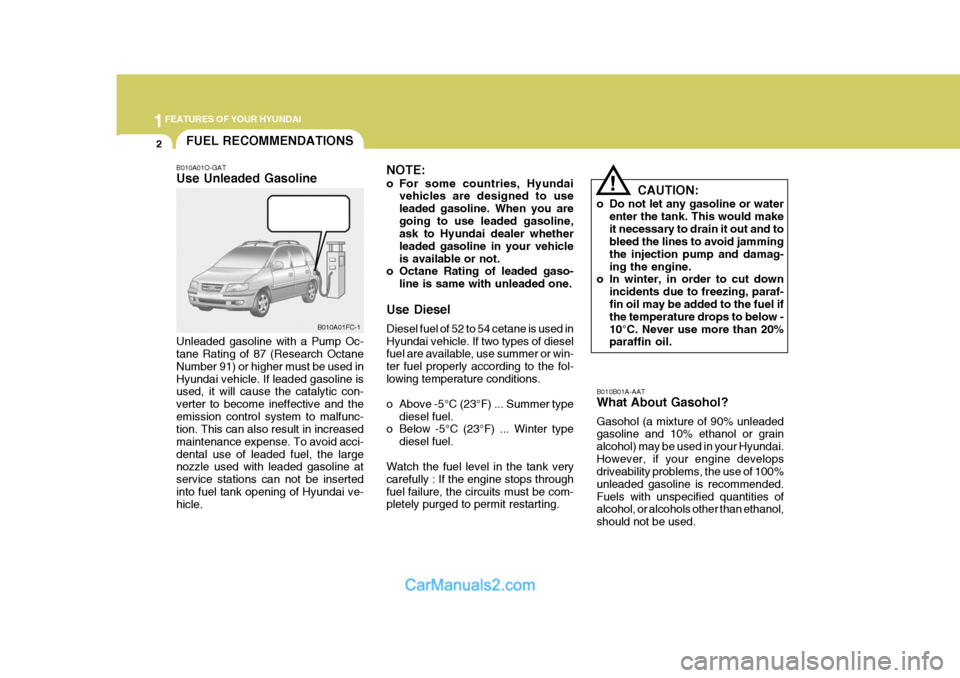
B010A01O-GAT Use Unleaded Gasoline Unleaded gasoline with a Pump Oc- tane Rating of 87 (Research Octane Number 91) or higher must be used inHyundai vehicle. If leaded gasoline is used, it will cause the catalytic con- verter to become ineffective and theemission control system to malfunc- tion. This can also result in increased maintenance expense. To avoid acci-dental use of leaded fuel, the large nozzle used with leaded gasoline at service stations can not be insertedinto fuel tank opening of Hyundai ve- hicle.
NOTE:
o For some countries, Hyundai
vehicles are designed to use leaded gasoline. When you aregoing to use leaded gasoline, ask to Hyundai dealer whether leaded gasoline in your vehicleis available or not.
o Octane Rating of leaded gaso-
line is same with unleaded one.
Use Diesel Diesel fuel of 52 to 54 cetane is used in Hyundai vehicle. If two types of diesel fuel are available, use summer or win- ter fuel properly according to the fol-lowing temperature conditions.
o Above -5°C (23°F) ... Summer type diesel fuel.
o Below -5°C (23°F) ... Winter type
diesel fuel.
Watch the fuel level in the tank very carefully : If the engine stops throughfuel failure, the circuits must be com- pletely purged to permit restarting. CAUTION:
o Do not let any gasoline or water enter the tank. This would make it necessary to drain it out and to bleed the lines to avoid jamming the injection pump and damag-ing the engine.
o In winter, in order to cut down
incidents due to freezing, paraf-fin oil may be added to the fuel if the temperature drops to below - 10°C. Never use more than 20% paraffin oil.
!
B010A01FC-1
FUEL RECOMMENDATIONS
Page 206 of 407
1FEATURES OF YOUR HYUNDAI
42
B240C03Y-GAT SRS Care The SRS is virtually maintenance-free and there are no parts you can safelyservice by yourself. The entire SRS system must be inspected by an au- thorized Hyundai dealer 10 years afterthe date that the vehicle was manufac- tured. Any work on the SRS system, such as removing, installing, repairing, or any work on the steering wheel must beperformed by a qualified Hyundai tech- nician. Improper handling of the SRS system may result in serious personalinjury.
!WARNING:
o The side impact airbag is supple- mental to the driver's and the passenger's seat belt systems and is not a substitute for them. Therefore your seat belts mustbe worn at all times while the vehicle is in motion. The airbags deploy only in certain side im-pact conditions severe enough to cause significant injury to the vehicle occupants.
o For best protection from the side
impact airbag system and toavoid being injured by the de- ploying side impact airbag, both front seat occupants should sitin an upright position with the seat belt properly fastened. The driver's hands should be placedon the steering wheel at the 9:00 and 3:00 o'clock positions. The passenger's arms and handsshould be placed on their laps.
o Do not use any accessory seat
covers. o Use of seat covers could reduce
or prevent the effectiveness ofthe system.
o Do not install any accessories on
the side or near the side impactairbag.
o Do not use excessive force on
the side of the seat.
o Do not place any objects over the airbag or between the airbag andyourself.
o Do not place any objects (an umbrella, bag, etc.) between thefront door and the front seat.Such objects may become dan- gerous projectiles and cause in- jury if the supplemental side im-pact air bag inflates.
o To prevent unexpected deploy-
ment of the side impact air bagthat may result in personal in- jury, avoid impact to the side airbag sensor when the ignitionkey is on.