maintenance schedule Hyundai Matrix 2006 User Guide
[x] Cancel search | Manufacturer: HYUNDAI, Model Year: 2006, Model line: Matrix, Model: Hyundai Matrix 2006Pages: 490, PDF Size: 11.58 MB
Page 217 of 490
6
DO-IT-YOURSELF MAINTENANCE
11
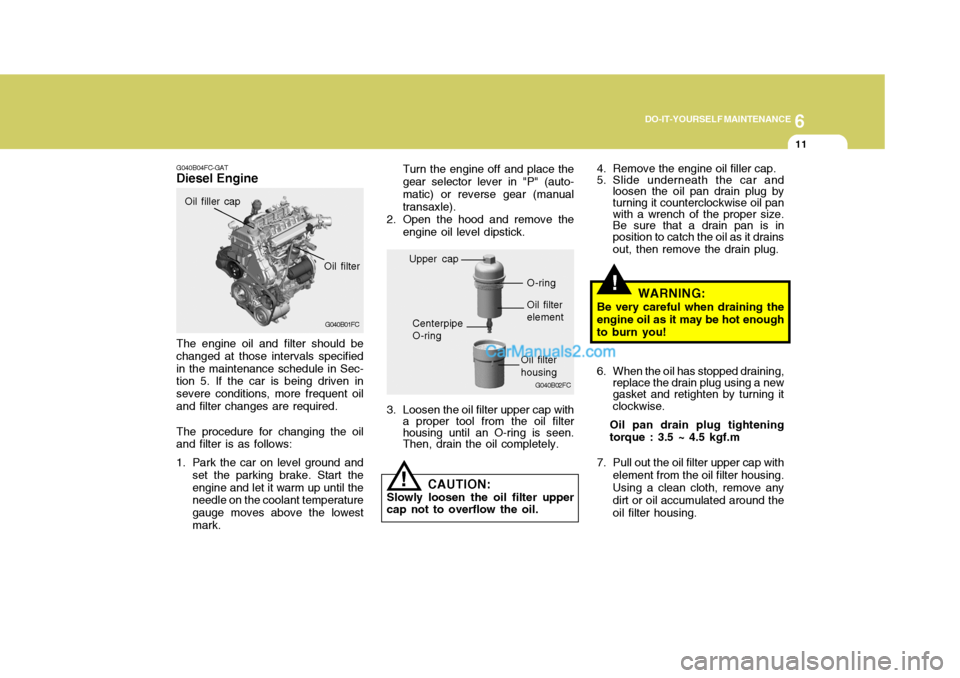
G040B04FC-GAT
Diesel Engine
Oil filter
G040B01FC
Oil filler cap
The engine oil and filter should be changed at those intervals specifiedin the maintenance schedule in Sec- tion 5. If the car is being driven in severe conditions, more frequent oiland filter changes are required. The procedure for changing the oil and filter is as follows:
1. Park the car on level ground and set the parking brake. Start the engine and let it warm up until the needle on the coolant temperature gauge moves above the lowestmark.
!
Centerpipe O-ring
G040B02FC
Upper capO-ring
Oil filter element
Oil filter housing
Turn the engine off and place the gear selector lever in "P" (auto-matic) or reverse gear (manual transaxle).
2. Open the hood and remove the engine oil level dipstick.
3. Loosen the oil filter upper cap with a proper tool from the oil filter housing until an O-ring is seen.Then, drain the oil completely. 4. Remove the engine oil filler cap.
5. Slide underneath the car and
loosen the oil pan drain plug by turning it counterclockwise oil pan with a wrench of the proper size. Be sure that a drain pan is inposition to catch the oil as it drains out, then remove the drain plug.
WARNING:
Be very careful when draining the engine oil as it may be hot enoughto burn you!
6. When the oil has stopped draining, replace the drain plug using a new gasket and retighten by turning it clockwise.
Oil pan drain plug tightening torque : 3.5 ~ 4.5 kgf.m
7. Pull out the oil filter upper cap with element from the oil filter housing. Using a clean cloth, remove any dirt or oil accumulated around the oil filter housing.
! CAUTION:
Slowly loosen the oil filter upper cap not to overflow the oil.
Page 220 of 490
6 DO-IT-YOURSELF MAINTENANCE
14
G050D01FC
G050D03A-AAT
To Change the Coolant
The coolant should be changed at those intervals specified in the ve- hicle maintenance schedule in Sec- tion 5.
! CAUTION:
Engine coolant can damage the finish of your car. If you spill en-gine coolant on the car, wash it off thoroughly with clean water.
1. Park the car on level ground, set the parking brake and remove the radia- tor cap when cool.
2. Be sure your drain receptacle is in
place. Open the drain cock on theradiator. Allow all the engine cool- ant to drain from the cooling sys- tem, then securely close the draincock.
3. Check Section 9 for the capacity of the cooling system in your car.Then, following the manufacturer's directions on the engine coolant container, add the appropriatequantity of coolant to the radiator.
!
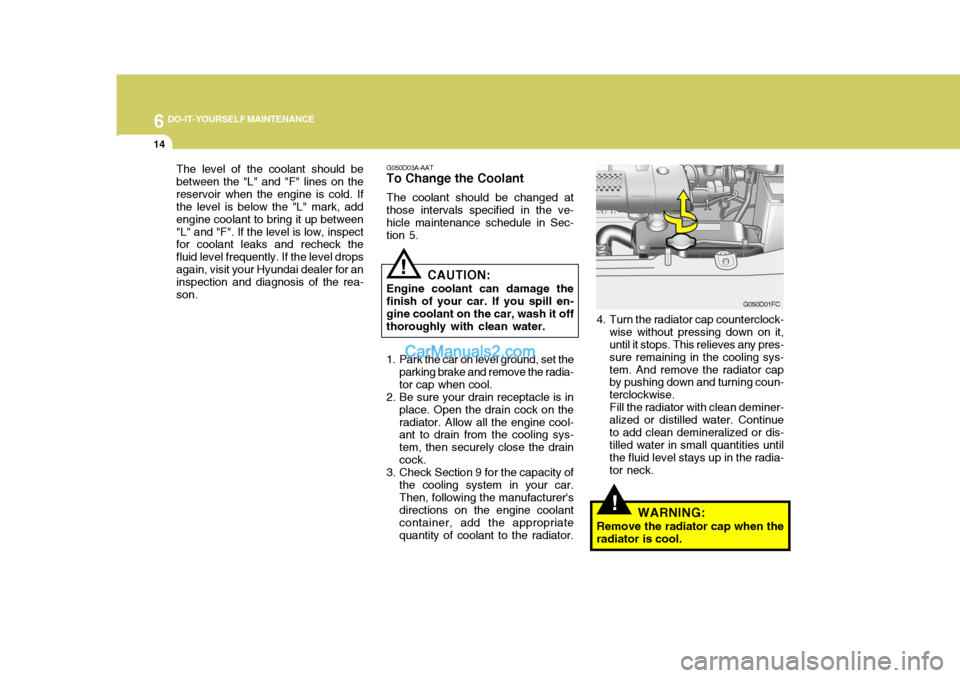
4. Turn the radiator cap counterclock-wise without pressing down on it, until it stops. This relieves any pres- sure remaining in the cooling sys-tem. And remove the radiator cap by pushing down and turning coun- terclockwise.Fill the radiator with clean deminer-alized or distilled water. Continueto add clean demineralized or dis- tilled water in small quantities until the fluid level stays up in the radia-tor neck.
WARNING:
Remove the radiator cap when theradiator is cool.
The level of the coolant should bebetween the "L" and "F" lines on thereservoir when the engine is cold. If the level is below the "L" mark, add engine coolant to bring it up between"L" and "F". If the level is low, inspect for coolant leaks and recheck the fluid level frequently. If the level dropsagain, visit your Hyundai dealer for an inspection and diagnosis of the rea- son.
Page 224 of 490
6 DO-IT-YOURSELF MAINTENANCE
18CHECKING THE TRANSAXLE OIL
!
CAUTION:
o Radiator antifreeze (engine cool- ant) should not be used in the washer system because it will damage the car's finish.
o The washer should not be oper- ated if the washer reservoir isempty. This can damage the washer fluid pump.
G100A01A
G100A02FC-GAT
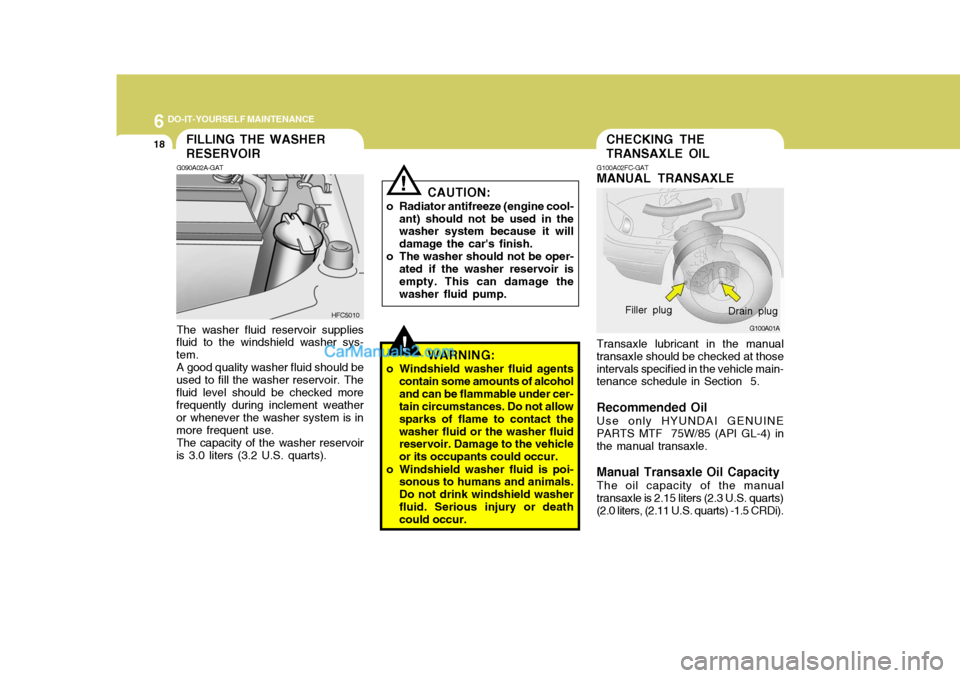
MANUAL TRANSAXLE
Transaxle lubricant in the manual
transaxle should be checked at those intervals specified in the vehicle main- tenance schedule in Section 5. Recommended Oil
Use only HYUNDAI GENUINE
PARTS MTF 75W/85 (API GL-4) in the manual transaxle. Manual Transaxle Oil Capacity
The oil capacity of the manual
transaxle is 2.15 liters (2.3 U.S. quarts) (2.0 liters, (2.11 U.S. quarts) -1.5 CRDi). Drain plug
Filler plug
!WARNING:
o Windshield washer fluid agents contain some amounts of alcohol and can be flammable under cer- tain circumstances. Do not allow sparks of flame to contact thewasher fluid or the washer fluid reservoir. Damage to the vehicle or its occupants could occur.
o Windshield washer fluid is poi- sonous to humans and animals.Do not drink windshield washerfluid. Serious injury or death could occur.
The washer fluid reservoir supplies
fluid to the windshield washer sys- tem.
A good quality washer fluid should be
used to fill the washer reservoir. Thefluid level should be checked more frequently during inclement weather or whenever the washer system is inmore frequent use. The capacity of the washer reservoir
is 3.0 liters (3.2 U.S. quarts).
FILLING THE WASHER RESERVOIR
G090A02A-GAT
HFC5010
Page 225 of 490
6
DO-IT-YOURSELF MAINTENANCE
19
!WARNING:
It is always better to check the transaxle oil level when the engine is cool or cold. If the engine is hot, you should exercise great cautionto avoid burning yourself on hot engine or exhaust parts. NOTE: It is recommended that the manual transaxle fluid should be checked by an authorized Hyundai dealer. G110A02E-AAT
AUTOMATIC TRANSAXLE
Transaxle fluid in the automatic transaxle should be checked at those intervals specified in the vehicle main- tenance schedule in Section 5. NOTE: Automatic transaxle fluid is a red in color. As driving distance increases, the fluid color turns darkish red gradually. It is a normal conditionand you should not judge the need to replace based upon the changing color.You must replace the automatictransaxle fluid in accordance withintervals specified in the vehicle maintenance schedule in section 5.
!
G110B04A-AAT Recommended Fluid Your Hyundai automatic transaxle is specially designed to operate with HYUNDAI GENUINE ATF SP III, DIA- MOND ATF SP-III, SK ATF SP III orother brands approved by Hundai Motor Co., Damage caused by a nonspecified fluid is not covered byyour new vehicle limited warranty.
CAUTION:
Use of aftermarket ATF additivesmay cause damage to the auto- matic transaxle. Only use HYUNDAI GENUINE ATF SP III, DIAMONDATF SP III, SK ATF SP III or other brands approved by Hyundai Mo- tor Co., If you are having yourvehicle serviced at a facility other than a Hyundai dealer, verify that the correct ATF is used for yourvehicle.
Page 227 of 490
6
DO-IT-YOURSELF MAINTENANCE
21
!
!
CHECKING THE BRAKES
G120A01A-AAT
! CAUTION:
Because brakes are essential to the safe operation of the car, it issuggested that they be checked and inspected by your Hyundai dealer. The brakes should bechecked and inspected for wear at those intervals specified in the vehicle maintenance schedule inSection 5.
WARNING (Diesel only):
Never work on injection system
with engine running or within 30 seconds after shutting off engine. High pressure pump, rail, injec-tors and high pressure pipes are subject to high pressure even af- ter the engine stopped. The fuel jetproduced by fuel leaks may cause serious injury, if it touch the body. People using pacemakers shouldnot move than 30cm closer to the ECU or wiring harness within the engine room while engine is run-ning, since the high currents in the Common Rail system produce considerable magnetic fields.
WARNING:
The cooling fan is controlled byengine coolant temperature andmay sometimes operate even when the engine is not running. Use extreme caution when workingnear the blades of the cooling fan so that you are not injured by a rotating fan blade. As the enginecoolant temperature decreases, the fan will automatically shut off. This is a normal condition.Fluid level should be within this range
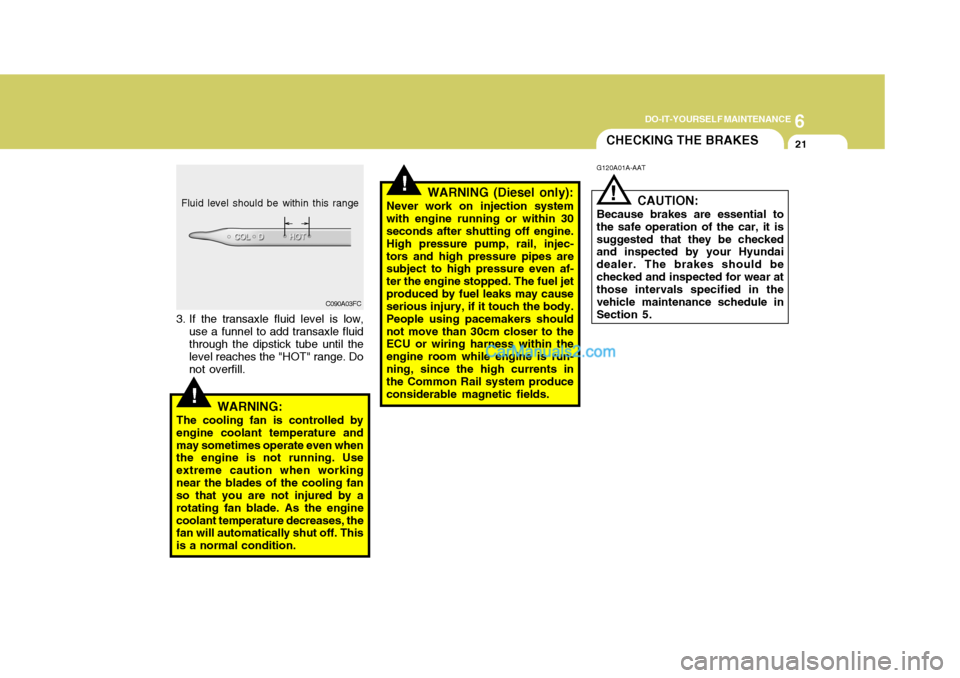
3. If the transaxle fluid level is low, use a funnel to add transaxle fluid through the dipstick tube until the level reaches the "HOT" range. Do not overfill. C090A03FC
Page 234 of 490
6 DO-IT-YOURSELF MAINTENANCE
28CHECKING AND REPLACING FUSES
G200A01A-AAT
Replacing a Fusible Link
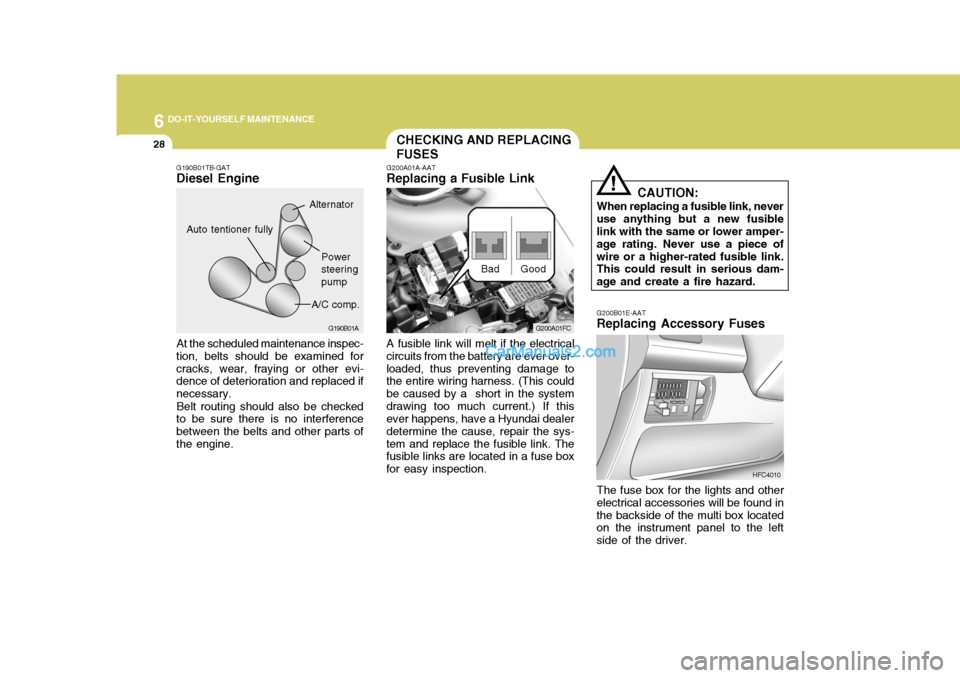
A fusible link will melt if the electrical
circuits from the battery are ever over- loaded, thus preventing damage to the entire wiring harness. (This could be caused by a short in the systemdrawing too much current.) If this ever happens, have a Hyundai dealer determine the cause, repair the sys-tem and replace the fusible link. The fusible links are located in a fuse box for easy inspection. Good
Bad
G200B01E-AAT
Replacing Accessory Fuses
HFC4010
CAUTION:
When replacing a fusible link, neveruse anything but a new fusible link with the same or lower amper- age rating. Never use a piece ofwire or a higher-rated fusible link. This could result in serious dam- age and create a fire hazard.
!
G200A01FC
G190B01A
Power steeringpump
A/C comp.
Auto tentioner fully
Alternator
G190B01TB-GAT Diesel Engine
At the scheduled maintenance inspec-
tion, belts should be examined for cracks, wear, fraying or other evi- dence of deterioration and replaced if necessary.
Belt routing should also be checked
to be sure there is no interferencebetween the belts and other parts ofthe engine.
The fuse box for the lights and other
electrical accessories will be found inthe backside of the multi box located on the instrument panel to the left side of the driver.
Page 250 of 490
7EMISSION CONTROL SYSTEMS
2EMISSION CONTROL SYSTEMS
H010A01A-GAT
(If Installed)
Your Hyundai is equipped with an
emission control system to meet all requirements of the Emission prohibi- tion rules of your province.
There are three emission control sys-
tems which are as follows.
(1) Crankcase emission control sys- tem
(2) Evaporative emission control sys- tem
(3) Exhaust emission control system
In order to assure the proper function
of the emission control systems, it is recommended that you have your carinspected and maintained by an au- thorized Hyundai dealer in accordance with the maintenance schedule in thismanual. H010B01A-AAT
1. Crankcase Emission Control
System
The positive crankcase ventilation
system is employed to prevent airpollution caused by blow-by gasesbeing emitted from the crankcase. This system supplies fresh filtered air to the crankcase through the air in-take hose. Inside the crankcase, the fresh air mixes with blow-by gases, then passes through the PCV valveinto the induction system.
H010C01E-GAT
2. Evaporative Emission Control
System
The Evaporative Emission Control
System is designed to prevent fuel vapors from escaping into the atmo- sphere. Canister
While the engine is inoperative, fuel
vapors generated inside the fuel tank are absorbed and stored in the canis- ter. When the engine is running, thefuel vapors absorbed in the canister are drawn into the induction system through the purge control solenoidvalve. Purge Control Solenoid Valve (PCSV)
The purge control solenoid valve is
controlled by the Engine Control Mod- ule (ECM); when the engine coolant temperature is low during idling, the PCSV closes so that evaporated fuelis not taken into the engine. After the engine warms-up during ordinary driv- ing, the PCSV opens so as to intro-duce evaporated fuel to the engine.
H010D01A-AAT
3. Exhaust Emission Control
System
The Exhaust Emission Control Sys-
tem is a highly effective system which controls exhaust emissions while maintaining good vehicle performance.
Page 267 of 490

10INDEX
4
Heating and VentilationAir flow control ........................................................ 1-85
Air intake control .................................................... 1-87
Bi-level heating ....................................................... 1-88
Fan speed control ................................................... 1-84
Heating controls ...................................................... 1-87
Temperature control ................................................ 1-84
High-mounted Rear Stoplight .....................................1-76
Hood Release ............................................................ 1-76
Horn ........................................................................... 1-82
I Ignition Sw itch ............................................................. 2-3
Immobilizer S ystem ..................................................... 1-5
Instrument Cluster and Indicator .................. 1-44 ~ 1-47
Interior Light Interior light ............................................................. 1-71
Map light ................................................................. 1-71
Intermittent Wiper ...................................................... 1-62
J Jump Starting .............................................................. 3-3
K
Keys ............................................................................ 1-4 If you lose your keys ............................................. 3-15
Positions ................................................................... 2-4 L Lubrication Chart
.......................................................... 9-4
Luggage Net .............................................................. 1-80
MMaintenance Intervals Explanation of scheduled maintenance items .......... 5-8Maintenance under severe usage conditions ............ 5-7
Scheduled maintenance .................................. 5-4 ~ 5-6
Service requirements ................................................ 5-2
Mirror
Day-night inside rearview ....... .................................1-75
Outside rearvi ew ..................................................... 1-73
Multi Box ................................................................... 1-72
O
Odometer ................................................................... 1-56
Outside Rearview Mirror Heater................................. 1-74
PParking Brake ............................................................ 1-68
Power Outlet .............................................................. 1-66
Power Steering Fluid Level ....................................... 6-34
Pre-tensioner Seat Belt ............................................. 1-35
Page 272 of 490
Responsibilty For Maintenance
It is the responsibility of the vehicle owner/driver to ensure that all routine mainte- nance services are undertaken in line with the recommendations specified in Section 5 of this manual. In addition, in order to ensure continued validity of the new vehiclewarranty and safe operation of the vehicle, non scheduled maintenance/running repairs should be undertaken at the earliest available opportunity. Under severe operating conditions, more frequent maintenance is required. Detailsof the maintenance schedule for such conditions are also given in section 5. It is recommended that all maintenance operations and repairs are entrusted to a franchised Hyundai authorised repairer to ensure that the latest repair methods,specialised tooling and genuine Hyundai parts are used to ensure the continued reliability and safety of the vehicle.
SA020A1-E
Page 386 of 490
2
DRIVING YOUR HYUNDAI
11
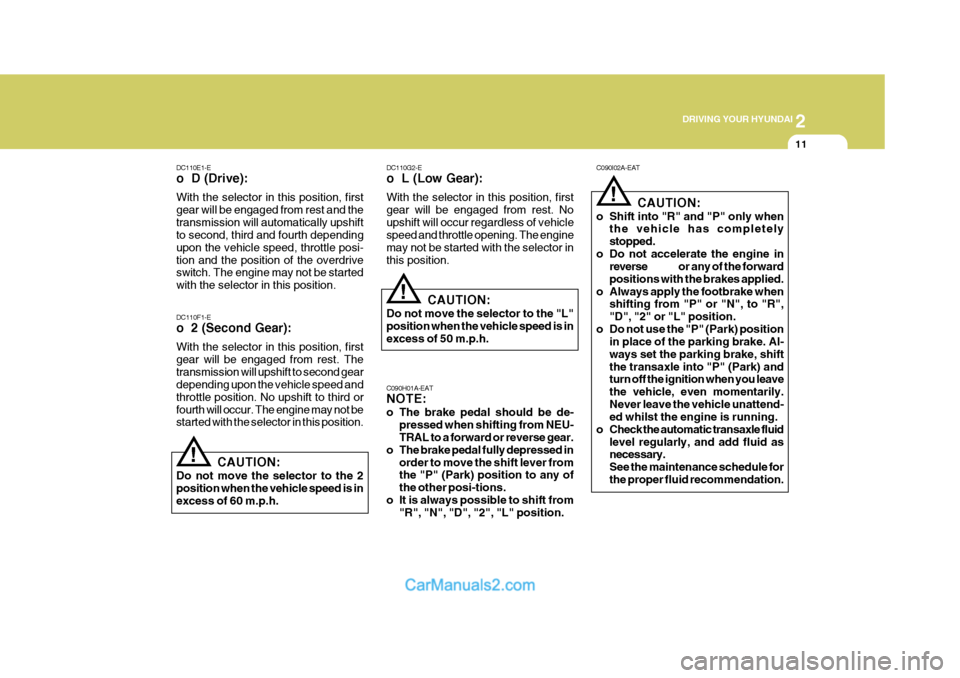
DC110G2-E o L (Low Gear): With the selector in this position, first gear will be engaged from rest. Noupshift will occur regardless of vehicle speed and throttle opening. The engine may not be started with the selector inthis position. C090I02A-EAT
CAUTION:
o Shift into "R" and "P" only when the vehicle has completelystopped.
o Do not accelerate the engine in reverse or any of the forward
positions with the brakes applied.
o Always apply the footbrake when shifting from "P" or "N", to "R","D", "2" or "L" position.
o Do not use the "P" (Park) position in place of the parking brake. Al-ways set the parking brake, shiftthe transaxle into "P" (Park) and turn off the ignition when you leave the vehicle, even momentarily.Never leave the vehicle unattend- ed whilst the engine is running.
o Check the automatic transaxle fluid level regularly, and add fluid asnecessary. See the maintenance schedule forthe proper fluid recommendation.
!
DC110E1-E o D (Drive): With the selector in this position, first gear will be engaged from rest and thetransmission will automatically upshift to second, third and fourth depending upon the vehicle speed, throttle posi-tion and the position of the overdrive switch. The engine may not be started with the selector in this position. DC110F1-E o 2 (Second Gear): With the selector in this position, first gear will be engaged from rest. Thetransmission will upshift to second gear depending upon the vehicle speed and throttle position. No upshift to third orfourth will occur. The engine may not be started with the selector in this position.
!
CAUTION:
Do not move the selector to the 2 position when the vehicle speed is in excess of 60 m.p.h.
! CAUTION:
Do not move the selector to the "L" position when the vehicle speed is inexcess of 50 m.p.h. C090H01A-EAT NOTE:
o The brake pedal should be de- pressed when shifting from NEU- TRAL to a forward or reverse gear.
o The brake pedal fully depressed in order to move the shift lever fromthe "P" (Park) position to any of the other posi-tions.
o It is always possible to shift from "R", "N", "D", "2", "L" position.