maintenance schedule Hyundai Matrix 2006 Owner's Guide
[x] Cancel search | Manufacturer: HYUNDAI, Model Year: 2006, Model line: Matrix, Model: Hyundai Matrix 2006Pages: 490, PDF Size: 11.58 MB
Page 393 of 490
2 DRIVING YOUR HYUNDAI
18
o Keep your car in good condition. For
better fuel economy and reduced maintenance costs, maintain your car in accordance with the mainte- nance schedule in Section 5. If youdrive your car in severe conditions, more frequent maintenance is re- quired (see Section 5 for details).
o Keep your car clean. For maximum service, your car should be keptclean and free of corrosive materi-als. It is especially important that mud, dirt, ice, etc. not be allowed to accumulate on the underside of thecar. This extra weight can result in increased fuel consumption and also contribute to corrosion.
o Travel lightly. Don't carry unneces- sary weight in your car. Weight is anenemy of good fuel economy.
o Don't let the engine idle longer than necessary. If you are waiting (andnot in traffic), turn off your engine andrestart only when you're ready to go.
SC150A1-F You can save fuel and get more miles from your car if you follow these sug-gestions:
o Drive smoothly. Accelerate at a
moderate rate. Don't make "jack- rabbit" starts or full-throttle shifts and maintain a steady cruising speed. Don't race between stoplights. Try toadjust your speed to that of the other traffic so you don't have to change speeds unnecessarily.Avoid heavy traffic whenever pos- sible. Always maintain a safe dis- tance from other vehicles so you canavoid unnecessary braking. This also reduces brake wear.
o Drive at a moderate speed. The faster you drive, the more fuel your caruses. Driving at a moderate speed, especially on the highway, is one ofthe most effective ways to reduce fuel consumption.
DRIVING FOR ECONOMY
o Don't "ride" the brake or clutch pedal.This can increase fuel consumption and also increase wear on these components. In addition, driving with your foot resting on the brake pedalmay cause the brakes to overheat, which reduces their effectiveness and may lead to more serious con-
sequences.
o Take care of your tyres. Keep them
inflated to the recommended pres-sure. Incorrect infla-tion, either too much or too little, results in unneces- sary tyre wear. Check the tyre pres-sures at least once a month.
o Be sure that the wheels are aligned
correctly. Improper alignment canresult from hitting curbs or driving too fast over irregular surfaces. Poor alignment causes faster tyre wearand may also result in other prob- lems as well as greater fuel con- sumption.
Page 420 of 490
Maintenance and Servicing Requirements ................... 5-2
Scheduled Maintenance ............................................... 5-3
Maintenance Under Severe Usage Conditions ............ 5-6
Explanation of Scheduled Maintenance Items .............. 5-7
5
VEHICLE MAINTENANCE REQUIREMENTS
5
Page 421 of 490
5VEHICLE MAINTENANCE REQUIREMENTS
2
SF030B1-E
SERVICE HISTORY
It is important that all scheduled main-
tenance services are recorded in the warranty and service passport to en- sure that proof of maintenance is avail-able when warranty service is required.
SF020C2-E
Specified Scheduled Procedures
The Specified scheduled procedures
are listed in the maintenance chartsbeginning at page 5-3. The operations specified must be performed at the time or mileage intervals shown irre-spective of whether the mileage inter- val has been reached before the speci- fied time interval.
Certain lubricants and components
degrade with both time and mileage(e.g. engine oil and brake fluid) andtherefore it is not permissable to base the maintenance schedule upon mile- age alone. It is strongly recommendedthat the maintenance operations are
SF020A1-E To ensure the continued reliability and safety of the vehicle, certain routine maintenance operations are requiredat specific mileage or time intervals.It is the responsibility of the vehicleowner to ensure that the maintenanceschedules shown in both this Owners Manual and the Warranty and Service Passport are adhered to.The new vehicle warranty may beinvalidated if the routine maintenanceoperations are not performed in line with the recommendations outlined and the safety and durability of the vehicleadversely affected.It is recommended that all mainte-nance operations with the exception ofthe daily operating checks are en- trusted to a Hyundai authorised re- pairer to ensure that the latest repairand maintenance procedures and specialised servicing tools are em- ployed.In addition, the use of genuine Hyundaireplacement parts will ensure that thevehicle safety and performance will not be compromised.
performed by the factory-trained or distributor-trained technicians at yourHyundai authorised repairer because of the need for specialised knowledge and tooling and to ensure that nopossibility of invalidating the manufac- turers warranty exists.
The maintenance schedules relate to
vehicles operated under normal condi-tions, vehicles which are operated under adverse conditions will requiremore frequent maintenance which is described at page 5-6. NOTE:
Service schedules may change de-
pending on individual country needs. Please ask your localHyundai authorised repairer for a copy of the service schedule that relates to that country.
MAINTENANCE AND SERVICING REQUIREMENTS
NOTE:The inspection and testing of cer-
tain electronic fuel injection/engine management and automatic trans- mission control systems requirespecialised electronic equipment specifically designed for Hyundai vehicles. The use of general pur-pose electrical test equipment may result in damage to the control unit microprocessors.
Page 422 of 490
5
VEHICLE MAINTENANCE REQUIREMENTS
3
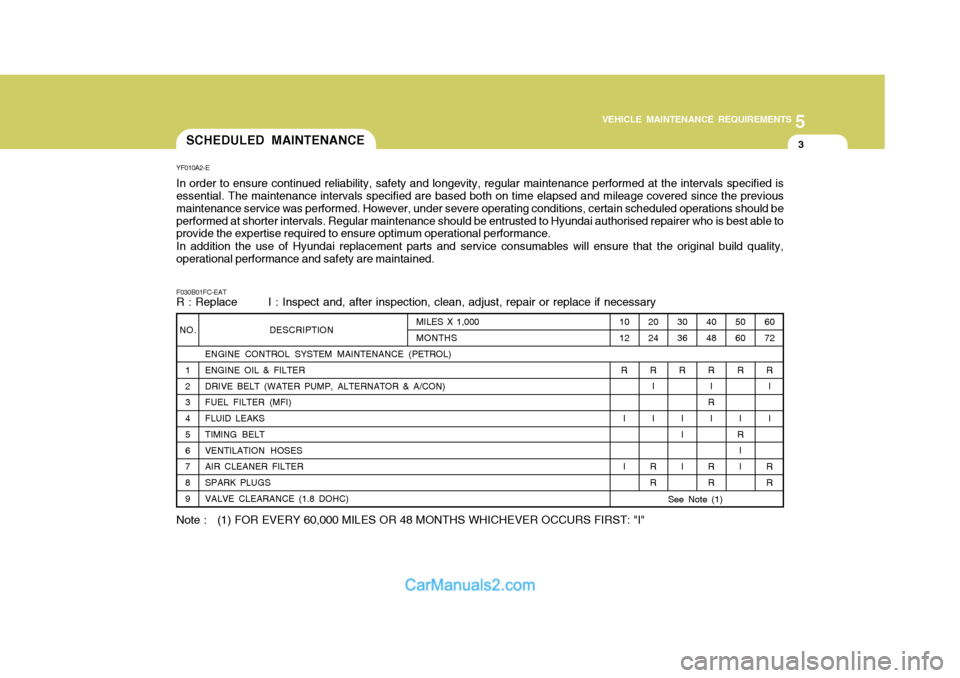
NO.
1 2 3 4 5 6 7 8 9 DESCRIPTION
ENGINE CONTROL SYSTEM MAINTENANCE (PETROL)ENGINE OIL & FILTER DRIVE BELT (WATER PUMP, ALTERNATOR & A/CON) FUEL FILTER (MFI) FLUID LEAKS TIMING BELT VENTILATION HOSES AIR CLEANER FILTER SPARK PLUGS VALVE CLEARANCE (1.8 DOHC)
YF010A2-E In order to ensure continued reliability, safety and longevity, regular maintenance performed at the intervals specified is essential. The maintenance intervals specified are based both on time elapsed and mileage covered since the previous maintenance service was performed. However, under severe operating conditions, certain scheduled operations should be
performed at shorter intervals. Regular maintenance should be entrusted to Hyundai authorised repairer who is best able to provide the expertise required to ensure optimum operational performance. In addition the use of Hyundai replacement parts and service consumables will ensure that the original build quality, operational performance and safety are maintained. F030B01FC-EAT R : Replace I : Inspect and, after inspection, clean, adjust, repair or replace if necessary60 72
R I I
R R
50 60
R
I
R II
4048
R I
R I
R R
30 36
R
II I
20 24
R I I
R R
10 12
R
I I
MILES X 1,000 MONTHS
See Note (1)
Note : (1) FOR EVERY 60,000 MILES OR 48 MONTHS WHICHEVER OCCURS FIRST: "I" SCHEDULED MAINTENANCE
Page 426 of 490

5
VEHICLE MAINTENANCE REQUIREMENTS
7EXPLANATION OF SCHEDULED MAINTENANCE ITEMS
!
6ZF060M1-A
o Engine Oil and Filter
The engine oil and filter should be changed at the intervals specified in the maintenance schedule. If the car is being driven in severe conditions,more frequent oil and filter changes are required. 6ZF060B1-A
o Drive Belts
Inspect all drive belts for evidence of cuts, cracks, excessive wear or oil contamination and replace if neces- sary. Drive belts should be checkedperiodically for proper tension and ad- justed as necessary. 6ZF060C1-A
o Fuel Filter A clogged filter can limit the speed at which the vehicle may be driven, dam- age the emission system and cause hard starting. If an excessive amountof foreign matter accumulates in the fuel tank, the filter may require re- placement more frequently.After installing a new filter, run theengine for several minutes, and checkfor leaks at the connections.
WARNING (Diesel only):
Never work on injection system with engine running or within 30 sec- onds after shutting off engine. Highpressure pump, rail, injectors and high pressure pipes are subject to high pressure even after the enginestopped. The fuel jet produced by fuel leaks may cause serious injury, if it contacts the body. People usingpacemakers should ensure that they keep a distance of 30cm from the ECU or wiring harness within theengine room whilst engine is run- ning, since the high currents in the Common Rail system produce con-siderable magnetic fields.
6ZF060D2-A
o Fuel lines, Fuel Hoses and
Connections
Check the fuel lines, fuel hoses and connections for leakage and damage. Replace any damaged or leaking parts immediately.
Page 428 of 490

5
VEHICLE MAINTENANCE REQUIREMENTS
9
6ZF070F1-A
o Brake Hoses and Lines Visually check for proper installation, chafing, cracks, deterioration and any leakage. Replace any deteriorated or damaged parts immediately. 6ZF070G2-A
o Brake Fluid Check brake fluid level in the brake fluid reservoir. The level should be between "MIN" and "MAX" marks on the side of the reservoir. Use onlyhydraulic brake fluid conforming to DOT 3 or DOT 4.
6ZF070H1-A
o Rear Brake Drums And
Linings/Parking Brake
Check the rear brake drums and lin-
ings for scoring, burning, leaking fluid, broken parts, and excessive wear. In- spect the parking brake system in- cluding the parking brake lever andcables. For detailed service proce- dures, refer to the Shop Manual.
6ZF070D1-A
o Manual Transaxle Oil
Inspect the manual transaxle oil ac-
cording to the maintenance schedule. NOTE:
If the oil level is low, check for
possible leaks before adding oil. Do not overfill. F070E05A-AAT
o Automatic Transaxle Fluid The fluid level should be in the "HOT" range of the dipstick, after the engine and transaxle are at normal operating temperature. Check the automatictransaxle fluid level with the engine running and the transaxle in neutral, with the parking brake properly ap-plied. Use Hyundai Genuine ATF SP- III, DIAMOND ATF SP-III, SK ATF SP-III or other brands approved byHyundai Motor Co., when adding or changing fluid.
6ZF070C1-A
o Engine Coolant
The coolant should be changed at
the intervals specified in the mainte-nance schedule.
Page 439 of 490
6 OWNER MAINTENANCE
10
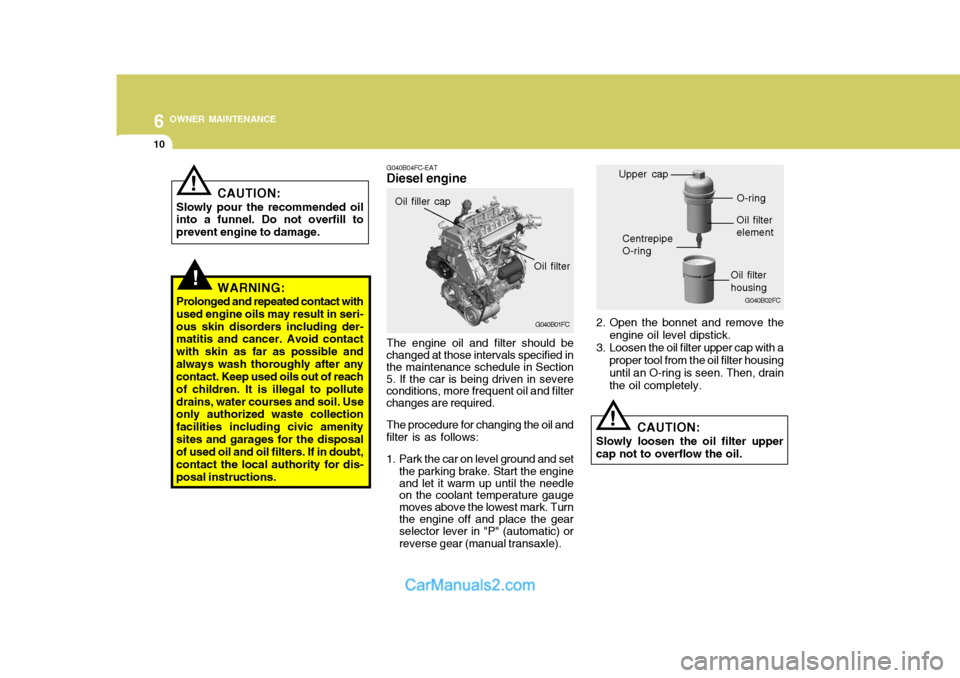
G040B04FC-EAT
Diesel engine
Oil filter
G040B01FC
Oil filler cap
Centrepipe O-ring G040B02FC
Upper capO-ring
Oil filter element
Oil filterhousing
The engine oil and filter should be
changed at those intervals specified in the maintenance schedule in Section 5. If the car is being driven in severe conditions, more frequent oil and filter changes are required.
The procedure for changing the oil and
filter is as follows:
1. Park the car on level ground and set the parking brake. Start the engine and let it warm up until the needle on the coolant temperature gauge moves above the lowest mark. Turn the engine off and place the gear selector lever in "P" (automatic) or reverse gear (manual transaxle). 2. Open the bonnet and remove the
engine oil level dipstick.
3. Loosen the oil filter upper cap with a proper tool from the oil filter housing until an O-ring is seen. Then, drainthe oil completely.
CAUTION:
Slowly loosen the oil filter uppercap not to overflow the oil.
!
!
CAUTION:
Slowly pour the recommended oil into a funnel. Do not overfill to prevent engine to damage.!
WARNING:
Prolonged and repeated contact with used engine oils may result in seri- ous skin disorders including der- matitis and cancer. Avoid contact with skin as far as possible andalways wash thoroughly after any contact. Keep used oils out of reach of children. It is illegal to pollutedrains, water courses and soil. Use only authorized waste collection facilities including civic amenitysites and garages for the disposal of used oil and oil filters. If in doubt, contact the local authority for dis-posal instructions.
Page 441 of 490

6 OWNER MAINTENANCE
12
!
ENGINE COOLANT CHECK- ING AND REPLACING
SG050B1-E Coolant recommended G050B01FC
SG050A1-E
WARNING:
Do not remove the radiator cap when the engine is hot, since the system is pressurised and coolant may be ejected from the radiator resultingin scalding.
G050B02FC
Petrol engine Diesel engine
Only ethylene glycol based coolantwith a corrosion inhibitor suited to alu- minium alloy engine components should be used in the cooling system. No further additives or inhibitors should be used. The coolant specific gravityshould be checked as prescribed in the maintenance schedule to ensure adequate frost and corrosion protec-tion. In addition, the engine coolant must be replaced at the specified in- terval since the corrosion inhibitor prop-erties deteriorate with time. It is important to note that whilst an
increase in the concentration of antifreeze gives an increase in the level of frost protection, a solution which is in excess of 65% anti freeze will result inreduced frost protection and engine overheating. Therefore the recom- mended concentration of 50% shouldnot be exceeded for general use. The use of methanol based anti freeze
compounds may result in engine over-heating and will invalidate the vehicle warranty.
NOTE: It is imperative that vehicles fitted
with an air conditioning system have a coolant concentration of the rec-ommended strength at all times. The use of the air conditioning sys- tem when the cooling system isfilled with water only will result in the heater matrix freezing and sub- sequently bursting.
Page 442 of 490

6
OWNER MAINTENANCE
13
SG050C1-E
To Check the Coolant Level If the level is below the "L" mark, add coolant of the correct concentrationuntil the level is between the "L" and "F" marks. If the level falls below the "L" mark on a regular basis despitebeing topped up, consult a Hyundai authorised repairer.
G050C01FC G050C02FC
Petrol engine
Diesel engine
The engine coolant level may be observed through the side of the plas- tic coolant reservoir (expansion tank) when the engine is cold.
G050D01FC
SG050D2-E
To Change the Coolant
The coolant should be changed at
those intervals specified in the vehicle maintenance schedule in Section 5.
NOTE: Care should be taken to ensure that
coolant is not allowed to spill onto the paintwork since the finish maybecome damaged. If coolant spill- age occurs, the affected area should be rinsed thoroughly with water.
1. Park the vehicle on level ground
and ensure that the parking brake is firmly applied, and the engine al- lowed to cool. Do not attempt this operation whilst the engine is hot since burning or scalding may result. 2. Prepare a suitable receptacle to
collect the displaced coolant and position this under the radiator drain tap.
3. With the heater temperature control set to the "HOT" position, removethe radiator cap and open the radia- tor drain tap.
4. When the engine coolant has drained completely, close the drain tap en-suring that this is not over tight- ened.
5. Prepare a suitable quantity of new engine coolant (refer to section 9)and pour this into the radiator.
Page 448 of 490

6
OWNER MAINTENANCE
19
G100B01L
!
CHECKING THE TRANSAXLE OIL
SG100A1-E
MANUAL TRANSAXLE LUBRI-CANT
The manual transaxle lubricant must
be checked and or changed at the intervals specified in the maintenanceschedule. Only those lubricants speci- fied should be used in order to prevent gear shifting difficulties or transaxledamage. WARNING:
The transaxle lubricant level should only be checked when the engine is cold to preclude the possibility ofpersonal injury by contact with hot components. Recommended Oil Use only HYUNDAI GENUINE PARTS
MTF 75W/85 (API GL-4) in the manual transaxle. Transaxle Lubricant Level Checking Ensure that the vehicle is parked on level ground with the parking brakefirmly applied and the engine cool. Remove the level plug from the transaxle when lubricant should beginto drip from the level hole. If the level is low and no lubricant is seen to drip, add the required quantity of lubricantand replace the plug.
G100A01A
Drain plug
Filler plug