ECU Hyundai Matrix 2006 Owner's Guide
[x] Cancel search | Manufacturer: HYUNDAI, Model Year: 2006, Model line: Matrix, Model: Hyundai Matrix 2006Pages: 490, PDF Size: 11.58 MB
Page 203 of 490
5VEHICLE MAINTENANCE REQUIREMENTS
8EXPLANATION OF SCHEDULED MAINTENANCE ITEMS
!
F060M01A-AAT o Engine Oil and Filter The engine oil and filter should be changed at the intervals specified in the maintenance schedule. If the car is being driven in severe conditions,more frequent oil and filter changes are required. F060B01A-AAT
o Drive Belts Inspect all drive belts for evidence of cuts, cracks, excessive wear or oil saturation and replace if necessary. Drive belts should be checked periodi-cally for proper tension and adjusted as necessary. F060C01A-AAT
o Fuel Filter
A clogged filter can limit the speed at
which the vehicle may be driven, dam-age the emission system and cause hard starting. If an excessive amountof foreign matter accumulates in the fuel tank, the filter may require re- placement more frequently. After installing a new filter, run the
engine for several minutes, and checkfor leaks at the connections. Fuel fil- ters should be installed by trained technicians. WARNING (Diesel only):
Never work on injection system with engine running or within 30 sec- onds after shutting off engine. Highpressure pump, rail, injectors and high pressure pipes are subject to high pressure even after the enginestopped. The fuel jet produced by fuel leaks may cause serious injury, if it touch the body. People usingpacemakers should not move than 30cm closer to the ECU or wiring harness within the engine roomwhile engine is running, since the high currents in the Common Rail system produce considerable mag-netic fields.
F060D01TB-AAT
o Fuel Lines, Fuel Hoses and Connections
Check the fuel lines, fuel hoses and
connections for leakage and damage.Replace any damaged or leaking partsimmediately.
Page 204 of 490
5
VEHICLE MAINTENANCE REQUIREMENTS
9
F060H01A-AAT o Air Cleaner Filter A Genuine Hyundai air cleaner filter is recommended when the filter is re- placed. F060J01A-AAT o Spark Plugs Make sure to install new spark plugs of the correct heat range. F070B01A-GAT o Cooling System Check the cooling system part, such as radiator, coolant reservoir, hosesand connections for leakage and dam- age. Replace any damaged parts.
F060E01A-AAT
o Timing Belt
Inspect all parts related to the timing belt for damage and deformation. Re- place any damaged parts immediately. F060G01A-AAT
o Vapor Hose and Fuel Filler Cap
The vapor hose and fuel filler cap should be inspected at those intervals specified in the maintenance sched-ule. Make sure that a new vapor hose or fuel filler cap is correctly replaced. F060F01A-AAT
o Vacuum, Crankcase
Ventilation Hoses
Inspect the surface of hoses for evi-
dence of heat and/or mechanical dam-age. Hard and brittle rubber, cracking, tears, cuts, abrasions, and excessiveswelling indicate deterioration. Particu- lar attention should be paid to examin- ing those hose surfaces nearest tohigh heat sources, such as the ex- haust manifold.
Inspect the hose routing to assure that
the hoses do not come in contact withany heat source, sharp edges or mov- ing component which might cause heatdamage or mechanical wear. Inspect all hose connections, such as clamps and couplings, to make sure they aresecure, and that no leaks are present. Hoses should be replaced immedi- ately if there is any evidence of dete-rioration or damage. F060N02E-GAT
o Valve Clearance
Inspect excessive valve noise and/or engine vibration and adjust if neces- sary. A qualified technician shouldperform the operation.
Page 220 of 490
6 DO-IT-YOURSELF MAINTENANCE
14
G050D01FC
G050D03A-AAT
To Change the Coolant
The coolant should be changed at those intervals specified in the ve- hicle maintenance schedule in Sec- tion 5.
! CAUTION:
Engine coolant can damage the finish of your car. If you spill en-gine coolant on the car, wash it off thoroughly with clean water.
1. Park the car on level ground, set the parking brake and remove the radia- tor cap when cool.
2. Be sure your drain receptacle is in
place. Open the drain cock on theradiator. Allow all the engine cool- ant to drain from the cooling sys- tem, then securely close the draincock.
3. Check Section 9 for the capacity of the cooling system in your car.Then, following the manufacturer's directions on the engine coolant container, add the appropriatequantity of coolant to the radiator.
!
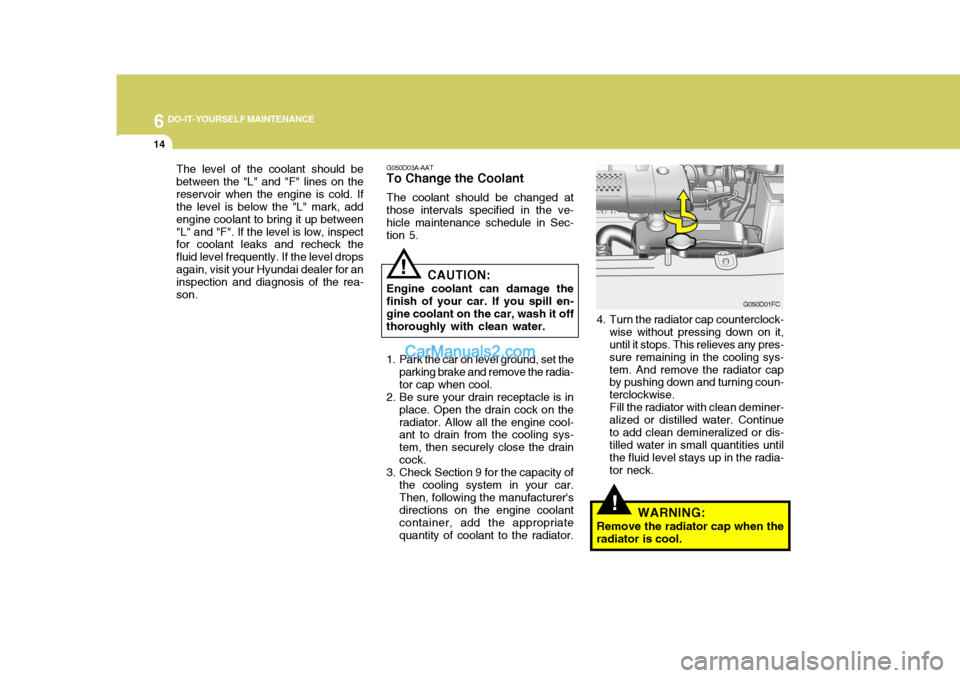
4. Turn the radiator cap counterclock-wise without pressing down on it, until it stops. This relieves any pres- sure remaining in the cooling sys-tem. And remove the radiator cap by pushing down and turning coun- terclockwise.Fill the radiator with clean deminer-alized or distilled water. Continueto add clean demineralized or dis- tilled water in small quantities until the fluid level stays up in the radia-tor neck.
WARNING:
Remove the radiator cap when theradiator is cool.
The level of the coolant should bebetween the "L" and "F" lines on thereservoir when the engine is cold. If the level is below the "L" mark, add engine coolant to bring it up between"L" and "F". If the level is low, inspect for coolant leaks and recheck the fluid level frequently. If the level dropsagain, visit your Hyundai dealer for an inspection and diagnosis of the rea- son.
Page 227 of 490
6
DO-IT-YOURSELF MAINTENANCE
21
!
!
CHECKING THE BRAKES
G120A01A-AAT
! CAUTION:
Because brakes are essential to the safe operation of the car, it issuggested that they be checked and inspected by your Hyundai dealer. The brakes should bechecked and inspected for wear at those intervals specified in the vehicle maintenance schedule inSection 5.
WARNING (Diesel only):
Never work on injection system
with engine running or within 30 seconds after shutting off engine. High pressure pump, rail, injec-tors and high pressure pipes are subject to high pressure even af- ter the engine stopped. The fuel jetproduced by fuel leaks may cause serious injury, if it touch the body. People using pacemakers shouldnot move than 30cm closer to the ECU or wiring harness within the engine room while engine is run-ning, since the high currents in the Common Rail system produce considerable magnetic fields.
WARNING:
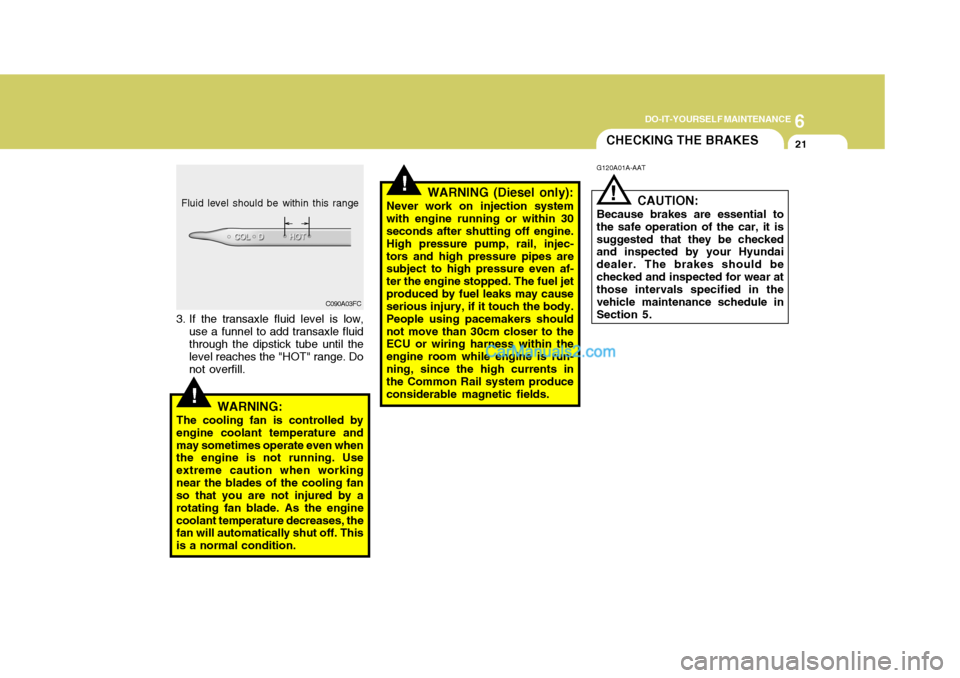
The cooling fan is controlled byengine coolant temperature andmay sometimes operate even when the engine is not running. Use extreme caution when workingnear the blades of the cooling fan so that you are not injured by a rotating fan blade. As the enginecoolant temperature decreases, the fan will automatically shut off. This is a normal condition.Fluid level should be within this range
3. If the transaxle fluid level is low, use a funnel to add transaxle fluid through the dipstick tube until the level reaches the "HOT" range. Do not overfill. C090A03FC
Page 245 of 490

6
DO-IT-YOURSELF MAINTENANCE
39FUSE PANEL DESCRIPTION
G200C03FC-GAT
Engine Compartment (Gasoline Engine)
G200C03FC
NOTE: Not all fuse panel descriptions in this manual may be applicable to your vehicle. It is accurate at the time of printing. When you inspect the fuse box on your vehicle, refer to the fuse box label.
PROTECTED COMPONENTS
Generator (A/CON, RR HTD, STOP, D/LOCK, HAZARD) Fuse Generator, Engine control relay, ECM Radiator fan relay Start relay, Ignition switch Blower relay Power window relay Condenser fan relay #1 ABS control module, ABS bleeding connector, ESP ABS control module, ABS bleeding connector, ESP Fuel pump relay Injector, lgnition coil MAP sensor, Oxygen sensor, CP sensor, Knock sensor, Throttle position sensor Audio, Room lamp, Overhead console lamp, lnstrument cluster DRL control module Horn relay A/C relay Front fog lamp relay ECM, TCM Tail lamp relay Left rear combi lamp, Left position lamp, Left License lamp Right rear combi lamp, Right position lamp, Right License lamp Left head lamp Right head lamp, (H/LP IND) Fuse
FUSE RATING
120A
40A 30A 20A 40A 40A 30A 20A 40A 40A 10A 15A 10A10A 15A 10A 10A 15A 10A 20A 10A 10A 15A 15A
DESCRIPTION
ALTB+
ECU RAD IGN
BLR
P/WIN
COND
ABSABS
F/PUMP INJ
SNSR
ROOM LP DRL
HORN
A/CON
FR FOG ECU
LP
TAIL LH
TAIL RH H/LP LH
H/LP RH
Page 247 of 490

6
DO-IT-YOURSELF MAINTENANCE
41
ALT B+
ECU RAD
IGN
BLR
P/WIN
COND ABSABS
F/PUMP ECU ECU
SNSR
ROOM LP DRL
HORN
A/CON
FR FOG ECU
LP
TAIL LH
TAIL RH H/LP LH
H/LP RH
PTC HTR 1
GLOW
PTC HTR 2 FFHS
PTC HTR 3 PROTECTED COMPONENTS
Generator (A/CON, RR HTD, STOP, D/LOCK, HAZARD) Fuse, Deicer Generator, Engine control relay, ECM Radiator fan relayStart relay, Ignition switchBlower relayPower window relayCondenser fan relay #1 ABS control module, ABS bleeding connector, ESP ABS control module, ABS bleeding connector, ESPFuel pump relayECM No.5 (Batt+)ECM No.4 (Batt+), Stop lamp switch, PTC heater relay #1Glow plug relay, Assistor heater relay 1/2, Stop lamp switch, TDC sensor, EGR act, Throttle plate act, VGT vacuum Audio, Room lamp, Overhead console lamp, lnstrument cluster, ETACM, Luggage lampDRL control moduleHorn relayA/C relayFront fog lamp relay ECM, TCM Tail lamp relayLeft rear combi lamp, Left position lamp, Left License lampRight rear combi lamp, Right position lamp, Right License lampLeft head lampRight head lamp, (H/LP IND) Fuse PTC heater relay #1 GLOW relayPTC heater relay #2FFHS relayPTC heater relay #3
FUSE RATING
140A40A30A30A40A40A 30A 30A40A40A10A30A 10A 15A 10A 15A10A10A 15A 10A20A10A10A15A 15A 40A80A40A30A40A
FUSE
FUSIBLE LINK DESCRIPTION
Page 248 of 490

6 DO-IT-YOURSELF MAINTENANCE
42
G200D01FC-GAT Inner Panel
G200D01FC
DESCRIPTIONH/LP IND
HTD IND
A/CON
RR HTD STOP
D/LOCK
HAZARD AUDIO
C/LIGHT A/B
A/B IND
T/SIG
ECU
ETACS
RR WPR
START
FRT WPR S/HTD
P/OUTLET
IG2
O/S MRRPROTECTED COMPONENTS
Head lamp indicator Defogger relay, Left(Right) outside mirror motor,Rear window motorA/C SwitchDefogger relayStop lamp switch, Power window relay Door lock(unlock) relay, ETACM, Sunroof relay Burglar alarm relay, Hazard relayAudioCigarette lighterSRS control moduleSRS IND. Hazard switch, Seat belt timer, Instrument cluster, ABS control module, Pre-excitation resistor, Washer motorECM, Vehicle speed sensor, TCM, Ignition coilETACM, A/T Shift leverRear wiper motor, Rear wiper relayStart relay Wiper relay, Washer motor, Wiper & Defogger timer Left (Right) front seat warmer switchFront (Rear) power outletETACM, Power window relay, Defogger relay, Sunroof relayHead lamp relay, Blower relayOutside mirror switch, Rear fog lamp relay
FUSE RATING
10A 10A 10A 30A10A15A 10A 10A15A10A10A 10A 15A 10A10A 10A 20A15A25A 10A 10A
Page 285 of 490

1
CONTROLS AND EQUIPMENT
5
B880C02A-GAT Key Numbers The vehicle key number is recorded upon a metal tag attached to the keys when the vehicle is first delivered to you.The key number should be recorded and kept in a safe place in case the need to order further keys arises. Newkeys are available from any Hyundai authorised repairer by quoting the rel- evant key number. In the interest of security, the metal tagattached to the keys which bears thekey number should be removed from the key ring after you receive your new vehicle. In addition, key numbers can-not be provided by Hyundai for security reasons. If you need additional keys or if youshould lose your keys, your Hyundai authorised repairer can make new keys.
AX10030A
!
DOOR
B040A02Y-EAT DOOR LOCKS
WARNING:
o Unlocked doors can be danger- ous. Before you drive away (espe- cially if there are children in the car), be sure that all the doors aresecurely closed and locked so that the doors cannot be inadvertently opened from the inside. This helpsensure that doors will not be opened accidentally. Also, when combined with the proper use ofseat belts, locking the doors helps keep occupants from being ejected from the car in case of an accident.
o Before opening the door, always look for and avoid oncoming traf-fic.
o In case of accident the door is unlocked automatically (Not allmodels)
Page 297 of 490

1
CONTROLS AND EQUIPMENT
17
3. To fold down the seatback , push and
hold the seatback folding lever to- ward the headrest, then push down the seatback.
4. Pull the seat cushion release lever upward, then fold up the seat cushion.
! 5. To secure the seat, hook the secur-
ing strap under the seat cushion to the headrest stay of front driver and passenger seat.
6. Insert the removed headrests be-
tween the seatback and seat cush-ion, so that they will not be thrown forward in the case of a sudden stop or an accident.
7. To return the seatback and seat cushion to its normal position, re-verse the above procedure.
o When you return the seatback to its upright position, always be sure it islocked into position by pulling andpushing on the top of seatback. WARNING:
o When you return the folded down seat back to its upright position, make sure the seat belts are in position to be accessible and tofunction properly.
o The purpose of the fold down rear
seat back and the fold forward rearseat cushion is to increase cargo space. Do not allow passengers to sit in the cargo area whilst the caris moving. This is not a proper seating position and no seat belts are available for use when the seat back is folded down. Passengers who are not properly seated andwearing seat belts could sustain serious injuries or death in case of an accident or a sudden stop.
o Objects should not extend higher than the top of the front seatbacks.This could allow cargo to slideforward and cause injury or dam- age during sudden stops.
!
CAUTION:
To prevent damage, ensure that the rear drinkholder, located in the rear console, is closed before folding the rear seatback and seat cushion. Seat cushion release lever
HFC2075
HFC2076
Securing strap
Page 304 of 490

1CONTROLS AND EQUIPMENT
24
B230A04P-EAT Children riding in the car should sit in the rear seat and must always be prop-erly restrained to minimise the risk of injury in an accident, sudden stop or sudden maneuver. According to acci-dent statistics, children are safer when properly restrained in the rear seats than in the front seat. Larger childrenshould use one of the seat belts pro- vided. You are required by law to use safetyrestraints for children. If small children ride in your vehicle you must put them in a child restraint system (safety seat).Children could be injured or killed in a crash if their restraints are not properly secured. For small children and babies,a child seat or infant seat must be used. Before buying a particular child restraint system, make sure it fits your car andseat belts, and fits your child. Follow all the instructions provided by the manu- facturer when installing the child re-straint system.CHILD RESTRAINT SYSTEM
!WARNING:
o A child restraint system must be placed in the rear seat. Never in- stall a child or infant seat on the front passenger's seat.Should an accident occur and cause the passenger side airbag to deploy, it could severely injureor kill an infant or child seated in an infant or child seat. Thus, only use a child restraint in the rearseat of your vehicle.
o Since a safety belt or child re-
straint system can become very hot if it is left in a closed vehicle, be sure to check the seat coverand buckles before placing a child there.
o When the child restraint system is not in use, fasten it with a safetybelt so that it will not be thrown forward in the case of a suddenstop or an accident. o Children who are too large to be in
a child restraint should still sit in the rear seat and be restrained with the available lap/shoulderbelts. Never allow children to ride in the front passenger seat.
o Always make sure that the shoul-
der belt portion of the outboardlap/shoulder belt is positioned midway over the shoulder, neveracross the neck or behind the back. Moving the child closer to the centre of the vehicle may helpprovide a good shoulder belt fit. The lap belt portion of the lap/ shoulder belt or the centre seat lapbelt must always be positioned as low as possible on the child's hips and as snug as possible.
o If the seat belt will not properly fit the child, we recommend the useof an approved booster seat in therear seat in order to raise the child's seating height so that the seat belt will properly fit the child.
o Never allow a child to stand up or kneel on the seat.