remove Hyundai Matrix 2006 Owner's Guide
[x] Cancel search | Manufacturer: HYUNDAI, Model Year: 2006, Model line: Matrix, Model: Hyundai Matrix 2006Pages: 490, PDF Size: 11.58 MB
Page 103 of 490
1
FEATURES OF YOUR HYUNDAI
89
1
FEATURES OF YOUR HYUNDAI
89
To remove frost or exterior fog on the windshield:
o Set the air flow control to the defrost
( ) position. (The A/C will turn on automatically and "Fresh" mode willbe activated.)
o Set the temperature control to warm.
o Set the fan speed control to position
"3" or "4".
NOTE: When the A/C is operated continu- ously on the floor-defrost level ( )or defrost level ( ), it may cause fog to form on the exterior windshield. If this occurs, set the air flow control tothe face level position ( )and fan speed control to the low position. B730A01L-GAT Operation Tips
o To keep dust or unpleasant fumes
from entering the car through the ventilation system, temporarily set the air intake control at "Recircula-tion". Be sure to return the control to "Fresh" when the irritation has passed to keep fresh air in the ve-hicle. This will help keep the driver alert and comfortable.
o Air for the heating/cooling system is
drawn in through the grilles just aheadof the wind-shield. Care should be taken that these are not blocked byleaves, snow, ice or other obstruc- tions.
o To prevent interior fog on the wind-
shield, set the air intake control tothe fresh air ( ) position, fan speed to the desired position, turn on the airconditioning system, and adjust tem- perature control to desired tempera- ture.
HFC2108
AIR CONDITIONING SYSTEM
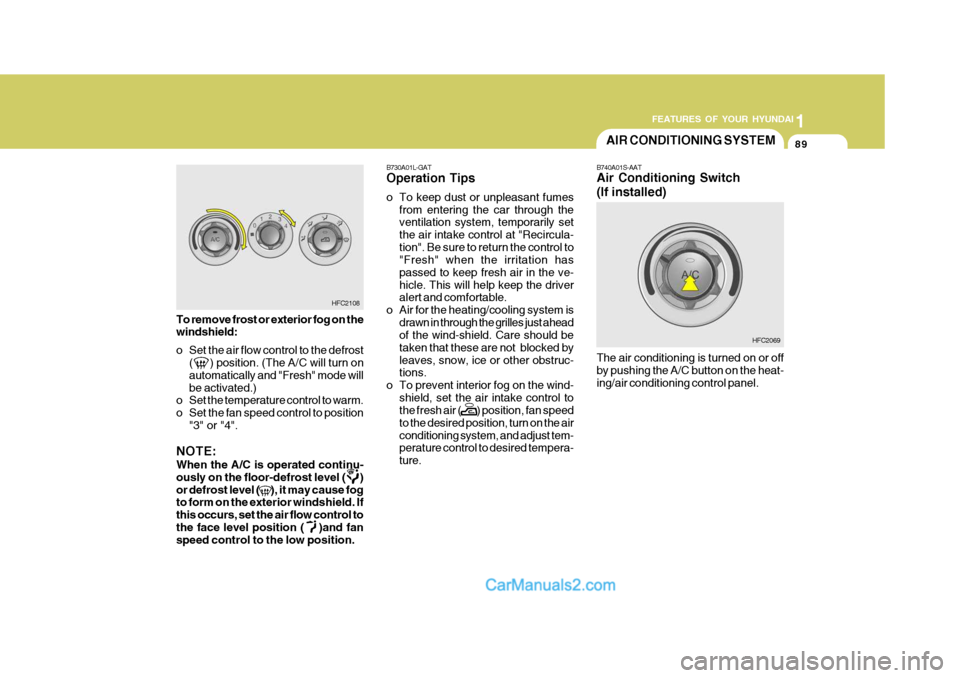
B740A01S-AAT Air Conditioning Switch (If installed) The air conditioning is turned on or off by pushing the A/C button on the heat- ing/air conditioning control panel. HFC2069
Page 128 of 490
1FEATURES OF YOUR HYUNDAI
114
B260D03O-AAT
1. Playing CD
o Insert the CD with the label facingupward.
o Insert the CD to start CD playback, during radio operation.
o When a disc is in the CD deck, if you press the CD button, the CD player will begin playing even if the radio is being used.
o The CD player can be used when the ignition switch is in either the "ON" or"ACC" position.
2. FF/REW ( / ) If you want to fast forward or reverse through the compact disc track, push and hold in the FF ( ) or REW ( ) button.When you release the button, the com- pact disc player will resume playing. 3. TRACK UP/DOWN
o The desired track on the disc cur-
rently being played can be selected using the track number.
o Press once to skip forward to the
beginning of the next track.Press once to skip back to the beginning of the track.
4. SCAN Button
o Press the SCAN button to playback the first 10 seconds of each track.
o Press the SCAN button again within 10 sec. when you have reached the desired track.
5. REPEAT Button
o To repeat the track you are currently listening to, press the RPT button. To cancel , press again.
o If you do not release RPT operation
when the track ends, it will automati-cally be replayed. This process will be continued until you push the button again. 6. EJECT Button When the EJECT button is pressed with a CD loaded, the CD will eject. NOTE:
o If the CD does not operate prop-
erly or if the ER2 fault code is displayed, use one of two meth- ods to reset the CD deck function.
- Remove the audio fuse for 5
minutes. Then, reinstall the audio fuse.
- Disconnect the negative termi- nal of the battery and wait 5minutes. Then reconnect the negative battery terminal.
o When replacing the fuse, replace it with a fuse having the correctcapacity.
o The preset station frequencies are all erased when the car battery isdisconnected. Therefore, all datawill have to be set again if this should occur.
o Do not add any oil to the rotating parts. Keep magnets, screwdriv-ers and other metallic objects away from the tape mechanism and head.
Page 148 of 490

1FEATURES OF YOUR HYUNDAI
134
CAUTION:
o Be sure to remove the antenna before washing the car in an auto- matic car wash or it may be dam- aged.
o Before entering a place with a low
height clearance, be sure to adjustthe roof antenna low.
o When reinstalling your antenna, it
is important that it is fully tight-ened to ensure proper reception.
!
This antenna is a removable type. To remove the antenna, turn the antennacounterclockwise. To install the an- tenna, turn the antenna clockwise.
Page 152 of 490

2 DRIVING YOUR HYUNDAI
4
!
KEY POSITIONS
C070C01E
C070C01A-AAT To remove the ignition key
1. Turn the ignition key to the "ACC"
position.
2. Simultaneously push and turn the
ignition key counterclockwise from the "ACC" position to the "LOCK" position.
3. The key can be removed in the "LOCK" position.LOCK
ACC
ON
o "ON" When the key is in the "ON position, the ignition is on and all accessories may be turned on. If the engine is notrunning, the key should not be left in the "ON" position. This will discharge the battery and may also damage theignition system.
o "ACC" With the key in the "ACC" position, the some electrical accessories (radio, etc.) may be operated.
o "LOCK" The key can be removed or inserted in this position. To protect against theft, the steering wheel locks by removing the key. NOTE: To unlocking the steering wheel, insert the key, and then turn thesteering wheel and key simulta- neously.
C040A01A-AAT
C040A01E
LOCK
ACC
ON
START
WARNING:
The engine should not be turned off or the key removed from the ignition key cylinder while the ve- hicle is in motion. The steeringwheel is locked by removing the key.
o "START" The engine is started in this position. It will crank until you release the key. NOTE: Do not hold the key in the "START" position for more than 15 seconds. START
Page 169 of 490
2
DRIVING YOUR HYUNDAI
21
C160H01A-AAT Use Approved Anti-Freeze in Window Washer System To keep the water in the window washer system from freezing, add an approvedanti-freeze solution in accordance with instructions on the container. Window washer anti-freeze is available fromHyundai dealers and most auto parts outlets. Do not use engine coolant or other types of anti-freeze as thesemay damage the finish.
C160G02A-GAT To Keep Locks from Freezing To keep the locks from freezing, squirt an approved de-icer fluid or glycerineinto the key opening. If a lock is cov- ered with ice, squirt it with an approved de-icing fluid to remove the ice. If thelock is frozen internally, you may be able to thaw it out by using a heated key. Handle the heated key with careto avoid injury. NOTE: The proper temperature for using the immobilizer key is from -40°C (-40°F) to 80°C(176°F). If you heat the immobilizer key over 80°C toopen the frozen lock, it may cause damage to the transponder in its head.
C160D01A-AAT Check Battery and Cables Winter puts additional burdens on the battery system. Visually inspect thebattery and cables as described in Section 6. The level of charge in your battery can be checked by your Hyundaidealer or a service station.
C160F01A-AAT Check Spark Plugs and Ignition System Inspect your spark plugs as described in Section 6 and replace them if neces-sary. Also check all ignition wiring and components to be sure they are not cracked, worn or damaged in any way.
C160E01A-AAT Change to "Winter Weight" Oil if Necessary In some climates it is recommended that a lower viscosity "winter weight" oil be used during cold weather. See Section 9 for recommendations. If youaren't sure what weight oil you should use, consult your Hyundai dealer.
C160I01A-AAT Don't Let Your Parking Brake Freeze Under some conditions your parking brake can freeze in the engaged posi- tion. This is most likely to happenwhen there is an accumulation of snow or ice around or near the rear brakes or if the brakes are wet. If there is a riskthe parking brake may freeze, apply it only temporarily while you put the gear selector lever in "P" (automatic) or infirst or reverse gear (manual transaxle) and block the rear wheels so the car cannot roll. Then release the parkingbrake.
Page 177 of 490

3
WHAT TO DO IN AN EMERGENCY
3
!
JUMP STARTING
D010D01A-AAT If the Engine Stalls While Driving
1. Reduce your speed gradually, keep- ing a straight line. Move cautiously off the road to a safe place.
2. Turn on your emergency flashers.
3. Try to start the engine again. If your
vehicle will not start, contact a Hyundai dealer or seek other quali- fied assistance. D020A03A-AAT
HFC4002
Discharged battery
Booster battery
WARNING:
The gas produced by the battery during the jump-start operation ishighly explosive. If these instruc- tions are not followed exactly, seri- ous personal injury and damage tothe vehicle may occur! If you are not sure how to follow this proce- dure, seek qualified assistance.Automobile batteries contain sul- furic acid. This is poisonous and highly corrosive. When jump start-ing, wear protective glasses and be careful not to get acid on yourself, your clothing or on the car. o If you should accidentally get acid on
your skin or in your eyes, immedi-ately remove any contaminated cloth- ing and flush the area with clean water for at least 15 minutes. Thenpromptly obtain medical attention. If you must be transported to an emer- gency facility, continue to apply wa-ter to the affected area with a sponge or cloth.
o The gas produced by the battery
during the jump-start operation ishighly explosive. Do not smoke or allow a spark or an open flame in thevicinity.
o The battery being used to provide
the jump start must be 12-volt. If youcannot determine that it is a 12-volt battery, do not attempt to use it for the jump start.
o To jump start a car with a discharged battery, follow this procedure ex-actly:
1. If the booster battery is installed in another vehicle, be sure the twovehicles are not touching.
2. Turn off all unnecessary lights and
acces-sories in both vehicles.
Page 178 of 490
3 WHAT TO DO IN AN EMERGENCY
4IF THE ENGINE OVERHEATS
D030A02A-AAT If your temperature gauge indicates overheating, you experience a loss of power, or hear loud pinging or knock- ing, the engine is probably too hot. Ifthis happens to you, you should:
1. Pull off the road and stop as soon as it is safe to do so.
2. Place the gear selector lever in "P"
(automatic) or neutral (manual transaxle) and set the parking brake. If the air conditioning is on, turn it off.
3. If engine coolant is running out un- der the car or steam is coming outfrom the hood, stop the engine. Donot open the hood until the engine coolant has stopped running or the steaming has stopped. If there is novisible loss of engine coolant and no steam, leave the engine running and check to be sure the enginecooling fan is operating. If the fan is not running, turn the engine off.
4. Check to see if the water pump drive belt is missing. If it is not missing,check to see that it is tight. If the drive belt seems to be satisfactory,
3. Attach the clamps of the jumper
cable in the exact location shown.First, attach one clamp of the jumper cable to the positive (+) post or cable of the discharged battery. Thenattach the other end of the same cable to the positive (+) post or cable of the booster battery. Next,using the other cable, attach one clamp to the negative (-) post or cable of the booster battery. Thenattach the other end of that cable to a solid metal part of the engine away from the battery. Do not con-nect the cable to any moving part.
4. Start the engine in the car with the
booster battery and let it run for afew minutes. This will help to as- sure that the booster battery is fully charged. During the jumping opera-tion, run the engine in this vehicle at about 2,000 rpm.
5. Start the engine in the car with the discharged battery using the nor-mal starting procedure. After the engine starts, leave the jumpercables connected and let the engine run at fast idle or about 2,000 rpm for several minutes. 6. Carefully remove the jumper cables
in the reverse order of attachment.
If you do not know why your batterybecame discharged (because the lightswere left on, etc.), have the charging system checked by your Hyundai dealer.
Page 179 of 490
3
WHAT TO DO IN AN EMERGENCY
5
!
!
!
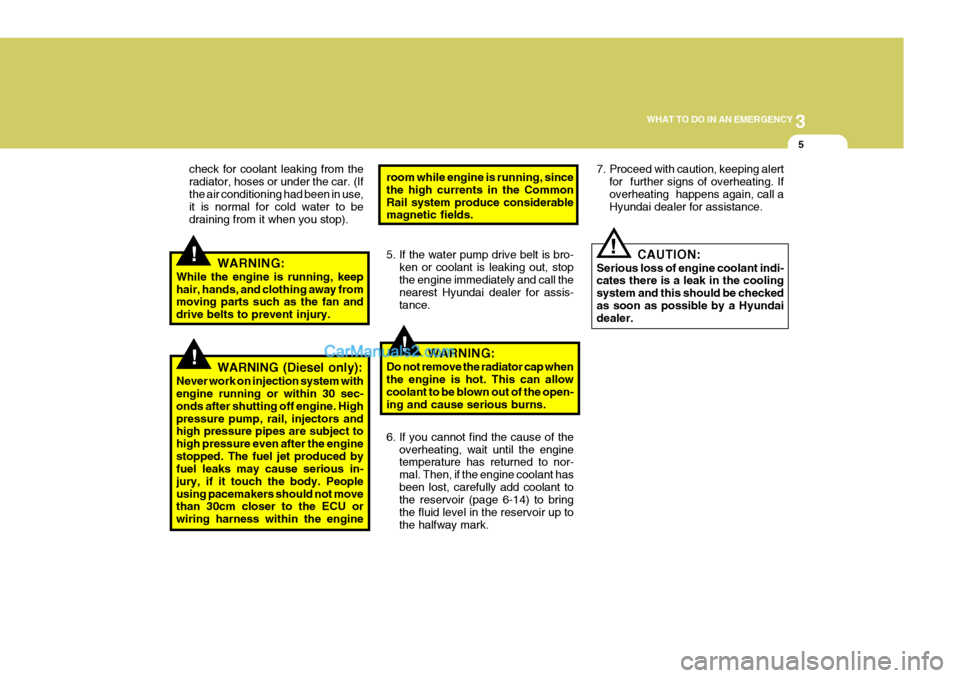
check for coolant leaking from the radiator, hoses or under the car. (Ifthe air conditioning had been in use, it is normal for cold water to be draining from it when you stop).
WARNING (Diesel only):
Never work on injection system with engine running or within 30 sec- onds after shutting off engine. Highpressure pump, rail, injectors and high pressure pipes are subject to high pressure even after the enginestopped. The fuel jet produced by fuel leaks may cause serious in- jury, if it touch the body. Peopleusing pacemakers should not move than 30cm closer to the ECU or wiring harness within the engine 5. If the water pump drive belt is bro-
ken or coolant is leaking out, stopthe engine immediately and call the nearest Hyundai dealer for assis- tance. CAUTION:
Serious loss of engine coolant indi- cates there is a leak in the cooling system and this should be checkedas soon as possible by a Hyundai dealer.
room while engine is running, since the high currents in the CommonRail system produce considerable magnetic fields.
6. If you cannot find the cause of the
overheating, wait until the engine temperature has returned to nor- mal. Then, if the engine coolant hasbeen lost, carefully add coolant to the reservoir (page 6-14) to bring the fluid level in the reservoir up tothe halfway mark.
WARNING:
While the engine is running, keephair, hands, and clothing away from moving parts such as the fan and drive belts to prevent injury.
WARNING:
Do not remove the radiator cap whenthe engine is hot. This can allowcoolant to be blown out of the open- ing and cause serious burns. 7. Proceed with caution, keeping alert
for further signs of overheating. If overheating happens again, call a Hyundai dealer for assistance.
!
Page 181 of 490
3
WHAT TO DO IN AN EMERGENCY
7IF YOU HAVE A FLAT TIRE
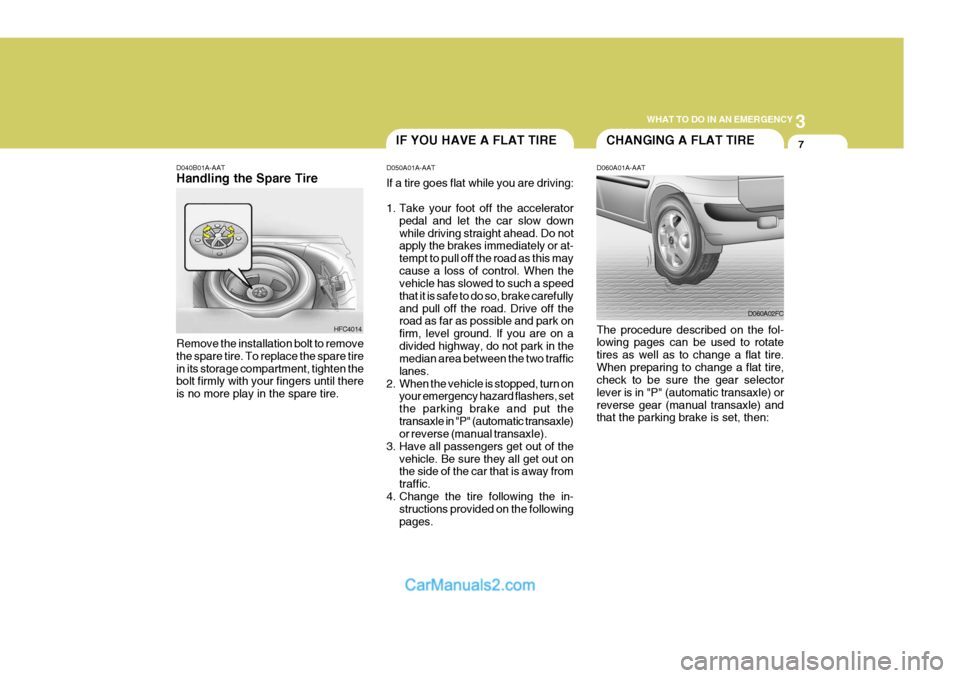
D040B01A-AAT Handling the Spare Tire
Remove the installation bolt to remove the spare tire. To replace the spare tirein its storage compartment, tighten the bolt firmly with your fingers until there is no more play in the spare tire. D050A01A-AAT If a tire goes flat while you are driving:
1. Take your foot off the accelerator
pedal and let the car slow down while driving straight ahead. Do not apply the brakes immediately or at- tempt to pull off the road as this maycause a loss of control. When the vehicle has slowed to such a speed that it is safe to do so, brake carefullyand pull off the road. Drive off the road as far as possible and park on firm, level ground. If you are on adivided highway, do not park in the median area between the two traffic lanes.
2. When the vehicle is stopped, turn on your emergency hazard flashers, setthe parking brake and put thetransaxle in "P" (automatic transaxle) or reverse (manual transaxle).
3. Have all passengers get out of the vehicle. Be sure they all get out onthe side of the car that is away from traffic.
4. Change the tire following the in- structions provided on the followingpages.
HFC4014CHANGING A FLAT TIRE
D060A01A-AAT The procedure described on the fol- lowing pages can be used to rotate tires as well as to change a flat tire.When preparing to change a flat tire, check to be sure the gear selector lever is in "P" (automatic transaxle) orreverse gear (manual transaxle) and that the parking brake is set, then: D060A02FC
Page 182 of 490
3 WHAT TO DO IN AN EMERGENCY
8
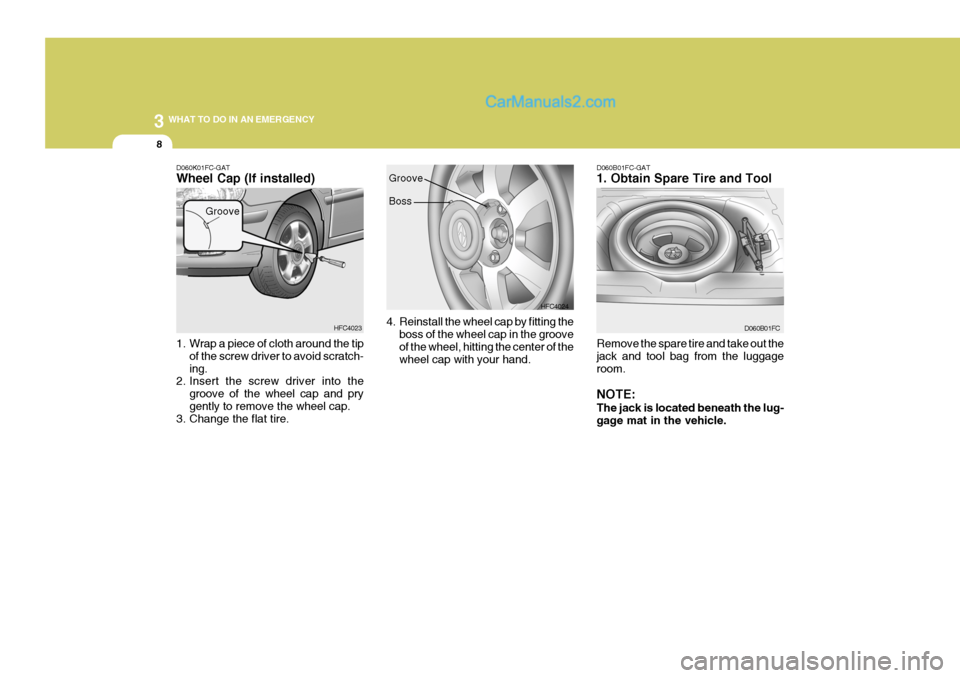
1. Wrap a piece of cloth around the tip
of the screw driver to avoid scratch- ing.
2. Insert the screw driver into the
groove of the wheel cap and prygently to remove the wheel cap.
3. Change the flat tire.
D060K01FC-GAT Wheel Cap (If installed)
HFC4023
Groove
4. Reinstall the wheel cap by fitting theboss of the wheel cap in the groove of the wheel, hitting the center of the wheel cap with your hand. HFC4024D060B01FC-GAT 1. Obtain Spare Tire and Tool Remove the spare tire and take out the jack and tool bag from the luggageroom. NOTE: The jack is located beneath the lug- gage mat in the vehicle.
D060B01FC
Boss
Groove