diesel Hyundai Matrix 2006 Workshop Manual
[x] Cancel search | Manufacturer: HYUNDAI, Model Year: 2006, Model line: Matrix, Model: Hyundai Matrix 2006Pages: 490, PDF Size: 11.58 MB
Page 405 of 490

3
IN CASE OF EMERGENCY
5
!
!
!WARNING:
Whilst the engine is running, keep hands and clothing away from mov- ing parts such as the fan and drive belts to prevent injury. 5. If the water pump drive belt is broken
or coolant is leaking out, stop theengine immediately and call the near- est Hyundai authorised repairer for assistance.
WARNING (Diesel only):
Never work on injection system with engine running or within 30 seconds after shutting off engine. High pres-sure pump, rail, injectors and high pressure pipes are subject to high pressure even after the enginestopped. The fuel jet produced by fuel leaks may cause serious injury, if it touch the body. People usingpacemakers should ensure that they keep a distance of 30cm from the ECU or wiring harness within theengine room whilst engine is run- ning, since the high currents in the Common Rail system produce con-siderable magnetic fields.!
WARNING:
Do not remove the radiator cap when the engine is hot since steam and boiling water may be ejected fromthe radiator resulting in burns or scalding.
6. If the cause of the overheating can- not be found, wait until the engine temperature has returned to normal. Then, if coolant has been lost, care-fully remove the radiator cap and add water to bring the fluid level in the reservoir up to the base of the radia-tor fill opening. Fill the coolant ex- pansion tank to the halfway mark.
7. Proceed with caution until it is estab- lished that the engine is operatingnormally. If the engine overheats repeatedly, the advice of a Hyundaiauthorised repairer should be sought. CAUTION:
Serious loss of coolant indicatesthere is a leak in the cooling system and this should be checked as soon as possible by a Hyundai authorisedrepairer.
Page 423 of 490
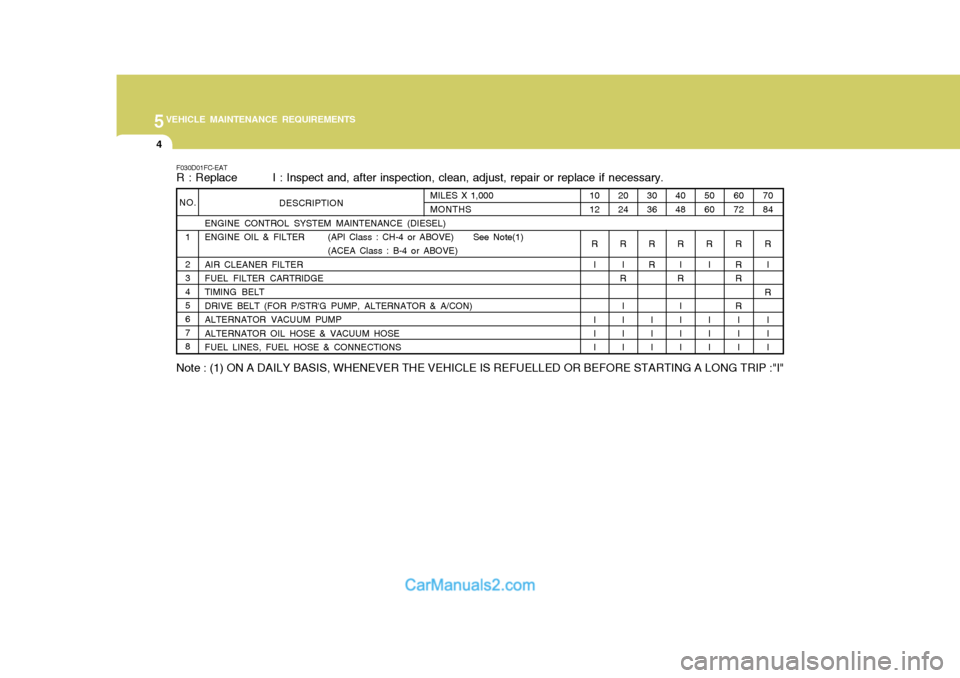
5VEHICLE MAINTENANCE REQUIREMENTS
4
NO.1 2 345678 ENGINE CONTROL SYSTEM MAINTENANCE (DIESEL)
ENGINE OIL & FILTER (API Class : CH-4 or ABOVE) See Note(1)
(ACEA Class : B-4 or ABOVE)
AIR CLEANER FILTER FUEL FILTER CARTRIDGE TIMING BELTDRIVE BELT (FOR P/STR'G PUMP, ALTERNATOR & A/CON)ALTERNATOR VACUUM PUMPALTERNATOR OIL HOSE & VACUUM HOSE FUEL LINES, FUEL HOSE & CONNECTIONS
F030D01FC-EAT
R : Replace I : Inspect and, after inspection, clean, adjust, repair or replace if necessary.
70 84
R I
R II I
60 72
R R R R I I I
50 60
R I I I I
40 48
R I
R
III I
30 36
R R
I I I
20 24
R I
R
III I
10 12
R I I I I
MILES X 1,000 MONTHSDESCRIPTION
Note : (1) ON A DAILY BASIS, WHENEVER THE VEHICLE IS REFUELLED OR BEFORE STARTING A LONG TRIP :"I"
Page 424 of 490
5
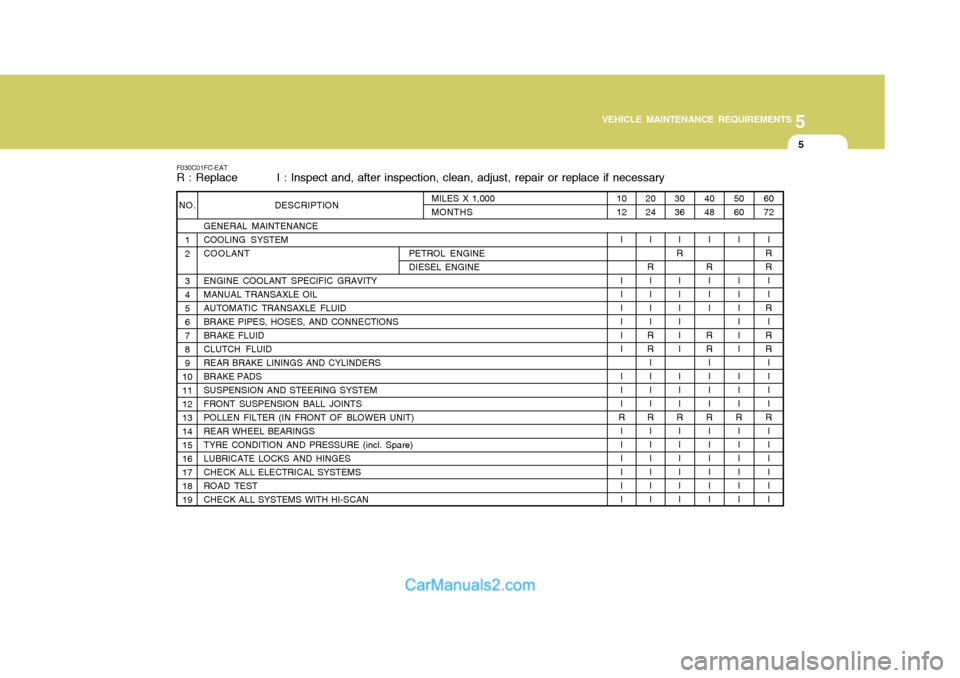
VEHICLE MAINTENANCE REQUIREMENTS
5
F030C01FC-EAT R : Replace I : Inspect and, after inspection, clean, adjust, repair or replace if necessary
DESCRIPTION
GENERAL MAINTENANCE COOLING SYSTEMCOOLANT PETROL ENGINEDIESEL ENGINE
ENGINE COOLANT SPECIFIC GRAVITYMANUAL TRANSAXLE OILAUTOMATIC TRANSAXLE FLUIDBRAKE PIPES, HOSES, AND CONNECTIONSBRAKE FLUIDCLUTCH FLUIDREAR BRAKE LININGS AND CYLINDERSBRAKE PADSSUSPENSION AND STEERING SYSTEMFRONT SUSPENSION BALL JOINTSPOLLEN FILTER (IN FRONT OF BLOWER UNIT)REAR WHEEL BEARINGSTYRE CONDITION AND PRESSURE (incl. Spare)LUBRICATE LOCKS AND HINGESCHECK ALL ELECTRICAL SYSTEMSROAD TESTCHECK ALL SYSTEMS WITH HI-SCAN
NO.
12 3 456789
10111213141516171819
60 72
I
RR II
R I
RR IIII
R IIIIII
5060
I I IIIII I II
R IIIIII
4048
I
R III
RR IIII
R IIIIII
3036
I
R
IIIIII I II
R IIIIII
2024
I
R IIII
RR IIII
R IIIIII
1012
I I IIIII I II
R IIIIII
MILES X 1,000 MONTHS
Page 425 of 490
5VEHICLE MAINTENANCE REQUIREMENTS
6
ENGINE OIL AND FILTER AIR CLEANER FILTER SPARK PLUGS TIMING BELT BRAKE PADSREAR BRAKE LININGS AND CYLINDERSSUSPENSION AND STEERING SYSTEMMANUAL TRANSAXLE OIL AUTOMATIC TRANSAXLE FLUID POLLEN FILTER(IN FRONT OF BLOWER UNIT) A, B,C, D, E, F, G, H, I, KA, B, C, D, F, H, I, JC, EB, HD, E, F, G C, D, G, HC, D, G, HC, D, E, FA, C, D, E, F, G, H, I, JA, C, E, F, G, H, IC,E
R R RR
I I I
RRR DRIVING
CONDITION
EVERY 4,500 MILES OR 6 MONTHS MORE FREQUENTLY MORE FREQUENTLY
EVERY 37,000 MILES OR 48 MONTHSMORE FREQUENTLYMORE FREQUENTLYMORE FREQUENTLYEVERY 60,000 MILESEVERY 27,000 MILESMORE FREQUENTLY MAINTENANCE INTERVALS
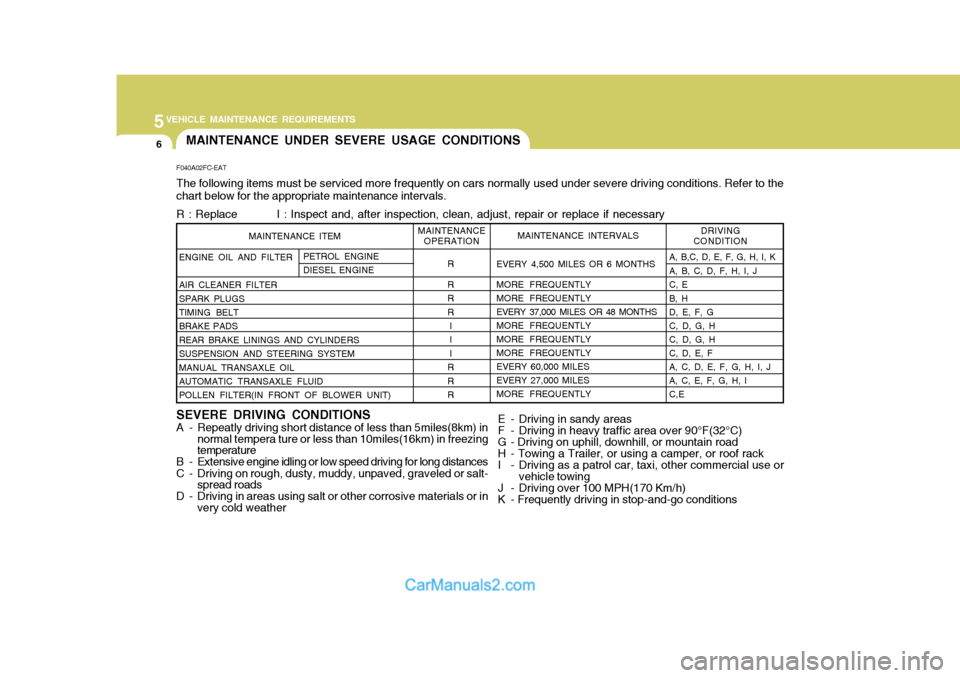
F040A02FC-EAT The following items must be serviced more frequently on cars normally used under severe driving conditions. Refer to the chart below for the appropriate maintenance intervals.
R : Replace I : Inspect and, after inspection, clean, adjust, repair or replace if necessary
SEVERE DRIVING CONDITIONS
A - Repeatly driving short distance of less than 5miles(8km) in
normal tempera ture or less than 10miles(16km) in freezing temperature
B - Extensive engine idling or low speed driving for long distances
C - Driving on rough, dusty, muddy, unpaved, graveled or salt- spread roads
D - Driving in areas using salt or other corrosive materials or in very cold weather
MAINTENANCEOPERATION
MAINTENANCE ITEM
E - Driving in sandy areas
F - Driving in heavy traffic area over 90°F(32°C)
G - Driving on uphill, downhill, or mountain road
H - Towing a Trailer, or using a camper, or roof rack
I - Driving as a patrol car, taxi, other commercial use orvehicle towing
J - Driving over 100 MPH(170 Km/h)
K - Frequently driving in stop-and-go conditions
MAINTENANCE UNDER SEVERE USAGE CONDITIONS
PETROL ENGINE DIESEL ENGINE
Page 426 of 490

5
VEHICLE MAINTENANCE REQUIREMENTS
7EXPLANATION OF SCHEDULED MAINTENANCE ITEMS
!
6ZF060M1-A
o Engine Oil and Filter
The engine oil and filter should be changed at the intervals specified in the maintenance schedule. If the car is being driven in severe conditions,more frequent oil and filter changes are required. 6ZF060B1-A
o Drive Belts
Inspect all drive belts for evidence of cuts, cracks, excessive wear or oil contamination and replace if neces- sary. Drive belts should be checkedperiodically for proper tension and ad- justed as necessary. 6ZF060C1-A
o Fuel Filter A clogged filter can limit the speed at which the vehicle may be driven, dam- age the emission system and cause hard starting. If an excessive amountof foreign matter accumulates in the fuel tank, the filter may require re- placement more frequently.After installing a new filter, run theengine for several minutes, and checkfor leaks at the connections.
WARNING (Diesel only):
Never work on injection system with engine running or within 30 sec- onds after shutting off engine. Highpressure pump, rail, injectors and high pressure pipes are subject to high pressure even after the enginestopped. The fuel jet produced by fuel leaks may cause serious injury, if it contacts the body. People usingpacemakers should ensure that they keep a distance of 30cm from the ECU or wiring harness within theengine room whilst engine is run- ning, since the high currents in the Common Rail system produce con-siderable magnetic fields.
6ZF060D2-A
o Fuel lines, Fuel Hoses and
Connections
Check the fuel lines, fuel hoses and connections for leakage and damage. Replace any damaged or leaking parts immediately.
Page 433 of 490

6 OWNER MAINTENANCE
4
1. Air filter element
2. Engine oil filler cap
3. Brake fluid and clutch fluid reservoir
4. Fuel filter 5. Relay box
6. Power steering fluid reservoir
7. Engine oil level dipstick
8. Engine coolant reservoir G010E02FC
G010E02FC-EAT
Diesel (1.5 CRDi)
CAUTION:
When inspecting or servic-
ing the engine, you should handle tools and other heavyobjects carefully so that the plastic cover of the engine is not damaged.
!
9. Radiator cap
10. Battery
11. Windscreen washer fluid reservoir
cap
Page 435 of 490

6 OWNER MAINTENANCE
6
G030B03FC-EAT
Recommended Oil Diesel Engine
NOTE: SAE 5W-20 (5W-30), ILSAC GF-3 engine oil is preferred regardless ofregional option and engine varia- tion. If SAE 5W-20, ILSAC GF-3 en- gine oil is not available, secondaryrecommended engine oil for corre- sponding temperature range can be used.
G030B01A
The correct engine oil level is of para- mount importance. An excessively high or low oil level may result in irreparable damage being sustained by the engine. The engineoil level must be checked on a daily basis, whenever the vehicle is refu- elled or before starting a long trip,whichever occurs sooner. In addition, it is imperative that only an
approved grade and specification of oilis used to avoid the possibility of serious engine damage and premature wear. The use of "budget price" oil isa false economy that must be avoided if the maximum reliability and useful life is to be obtained from the vehicle.
The engine oil quality should meet the
following classification:
API class: CH-4 or ABOVE ACEA class: B4 or ABOVE NOTE: SAE 0W-30 oil is for use in very cold
zones. Its use should therefore be restricted only to driving in these type of sub-zero conditions. (Espe-cially, not recommended for sus- tained high engine load and high speed operation.)
Page 436 of 490

6
OWNER MAINTENANCE
7
!
SG030C2-E
Engine Oil Level
HFC5007
Petrol engine
G030C02FC
Diesel engine SG030D3-E
Engine Oil Replenishment
HFC5009
Petrol engine
Diesel engine
The engine oil level should be checked with the engine at normal operating temperature and the vehicle parkedupon level ground. If the indicated oil level is at or below the lower mark of the dipstick, oil should be added until the level is at orbelow the upper mark.
WARNING:
Be very careful not to touch the
radiator hose when checking the engine oil as it may be hot enough to burn you. Prior to checking the level, the vehicle
should be allowed to stand for severalminutes after the engine has been switched off to allow the oil to drain back to the sump.
Withdraw the dipstick and wipe it with
a clean rag. Replace the dipstick fullyand withdraw again when the oil levelmay be read from the stick. Normal oil level is indicated when the oil is present between the two marks on the stick. Itis not necessary to add oil if the level is above the lower mark and in any case, oil must not be added to thedegree that the level exceeds the up- per mark. Replace the dipstick fully after checking the level.
G030D03FC
Page 437 of 490
6 OWNER MAINTENANCE
8
ZG030E1-A
ENGINE OIL CONSUMPTION Function of engine oil
Engine oil has the primary function of lubricating and cooling the inside of the engine.
Engine oil consumption It is normal that an engine should consume some engine oil in the course of normal driving. The cause of oil consumption in a normal engine are asfollows;
o Engine oil is used to lubricate pis- tons, piston rings and cylinders. A thin film of oil is left on the cylinder wall when a piston moves downwards in the cylinder. High negative pressure generated duringengine operation sucks some of the oil into the combustion chamber. This oil with some oil of the cylinder wall is burned by the high tempera- ture combustion gases during thecombustion process.
To add oil to the engine, remove the
filler cap by rotating in an counter-clockwise direction and pour engine oil into the engine. Before checking the level again, allow several minutes forthe oil to drain into the sump. Replace the oil filler cap rotating it in a clock- wise direction until tight.
The quantity of oil required to raise the
level from the minimum to maximumlevel is approximately 1 litre.
The distance between the "F" and "L"
marks is equal to about 1 liter(Petrol Engine)/1.2 liter(Diesel Engine) of oil.
!
CAUTION:
Slowly pour the recommended oil into a funnel. Do not overfill toprevent engine to damage.!
WARNING:
Be very careful not to touch the radiator hose when checking the engine oil as it may be hot enoughto burn you. o The engine oil consumption is
strongly effected by the viscosityand quality of oil, engine rpm and driving condition etc. More engine oil may be consumed under severe driving conditions such as high speeds, frequent accelera- tion and deceleration, compared tonormal driving.
Page 439 of 490
6 OWNER MAINTENANCE
10
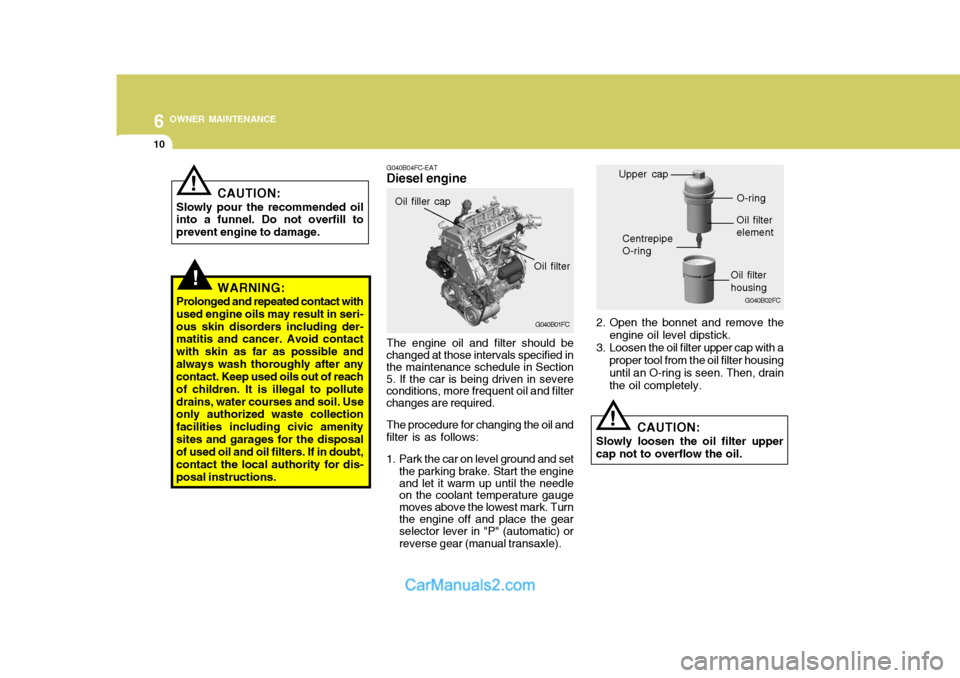
G040B04FC-EAT
Diesel engine
Oil filter
G040B01FC
Oil filler cap
Centrepipe O-ring G040B02FC
Upper capO-ring
Oil filter element
Oil filterhousing
The engine oil and filter should be
changed at those intervals specified in the maintenance schedule in Section 5. If the car is being driven in severe conditions, more frequent oil and filter changes are required.
The procedure for changing the oil and
filter is as follows:
1. Park the car on level ground and set the parking brake. Start the engine and let it warm up until the needle on the coolant temperature gauge moves above the lowest mark. Turn the engine off and place the gear selector lever in "P" (automatic) or reverse gear (manual transaxle). 2. Open the bonnet and remove the
engine oil level dipstick.
3. Loosen the oil filter upper cap with a proper tool from the oil filter housing until an O-ring is seen. Then, drainthe oil completely.
CAUTION:
Slowly loosen the oil filter uppercap not to overflow the oil.
!
!
CAUTION:
Slowly pour the recommended oil into a funnel. Do not overfill to prevent engine to damage.!
WARNING:
Prolonged and repeated contact with used engine oils may result in seri- ous skin disorders including der- matitis and cancer. Avoid contact with skin as far as possible andalways wash thoroughly after any contact. Keep used oils out of reach of children. It is illegal to pollutedrains, water courses and soil. Use only authorized waste collection facilities including civic amenitysites and garages for the disposal of used oil and oil filters. If in doubt, contact the local authority for dis-posal instructions.