engine Hyundai Matrix 2007 Owner's Manual
[x] Cancel search | Manufacturer: HYUNDAI, Model Year: 2007, Model line: Matrix, Model: Hyundai Matrix 2007Pages: 490, PDF Size: 12.81 MB
Page 391 of 490

2
DRIVING YOUR HYUNDAI
17
C310D01JM-EAT Indicators and Warning The indicators should illuminate when the ignition key is turned to ON orSTART but should go out after approxi- mately 3 seconds. If the indicators do not illuminate, or theESP or ESP-OFF indicator does not go out after approximately 3 seconds, have the vehicle checked by Hyundaiauthorised repairer. Should there be any unusual conditions in the device whilst driving, ESP-OFF indicator illuminates as a warning. If ESP-OFF indicator illuminates, pullyour car to a safe place and stop the engine. Then, start the engine again to check ifthe ESP-OFF indicator goes out. If the indicator remains lit even after the engine has been started, have your car checked by Hyundai authorised repairer.EFFECTIVE BRAKING
SC140A2-E Braking system performance and fric- tion material life are greatly affected by the driving style adopted. The following suggestions are made to assist inachieving the best results from the braking system.
o Anticipate the road and conditions ahead in order that heavy braking may be avoided.
o When descending long gradients, use the engine to assist in retarding thevehicle to minimize the possibility of brake fade occurring.
o When trailer towing, ensure that the trailer brakes function correctly anduse engine braking to assist thevehicle braking system.
o Use only genuine Hyundai replace-
ment brake pads and shoes to en-sure consistent friction characteris- tics and wear rates.
o After driving through deep water (e.g. fording), the brakes may become wetand performance reduced. Always check brake efficiency after emerg-ing from the water and dry the brakes by lightly depressing the brake pedal several times whilst driving slowly. o Apply the parking brake only when
the vehicle is at rest.
o Since the power assistance provided by the brake servo is derived fromthe engine, coasting with the engineturned off or towing of the vehicle with the engine turned off will result in greatly increased pedal pressuresbeing required to stop the vehicle.
o Do not hold the vehicle on an incline
with the accelerator pedal. This cancause the transmission to overheat. Always use the brake pedal or park- ing brake.
o Use caution when parking on a hill. Engage the parking brake and placethe gear selector lever in "P" (auto-matic transaxle) or in first or reverse gear (manual transaxle). If your car is facing downhill, turn the frontwheels into the curb to help keep the car from rolling. If your car is facing uphill, turn the front wheels awayfrom the curb to help keep the car from rolling. If there is no curb or if it is required by other conditions tokeep the car from rolling, block the wheels.
fcuk-2.p65 12/27/2006, 10:14 AM
17
Page 392 of 490

2 DRIVING YOUR HYUNDAI
18
o Keep your car in good condition. For
better fuel economy and reduced maintenance costs, maintain your car in accordance with the mainte- nance schedule in Section 5. If youdrive your car in severe conditions, more frequent maintenance is re- quired (see Section 5 for details).
o Keep your car clean. For maximum service, your car should be keptclean and free of corrosive materi-als. It is especially important that mud, dirt, ice, etc. not be allowed to accumulate on the underside of thecar. This extra weight can result in increased fuel consumption and also contribute to corrosion.
o Travel lightly. Don't carry unneces- sary weight in your car. Weight is anenemy of good fuel economy.
o Don't let the engine idle longer than necessary. If you are waiting (andnot in traffic), turn off your engine andrestart only when you're ready to go.
SC150A1-F You can save fuel and get more miles from your car if you follow these sug-gestions:
o Drive smoothly. Accelerate at a
moderate rate. Don't make "jack- rabbit" starts or full-throttle shifts and maintain a steady cruising speed. Don't race between stoplights. Try toadjust your speed to that of the other traffic so you don't have to change speeds unnecessarily.Avoid heavy traffic whenever pos- sible. Always maintain a safe dis- tance from other vehicles so you canavoid unnecessary braking. This also reduces brake wear.
o Drive at a moderate speed. The faster you drive, the more fuel your caruses. Driving at a moderate speed, especially on the highway, is one ofthe most effective ways to reduce fuel consumption.
DRIVING FOR ECONOMY
o Don't "ride" the brake or clutch pedal.This can increase fuel consumption and also increase wear on these components. In addition, driving with your foot resting on the brake pedalmay cause the brakes to overheat, which reduces their effectiveness and may lead to more serious con-
sequences.
o Take care of your tyres. Keep them
inflated to the recommended pres-sure. Incorrect infla-tion, either too much or too little, results in unneces- sary tyre wear. Check the tyre pres-sures at least once a month.
o Be sure that the wheels are aligned
correctly. Improper alignment canresult from hitting curbs or driving too fast over irregular surfaces. Poor alignment causes faster tyre wearand may also result in other prob- lems as well as greater fuel con- sumption.
fcuk-2.p65 12/27/2006, 10:14 AM
18
Page 393 of 490

2
DRIVING YOUR HYUNDAI
19
o Remember, your car does not re- quire extended warm-up. As soon as the engine is running smoothly, you can drive away. In very cold weather, however, give your engine a slightlylonger warm-up period.
o Don't "lug" or "over-rev" the engine.
Lugging is driving too slowly in toohigh a gear resulting in the engine bucking. If this happens to you, shift to a lower gear.Over-revving is racing the engine beyond its safe limit. This can be avoided by shifting at the recom-mended speeds.
o Use your air conditioning sparingly.
The air conditioning system is oper-ated by the engine power so your fuel economy is reduced when you use it.SMOOTH CORNERING
SC160A1-F Avoid braking or gear changing in cor- ners, especially when roads are wet. Ideally, corners should always be taken under gentle acceleration. If you followthese suggestions, tyre wear will be held to a minimum.WINTER MOTORING
SC170A1-E The onset of winter conditions subject motor vehicles to greater operating de-mands. Therefore, the following sug- gestions will assist in maintaining peak performance and reliability during theseperiods: ZC170B1-E Electrical System Winter conditions impose severe de- mands upon vehicle electrical systems, particularly the charging circuit. The battery condition and performance along with the alternator performance and drive belt condition should be checkedprior to the onset of winter.
fcuk-2.p65 12/27/2006, 10:14 AM
19
Page 394 of 490

2 DRIVING YOUR HYUNDAI
20
SC170E1-E Windscreen Washers and Wip- ers The windscreen washer bottle should be filled with a solution of water and aproprietary winter screen wash addi- tive. The windscreen wipers should not be used if the blades are frozen to thewindscreen or if they are covered with snow, before this is removed. NOTE: Never allow undiluted screen washer fluid additive to spill upon the paintwork or use engine coolant anti- freeze since damage to the paintworkmay result.
ZC170D1-E Door Locks Should the door lock mechanism be- come frozen, a proprietary lock de-icershould be used. Alternatively, warming the door key may thaw the door lock. However, the key should be handledcarefully to avoid burning the fingers. Never attempt to thaw a frozen door lock using hot water, since the waterwill eventually freeze and compound the problem. NOTE: The proper temperature for using the immobiliser key is from -40°F to 176°F (-40°C to 80°C). If you heat theimmobiliser key over 176°F (80°C) to open the frozen lock, it may cause damage to the transponder in itshead.
ZC170C1-E Anti-freeze/Corrosion inhibitor The cooling system must always con- tain an Ethylene-Glycol based anti-freeze solution. The system is filled during manufacture with solution of the correct strength which should bechecked before the onset of winter and adjusted or changed as required. NOTE: The anti-freeze solution contains a corrosion inhibitor to prevent degra- dation of the aluminum castingscontained within the engine. There- fore, never, drain the system and refill with water only. In addition, anti-freeze solution must ALWAYS be used in vehicles fitted withair conditioning, to prevent the heater matrix from freezing and subsequently bursting with the refrigeration system inuse.
fcuk-2.p65
12/27/2006, 10:14 AM
20
Page 396 of 490

2 DRIVING YOUR HYUNDAI
22
SC200B3-E TOWING ATTACHMENTS It is strongly recommended that only an Hyundai Approved towing attachmentis used to ensure that the loads placed upon the body structure are correctly distributed. The use of a non approvedattachment will result in the invalidation of the vehicle warranty. Hyundai towing attachments are designed and con-structed to ensure maximum towing performance and ease of fitment. A range of accessories including electri-cal kits are available through the Hyundai authorised repairer network. It is of the utmost importance that those areas of the vehicle which are sub- jected to greater stress during towing are maintained in accordance with therecommendations given at the end of this book. In addition, the daily operat- ing checks relating to engine oil, trans-mission oil and tyres must be per- formed at each refuelling to ensure maximum reliability and safety.The use of a proprietary stabiliser will assist in achieving an inherently stable outfit but whilst the use of such equip-ment will improve the characteristics of a balanced outfit, it will not compensatefor a badly loaded and therefore un-stable outfit. The tyres and braking equipment fitted to the trailer or caravan must be main-tained in accordance with the recom- mendations of the manufacturer. Spe- cial attention should be paid to tyreswhich deteriorate through time and ex- posure rather than as a result of the distances towed. The inside walls ofthe tyres should be inspected along with the outside walls for cracking and damage. The trailer wheel nut torquemust be checked on a regular basis, preferably before each towing session. The trailer hitch and the safety catch mechanism must be maintained in good working order. The trailer break away cable or chain should be inspected fordamage and should be attached to the vehicle towing attachment each and every time the trailer is hitched to thevehicle. Whilst towing, the performance of the vehicle will be reduced in terms ofacceleration, braking and handling due
to the increased loads placed upon thevehicle. The driver should anticipatethe change in characteristics and ad- just the driving style in keeping with these changes. Care should be exer-cised when cornering and braking to prevent the outfit becoming uncontrol- lable by reducing cornering speeds andallowing increased braking distances. The driver should exercise care to en- sure that when pulling away from restparticularly on uphill gradients the clutch unit is not subjected to excessive slip- page which will reduce the useful life ofthis component. Use of the "Overdrive Off" "2" and "L" positions when driving vehicles with automatic transmissionwill assist with braking performance when long down hill gradients are en- countered. Improved acceleration per-formance will be available by selecting "Overdrive Off","2", or "1" depending upon road speed if it is found that thetransmission unit makes an undesir- able upshift whilst hill climbing or over- taking. The transmission unit should beoperated in "D" with the Overdrive "On" under normal circumstances to enhance fuel economy and reduce noise andengine wear.
fcuk-2.p65
12/27/2006, 10:14 AM
22
Page 398 of 490

2 DRIVING YOUR HYUNDAI
24
YC200E2-E Trailer or Vehicle Towing Tips
1. Before towing, check towbar ball andsafety cable connections as well as proper operation of the trailer running lights, brake lights, and turn signals.
2. Always drive your vehicle at a mod- erate speed (Less than 60 MPH)
3. Trailer towing requires more fuel
than normal conditions.
4. To maintain engine braking effi- ciency and electrical charging per- formance, do not use fifth gear(manual transaxle) or overdrive (au- tomatic transaxle).
5. Always secure items in the trailer to prevent load shift whilst driving.
6. Check the condition and air pres-
sure of all tyres on the trailer and your vehicle. Low tyre pressure can seriously affect the handling. Also check the spare tyre. 7. The vehicle/trailer combination is
more affected by crosswind andbuffeting. When being passed by a large ve- hicle, keep a constant speed andsteer straight ahead. If there is too much wind buffeting slow down to get out of the other vehicle's airturbulence.
8. When parking your vehicle and
trailer, especially on a hill, be sure tofollow all the normal precautions. Turn your front wheels into the curb, set the parking brake firmly, and putthe transaxle in 1st or Reverse (manual) or Park (automatic). In ad- dition, we advise the use of wheelchocks at each of the trailer's tyres.
9. If the trailer has electric brakes,
start your vehicle and trailer mov-ing, and then apply the trailer brake controller by hand to be sure the brakes are working. This lets youcheck your electrical connection at the same time. 10. During your trip, check occasionally
to be sure that the load is secure, and that the lights and any trailer brakes are still working.
11. Avoid jerky starts, sudden acceler-
ation or sudden stops.
12. Avoid sharp turns and rapid lane
changes.
13. Avoid holding the brake pedal down too long or too frequently. This could cause the brakes to overheat, re-sulting in reduced braking efficien- cy.
14. When going down a hill, shift into a
lower gear and use the engine brak-ing effect. When climbing a long grade, down-shift the transaxle to a lower gear and reduce speed to reduce chances of engine overloading and/or over-heating.
fcuk-2.p65 12/27/2006, 10:14 AM
24
Page 399 of 490

2
DRIVING YOUR HYUNDAI
25
15. If you have to stop whilst going uphill, do not hold the vehicle in place by pressing on the accelera- tor. This can cause the automatic transaxle to overheat. Use the park-ing brake or footbrake.
NOTE: When towing check transaxle fluid more frequently.
! CAUTION:
If overheating should occur when towing, (temperature gauge readsnear the red zone), taking the follow- ing actions may reduce or eliminate the problem.
1. Turn off the air conditioner.
2. Reduce highway speed.
3. Select a lower gear when going uphill.
4. Whilst in stop and go traffic, place the gear selection in park or neu- tral and idle the engine at a higher speed.
fcuk-2.p65 12/27/2006, 10:14 AM
25
Page 400 of 490

3
If the Engine Will not Start .......................................... 3-2
Jump Starting .............................................................. 3-3
If the Engine Overheats .............................................. 3-4
Spare Tyre ................................................................... 3-6
In the Event of a Puncture ........................................... 3-7
Changing A Flat Tyre ................................................... 3-7
If Your Vehicle Must Be Towed ..................................3-12
Emergency Towing ..................................................... 3-14
If You Lose Your K eys ................................................ 3-14
IN CASE OF EMERGENCY
3
fcuk-3.p65
12/27/2006, 10:15 AM
1
Page 401 of 490

3 IN CASE OF EMERGENCY
2IF THE ENGINE WILL NOT START
SD020B1-E If the Engine Cannot be Cranked
1. If the vehicle is fitted with manualtransaxle, ensure that the clutch pedal is depressed whilst cranking the engine. If the vehicle is fitted with automatic transaxle, ensure that the transaxle
selector is at the "P" or "N" position.
2. Check the battery terminals and con-
nections to ensure that these areclean and also tight.
3. If the ignition warning lights dim when
the engine is cranked and the batteryterminals have been checked, a dis- charged battery is indicated.
4. Do not attempt to push or tow start
the vehicle, refer to "Jump Starting"for information regarding engine start- ing when the battery is discharged. D010C02A-EAT If Engine Turns Over Normally but Does Not Start
D010B01FC 1. Check fuel level.
2. With the key in the "OFF" position,check all connectors at ignition coilsand spark plugs(For Petrol Engine)or check all connectors at glow plug and glow plug relay(For Diesel En- gine). Reconnect any that may bedisconnected or loose.
3. Check fuel line in the engine com-
partment.
4. If engine still refuses to start, call a Hyundai authorised repairer or seekother qualified assistance. SSA3020C
!
SD020A1-E Seek assistance from the nearest Hyundai authorised repairer with regardto the method of ignition and fuel sys- tem diagnosis.
CAUTION:
If the engine refuses to start, noattempt should be made to push or tow start the vehicle. Vehicles withautomatic transaxle or fuel injection will not be able to be started in this manner since no drive is transmittedthrough the automatic transaxle whilst the engine is not running, and in the case of fuel injected deriva-tives, the fuel pump will not operate under tow start conditions. In addi- tion, if the vehicle is equipped withan exhaust catalyst, damage to the catalyst may result if the vehicle is tow started.
fcuk-3.p65 12/27/2006, 10:15 AM
2
Page 402 of 490
3
IN CASE OF EMERGENCY
3
!
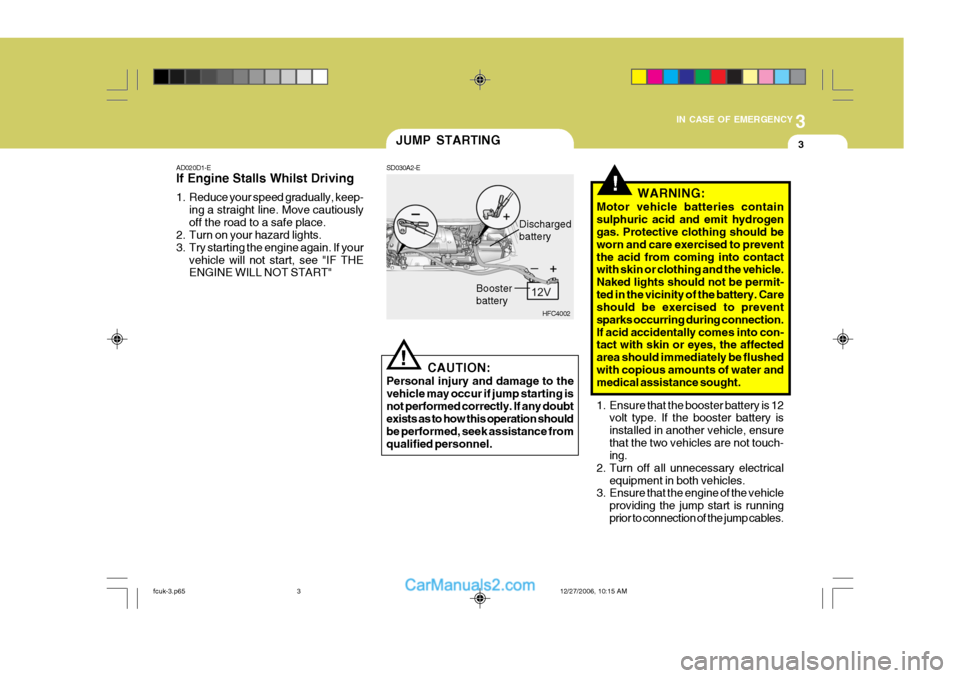
JUMP STARTING
AD020D1-E If Engine Stalls Whilst Driving
1. Reduce your speed gradually, keep- ing a straight line. Move cautiously off the road to a safe place.
2. Turn on your hazard lights.
3. Try starting the engine again. If your
vehicle will not start, see "IF THE ENGINE WILL NOT START" SD030A2-E
HFC4002
Discharged battery
Booster battery
CAUTION:
Personal injury and damage to the vehicle may occur if jump starting isnot performed correctly. If any doubt exists as to how this operation should be performed, seek assistance fromqualified personnel.! WARNING:
Motor vehicle batteries contain sulphuric acid and emit hydrogen gas. Protective clothing should be worn and care exercised to preventthe acid from coming into contact with skin or clothing and the vehicle. Naked lights should not be permit-ted in the vicinity of the battery. Care should be exercised to prevent sparks occurring during connection.If acid accidentally comes into con- tact with skin or eyes, the affected area should immediately be flushed with copious amounts of water and medical assistance sought.
1. Ensure that the booster battery is 12 volt type. If the booster battery is installed in another vehicle, ensurethat the two vehicles are not touch- ing.
2. Turn off all unnecessary electrical
equipment in both vehicles.
3. Ensure that the engine of the vehicle
providing the jump start is running prior to connection of the jump cables.
fcuk-3.p65 12/27/2006, 10:15 AM
3