coolant temperature Hyundai Matrix 2007 User Guide
[x] Cancel search | Manufacturer: HYUNDAI, Model Year: 2007, Model line: Matrix, Model: Hyundai Matrix 2007Pages: 490, PDF Size: 12.81 MB
Page 236 of 490
6 DO-IT-YOURSELF MAINTENANCE
32
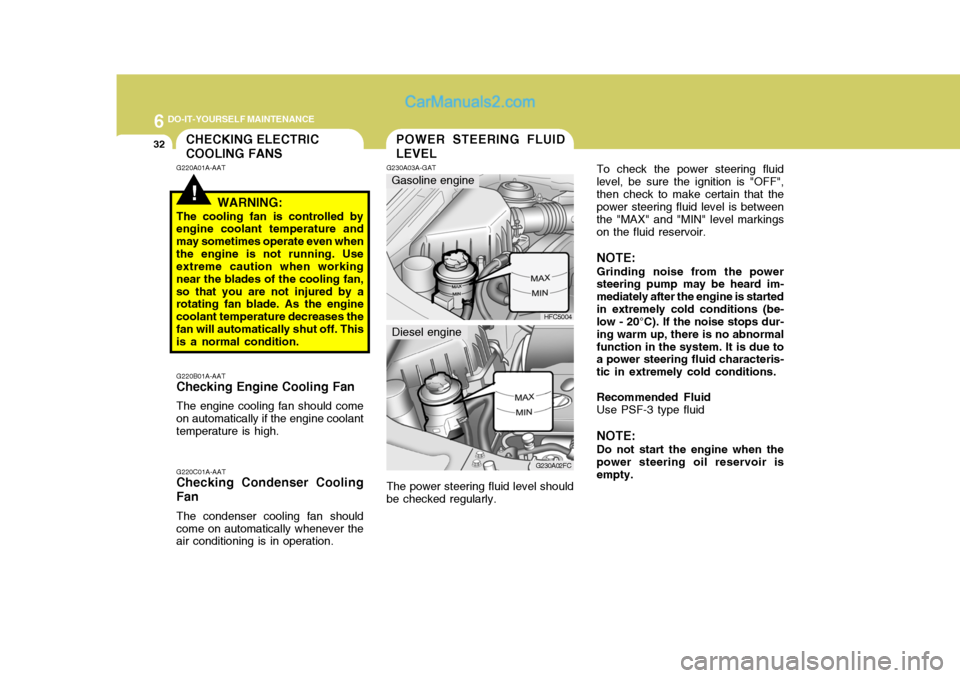
To check the power steering fluid level, be sure the ignition is "OFF",then check to make certain that the power steering fluid level is between the "MAX" and "MIN" level markingson the fluid reservoir. NOTE: Grinding noise from the power steering pump may be heard im- mediately after the engine is startedin extremely cold conditions (be- low - 20°C). If the noise stops dur- ing warm up, there is no abnormalfunction in the system. It is due to a power steering fluid characteris- tic in extremely cold conditions. Recommended Fluid Use PSF-3 type fluid NOTE: Do not start the engine when the power steering oil reservoir is empty.
!
CHECKING ELECTRIC COOLING FANS
G220A01A-AAT
WARNING:
The cooling fan is controlled by engine coolant temperature and may sometimes operate even whenthe engine is not running. Use extreme caution when working near the blades of the cooling fan,so that you are not injured by a rotating fan blade. As the engine coolant temperature decreases thefan will automatically shut off. This is a normal condition.POWER STEERING FLUID LEVEL
G220B01A-AAT
Checking Engine Cooling Fan
The engine cooling fan should come on automatically if the engine coolant temperature is high. G220C01A-AAT
Checking Condenser Cooling Fan
The condenser cooling fan should come on automatically whenever the air conditioning is in operation. G230A03A-GAT
HFC5004
G230A02FC
Gasoline engine
Diesel engine
The power steering fluid level should be checked regularly.
Page 248 of 490

7EMISSION CONTROL SYSTEMS
2EMISSION CONTROL SYSTEMS
H010A01A-GAT
(If Installed)
Your Hyundai is equipped with an
emission control system to meet all requirements of the Emission prohibi- tion rules of your province.
There are three emission control sys-
tems which are as follows.
(1) Crankcase emission control sys- tem
(2) Evaporative emission control sys- tem
(3) Exhaust emission control system
In order to assure the proper function
of the emission control systems, it is recommended that you have your carinspected and maintained by an au- thorized Hyundai dealer in accordance with the maintenance schedule in thismanual. H010B01A-AAT
1. Crankcase Emission Control
System
The positive crankcase ventilation
system is employed to prevent airpollution caused by blow-by gasesbeing emitted from the crankcase. This system supplies fresh filtered air to the crankcase through the air in-take hose. Inside the crankcase, the fresh air mixes with blow-by gases, then passes through the PCV valveinto the induction system.
H010C01E-GAT
2. Evaporative Emission Control
System
The Evaporative Emission Control
System is designed to prevent fuel vapors from escaping into the atmo- sphere. Canister
While the engine is inoperative, fuel
vapors generated inside the fuel tank are absorbed and stored in the canis- ter. When the engine is running, thefuel vapors absorbed in the canister are drawn into the induction system through the purge control solenoidvalve. Purge Control Solenoid Valve (PCSV)
The purge control solenoid valve is
controlled by the Engine Control Mod- ule (ECM); when the engine coolant temperature is low during idling, the PCSV closes so that evaporated fuelis not taken into the engine. After the engine warms-up during ordinary driv- ing, the PCSV opens so as to intro-duce evaporated fuel to the engine.
H010D01A-AAT
3. Exhaust Emission Control
System
The Exhaust Emission Control Sys-
tem is a highly effective system which controls exhaust emissions while maintaining good vehicle performance.
Page 264 of 490
10
INDEX
3
D Defrosting/Defogging .................................................. 1-88
Digital Clock .............................................................. 1-65
Door Central door lock ...................................................... 1-9
Child-protector rear door lock .................................... 1-9
Door locks ................................................................ 1-7
Locking and unlocking front doors with a key .......... 1-7
Drink Holder ............................................................... 1-67
Drive Belts ................................................................. 6-29
Driving
Economical driving ................................................. 2-18
Smooth corneri ng .................................................... 2-19
Winter driving .......................................................... 2-20
E
EGR System ............................................................... 7-4 Electronic Stability Program (ESP) ...........................2-16
Emissions Control Systems ........................................ 7-2Engine Before starting the engine ........................................ 2-3Compartment .................................................. 6-2 ~ 6-4
Coolant ................................................................... 6-12
Coolant temperature gauge .....................................1-54
If the engine overheats ............................................. 3-4
Number ..................................................................... 8-2
Oil ............................................................................. 6-6Starting ..................................................................... 2-5
Engine Exhaust Can Be Dangerous ............................ 2-2 FFog Light
Front fog light switch .............................................. 1-63
Rear fog light switch ............................................... 1-64
Fold-up Tray .............................................................. 1-76
Front Seats Adjustable front seats ............................................. 1-14
Lumbar support control ........................................... 1-16
Seat cushion height adjustment ............................. 1-16
Fuel Capacity ................................................................... 9-2
Gauge ..................................................................... 1-54
Recommendations .................................................... 1-2
Fuel Filler Lid Remote release ...................................................... 1-77
Fuse Panel Description ............................................. 6-39
Fuses ........................................................................ 6-29
GGeneral Checks ........................................................... 6-5
Glove box .................................................................. 1-73
HHazard Warning System ............................................ 1-62
Headlight Aiming Adjustm ent .................................... 6-35
Headlight Bulb ........................................................... 6-37
Headlight Leveling Device S ystem ............................1-64
Heating and Cooling Control ......................................1-83
Page 328 of 490

1
CONTROLS AND EQUIPMENT
49
SB215B1-E ENGINE COOLANT TEMPERA- TURE GAUGE
HFC2045 HFC2101
INSTRUMENT CLUSTER
SB215A1-E FUEL GAUGE The fuel gauge indicates the quantity of fuel remaining in the fuel tank. NOTE: The fuel gauge is not intended to give other than an approximate indi- cation of the fuel level and is unsuit- able for the purposes of calculatingfuel consumption figures.
SB210S1-E BRAKE PAD WEAR INDICATOR The front brake disc pads are fitted with an audible wear indicator which will cause a high pitched noise to be emit-ted when the remaining amount of fric- tion lining is below the specified value. When the wear indicator is heard, thebrake pads should be replaced without delay to avoid damage occurring to the brake discs and a severe reduction inbraking efficiency. B950A01E-EAT REAR FOG AUDIBLE WARNING SOUND The rear fog audible warning chime sounds when the rear fog lights are onand the door in driver side is open.
The engine coolant temperature gaugeindicates the engine coolant tempera-ture and will, under normal circum- stances, give an indication in the "Nor- mal" or centre portion of the scale.Should the indication move into the
upper or "HOT" portion of the scale, engine overheating is indicated. Underthese circumstances, the vehicle should be brought to rest as soon as is safe to do so and the engine turned off. Oncethe engine has cooled somewhat, the coolant level and the condition of the generator/water pump drive belt shouldbe checked.
fcuk-1.p65
12/27/2006, 10:12 AM
49
Page 394 of 490

2 DRIVING YOUR HYUNDAI
20
SC170E1-E Windscreen Washers and Wip- ers The windscreen washer bottle should be filled with a solution of water and aproprietary winter screen wash addi- tive. The windscreen wipers should not be used if the blades are frozen to thewindscreen or if they are covered with snow, before this is removed. NOTE: Never allow undiluted screen washer fluid additive to spill upon the paintwork or use engine coolant anti- freeze since damage to the paintworkmay result.
ZC170D1-E Door Locks Should the door lock mechanism be- come frozen, a proprietary lock de-icershould be used. Alternatively, warming the door key may thaw the door lock. However, the key should be handledcarefully to avoid burning the fingers. Never attempt to thaw a frozen door lock using hot water, since the waterwill eventually freeze and compound the problem. NOTE: The proper temperature for using the immobiliser key is from -40°F to 176°F (-40°C to 80°C). If you heat theimmobiliser key over 176°F (80°C) to open the frozen lock, it may cause damage to the transponder in itshead.
ZC170C1-E Anti-freeze/Corrosion inhibitor The cooling system must always con- tain an Ethylene-Glycol based anti-freeze solution. The system is filled during manufacture with solution of the correct strength which should bechecked before the onset of winter and adjusted or changed as required. NOTE: The anti-freeze solution contains a corrosion inhibitor to prevent degra- dation of the aluminum castingscontained within the engine. There- fore, never, drain the system and refill with water only. In addition, anti-freeze solution must ALWAYS be used in vehicles fitted withair conditioning, to prevent the heater matrix from freezing and subsequently bursting with the refrigeration system inuse.
fcuk-2.p65
12/27/2006, 10:14 AM
20
Page 403 of 490

3 IN CASE OF EMERGENCY
4IF THE ENGINE OVERHEATS
D030A02TB-EAT If the temperature gauge indicates over- heating:
1. Pull off the road and stop as soon as it is safe to do so.
2. Place the gear selector lever in "P" (automatic) or neutral (manual transaxle) and set the parking brake.If the air conditioning is on, turn it off.
3. If coolant is running out under the car
or steam is coming out from underthe bonnet stop the engine. Do not open the bonnet until the coolant has stopped running or the steaming hasstopped. If there is no visible loss of coolant and no steam, leave the engine running and check to be surethe engine cooling fan is operating. If the fan is not running, turn the engine off.
4. Check to see if the water pump drive belt is broken. If it is not broken,check to see that it is tight.If the drive belt seems to be satisfac- tory, check for coolant leaking from the radiator, hoses or under the car.(If the air conditioning had been in use, it is normal for cold water to be draining from it).
4. Connect the red jump cable to the
positive (+) terminal of the boosterbattery and the other end to the positive (+) terminal of the discharged battery.
5. Attach the black jump cable to the negative (-) terminal of the boosterbattery, and the other end to a groundpoint within the engine compartment of the vehicle with the flat battery. Do not connect to the negative batteryterminal of the flat battery since sparks may be generated with the subsequent risk of explosion.
6. Raise the booster vehicle engine speed to 2,000 r.p.m. and start theengine of the vehicle with the flatbattery.
7. Switch "ON" the main beam
headlamps before carefully remov-ing the jumper cables in the reverse order of attachment. Once the jumper cables have been removed, switch"OFF" the main beam headlamps. CAUTION:
If the jump cables are incorrectlyinstalled, damage to the vehicle elec- trical system may occur, in particu- lar the electronic components suchas the Fuel Injection system com- puter and the Automatic Transaxle computer. The battery must never bedisconnected whilst the engine is running.
!
fcuk-3.p65 12/27/2006, 10:15 AM
4
Page 404 of 490

3
IN CASE OF EMERGENCY
5
!
!
!WARNING:
Whilst the engine is running, keep hands and clothing away from mov- ing parts such as the fan and drive belts to prevent injury. 5. If the water pump drive belt is broken
or coolant is leaking out, stop theengine immediately and call the near- est Hyundai authorised repairer for assistance.
WARNING (Diesel only):
Never work on injection system with engine running or within 30 seconds after shutting off engine. High pres-sure pump, rail, injectors and high pressure pipes are subject to high pressure even after the enginestopped. The fuel jet produced by fuel leaks may cause serious injury, if it touches the body. People usingpacemakers should not move closer than 30cm etc. to the ECU or wiring harness within the engine roomwhilst engine is running, since the high currents in the Common Rail system produce considerable mag-netic fields.
!
WARNING:
Do not remove the radiator cap when the engine is hot since steam and boiling water may be ejected fromthe radiator resulting in burns or scalding.
6. If the cause of the overheating can- not be found, wait until the engine temperature has returned to normal. Then, if coolant has been lost, care-fully remove the radiator cap and add water to bring the fluid level in the reservoir up to the base of the radia-tor fill opening. Fill the coolant ex- pansion tank to the halfway mark. To ensure the correct water to cool-ant mix is obtained after top up, testing by an authorised repairer is required. 7. Proceed with caution until it is estab-
lished that the engine is operatingnormally. If the engine overheats repeatedly, the advice of a Hyundai authorised repairer should be sought.
CAUTION:
Serious loss of coolant indicatesthere is a leak in the cooling systemand this should be checked as soon as possible by a Hyundai authorised repairer.
fcuk-3.p65 12/27/2006, 10:15 AM
5
Page 427 of 490
5
VEHICLE MAINTENANCE REQUIREMENTS
9
6ZF070F1-A
o Brake Hoses and Lines Visually check for proper installation, chafing, cracks, deterioration and any leakage. Replace any deteriorated or damaged parts immediately. 6ZF070G2-A
o Brake Fluid Check brake fluid level in the brake fluid reservoir. The level should be between "MIN" and "MAX" marks on the side of the reservoir. Use onlyhydraulic brake fluid conforming to DOT 3 or DOT 4.
6ZF070H1-A
o Rear Brake Drums And
Linings/Parking Brake
Check the rear brake drums and lin-
ings for scoring, burning, leaking fluid, broken parts, and excessive wear. In- spect the parking brake system in- cluding the parking brake lever andcables. For detailed service proce- dures, refer to the Shop Manual.
6ZF070D1-A
o Manual Transaxle Oil
Inspect the manual transaxle oil ac-
cording to the maintenance schedule. NOTE:
If the oil level is low, check for
possible leaks before adding oil. Do not overfill. F070E05A-AAT
o Automatic Transaxle Fluid The fluid level should be in the "HOT" range of the dipstick, after the engine and transaxle are at normal operating temperature. Check the automatictransaxle fluid level with the engine running and the transaxle in neutral, with the parking brake properly ap-plied. Use Hyundai Genuine ATF SP- III, DIAMOND ATF SP-III, SK ATF SP-III or other brands approved byHyundai Motor Co., when adding or changing fluid.
6ZF070C1-A
o Engine Coolant
The coolant should be changed at
the intervals specified in the mainte-nance schedule.
fcuk-5.p65 12/27/2006, 10:15 AM
9
Page 438 of 490

6 OWNER MAINTENANCE
10
G040B04FC-EAT
Diesel engine
Oil filter
G040B01FC
Oil filler cap
Centrepipe O-ring G040B02FC
Upper capO-ring
Oil filter element
Oil filterhousing
The engine oil and filter should be
changed at those intervals specified in the maintenance schedule in Section 5. If the car is being driven in severe conditions, more frequent oil and filter changes are required.
The procedure for changing the oil and
filter is as follows:
1. Park the car on level ground and set the parking brake. Start the engine and let it warm up until the needle on the coolant temperature gauge moves above the lowest mark. Turn the engine off and place the gear selector lever in "P" (automatic) or reverse gear (manual transaxle). 2. Open the bonnet and remove the
engine oil level dipstick.
3. Loosen the oil filter upper cap with a proper tool from the oil filter housing until an O-ring is seen. Then, drainthe oil completely.
CAUTION:
Slowly loosen the oil filter uppercap not to overflow the oil.
!
!
CAUTION:
Slowly pour the recommended oil into a funnel. Do not overfill to prevent engine to damage.!
WARNING:
Prolonged and repeated contact with used engine oils may result in seri- ous skin disorders including der- matitis and cancer. Avoid contact with skin as far as possible andalways wash thoroughly after any contact. Keep used oils out of reach of children. It is illegal to pollutedrains, water courses and soil. Use only authorized waste collection facilities including civic amenitysites and garages for the disposal of used oil and oil filters. If in doubt, contact the local authority for dis-posal instructions.
fcuk-6.p65 12/27/2006, 10:16 AM
10
Page 441 of 490

6
OWNER MAINTENANCE
13
SG050C1-E
To Check the Coolant Level If the level is below the "L" mark, add coolant of the correct concentrationuntil the level is between the "L" and "F" marks. If the level falls below the "L" mark on a regular basis despitebeing topped up, consult a Hyundai authorised repairer.
G050C01FC G050C02FC
Petrol engine
Diesel engine
The engine coolant level may be observed through the side of the plas- tic coolant reservoir (expansion tank) when the engine is cold.
G050D01FC
SG050D2-E
To Change the Coolant
The coolant should be changed at
those intervals specified in the vehicle maintenance schedule in Section 5.
NOTE: Care should be taken to ensure that
coolant is not allowed to spill onto the paintwork since the finish maybecome damaged. If coolant spill- age occurs, the affected area should be rinsed thoroughly with water.
1. Park the vehicle on level ground
and ensure that the parking brake is firmly applied, and the engine al- lowed to cool. Do not attempt this operation whilst the engine is hot since burning or scalding may result. 2. Prepare a suitable receptacle to
collect the displaced coolant and position this under the radiator drain tap.
3. With the heater temperature control set to the "HOT" position, removethe radiator cap and open the radia- tor drain tap.
4. When the engine coolant has drained completely, close the drain tap en-suring that this is not over tight- ened.
5. Prepare a suitable quantity of new engine coolant (refer to section 9)and pour this into the radiator.
fcuk-6.p65 12/27/2006, 10:16 AM
13