engine overheat Hyundai Matrix 2007 User Guide
[x] Cancel search | Manufacturer: HYUNDAI, Model Year: 2007, Model line: Matrix, Model: Hyundai Matrix 2007Pages: 490, PDF Size: 12.81 MB
Page 249 of 490

7
EMISSION CONTROL SYSTEMS
3CATALYTIC CONVERTER
H020A01A-GAT
(If Installed) ; For a gasoline engine
HFC505
The catalytic converter is part of the
exhaust emission control system. Its purpose is to remove certain engine emission products from the engine'sexhaust. It looks something like a muffler and is located underneath the car in the exhaust system.
Catalytic Converter H020B01A-GAT
About the Catalytic Converter
Exhaust gases passing through the
catalytic converter cause it to operate at very high temperatures. As a re- sult, the introduction of large amounts of unburned gasoline may cause it tooverheat and create a fire hazard. This can be avoided by observing the following:
o Use unleaded fuel only.
o Maintain your engine in good con- dition. Extremely high converter temperatures can result from im-proper operation of the electrical, ignition or fuel injection systems. o If your engine stalls, pings, knocks,
or is hard to start, take your car to your Hyundai dealer as soon as possible and have the difficulty corrected.
o Avoid driving with a very low fuel level. If your run out of gasoline, itcould cause the engine to misfireand result in excessive loading of the catalytic converter.
o Avoid idling the engine for periods longer than 10 minutes.
o Your Hyundai should not be either pushed or pulled to get it started.This can cause the catalytic con- verter to overload.
o Take care not to stop your Hyundai
over any combustible material suchas grass, paper, leaves or rags. As these materials could come in con- tact with the catalytic converter andcould cause a fire.
o Do not touch the catalytic con-
verter or any other part of the ex-haust system while the engine is running as it is very hot and could result in burns.
o Remember that your Hyundai
dealer is your best source of assis-tance.
H020D01S-GAT
; For a diesel engine
All Hyundai vehicles are equipped
with oxidation type catalytic converter to reduce the carbon monoxide, hy- drocarbons and particulate containedin the exhaust gas.
Page 264 of 490
10
INDEX
3
D Defrosting/Defogging .................................................. 1-88
Digital Clock .............................................................. 1-65
Door Central door lock ...................................................... 1-9
Child-protector rear door lock .................................... 1-9
Door locks ................................................................ 1-7
Locking and unlocking front doors with a key .......... 1-7
Drink Holder ............................................................... 1-67
Drive Belts ................................................................. 6-29
Driving
Economical driving ................................................. 2-18
Smooth corneri ng .................................................... 2-19
Winter driving .......................................................... 2-20
E
EGR System ............................................................... 7-4 Electronic Stability Program (ESP) ...........................2-16
Emissions Control Systems ........................................ 7-2Engine Before starting the engine ........................................ 2-3Compartment .................................................. 6-2 ~ 6-4
Coolant ................................................................... 6-12
Coolant temperature gauge .....................................1-54
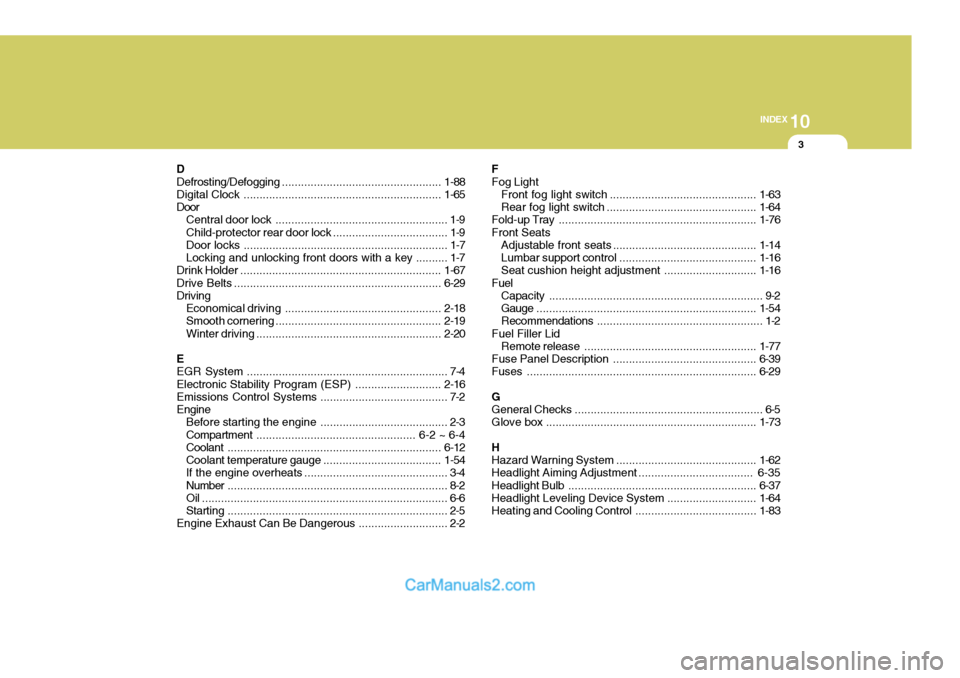
If the engine overheats ............................................. 3-4
Number ..................................................................... 8-2
Oil ............................................................................. 6-6Starting ..................................................................... 2-5
Engine Exhaust Can Be Dangerous ............................ 2-2 FFog Light
Front fog light switch .............................................. 1-63
Rear fog light switch ............................................... 1-64
Fold-up Tray .............................................................. 1-76
Front Seats Adjustable front seats ............................................. 1-14
Lumbar support control ........................................... 1-16
Seat cushion height adjustment ............................. 1-16
Fuel Capacity ................................................................... 9-2
Gauge ..................................................................... 1-54
Recommendations .................................................... 1-2
Fuel Filler Lid Remote release ...................................................... 1-77
Fuse Panel Description ............................................. 6-39
Fuses ........................................................................ 6-29
GGeneral Checks ........................................................... 6-5
Glove box .................................................................. 1-73
HHazard Warning System ............................................ 1-62
Headlight Aiming Adjustm ent .................................... 6-35
Headlight Bulb ........................................................... 6-37
Headlight Leveling Device S ystem ............................1-64
Heating and Cooling Control ......................................1-83
Page 325 of 490

1CONTROLS AND EQUIPMENT
46
SB2100I-EDoor Open (Ajar) Warn-
ing Light
The door ajar warning light indicates that a door is not correctly closed.Ensure that the light is extinguished prior to driving the vehicle.
CAUTION:
If the drive belt (generator belt) is loose, broken, or missing whilst thevehicle is driving, there may be a serious malfunction, engine could overheat because this belt also drivesthe water pump.! SB210P1-E
Low Fuel Level Warning Light
The low fuel warning light serves to warn the driver that the remaining fuelquantity is approximately 9 litres and that the vehicle should be refuelled. If the vehicle is driven for an extendedperiod with the low fuel warning light illuminated there exists a possibility that misfiring due to fuel shortage mayoccur. This situation must be avoided to prevent damage to the catalyst oc- curring.
SB210M1-E Charging System Warning Light
The charging system warning light should illuminate when the ignitionswitch is turned to the "ON" position and should be extinguished when the engine is started. If the light fails toilluminate when the ignition is turned "ON" or fails to extinguish after starting the engine, the nearest Hyundaiauthorised repairer should be contacted. If the light illuminates whilst the vehicle is being driven, stop the vehicle assoon as it is safe to do so and check the condition of the alternator drive belt. If the belt is in place and the tension issatisfactory, the advice of a Hyundai authorised repairer should be sought.
SB210J1-E High Beam Indicator Light
The high beam indicator light will illumi- nate whenever the headlights are switched to high beam of flash position.
B260B01FC-EAT
Hatchback Door Open Warning
Light
The hatchback door open warning light indicates when hatchback door open isopen or is not fully closed. Ensure that the light has extinguished prior to driv- ing the vehicle.
SB210K1-E Oil Pressure Warning Light CAUTION:
If the oil pressure light illuminates when the engine is running, an in- sufficient oil pressure level for con- tinued safe operation of the engine exists. Continued operation of the engine in this condition may result in serious engine damage.
!
fcuk-1.p65 12/27/2006, 10:12 AM
46
Page 328 of 490

1
CONTROLS AND EQUIPMENT
49
SB215B1-E ENGINE COOLANT TEMPERA- TURE GAUGE
HFC2045 HFC2101
INSTRUMENT CLUSTER
SB215A1-E FUEL GAUGE The fuel gauge indicates the quantity of fuel remaining in the fuel tank. NOTE: The fuel gauge is not intended to give other than an approximate indi- cation of the fuel level and is unsuit- able for the purposes of calculatingfuel consumption figures.
SB210S1-E BRAKE PAD WEAR INDICATOR The front brake disc pads are fitted with an audible wear indicator which will cause a high pitched noise to be emit-ted when the remaining amount of fric- tion lining is below the specified value. When the wear indicator is heard, thebrake pads should be replaced without delay to avoid damage occurring to the brake discs and a severe reduction inbraking efficiency. B950A01E-EAT REAR FOG AUDIBLE WARNING SOUND The rear fog audible warning chime sounds when the rear fog lights are onand the door in driver side is open.
The engine coolant temperature gaugeindicates the engine coolant tempera-ture and will, under normal circum- stances, give an indication in the "Nor- mal" or centre portion of the scale.Should the indication move into the
upper or "HOT" portion of the scale, engine overheating is indicated. Underthese circumstances, the vehicle should be brought to rest as soon as is safe to do so and the engine turned off. Oncethe engine has cooled somewhat, the coolant level and the condition of the generator/water pump drive belt shouldbe checked.
fcuk-1.p65
12/27/2006, 10:12 AM
49
Page 329 of 490
1CONTROLS AND EQUIPMENT
50
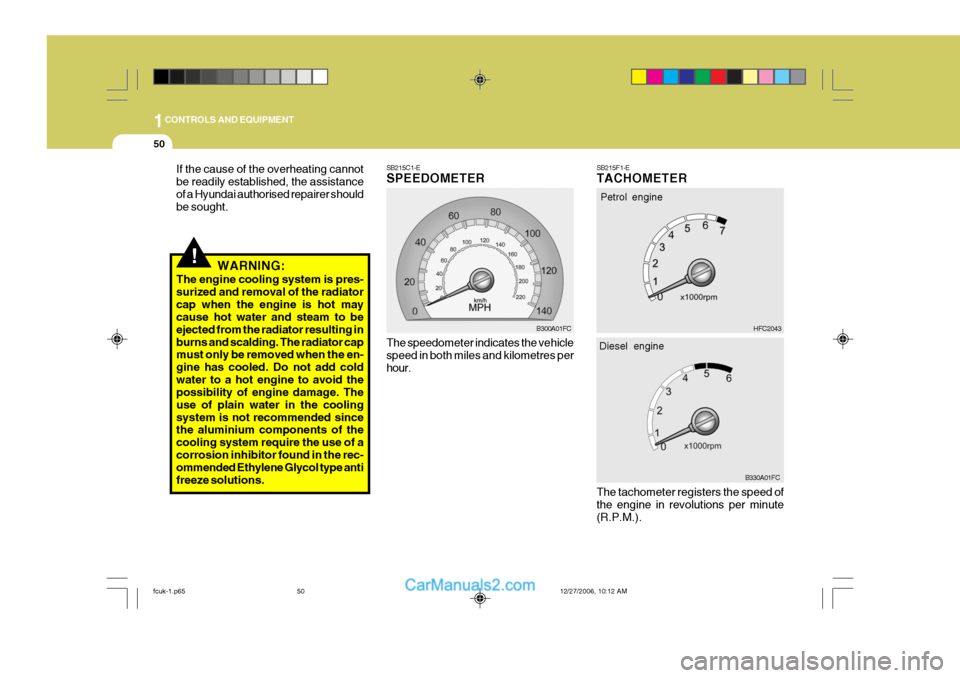
SB215F1-E TACHOMETER
HFC2043
B330A01FC
Petrol engine
Diesel engine
If the cause of the overheating cannot be readily established, the assistanceof a Hyundai authorised repairer should be sought.
!WARNING:
The engine cooling system is pres- surized and removal of the radiatorcap when the engine is hot may cause hot water and steam to be ejected from the radiator resulting inburns and scalding. The radiator cap must only be removed when the en- gine has cooled. Do not add coldwater to a hot engine to avoid the possibility of engine damage. The use of plain water in the coolingsystem is not recommended since the aluminium components of the cooling system require the use of acorrosion inhibitor found in the rec- ommended Ethylene Glycol type anti freeze solutions. SB215C1-E SPEEDOMETER
B300A01FC
The speedometer indicates the vehicle speed in both miles and kilometres per hour.
The tachometer registers the speed of the engine in revolutions per minute(R.P.M.).
fcuk-1.p65 12/27/2006, 10:12 AM
50
Page 391 of 490

2
DRIVING YOUR HYUNDAI
17
C310D01JM-EAT Indicators and Warning The indicators should illuminate when the ignition key is turned to ON orSTART but should go out after approxi- mately 3 seconds. If the indicators do not illuminate, or theESP or ESP-OFF indicator does not go out after approximately 3 seconds, have the vehicle checked by Hyundaiauthorised repairer. Should there be any unusual conditions in the device whilst driving, ESP-OFF indicator illuminates as a warning. If ESP-OFF indicator illuminates, pullyour car to a safe place and stop the engine. Then, start the engine again to check ifthe ESP-OFF indicator goes out. If the indicator remains lit even after the engine has been started, have your car checked by Hyundai authorised repairer.EFFECTIVE BRAKING
SC140A2-E Braking system performance and fric- tion material life are greatly affected by the driving style adopted. The following suggestions are made to assist inachieving the best results from the braking system.
o Anticipate the road and conditions ahead in order that heavy braking may be avoided.
o When descending long gradients, use the engine to assist in retarding thevehicle to minimize the possibility of brake fade occurring.
o When trailer towing, ensure that the trailer brakes function correctly anduse engine braking to assist thevehicle braking system.
o Use only genuine Hyundai replace-
ment brake pads and shoes to en-sure consistent friction characteris- tics and wear rates.
o After driving through deep water (e.g. fording), the brakes may become wetand performance reduced. Always check brake efficiency after emerg-ing from the water and dry the brakes by lightly depressing the brake pedal several times whilst driving slowly. o Apply the parking brake only when
the vehicle is at rest.
o Since the power assistance provided by the brake servo is derived fromthe engine, coasting with the engineturned off or towing of the vehicle with the engine turned off will result in greatly increased pedal pressuresbeing required to stop the vehicle.
o Do not hold the vehicle on an incline
with the accelerator pedal. This cancause the transmission to overheat. Always use the brake pedal or park- ing brake.
o Use caution when parking on a hill. Engage the parking brake and placethe gear selector lever in "P" (auto-matic transaxle) or in first or reverse gear (manual transaxle). If your car is facing downhill, turn the frontwheels into the curb to help keep the car from rolling. If your car is facing uphill, turn the front wheels awayfrom the curb to help keep the car from rolling. If there is no curb or if it is required by other conditions tokeep the car from rolling, block the wheels.
fcuk-2.p65 12/27/2006, 10:14 AM
17
Page 392 of 490

2 DRIVING YOUR HYUNDAI
18
o Keep your car in good condition. For
better fuel economy and reduced maintenance costs, maintain your car in accordance with the mainte- nance schedule in Section 5. If youdrive your car in severe conditions, more frequent maintenance is re- quired (see Section 5 for details).
o Keep your car clean. For maximum service, your car should be keptclean and free of corrosive materi-als. It is especially important that mud, dirt, ice, etc. not be allowed to accumulate on the underside of thecar. This extra weight can result in increased fuel consumption and also contribute to corrosion.
o Travel lightly. Don't carry unneces- sary weight in your car. Weight is anenemy of good fuel economy.
o Don't let the engine idle longer than necessary. If you are waiting (andnot in traffic), turn off your engine andrestart only when you're ready to go.
SC150A1-F You can save fuel and get more miles from your car if you follow these sug-gestions:
o Drive smoothly. Accelerate at a
moderate rate. Don't make "jack- rabbit" starts or full-throttle shifts and maintain a steady cruising speed. Don't race between stoplights. Try toadjust your speed to that of the other traffic so you don't have to change speeds unnecessarily.Avoid heavy traffic whenever pos- sible. Always maintain a safe dis- tance from other vehicles so you canavoid unnecessary braking. This also reduces brake wear.
o Drive at a moderate speed. The faster you drive, the more fuel your caruses. Driving at a moderate speed, especially on the highway, is one ofthe most effective ways to reduce fuel consumption.
DRIVING FOR ECONOMY
o Don't "ride" the brake or clutch pedal.This can increase fuel consumption and also increase wear on these components. In addition, driving with your foot resting on the brake pedalmay cause the brakes to overheat, which reduces their effectiveness and may lead to more serious con-
sequences.
o Take care of your tyres. Keep them
inflated to the recommended pres-sure. Incorrect infla-tion, either too much or too little, results in unneces- sary tyre wear. Check the tyre pres-sures at least once a month.
o Be sure that the wheels are aligned
correctly. Improper alignment canresult from hitting curbs or driving too fast over irregular surfaces. Poor alignment causes faster tyre wearand may also result in other prob- lems as well as greater fuel con- sumption.
fcuk-2.p65 12/27/2006, 10:14 AM
18
Page 398 of 490

2 DRIVING YOUR HYUNDAI
24
YC200E2-E Trailer or Vehicle Towing Tips
1. Before towing, check towbar ball andsafety cable connections as well as proper operation of the trailer running lights, brake lights, and turn signals.
2. Always drive your vehicle at a mod- erate speed (Less than 60 MPH)
3. Trailer towing requires more fuel
than normal conditions.
4. To maintain engine braking effi- ciency and electrical charging per- formance, do not use fifth gear(manual transaxle) or overdrive (au- tomatic transaxle).
5. Always secure items in the trailer to prevent load shift whilst driving.
6. Check the condition and air pres-
sure of all tyres on the trailer and your vehicle. Low tyre pressure can seriously affect the handling. Also check the spare tyre. 7. The vehicle/trailer combination is
more affected by crosswind andbuffeting. When being passed by a large ve- hicle, keep a constant speed andsteer straight ahead. If there is too much wind buffeting slow down to get out of the other vehicle's airturbulence.
8. When parking your vehicle and
trailer, especially on a hill, be sure tofollow all the normal precautions. Turn your front wheels into the curb, set the parking brake firmly, and putthe transaxle in 1st or Reverse (manual) or Park (automatic). In ad- dition, we advise the use of wheelchocks at each of the trailer's tyres.
9. If the trailer has electric brakes,
start your vehicle and trailer mov-ing, and then apply the trailer brake controller by hand to be sure the brakes are working. This lets youcheck your electrical connection at the same time. 10. During your trip, check occasionally
to be sure that the load is secure, and that the lights and any trailer brakes are still working.
11. Avoid jerky starts, sudden acceler-
ation or sudden stops.
12. Avoid sharp turns and rapid lane
changes.
13. Avoid holding the brake pedal down too long or too frequently. This could cause the brakes to overheat, re-sulting in reduced braking efficien- cy.
14. When going down a hill, shift into a
lower gear and use the engine brak-ing effect. When climbing a long grade, down-shift the transaxle to a lower gear and reduce speed to reduce chances of engine overloading and/or over-heating.
fcuk-2.p65 12/27/2006, 10:14 AM
24
Page 399 of 490

2
DRIVING YOUR HYUNDAI
25
15. If you have to stop whilst going uphill, do not hold the vehicle in place by pressing on the accelera- tor. This can cause the automatic transaxle to overheat. Use the park-ing brake or footbrake.
NOTE: When towing check transaxle fluid more frequently.
! CAUTION:
If overheating should occur when towing, (temperature gauge readsnear the red zone), taking the follow- ing actions may reduce or eliminate the problem.
1. Turn off the air conditioner.
2. Reduce highway speed.
3. Select a lower gear when going uphill.
4. Whilst in stop and go traffic, place the gear selection in park or neu- tral and idle the engine at a higher speed.
fcuk-2.p65 12/27/2006, 10:14 AM
25
Page 400 of 490

3
If the Engine Will not Start .......................................... 3-2
Jump Starting .............................................................. 3-3
If the Engine Overheats .............................................. 3-4
Spare Tyre ................................................................... 3-6
In the Event of a Puncture ........................................... 3-7
Changing A Flat Tyre ................................................... 3-7
If Your Vehicle Must Be Towed ..................................3-12
Emergency Towing ..................................................... 3-14
If You Lose Your K eys ................................................ 3-14
IN CASE OF EMERGENCY
3
fcuk-3.p65
12/27/2006, 10:15 AM
1