ECU Hyundai Matrix 2007 Owner's Guide
[x] Cancel search | Manufacturer: HYUNDAI, Model Year: 2007, Model line: Matrix, Model: Hyundai Matrix 2007Pages: 490, PDF Size: 12.81 MB
Page 304 of 490
1
CONTROLS AND EQUIPMENT
25
o Never use an infant carrier or child
safety seat that "hooks" over a seatback; it may not provide ad- equate security in an accident.
o Never allow a child to be held in a person's arms whilst they are in amoving vehicle, as this could re-sult in serious injury to the child in the event of an accident or a sudden stop. Holding a child in amoving vehicle does not provide the child with any means of pro- tection during an accident, even ifthe person holding the child is wearing a seat belt.
o If the child restraint seat is not
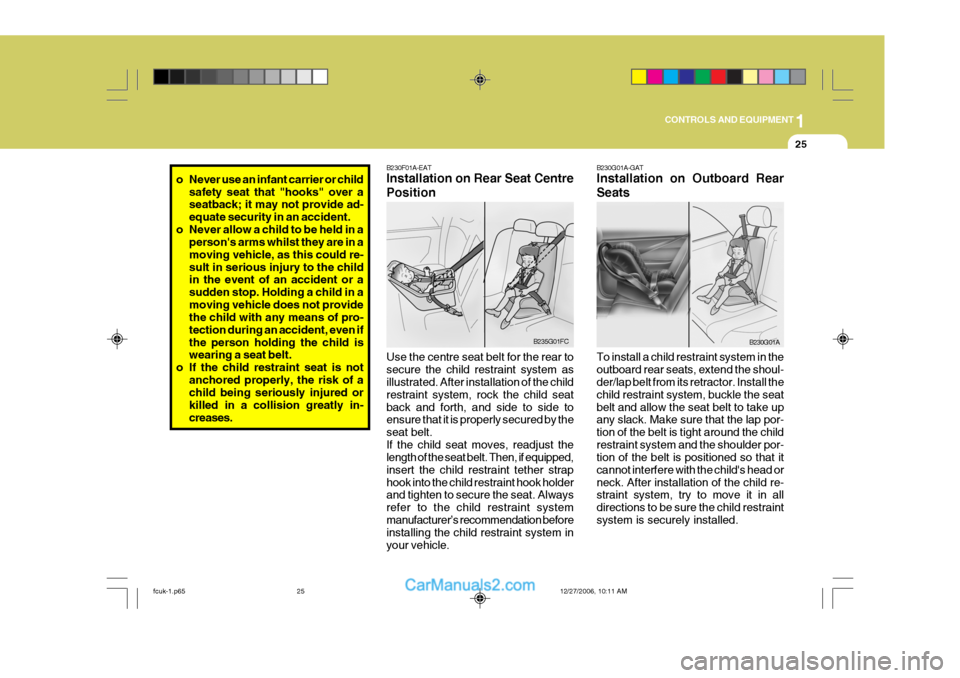
anchored properly, the risk of achild being seriously injured or killed in a collision greatly in-creases. B230F01A-EAT Installation on Rear Seat Centre Position Use the centre seat belt for the rear to secure the child restraint system as illustrated. After installation of the child restraint system, rock the child seatback and forth, and side to side to ensure that it is properly secured by the seat belt.If the child seat moves, readjust the length of the seat belt. Then, if equipped, insert the child restraint tether straphook into the child restraint hook holder and tighten to secure the seat. Always refer to the child restraint systemmanufacturer’s recommendation before installing the child restraint system in your vehicle.
B235G01FC
B230G01A-GAT Installation on Outboard Rear Seats To install a child restraint system in the outboard rear seats, extend the shoul- der/lap belt from its retractor. Install the child restraint system, buckle the seatbelt and allow the seat belt to take up any slack. Make sure that the lap por- tion of the belt is tight around the childrestraint system and the shoulder por- tion of the belt is positioned so that it cannot interfere with the child's head orneck. After installation of the child re- straint system, try to move it in all directions to be sure the child restraintsystem is securely installed.
B230G01A
fcuk-1.p65
12/27/2006, 10:11 AM
25
Page 306 of 490
1
CONTROLS AND EQUIPMENT
27
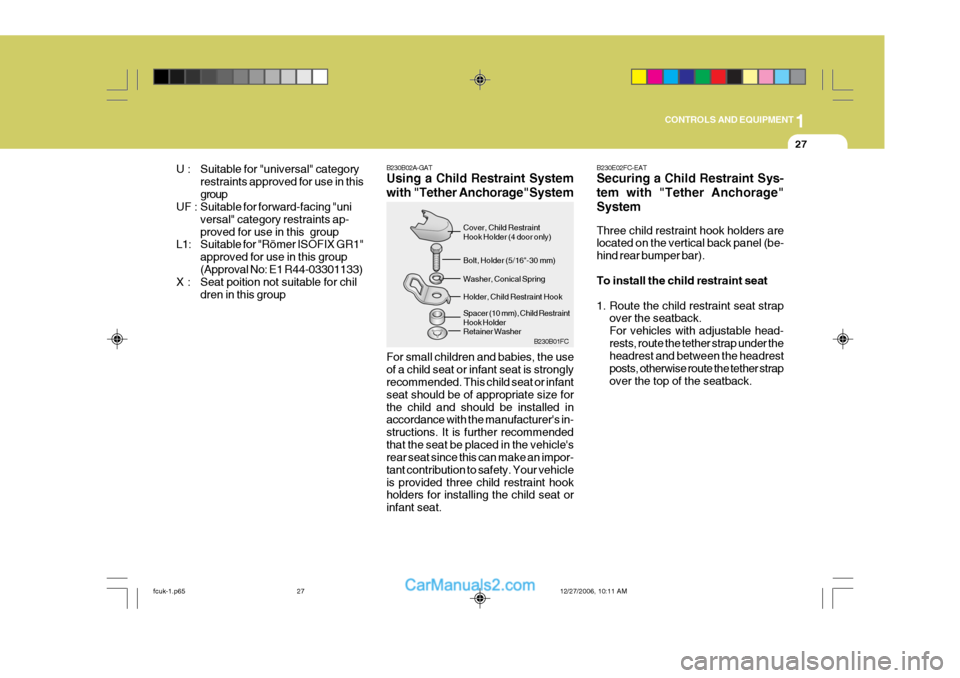
B230B02A-GAT Using a Child Restraint System
with "Tether Anchorag
e"System
For small children and babies, the use of a child seat or infant seat is strongly recommended. This child seat or infant seat should be of appropriate size forthe child and should be installed in accordance with the manufacturer's in- structions. It is further recommendedthat the seat be placed in the vehicle's rear seat since this can make an impor- tant contribution to safety. Your vehicleis provided three child restraint hook holders for installing the child seat or infant seat. B230B01FC
Cover, Child Restraint Hook Holder (4 door only)
Bolt, Holder (5/16"-30 mm) Washer, Conical Spring
Holder, Child Restraint Hook
Spacer (10 mm), Child Restraint Hook Holder Retainer Washer
B230E02FC-EAT Securing a Child Restraint Sys- tem with "Tether Anchorage"System Three child restraint hook holders are located on the vertical back panel (be- hind rear bumper bar). To install the child restraint seat
1. Route the child restraint seat strap over the seatback. For vehicles with adjustable head-rests, route the tether strap under the headrest and between the headrest posts, otherwise route the tether strapover the top of the seatback.
U : Suitable for "universal" category
restraints approved for use in thisgroup
UF : Suitable for forward-facing "uni
versal" category restraints ap-proved for use in this group
L1: Suitable for "Römer ISOFIX GR1"
approved for use in this group(Approval No: E1 R44-03301133)
X : Seat poition not suitable for chil
dren in this group
fcuk-1.p65 12/27/2006, 10:11 AM
27
Page 307 of 490
1CONTROLS AND EQUIPMENT
28
B230C03FC-EAT Using a Child Restraint System with "ISOFIX" System and"Tether Anchorage" System
B230F01FC
ISOFIX is a standardised method of fitting child seats that eliminates the need to use the standard adult seat belt to secure the seat in the vehicle. This enables a much more secure and positive location with the added benefitof easier and quicker installation.
!
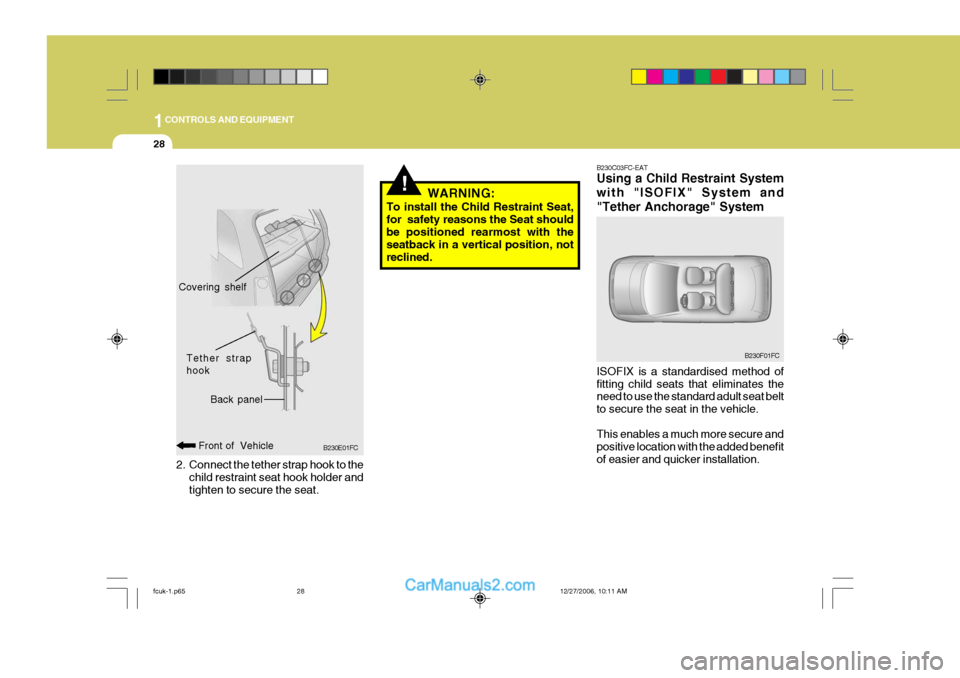
2. Connect the tether strap hook to the child restraint seat hook holder and tighten to secure the seat. WARNING:
To install the Child Restraint Seat,for safety reasons the Seat should be positioned rearmost with the seatback in a vertical position, notreclined.
B230E01FC
Front of Vehicle
Back panel
Covering shelf
Tether strap hook
fcuk-1.p65 12/27/2006, 10:11 AM
28
Page 308 of 490
1
CONTROLS AND EQUIPMENT
29
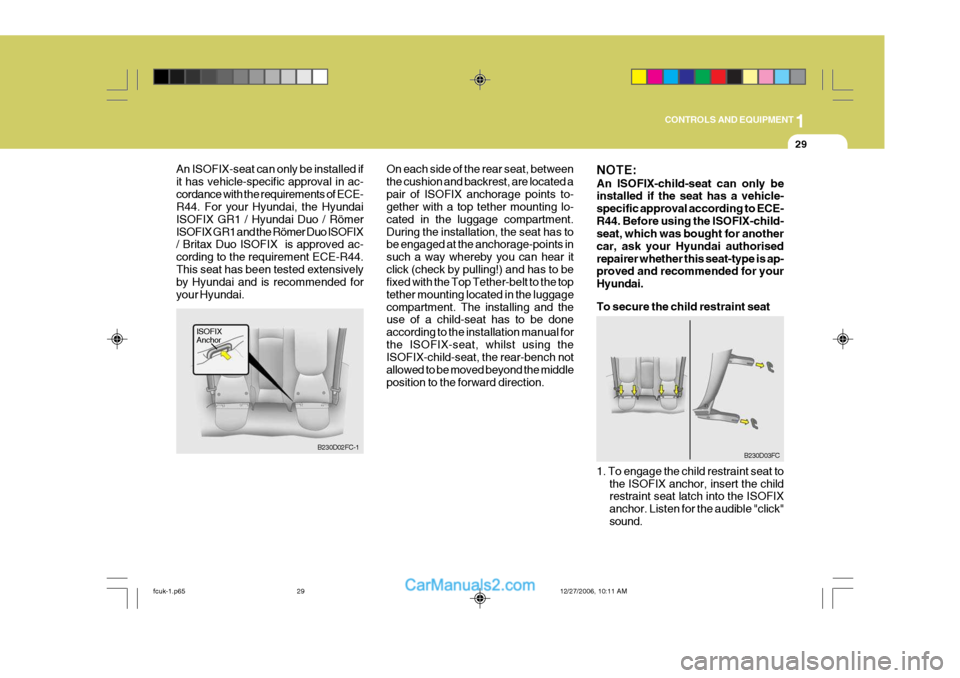
An ISOFIX-seat can only be installed if it has vehicle-specific approval in ac-cordance with the requirements of ECE- R44. For your Hyundai, the Hyundai ISOFIX GR1 / Hyundai Duo / RömerISOFIX GR1 and the Römer Duo ISOFIX / Britax Duo ISOFIX is approved ac- cording to the requirement ECE-R44.This seat has been tested extensively by Hyundai and is recommended for your Hyundai. On each side of the rear seat, betweenthe cushion and backrest, are located apair of ISOFIX anchorage points to- gether with a top tether mounting lo- cated in the luggage compartment.During the installation, the seat has to be engaged at the anchorage-points in such a way whereby you can hear itclick (check by pulling!) and has to be fixed with the Top Tether-belt to the top tether mounting located in the luggagecompartment. The installing and the use of a child-seat has to be done according to the installation manual forthe ISOFIX-seat, whilst using the ISOFIX-child-seat, the rear-bench not allowed to be moved beyond the middleposition to the forward direction.
B230D02FC-1
ISOFIX Anchor
NOTE: An ISOFIX-child-seat can only be installed if the seat has a vehicle- specific approval according to ECE-R44. Before using the ISOFIX-child- seat, which was bought for another car, ask your Hyundai authorisedrepairer whether this seat-type is ap- proved and recommended for your Hyundai. To secure the child restraint seat 1. To engage the child restraint seat to
the ISOFIX anchor, insert the child restraint seat latch into the ISOFIX anchor. Listen for the audible "click"sound.
B230D03FC
fcuk-1.p65 12/27/2006, 10:11 AM
29
Page 309 of 490
1CONTROLS AND EQUIPMENT
30
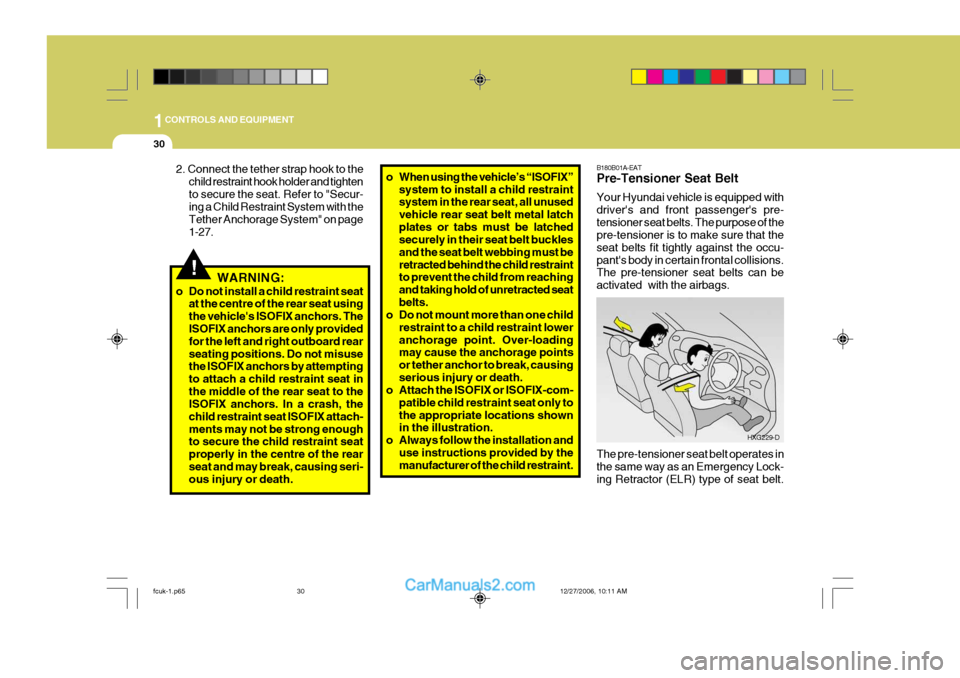
B180B01A-EAT Pre-Tensioner Seat Belt Your Hyundai vehicle is equipped with driver's and front passenger's pre-tensioner seat belts. The purpose of the pre-tensioner is to make sure that the seat belts fit tightly against the occu-pant's body in certain frontal collisions. The pre-tensioner seat belts can be activated with the airbags.
HXG229-D
The pre-tensioner seat belt operates in the same way as an Emergency Lock-ing Retractor (ELR) type of seat belt.
2. Connect the tether strap hook to the child restraint hook holder and tighten to secure the seat. Refer to "Secur- ing a Child Restraint System with the Tether Anchorage System" on page1-27.
WARNING:
o Do not install a child restraint seat at the centre of the rear seat usingthe vehicle's ISOFIX anchors. TheISOFIX anchors are only provided for the left and right outboard rear seating positions. Do not misuse the ISOFIX anchors by attempting to attach a child restraint seat inthe middle of the rear seat to the ISOFIX anchors. In a crash, the child restraint seat ISOFIX attach-ments may not be strong enough to secure the child restraint seat properly in the centre of the rearseat and may break, causing seri- ous injury or death.
!
o When using the vehicle’s “ISOFIX”
system to install a child restraint system in the rear seat, all unused vehicle rear seat belt metal latchplates or tabs must be latched securely in their seat belt buckles and the seat belt webbing must beretracted behind the child restraint to prevent the child from reaching and taking hold of unretracted seatbelts.
o Do not mount more than one child
restraint to a child restraint loweranchorage point. Over-loading may cause the anchorage points or tether anchor to break, causingserious injury or death.
o Attach the ISOFIX or ISOFIX-com-
patible child restraint seat only tothe appropriate locations shown in the illustration.
o Always follow the installation and use instructions provided by themanufacturer of the child restraint.
fcuk-1.p65 12/27/2006, 10:11 AM
30
Page 351 of 490

1CONTROLS AND EQUIPMENT
72HATCHBACK DOOR
o Automotive fuels are flammable/
explosive materials. When refuel- ing, please note the following guidelines carefully.
o Before touching the fuel nozzle or fuel filler cap, have one's hands incontact with metal parts away from the filler neck to discharge staticelectricity.
o Do not get back in the vehicle
whilst refueling. Do not operateanything that can produce static electricity. Static electricity dis- charge can ignite fuel vapors re-sulting in explosion.
o When using a portable fuel con-
tainer be sure to place the con-tainer on the ground whilst refuel- ing. Static electricity discharge from the container can ignite fuelvapors causing a fire. Whilst start- ing refueling contact should be maintained until the filling is com-plete. o Do not use cellular phones around
a gas station. The electric currentor electronic interference from cellular phones can ignite fuel vapors causing a fire.
o When refueling always shut the engine off. Sparks by electricalequipment of the engine can ig-nite fuel vapors causing a fire. After refueling, check to make sure the fuel filler cap is securely closed,and then start the engine.
o Do not smoke or try to light ciga-
rettes around a gas station. Auto-motive fuels are flammable.
!
B540A01FC-EAT
WARNING:
The hatchback door should always be kept completely closed whilst the vehicle is in motion. If it is left open or ajar, poisonous exhaust gasesmay enter the car resulting in seri- ous illness or death to the occu- pants. See additional warnings con-cerning exhaust gases on page 2-2. B540A02FC
LOCK
UNLOCK
fcuk-1.p65
12/27/2006, 10:12 AM
72
Page 353 of 490
1CONTROLS AND EQUIPMENT
74ROOF RACK
34 kg (75 lb)
EVENLY DISTRBUTED
ROOF RACK
o Loading cargo or luggage above
34 kg (75 lb) on the roof rack may damage your vehicle.When you carry large objects, never let them hang over the rear or the sides of your vehicle.
o To prevent damage or loss of cargo as you are driving, check fre-quently to make sure the luggagecarrier and cargo are still securely fastened.
o Always drive your vehicle at a moderate speed.
o To use the roof rails as a roof rack,
you must fit the roof rails with two or more crossrails or equivalent before carrying cargo or lugguage on the roof.
o When crossrail is adapted, you can load items on the roof rack.
o Loading cargo or luggage over specification on the roof rack may damage stability of your vehicle.
o In case the sunroof is equipped, do not position roof rack loadsthat could interfere with opening of the sunroof.
B650A01FC-EAT Nothing should be carried on top of the luggage cover. Loose materials couldresult in injury to vehicle occupants during sudden braking. B640A02FC
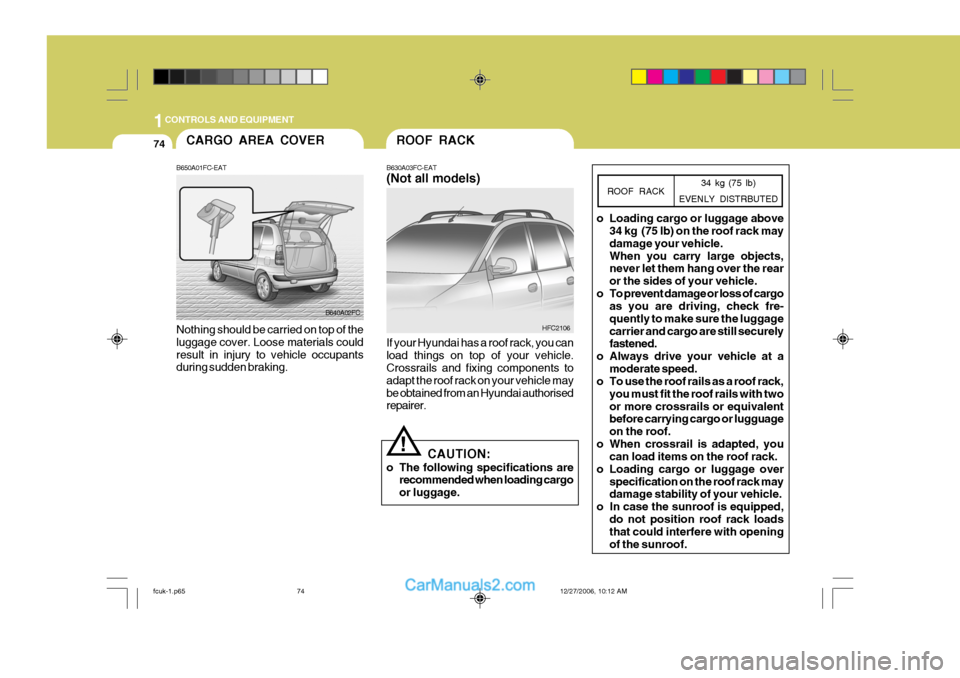
CARGO AREA COVERB630A03FC-EAT (Not all models) If your Hyundai has a roof rack, you can load things on top of your vehicle. Crossrails and fixing components to adapt the roof rack on your vehicle maybe obtained from an Hyundai authorised repairer.
CAUTION:
o The following specifications are recommended when loading cargo or luggage.
! HFC2106
fcuk-1.p65
12/27/2006, 10:12 AM
74
Page 354 of 490

1
CONTROLS AND EQUIPMENT
75AUTO FUEL CUT SWITCH
!
To adjust the steering wheel:
1. Push the lever downward to unlock.
2. Raise or lower the steering wheel to
the desired position.
3. After adjustment, securely tighten the lever by pulling it upward
SB520A1-F
STEERING WHEEL TILT LEVER
HORN
HFC2041
WARNING:
Do not attempt to adjust the steering wheel whilst driving as this mayresult in loss of control of the vehicle and result in death or serious injury. B610A01S-EATHFC2099
Press the pad of the steering wheel to sound the horn.
!
B560B01O-GAT (Petrol Engine)
The auto fuel cut switch is located on the driver's side of the engine compartment. In the event of a collision or suddenimpact, the auto fuel cut device cuts off the fuel supply. If this device is acti- vated, it must be reset by pressing in onthe top of the switch before the engine can be restarted.
HFC4001
WARNING:
Before resetting the auto fuel cut switch, the fuel line should be checked for fuel leaks. With Airbag
fcuk-1.p65
12/27/2006, 10:12 AM
75
Page 398 of 490

2 DRIVING YOUR HYUNDAI
24
YC200E2-E Trailer or Vehicle Towing Tips
1. Before towing, check towbar ball andsafety cable connections as well as proper operation of the trailer running lights, brake lights, and turn signals.
2. Always drive your vehicle at a mod- erate speed (Less than 60 MPH)
3. Trailer towing requires more fuel
than normal conditions.
4. To maintain engine braking effi- ciency and electrical charging per- formance, do not use fifth gear(manual transaxle) or overdrive (au- tomatic transaxle).
5. Always secure items in the trailer to prevent load shift whilst driving.
6. Check the condition and air pres-
sure of all tyres on the trailer and your vehicle. Low tyre pressure can seriously affect the handling. Also check the spare tyre. 7. The vehicle/trailer combination is
more affected by crosswind andbuffeting. When being passed by a large ve- hicle, keep a constant speed andsteer straight ahead. If there is too much wind buffeting slow down to get out of the other vehicle's airturbulence.
8. When parking your vehicle and
trailer, especially on a hill, be sure tofollow all the normal precautions. Turn your front wheels into the curb, set the parking brake firmly, and putthe transaxle in 1st or Reverse (manual) or Park (automatic). In ad- dition, we advise the use of wheelchocks at each of the trailer's tyres.
9. If the trailer has electric brakes,
start your vehicle and trailer mov-ing, and then apply the trailer brake controller by hand to be sure the brakes are working. This lets youcheck your electrical connection at the same time. 10. During your trip, check occasionally
to be sure that the load is secure, and that the lights and any trailer brakes are still working.
11. Avoid jerky starts, sudden acceler-
ation or sudden stops.
12. Avoid sharp turns and rapid lane
changes.
13. Avoid holding the brake pedal down too long or too frequently. This could cause the brakes to overheat, re-sulting in reduced braking efficien- cy.
14. When going down a hill, shift into a
lower gear and use the engine brak-ing effect. When climbing a long grade, down-shift the transaxle to a lower gear and reduce speed to reduce chances of engine overloading and/or over-heating.
fcuk-2.p65 12/27/2006, 10:14 AM
24
Page 404 of 490

3
IN CASE OF EMERGENCY
5
!
!
!WARNING:
Whilst the engine is running, keep hands and clothing away from mov- ing parts such as the fan and drive belts to prevent injury. 5. If the water pump drive belt is broken
or coolant is leaking out, stop theengine immediately and call the near- est Hyundai authorised repairer for assistance.
WARNING (Diesel only):
Never work on injection system with engine running or within 30 seconds after shutting off engine. High pres-sure pump, rail, injectors and high pressure pipes are subject to high pressure even after the enginestopped. The fuel jet produced by fuel leaks may cause serious injury, if it touches the body. People usingpacemakers should not move closer than 30cm etc. to the ECU or wiring harness within the engine roomwhilst engine is running, since the high currents in the Common Rail system produce considerable mag-netic fields.
!
WARNING:
Do not remove the radiator cap when the engine is hot since steam and boiling water may be ejected fromthe radiator resulting in burns or scalding.
6. If the cause of the overheating can- not be found, wait until the engine temperature has returned to normal. Then, if coolant has been lost, care-fully remove the radiator cap and add water to bring the fluid level in the reservoir up to the base of the radia-tor fill opening. Fill the coolant ex- pansion tank to the halfway mark. To ensure the correct water to cool-ant mix is obtained after top up, testing by an authorised repairer is required. 7. Proceed with caution until it is estab-
lished that the engine is operatingnormally. If the engine overheats repeatedly, the advice of a Hyundai authorised repairer should be sought.
CAUTION:
Serious loss of coolant indicatesthere is a leak in the cooling systemand this should be checked as soon as possible by a Hyundai authorised repairer.
fcuk-3.p65 12/27/2006, 10:15 AM
5