Fuel cell HYUNDAI NEXO 2023 User Guide
[x] Cancel search | Manufacturer: HYUNDAI, Model Year: 2023, Model line: NEXO, Model: HYUNDAI NEXO 2023Pages: 558, PDF Size: 35.01 MB
Page 242 of 558
3-155
Convenient features of your vehicle
3
Air conditioning
Your HYUNDAI vehicle air condition- ing system is filled with R-1234yf
refrigerant.
1. Start the vehicle.
2. Press the air conditioning button.
3. Select the Face Level mode.
4. Set the air intake control toRecirculation mode temporarily to
allow the cabin to cool quickly.
When the desired temperature inthe cabin is reached, change the
air intake control back to Fresh
mode.
5. Adjust the fan speed control and temperature control to maintain
maximum comfort.
When maximum cooling is desired,
set the temperature control to the
MAX A/C position, then set the fanspeed control to the highest setting. When using the air conditioning
system, monitor the temperature
gauge closely while driving up
hills or in heavy traffic when out-
side temperatures. Air condition-
ing system operation when climb-ing a steep grade or in high out-side ambient temperatures can
cause fuel cell stack overheating.
Continue to use the fan, but turn the air conditioning system off if
the temperature gauge indicates
fuel cell stack overheating.
Air conditioning system operation
tips
If the vehicle has been parked in
direct sunlight during hot weather,
open the windows for a short time
to let the hot air inside the vehicle
escape.
After sufficient cooling has been achieved, switch back from recircu-
lation mode to fresh mode. To help reduce moisture inside of
the windows on rainy or humid
days, decrease the humidity inside
the vehicle by operating the airconditioning system with the win-
dows and sunroof closed.
Use the air conditioning system every month only for a few minutes
to ensure maximum system per-
formance.
If you operate air conditioner exces- sively, the difference between the
temperature of the outside air andthat of the windshield could cause
the outer surface of the windshield
to fog up, causing loss of visibility. In
this case, set the mode selection
knob or button to the position
and fan speed control to the lowerspeed.
NOTICE
Page 385 of 558
5-118
Driving your vehicle
Hazardous Driving Conditions
When hazardous driving elements
are encountered such as water,
snow, ice, mud and sand, take the
bellow suggestions:
Drive cautiously and keep a longerbraking distance.
Avoid abrupt braking or steering.
When your vehicle is stuck in snow, mud, or sand, use second gear.
Accelerate slowly to avoid unnec-
essary wheel spin.
Put sand, rock salt or other non- slip materials under the wheels to
provide additional traction while
the vehicle becomes stuck in ice,
snow, or mud.
Rocking the Vehicle
If it is necessary to rock the vehicle
to free it from snow, sand, or mud,
first turn the steering wheel right and
left to clear the area around your
front wheels. Then, shift back and
forth between R (Reverse) and a for-
ward gear.
Try to avoid spinning the wheels, and
do not race the vehicle.
To prevent reduction gear wear, wait
until the wheels stop spinning before
shifting gears. Release the accelera-tor pedal while shifting, and press
lightly on the accelerator pedal while
the reduction gear is in gear. Slowly
spinning the wheels in forward and
reverse directions causes a rocking
motion that may free the vehicle.
SSPP EECCIIAA LL DD RRIIVV IINN GG CC OO NNDDIITT IIOO NNSS
If the vehicle is stuck and
excessive wheel spin occurs,the temperature in the tires can
increase very quickly. If the tires
become damaged, a tire blow
out or tire explosion can occur.
This condition is dangerous -
you and others may be injured.
Do not attempt this procedure if
people or objects are anywhere
near the vehicle.
If you attempt to free the vehi-
cle, the vehicle can overheat
quickly, possibly causing an
fuel cell power module com-
partment fire or other damage.
Try to avoid spinning the
wheels as much as possible to
prevent overheating of either
the tires or the vehicle. DO NOT
allow the vehicle to spin the
wheels above 56 km/h (35 mph).
WARNING
Page 391 of 558
5-124
Driving your vehicle
Do not let ice and snow accu-mulate underneath
Under some conditions, snow and
ice can build up under the fenders
and interfere with the steering. When
driving in severe winter conditions
where this may happen, you should
periodically check underneath the
car to be sure the movement of the
front wheels and the steering com-
ponents is not obstructed.
Don't place foreign objects ormaterials in the fuel cell power
module compartment
Placement of foreign object or mate-
rials which prevent cooling of the
vehicle, in the fuel cell power module
compartment, may cause a failure.
The manufacturer is not responsible
for the damage caused by suchplacement.
To keep locks from freezing
To keep the locks from freezing,
squirt an approved de-icer fluid or
glycerine into the key opening. If a
lock is covered with ice, squirt it with
an approved de-icing fluid to remove
the ice. If the lock is frozen internally,
you may be able to thaw it out by
using a heated key. Handle the heat-
ed key with care to avoid injury.
Page 399 of 558
6-2
The hazard warning flasher serves
as a warning to other drivers to exer-
cise extreme caution when approach-
ing, overtaking, or passing your vehi-
cle.
It should be used whenever emer- gency repairs are being made or
when the vehicle is stopped near the
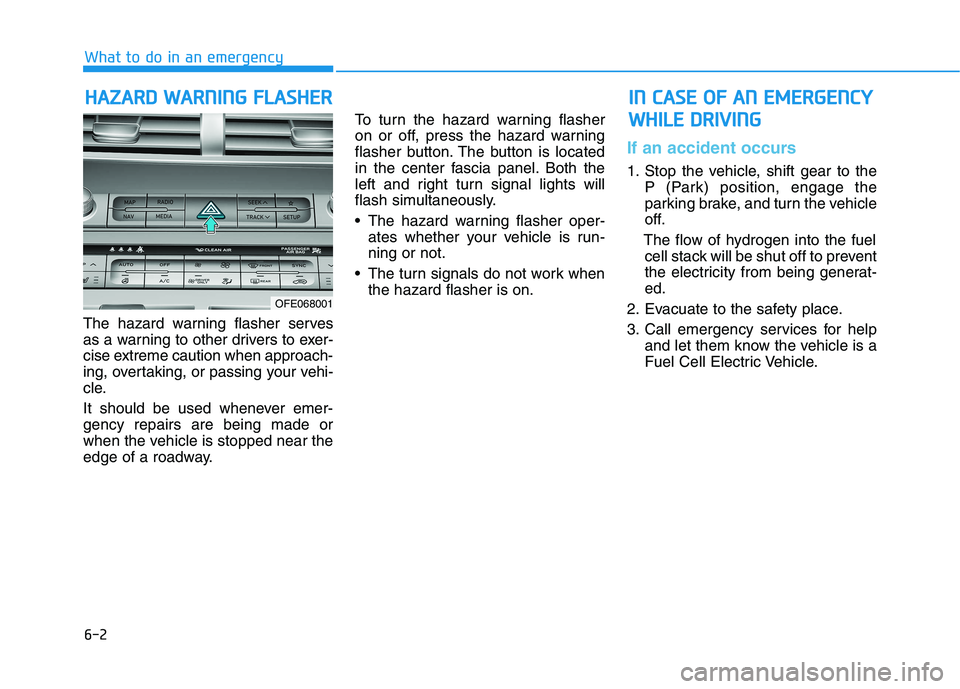
edge of a roadway. To turn the hazard warning flasher
on or off, press the hazard warning
flasher button. The button is located
in the center fascia panel. Both the
left and right turn signal lights will
flash simultaneously.
• The hazard warning flasher oper-
ates whether your vehicle is run- ning or not.
The turn signals do not work when the hazard flasher is on.
If an accident occurs
1. Stop the vehicle, shift gear to the P (Park) position, engage the
parking brake, and turn the vehicle
off.
The flow of hydrogen into the fuel cell stack will be shut off to prevent
the electricity from being generat-ed.
2. Evacuate to the safety place.
3. Call emergency services for help and let them know the vehicle is a
Fuel Cell Electric Vehicle.
HHAAZZAA RRDD WW AARRNN IINN GG FF LLAA SSHH EERR
What to do in an emergency
OFE068001
IINN CC AA SSEE OO FF AA NN EE MM EERR GG EENN CCYY
W
W HHIILL EE DD RRIIVV IINN GG
Page 400 of 558
6-3
What to do in an emergency
If a fire occurs
1. Stop the vehicle, shift gear to theP(Park) position, engage the park-
ing brake, and turn the vehicle off.
The flow of hydrogen into the fuel cell stack will be shut off to prevent
the electricity from being generat-ed.
2. If the fire is small, which can be extinguished with fire extinguisher,
use carbon dioxide extinguisher.
You can also extinguish the fire with water when the vehicle power
is turned off. If the fire is too big to be extin-
guished with the fire extinguisher,
evacuate from the vehicle, call the
fire department, and let them know
the vehicle is a Fuel Cell Electric
Vehicle. Do not come close to the
vehicle until the fire is totally extin-guished.
Emergency venting of hydro-
gen gas
If the temperature near the safety
valve located at the rear under vehi-
cle is over 110°C (230°F) caused by
a fire or other reasons, the safety
valve will open to vent hydrogen gas.
Venting the hydrogen gas makes a
loud noise because the venting
speed is very fast. Stay well away
from the vehicle. The discharge of
hydrogen gas from the vehicle is
flammable and could cause a fire.
If a submersion in water
occurs
If your vehicle was flooded and has
soaked carpeting or water on the
flooring, you should not try to start
the vehicle by pressing the POWER
button.
Contact an authorized HYUNDAI
dealer immediately.
If the vehicle stalls at a cross-
road or crossing
If the vehicle stalls at a crossroad or crossing, set the gear in the N
(Neutral) position and then push the
vehicle to a safe place.
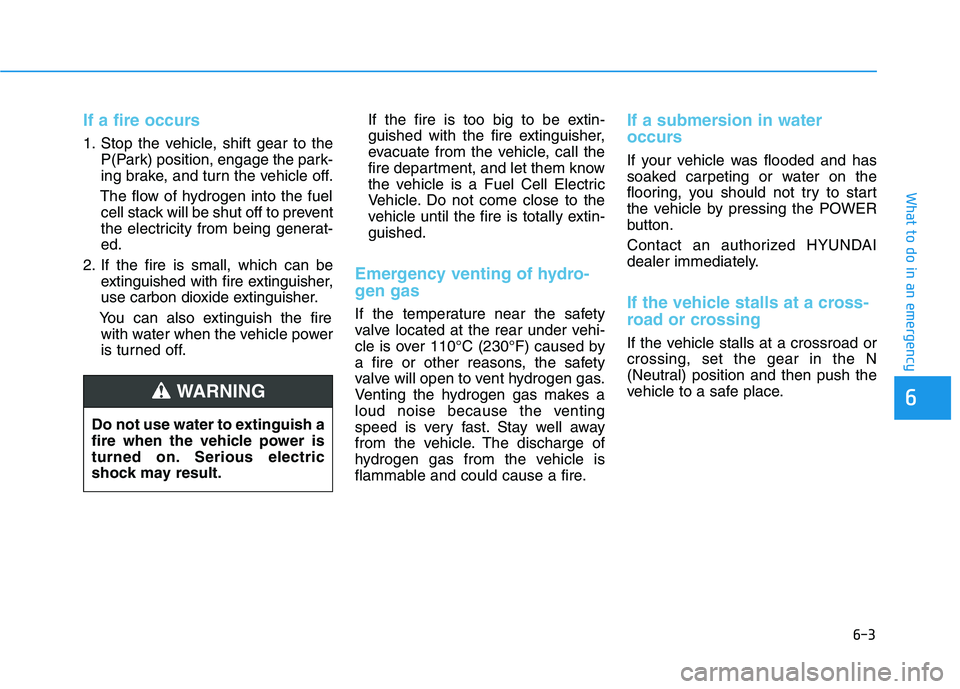
6
Do not use water to extinguish a
fire when the vehicle power is
turned on. Serious electric
shock may result.
WARNING
Page 403 of 558
6-6
What to do in an emergency
The following items may need to be
reset after the battery has been dis-
charged or the battery has been dis-
connected. See chapter 3 or 4 for:
Power Windows
Trip Computer
Climate Control System
Clock
Audio System
Sunroof
Driver Position Memory System
External power source using 12V
battery
The use of external power acces-
sories may reduce performance
and function of the vehicle.
Especially, the use of dash cam-
eras may shut off the power of the
vehicle prior to the dash camera's
automatic shut-down.
If the power of the vehicle is shut
off, start the vehicle as explained.
(refer to "Using the 12V Battery
Switch")Jump Starting
In the event vehicle still does not
have a functional 12V battery (check
if interior lights will not turn on) then
you can try a jump start using a 12V
booster pack or jumper cables from
another vehicle's 12V battery
according to the following instruc-
tions.1. Position the vehicles close enough
that the jumper cables will reach,
but do not allow the vehicles totouch.
2. Avoid fans or any moving parts in the fuel cell power module com-
partment at all times, even when
the vehicles are turned off.
3. Turn off all electrical devices such as radios, lights, air conditioning,
etc. Put the vehicles in P (Park)
and set the parking brake. Turn
both vehicles OFF.
NOTICE
Jump starting can be danger-
ous if done incorrectly. Follow
the jump starting procedure in
this section to avoid serious
injury or damage to your vehi-
cle. If in doubt about how to
properly jump start your vehi-
cle, we strongly recommend
that you have a service techni-
cian or towing service do it for
you.
CAUTION
Page 425 of 558
7
Maintenance
7
Maintenance
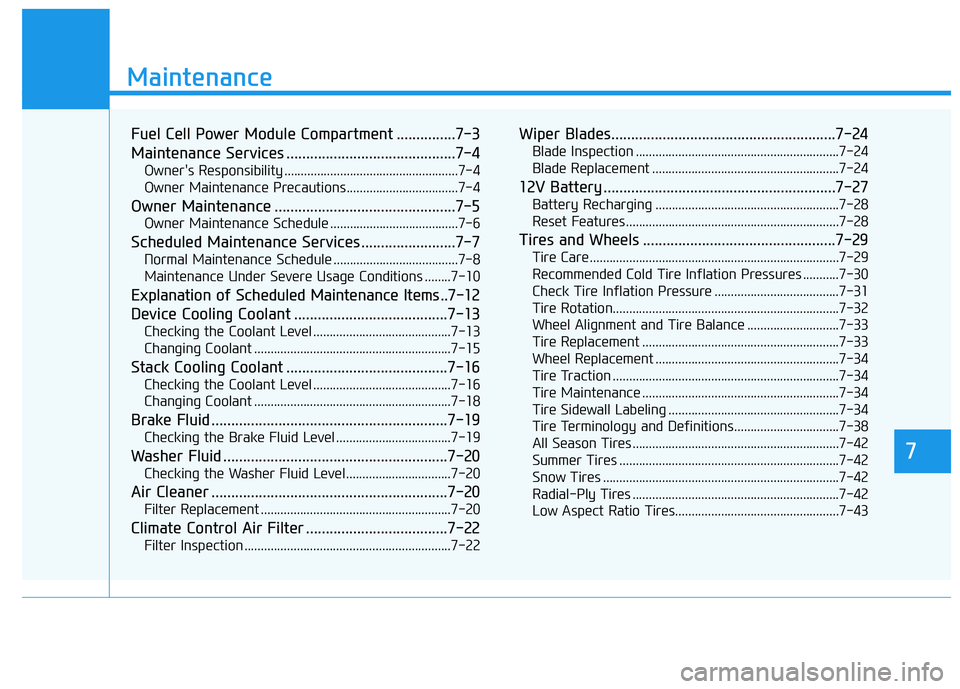
Fuel Cell Power Module Compartment ...............7-3
Maintenance Services ...........................................7-4Owner's Responsibility .....................................................7-4
Owner Maintenance Precautions..................................7-4
Owner Maintenance ..............................................7-5 Owner Maintenance Schedule .......................................7-6
Scheduled Maintenance Services........................7-7 Normal Maintenance Schedule ......................................7-8
Maintenance Under Severe Usage Conditions ........7-10
Explanation of Scheduled Maintenance Items ..7-12
Device Cooling Coolant .......................................7-13 Checking the Coolant Level ..........................................7-13
Changing Coolant ............................................................7-15
Stack Cooling Coolant .........................................7-16 Checking the Coolant Level ..........................................7-16
Changing Coolant ............................................................7-18
Brake Fluid ............................................................7-19 Checking the Brake Fluid Level ...................................7-19
Washer Fluid .........................................................7-20 Checking the Washer Fluid Level................................7-20
Air Cleaner ............................................................7-20 Filter Replacement ..........................................................7-20
Climate Control Air Filter ....................................7-22 Filter Inspection ...............................................................7-22 Wiper Blades.........................................................7-24
Blade Inspection ..............................................................7-24
Blade Replacement .........................................................7-24
12V Battery ...........................................................7-27 Battery Recharging ........................................................7-28
Reset Features.................................................................7-28
Tires and Wheels .................................................7-29 Tire Care ............................................................................7-29
Recommended Cold Tire Inflation Pressures ...........7-30
Check Tire Inflation Pressure ......................................7-31
Tire Rotation.....................................................................7-32
Wheel Alignment and Tire Balance ............................7-33
Tire Replacement ............................................................7-33
Wheel Replacement ........................................................7-34
Tire Traction .....................................................................7-34
Tire Maintenance ............................................................7-34
Tire Sidewall Labeling ....................................................7-34
Tire Terminology and Definitions................................7-38
All Season Tires ...............................................................7-42
Summer Tires ...................................................................7-42
Snow Tires ........................................................................7-42
Radial-Ply Tires ...............................................................7-42
Low Aspect Ratio Tires..................................................7-43
7
Page 426 of 558
7
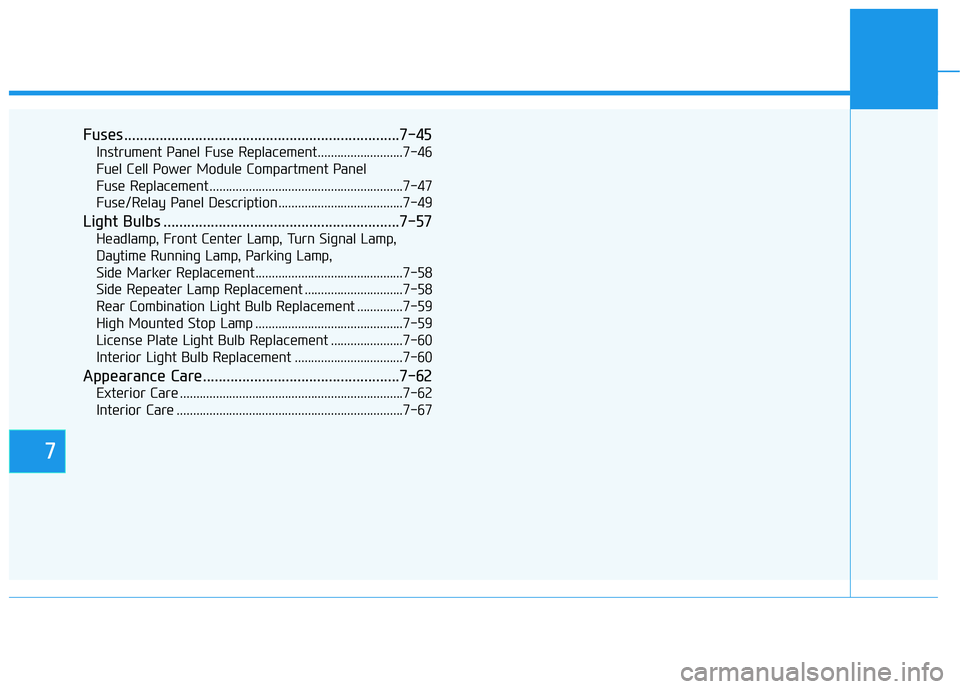
Fuses ......................................................................7-45Instrument Panel Fuse Replacement..........................7-46
Fuel Cell Power Module Compartment Panel
Fuse Replacement ...........................................................7-47
Fuse/Relay Panel Description ......................................7-49
Light Bulbs ............................................................7-57 Headlamp, Front Center Lamp, Turn Signal Lamp,
Daytime Running Lamp, Parking Lamp,
Side Marker Replacement.............................................7-58
Side Repeater Lamp Replacement ..............................7-58
Rear Combination Light Bulb Replacement ..............7-59
High Mounted Stop Lamp .............................................7-59
License Plate Light Bulb Replacement ......................7-60
Interior Light Bulb Replacement .................................7-60
Appearance Care..................................................7-62 Exterior Care ....................................................................7-62
Interior Care .....................................................................7-67
Page 427 of 558
7-3
7
Maintenance
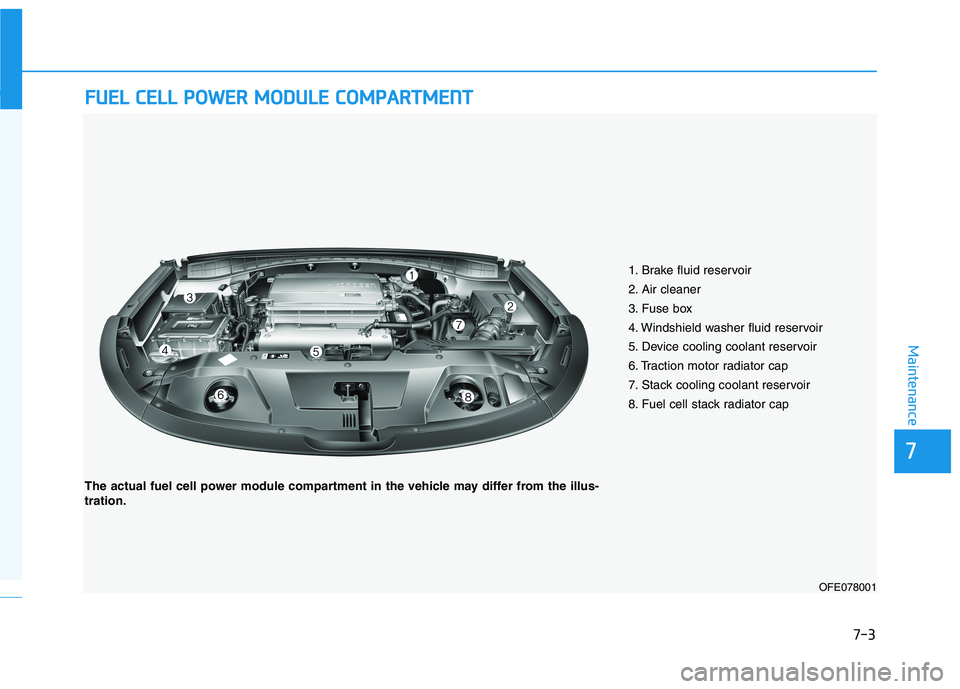
FFUU EELL CC EE LLLL PP OO WW EERR MM OODDUU LLEE CC OO MM PPAA RRTTMM EENN TT
1. Brake fluid reservoir
2. Air cleaner
3. Fuse box
4. Windshield washer fluid reservoir
5. Device cooling coolant reservoir
6. Traction motor radiator cap
7. Stack cooling coolant reservoir
8. Fuel cell stack radiator cap
OFE078001
The actual fuel cell power module compartment in the vehicle may differ from the illus- tration.
Page 428 of 558
7-4
MaintenanceM
M AAIINN TTEENN AANN CCEE SS EE RR VV IICC EE SS
You should exercise the utmost care
to prevent damage to your vehicle
and injury to yourself whenever per-
forming any maintenance or inspec-
tion procedures.
We recommend you have your vehi-
cle maintained and repaired by an
authorized HYUNDAI dealer. An
authorized HYUNDAI dealer meets
HYUNDAI's high service quality
standards and receives technical
support from HYUNDAI in order to
provide you with a high level of serv-
ice satisfaction.Owner's Responsibility
Maintenance service and record
retention are the owner's responsibil-
ity.
You should retain documents that
show proper maintenance has been
performed on your vehicle in accor-dance with the scheduled mainte-
nance service charts shown on the
following pages. You need this infor-
mation to establish your compliance
with the servicing and maintenance
requirements of your vehicle war-
ranties.
Detailed warranty information is pro-
vided in your Service Passport. Repairs and adjustments required as a result of improper maintenance or
a lack of required maintenance are
not covered.
Owner Maintenance Precautions
Inadequate, incomplete or insuffi-
cient servicing may result in opera-
tional problems with your vehicle that
could lead to vehicle damage, an
accident, or personal injury. This
chapter provides instructions only forthe maintenance items that are easy
to perform. Several procedures can
be done only by an authorized
HYUNDAI dealer with special tools.
Your vehicle should not be modified
in any way. Such modifications may
adversely affect the performance,
safety or durability of your vehicle
and may, in addition, violate condi-
tions of the limited warranties cover-
ing the vehicle.
High voltage caution
Do not disassemble or perform maintenance on the fuel cell
system unless you are quali-
fied. The fuel cell system can be
highly dangerous since there
are many high voltage parts
inside even if when power is off.
WARNING