cooling HYUNDAI NEXO 2023 Owner's Manual
[x] Cancel search | Manufacturer: HYUNDAI, Model Year: 2023, Model line: NEXO, Model: HYUNDAI NEXO 2023Pages: 558, PDF Size: 35.01 MB
Page 441 of 558
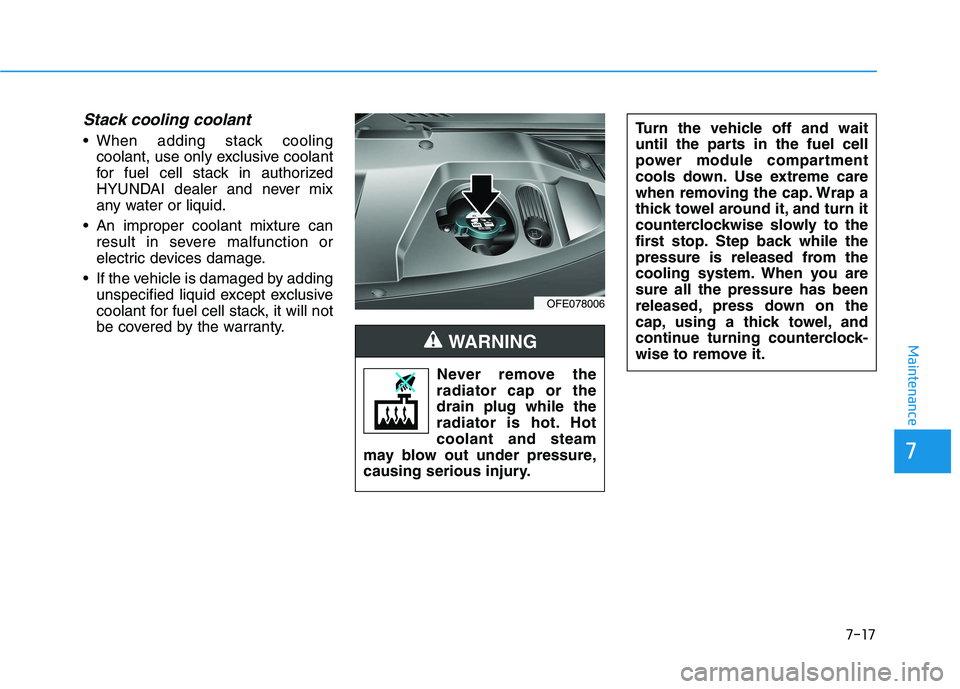
Stack cooling coolant
When adding stack coolingcoolant, use only exclusive coolant
for fuel cell stack in authorized
HYUNDAI dealer and never mix
any water or liquid.
An improper coolant mixture can result in severe malfunction or
electric devices damage.
If the vehicle is damaged by adding unspecified liquid except exclusive
coolant for fuel cell stack, it will not
be covered by the warranty.
7-17
7
Maintenance
Never remove the
radiator cap or the drain plug while the
radiator is hot. Hotcoolant and steam
may blow out under pressure,
causing serious injury.
WARNING
OFE078006 Turn the vehicle off and wait
until the parts in the fuel cell
power module compartment
cools down. Use extreme care
when removing the cap. Wrap a
thick towel around it, and turn it
counterclockwise slowly to the
first stop. Step back while the
pressure is released from the
cooling system. When you aresure all the pressure has been
released, press down on the
cap, using a thick towel, and
continue turning counterclock-
wise to remove it.
Page 442 of 558
The electric motor for the cooling fan
is controlled by coolant temperature,
refrigerant pressure and vehicle
speed. As the coolant temperature
decreases, the electric motor will
automatically shut off. This is a nor-mal condition.
Changing Coolant
For the fuel cell stack, an exclusive
coolant must be used . When chang-
ing the fuel cell stack coolant, werecommend that coolant be changed
by an authorized HYUNDAI dealeraccording to the MaintenanceSchedule at the beginning of this
chapter.To prevent damage to parts in the
fuel cell power module compart-
ment, put a thick towel around the
coolant cap before refilling the
coolant to prevent the coolant
from overflowing into parts in the
fuel cell power module compart-ment.
NOTICE
7-18
Maintenance
The electric motor for
the cooling fan may
continue to operate
or start up when the
vehicle is not running
and can cause serious injury.
Keep hands, clothing and tools
away from the rotating fan
blades of the cooling fan.
WARNING
Do not use coolant or antifreeze
in the washer fluid reservoir.
Coolant can severely obscure
visibility when sprayed on the
windshield and may cause loss
of vehicle control resulting in anaccident.
Coolant may also cause dam-
age to paint and body trim.
WARNING
Do not mix-up the caps of
device cooling coolant and
stack cooling coolant because
the fluid material is different. If
the cap is mixed, the fuel cell
system may be damage.
We recommend that you con-
sult an authorized HYUNDAI
dealer.
CAUTION
Page 478 of 558
7-54
Maintenance
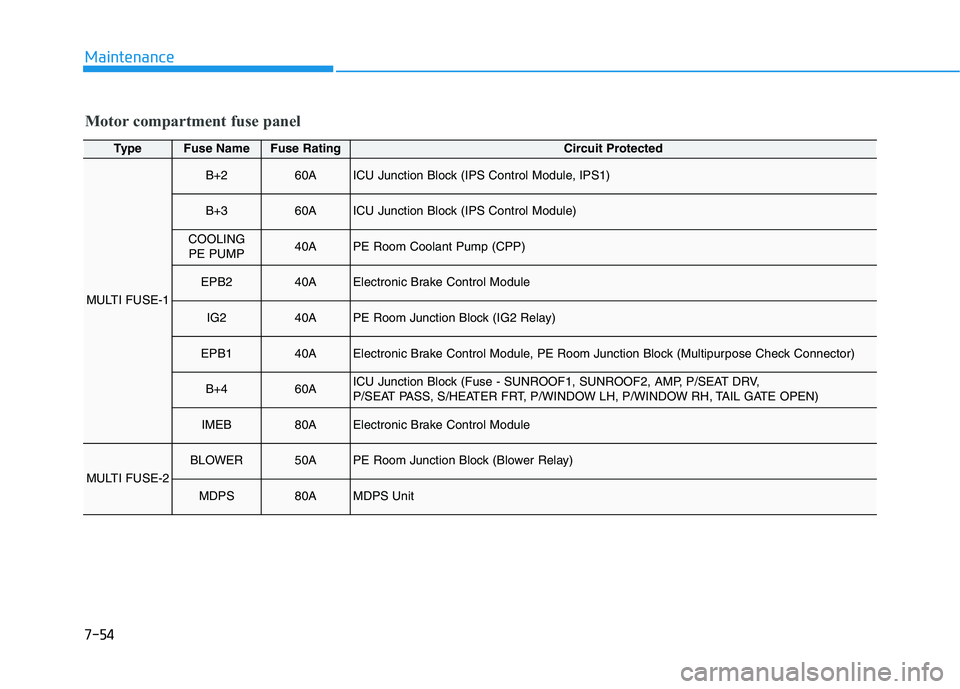
Motor compartment fuse panel
TypeFuse NameFuse RatingCircuit Protected
MULTI FUSE-1
B+260AICU Junction Block (IPS Control Module, IPS1)
B+360AICU Junction Block (IPS Control Module)
COOLING PE PUMP40APE Room Coolant Pump (CPP)
EPB240AElectronic Brake Control Module
IG240APE Room Junction Block (IG2 Relay)
EPB140AElectronic Brake Control Module, PE Room Junction Block (Multipurpose Check Connector)
B+460AICU Junction Block (Fuse - SUNROOF1, SUNROOF2, AMP, P/SEAT DRV,
P/SEAT PASS, S/HEATER FRT, P/WINDOW LH, P/WINDOW RH, TAIL GATE OPEN)
IMEB80AElectronic Brake Control Module
MULTI FUSE-2
BLOWER50APE Room Junction Block (Blower Relay)
MDPS80AMDPS Unit
Page 479 of 558
7-55
7
Maintenance
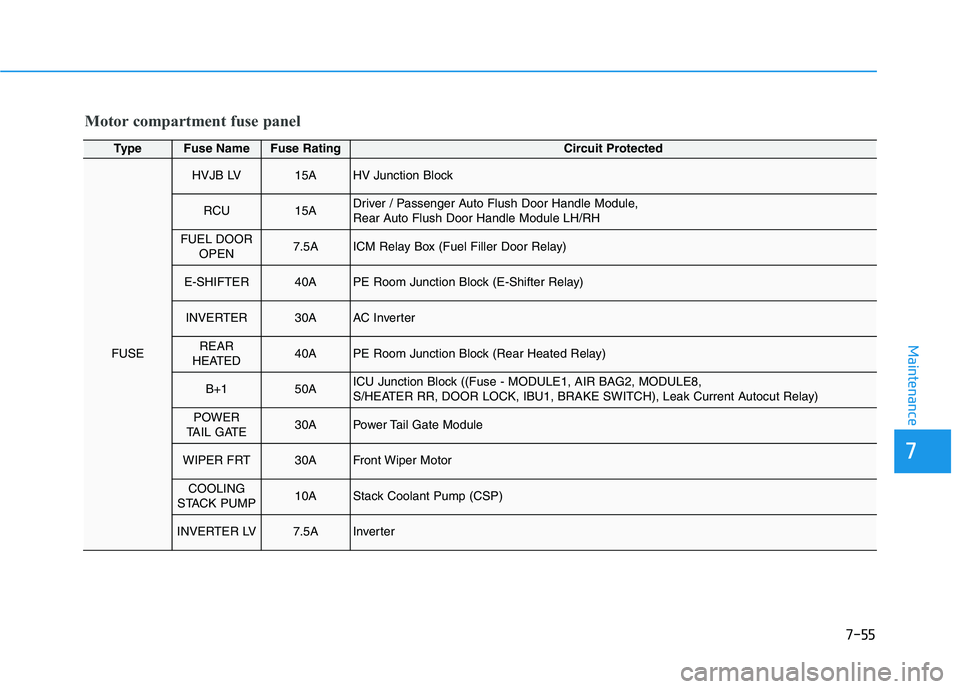
Motor compartment fuse panel
TypeFuse NameFuse RatingCircuit Protected
FUSE
HVJB LV15AHV Junction Block
RCU15ADriver / Passenger Auto Flush Door Handle Module,
Rear Auto Flush Door Handle Module LH/RH
FUEL DOOROPEN7.5AICM Relay Box (Fuel Filler Door Relay)
E-SHIFTER40APE Room Junction Block (E-Shifter Relay)
INVERTER30AAC Inverter
REAR
HEATED40APE Room Junction Block (Rear Heated Relay)
B+150AICU Junction Block ((Fuse - MODULE1, AIR BAG2, MODULE8,
S/HEATER RR, DOOR LOCK, IBU1, BRAKE SWITCH), Leak Current Autocut Relay)
POWER
TAIL GATE30APower Tail Gate Module
WIPER FRT30AFront Wiper Motor
COOLING
STACK PUMP10AStack Coolant Pump (CSP)
INVERTER LV7.5AInverter
Page 515 of 558
H13
Information
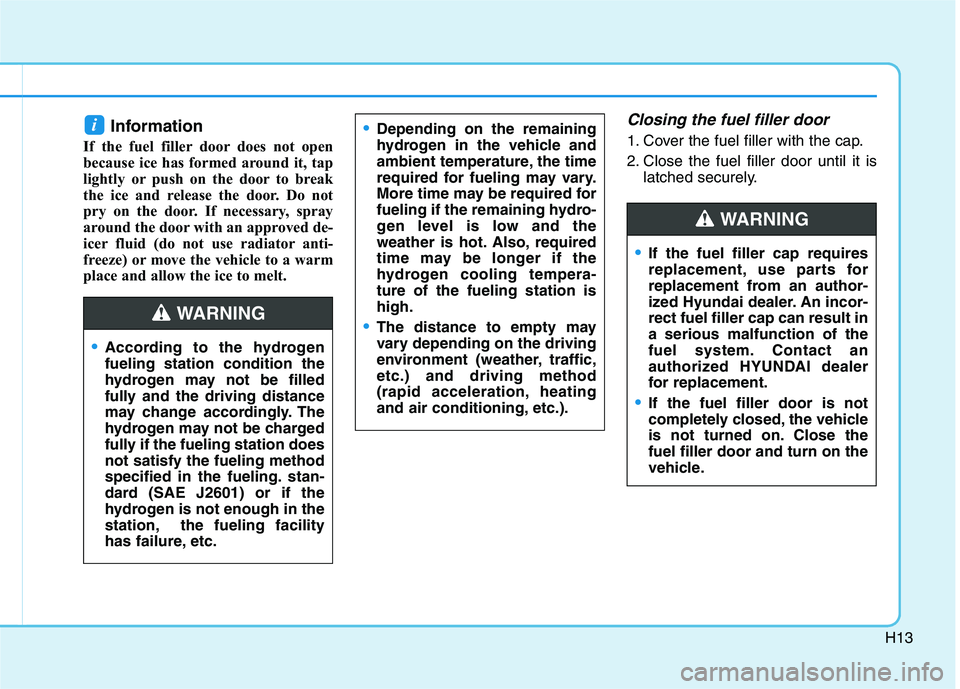
If the fuel filler door does not open
because ice has formed around it, tap
lightly or push on the door to break
the ice and release the door. Do not
pry on the door. If necessary, spray
around the door with an approved de-
icer fluid (do not use radiator anti-
freeze) or move the vehicle to a warm
place and allow the ice to melt.Closing the fuel filler door
1. Cover the fuel filler with the cap.
2. Close the fuel filler door until it is latched securely.i
If the fuel filler cap requires
replacement, use parts for
replacement from an author-
ized Hyundai dealer. An incor-rect fuel filler cap can result ina serious malfunction of the
fuel system. Contact an
authorized HYUNDAI dealer
for replacement.
If the fuel filler door is not
completely closed, the vehicle
is not turned on. Close thefuel filler door and turn on the
vehicle.
WARNING
According to the hydrogen fueling station condition the
hydrogen may not be filled
fully and the driving distance
may change accordingly. The
hydrogen may not be charged
fully if the fueling station doesnot satisfy the fueling method
specified in the fueling. stan-
dard (SAE J2601) or if the
hydrogen is not enough in the
station, the fueling facility
has failure, etc.
Depending on the remaining
hydrogen in the vehicle and
ambient temperature, the time
required for fueling may vary.
More time may be required for
fueling if the remaining hydro-
gen level is low and the
weather is hot. Also, required
time may be longer if the
hydrogen cooling tempera-ture of the fueling station ishigh.
The distance to empty may
vary depending on the driving
environment (weather, traffic,etc.) and driving method
(rapid acceleration, heating
and air conditioning, etc.).WARNING
Page 533 of 558
H31
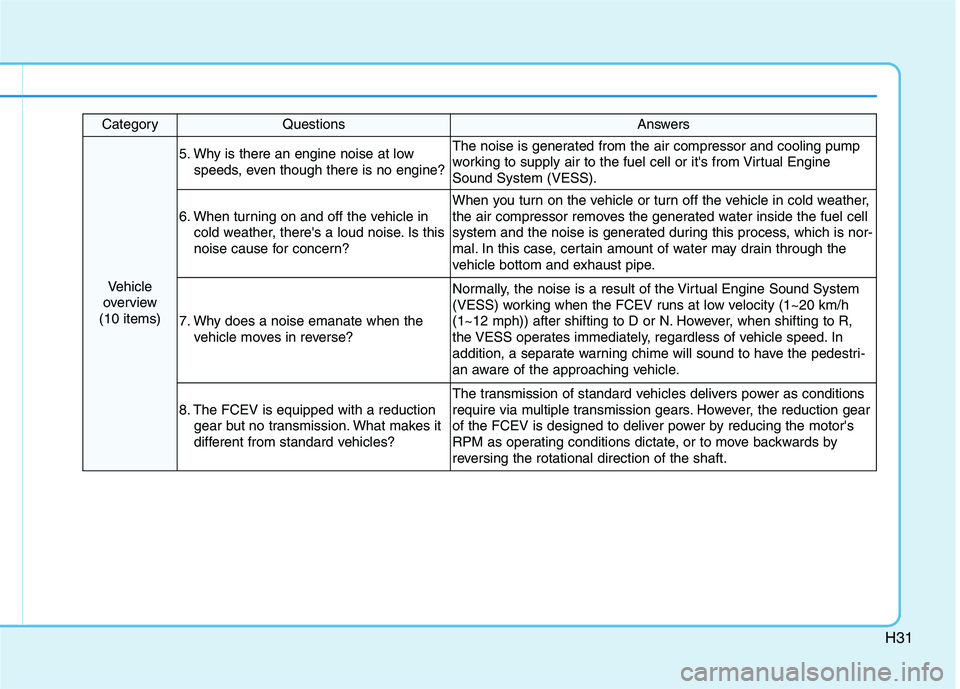
CategoryQuestionsAnswers
Vehicle
overview
(10 items)
5. Why is there an engine noise at low speeds, even though there is no engine?The noise is generated from the air compressor and cooling pump
working to supply air to the fuel cell or it's from Virtual EngineSound System (VESS).
6. When turning on and off the vehicle incold weather, there's a loud noise. Is this
noise cause for concern?
When you turn on the vehicle or turn off the vehicle in cold weather,
the air compressor removes the generated water inside the fuel cell
system and the noise is generated during this process, which is nor-
mal. In this case, certain amount of water may drain through the
vehicle bottom and exhaust pipe.
7. Why does a noise emanate when thevehicle moves in reverse?
Normally, the noise is a result of the Virtual Engine Sound System
(VESS) working when the FCEV runs at low velocity (1~20 km/h
(1~12 mph)) after shifting to D or N. However, when shifting to R,
the VESS operates immediately, regardless of vehicle speed. In
addition, a separate warning chime will sound to have the pedestri-
an aware of the approaching vehicle.
8. The FCEV is equipped with a reduction
gear but no transmission. What makes it
different from standard vehicles?
The transmission of standard vehicles delivers power as conditions
require via multiple transmission gears. However, the reduction gear
of the FCEV is designed to deliver power by reducing the motor's
RPM as operating conditions dictate, or to move backwards by
reversing the rotational direction of the shaft.
Page 536 of 558
H34
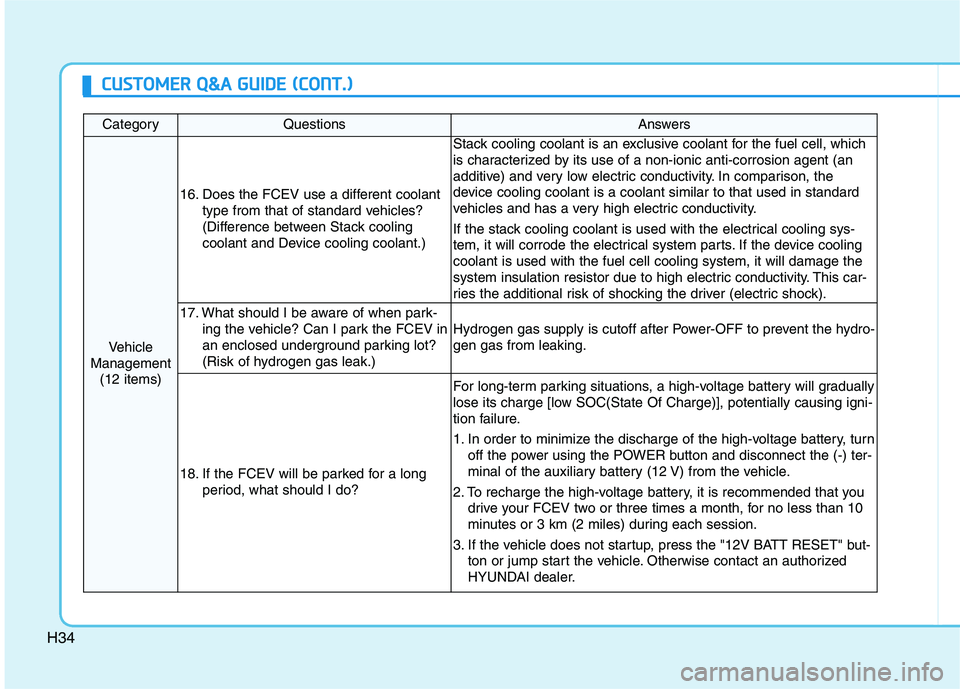
CategoryQuestionsAnswers
Vehicle
Management (12 items)
16. Does the FCEV use a different coolant type from that of standard vehicles?
(Difference between Stack cooling
coolant and Device cooling coolant.)
Stack cooling coolant is an exclusive coolant for the fuel cell, which
is characterized by its use of a non-ionic anti-corrosion agent (an
additive) and very low electric conductivity. In comparison, the
device cooling coolant is a coolant similar to that used in standard
vehicles and has a very high electric conductivity.
If the stack cooling coolant is used with the electrical cooling sys-
tem, it will corrode the electrical system parts. If the device coolingcoolant is used with the fuel cell cooling system, it will damage the
system insulation resistor due to high electric conductivity. This car-
ries the additional risk of shocking the driver (electric shock).
17. What should I be aware of when park-ing the vehicle? Can I park the FCEV in
an enclosed underground parking lot?
(Risk of hydrogen gas leak.)
Hydrogen gas supply is cutoff after Power-OFF to prevent the hydro- gen gas from leaking.
18. If the FCEV will be parked for a longperiod, what should I do?
For long-term parking situations, a high-voltage battery will gradually
lose its charge [low SOC(State Of Charge)], potentially causing igni-
tion failure.
1. In order to minimize the discharge of the high-voltage battery, turnoff the power using the POWER button and disconnect the (-) ter-
minal of the auxiliary battery (12 V) from the vehicle.
2. To recharge the high-voltage battery, it is recommended that you drive your FCEV two or three times a month, for no less than 10
minutes or 3 km (2 miles) during each session.
3. If the vehicle does not startup, press the "12V BATT RESET" but- ton or jump start the vehicle. Otherwise contact an authorized
HYUNDAI dealer.
CCUU SSTT OO MM EERR QQ &&AA GG UU IIDD EE (( CC OO NNTT..))
Page 537 of 558
H35
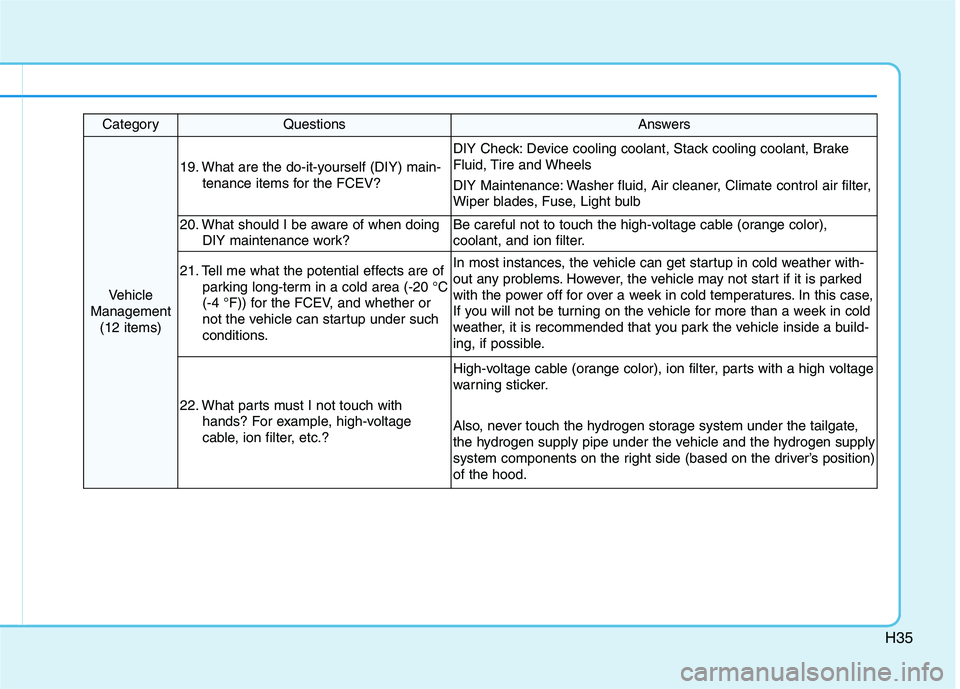
CategoryQuestionsAnswers
Vehicle
Management (12 items)
19. What are the do-it-yourself (DIY) main-
tenance items for the FCEV?
DIY Check: Device cooling coolant, Stack cooling coolant, Brake
Fluid, Tire and Wheels
DIY Maintenance: Washer fluid, Air cleaner, Climate control air filter,
Wiper blades, Fuse, Light bulb
20. What should I be aware of when doingDIY maintenance work?Be careful not to touch the high-voltage cable (orange color),
coolant, and ion filter.
21. Tell me what the potential effects are ofparking long-term in a cold area (-20 °C
(-4 °F)) for the FCEV, and whether or
not the vehicle can startup under such
conditions.In most instances, the vehicle can get startup in cold weather with-
out any problems. However, the vehicle may not start if it is parked
with the power off for over a week in cold temperatures. In this case,
If you will not be turning on the vehicle for more than a week in cold
weather, it is recommended that you park the vehicle inside a build-
ing, if possible.
22. What parts must I not touch with
hands? For example, high-voltage
cable, ion filter, etc.?
High-voltage cable (orange color), ion filter, parts with a high voltage
warning sticker.
Also, never touch the hydrogen storage system under the tailgate,
the hydrogen supply pipe under the vehicle and the hydrogen supply
system components on the right side (based on the driver’s position)of the hood.
Page 550 of 558
I-3
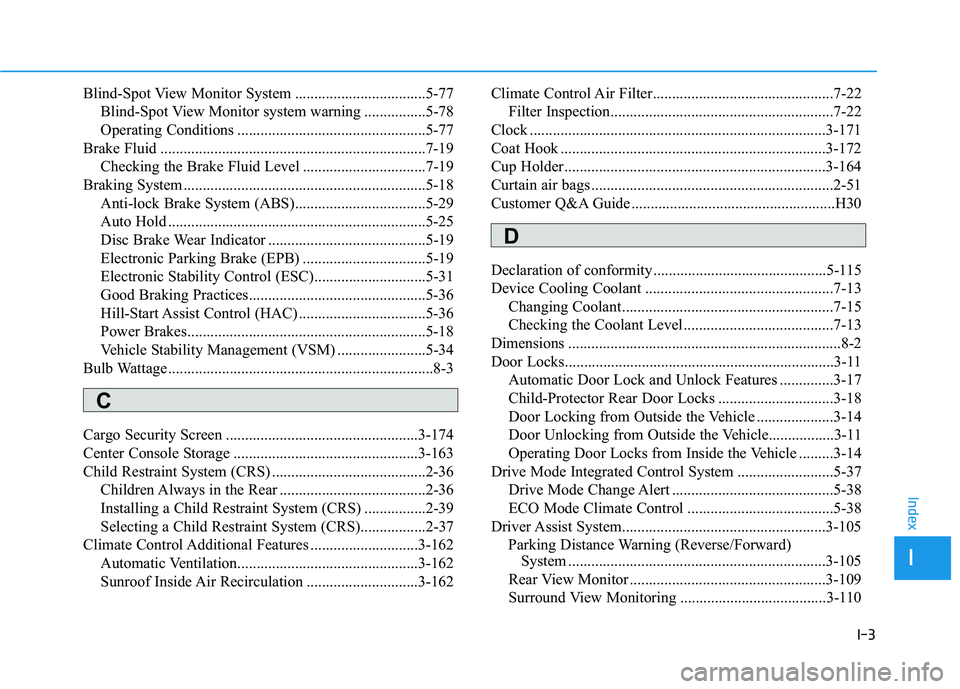
Blind-Spot View Monitor System ..................................5-77
Blind-Spot View Monitor system warning ................5-78
Operating Conditions .................................................5-77
Brake Fluid .....................................................................7-19 Checking the Brake Fluid Level ................................7-19
Braking System ...............................................................5-18 Anti-lock Brake System (ABS)..................................5-29
Auto Hold ...................................................................5-25
Disc Brake Wear Indicator .........................................5-19
Electronic Parking Brake (EPB) ................................5-19
Electronic Stability Control (ESC).............................5-31
Good Braking Practices..............................................5-36
Hill-Start Assist Control (HAC) .................................5-36
Power Brakes..............................................................5-18
Vehicle Stability Management (VSM) .......................5-34
Bulb Wattage .....................................................................8-3
Cargo Security Screen ..................................................3-174
Center Console Storage ................................................3-163
Child Restraint System (CRS) ........................................2-36 Children Always in the Rear ......................................2-36
Installing a Child Restraint System (CRS) ................2-39
Selecting a Child Restraint System (CRS).................2-37
Climate Control Additional Features ............................3-162
Automatic Ventilation...............................................3-162
Sunroof Inside Air Recirculation .............................3-162 Climate Control Air Filter...............................................7-22
Filter Inspection..........................................................7-22
Clock .............................................................................3-171
Coat Hook .....................................................................3-172
Cup Holder....................................................................3-164
Curtain air bags ...............................................................2-51
Customer Q&A Guide .....................................................H30
Declaration of conformity .............................................5-115
Device Cooling Coolant .................................................7-13
Changing Coolant.......................................................7-15
Checking the Coolant Level .......................................7-13
Dimensions .......................................................................8-2
Door Locks......................................................................3-11 Automatic Door Lock and Unlock Features ..............3-17
Child-Protector Rear Door Locks ..............................3-18
Door Locking from Outside the Vehicle ....................3-14
Door Unlocking from Outside the Vehicle.................3-11
Operating Door Locks from Inside the Vehicle .........3-14
Drive Mode Integrated Control System .........................5-37
Drive Mode Change Alert ..........................................5-38
ECO Mode Climate Control ......................................5-38
Driver Assist System.....................................................3-105 Parking Distance Warning (Reverse/Forward) System ...................................................................3-105
Rear View Monitor ...................................................3-109
Surround View Monitoring ......................................3-110
I
Index
C
D
Page 556 of 558
I-9
Smart Cruise Control Vehicle-to-Vehicle Distance ..5-105
To Adjust the Sensitivity of Smart Cruise Control ..5-100
To Convert to Cruise Control Mode ........................5-100
Smart Key .........................................................................3-3
Smart Tailgate .................................................................3-51
Special Driving Conditions ...........................................5-118 Driving at Night........................................................5-119
Driving in Flooded Areas .........................................5-120
Driving in the Rain ...................................................5-119
Hazardous Driving Conditions .................................5-118
Highway Driving ......................................................5-120
Reducing the Risk of a Rollover ..............................5-121
Rocking the Vehicle..................................................5-118
Smooth Cornering ....................................................5-119
SRS Care .........................................................................2-68
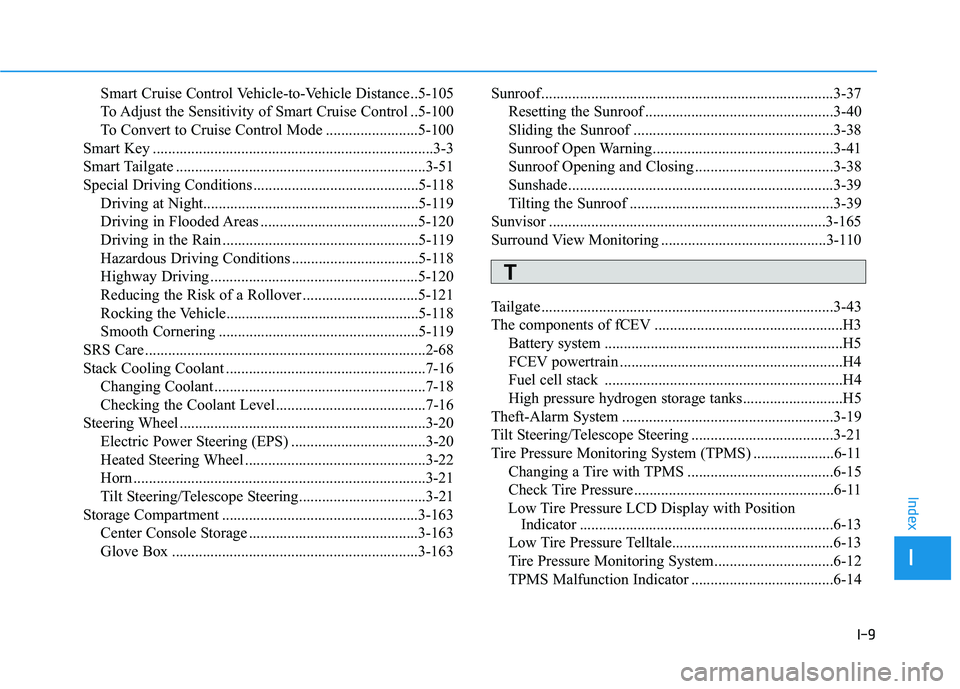
Stack Cooling Coolant ....................................................7-16 Changing Coolant.......................................................7-18
Checking the Coolant Level .......................................7-16
Steering Wheel ................................................................3-20
Electric Power Steering (EPS) ...................................3-20
Heated Steering Wheel ...............................................3-22
Horn ............................................................................3-21
Tilt Steering/Telescope Steering.................................3-21
Storage Compartment ...................................................3-163 Center Console Storage ............................................3-163
Glove Box ................................................................3-163 Sunroof............................................................................3-37
Resetting the Sunroof .................................................3-40
Sliding the Sunroof ....................................................3-38
Sunroof Open Warning...............................................3-41
Sunroof Opening and Closing ....................................3-38
Sunshade.....................................................................3-39
Tilting the Sunroof .....................................................3-39
Sunvisor ........................................................................3-165
Surround View Monitoring ...........................................3-110
Tailgate ............................................................................3-43
The components of fCEV .................................................H3 Battery system ..............................................................H5
FCEV powertrain ..........................................................H4
Fuel cell stack ..............................................................H4
High pressure hydrogen storage tanks..........................H5
Theft-Alarm System .......................................................3-19
Tilt Steering/Telescope Steering .....................................3-21
Tire Pressure Monitoring System (TPMS) .....................6-11 Changing a Tire with TPMS ......................................6-15
Check Tire Pressure ....................................................6-11
Low Tire Pressure LCD Display with Position Indicator ..................................................................6-13
Low Tire Pressure Telltale..........................................6-13
Tire Pressure Monitoring System...............................6-12
TPMS Malfunction Indicator .....................................6-14
I
Index
T