awd HYUNDAI PALISADE 2022 User Guide
[x] Cancel search | Manufacturer: HYUNDAI, Model Year: 2022, Model line: PALISADE, Model: HYUNDAI PALISADE 2022Pages: 663, PDF Size: 15.74 MB
Page 383 of 663
5-49
Driving your vehicle
5
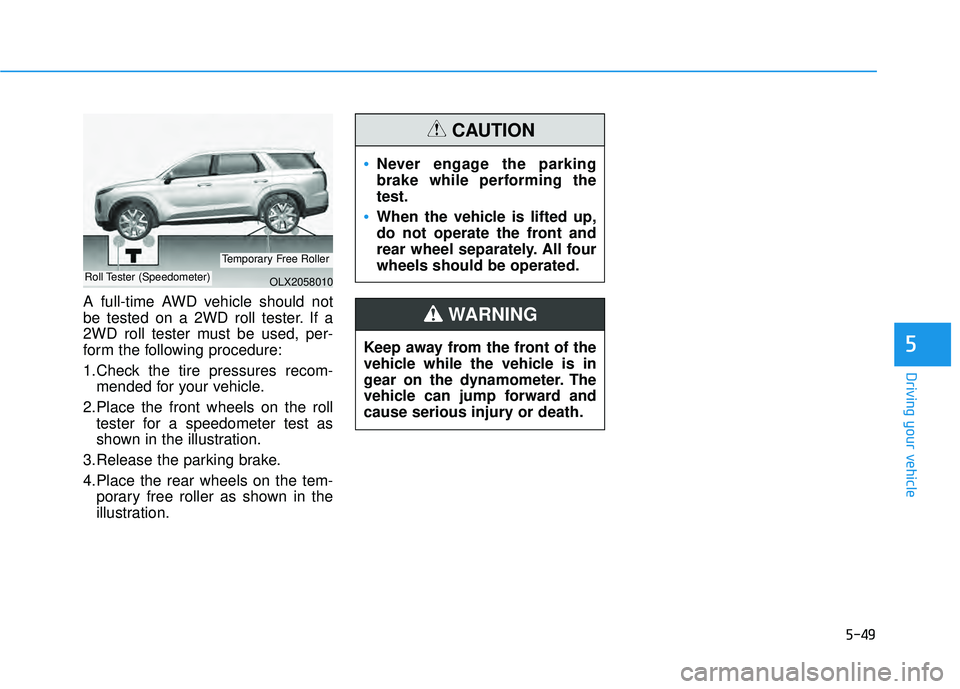
A full-time AWD vehicle should not
be tested on a 2WD roll tester. If a
2WD roll tester must be used, per-
form the following procedure:
1.Check the tire pressures recom-mended for your vehicle.
2.Place the front wheels on the roll tester for a speedometer test as
shown in the illustration.
3.Release the parking brake.
4.Place the rear wheels on the tem- porary free roller as shown in the
illustration.
Never engage the parking
brake while performing the
test.
When the vehicle is lifted up,
do not operate the front and
rear wheel separately. All four
wheels should be operated.
CAUTION
Keep away from the front of the
vehicle while the vehicle is in
gear on the dynamometer. The
vehicle can jump forward and
cause serious injury or death.
WARNING
OLX2058010Roll Tester (Speedometer)
Temporary Free Roller
Page 394 of 663
5-60
Driving your vehicle
SPORT mode : SPORT mode provides sporty but
firm riding.
ECO mode : ECO mode helps improve fuel effi-
ciency for eco-friendly driving.
COMFORT mode : COMFORT mode provides smooth
driving and comfortable riding.
SMART mode
SMART mode selects the
proper driving mode
among ECO, COMFORT,
and SPORT by judging
the driver's driving habits (i.e.
Economical or Aggressive) from the
brake pedal depression or the steer-
ing wheel operation.
Rotate the DRIVE/TERRAIN mode selection knob to activate SMART
mode. When SMART mode is acti-
vated, the indicator illuminates on
the instrument cluster.
The vehicle starts in SMART mode, when the engine was turned
OFF in SMART mode. SMART mode automatically con-
trols gear shifting patterns, engine
torque, in accordance with the dri-
ver's driving habits.
SMART mode automatically con- trols the vehicle driving, such as
gear shifting patterns, engine
torque, riding quality (if equipped
with the electronic suspension sys-
tem), and power distribution (if
equipped with the All-Wheel Drive
(AWD) system), in accordance with
the driver's driving habits.
Information
• When you mildly drive the vehiclein SMART mode, the driving mode
changes to ECO mode to improve
fuel efficiency. However, the actual
fuel efficiency may differ in accor-
dance with your driving situations
(i.e. upward/downward slope, vehi-
cle deceleration/acceleration).
• When you dynamically drive the vehicle in SMART mode by abrupt-
ly decelerating or sharply turning
the driving mode changes to SPORT
mode. However, it may adversely
affect fuel economy.
Various driving situations, which
you may encounter in SMART
mode
The driving mode automaticallychanges to ECO mode after a cer-
tain period of time, when you gen-
tly depress the accelerator pedal
(Your driving is categorized to be
economical.).
The driving mode automatically changes from SMART ECO mode
to SMART COMFORT mode after
a certain period of time, when you
sharply or repetitively depress the
accelerator pedal.
The driving mode automatically changes to SMART COMFORT
mode with the same driving pat-
terns, when the vehicle starts to
drive on an upward slope of a cer-
tain angle. The driving mode auto-
matically returns to SMART ECO
mode, when the vehicle enters a
leveled road.
iSMART
Page 556 of 663
![HYUNDAI PALISADE 2022 User Guide 6-22
What to do in an emergency
Towing Service
[A] : Dollies
If emergency towing is necessary,
we recommend having it done by an
authorized HYUNDAI dealer or a
commercial tow-truck service.
Proper lif](/img/35/41170/w960_41170-555.png "HYUNDAI PALISADE 2022 User Guide 6-22
What to do in an emergency
Towing Service
[A] : Dollies
If emergency towing is necessary,
we recommend having it done by an
authorized HYUNDAI dealer or a
commercial tow-truck service.
Proper lif")
6-22
What to do in an emergency
Towing Service
[A] : Dollies
If emergency towing is necessary,
we recommend having it done by an
authorized HYUNDAI dealer or a
commercial tow-truck service.
Proper lifting and towing procedures
are necessary to prevent damage to
the vehicle. The use of wheel dollies
or flatbed is recommended.On 2WD vehicles, it is acceptable to
tow the vehicle with the rear wheels
on the ground (without dollies) and
the front wheels off the ground. If any
of the loaded wheels or suspension
components are damaged or the
vehicle is being towed with the front
wheels on the ground, use a towing
dolly under the front wheels.
When being towed by a commercial
tow truck and wheel dollies are not
used, the front of the vehicle should
always be lifted, not the rear.
If your vehicle is an AWD vehicle, it
must be towed with a wheel lift and
dollies or flatbed equipment with all
the wheels off the ground.
An AWD vehicle should never be
towed with the wheels on the
ground. This can cause serious
damage to the transaxle or the
AWD system.
Do not tow the vehicle with the
front wheels on the ground as
this may cause damage to the
vehicle.
Do not tow with sling-type equipment. Use a wheel lift or
flatbed equipment.
NOTICE
NOTICE
T TO O W W I IN N G G
OLX2068011L
OLX2068014
OLX2068013
Page 568 of 663
Maintenance
7
7-9
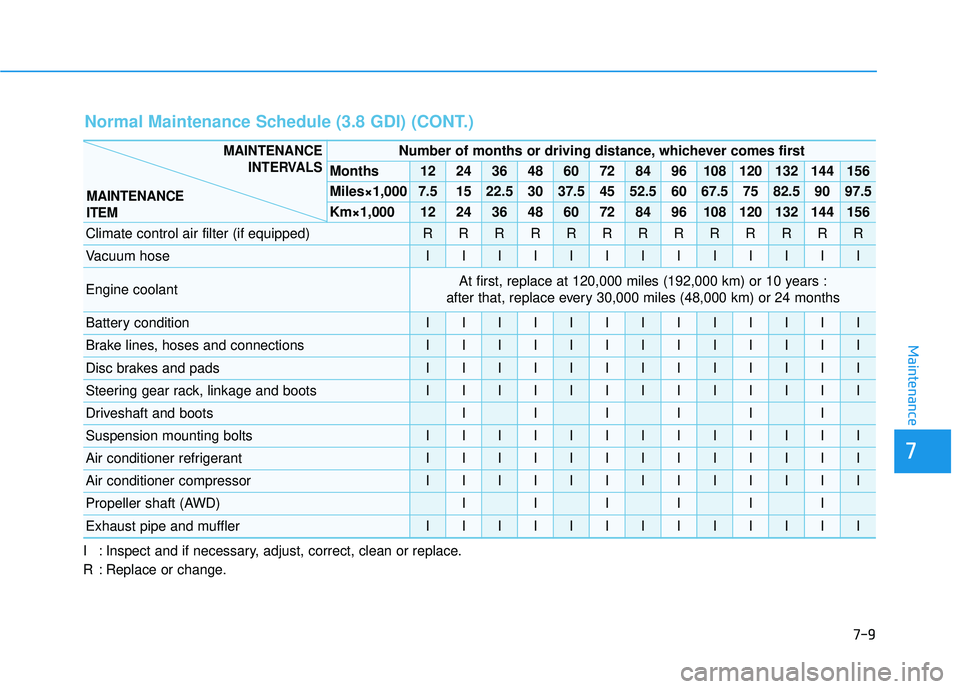
I : Inspect and if necessary, adjust, correct, clean or replace.
R : Replace or change.
Number of months or driving distance, whichever comes first
Months1224364860728496108120132144156
Miles×1,0007.51522.53037.54552.56067.57582.59097.5
Km×1,0001224364860728496108120132144156
Climate control air filter (if equipped)RRRRRRRRRRRRR
Vacuum hoseIIIIIIIIIIIII
Engine coolantAt first, replace at 120,000 miles (192,000 km) or 10 years :
after that, replace every 30,000 miles (48,000 km) or 24 months
Battery conditionIIIIIIIIIIIII
Brake lines, hoses and connectionsIIIIIIIIIIIII
Disc brakes and padsIIIIIIIIIIIII
Steering gear rack, linkage and bootsIIIIIIIIIIIII
Driveshaft and bootsIIIIII
Suspension mounting boltsIIIIIIIIIIIII
Air conditioner refrigerantIIIIIIIIIIIII
Air conditioner compressorIIIIIIIIIIIII
Propeller shaft (AWD)IIIIII
Exhaust pipe and mufflerIIIIIIIIIIIII
MAINTENANCE INTERVALS
MAINTENANCE
ITEM
Normal Maintenance Schedule (3.8 GDI) (CONT.)
Page 569 of 663
Maintenance
7-10
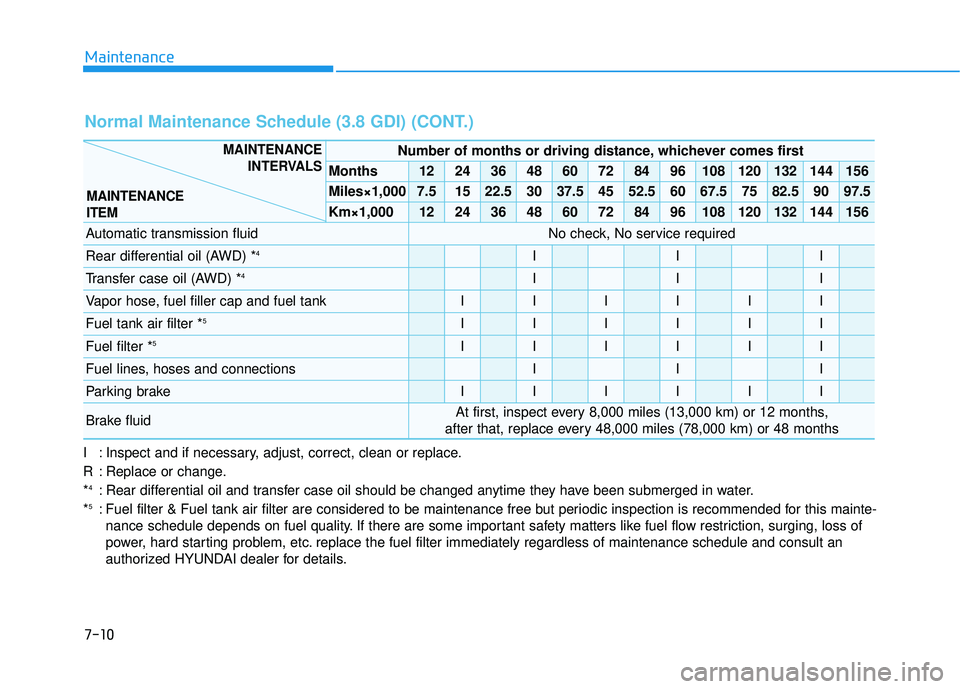
I : Inspect and if necessary, adjust, correct, clean or replace.
R : Replace or change.
*
4: Rear differential oil and transfer case oil should be changed anytime they have been submerged in water.
*5: Fuel filter & Fuel tank air filter are considered to be maintenance free\
but periodic inspection is recommended for this mainte- nance schedule depends on fuel quality. If there are some important safety matters like fuel flow restriction, surging, loss of
power, hard starting problem, etc. replace the fuel filter immediately regardless of maintenance schedule a\
nd consult an
authorized HYUNDAI dealer for details.
Number of months or driving distance, whichever comes first
Months1224364860728496108120132144156
Miles×1,0007.51522.53037.54552.56067.57582.59097.5
Km×1,0001224364860728496108120132144156
Automatic transmission fluidNo check, No service required
Rear differential oil (AWD) *4III
Transfer case oil (AWD) *4III
Vapor hose, fuel filler cap and fuel tankIIIIII
Fuel tank air filter *5IIIIII
Fuel filter *5IIIIII
Fuel lines, hoses and connectionsIII
Parking brakeIIIIII
Brake fluidAt first, inspect every 8,000 miles (13,000 km) or 12 months,
after that, replace every 48,000 miles (78,000 km) or 48 months
MAINTENANCE INTERVALS
MAINTENANCE
ITEM
Normal Maintenance Schedule (3.8 GDI) (CONT.)
Page 571 of 663
Maintenance
7-12
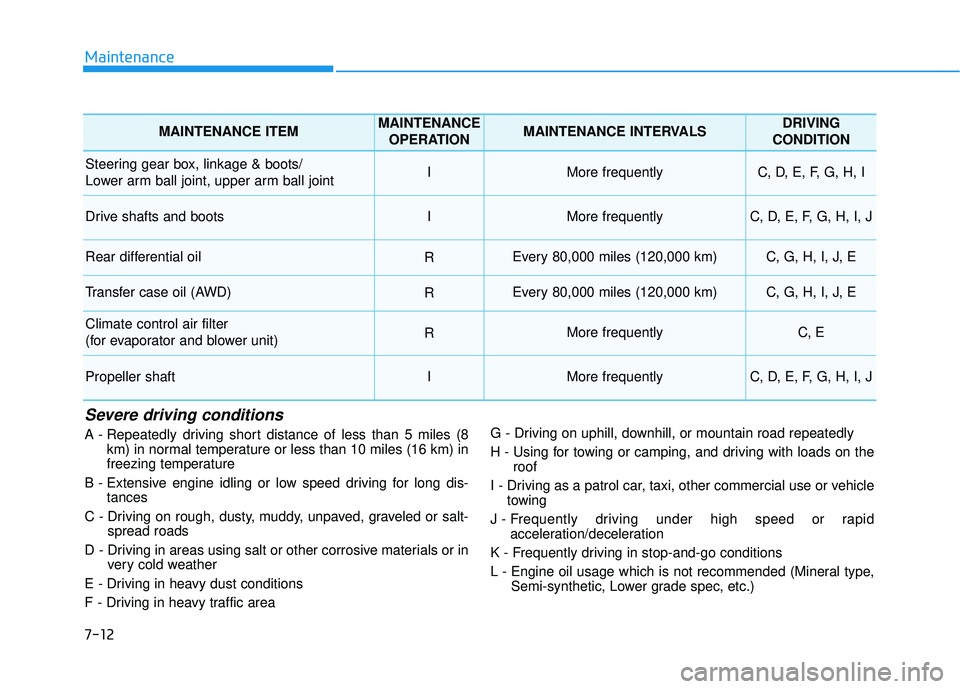
Severe driving conditions
A - Repeatedly driving short distance of less than 5 miles (8km) in normal temperature or less than 10 miles (16 km) in
freezing temperature
B - Extensive engine idling or low speed driving for long dis- tances
C - Driving on rough, dusty, muddy, unpaved, graveled or salt- spread roads
D - Driving in areas using salt or other corrosive materials or in very cold weather
E - Driving in heavy dust conditions
F - Driving in heavy traffic area G - Driving on uphill, downhill, or mountain road repeatedly
H - Using for towing or camping, and driving with loads on the
roof
I - Driving as a patrol car, taxi, other commercial use or vehicle towing
J - Frequently driving under high speed or rapid acceleration/deceleration
K - Frequently driving in stop-and-go conditions
L - Engine oil usage which is not recommended (Mineral type, Semi-synthetic, Lower grade spec, etc.)
MAINTENANCE ITEMMAINTENANCE
OPERATIONMAINTENANCE INTERVALSDRIVING
CONDITION
Steering gear box, linkage & boots/
Lower arm ball joint, upper arm ball jointIMore frequentlyC, D, E, F, G, H, I
Drive shafts and bootsIMore frequentlyC, D, E, F, G, H, I, J
Rear differential oilREvery 80,000 miles (120,000 km)C, G, H, I, J, E
Transfer case oil (AWD)REvery 80,000 miles (120,000 km)C, G, H, I, J, E
Climate control air filter
(for evaporator and blower unit)RMore frequentlyC, E
Propeller shaftIMore frequentlyC, D, E, F, G, H, I, J
Page 617 of 663
7-58
Maintenance
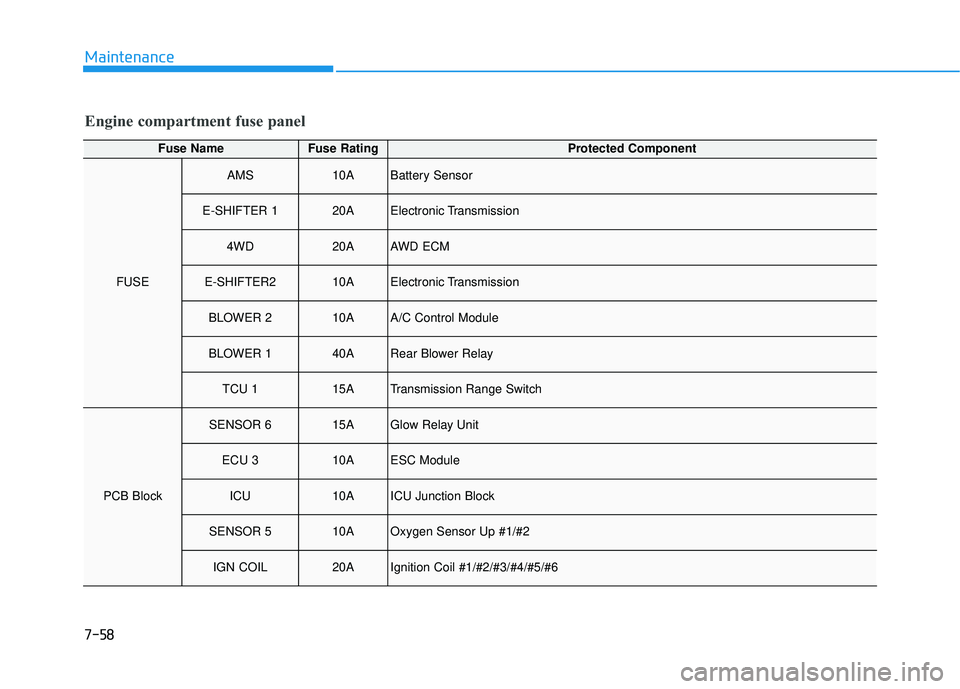
Engine compartment fuse panel
Fuse NameFuse RatingProtected Component
FUSE
AMS10ABattery Sensor
E-SHIFTER 120AElectronic Transmission
4WD20AAWD ECM
E-SHIFTER210AElectronic Transmission
BLOWER 210AA/C Control Module
BLOWER 140ARear Blower Relay
TCU 115ATransmission Range Switch
PCB Block
SENSOR 615AGlow Relay Unit
ECU 310AESC Module
ICU10AICU Junction Block
SENSOR 510AOxygen Sensor Up #1/#2
IGN COIL20AIgnition Coil #1/#2/#3/#4/#5/#6
Page 646 of 663
8-6
Specifications, Consumer information and Reporting safety defects
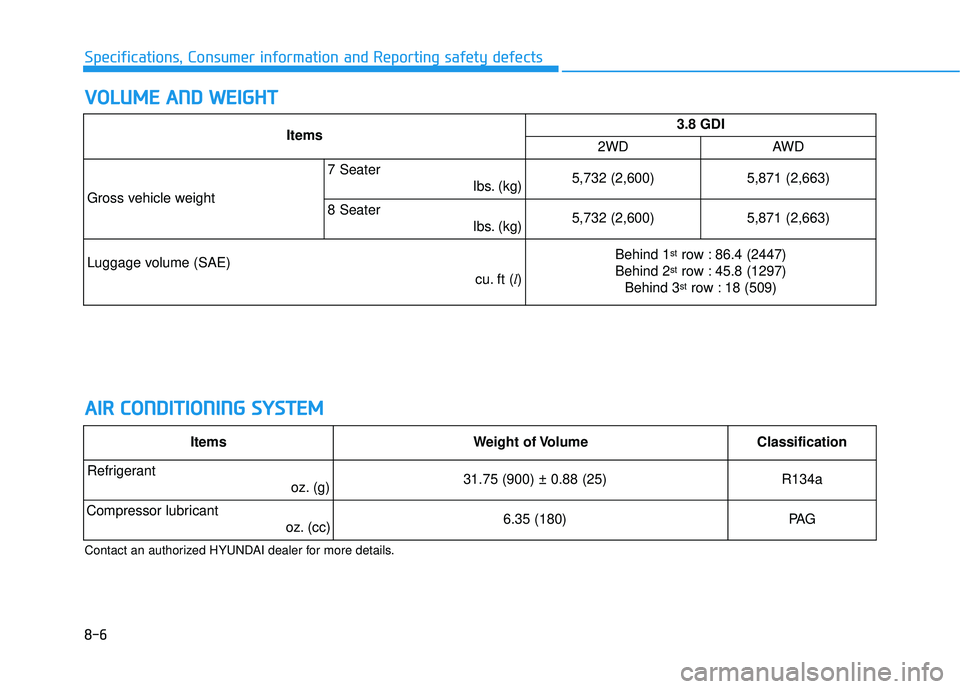
V VO O L LU U M M E E A A N N D D W W E EI IG G H H T T
A A I IR R C C O O N ND DI IT T I IO O N NI IN N G G S S Y Y S ST T E EM M
Contact an authorized HYUNDAI dealer for more details.
Items3.8 GDI
2WDAWD
Gross vehicle weight
7 Seater
lbs. (kg)5,732 (2,600)5,871 (2,663)
8 Seaterlbs. (kg)5,732 (2,600)5,871 (2,663)
Luggage volume (SAE) cu. ft (l)Behind 1strow : 86.4 (2447)
Behind 2strow : 45.8 (1297)
Behind 3strow : 18 (509)
ItemsWeight of VolumeClassification
Refrigerant oz. (g) 31.75 (900) ± 0.88 (25)R134a
Compressor lubricantoz. (cc) 6.35 (180)PA G
Page 648 of 663
8-8
Specifications, Consumer information and Reporting safety defects
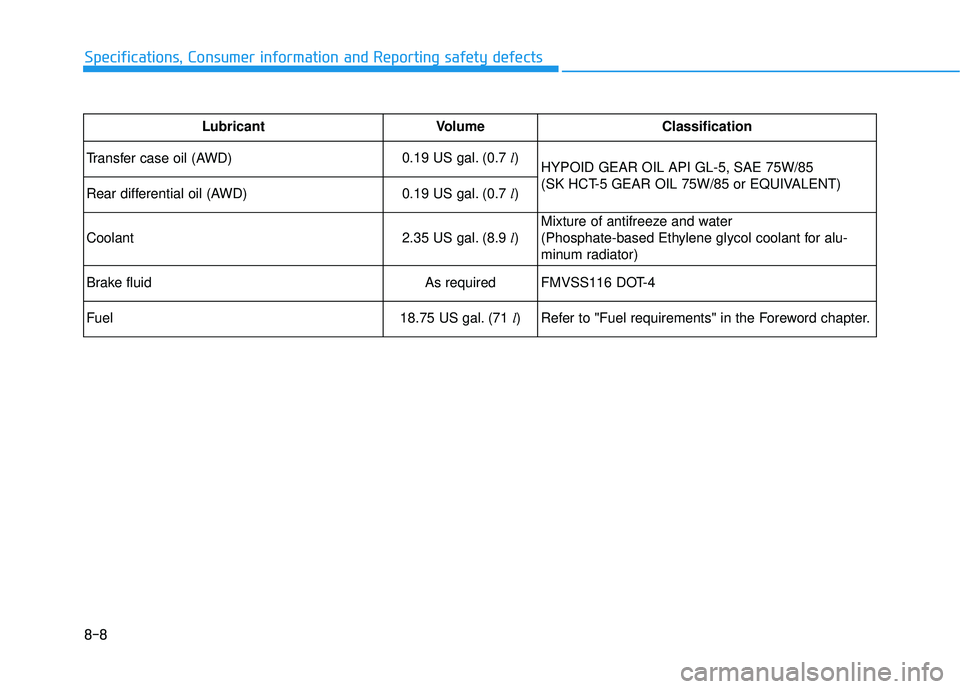
LubricantVolumeClassification
Transfer case oil (AWD)
0.19 US gal. (0.7 l) HYPOID GEAR OIL API GL-5, SAE 75W/85
(SK HCT-5 GEAR OIL 75W/85 or EQUIVALENT)
Rear differential oil (AWD)
0.19 US gal. (0.7 l)
Coolant
2.35 US gal. (8.9 l) Mixture of antifreeze and water
(Phosphate-based Ethylene glycol coolant for alu-
minum radiator)
Brake fluid
As required FMVSS116 DOT-4
Fuel18.75 US gal. (71 l)Refer to "Fuel requirements" in the Foreword chapter.
Page 655 of 663
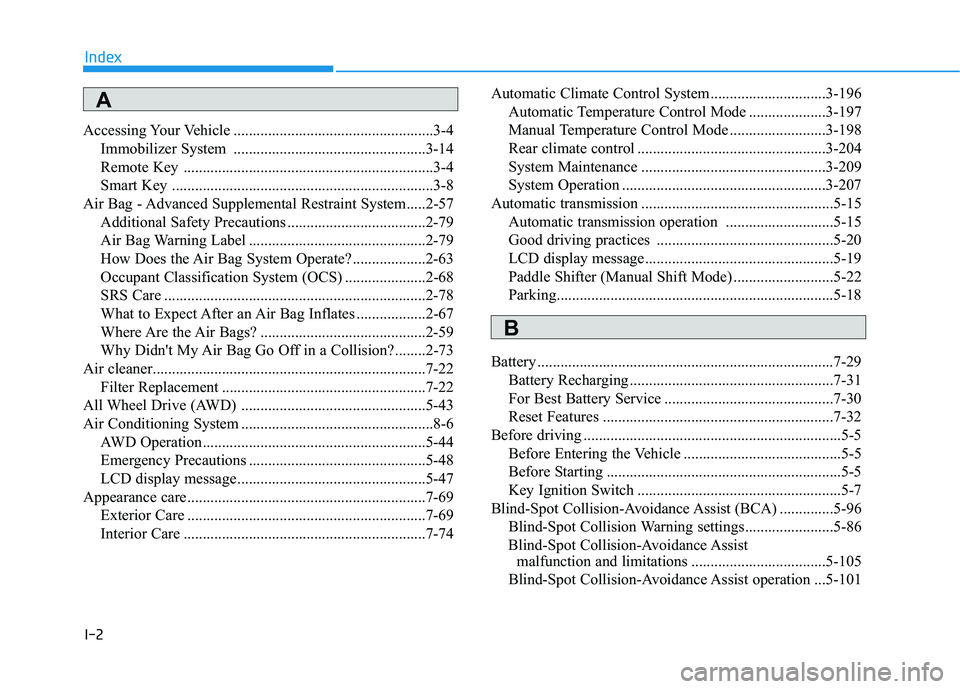
I-2
Accessing Your Vehicle ....................................................3-4Immobilizer System ..................................................3-14
Remote Key .................................................................3-4
Smart Key ....................................................................3-8
Air Bag - Advanced Supplemental Restraint System.....2-57 Additional Safety Precautions ....................................2-79
Air Bag Warning Label ..............................................2-79
How Does the Air Bag System Operate? ...................2-63
Occupant Classification System (OCS) .....................2-68
SRS Care ....................................................................2-78\
What to Expect After an Air Bag Inflates ..................2-67
Where Are the Air Bags? ...........................................2-59
Why Didn't My Air Bag Go Off in a Collision?........2-73
Air cleaner.......................................................................7\
-22 Filter Replacement .....................................................7-22
All Wheel Drive (AWD) ................................................5-43
Air Conditioning System ..................................................8-6 AWD Operation..........................................................5-44
Emergency Precautions ..............................................5-48
LCD display message .................................................5-47
Appearance care..............................................................7-69 Exterior Care ..............................................................7-69
Interior Care ...............................................................7-74 Automatic Climate Control System..............................3-196
Automatic Temperature Control Mode ....................3-197
Manual Temperature Control Mode .........................3-198
Rear climate control .................................................3-204
System Maintenance ................................................3-209
System Operation .....................................................3-207
Automatic transmission ..................................................5-15 Automatic transmission operation ............................5-15
Good driving practices ..............................................5-20
LCD display message .................................................5-19
Paddle Shifter (Manual Shift Mode) ..........................5-22
Parking........................................................................\
5-18
Battery ........................................................................\
.....7-29 Battery Recharging .....................................................7-31
For Best Battery Service ............................................7-30
Reset Features ............................................................7-32
Before driving ...................................................................5-5 Before Entering the Vehicle .........................................5-5
Before Starting .............................................................5-5
Key Ignition Switch .....................................................5-7
Blind-Spot Collision-Avoidance Assist (BCA) ..............5-96 Blind-Spot Collision Warning settings.......................5-86
Blind-Spot Collision-Avoidance Assist malfunction and limitations ...................................5-105
Blind-Spot Collision-Avoidance Assist operation ...5-101
Index
A
B