parking brake HYUNDAI PALISADE 2022 Repair Manual
[x] Cancel search | Manufacturer: HYUNDAI, Model Year: 2022, Model line: PALISADE, Model: HYUNDAI PALISADE 2022Pages: 663, PDF Size: 15.74 MB
Page 574 of 663
7-15
7
Maintenance
Brake Hoses and Lines
Visually check for proper installation,
chafing, cracks, deterioration and
any leakage. Replace any deteriorat-
ed or damaged parts immediately.
Brake Fluid
Check the brake fluid level in the
brake fluid reservoir. The level should
be between the MIN and the MAX
marks on the side of the reservoir.
Use only hydraulic brake fluid con-
forming to DOT 3 or DOT 4 specifi-
cation.
Parking Brake
Inspect the parking brake system.
Brake Discs, Pads, Calipers
and Rotors
Check the pads for excessive wear,
discs for run out and wear, and
calipers for fluid leakage.
Exhaust Pipe and Muffler
Visually inspect the exhaust pipes,
muffler and hangers for cracks, dete-
rioration, or damage. Start the
engine and listen carefully for any
exhaust gas leakage. Tighten con-
nections or replace parts as neces-
sary.
Suspension Mounting Bolts
Check the suspension connections
for looseness or damage. Retighten
to the specified torque.
Steering Gear Box, Linkage &
Boots/Lower Arm Ball Joint
With the vehicle stopped and the
engine off, check for excessive free-
play in the steering wheel. Check the
linkage for bends or damage. Check
the dust boots and ball joints for
deterioration, cracks, or damage.
Replace any damaged parts.
Drive Shafts and Boots
Check the drive shafts, boots and
clamps for cracks, deterioration, or
damage. Replace any damaged
parts and, if necessary, repack the
grease.
Air Conditioning Refrigerant
Check the air conditioning lines and
connections for leakage and dam-
age.
Page 575 of 663
7-16
Maintenance
Checking the Engine Oil Level
Engine oil is used for lubricating,
cooling, and operating various
hydraulic components in the engine.
Engine oil consumption while driving
is normal, and it is necessary to
check and refill the engine oil regu-
larly. Also, check and refill the oil
level within the recommended main-
tenance schedule to prevent deterio-
ration of oil performance.
Check the engine oil following the
below procedure.
1. Follow all of the oil manufacturer'sprecautions.
2. Be sure the vehicle is on the level ground in P (Park) with the parking
brake set. If possible, block the
wheels.
3. Turn the engine on and warm the engine up until the coolant tem-
perature reaches a constant nor-
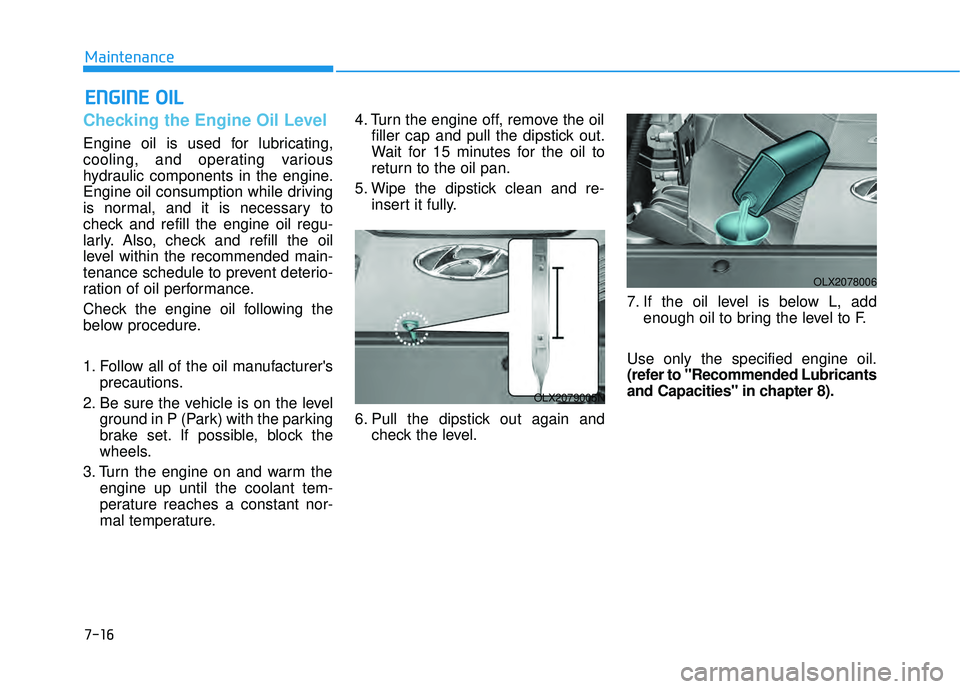
mal temperature. 4. Turn the engine off, remove the oil
filler cap and pull the dipstick out.
Wait for 15 minutes for the oil to
return to the oil pan.
5. Wipe the dipstick clean and re- insert it fully.
6. Pull the dipstick out again and check the level. 7. If the oil level is below L, add
enough oil to bring the level to F.
Use only the specified engine oil.
(refer to "Recommended Lubricants
and Capacities" in chapter 8).
OLX2079005N
OLX2078006
E E N N G GI IN N E E O O I IL L
Page 620 of 663
7-61
7
Maintenance
L LI IG G H H T T B B U U L LB B S S
Consult an authorized HYUNDAI
dealer to replace most vehicle light
bulbs. It is difficult to replace vehicle
light bulbs because other parts of the
vehicle must be removed before you
can get to the bulb. This is especially
true for removing the headlamp
assembly to get to the bulb(s).
Removing/installing the headlamp
assembly can result in damage to
the vehicle.
Information
The headlamp and tail lamp lenses
could appear frosty if the vehicle is
washed after driving or the vehicle is
driven at night in wet weather. This
condition is caused by temperature
difference between the lamp inside
and outside and, it does not indicate a
problem with your vehicle. When
moisture condenses in the lamp, it will
be removed after driving with the
headlamp on. The removable level
may differ depending on lamp size,
lamp position and environmental con-
dition. However, if moisture is not
removed, we recommend that your
vehicle is inspected by an authorized
HYUNDAI dealer.
Headlamp, Parking lamp,
Daytime Running Light, Turn
signal lamp and Side marker
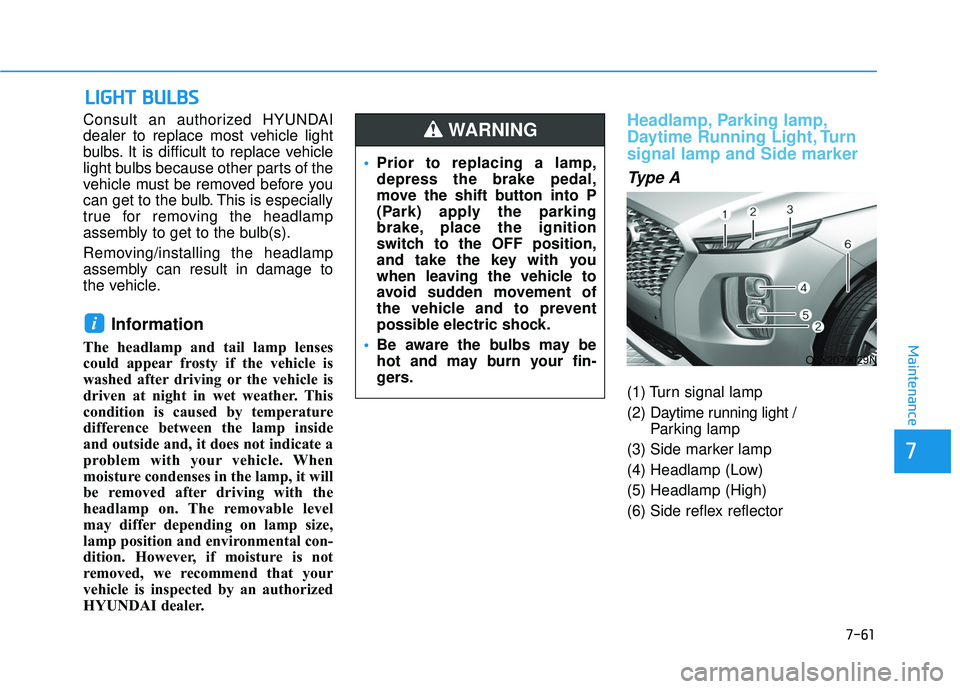
Type A
(1) Turn signal lamp
(2) Daytime running light /
Parking lamp
(3) Side marker lamp
(4) Headlamp (Low)
(5) Headlamp (High)
(6) Side reflex reflector
i
Prior to replacing a lamp,
depress the brake pedal,
move the shift button into P
(Park) apply the parking
brake, place the ignition
switch to the OFF position,
and take the key with you
when leaving the vehicle to
avoid sudden movement of
the vehicle and to prevent
possible electric shock.
Be aware the bulbs may be
hot and may burn your fin-
gers.
WARNING
OLX2079029N
Page 656 of 663
I-3
Blind-spot Collison Warning(BCW)...............................5-85Blind-Spot Collision Warning malfunction and limitations ..........................................................5-90
Blind-Spot Collision Warning operation ...................5-89
Blind-Spot Collision Warning settings settings .........5-86
Blind-Spot View Monitor (BVM) ...............................3-182 Blind-Spot View Monitor malfunction ....................3-183
Blind-Spot View Monitor operation.........................3-183
Blind-Spot View Monitor settings ...........................3-182
Brake fluid ......................................................................7-\
21 Checking the Brake Fluid Level ................................7-21
Braking system ...............................................................5-23 Anti-lock Brake System (ABS)..................................5-33
Auto Hold ...................................................................5-29
Disc Brakes Wear Indicator........................................5-24
Downhill Brake Control (DBC) ................................5-39
Electronic Parking Brake (EPB) ................................5-24
Electronic Stability Control (ESC).............................5-35
Good Braking Practices ............................................5-42
Hill-Start Assist Control (HAC) .................................5-39
Power Brakes..............................................................5-23
Trailer Stability Assist (TSA) .....................................5-42
Vehicle Stability Management (VSM) .......................5-38
Bulb Wattage .....................................................................8-3\
California perchlorate notice ..........................................7-81
Child Restraint System (CRS) ........................................2-45
Children Always in the Rear ......................................2-45
Installing a Child Restraint System (CRS) ................2-49
Selecting a Child Restraint System (CRS).................2-47
Climate Control Additional Features ............................3-216 Automatic Ventilation...............................................3-216
Cluster ionizer .........................................................3-216
Sunroof Inside Air Recirculation ............................3-216
Climate control air filter .................................................7-24 Filter Inspection..........................................................7-24
Consumer Information ....................................................8-12
Declaration of confirmity .............................................5-200 Front radar ...............................................................5-200
Rear corner radar .....................................................5-200
Dimensions .......................................................................8\
-2
Door Locks .....................................................................3-1\
6 Automatic Door Lock and Unlock Features ..............3-20
Child-Protector Rear Door Locks .............................3-21
Electronic Child Safety Lock System .......................3-21
Operating Door Locks from Inside the Vehicle ........3-17
Operating Door Locks from Outside the Vehicle .....3-16
I
Index
C
D