pressure Hyundai Santa Fe 2009 Owner's Manual - RHD (UK, Australia)
[x] Cancel search | Manufacturer: HYUNDAI, Model Year: 2009, Model line: Santa Fe, Model: Hyundai Santa Fe 2009Pages: 269, PDF Size: 9.78 MB
Page 10 of 269

YOUR VEHICLE AT A GLANCE
F10B255A01CM-DAT INDICATOR SYMBOLS ON THE INSTRUMENT CLUSTER
* More detailed explanations of these items will be found beginning on page 1-48.
4WD System Warning Light
Malfunction Indicator Light
SRS (Airbag) Service Reminder Indicator (SRI)
Tail Gate Open Warning Light
Low Fuel Level Warning Light Door Ajar Warning Light
ABS Service Reminder Indicator
Turn Signal Indicator Lights
High Beam Indicator Light Low Oil Pressure Warning Light Parking Brake/Brake Fluid Level Warning Light Charging System Warning Light
Immobiliser Warning Light
4WD Lock Indicator Light
Electronic Stability Program Indicator Lights (If Installed)
Cruise SET Indicator Light (If Installed)
Door/Tail Gate Open Display (If installed)
Cruise Indicator Light (If Installed)
Low Windshield Washer Fluid Level Warning LightSeat Belt Warning Light
Diesel Preheat Indicator Light
Fuel Filter Warning Light (Diesel Engine)
CM-aust-00.p65 5/19/2008, 6:25 PM
10
Page 49 of 269
1FEATURES OF YOUR HYUNDAI
38
OCM051009R
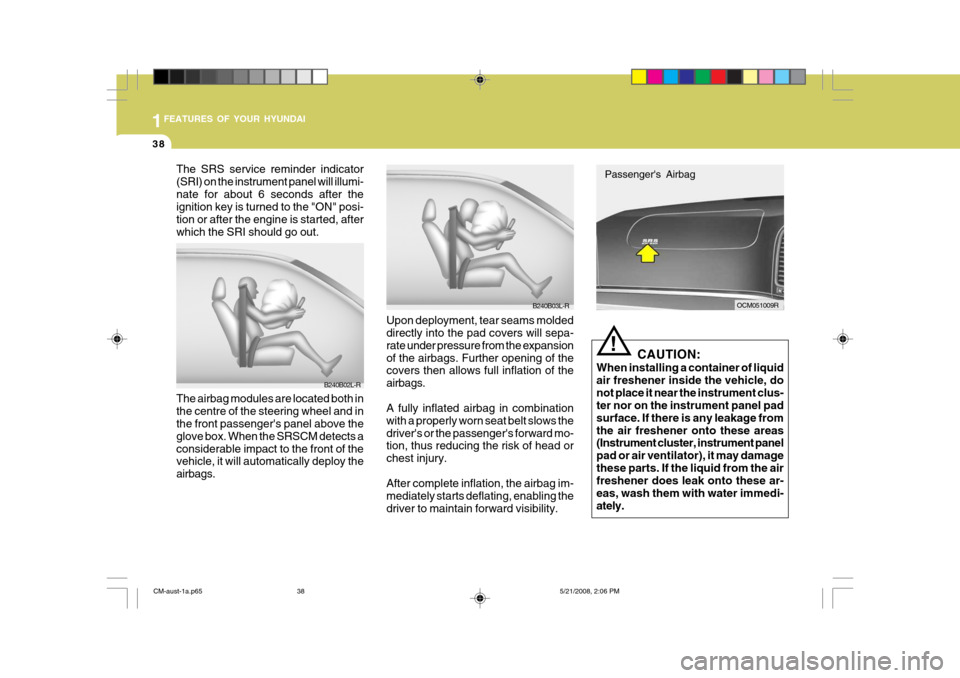
The SRS service reminder indicator (SRI) on the instrument panel will illumi-nate for about 6 seconds after the ignition key is turned to the "ON" posi- tion or after the engine is started, afterwhich the SRI should go out.
B240B02L-R B240B03L-R
Upon deployment, tear seams moldeddirectly into the pad covers will sepa- rate under pressure from the expansion of the airbags. Further opening of the covers then allows full inflation of the airbags. A fully inflated airbag in combination with a properly worn seat belt slows thedriver's or the passenger's forward mo- tion, thus reducing the risk of head or chest injury. After complete inflation, the airbag im- mediately starts deflating, enabling thedriver to maintain forward visibility. CAUTION:
When installing a container of liquidair freshener inside the vehicle, donot place it near the instrument clus- ter nor on the instrument panel pad surface. If there is any leakage fromthe air freshener onto these areas (Instrument cluster, instrument panel pad or air ventilator), it may damagethese parts. If the liquid from the air freshener does leak onto these ar- eas, wash them with water immedi-ately.
!
Passenger's Airbag
The airbag modules are located both in the centre of the steering wheel and in the front passenger's panel above the glove box. When the SRSCM detects aconsiderable impact to the front of the vehicle, it will automatically deploy the airbags.
CM-aust-1a.p65 5/21/2008, 2:06 PM
38
Page 56 of 269
1
FEATURES OF YOUR HYUNDAI
45
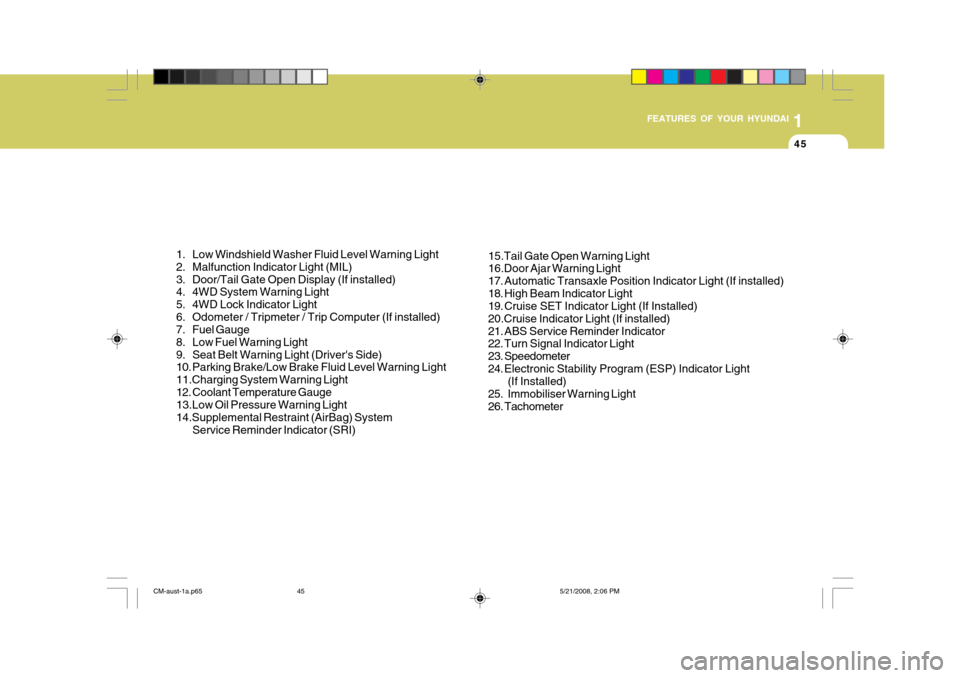
1. Low Windshield Washer Fluid Level Warning Light
2. Malfunction Indicator Light (MIL)
3. Door/Tail Gate Open Display (If installed)
4. 4WD System Warning Light
5. 4WD Lock Indicator Light
6. Odometer / Tripmeter / Trip Computer (If installed)
7. Fuel Gauge
8. Low Fuel Warning Light
9. Seat Belt Warning Light (Driver's Side)
10. Parking Brake/Low Brake Fluid Level Warning Light 11.Charging System Warning Light
12. Coolant Temperature Gauge 13.Low Oil Pressure Warning Light 14.Supplemental Restraint (AirBag) System Service Reminder Indicator (SRI) 15.Tail Gate Open Warning Light 16.Door Ajar Warning Light
17. Automatic Transaxle Position Indicator Light (If installed)
18. High Beam Indicator Light
19. Cruise SET Indicator Light (If Installed) 20.Cruise Indicator Light (If installed)
21. ABS Service Reminder Indicator
22. Turn Signal Indicator Light
23. Speedometer
24. Electronic Stability Program (ESP) Indicator Light
(If Installed)
25. Immobiliser Warning Light
26. Tachometer
CM-aust-1a.p65 5/21/2008, 2:06 PM
45
Page 58 of 269
1
FEATURES OF YOUR HYUNDAI
47
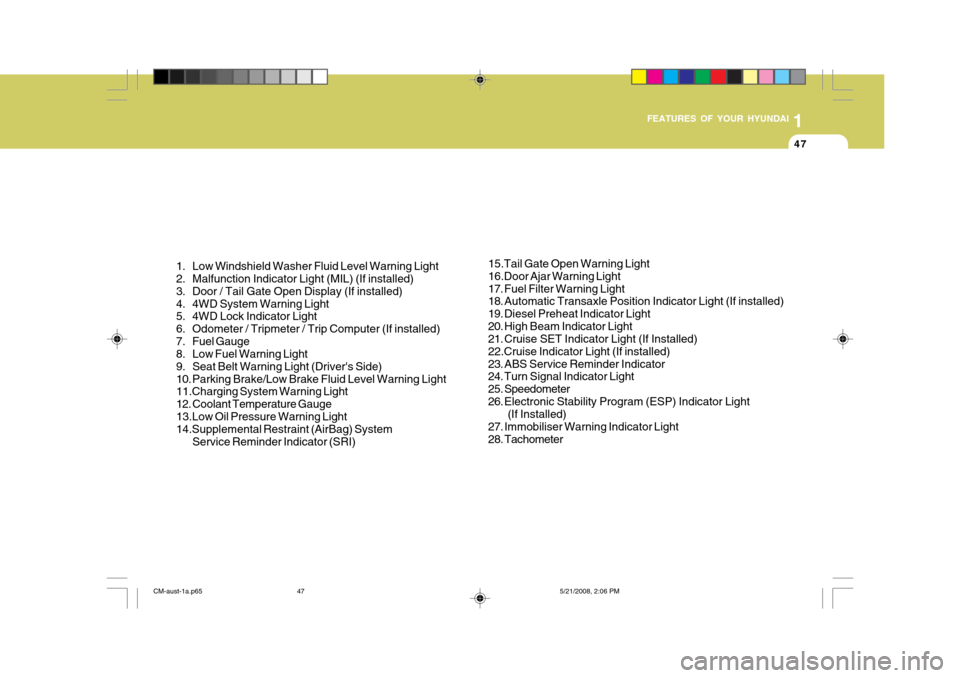
1. Low Windshield Washer Fluid Level Warning Light
2. Malfunction Indicator Light (MIL) (If installed)
3. Door / Tail Gate Open Display (If installed)
4. 4WD System Warning Light
5. 4WD Lock Indicator Light
6. Odometer / Tripmeter / Trip Computer (If installed)
7. Fuel Gauge
8. Low Fuel Warning Light
9. Seat Belt Warning Light (Driver's Side)
10. Parking Brake/Low Brake Fluid Level Warning Light 11.Charging System Warning Light
12. Coolant Temperature Gauge13.Low Oil Pressure Warning Light 14.Supplemental Restraint (AirBag) System Service Reminder Indicator (SRI) 15.Tail Gate Open Warning Light 16.Door Ajar Warning Light
17. Fuel Filter Warning Light
18. Automatic Transaxle Position Indicator Light (If installed)
19. Diesel Preheat Indicator Light
20. High Beam Indicator Light
21. Cruise SET Indicator Light (If Installed) 22.Cruise Indicator Light (If installed)
23. ABS Service Reminder Indicator
24. Turn Signal Indicator Light
25. Speedometer
26. Electronic Stability Program (ESP) Indicator Light
(If Installed)
27. Immobiliser Warning Indicator Light
28. Tachometer
CM-aust-1a.p65 5/21/2008, 2:06 PM
47
Page 60 of 269
1
FEATURES OF YOUR HYUNDAI
49
!
B260G01A-AAT
Low Oil Pressure Warn- ing Light
CAUTION:
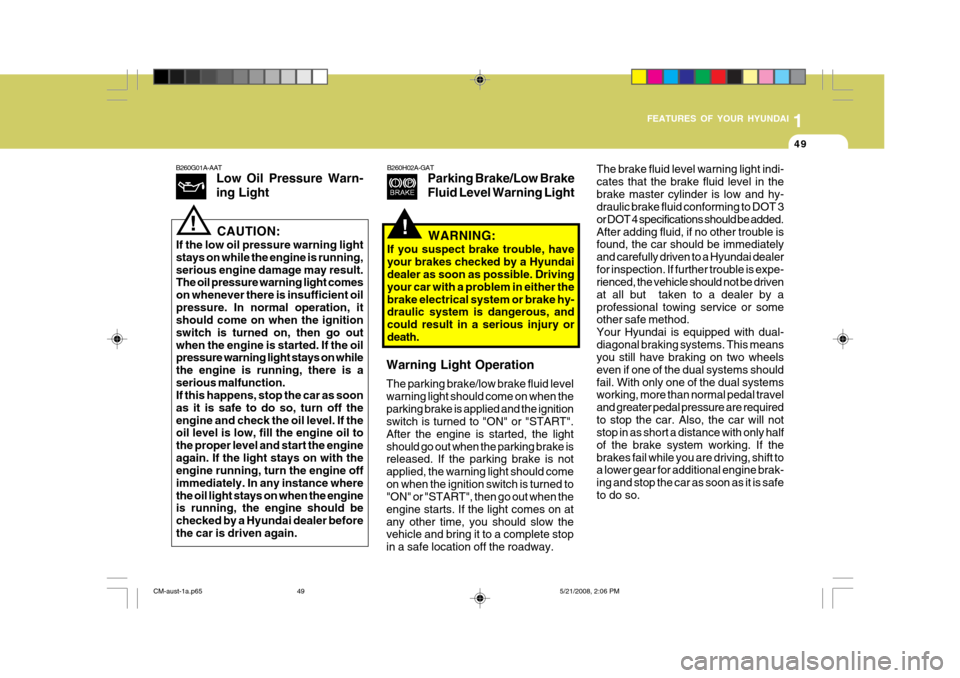
If the low oil pressure warning light stays on while the engine is running,serious engine damage may result. The oil pressure warning light comes on whenever there is insufficient oilpressure. In normal operation, it should come on when the ignition switch is turned on, then go outwhen the engine is started. If the oil pressure warning light stays on while the engine is running, there is aserious malfunction. If this happens, stop the car as soon as it is safe to do so, turn off theengine and check the oil level. If the oil level is low, fill the engine oil to the proper level and start the engineagain. If the light stays on with the engine running, turn the engine off immediately. In any instance wherethe oil light stays on when the engine is running, the engine should be checked by a Hyundai dealer beforethe car is driven again.
!
B260H02A-GAT Parking Brake/Low Brake Fluid Level Warning Light
WARNING:
If you suspect brake trouble, have your brakes checked by a Hyundai dealer as soon as possible. Driving your car with a problem in either thebrake electrical system or brake hy- draulic system is dangerous, and could result in a serious injury or death.
Warning Light Operation The parking brake/low brake fluid level warning light should come on when theparking brake is applied and the ignition switch is turned to "ON" or "START". After the engine is started, the lightshould go out when the parking brake is released. If the parking brake is not applied, the warning light should comeon when the ignition switch is turned to "ON" or "START", then go out when the engine starts. If the light comes on atany other time, you should slow the vehicle and bring it to a complete stop in a safe location off the roadway. The brake fluid level warning light indi-cates that the brake fluid level in thebrake master cylinder is low and hy- draulic brake fluid conforming to DOT 3 or DOT 4 specifications should be added.After adding fluid, if no other trouble is found, the car should be immediately and carefully driven to a Hyundai dealerfor inspection. If further trouble is expe- rienced, the vehicle should not be driven at all but taken to a dealer by aprofessional towing service or some other safe method. Your Hyundai is equipped with dual-diagonal braking systems. This means you still have braking on two wheels even if one of the dual systems shouldfail. With only one of the dual systems working, more than normal pedal travel and greater pedal pressure are requiredto stop the car. Also, the car will not stop in as short a distance with only half of the brake system working. If thebrakes fail while you are driving, shift to a lower gear for additional engine brak- ing and stop the car as soon as it is safeto do so.
CM-aust-1a.p65
5/21/2008, 2:06 PM
49
Page 65 of 269
1FEATURES OF YOUR HYUNDAI
54
!
OCM029011L
INSTRNMENT CLUSTER
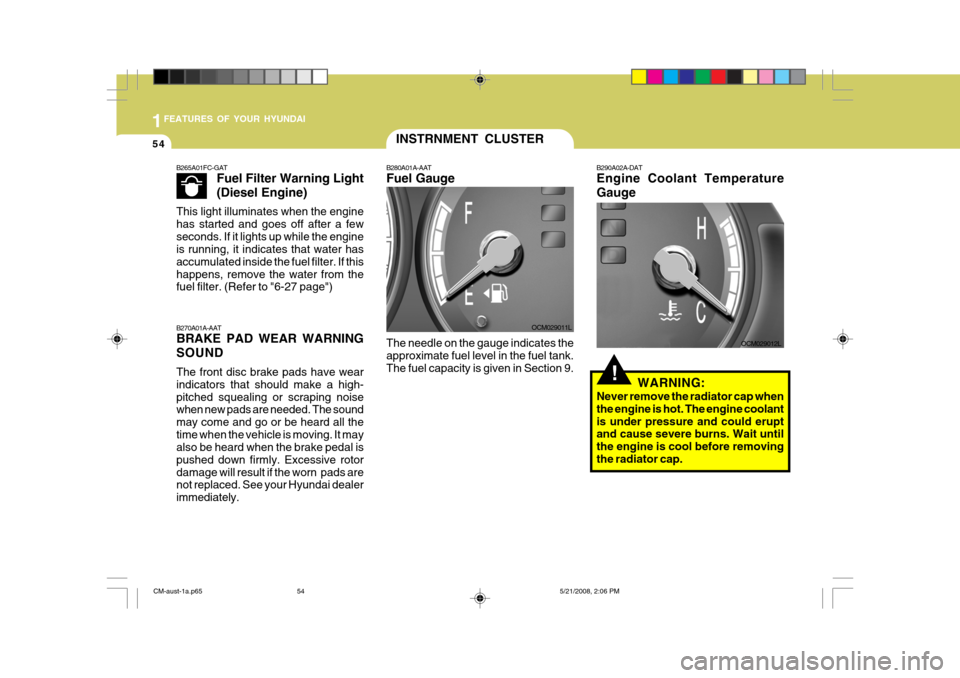
B280A01A-AAT Fuel Gauge The needle on the gauge indicates the approximate fuel level in the fuel tank.The fuel capacity is given in Section 9. B290A02A-DAT Engine Coolant Temperature Gauge
OCM029012L
WARNING:
Never remove the radiator cap when the engine is hot. The engine coolantis under pressure and could erupt and cause severe burns. Wait until the engine is cool before removingthe radiator cap.
B270A01A-AAT BRAKE PAD WEAR WARNING SOUND The front disc brake pads have wear indicators that should make a high-pitched squealing or scraping noise when new pads are needed. The sound may come and go or be heard all thetime when the vehicle is moving. It may also be heard when the brake pedal is pushed down firmly. Excessive rotordamage will result if the worn pads are not replaced. See your Hyundai dealer immediately.
B265A01FC-GAT
Fuel Filter Warning Light (Diesel Engine)
This light illuminates when the engine has started and goes off after a fewseconds. If it lights up while the engine is running, it indicates that water has accumulated inside the fuel filter. If thishappens, remove the water from the fuel filter. (Refer to "6-27 page")
CM-aust-1a.p65 5/21/2008, 2:06 PM
54
Page 98 of 269
1
FEATURES OF YOUR HYUNDAI
87HIGH-MOUNTED REAR STOP LIGHT
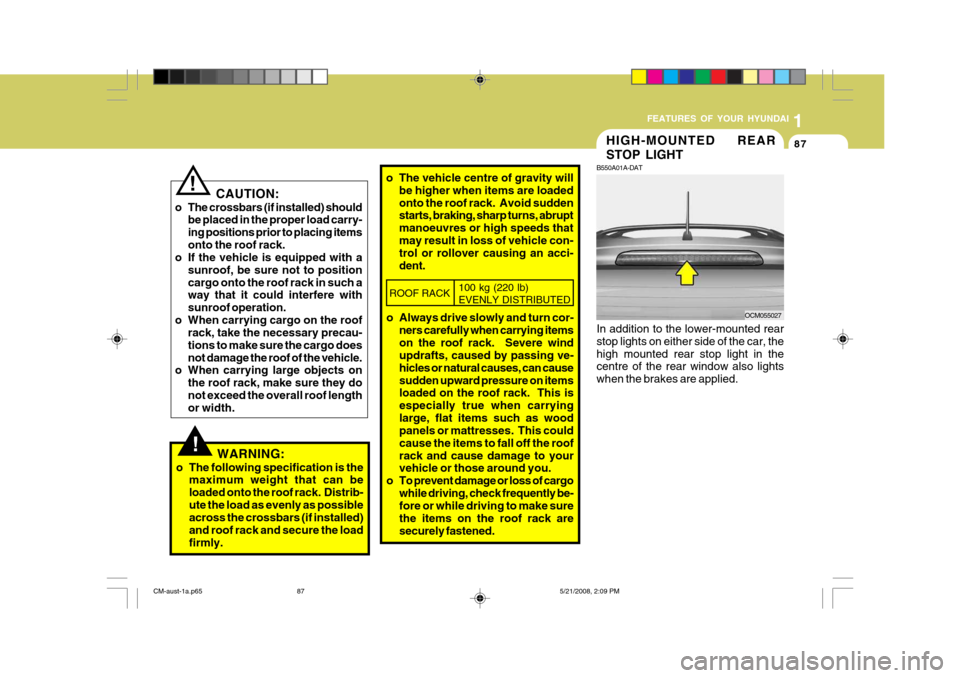
B550A01A-DAT In addition to the lower-mounted rear stop lights on either side of the car, the high mounted rear stop light in the centre of the rear window also lights when the brakes are applied. OCM055027
!WARNING:
o The following specification is the maximum weight that can be loaded onto the roof rack. Distrib-ute the load as evenly as possible across the crossbars (if installed) and roof rack and secure the loadfirmly. o The vehicle centre of gravity will
be higher when items are loadedonto the roof rack. Avoid sudden starts, braking, sharp turns, abrupt manoeuvres or high speeds thatmay result in loss of vehicle con- trol or rollover causing an acci- dent.
CAUTION:
o The crossbars (if installed) should be placed in the proper load carry-ing positions prior to placing itemsonto the roof rack.
o If the vehicle is equipped with a
sunroof, be sure not to positioncargo onto the roof rack in such a way that it could interfere with sunroof operation.
o When carrying cargo on the roof rack, take the necessary precau-tions to make sure the cargo doesnot damage the roof of the vehicle.
o When carrying large objects on
the roof rack, make sure they donot exceed the overall roof length or width.
!
ROOF RACK 100 kg (220 lb) EVENLY DISTRIBUTED
o Always drive slowly and turn cor-
ners carefully when carrying items on the roof rack. Severe wind updrafts, caused by passing ve- hicles or natural causes, can causesudden upward pressure on items loaded on the roof rack. This is especially true when carryinglarge, flat items such as wood panels or mattresses. This could cause the items to fall off the roofrack and cause damage to your vehicle or those around you.
o To prevent damage or loss of cargo while driving, check frequently be-fore or while driving to make sure the items on the roof rack aresecurely fastened.
CM-aust-1a.p65 5/21/2008, 2:09 PM
87
Page 99 of 269
1FEATURES OF YOUR HYUNDAI
88
!WARNING:
o Fuel vapours are dangerous. Be- fore refuelling, always stop the engine and never allow sparks or open flames near the filler area. Ifyou need to replace the filler cap, use a genuine Hyundai replace- ment part.If you open the fuel filler cap dur- ing high ambient temperatures, a slight "pressure sound" may beheard. This is normal and not a cause for concern. Whenever you open the fuel fillercap, turn it slowly.
REMOTE FUEL-FILLER LID RELEASE
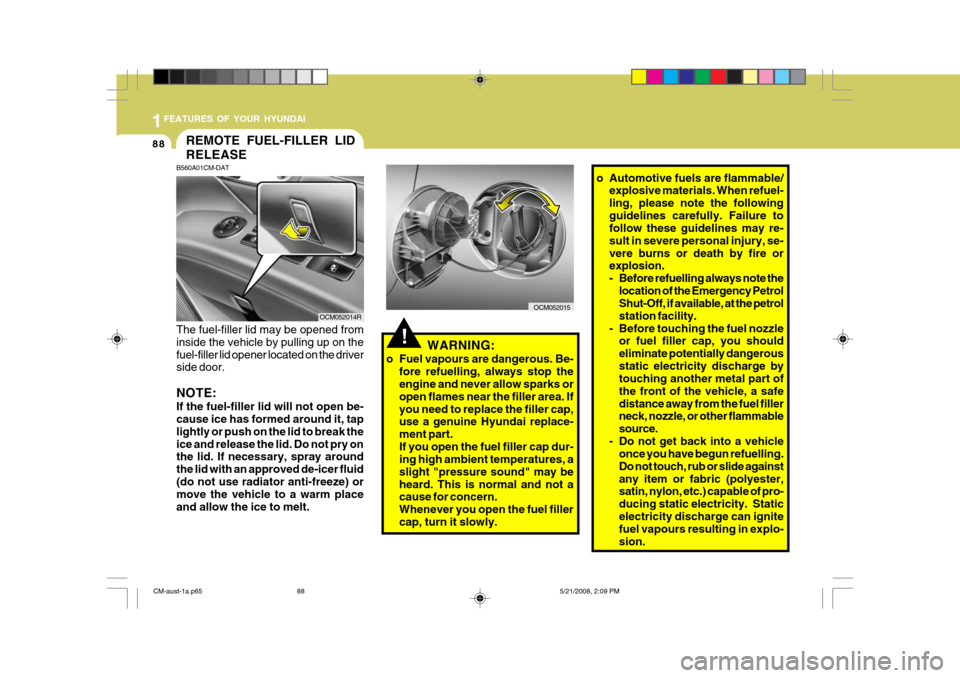
B560A01CM-DAT The fuel-filler lid may be opened from inside the vehicle by pulling up on thefuel-filler lid opener located on the driver side door. NOTE: If the fuel-filler lid will not open be- cause ice has formed around it, tap lightly or push on the lid to break theice and release the lid. Do not pry on the lid. If necessary, spray around the lid with an approved de-icer fluid(do not use radiator anti-freeze) or move the vehicle to a warm place and allow the ice to melt. OCM052014R
OCM052015
o Automotive fuels are flammable/
explosive materials. When refuel- ling, please note the followingguidelines carefully. Failure to follow these guidelines may re- sult in severe personal injury, se-vere burns or death by fire or explosion.
- Before refuelling always note the
location of the Emergency Petrol Shut-Off, if available, at the petrol station facility.
- Before touching the fuel nozzle or fuel filler cap, you shouldeliminate potentially dangerousstatic electricity discharge by touching another metal part of the front of the vehicle, a safedistance away from the fuel filler neck, nozzle, or other flammable source.
- Do not get back into a vehicle once you have begun refuelling.Do not touch, rub or slide againstany item or fabric (polyester, satin, nylon, etc.) capable of pro- ducing static electricity. Staticelectricity discharge can ignite fuel vapours resulting in explo- sion.
CM-aust-1a.p65 5/21/2008, 2:09 PM
88
Page 159 of 269
2DRIVING YOUR HYUNDAI
14
o The risk of rollover is greatly in-
creased if you lose control of your vehicle at highway speeds.
o Loss of control often occurs if two or more wheels drop off theroadway and the driver oversteers to reenter the roadway.
o In the event your vehicle leaves the roadway, do not steer sharply.Instead, slow down before pull- ing back into the travel lanes.
o Never exceed posted speed lim- its.
o If your vehicle becomes stuck in
snow, mud, sand, etc., then youmay attempt to rock the vehicle free by moving it forward andbackward. Do not attempt this procedure if people or objects are anywhere near the vehicle.During the rocking operation the vehicle may suddenly move for- ward of backward as it becomesunstuck, causing injury or dam- age to nearby people or objects.!WARNING:
Your ABS (ESP) will not prevent accidents due to improper or dan-gerous driving manoeuvres. Even though vehicle control is improved during emergency braking, alwaysmaintain a safe distance between you and objects ahead. Vehicle speeds should always be reducedduring extreme road conditions. The braking distance for cars equipped with an anti-lock brakingsystem (the electronic stability pro- gram) may be longer than for those without it in the following road con-ditions. These roads should be driven at reduced speeds.
o Rough, gravel or snow-covered roads.
o With tyre chains installed.
o On roads where the road surface is pitted or has different surface height.
ANTI-LOCK BRAKE SYSTEM
C120A01FC-DAT The Anti-Lock Brake System (ABS) is designed to prevent wheel lock-up dur- ing sudden braking or on hazardous road surfaces. The ABS control modulemonitors the wheel speed and controls the pressure applied to each brake. Thus, in emergency situations or onslick roads, ABS will increase vehicle control during braking. NOTE:
o A click sound may be heard in the engine compartment when the vehicle begins to move after the engine is started. These condi- tions are normal and indicate thatthe anti-lock brake system (Elec- tronic Stability Program) is func- tioning properly.
o During ABS (ESP) operation, a
slight pulsation may be felt in thebrake pedal when the brakes are applied. Also, a noise may be heard in the engine compartmentwhile braking. These conditions are normal and indicate that the anti-lock brake system (ElectronicStability Program) is functioning properly.
CM-aust-2.p65 5/19/2008, 6:35 PM
14
Page 162 of 269
2
DRIVING YOUR HYUNDAI
17
!
(7)The full-time 4WD vehicle cannot
be towed by an ordinary tow truck. Make sure that the vehicle is towed with its four wheels raised off the ground.
o If the vehicle is towed with its only two wheels raised off the ground,the 4WD system could be dam- aged.
o In unavoidable case, if the vehicle
is being towed with all four wheelson the ground, it should be towed only forward direction with rope.
o While towing, check the following items.
1. The ignition switch is in "ACC" or "ON".
2. Place the shift lever in neutral
(For Automatic Transaxle, "N" position).
3. Release the parking brake.
NOTE: To avoid serious damage to your 4WD vehicle, limit towing to 15 km/h (10 mph) and not for more than 1.5km (1 mile) at ANY TIME.
(5)The stopping distance of the full-
time 4WD vehicle differs very littlefrom that of the 2WD vehicle. When driving on a snow-covered road or a slippery, muddy surface, makesure that you keep a sufficient dis- tance between your vehicle and the one ahead of you.
(6)Since the driving torque is always applied to the 4 wheels, the perfor-mance of the full-time 4WD vehicleis greatly affected by the condition of the tyres. Be sure to equip it with all four tyres of the same size and type.
o When replacement of any of the tyres or disc wheels is necessary,replace all of them.
o Rotate the tyres and check the tyre pressure at regular intervals. WARNING:
Your vehicle is equipped with tyresdesigned to provide for safe ride and handling capability. Do not use a size and type of tyre andwheel that is different from the one that was originally installed on your vehicle. It can affect the safety andperformance of your vehicle, which could lead to handling failure or rollover and serious injury.When replacing the tyres, be sure to equip all four tyres with the tyre and wheel of the same size, type, tread,brand and load-carrying capacity. If you nevertheless decide to equip your vehicle with any tyre/wheel com-bination not recommended by Hyundai for off-road driving, you should not use these tyres for high-way driving.
CM-aust-2.p65 5/19/2008, 6:35 PM
17