check engine Hyundai Santa Fe 2012 Workshop Manual
[x] Cancel search | Manufacturer: HYUNDAI, Model Year: 2012, Model line: Santa Fe, Model: Hyundai Santa Fe 2012Pages: 419, PDF Size: 5.61 MB
Page 358 of 419
731
Maintenance
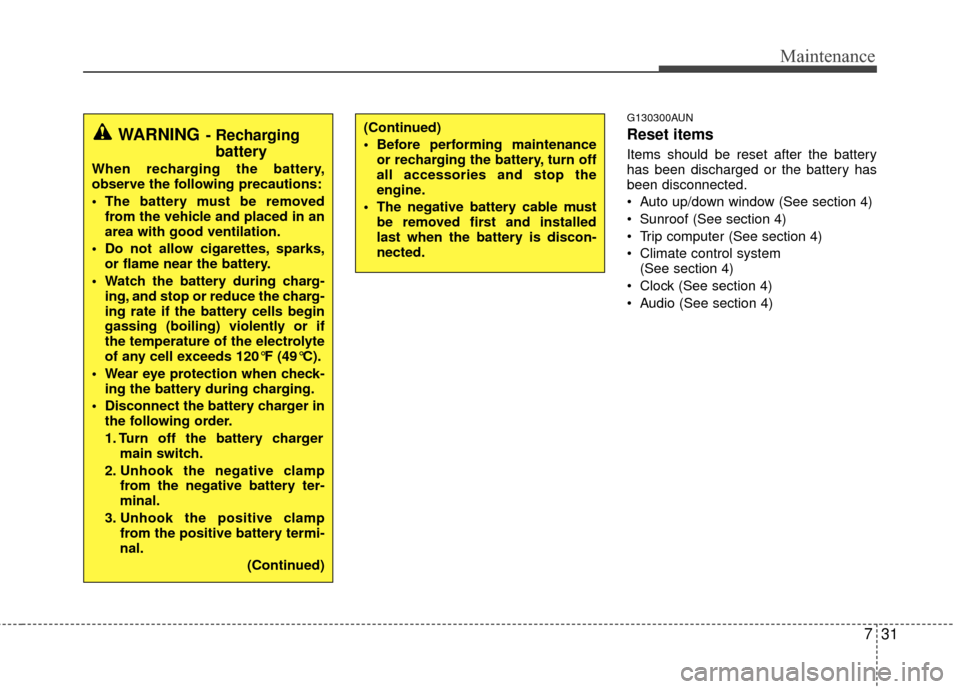
G130300AUN
Reset items
Items should be reset after the battery
has been discharged or the battery has
been disconnected.
Auto up/down window (See section 4)
Sunroof (See section 4)
Trip computer (See section 4)
Climate control system (See section 4)
Clock (See section 4)
Audio (See section 4)
(Continued)
Before performing maintenance or recharging the battery, turn off
all accessories and stop the
engine.
The negative battery cable must be removed first and installed
last when the battery is discon-
nected.WARNING- Rechargingbattery
When recharging the battery,
observe the following precautions:
The battery must be removed
from the vehicle and placed in an
area with good ventilation.
Do not allow cigarettes, sparks, or flame near the battery.
Watch the battery during charg- ing, and stop or reduce the charg-
ing rate if the battery cells begin
gassing (boiling) violently or if
the temperature of the electrolyte
of any cell exceeds 120°F (49°C).
Wear eye protection when check- ing the battery during charging.
Disconnect the battery charger in the following order.
1. Turn off the battery charger main switch.
2. Unhook the negative clamp from the negative battery ter-
minal.
3. Unhook the positive clamp from the positive battery termi-
nal.
(Continued)
Page 372 of 419
745
Maintenance
FUSES
G210000AFD
A vehicle’s electrical system is protected
from electrical overload damage by
fuses.This vehicle has 2 fuse panels, one locat-
ed in the driver’s side panel bolster, the
other in the engine compartment near
the battery.
If any of your vehicle’s lights, acces-
sories, or controls do not work, check the
appropriate circuit fuse. If a fuse has
blown, the element inside the fuse will be
melted.
If the electrical system does not work,
first check the driver’s side fuse panel.
Always replace a blown fuse with one of
the same rating.
If the replacement fuse blows, this indi-
cates an electrical problem. Avoid using
the system involved and immediately
consult an authorized HYUNDAI dealer.
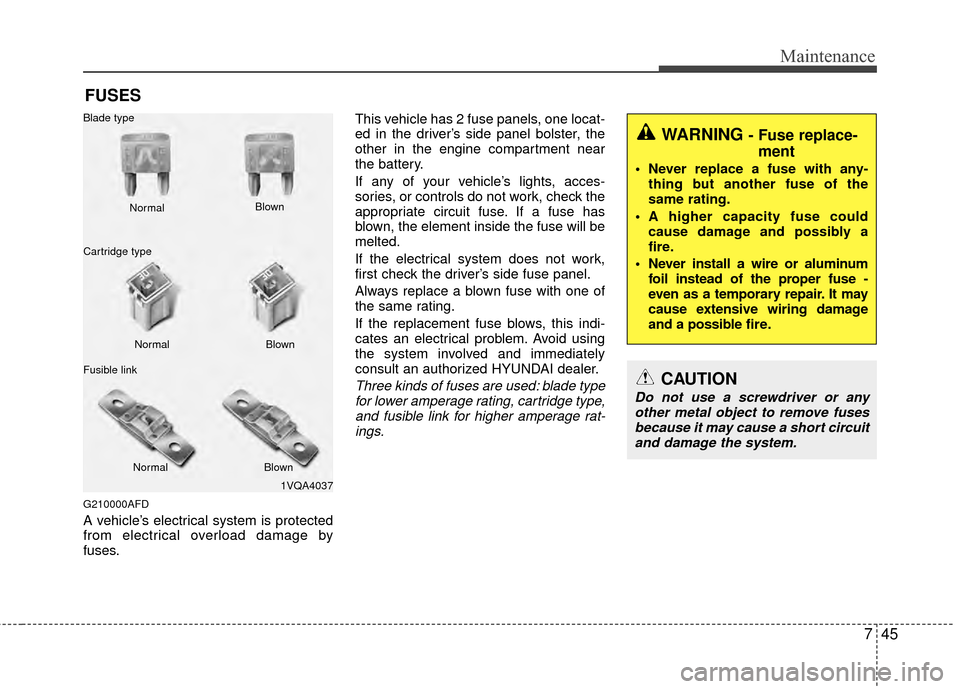
Three kinds of fuses are used: blade type
for lower amperage rating, cartridge type, and fusible link for higher amperage rat-ings.
1VQA4037
Normal
Normal
Blade type
Cartridge type
Fusible link Blown
Blown
Normal Blown
WARNING - Fuse replace-
ment
Never replace a fuse with any-
thing but another fuse of the
same rating.
A higher capacity fuse could cause damage and possibly a
fire.
Never install a wire or aluminum foil instead of the proper fuse -
even as a temporary repair. It may
cause extensive wiring damage
and a possible fire.
CAUTION
Do not use a screwdriver or anyother metal object to remove fuses because it may cause a short circuitand damage the system.
Page 373 of 419
Maintenance
46
7
G210100AUN
Inner panel fuse replacement
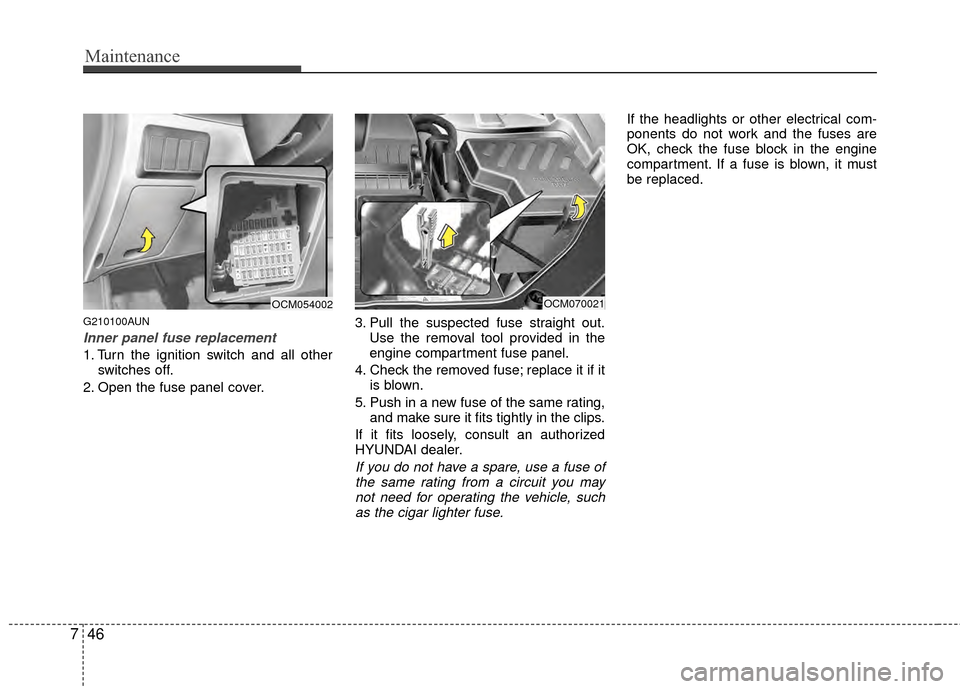
1. Turn the ignition switch and all other
switches off.
2. Open the fuse panel cover. 3. Pull the suspected fuse straight out.
Use the removal tool provided in the
engine compartment fuse panel.
4. Check the removed fuse; replace it if it is blown.
5. Push in a new fuse of the same rating, and make sure it fits tightly in the clips.
If it fits loosely, consult an authorized
HYUNDAI dealer.
If you do not have a spare, use a fuse of the same rating from a circuit you maynot need for operating the vehicle, such as the cigar lighter fuse.
If the headlights or other electrical com-
ponents do not work and the fuses are
OK, check the fuse block in the engine
compartment. If a fuse is blown, it must
be replaced.
OCM054002OCM070021
Page 375 of 419
Maintenance
48
7
3. Check the removed fuse; replace it if it
is blown. To remove or insert the fuse,
use the fuse puller in the engine com-
partment fuse panel.
4. Push in a new fuse of the same rating, and make sure it fits tightly in the clips.
If it fits loosely, consult an authorized
HYUNDAI dealer.
G210201ACM
Main fuse
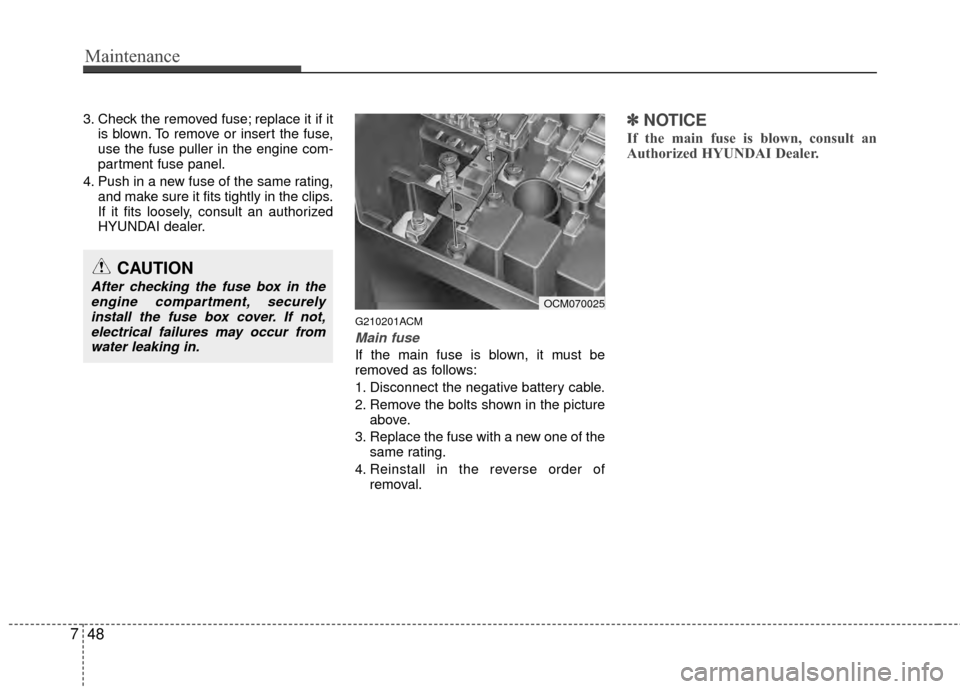
If the main fuse is blown, it must be
removed as follows:
1. Disconnect the negative battery cable.
2. Remove the bolts shown in the pictureabove.
3. Replace the fuse with a new one of the same rating.
4. Reinstall in the reverse order of removal.
✽ ✽NOTICE
If the main fuse is blown, consult an
Authorized HYUNDAI Dealer.
CAUTION
After checking the fuse box in the
engine compartment, securelyinstall the fuse box cover. If not,electrical failures may occur fromwater leaking in.
OCM070025
Page 379 of 419
Maintenance
52
7
Engine compartment
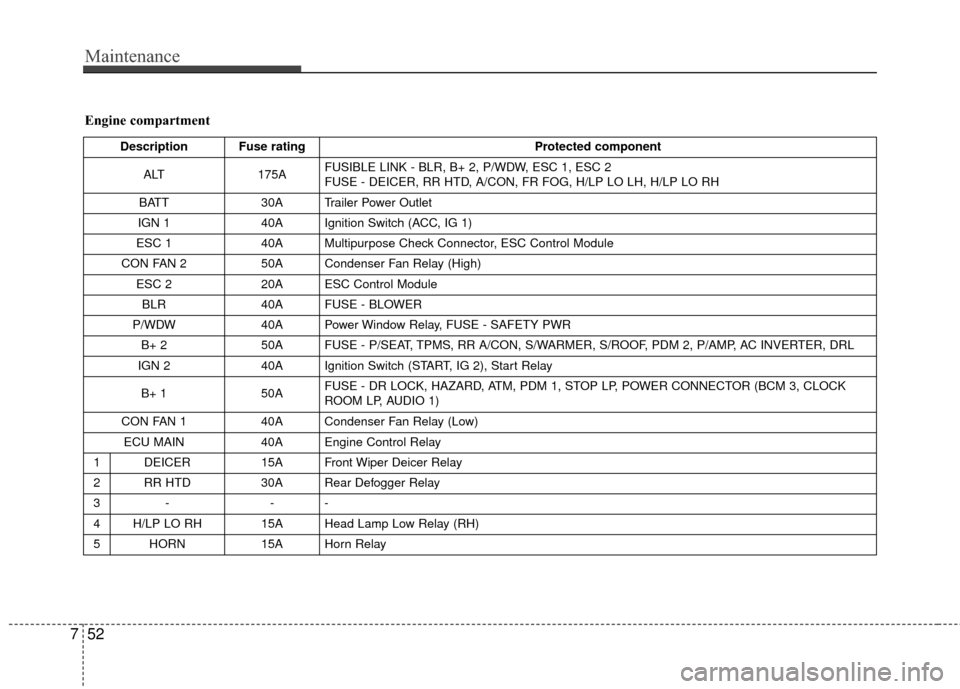
Description Fuse rating Protected component
ALT 175AFUSIBLE LINK - BLR, B+ 2, P/WDW, ESC 1, ESC 2
FUSE - DEICER, RR HTD, A/CON, FR FOG, H/LP LO LH, H/LP LO RH
BATT 30A Trailer Power Outlet
IGN 1 40A Ignition Switch (ACC, IG 1)
ESC 1 40A Multipurpose Check Connector, ESC Control Module
CON FAN 2 50A Condenser Fan Relay (High)
ESC 2 20A ESC Control Module
BLR 40A FUSE - BLOWER
P/WDW 40A Power Window Relay, FUSE - SAFETY PWR
B+ 2 50A FUSE - P/SEAT, TPMS, RR A/CON, S/WARMER, S/ROOF, PDM 2, P/AMP, AC INVERTER, DRL
IGN 2 40A Ignition Switch (START, IG 2), Start Relay
B+ 1 50AFUSE - DR LOCK, HAZARD, ATM, PDM 1, STOP LP, POWER CONNECTOR (BCM 3, CLOCK
ROOM LP, AUDIO 1)
CON FAN 1 40A Condenser Fan Relay (Low)
ECU MAIN 40A Engine Control Relay
1 DEICER 15A Front Wiper Deicer Relay
2 RR HTD 30A Rear Defogger Relay
3- --
4 H/LP LO RH 15A Head Lamp Low Relay (RH)
5 HORN 15A Horn Relay
Page 398 of 419
771
Maintenance
G270300AUN
3. Exhaust emission control system
The Exhaust Emission Control System is
a highly effective system which controls
exhaust emissions while maintaining
good vehicle performance.
G270301BUN
Vehicle modifications
This vehicle should not be modified.
Modification of your vehicle could affect
its performance, safety or durability and
may even violate governmental safety
and emissions regulations.
In addition, damage or performance
problems resulting from any modification
may not be covered under warranty.
If you use unauthorized electronic
devices, it may cause the vehicle to
operate abnormally, wire damage, bat-
tery discharge and fire. For your safety,
do not use unauthorized electronic
devices.
G270302AUN-EU
Engine exhaust gas precautions (car-bon monoxide)
Carbon monoxide can be present with other exhaust fumes. Therefore, if you
smell exhaust fumes of any kind inside
your vehicle, have it inspected and
repaired immediately. If you ever sus-
pect exhaust fumes are coming into
your vehicle, drive it only with all the
windows fully open. Have your vehicle
checked and repaired immediately.
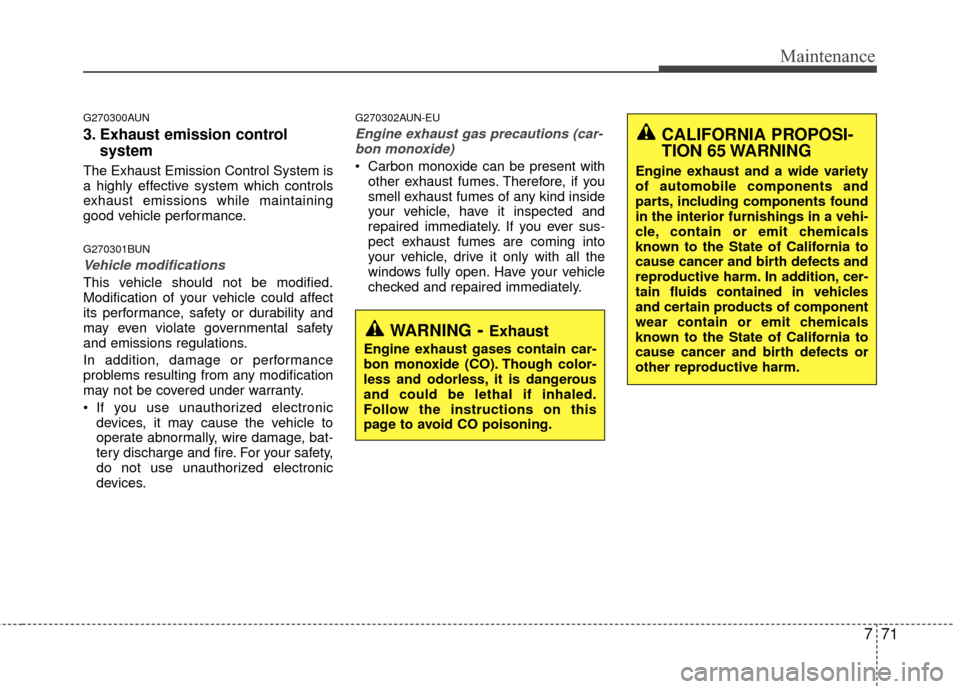
WARNING- Exhaust
Engine exhaust gases contain car-
bon monoxide (CO). Though color-
less and odorless, it is dangerous
and could be lethal if inhaled.
Follow the instructions on this
page to avoid CO poisoning.
CALIFORNIA PROPOSI-
TION 65 WARNING
Engine exhaust and a wide variety
of automobile components and
parts, including components found
in the interior furnishings in a vehi-
cle, contain or emit chemicals
known to the State of California to
cause cancer and birth defects and
reproductive harm. In addition, cer-
tain fluids contained in vehicles
and certain products of component
wear contain or emit chemicals
known to the State of California to
cause cancer and birth defects or
other reproductive harm.
Page 406 of 419
Specifications, Consumer information, Reporting safety defects
68
I040100AXM
Recommended SAE viscosity
number
Engine oil viscosity (thickness) has an
effect on fuel economy and cold weather
operating (engine start and engine oil
flowability). Lower viscosity engine oils
can provide better fuel economy and cold
weather performance, however, higher
viscosity engine oils are required for sat-
isfactory lubrication in hot weather. Using
oils of any viscosity other than those rec-
ommended could result in engine dam-
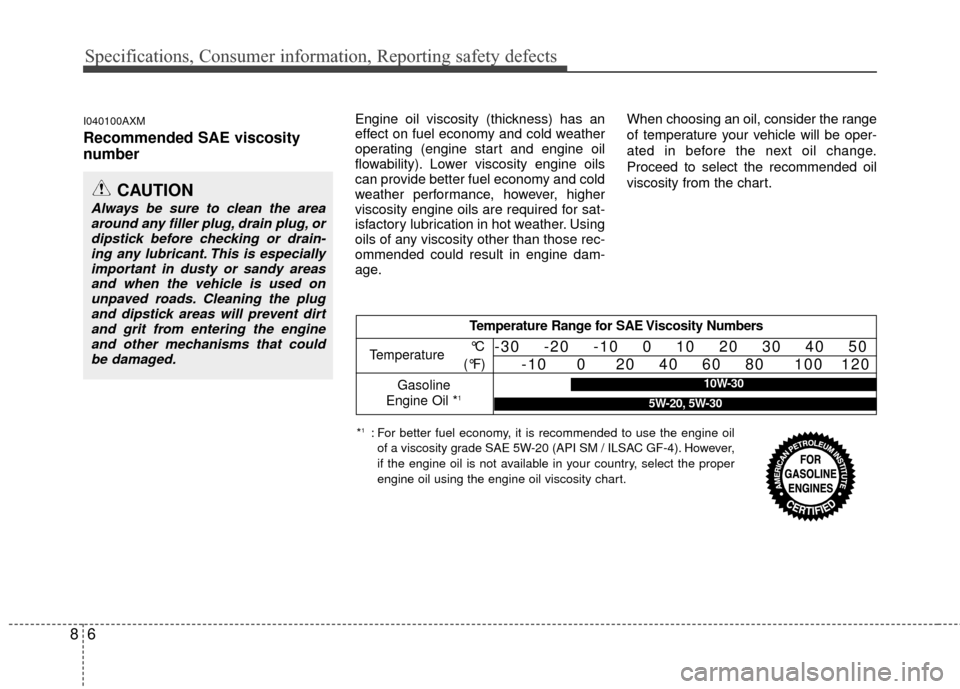
age.When choosing an oil, consider the range
of temperature your vehicle will be oper-
ated in before the next oil change.
Proceed to select the recommended oil
viscosity from the chart.
CAUTION
Always be sure to clean the area
around any filler plug, drain plug, ordipstick before checking or drain-ing any lubricant. This is especiallyimportant in dusty or sandy areasand when the vehicle is used onunpaved roads. Cleaning the plugand dipstick areas will prevent dirtand grit from entering the engine and other mechanisms that couldbe damaged.
Temperature Range for SAE Viscosity Numbers
Temperature
Gasoline
Engine Oil *
1
°C
(°F)-30 -20 -10 0 10 20 30 40 50 -10 0 20 40 60 80 100 120
*1: For better fuel economy, it is recommended to use the engine oil
of a viscosity grade SAE 5W-20 (API SM / ILSAC GF-4). However,
if the engine oil is not available in your country, select the proper
engine oil using the engine oil viscosity chart.
10W-30
5W-20, 5W-30
Page 416 of 419

Index
6I
Lumbar support ··················\
··················\
··················\
·······3-6
Rear seat adjustment··················\
··················\
················3-12
Seatback pocket ··················\
··················\
··················\
·····3-11
Seat warmer ··················\
··················\
··················\
···········3-10
Special driving conditions ··················\
··················\
·········5-40 Driving at night ··················\
··················\
··················\
·····5-41
Driving in flooded areas ··················\
··················\
··········5-42
Driving in the rain ··················\
··················\
··················\
·5-42
Hazardous driving conditions ··················\
··················\
··5-40
Highway driving ··················\
··················\
··················\
····5-43
Rocking the vehicle ··················\
··················\
·················5-40\
Smooth cornering ··················\
··················\
··················\
··5-41
Starting the engine ··················\
··················\
··················\
·····5-6
Steering wheel ··················\
··················\
··················\
·········4-26 Horn ··················\
··················\
··················\
··················\
·····4-27
Power steering ··················\
··················\
··················\
·······4-26
Tilt steering ··················\
··················\
··················\
············4-26
Storage compartment ··················\
··················\
·················4-89\
Center console storage·············\
··················\
··················\
4-89
Glove box ··················\
··················\
··················\
··············4-89
Multi box ··················\
··················\
··················\
···············4-90
Luggage box ··················\
··················\
··················\
··········4-91
Sunglass holder··················\
··················\
··················\
······4-90
Sunroof··················\
··················\
··················\
··················\
···4-22 Tailgate··················\
··················\
··················\
··················\
···4-11
Theft-alarm system ··················\
··················\
··················\
····4-5
Tires pressure monitoring system (TPMS)··················\
····6-7
Changing a tire with TPMS··················\
··················\
·····6-10
Low tire pressure telltale ··················\
··················\
···········6-8
TPMS (Tire pressure monitoring system) malfunction indicator ··················\
··················\
··············6-9
Tire specification and pressure label ··················\
·············8-8
Tires and wheels ··················\
··················\
·················7-32\
, 8-3 All season tires ··················\
··················\
··················\
······7-43
Checking tire inflation pressure ··················\
················7-34
Compact spare tire replacement ··················\
················7-36
Radial-ply tires ··················\
··················\
··················\
······7-44
Recommended cold tire inflation pressures ················7-32
Snow tires ··················\
··················\
··················\
··············7-43
Summer tires··················\
··················\
··················\
··········7-43
Tire care ··················\
··················\
··················\
·················7-32\
Tire chains ··················\
··················\
··················\
·············7-44
Tire maintenance ··················\
··················\
··················\
···7-38
Tire replacement ··················\
··················\
··················\
····7-36
Tire rotation ··················\
··················\
··················\
···········7-35
Tire sidewall labeling ··················\
··················\
··············7-38
Tire terminology and definitions ··················\
···············7-41
Tire traction ··················\
··················\
··················\
···········7-38
Wheel alignment and tire balance ··················\
·············7-36
Wheel replacement ··················\
··················\
··················\
7-36T