indicator Hyundai Santa Fe 2012 Owner's Manual
[x] Cancel search | Manufacturer: HYUNDAI, Model Year: 2012, Model line: Santa Fe, Model: Hyundai Santa Fe 2012Pages: 419, PDF Size: 5.61 MB
Page 8 of 419
1
How to use this manual / 1-2
Fuel requirements / 1-2
Vehicle handling instructions / 1-4
Vehicle break-in process / 1-5
Vehicle data collection and event data recorders / 1-5
Indicator symbols on the instrument cluster / 1-6
Introduction
Page 13 of 419
Introduction
61
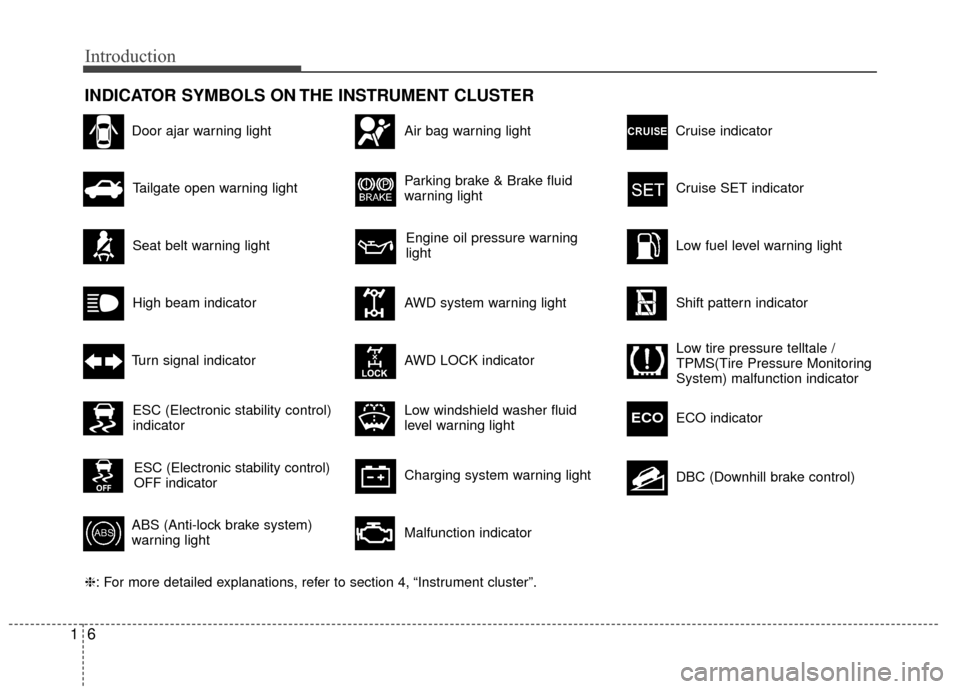
INDICATOR SYMBOLS ON THE INSTRUMENT CLUSTER
Engine oil pressure warning
light
❈: For more detailed explanations, refer to section 4, “Instrument cluster”.Seat belt warning light
Tailgate open warning light
High beam indicator
Turn signal indicator
ABS (Anti-lock brake system)
warning light
Parking brake & Brake fluid
warning light
AWD system warning light
AWD LOCK indicator
Malfunction indicator
Air bag warning light
Cruise SET indicator
Low fuel level warning light
Shift pattern indicator
Charging system warning light
Low windshield washer fluid
level warning light
Door ajar warning lightESC (Electronic stability control)
indicator
ESC (Electronic stability control)
OFF indicator
Low tire pressure telltale /
TPMS(Tire Pressure Monitoring
System) malfunction indicator
ECO indicator
ECO
Cruise indicator
DBC (Downhill brake control)
Page 51 of 419
Safety systems of your vehicle
34
3
C030104BFD-EU
Securing a child restraint seat with
child seat lower anchor system
Some child seat manufacturers make
child restraint seats that are labeled as
LATCH or LATCH-compatible child
restraint seats. LATCH stands for "Lower
Anchors and Tethers for Children". These
seats include two rigid or webbing
mounted attachments that connect to
two LATCH anchors at specific seating
positions in your vehicle. This type of
child restraint seat eliminates the need to
use seat belts to attach the child seat in
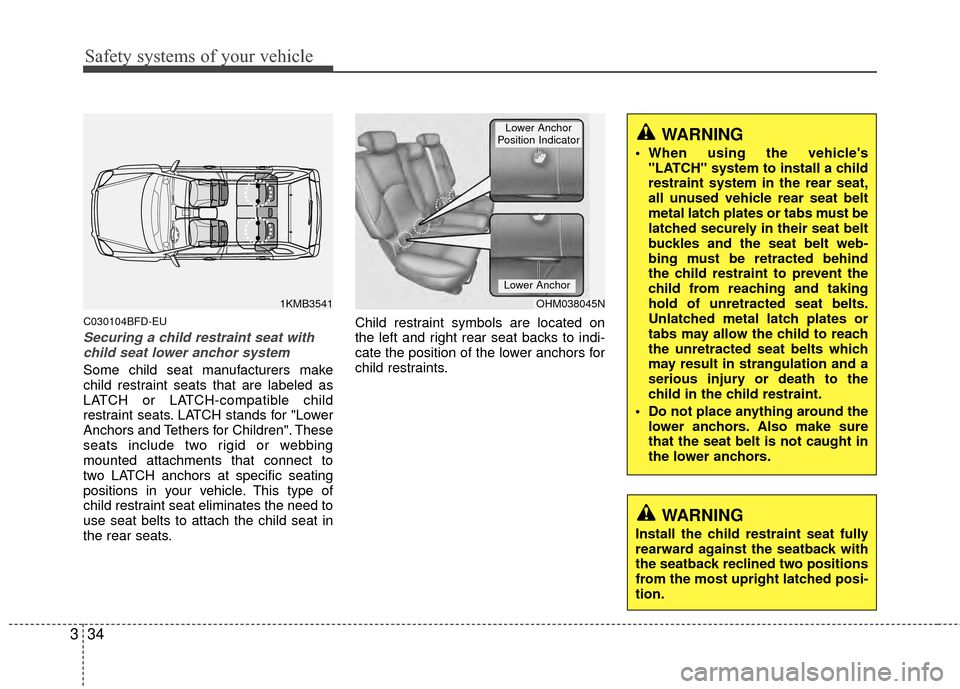
the rear seats. Child restraint symbols are located on
the left and right rear seat backs to indi-
cate the position of the lower anchors for
child restraints.
OHM038045N
Lower Anchor
Lower Anchor
Position IndicatorWARNING
When using the vehicle's "LATCH" system to install a child
restraint system in the rear seat,
all unused vehicle rear seat belt
metal latch plates or tabs must be
latched securely in their seat belt
buckles and the seat belt web-
bing must be retracted behind
the child restraint to prevent the
child from reaching and taking
hold of unretracted seat belts.
Unlatched metal latch plates or
tabs may allow the child to reach
the unretracted seat belts which
may result in strangulation and a
serious injury or death to the
child in the child restraint.
Do not place anything around the lower anchors. Also make sure
that the seat belt is not caught in
the lower anchors.
WARNING
Install the child restraint seat fully
rearward against the seatback with
the seatback reclined two positions
from the most upright latched posi-
tion.
1KMB3541
Page 54 of 419
337
Safety systems of your vehicle
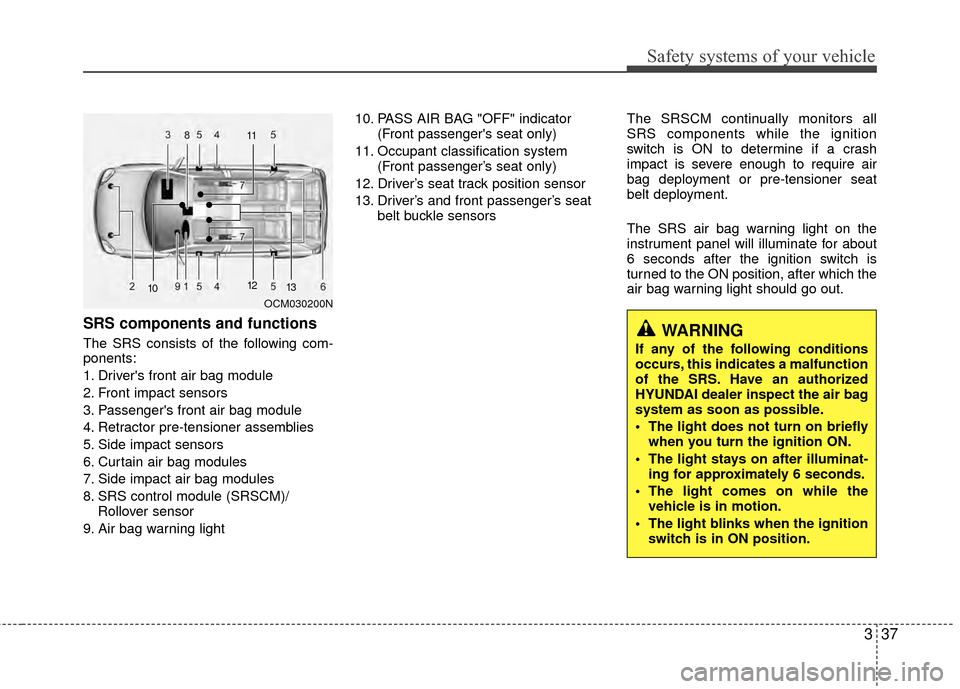
SRS components and functions
The SRS consists of the following com-
ponents:
1. Driver's front air bag module
2. Front impact sensors
3. Passenger's front air bag module
4. Retractor pre-tensioner assemblies
5. Side impact sensors
6. Curtain air bag modules
7. Side impact air bag modules
8. SRS control module (SRSCM)/Rollover sensor
9. Air bag warning light 10. PASS AIR BAG "OFF" indicator
(Front passenger's seat only)
11. Occupant classification system (Front passenger’s seat only)
12. Driver’s seat track position sensor
13. Driver’s and front passenger’s seat belt buckle sensors The SRSCM continually monitors all
SRS components while the ignition
switch is ON to determine if a crash
impact is severe enough to require air
bag deployment or pre-tensioner seat
belt deployment.
The SRS air bag warning light on the
instrument panel will illuminate for about
6 seconds after the ignition switch is
turned to the ON position, after which the
air bag warning light should go out.WARNING
If any of the following conditions
occurs, this indicates a malfunction
of the SRS. Have an authorized
HYUNDAI dealer inspect the air bag
system as soon as possible.
The light does not turn on briefly
when you turn the ignition ON.
The light stays on after illuminat- ing for approximately 6 seconds.
The light comes on while the vehicle is in motion.
The light blinks when the ignition switch is in ON position.
OCM030200N
10 11
13
12
10 11
13
12
Page 57 of 419
Safety systems of your vehicle
40
3
C040300AUN-EU
Occupant classification system
Your vehicle is equipped with an occu-
pant classification system in the front
passenger's seat.
The occupant classification system is
designed to detect the presence of a
properly-seated front passenger and
determine if the passenger's front air bag
should be enabled (may inflate) or not.
The driver's front air bag is not affected
or controlled by the occupant classifica-
tion system.
Main components of occupant classi-
fication system
A detection device located within the front passenger seat track.
Electronic system to determine whether the passenger air bag sys-
tems (both front and side) should be
activated or deactivated.
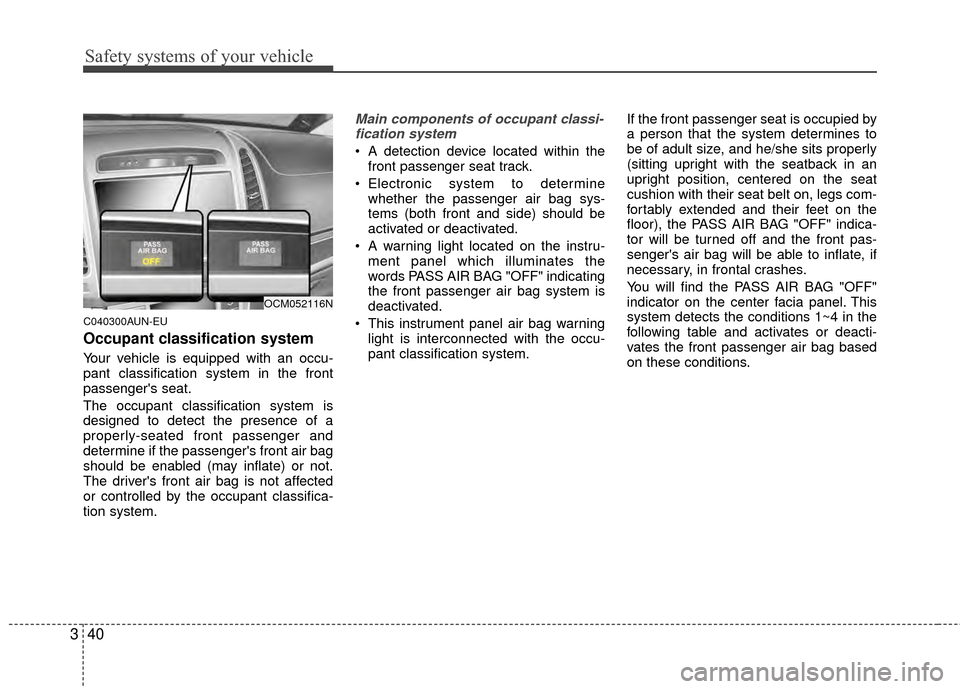
A warning light located on the instru- ment panel which illuminates the
words PASS AIR BAG "OFF" indicating
the front passenger air bag system is
deactivated.
This instrument panel air bag warning light is interconnected with the occu-
pant classification system. If the front passenger seat is occupied by
a person that the system determines to
be of adult size, and he/she sits properly
(sitting upright with the seatback in an
upright position, centered on the seat
cushion with their seat belt on, legs com-
fortably extended and their feet on the
floor), the PASS AIR BAG "OFF" indica-
tor will be turned off and the front pas-
senger's air bag will be able to inflate, if
necessary, in frontal crashes.
You will find the PASS AIR BAG "OFF"
indicator on the center facia panel. This
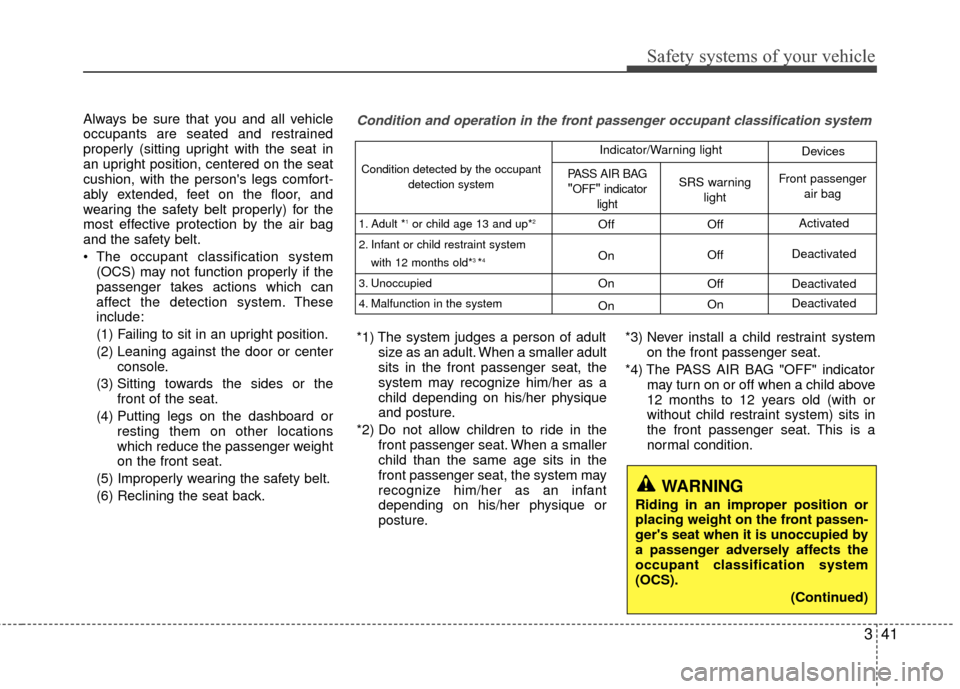
system detects the conditions 1~4 in the
following table and activates or deacti-
vates the front passenger air bag based
on these conditions.
OCM052116N
Page 58 of 419
341
Safety systems of your vehicle
Always be sure that you and all vehicle
occupants are seated and restrained
properly (sitting upright with the seat in
an upright position, centered on the seat
cushion, with the person's legs comfort-
ably extended, feet on the floor, and
wearing the safety belt properly) for the
most effective protection by the air bag
and the safety belt.
The occupant classification system(OCS) may not function properly if the
passenger takes actions which can
affect the detection system. These
include:
(1) Failing to sit in an upright position.
(2) Leaning against the door or center console.
(3) Sitting towards the sides or the front of the seat.
(4) Putting legs on the dashboard or resting them on other locations
which reduce the passenger weight
on the front seat.
(5) Improperly wearing the safety belt.
(6) Reclining the seat back.Condition and operation in the front passenger occupant classification system
*1) The system judges a person of adult size as an adult. When a smaller adult
sits in the front passenger seat, the
system may recognize him/her as a
child depending on his/her physique
and posture.
*2) Do not allow children to ride in the front passenger seat. When a smaller
child than the same age sits in the
front passenger seat, the system may
recognize him/her as an infant
depending on his/her physique or
posture. *3) Never install a child restraint system
on the front passenger seat.
*4) The PASS AIR BAG "OFF" indicator may turn on or off when a child above
12 months to 12 years old (with or
without child restraint system) sits in
the front passenger seat. This is a
normal condition.
Condition detected by the occupant
detection system
1. Adult *
1or child age 13 and up*2
2. Infant or child restraint system with 12 months old*3 *4
3. Unoccupied
4. Malfunction in the system
Off
On
On
On Off
Off
Off
On Activated
Deactivated
Deactivated
Deactivated
PASS AIR BAG"OFF"indicator
lightSRS warning lightFront passenger air bag
Indicator/Warning light Devices
WARNING
Riding in an improper position or
placing weight on the front passen-
ger's seat when it is unoccupied by
a passenger adversely affects the
occupant classification system
(OCS).
(Continued)
Page 60 of 419
343
Safety systems of your vehicle
When an adult is seated in the front pas-
senger seat, if the PASS AIR BAG "OFF"
indicator is on, turn the ignition switch to
the LOCK position and ask the passen-
ger to sit properly (sitting upright with the
seat back in an upright position, centered
on the seat cushion with their seat belt
on, legs comfortably extended and their
feet on the floor). Restart the engine and
have the person remain in that position.
This will allow the system to detect the
person and to enable the passenger air
bag.If the PASS AIR BAG "OFF" indicator is
still on, ask the passenger to move to the
rear seat.
✽ ✽
NOTICE
The PASS AIR BAG "OFF" indicator
illuminates for about 4 seconds after the
ignition switch is turned to the ON posi-
tion or after the engine is started. If the
front passenger seat is occupied, the
occupant classification sensor will then
classify the front passenger after several
more seconds.
B990A01O
WARNING
Do not allow an adult passenger to
ride in the front seat when the PASS
AIR BAG "OFF" indicator is illumi-
nated because the air bag will not
deploy in the event of a crash. If the
PASS AIR BAG "OFF" indicator
remains illuminated after the adult
passenger repositions themselves
properly and the car is restarted, it
is recommended that passenger
move to the rear seat because the
passenger's front air bag will not
deploy.
Front seat passengers must stay
properly seated to avoid serious
injury from a deploying air bag.
WARNING
Do not put a heavy load in the front
passenger seatback pocket or on
the front passenger seat. Do not
hang onto the front passenger
seatback. Do not hang any items,
such as a seatback table, on the
front passenger seatback. Do not
place feet on the front passenger
seatback. Do not place any items
under the front passenger seat.
Any of these could interfere with
proper sensor operation.
Page 62 of 419
345
Safety systems of your vehicle
C040400AFD
Driver's and passenger's front air
bag (if equipped)
Your vehicle is equipped with an
Advanced Supplemental Restraint (Air
Bag) System and lap/shoulder belts at
both the driver and passenger seating
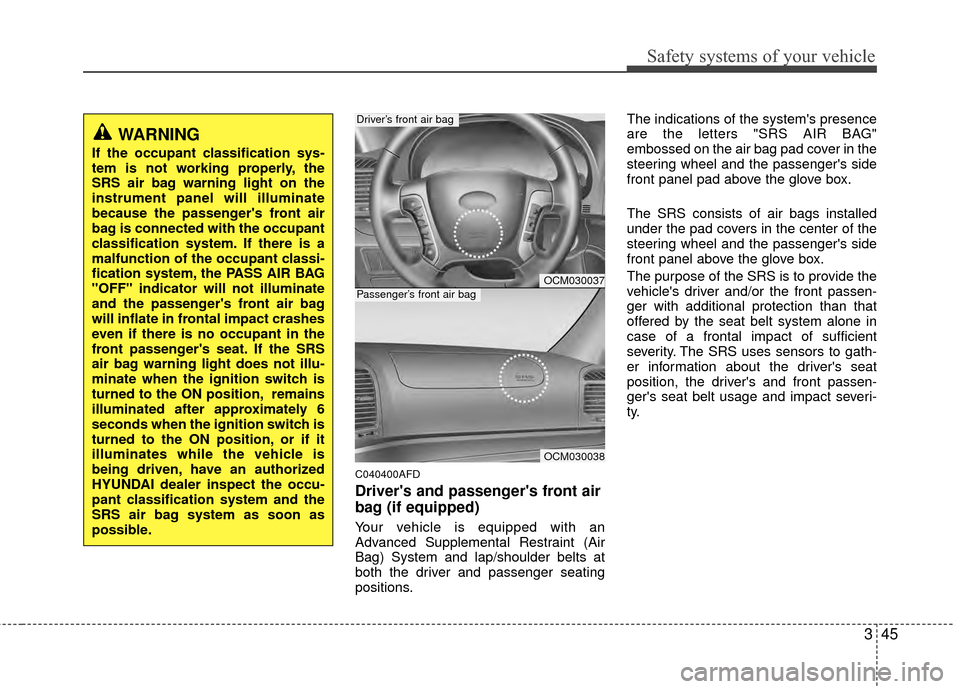
positions.The indications of the system's presence
are the letters "SRS AIR BAG"
embossed on the air bag pad cover in the
steering wheel and the passenger's side
front panel pad above the glove box.
The SRS consists of air bags installed
under the pad covers in the center of the
steering wheel and the passenger's side
front panel above the glove box.
The purpose of the SRS is to provide the
vehicle's driver and/or the front passen-
ger with additional protection than that
offered by the seat belt system alone in
case of a frontal impact of sufficient
severity. The SRS uses sensors to gath-
er information about the driver's seat
position, the driver's and front passen-
ger's seat belt usage and impact severi-
ty.
WARNING
If the occupant classification sys-
tem is not working properly, the
SRS air bag warning light on the
instrument panel will illuminate
because the passenger's front air
bag is connected with the occupant
classification system. If there is a
malfunction of the occupant classi-
fication system, the PASS AIR BAG
"OFF" indicator will not illuminate
and the passenger's front air bag
will inflate in frontal impact crashes
even if there is no occupant in the
front passenger's seat. If the SRS
air bag warning light does not illu-
minate when the ignition switch is
turned to the ON position, remains
illuminated after approximately 6
seconds when the ignition switch is
turned to the ON position, or if it
illuminates while the vehicle is
being driven, have an authorized
HYUNDAI dealer inspect the occu-
pant classification system and the
SRS air bag system as soon as
possible.
OCM030037
OCM030038
Driver’s front air bag
Passenger’s front air bag
Page 64 of 419
347
Safety systems of your vehicle
✽
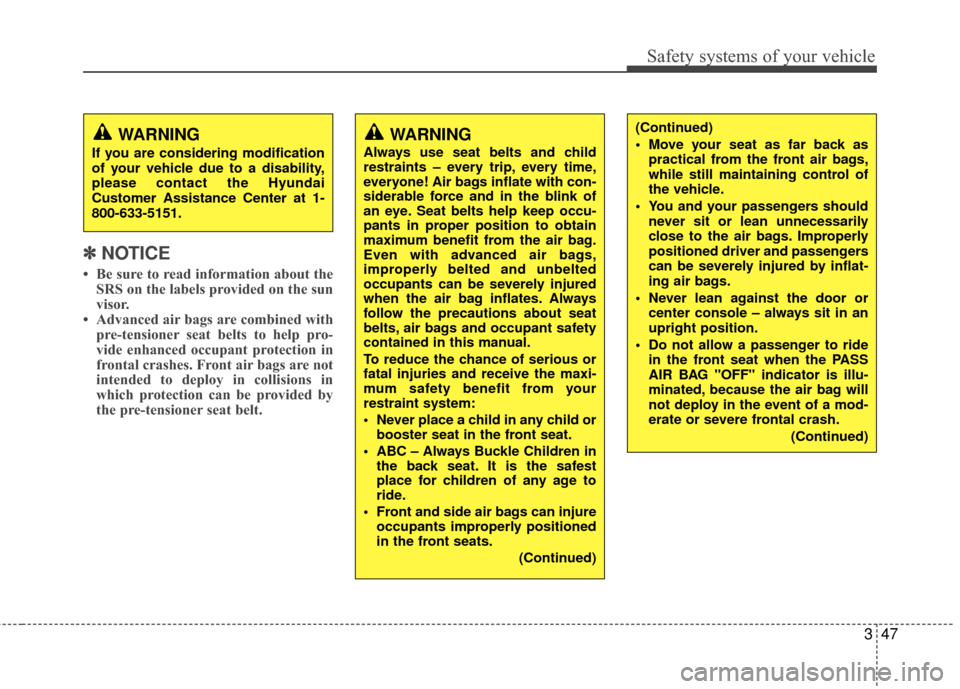
✽NOTICE
• Be sure to read information about the
SRS on the labels provided on the sun
visor.
• Advanced air bags are combined with pre-tensioner seat belts to help pro-
vide enhanced occupant protection in
frontal crashes. Front air bags are not
intended to deploy in collisions in
which protection can be provided by
the pre-tensioner seat belt.
WARNING
If you are considering modification
of your vehicle due to a disability,
please contact the Hyundai
Customer Assistance Center at 1-
800-633-5151.
(Continued)
Move your seat as far back as
practical from the front air bags,
while still maintaining control of
the vehicle.
You and your passengers should never sit or lean unnecessarily
close to the air bags. Improperly
positioned driver and passengers
can be severely injured by inflat-
ing air bags.
Never lean against the door or center console – always sit in an
upright position.
Do not allow a passenger to ride in the front seat when the PASS
AIR BAG "OFF" indicator is illu-
minated, because the air bag will
not deploy in the event of a mod-
erate or severe frontal crash.
(Continued)WARNING
Always use seat belts and child
restraints – every trip, every time,
everyone! Air bags inflate with con-
siderable force and in the blink of
an eye. Seat belts help keep occu-
pants in proper position to obtain
maximum benefit from the air bag.
Even with advanced air bags,
improperly belted and unbelted
occupants can be severely injured
when the air bag inflates. Always
follow the precautions about seat
belts, air bags and occupant safety
contained in this manual.
To reduce the chance of serious or
fatal injuries and receive the maxi-
mum safety benefit from your
restraint system:
Never place a child in any child orbooster seat in the front seat.
ABC – Always Buckle Children in the back seat. It is the safest
place for children of any age to
ride.
Front and side air bags can injure occupants improperly positioned
in the front seats.
(Continued)
Page 77 of 419
Safety systems of your vehicle
60
3
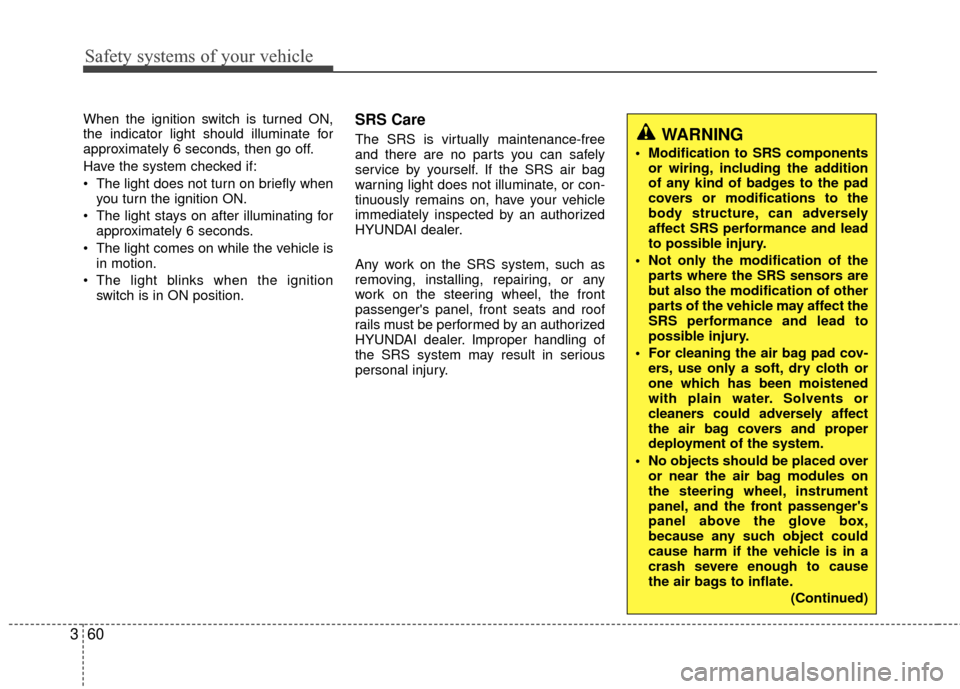
When the ignition switch is turned ON,
the indicator light should illuminate for
approximately 6 seconds, then go off.
Have the system checked if:
The light does not turn on briefly when
you turn the ignition ON.
The light stays on after illuminating for approximately 6 seconds.
The light comes on while the vehicle is in motion.
The light blinks when the ignition switch is in ON position.SRS Care
The SRS is virtually maintenance-free
and there are no parts you can safely
service by yourself. If the SRS air bag
warning light does not illuminate, or con-
tinuously remains on, have your vehicle
immediately inspected by an authorized
HYUNDAI dealer.
Any work on the SRS system, such as
removing, installing, repairing, or any
work on the steering wheel, the front
passenger's panel, front seats and roof
rails must be performed by an authorized
HYUNDAI dealer. Improper handling of
the SRS system may result in serious
personal injury.WARNING
Modification to SRS componentsor wiring, including the addition
of any kind of badges to the pad
covers or modifications to the
body structure, can adversely
affect SRS performance and lead
to possible injury.
Not only the modification of the parts where the SRS sensors are
but also the modification of other
parts of the vehicle may affect the
SRS performance and lead to
possible injury.
For cleaning the air bag pad cov- ers, use only a soft, dry cloth or
one which has been moistened
with plain water. Solvents or
cleaners could adversely affect
the air bag covers and proper
deployment of the system.
No objects should be placed over or near the air bag modules on
the steering wheel, instrument
panel, and the front passenger's
panel above the glove box,
because any such object could
cause harm if the vehicle is in a
crash severe enough to cause
the air bags to inflate.
(Continued)