park Hyundai Santa Fe 2013 Owner's Manual
[x] Cancel search | Manufacturer: HYUNDAI, Model Year: 2013, Model line: Santa Fe, Model: Hyundai Santa Fe 2013Pages: 711, PDF Size: 14.72 MB
Page 8 of 711
13
Introduction
Gasoline engine
Unleaded
For Europe
For the optimal vehicle performance,
we recommend you to use unleaded
gasoline which complies with EN 228
and has an octane rating of RON
(Research Octane Number) 95 / AKI
(Anti Knock Index) 91 or higher. You
may use unleaded gasoline with an
octane rating of RON 91-94 / AKI 87-
90 but it may result in slight perform-
ance reduction of the vehicle.
Except Europe
Your new vehicle is designed to use
only unleaded fuel having an Octane
Rating of RON (Research Octane
Number) 91 / AKI (Anti-Knock Index)
87 or higher.
Your new vehicle is designed to
obtain maximum performance with
UNLEADED FUEL, as well as mini-
mize exhaust emissions and spark
plug fouling.
Leaded (if equipped)
For some countries, your vehicle is
designed to use leaded gasoline.
When you are going to use leaded
gasoline, we recommend that you
ask an authorized HYUNDAI dealer
whether leaded gasoline in your
vehicle is available or not.
Octane Rating of leaded gasoline is
same with unleaded one.
FUEL REQUIREMENTS
CAUTION
NEVER USE LEADED FUEL. The
use of leaded fuel is detrimental
to the catalytic converter and
will damage the engine control
system’s oxygen sensor and
affect emission control.
Never add any fuel system
cleaning agents to the fuel tank
other than what has been speci-
fied (We recommend that you
consult an authorized HYUNDAI
dealer for details.)
WARNING
• Do not "top off" after the noz-
zle automatically shuts off
when refueling.
• Always check that the fuel cap
is installed securely to pre-
vent fuel spillage in the event
of an accident.
Page 15 of 711
23
Your vehicle at a glance
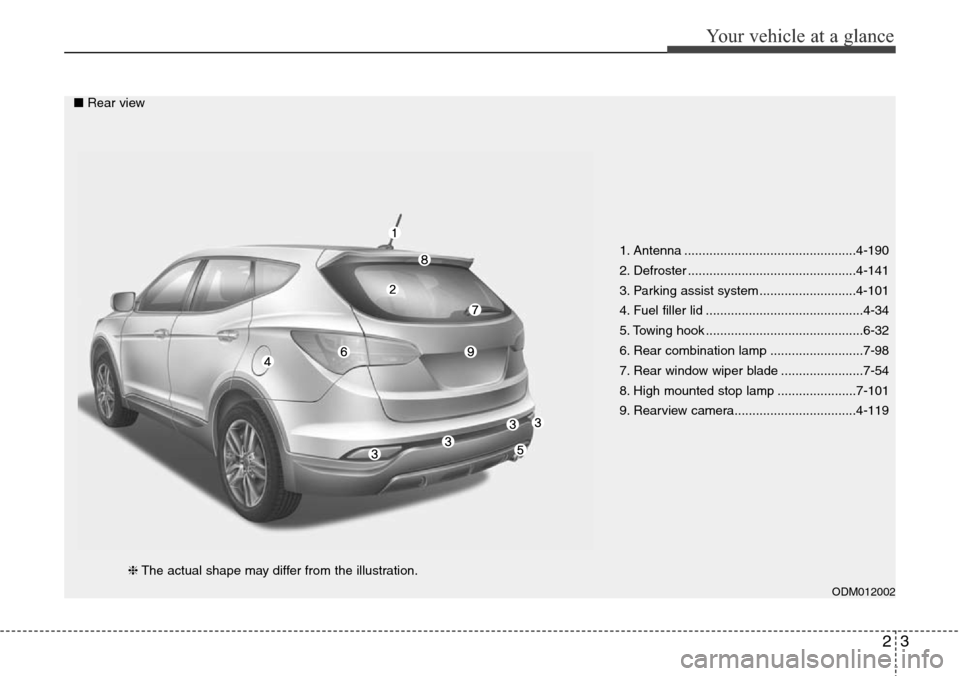
1. Antenna ................................................4-190
2. Defroster ...............................................4-141
3. Parking assist system ...........................4-101
4. Fuel filler lid ............................................4-34
5. Towing hook ............................................6-32
6. Rear combination lamp ..........................7-98
7. Rear window wiper blade .......................7-54
8. High mounted stop lamp ......................7-101
9. Rearview camera..................................4-119
ODM012002
■Rear view
❈The actual shape may differ from the illustration.
Page 18 of 711
Your vehicle at a glance
6 2
INTERIOR OVERVIEW (II)
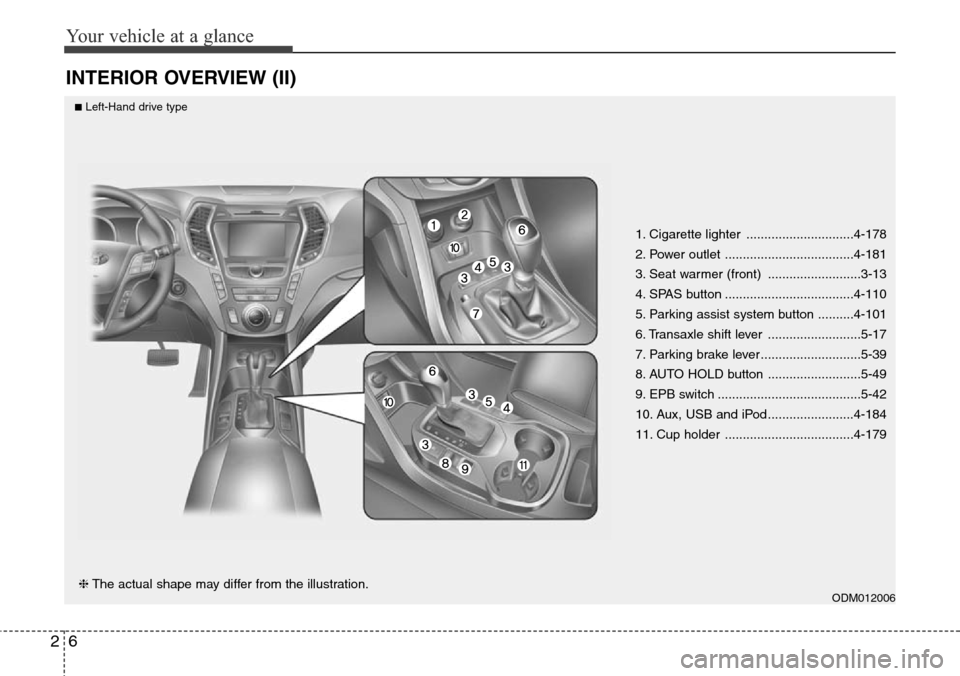
1. Cigarette lighter ..............................4-178
2. Power outlet ....................................4-181
3. Seat warmer (front) ..........................3-13
4. SPAS button ....................................4-110
5. Parking assist system button ..........4-101
6. Transaxle shift lever ..........................5-17
7. Parking brake lever ............................5-39
8. AUTO HOLD button ..........................5-49
9. EPB switch ........................................5-42
10. Aux, USB and iPod ........................4-184
11. Cup holder ....................................4-179
ODM012006❈The actual shape may differ from the illustration.
■Left-Hand drive type
Page 19 of 711
27
Your vehicle at a glance
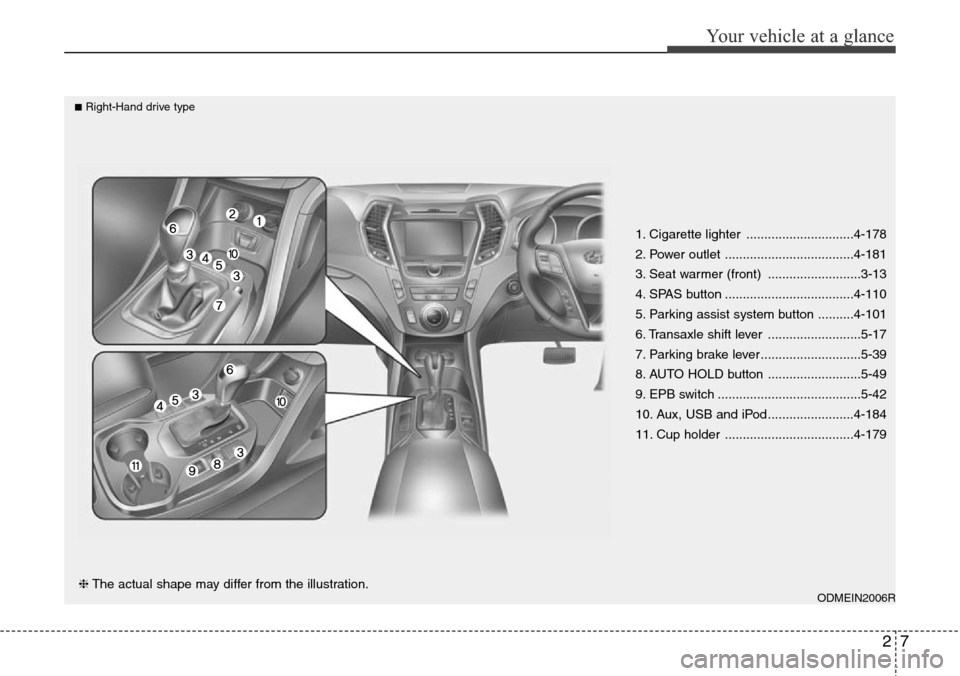
1. Cigarette lighter ..............................4-178
2. Power outlet ....................................4-181
3. Seat warmer (front) ..........................3-13
4. SPAS button ....................................4-110
5. Parking assist system button ..........4-101
6. Transaxle shift lever ..........................5-17
7. Parking brake lever ............................5-39
8. AUTO HOLD button ..........................5-49
9. EPB switch ........................................5-42
10. Aux, USB and iPod ........................4-184
11. Cup holder ....................................4-179
ODMEIN2006R❈The actual shape may differ from the illustration.
■Right-Hand drive type
Page 47 of 711

Safety features of your vehicle
22 3
Headrest (for rear seat)
The rear seat(s) is equipped with
headrests in all the seating positions
for the occupant's safety and com-
for t.
The headrest not only provides com-
fort for passengers, but also helps
protect the head and neck in the
event of a collision.
WARNING- Cargo
Cargo should always be
secured to prevent it from being
thrown about the vehicle in a
collision and causing injury to
the vehicle occupants. Do not
place objects in the rear (2nd
and/or 3rd row) seats, since they
cannot be properly secured and
may hit the front seat occupants
in a collision.
WARNING - Cargo loading
Make sure the engine is off, the
automatic transaxle is in P (Park)
or the manual transaxle is in R
(Reverse) or 1st, and the parking
brake is securely applied when-
ever loading or unloading cargo.
Failure to take these steps may
allow the vehicle to move if the
shift lever is inadvertently
moved to another position.
OHM038049N
*
*
* if equipped
WARNING
• For maximum effectiveness in
case of an accident, the head-
rest should be adjusted so the
middle of the headrest is at
the same height as the center
of gravity of an occupant's
head. Generally, the center of
gravity of most people's head
is similar with the height of
the top of their eyes. Also
adjust the headrest as close
to your head as possible. For
this reason, the use of a cush-
ion that holds the body away
from the seatback is not rec-
ommended.
(Continued)
Page 65 of 711

Safety features of your vehicle
40 3
WARNING
To reduce a risk of serious or
fatal injuries:
• Children of all ages are safer
when restrained in the rear
seat. A child riding in the
front passenger seat can be
forcefully struck by an inflat-
ing air bag resulting in seri-
ous or fatal injuries.
• Always follow the instructions
for installation and use of the
child restraint maker.
• Always make sure the child
seat is secured properly in the
car and your child is securely
restrained in the child seat.
• Never hold a child in your
arms or lap when riding in a
vehicle. The violent forces cre-
ated during a crash will tear
the child from your arms and
throw the child against the
car’s interior.
(Continued)
(Continued)
• Never put a seat belt over
yourself and a child. During a
crash, the belt could press
deep into the child causing
serious internal injuries.
• Never leave children unat-
tended in a vehicle – not even
for a short time. The car can
heat up very quickly, resulting
in serious injuries to children
inside. Even very young chil-
dren may inadvertently cause
the vehicle to move, entangle
themselves in the windows, or
lock themselves or others
inside the vehicle.
• Never allow two children, or
any two persons, to use the
same seat belt.
• Children often squirm and
reposition themselves improp-
erly. Never let a child ride with
the shoulder belt under their
arm or behind their back.
Always properly position and
secure children in the rear
seat.
(Continued)(Continued)
• Never allow a child to stand-
up or kneel on the seat or
floorboard of a moving vehi-
cle. During a collision or sud-
den stop, the child can be vio-
lently thrown against the vehi-
cles interior, resulting in seri-
ous injury.
• Never use an infant carrier or
a child safety seat that
"hooks" over a seatback, it
may not provide adequate
security in an accident.
• Seat belts can become very
hot, especially when the car is
parked in direct sunlight.
Always check seat belt buck-
les before fastening them
over a child.
• After an accident, we recom-
mend that the system be
checked by an authorized
HYUNDAI dealer.
(Continued)
Page 86 of 711

361
Safety features of your vehicle
Passenger’s front air bag ON/OFF
switch (if equipped)
The passenger’s front air bag can be
deactivated by the passenger’s front
air bag ON/OFF switch if a child
restraint is installed on the front pas-
senger's seat or if the front passen-
ger's seat is unoccupied by a person.
To ensure the safety of your child,
the passenger’s front air bag must be
deactivated when it should be neces-
sary to install a rearward facing child
seat on the front passenger seat in
exceptional circumstances.
(Continued)
• Sitting improperly or out of
position can result in serious
or fatal injury in a crash. All
occupants should sit upright
with the seat back in an
upright position, centered on
the seat cushion with their
seat belt on, legs comfortably
extended and their feet on the
floor until the vehicle is
parked and the ignition key is
removed.
• The SRS air bag system must
deploy very rapidly to provide
protection in a crash. If an
occupant is out of position
because of not wearing a seat
belt, the air bag may forcefully
contact the occupant causing
serious or fatal injuries.
ODMESA2008
(Continued)
• Children age 12 and under
must always be properly
restrained in the rear seat.
Never allow children to ride in
the front passenger seat. If a
child over 12 must be seated
in the front seat, he or she
must be properly belted and
the seat should be moved as
far back as possible.
• For maximum safety protec-
tion in all types of crashes, all
occupants including the driv-
er should always wear their
seat belts whether or not an
air bag is also provided at
their seating position to mini-
mize the risk of severe injury
or death in the event of a
crash. Do not sit or lean
unnecessarily close to the air
bag while the vehicle is in
motion.
(Continued)
Page 103 of 711
Mirrors . . . . . . . . . . . . . . . . . . . . . . . . . . . . . . . . . . 4-48
• Inside rearview mirror . . . . . . . . . . . . . . . . . . . . . . . . 4-48
• Outside rearview mirror . . . . . . . . . . . . . . . . . . . . . . . 4-52
Instrument cluster . . . . . . . . . . . . . . . . . . . . . . . . . 4-56
• Instrument Cluster Control . . . . . . . . . . . . . . . . . . . . 4-58
• LCD Display Control . . . . . . . . . . . . . . . . . . . . . . . . . 4-59
• Gauges . . . . . . . . . . . . . . . . . . . . . . . . . . . . . . . . . . . . . 4-59
• Transaxle Shift Indicator . . . . . . . . . . . . . . . . . . . . . . 4-64
LCD display . . . . . . . . . . . . . . . . . . . . . . . . . . . . . . 4-66
• LCD Modes . . . . . . . . . . . . . . . . . . . . . . . . . . . . . . . . . 4-66
• Service Mode . . . . . . . . . . . . . . . . . . . . . . . . . . . . . . . . 4-67
• User Settings Mode . . . . . . . . . . . . . . . . . . . . . . . . . . . 4-68
• A/V Mode . . . . . . . . . . . . . . . . . . . . . . . . . . . . . . . . . . . 4-71
• Turn By Turn Mode. . . . . . . . . . . . . . . . . . . . . . . . . . . 4-71
• Warning Messages . . . . . . . . . . . . . . . . . . . . . . . . . . . . 4-72
Trip computer . . . . . . . . . . . . . . . . . . . . . . . . . . . . . 4-79
• Overview. . . . . . . . . . . . . . . . . . . . . . . . . . . . . . . . . . . . 4-79
• Trip A/B . . . . . . . . . . . . . . . . . . . . . . . . . . . . . . . . . . . . 4-80
• Fuel Economy . . . . . . . . . . . . . . . . . . . . . . . . . . . . . . . 4-81
Warning and indicator lights . . . . . . . . . . . . . . . . 4-83
• Warning lights . . . . . . . . . . . . . . . . . . . . . . . . . . . . . . . 4-83
• Indicator Lights . . . . . . . . . . . . . . . . . . . . . . . . . . . . . . 4-93
Rear parking assist system . . . . . . . . . . . . . . . . . . 4-98
• Operation . . . . . . . . . . . . . . . . . . . . . . . . . . . . . . . . . . . 4-98
• Non-operational conditions . . . . . . . . . . . . . . . . . . . . 4-99• Self-diagnosis . . . . . . . . . . . . . . . . . . . . . . . . . . . . . . . 4-100
Parking assist system . . . . . . . . . . . . . . . . . . . . . . 4-101
• Operation . . . . . . . . . . . . . . . . . . . . . . . . . . . . . . . . . . 4-101
• Non-operational conditions . . . . . . . . . . . . . . . . . . . 4-103
• Self-diagnosis . . . . . . . . . . . . . . . . . . . . . . . . . . . . . . . 4-105
Smart parking assist system(SPAS) . . . . . . . . . . 4-106
• Operation . . . . . . . . . . . . . . . . . . . . . . . . . . . . . . . . . . 4-107
• Non-operational conditions . . . . . . . . . . . . . . . . . . . 4-107
• How the system works . . . . . . . . . . . . . . . . . . . . . . . 4-110
• Additional instructions . . . . . . . . . . . . . . . . . . . . . . . 4-117
• System malfunction . . . . . . . . . . . . . . . . . . . . . . . . . . 4-118
Rearview camera . . . . . . . . . . . . . . . . . . . . . . . . . 4-119
Hazard warning flasher . . . . . . . . . . . . . . . . . . . . 4-120
Lighting . . . . . . . . . . . . . . . . . . . . . . . . . . . . . . . . . 4-121
• Battery saver function. . . . . . . . . . . . . . . . . . . . . . . . 4-121
• Headlamp escort function. . . . . . . . . . . . . . . . . . . . . 4-121
• Smart cornering light . . . . . . . . . . . . . . . . . . . . . . . . 4-121
• Lighting control . . . . . . . . . . . . . . . . . . . . . . . . . . . . . 4-122
• Traffic change . . . . . . . . . . . . . . . . . . . . . . . . . . . . . . 4-124
• High - beam operation . . . . . . . . . . . . . . . . . . . . . . . 4-125
• Turn signals and lane change signals . . . . . . . . . . . 4-126
• Front fog light . . . . . . . . . . . . . . . . . . . . . . . . . . . . . . 4-127
• Rear fog light . . . . . . . . . . . . . . . . . . . . . . . . . . . . . . . 4-128
• Daytime running light . . . . . . . . . . . . . . . . . . . . . . . . 4-128
• Headlight leveling device . . . . . . . . . . . . . . . . . . . . . 4-129
4
Page 117 of 711
Features of your vehicle
16 4
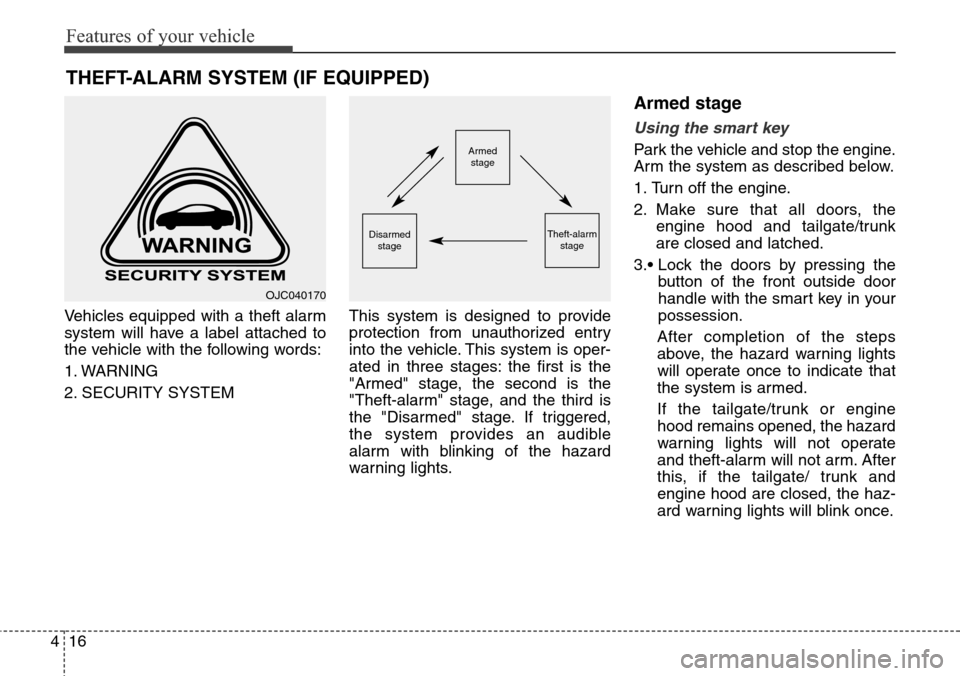
Vehicles equipped with a theft alarm
system will have a label attached to
the vehicle with the following words:
1. WARNING
2. SECURITY SYSTEMThis system is designed to provide
protection from unauthorized entry
into the vehicle. This system is oper-
ated in three stages: the first is the
"Armed" stage, the second is the
"Theft-alarm" stage, and the third is
the "Disarmed" stage. If triggered,
the system provides an audible
alarm with blinking of the hazard
warning lights.
Armed stage
Using the smart key
Park the vehicle and stop the engine.
Arm the system as described below.
1. Turn off the engine.
2. Make sure that all doors, the
engine hood and tailgate/trunk
are closed and latched.
3.• Lock the doors by pressing the
button of the front outside door
handle with the smart key in your
possession.
After completion of the steps
above, the hazard warning lights
will operate once to indicate that
the system is armed.
If the tailgate/trunk or engine
hood remains opened, the hazard
warning lights will not operate
and theft-alarm will not arm. After
this, if the tailgate/ trunk and
engine hood are closed, the haz-
ard warning lights will blink once.
THEFT-ALARM SYSTEM (IF EQUIPPED)
Armed
stage
Theft-alarm
stageDisarmed
stage
OJC040170
Page 118 of 711
417
Features of your vehicle
• Lock the doors by pressing the
lock button on the smart key.
After completion of the steps
above, the hazard warning lights
will operate once to indicate that
the system is armed.
If any door, tailgate/trunk or engine
hood remains open, the hazard
warning lights won't operate and
theft-alarm will not arm. After this,
if all doors, tailgate/trunk and
engine hood are closed, the haz-
ard warning lights will blink once.Using the transmitter
Park the vehicle and stop the engine.
Arm the system as described below.
1.Turn off the engine and remove the
ignition key from the ignition switch.
2.Make sure that all doors, the
engine hood and tailgate/trunk are
closed and latched.
3.Lock the doors by pressing the lock
button on the transmitter.
After completion of the steps
above, the hazard warning lights
will blink once to indicate that the
system is armed.
If any door, tailgate/trunk or engine
hood remains opened, the hazard
warning lights will not operate and
theft-alarm will not arm. After this, if
all doors, tailgate/trunk and engine
hood are closed, the hazard warn-
ing lights will blink once.• Do not arm the system until all
passengers have left the vehi-
cle. If the system is armed while
a passenger(s) remains in the
vehicle, the alarm may be acti-
vated when the remaining pas-
senger(s) leave the vehicle. If
any door, tailgate/trunk lid or
engine hood is opened within 30
seconds after entering the
armed stage, the system is dis-
armed to prevent unnecessary
alarm.