start engine Hyundai Santa Fe 2014 Owner's Manual
[x] Cancel search | Manufacturer: HYUNDAI, Model Year: 2014, Model line: Santa Fe, Model: Hyundai Santa Fe 2014Pages: 711, PDF Size: 14.72 MB
Page 623 of 711
Maintenance
38 7
ENGINE OIL
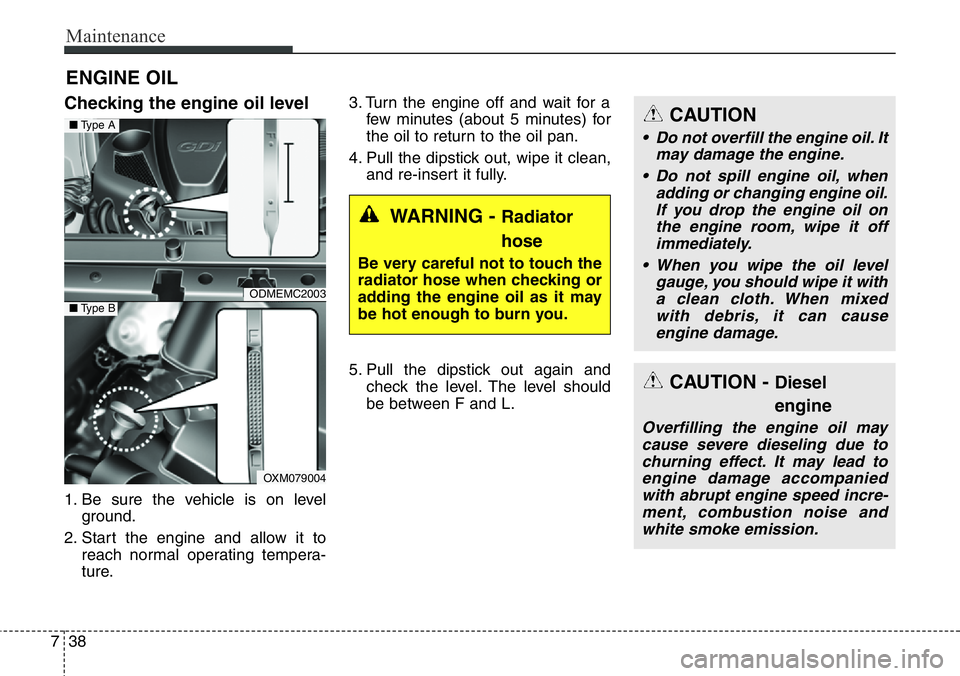
Checking the engine oil level
1. Be sure the vehicle is on level
ground.
2. Start the engine and allow it to
reach normal operating tempera-
ture.3. Turn the engine off and wait for a
few minutes (about 5 minutes) for
the oil to return to the oil pan.
4. Pull the dipstick out, wipe it clean,
and re-insert it fully.
5. Pull the dipstick out again and
check the level. The level should
be between F and L.
WARNING - Radiator
hose
Be very careful not to touch the
radiator hose when checking or
adding the engine oil as it may
be hot enough to burn you.
CAUTION - Diesel
engine
Overfilling the engine oil may
cause severe dieseling due to
churning effect. It may lead to
engine damage accompanied
with abrupt engine speed incre-
ment, combustion noise and
white smoke emission.
CAUTION
• Do not overfill the engine oil. It
may damage the engine.
• Do not spill engine oil, when
adding or changing engine oil.
If you drop the engine oil on
the engine room, wipe it off
immediately.
• When you wipe the oil level
gauge, you should wipe it with
a clean cloth. When mixed
with debris, it can cause
engine damage.
ODMEMC2003
OXM079004
■Type A
■Type B
Page 629 of 711
Maintenance
44 7
POWER STEERING FLUID (IF EQUIPPED)
Checking the power steering
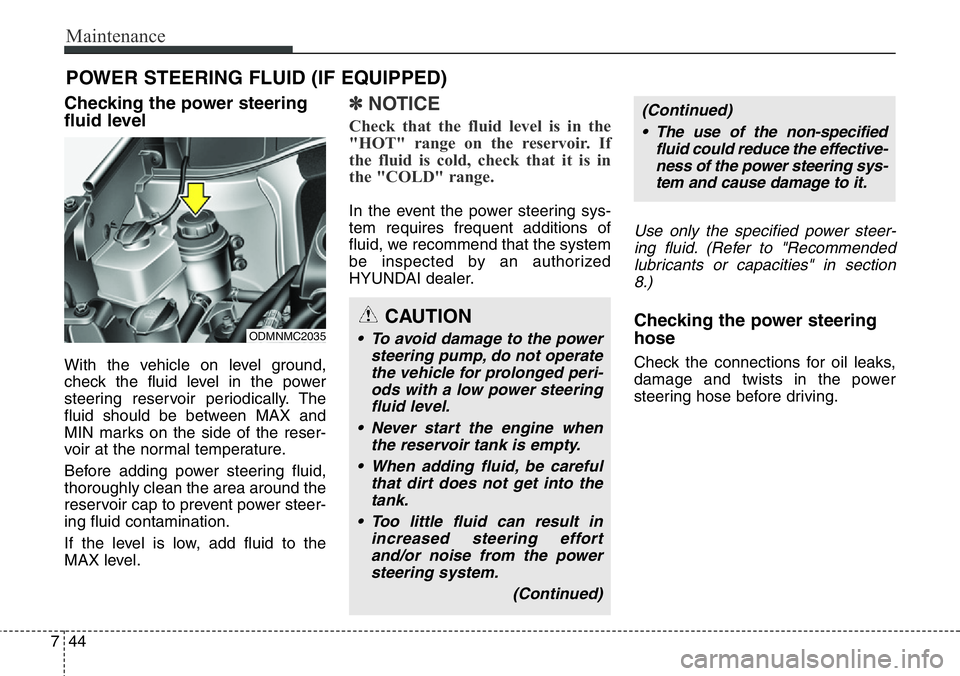
fluid level
With the vehicle on level ground,
check the fluid level in the power
steering reservoir periodically. The
fluid should be between MAX and
MIN marks on the side of the reser-
voir at the normal temperature.
Before adding power steering fluid,
thoroughly clean the area around the
reservoir cap to prevent power steer-
ing fluid contamination.
If the level is low, add fluid to the
MAX level.
✽NOTICE
Check that the fluid level is in the
"HOT" range on the reservoir. If
the fluid is cold, check that it is in
the "COLD" range.
In the event the power steering sys-
tem requires frequent additions of
fluid, we recommend that the system
be inspected by an authorized
HYUNDAI dealer.
Use only the specified power steer-
ing fluid. (Refer to "Recommended
lubricants or capacities" in section
8.)
Checking the power steering
hose
Check the connections for oil leaks,
damage and twists in the power
steering hose before driving.
CAUTION
• To avoid damage to the power
steering pump, do not operate
the vehicle for prolonged peri-
ods with a low power steering
fluid level.
• Never start the engine when
the reservoir tank is empty.
• When adding fluid, be careful
that dirt does not get into the
tank.
• Too little fluid can result in
increased steering effort
and/or noise from the power
steering system.
(Continued)ODMNMC2035
(Continued)
• The use of the non-specified
fluid could reduce the effective-
ness of the power steering sys-
tem and cause damage to it.
Page 697 of 711
Maintenance
112 7
3. Exhaust emission control
system
The Exhaust Emission Control
System is a highly effective system
which controls exhaust emissions
while maintaining good vehicle per-
formance.
Vehicle modifications
This vehicle should not be modified.
Modification of your vehicle could
affect its performance, safety or
durability and may even violate gov-
ernmental safety and emissions reg-
ulations.
In addition, damage or performance
problems resulting from any modifi-
cation may not be covered under
warranty.
• If you use unauthorized electronic
devices, it may cause the vehicle to
operate abnormally, wire damage,
battery discharge and fire. For your
safety, do not use unauthorized
electronic devices.
Engine exhaust gas precautions
(carbon monoxide)
• Carbon monoxide can be present
with other exhaust fumes.
Therefore, if you smell exhaust
fumes of any kind inside your vehi-
cle, have it inspected and repaired
immediately. If you ever suspect
exhaust fumes are coming into
your vehicle, drive it only with all
the windows fully open. Have your
vehicle checked and repaired
immediately.• Do not operate the engine in con-
fined or closed areas (such as
garages) any more than what is
necessary to move the vehicle in or
out of the area.
• When the vehicle is stopped in an
open area for more than a short
time with the engine running,
adjust the ventilation system (as
needed) to draw outside air into the
vehicle.
• Never sit in a parked or stopped
vehicle for any extended time with
the engine running.
• When the engine stalls or fails to
start, excessive attempts to restart
the engine may cause damage to
the emission control system.
WARNING - Exhaust
Engine exhaust gases contain
carbon monoxide (CO). Though
colorless and odorless, it is
dangerous and could be lethal if
inhaled. Follow the instructions
following to avoid CO poison-
ing.
Page 707 of 711
Specifications & Consumer information
8 8
Recommended SAE viscosity
number
Engine oil viscosity (thickness) has
an effect on fuel economy and cold
weather operating (engine start and
engine oil flowability). Lower viscosi-
ty engine oils can provide better fuel
economy and cold weather perform-
ance, however, higher viscosity
engine oils are required for satisfac-
tory lubrication in hot weather. Using
oils of any viscosity other than those
recommended could result in engine
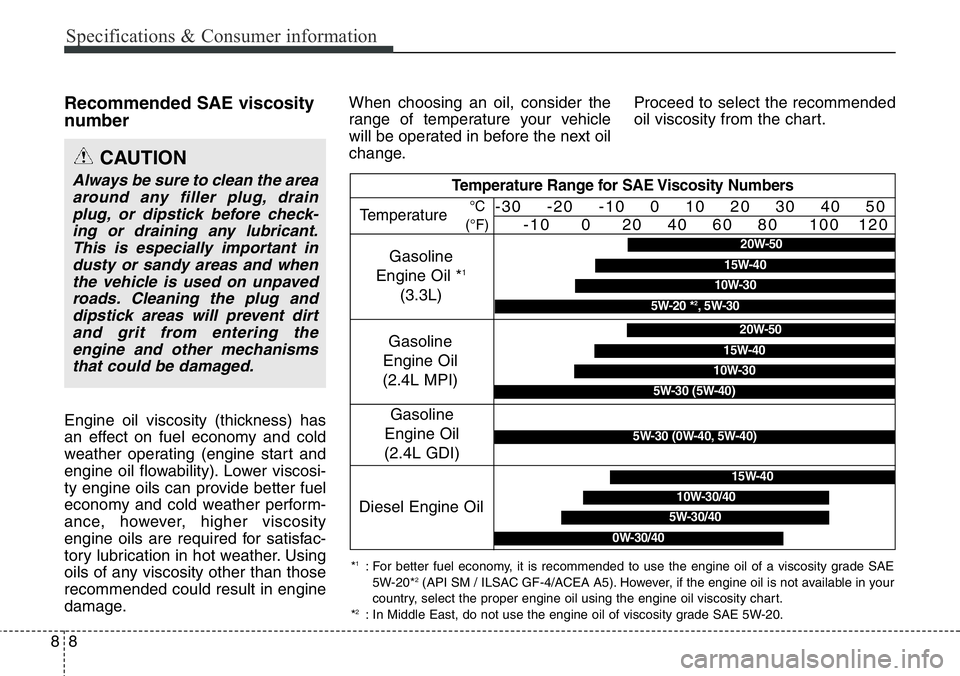
damage.When choosing an oil, consider the
range of temperature your vehicle
will be operated in before the next oil
change.Proceed to select the recommended
oil viscosity from the chart.
CAUTION
Always be sure to clean the area
around any filler plug, drain
plug, or dipstick before check-
ing or draining any lubricant.
This is especially important in
dusty or sandy areas and when
the vehicle is used on unpaved
roads. Cleaning the plug and
dipstick areas will prevent dirt
and grit from entering the
engine and other mechanisms
that could be damaged.
*1: For better fuel economy, it is recommended to use the engine oil of a viscosity grade SAE
5W-20*2(API SM / ILSAC GF-4/ACEA A5). However, if the engine oil is not available in your
country, select the proper engine oil using the engine oil viscosity chart.
*
2: In Middle East, do not use the engine oil of viscosity grade SAE 5W-20.
Temperature Range for SAE Viscosity Numbers
Temperature
Gasoline
Engine Oil *1
(3.3L)
°C
(°F)-30 -20 -10 0 10 20 30 40 50
-10 0 20 40 60 80 100 120
Diesel Engine Oil5W-30/40
15W-40
10W-30/40
0W-30/40
20W-50
10W-30
15W-40
5W-20 *2, 5W-30
Gasoline
Engine Oil
(2.4L MPI)20W-50
10W-30
15W-40
5W-30 (5W-40)
Gasoline
Engine Oil
(2.4L GDI)
5W-30 (0W-40, 5W-40)