Lower Hyundai Santa Fe 2017 User Guide
[x] Cancel search | Manufacturer: HYUNDAI, Model Year: 2017, Model line: Santa Fe, Model: Hyundai Santa Fe 2017Pages: 569, PDF Size: 16.88 MB
Page 58 of 569
337
Safety features of your vehicle
When the vehicle stops suddenly, or
if the occupant tries to lean forward
too quickly, the seat belt retractor will
lock into position. In certain frontal
collisions (or side collisions or
rollovers), the pre-tensioner will acti-
vate and pull the seat belt into tighter
contact against the occupant's body.
(1) Retractor PretensionerThe purpose of the retractor pre-tensioner is to make sure that the
shoulder belts fit in tightly against
the occupant's upper body in cer-
tain frontal collisions (or side colli-
sions or rollovers).
(2) EFD (Emergency Fastening Device)
The purpose of the EFD is to makesure that the pelvis belts fit in tight-
ly against the occupant's lower
body in certain frontal collisions (or
rollovers). (for passenger’s side)
If the system senses excessive ten-
sion on the driver or passenger's seat
belt when the pre-tensioner system
activates, the load limiter inside the
retractor pre-tensioner will release
some of the pressure on the affected
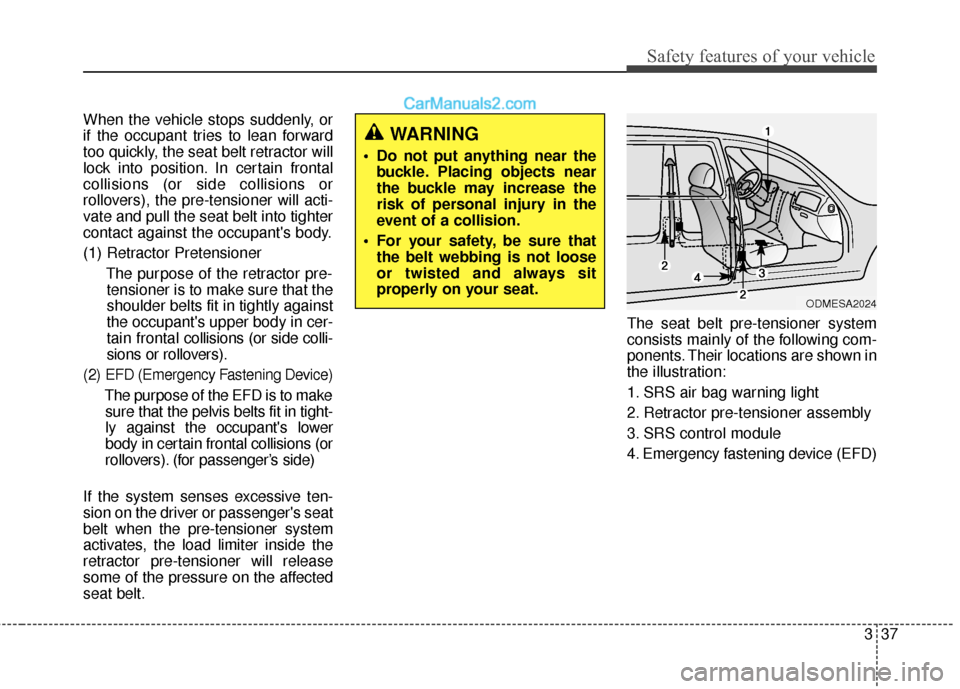
seat belt. The seat belt pre-tensioner system
consists mainly of the following com-
ponents. Their locations are shown in
the illustration:
1. SRS air bag warning light
2. Retractor pre-tensioner assembly
3. SRS control module
4. Emergency fastening device (EFD)
WARNING
Do not put anything near the
buckle. Placing objects near
the buckle may increase the
risk of personal injury in the
event of a collision.
For your safety, be sure that the belt webbing is not loose
or twisted and always sit
properly on your seat.
ODMESA2024
Page 66 of 569
345
Safety features of your vehicle
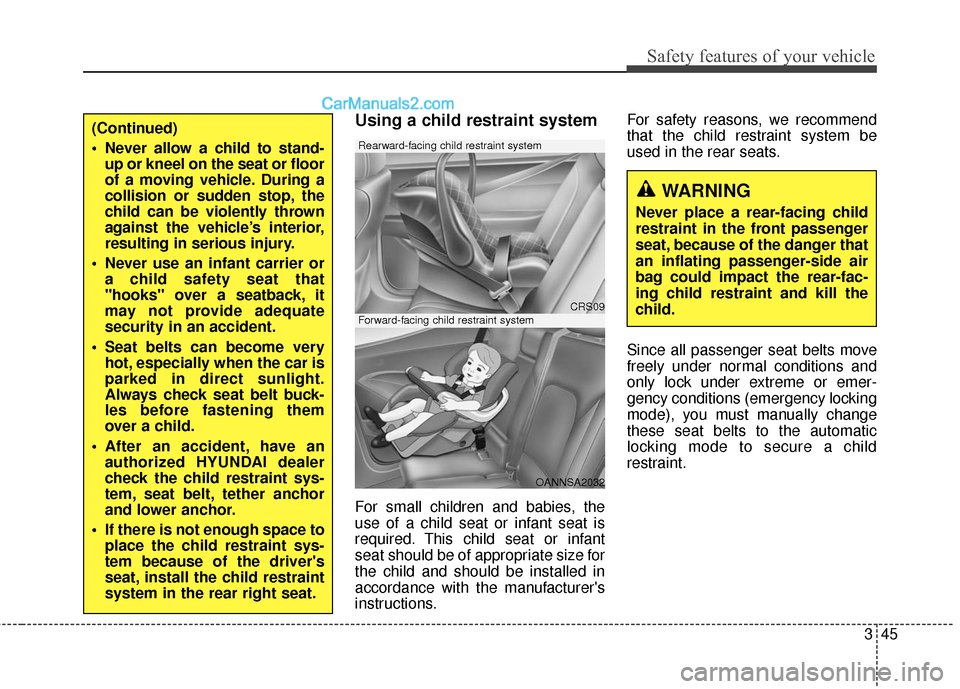
Using a child restraint system
For small children and babies, the
use of a child seat or infant seat is
required. This child seat or infant
seat should be of appropriate size for
the child and should be installed in
accordance with the manufacturer's
instructions.For safety reasons, we recommend
that the child restraint system be
used in the rear seats.
Since all passenger seat belts move
freely under normal conditions and
only lock under extreme or emer-
gency conditions (emergency locking
mode), you must manually change
these seat belts to the automatic
locking mode to secure a child
restraint.
WARNING
Never place a rear-facing child
restraint in the front passenger
seat, because of the danger that
an inflating passenger-side air
bag could impact the rear-fac-
ing child restraint and kill the
child.
CRS09
OANNSA2032
Forward-facing child restraint system
Rearward-facing child restraint system
(Continued)
Never allow a child to stand-
up or kneel on the seat or floor
of a moving vehicle. During a
collision or sudden stop, the
child can be violently thrown
against the vehicle’s interior,
resulting in serious injury.
Never use an infant carrier or a child safety seat that
"hooks" over a seatback, it
may not provide adequate
security in an accident.
Seat belts can become very hot, especially when the car is
parked in direct sunlight.
Always check seat belt buck-
les before fastening them
over a child.
After an accident, have an authorized HYUNDAI dealer
check the child restraint sys-
tem, seat belt, tether anchor
and lower anchor.
If there is not enough space to place the child restraint sys-
tem because of the driver's
seat, install the child restraint
system in the rear right seat.
Page 71 of 569
Safety features of your vehicle
50
3
WARNING - Tether strap
Never mount more than one
child restraint to a single tether
anchor or to a single lower
anchorage point. The increased
load caused by multiple seats
may cause the tethers or
anchorage points to break,
causing serious injury or death.
WARNING
A child can be seriously injured
or killed in a collision if the
child restraint is not properly
anchored to the car and the
child is not properly restrained
in the child restraint. Always fol-
low the child seat manufactur-
er’s instructions for installation
and use.
WARNING
When using the vehicle's "Tether Anchor" system to
install a child restraint system
in the rear seat, all unused
vehicle rear seat belt metal
latch plates or tabs must be
latched securely in their seat
belt buckles and the seat belt
webbing must be retracted
behind the child restraint to
prevent the child from reach-
ing and taking hold of unre-
tracted seat belts. Unlatched
metal latch plates or tabs may
allow the child to reach the
unretracted seat belts which
may result in strangulation
and a serious injury or death
to the child in the child
restraint.
Do not place anything around the lower anchors. Also make
sure that the seat belt is not
caught in the lower anchors.
WARNING - Child restraint
check
Check that the child restraint
system is secure by pushing
and pulling it in different direc-
tions. Incorrectly fitted child
restraints may swing, twist, tip
or separate causing death or
serious injury.
WARNING - Child restraint
anchorage
Child restraint anchorages are designed to withstand
only those loads imposed by
correctly fitted child
restraints. Under no circum-
stances are they to be used
for adult seat belts or har-
nesses or for attaching other
items or equipment to the
vehicle.
The tether strap may not work properly if attached some-
where other than the correct
tether anchor.
Page 72 of 569
351
Safety features of your vehicle
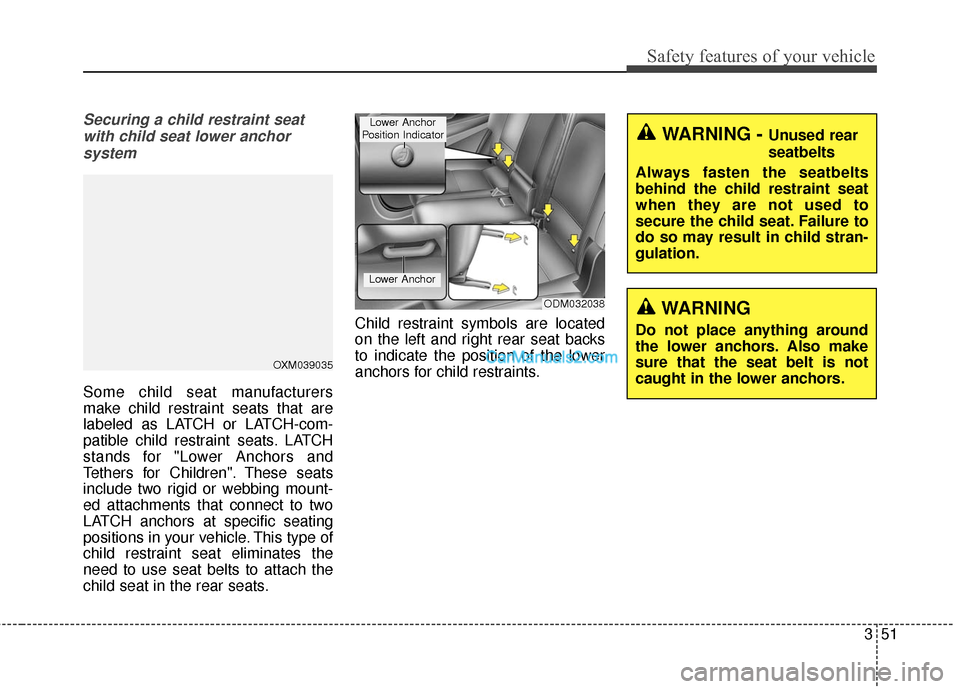
Securing a child restraint seatwith child seat lower anchor system
Some child seat manufacturers
make child restraint seats that are
labeled as LATCH or LATCH-com-
patible child restraint seats. LATCH
stands for "Lower Anchors and
Tethers for Children". These seats
include two rigid or webbing mount-
ed attachments that connect to two
LATCH anchors at specific seating
positions in your vehicle. This type of
child restraint seat eliminates the
need to use seat belts to attach the
child seat in the rear seats. Child restraint symbols are located
on the left and right rear seat backs
to indicate the position of the lower
anchors for child restraints.
OXM039035
ODM032038
Lower Anchor
Lower Anchor
Position IndicatorWARNING - Unused rear
seatbelts
Always fasten the seatbelts
behind the child restraint seat
when they are not used to
secure the child seat. Failure to
do so may result in child stran-
gulation.
WARNING
Do not place anything around
the lower anchors. Also make
sure that the seat belt is not
caught in the lower anchors.
Page 73 of 569
Safety features of your vehicle
52
3
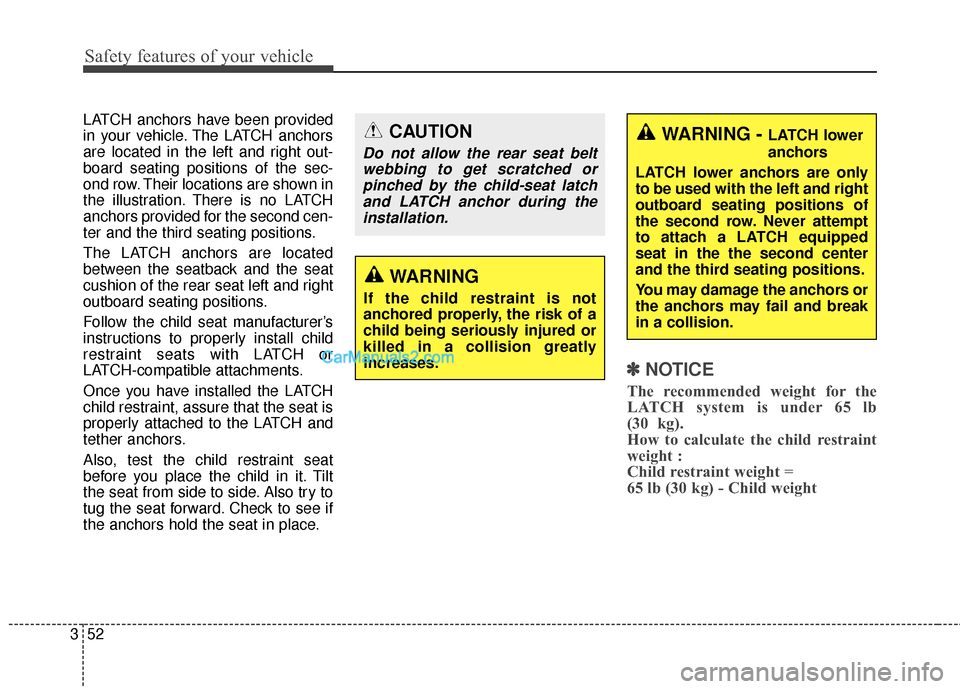
LATCH anchors have been provided
in your vehicle. The LATCH anchors
are located in the left and right out-
board seating positions of the sec-
ond row. Their locations are shown in
the illustration. There is no LATCH
anchors provided for the second cen-
ter and the third seating positions.
The LATCH anchors are located
between the seatback and the seat
cushion of the rear seat left and right
outboard seating positions.
Follow the child seat manufacturer’s
instructions to properly install child
restraint seats with LATCH or
LATCH-compatible attachments.
Once you have installed the LATCH
child restraint, assure that the seat is
properly attached to the LATCH and
tether anchors.
Also, test the child restraint seat
before you place the child in it. Tilt
the seat from side to side. Also try to
tug the seat forward. Check to see if
the anchors hold the seat in place.
✽ ✽
NOTICE
The recommended weight for the
LATCH system is under 65 lb
(30 kg).
How to calculate the child restraint
weight :
Child restraint weight =
65 lb (30 kg) - Child weight
WARNING
If the child restraint is not
anchored properly, the risk of a
child being seriously injured or
killed in a collision greatly
increases.
CAUTION
Do not allow the rear seat belt
webbing to get scratched orpinched by the child-seat latchand LATCH anchor during theinstallation.
WARNING - LATCH lower
anchors
LATCH lower anchors are only
to be used with the left and right
outboard seating positions of
the second row. Never attempt
to attach a LATCH equipped
seat in the the second center
and the third seating positions.
You may damage the anchors or
the anchors may fail and break
in a collision.
Page 99 of 569
Safety features of your vehicle
78
3
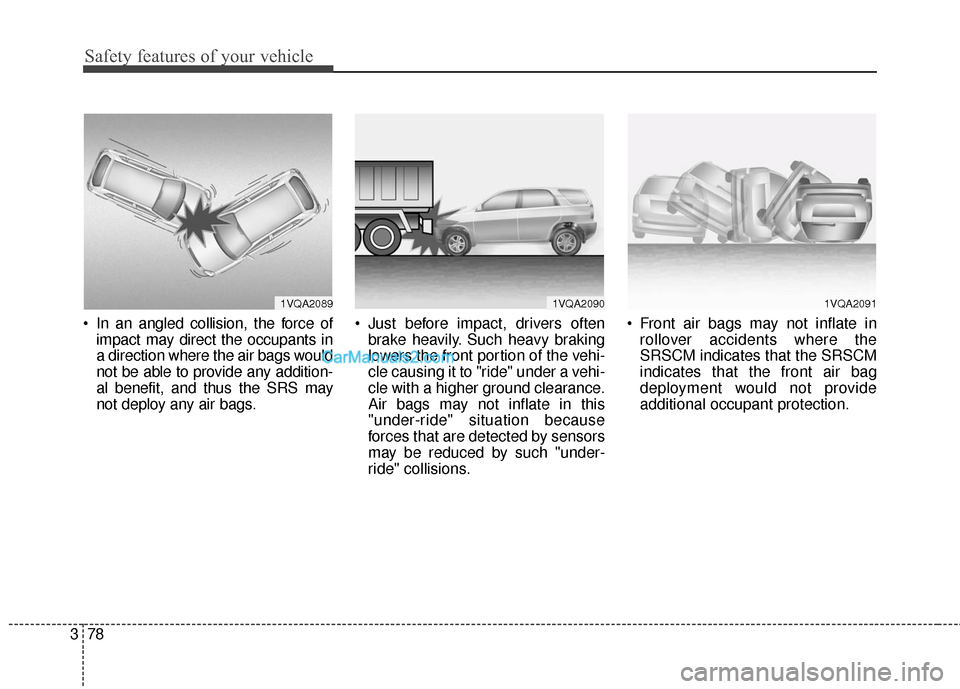
In an angled collision, the force of
impact may direct the occupants in
a direction where the air bags would
not be able to provide any addition-
al benefit, and thus the SRS may
not deploy any air bags. Just before impact, drivers often
brake heavily. Such heavy braking
lowers the front portion of the vehi-
cle causing it to "ride" under a vehi-
cle with a higher ground clearance.
Air bags may not inflate in this
"under-ride" situation because
forces that are detected by sensors
may be reduced by such "under-
ride" collisions. Front air bags may not inflate in
rollover accidents where the
SRSCM indicates that the SRSCM
indicates that the front air bag
deployment would not provide
additional occupant protection.
1VQA20901VQA20891VQA2091
Page 126 of 569
423
Features of your vehicle
Operating door locks from
inside the vehicle
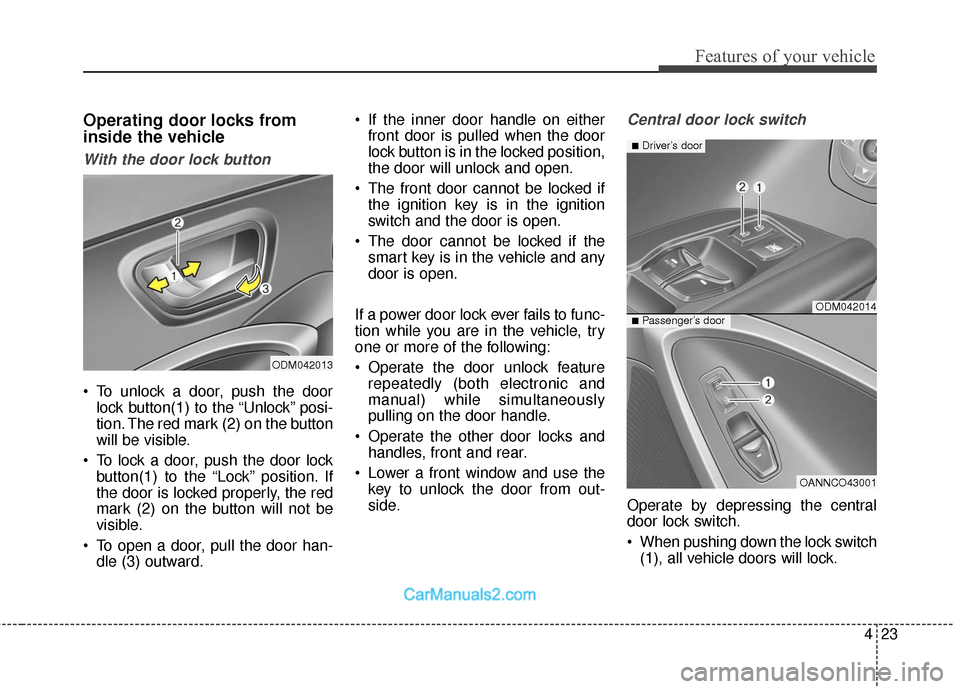
With the door lock button
To unlock a door, push the doorlock button(1) to the “Unlock” posi-
tion. The red mark (2) on the button
will be visible.
To lock a door, push the door lock button(1) to the “Lock” position. If
the door is locked properly, the red
mark (2) on the button will not be
visible.
To open a door, pull the door han- dle (3) outward. If the inner door handle on either
front door is pulled when the door
lock button is in the locked position,
the door will unlock and open.
The front door cannot be locked if the ignition key is in the ignition
switch and the door is open.
The door cannot be locked if the smart key is in the vehicle and any
door is open.
If a power door lock ever fails to func-
tion while you are in the vehicle, try
one or more of the following:
Operate the door unlock feature repeatedly (both electronic and
manual) while simultaneously
pulling on the door handle.
Operate the other door locks and handles, front and rear.
Lower a front window and use the key to unlock the door from out-
side.
Central door lock switch
Operate by depressing the central
door lock switch.
When pushing down the lock switch(1), all vehicle doors will lock.
ODM042013
ODM042014
OANNCO43001
■Driver’s door
■Passenger’s door
Page 129 of 569
Features of your vehicle
26
4
Non-Powered liftgate (tailgate)
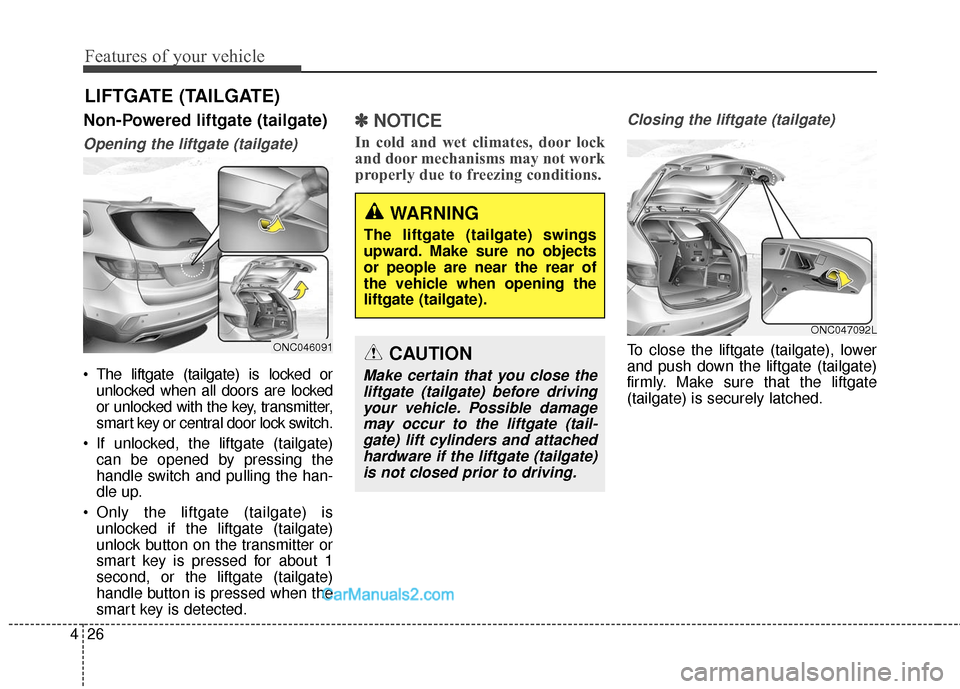
Opening the liftgate (tailgate)
• The liftgate (tailgate) is locked or
unlocked when all doors are locked
or unlocked with the key, transmitter,
smart key or central door lock switch.
If unlocked, the liftgate (tailgate) can be opened by pressing the
handle switch and pulling the han-
dle up.
Only the liftgate (tailgate) is unlocked if the liftgate (tailgate)
unlock button on the transmitter or
smart key is pressed for about 1
second, or the liftgate (tailgate)
handle button is pressed when the
smart key is detected.
✽ ✽ NOTICE
In cold and wet climates, door lock
and door mechanisms may not work
properly due to freezing conditions.
Closing the liftgate (tailgate)
To close the liftgate (tailgate), lower
and push down the liftgate (tailgate)
firmly. Make sure that the liftgate
(tailgate) is securely latched.
LIFTGATE (TAILGATE)
ONC046091
ONC047092L
WARNING
The liftgate (tailgate) swings
upward. Make sure no objects
or people are near the rear of
the vehicle when opening the
liftgate (tailgate).
CAUTION
Make certain that you close the
liftgate (tailgate) before drivingyour vehicle. Possible damagemay occur to the liftgate (tail-gate) lift cylinders and attachedhardware if the liftgate (tailgate)is not closed prior to driving.
Page 143 of 569
Features of your vehicle
40
4
Power windows
The ignition switch must be in the ON
position for power windows to operate.
Each door has a power window
switch that controls that door's win-
dow. The driver has a power window
lock switch which can block the oper-
ation of passenger windows. The dri-
ver’s door has a master power win-
dow switch that controls all the win-
dows in the vehicle. The power win-
dows can be operated for approxi-
mately 30 seconds after the ignition
key is removed or turned to the ACC
or LOCK position. However, if the
front doors open, the power windows
cannot be operated within the 30
second period.
✽ ✽
NOTICE
While driving with the rear windows
down or with the sunroof (if
equipped) in an open (or partially
open) position, your vehicle may
demonstrate a wind buffeting or
pulsation noise. This noise is a nor-
mal occurrence and can be reduced
or eliminated by taking the follow-
ing actions. If the noise occurs with
one or both of the rear windows
down, partially lower both front
windows approximately one inch. If
you experience the noise with the
sunroof open, slightly reduce the
size of the sunroof opening.
Window opening and closing
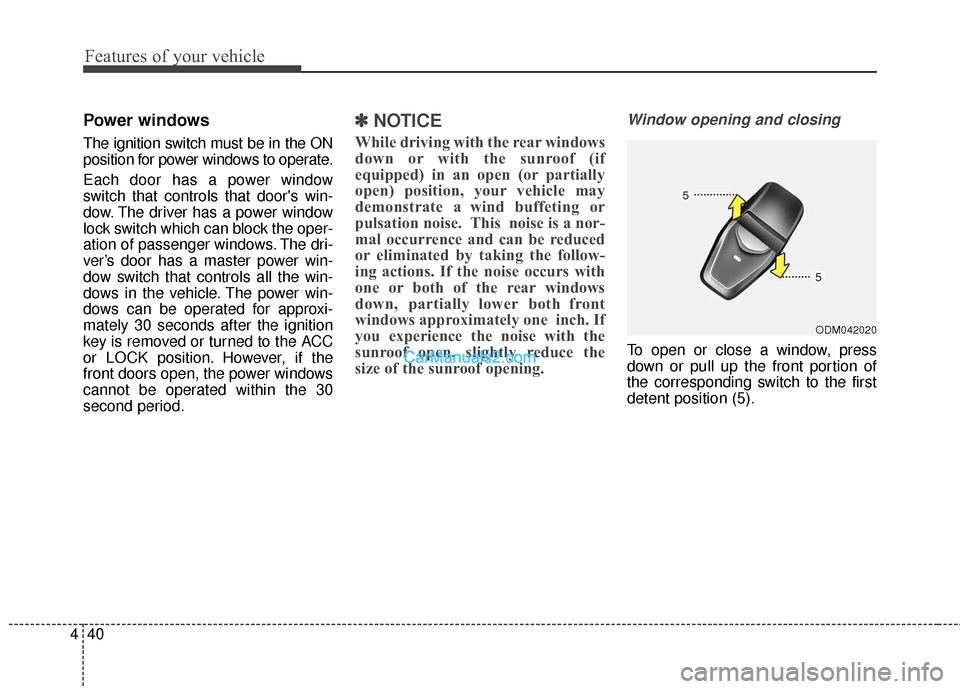
To open or close a window, press
down or pull up the front portion of
the corresponding switch to the first
detent position (5).
ODM042020
Page 144 of 569
441
Features of your vehicle
Auto up/down window (front seat)(if equipped)
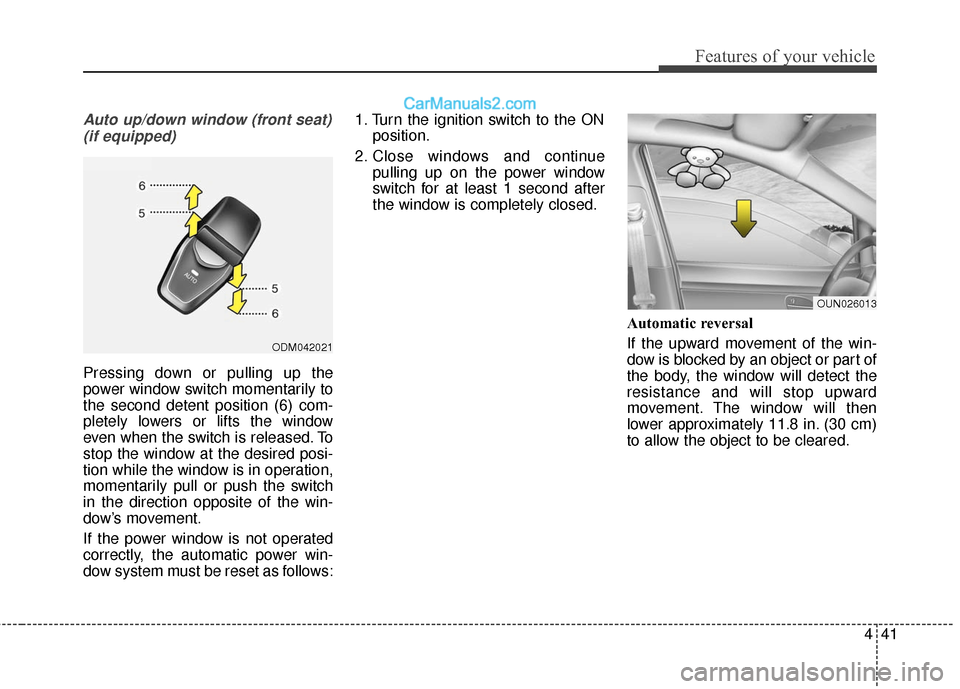
Pressing down or pulling up the
power window switch momentarily to
the second detent position (6) com-
pletely lowers or lifts the window
even when the switch is released. To
stop the window at the desired posi-
tion while the window is in operation,
momentarily pull or push the switch
in the direction opposite of the win-
dow’s movement.
If the power window is not operated
correctly, the automatic power win-
dow system must be reset as follows: 1. Turn the ignition switch to the ON
position.
2. Close windows and continue pulling up on the power window
switch for at least 1 second after
the window is completely closed.
Automatic reversal
If the upward movement of the win-
dow is blocked by an object or part of
the body, the window will detect the
resistance and will stop upward
movement. The window will then
lower approximately 11.8 in. (30 cm)
to allow the object to be cleared.
ODM042021
OUN026013