warning Hyundai Santa Fe Sport 2015 Owner's Guide
[x] Cancel search | Manufacturer: HYUNDAI, Model Year: 2015, Model line: Santa Fe Sport, Model: Hyundai Santa Fe Sport 2015Pages: 785, PDF Size: 13.38 MB
Page 56 of 785
335
Safety features of your vehicle
Children riding in the car should sit in
the rear seat and must always be
properly restrained to minimize the
risk of injury in an accident, sudden
stop or sudden maneuver. According
to accident statistics, children are
safer when properly restrained in the
rear seats than in the front seat.
Larger children not in a child restraint
should use one of the seat belts pro-
vided.
You should be aware of the specific
requirements in your country. Child
and/or infant safety seats must be
properly placed and installed in the
rear seat. You must use a commer-
cially available child restraint system
that meets the requirements of the
Safety Standards of your country.
Child restraint systems are designed
to be secured in vehicle seats by lap
belts or the lap belt portion of a
lap/shoulder belt, or by a LATCH sys-
tem (if equipped).Children could be injured or killed in
a crash if their restraints are not
properly secured. For small children
and babies, a child seat or infant seat
must be used. Before buying a par-
ticular child restraint system, make
sure it fits your car seat and seat
belts, and fits your child. Follow all
the instructions provided by the man-
ufacturer when installing the child
restraint system.
CHILD RESTRAINT SYSTEM
WARNING
• A child restraint system must
be placed in the rear seat.
Never install a child or infant
seat on the front passenger's
seat. Should an accident
occur and cause the passen-
ger-side air bag to deploy, it
could severely injure or kill an
infant or child seated in an
infant or child seat. Thus only
use a child restraint in the
rear seat of your vehicle.
(Continued)
(Continued)
• A seat belt or child restraint
system can become very hot
if it is left in a closed vehicle
on a sunny day, even if the
outside temperature does not
feel hot. Be sure to check the
seat cover and buckles before
placing a child there.
• When the child restraint sys-
tem is not in use, store it in
the luggage area or fasten it
with a seat belt so that it will
not be thrown forward in the
case of a sudden stop or an
accident.
• Children may be seriously
injured or killed by an inflating
air bag. All children, even
those too large for child
restraints, must ride in the
rear seat.
Page 57 of 785
Safety features of your vehicle
36 3
WARNING
To reduce the chance of serious
or fatal injuries:
• Children of all ages are safer
when restrained in the rear
seat. A child riding in the front
passenger seat can be force-
fully struck by an inflating air
bag resulting in serious or
fatal injuries.
• Always follow the child
restraint system manufactur-
er’s instructions for installation
and use of the child restraint.
• Always make sure the child
seat is secured properly in the
car and your child is securely
restrained in the child seat.
• Never hold a child in your
arms or lap when riding in a
vehicle. The violent forces cre-
ated during a crash will tear
the child from your arms and
throw the child against the
car’s interior.
(Continued)
(Continued)
• Never put a seat belt over
yourself and a child. During a
crash, the belt could press
deep into the child causing
serious internal injuries.
• Never leave children unat-
tended in a vehicle – not even
for a short time. The car can
heat up very quickly, resulting
in serious injuries to children
inside. Even very young chil-
dren may inadvertently cause
the vehicle to move, entangle
themselves in the windows, or
lock themselves or others
inside the vehicle.
• Never allow two children, or
any two persons, to use the
same seat belt.
• Children often squirm and
reposition themselves improp-
erly. Never let a child ride with
the shoulder belt under their
arm or behind their back.
Always properly position and
secure children in the rear seat.
(Continued)(Continued)
• Never allow a child to stand-
up or kneel on the seat or floor
of a moving vehicle. During a
collision or sudden stop, the
child can be violently thrown
against the vehicle’s interior,
resulting in serious injury.
• Never use an infant carrier or
a child safety seat that
"hooks" over a seatback, it
may not provide adequate
security in an accident.
• Seat belts can become very
hot, especially when the car is
parked in direct sunlight.
Always check seat belt buck-
les before fastening them
over a child.
• After an accident, have an
authorized HYUNDAI dealer
check the child restraint sys-
tem, seat belt, tether anchor
and lower anchor.
• If there is not enough space to
place the child restraint sys-
tem because of the driver's
seat, install the child restraint
system in the rear right seat.
Page 58 of 785
337
Safety features of your vehicle
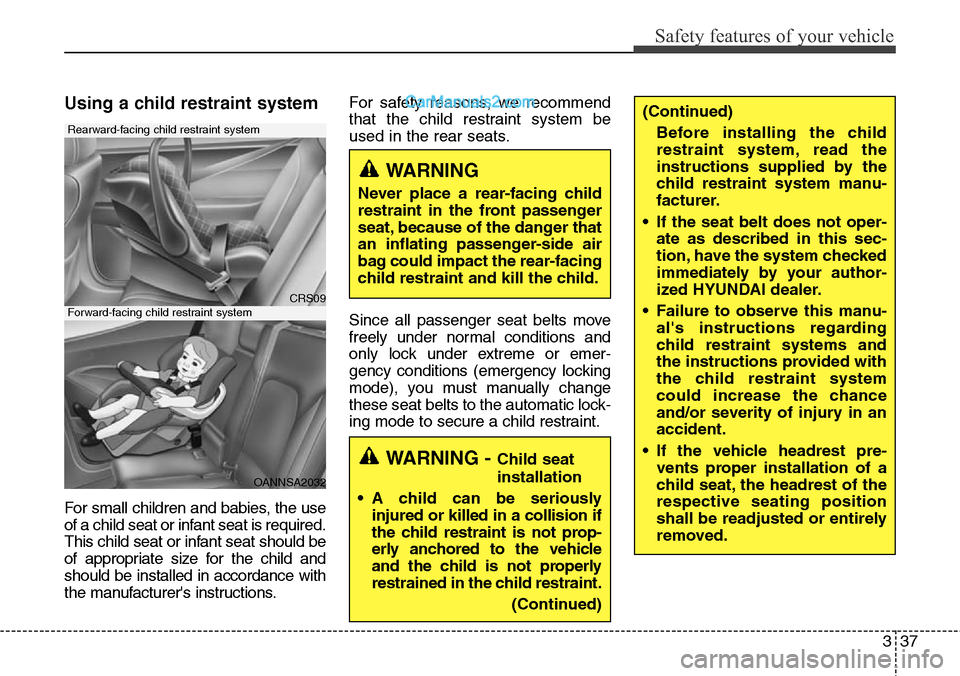
Using a child restraint system
For small children and babies, the use
of a child seat or infant seat is required.
This child seat or infant seat should be
of appropriate size for the child and
should be installed in accordance with
the manufacturer's instructions.For safety reasons, we recommend
that the child restraint system be
used in the rear seats.
Since all passenger seat belts move
freely under normal conditions and
only lock under extreme or emer-
gency conditions (emergency locking
mode), you must manually change
these seat belts to the automatic lock-
ing mode to secure a child restraint.
WARNING - Child seat
installation
• A child can be seriously
injured or killed in a collision if
the child restraint is not prop-
erly anchored to the vehicle
and the child is not properly
restrained in the child restraint.
(Continued)
(Continued)
Before installing the child
restraint system, read the
instructions supplied by the
child restraint system manu-
facturer.
• If the seat belt does not oper-
ate as described in this sec-
tion, have the system checked
immediately by your author-
ized HYUNDAI dealer.
• Failure to observe this manu-
al's instructions regarding
child restraint systems and
the instructions provided with
the child restraint system
could increase the chance
and/or severity of injury in an
accident.
• If the vehicle headrest pre-
vents proper installation of a
child seat, the headrest of the
respective seating position
shall be readjusted or entirely
removed.
WARNING
Never place a rear-facing child
restraint in the front passenger
seat, because of the danger that
an inflating passenger-side air
bag could impact the rear-facing
child restraint and kill the child.
CRS09
OANNSA2032
Forward-facing child restraint system
Rearward-facing child restraint system
Page 61 of 785
Safety features of your vehicle
40 3
When the seat belt is allowed to
retract to its fully stowed position,
the retractor will automatically
switch from the “Automatic lock-
ing” mode to the emergency lock
mode for normal adult usage.
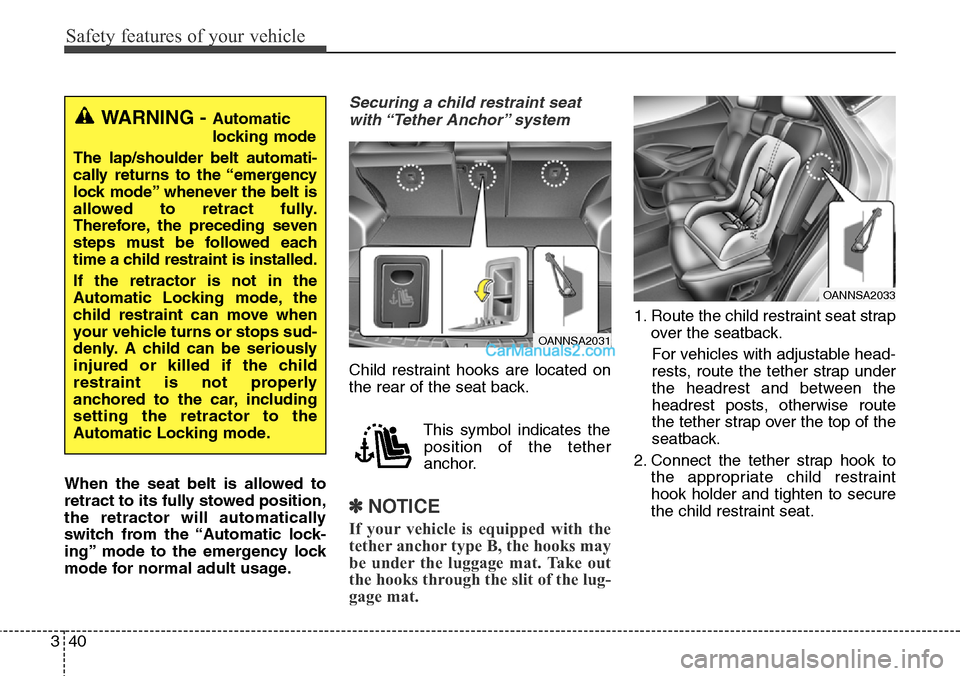
Securing a child restraint seat
with “Tether Anchor” system
Child restraint hooks are located on
the rear of the seat back.
This symbol indicates the
position of the tether
anchor.
✽NOTICE
If your vehicle is equipped with the
tether anchor type B, the hooks may
be under the luggage mat. Take out
the hooks through the slit of the lug-
gage mat.
1. Route the child restraint seat strap
over the seatback.
For vehicles with adjustable head-
rests, route the tether strap under
the headrest and between the
headrest posts, otherwise route
the tether strap over the top of the
seatback.
2. Connect the tether strap hook to
the appropriate child restraint
hook holder and tighten to secure
the child restraint seat.
WARNING - Automatic
locking mode
The lap/shoulder belt automati-
cally returns to the “emergency
lock mode” whenever the belt is
allowed to retract fully.
Therefore, the preceding seven
steps must be followed each
time a child restraint is installed.
If the retractor is not in the
Automatic Locking mode, the
child restraint can move when
your vehicle turns or stops sud-
denly. A child can be seriously
injured or killed if the child
restraint is not properly
anchored to the car, including
setting the retractor to the
Automatic Locking mode.
OANNSA2031
OANNSA2033
Page 62 of 785
341
Safety features of your vehicle
WARNING - Tether strap
Never mount more than one
child restraint to a single tether
anchor or to a single lower
anchorage point. The increased
load caused by multiple seats
may cause the tethers or
anchorage points to break,
causing serious injury or death.
WARNING
A child can be seriously injured
or killed in a collision if the
child restraint is not properly
anchored to the car and the
child is not properly restrained
in the child restraint. Always fol-
low the child seat manufactur-
er’s instructions for installation
and use.
WARNING
• When using the vehicle's
"Tether Anchor" system to
install a child restraint system
in the rear seat, all unused
vehicle rear seat belt metal
latch plates or tabs must be
latched securely in their seat
belt buckles and the seat belt
webbing must be retracted
behind the child restraint to
prevent the child from reaching
and taking hold of unretracted
seat belts. Unlatched metal
latch plates or tabs may allow
the child to reach the unretract-
ed seat belts which may result
in strangulation and a serious
injury or death to the child in
the child restraint.
• Do not place anything around
the lower anchors. Also make
sure that the seat belt is not
caught in the lower anchors.
WARNING - Child restraint
check
Check that the child restraint
system is secure by pushing
and pulling it in different direc-
tions. Incorrectly fitted child
restraints may swing, twist, tip
or separate causing death or
serious injury.
WARNING - Child restraint
anchorage
• Child restraint anchorages are
designed to withstand only
those loads imposed by cor-
rectly fitted child restraints.
Under no circumstances are
they to be used for adult seat
belts or harnesses or for
attaching other items or
equipment to the vehicle.
• The tether strap may not work
properly if attached some-
where other than the correct
tether anchor.
Page 63 of 785
Safety features of your vehicle
42 3
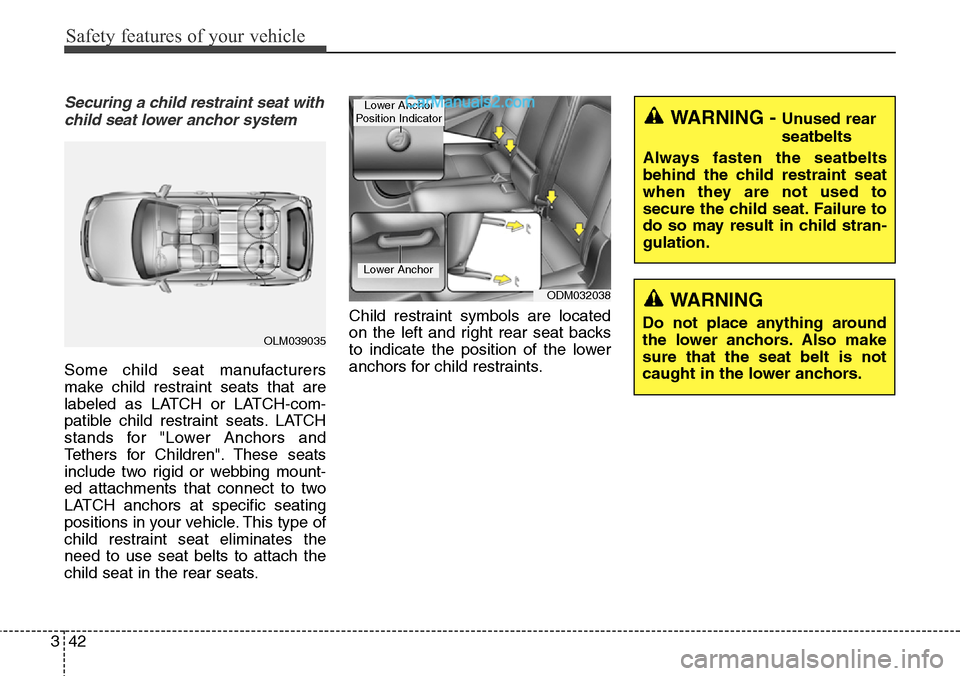
Securing a child restraint seat with
child seat lower anchor system
Some child seat manufacturers
make child restraint seats that are
labeled as LATCH or LATCH-com-
patible child restraint seats. LATCH
stands for "Lower Anchors and
Tethers for Children". These seats
include two rigid or webbing mount-
ed attachments that connect to two
LATCH anchors at specific seating
positions in your vehicle. This type of
child restraint seat eliminates the
need to use seat belts to attach the
child seat in the rear seats.Child restraint symbols are located
on the left and right rear seat backs
to indicate the position of the lower
anchors for child restraints.
OLM039035
WARNING - Unused rear
seatbelts
Always fasten the seatbelts
behind the child restraint seat
when they are not used to
secure the child seat. Failure to
do so may result in child stran-
gulation.
WARNING
Do not place anything around
the lower anchors. Also make
sure that the seat belt is not
caught in the lower anchors.
ODM032038
Lower Anchor
Lower Anchor
Position Indicator
Page 64 of 785

343
Safety features of your vehicle
LATCH anchors have been provided
in your vehicle. The LATCH anchors
are located in the left and right out-
board rear seating positions. Their
locations are shown in the illustration.
There is no LATCH anchor provided
for the center rear seating position.
The LATCH anchors are located
between the seatback and the seat
cushion of the rear seat left and right
outboard seating positions.
Follow the child seat manufacturer’s
instructions to properly install child
restraint seats with LATCH or
LATCH-compatible attachments.
Once you have installed the LATCH
child restraint, assure that the seat is
properly attached to the LATCH and
tether anchors.
Also, test the child restraint seat
before you place the child in it. Tilt
the seat from side to side. Also try to
tug the seat forward. Check to see if
the anchors hold the seat in place.
WARNING
If the child restraint is not
anchored properly, the risk of a
child being seriously injured or
killed in a collision greatly
increases.
WARNING - LATCH lower
anchors
LATCH lower anchors are only
to be used with the left and right
rear outboard seating positions.
Never attempt to attach a LATCH
equipped seat in the center
seating position. You may dam-
age the anchors or the anchors
may fail and break in a collision.CAUTION
Do not allow the rear seat belt
webbing to get scratched or
pinched by the child-seat latch
and LATCH anchor during the
installation.
Page 65 of 785

Safety features of your vehicle
44 3
(1) Driver’s front air bag
(2) Passenger’s front air bag
(3) Side impact air bag
(4) Curtain air bag
(5) Driver’s knee air bag
AIR BAG - ADVANCED SUPPLEMENTAL RESTRAINT SYSTEM
WARNING
Even in vehicles with air bags,
you and your passengers must
always wear the seat belts pro-
vided in order to minimize the
risk and severity of injury in the
event of a collision or rollover.
OANNSA2035
❈The actual air bags in the vehicle may differ from the illustration.
Page 66 of 785

345
Safety features of your vehicle
How does the air bag system
operate
• Air bags are activated (able to
inflate if necessary) only when the
ignition switch is turned to the ON or
START position.
• The appropriate air bags inflate
instantly in the event of serious
frontal or side collision in order to
help protect the occupants from
serious physical injury.
• There is no single speed at which
the air bags will inflate.
Generally, air bags are designed to
inflate by the severity of a collision
and its direction. These two factors
determine whether the sensors
send out an electronic deployment/
inflation signal.
• Air bag deployment depends on a
number of factors including vehicle
speed, angles of impact and the
density and stiffness of the vehicles
or objects which your vehicle hits in
the collision. Though, factors are not
limited to those mentioned above.• The front air bags will completely
inflate and deflate in an instant.
It is virtually impossible for you to
see the air bags inflate during an
accident.
It is much more likely that you will
simply see the deflated air bags
hanging out of their storage com-
partments after the collision.
• In addition to inflating in serious
side collisions, side and/or curtain
air bags will inflate if the sensing
system detects a rollover.
• When a rollover is detected, side
and/or curtain airbags will remain
inflated longer to help provide pro-
tection from ejection, especially
when used in conjunction with the
seat belts.
• In order to help provide protection,
the air bags must inflate rapidly. The
speed of air bag inflation is a con-
sequence of the extremely short
time in which to inflate the air bag
between the occupant and the vehi-
cle structures before the occupant
impacts those structures.This speed of inflation reduces the
risk of serious or life-threatening
injuries and is thus a necessary part
of air bag design.
However, air bag inflation can also
cause injuries which normally can
include facial abrasions, bruises and
broken bones because the inflation
speed also causes the air bags to
expand with a great deal of force.
• There are even circumstances
under which contact with the air
bag can cause fatal injuries, espe-
cially if the occupant is positioned
excessively close to the air bag.
WARNING
• To avoid severe personal injury
or death caused by deploying
air bags in a collision, the driv-
er should sit as far back from
the steering wheel air bag as
possible (at least 250 mm (10
inches) away). The front pas-
sengers should always move
their seats as far back as pos-
sible and sit back in their seat.
(Continued)
Page 67 of 785

Safety features of your vehicle
46 3
Noise and smoke
When the air bags inflate, they make a
loud noise and they leave smoke and
powder in the air inside of the vehicle.
This is normal and is a result of the
ignition of the air bag inflator. After the
air bag inflates, you may feel substan-
tial discomfort in breathing due to the
contact of your chest with both the
seat belt and the air bag, as well as
from breathing the smoke and powder.
Open your doors and/or windows
as soon as possible after impact in
order to reduce discomfort and pre-
vent prolonged exposure to the
smoke and powder.Though the smoke and powder are
non-toxic, they may cause irritation to
the skin (eyes, nose and throat, etc). If
this is the case, wash and rinse with
cold water immediately and consult a
doctor if the symptom persists.
Do not install a child restraint on
the front passenger’s seat
Never place a rear-facing child
restraint in the front passenger’s
seat. If the air bag deploys, it would
impact the rear-facing child restraint,
causing serious or fatal injury.
In addition, do not place front-facing
child restraints in the front passen-
ger’s seat either. If the front passen-
ger air bag inflates, it could cause
serious or fatal injuries to the child.
1JBH3051
WARNING - Hot
components
Do not touch the air bag storage
area's internal components
immediately after airbag infla-
tion. The air bag related parts in
the steering wheel, instrument
panel and the roof rails above
the front and rear doors are
very hot. Hot components can
result in burn injuries.
(Continued)
• Air bags inflate instantly in the
event of collision, and passen-
gers may be injured by the air
bag expansion force if they are
not in proper position.
• Air bag inflation may cause
injuries which normally include
facial or bodily abrasions,
injuries from broken glasses or
burns by the air bag inflation
gasses.