engine overheat Hyundai Sonata
[x] Cancel search | Manufacturer: HYUNDAI, Model Year: , Model line: , Model:Pages: 286, PDF Size: 9.58 MB
Page 176 of 286
2
DRIVING YOUR HYUNDAI
23
8. When parking your car and trailer, es-
pecially on a hill, be sure to follow all
the normal precautions. Turn your front
wheel into the curb, set the parking
brake firmly, and put the transaxle in 1st
or Reverse (manual) or Park (automatic).
In addition, place wheel chocks at each
of the trailer's tires.
9. If the trailer has electric brakes, start
your vehicle and trailer moving, and
then apply the trailer brake controller by
hand to be sure the brakes are working.
This lets you check your electrical
connection at the same time.
10. During your trip, check occasionally to
be sure that the load is secure, and that
the lights and any trailer brakes are still
working.
11. Avoid jerky starts, sudden acceleration
or sudden stops.
12. Avoid sharp turns and rapid lane
changes.
13. Avoid holding the brake pedal down
too long or too frequently. This could
cause the brakes to overheat, resulting
in reduced braking efficiency.
14. When going down a hill, shift into a
lower gear and use the engine braking
effect.
When ascending a long grade, down-
shift the transaxle to a lower gear and
reduce speed to reduce chances of
engine overloading and/or overheat-
ing.
CAUTION:
If overheating should occur when tow-
ing, (the temperature gauge reads near
red zone), taking the following action
may reduce or eliminate the problem.
1. Turn off the air conditioner.
2. Reduce highway speed.
3. Select a lower gear when going uphill.
4. While in stop and go traffic, place the
gear selector in park or neutral and
idle the engine at a higher speed.
!
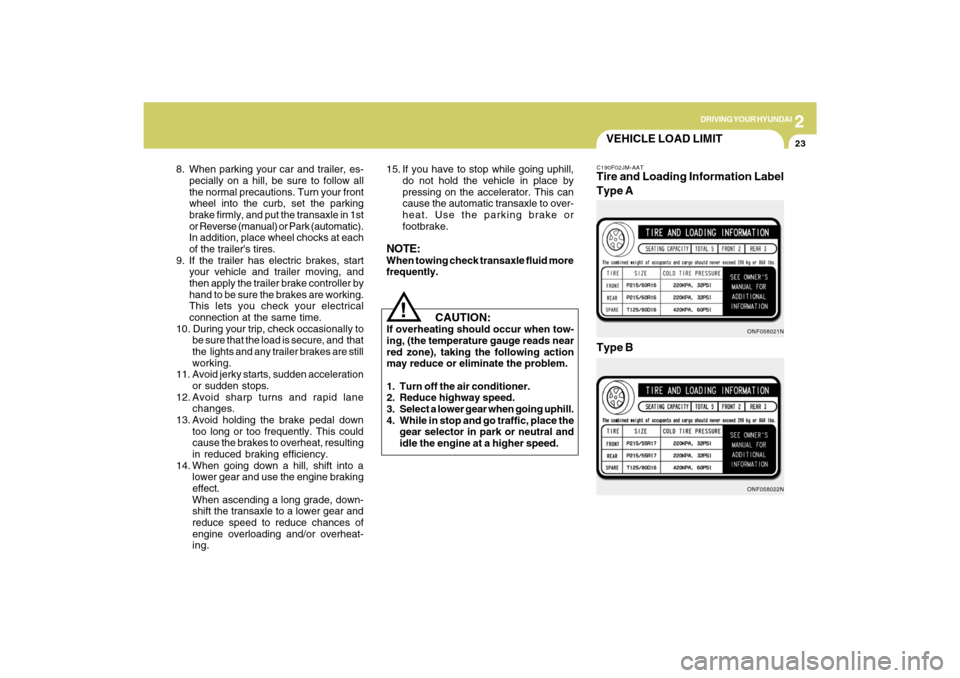
VEHICLE LOAD LIMITC190F02JM-AATTire and Loading Information Label
ONF058021N
15. If you have to stop while going uphill,
do not hold the vehicle in place by
pressing on the accelerator. This can
cause the automatic transaxle to over-
heat. Use the parking brake or
footbrake.NOTE:When towing check transaxle fluid more
frequently.
Type A
Type B
ONF058022N
Page 182 of 286
If the Engine Will Not Start ............................................ 3-2
Jump Starting ................................................................ 3-3
If the Engine Overheats ................................................ 3-4
Tire Pressure Monitoring System (TPMS) .................... 3-5
Spare Tire ..................................................................... 3-9
If You Have a Flat Tire ................................................3-10
Changing a Flat Tire ....................................................3-10
If Your Vehicle Must Be Towed...................................3-15
Emergency Towing.....................................................3-17
If You Lose Your Keys................................................3-18
3
WHAT TO DO IN AN EMERGENCY
3
Page 185 of 286
34WHAT TO DO IN AN EMERGENCY
IF THE ENGINE OVERHEATS
!!
!
WARNING:
While the engine is running, keep hair,
hands and clothing away from moving
parts such as the fan and drive belts to
prevent injury.
5. If the water pump drive belt is broken or
engine coolant is leaking out, stop the
engine immediately and call the nearest
Hyundai dealer for assistance.
WARNING:
Do not remove the radiator cap when the
engine is hot. This can allow coolant to be
blown out of the opening and cause se-
rious burns.6. If you cannot find the cause of the
overheat-ing, wait until the engine
temperature has returned to normal.
Then, if coolant has been lost, carefully
add coolant to the reservoir (page 6-9)
to bring the fluid level in the reservoir up
to the halfway mark.
7. Proceed with caution, keeping alert for
further signs of overheating. If
overheating happens again, call a
Hyundai dealer for assistance.
CAUTION:
Serious loss of coolant indicates there is
a leak in the cooling system and this
should be checked as soon as possible
by a Hyundai dealer.
D030A02A-AATIf your temperature gauge indicates over-
heating, you experience a loss of power, or
hear loud pinging or knocking, the engine
is probably too hot. If this happens, you
should:
1. Pull off the road and stop as soon as it
is safe to do so.
2. Place the gear selector lever in "P"
(automatic) or neutral (manual
transaxle) and set the parking brake. If
the air conditioning is on, turn it off.
3. If engine coolant is running out under
the car or steam is coming out from the
hood, stop the engine. Do not open the
hood until the coolant has stopped
running or the steaming has stopped. If
there is no visible loss of engine coolant
and no steam, leave the engine running
and check to be sure the engine cooling
fan is operating. If the fan is not running,
turn the engine off.
4. Check to see if the water pump drive belt
is missing. If it is not missing, check to
see that it is tight. If the drive belt seems
to be satisfactory, check for coolant
leaking from the radiator, hoses or under
the car. (If the air conditioning had been
in use, it is normal for cold water to be
draining from it when you stop).
Page 224 of 286
6
DO-IT-YOURSELF MAINTENANCE
9
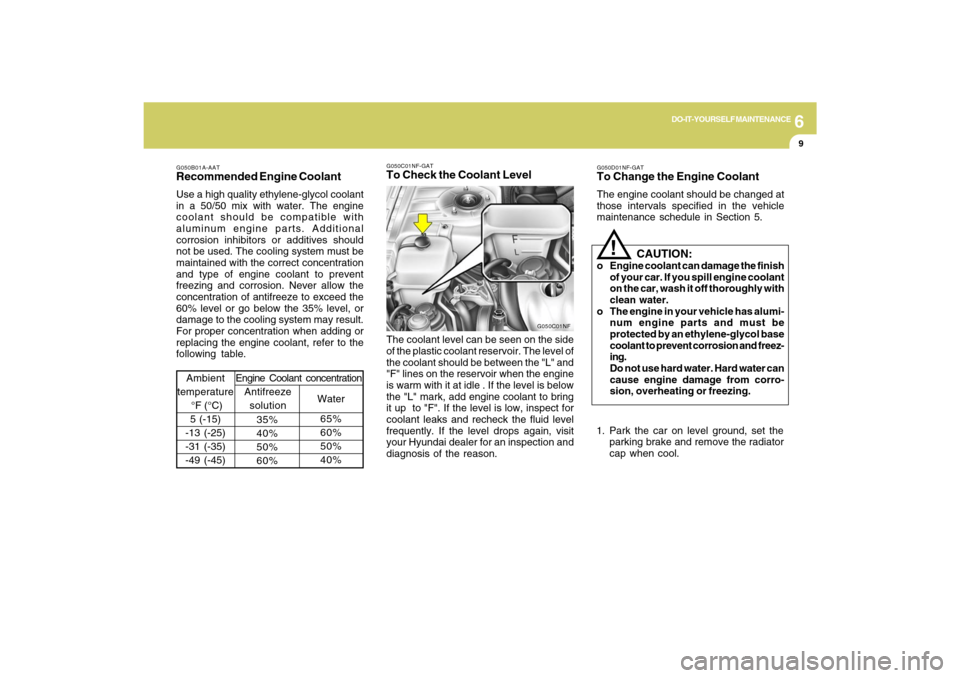
G050B01A-AATRecommended Engine CoolantUse a high quality ethylene-glycol coolant
in a 50/50 mix with water. The engine
coolant should be compatible with
aluminum engine parts. Additional
corrosion inhibitors or additives should
not be used. The cooling system must be
maintained with the correct concentration
and type of engine coolant to prevent
freezing and corrosion. Never allow the
concentration of antifreeze to exceed the
60% level or go below the 35% level, or
damage to the cooling system may result.
For proper concentration when adding or
replacing the engine coolant, refer to the
following table.
G050C01NF-GATTo Check the Coolant LevelThe coolant level can be seen on the side
of the plastic coolant reservoir. The level of
the coolant should be between the "L" and
"F" lines on the reservoir when the engine
is warm with it at idle . If the level is below
the "L" mark, add engine coolant to bring
it up to "F". If the level is low, inspect for
coolant leaks and recheck the fluid level
frequently. If the level drops again, visit
your Hyundai dealer for an inspection and
diagnosis of the reason.
G050C01NFG050D01NF-GAT
To Change the Engine CoolantThe engine coolant should be changed at
those intervals specified in the vehicle
maintenance schedule in Section 5.
CAUTION:
o Engine coolant can damage the finish
of your car. If you spill engine coolant
on the car, wash it off thoroughly with
clean water.
o The engine in your vehicle has alumi-
num engine parts and must be
protected by an ethylene-glycol base
coolant to prevent corrosion and freez-
ing.
Do not use hard water. Hard water can
cause engine damage from corro-
sion, overheating or freezing.
!
1. Park the car on level ground, set the
parking brake and remove the radiator
cap when cool. Ambient
temperature
°F (°C)
5 (-15)
-13 (-25)
-31 (-35)
-49 (-45)
65%
60%
50%
40% 35%
40%
50%
60%Water Antifreeze
solution Engine Coolant concentration
Page 258 of 286
7
EMISSION CONTROL SYSTEMS
3
!
!
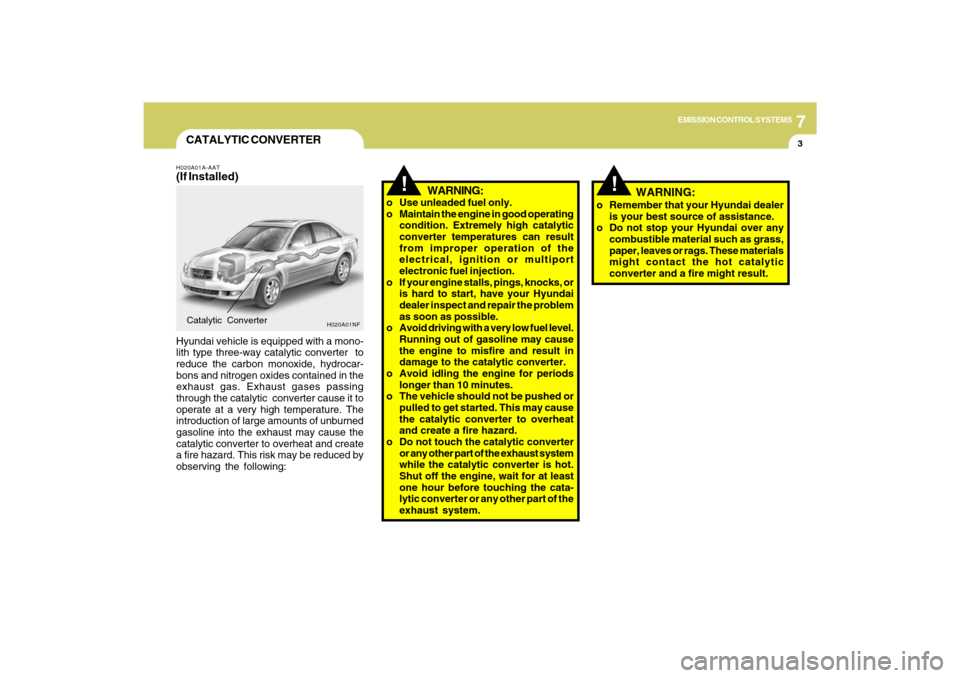
CATALYTIC CONVERTERH020A01A-AAT(If Installed)Hyundai vehicle is equipped with a mono-
lith type three-way catalytic converter to
reduce the carbon monoxide, hydrocar-
bons and nitrogen oxides contained in the
exhaust gas. Exhaust gases passing
through the catalytic converter cause it to
operate at a very high temperature. The
introduction of large amounts of unburned
gasoline into the exhaust may cause the
catalytic converter to overheat and create
a fire hazard. This risk may be reduced by
observing the following:Catalytic Converter
WARNING:
o Use unleaded fuel only.
o Maintain the engine in good operating
condition. Extremely high catalytic
converter temperatures can result
from improper operation of the
electrical, ignition or multiport
electronic fuel injection.
o If your engine stalls, pings, knocks, or
is hard to start, have your Hyundai
dealer inspect and repair the problem
as soon as possible.
o Avoid driving with a very low fuel level.
Running out of gasoline may cause
the engine to misfire and result in
damage to the catalytic converter.
o Avoid idling the engine for periods
longer than 10 minutes.
o The vehicle should not be pushed or
pulled to get started. This may cause
the catalytic converter to overheat
and create a fire hazard.
o Do not touch the catalytic converter
or any other part of the exhaust system
while the catalytic converter is hot.
Shut off the engine, wait for at least
one hour before touching the cata-
lytic converter or any other part of the
exhaust system.
H020A01NF
o Remember that your Hyundai dealer
is your best source of assistance.
o Do not stop your Hyundai over any
combustible material such as grass,
paper, leaves or rags. These materials
might contact the hot catalytic
converter and a fire might result.
WARNING:
Page 282 of 286

10
INDEX
3
Combination Light
Auto Light ........................................................................1-62
Headlight flasher ............................................................1-62
Headlight switch .............................................................1-61
High-beam switch ...........................................................1-62
Lane change signal ........................................................1-61
Parking light auto off ......................................................1-61
Turn signal operation .....................................................1-60
Consumer Information .......................................................8-14
Cooling Fans ......................................................................6-26
Corrosion protection
Cleaning the interior ......................................................... 4-5
Protecting your Hyundai from corrosion .......................... 4-2
Washing and waxing ........................................................ 4-3
Cruise Control ....................................................................1-91
D
Day/night Inside Rearview Mirror ......................................1-76
Defrosting/Defogging.......................................................1-103
Door
Central door locks ............................................................ 1-6
Door locks ......................................................................... 1-4
Front door warning light .................................................1-90
Locking and unlocking front door with a key .................. 1-5
Drink Holder .......................................................................1-67
Driving
Economical driving .........................................................2-16
Smooth cornering ...........................................................2-17
Winter driving ..................................................................2-17E
Electronic Stability Control (ESC) System ........................2-13
Emission Control System ..................................................... 7-2
Engine
Before starting the engine ................................................ 2-3
Compartment (2.4 DOHC) ................................................ 6-2
Compartment (3.3 V6) ...................................................... 6-3
Coolant.............................................................................. 6-8
Coolant temperature gauge ...........................................1-55
If the engine overheats ..................................................... 3-4
Number............................................................................. 8-2
Oil ...................................................................................... 6-4
Starting.............................................................................. 2-5
Engine Exhaust Can Be Dangerous! .................................. 2-2
F
Fan Speed Control ................................................. 1-97, 1-107
Fog Light
Front ................................................................................1-63
Front Seats
Active headrests .............................................................1-16
Adjustable front seats .....................................................1-14
Adjustable headrests ......................................................1-15
Adjusting seat forward and rearward .................. 1-14, 1-18
Adjusting seatback angle ..................................... 1-15, 1-18
Power driver's seat .........................................................1-17
Seat cushion height adjustment ......................... 1-17, 1-18
Seat warmer ....................................................................1-19