brake Hyundai Sonata
[x] Cancel search | Manufacturer: HYUNDAI, Model Year: , Model line: , Model:Pages: 286, PDF Size: 9.58 MB
Page 218 of 286
6
DO-IT-YOURSELF MAINTENANCE
3
8G010A01NF
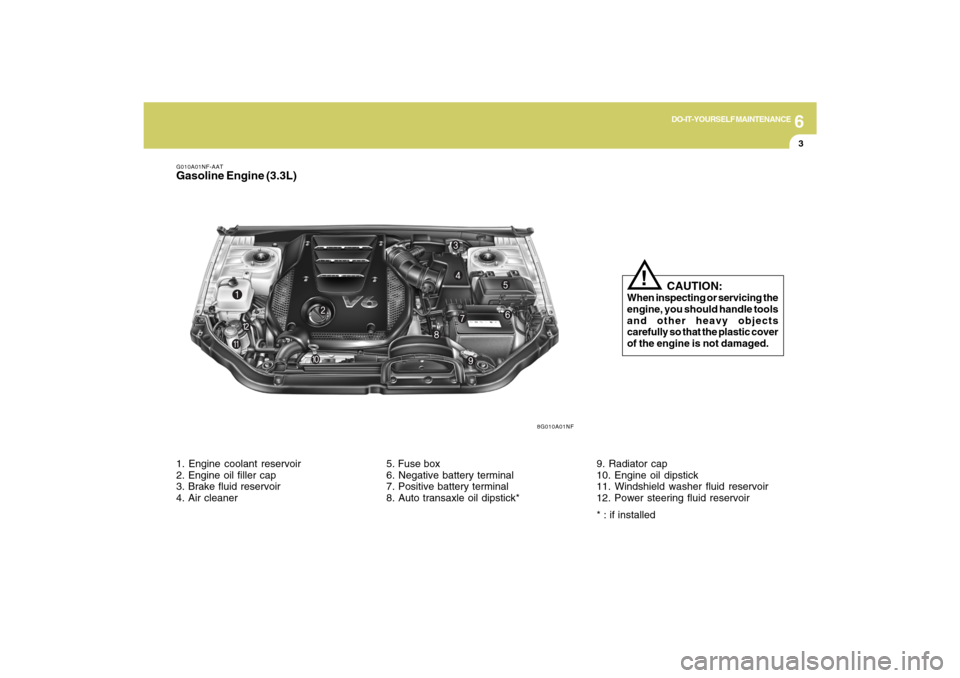
G010A01NF-AATGasoline Engine (3.3L)
CAUTION:
When inspecting or servicing the
engine, you should handle tools
and other heavy objects
carefully so that the plastic cover
of the engine is not damaged.
!
1. Engine coolant reservoir
2. Engine oil filler cap
3. Brake fluid reservoir
4. Air cleaner5. Fuse box
6. Negative battery terminal
7. Positive battery terminal
8. Auto transaxle oil dipstick*9. Radiator cap
10. Engine oil dipstick
11. Windshield washer fluid reservoir
12. Power steering fluid reservoir
* : if installed
Page 219 of 286
6
DO-IT-YOURSELF MAINTENANCE
4
G020C01A-AATVehicle InteriorThe following should be checked each
time when the vehicle is driven:
o Lights operation
o Windshield wiper operation
o Horn operation
o Defroster, heating system operation
(and air conditioning, if installed)
o Steering operation and condition
o Mirror condition and operation
o Turn signal operation
o Accelerator pedal operation
o Brake operation, including parking
brake
o Manual transaxle operation, including
clutch operation
o Automatic transaxle operation,
including "Park" mechanism operation
o Seat control condition and operation
o Seat belt condition and operation
o Sun visor operation
If you notice anything that does not operate
correctly or appears to be functioning
correctly, inspect it carefully and seek
assistance from your Hyundai dealer if
service is needed.
G020B01A-AATVehicle ExteriorThe following should be checked monthly:
o Overall appearance and condition
o Wheel condition and wheel nut torque
o Exhaust system condition
o Light condition and operation
o Windshield glass condition
o Wiper blade condition
o Paint condition and body corrosion
o Fluid leaks
o Door and hood lock condition
o Tire pressure and condition
(including spare tire)GENERAL CHECKSG020A01NF-AATEngine CompartmentThe following should be checked regu-
larly:
o Engine oil level and condition
o Transaxle fluid level and condition
o Brake fluid level
o Engine coolant level
o Windshield washer fluid level
o Accessory drive belt condition
o Engine coolant hose condition
o Fluid leaks (on or below components)
o Power steering fluid level
o Battery condition
o Air filter condition
o Engine vibration
CHECKING THE ENGINE OILG030B01O-AATRecommended OilThe engine oil quality should meet the
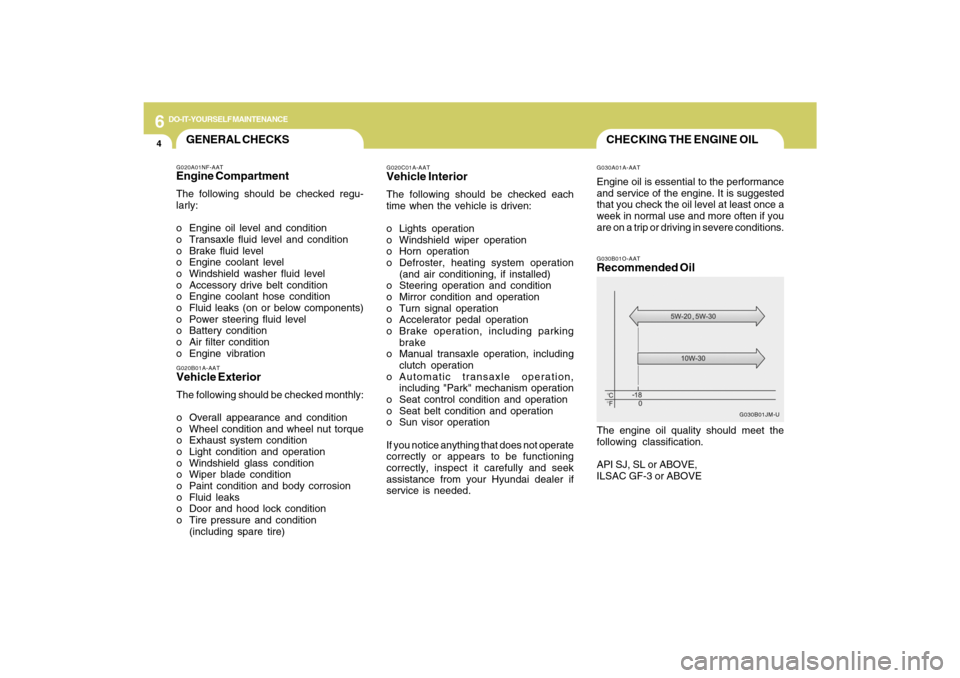
following classification.
API SJ, SL or ABOVE,
ILSAC GF-3 or ABOVE
G030B01JM-U G030A01A-AAT
Engine oil is essential to the performance
and service of the engine. It is suggested
that you check the oil level at least once a
week in normal use and more often if you
are on a trip or driving in severe conditions.
Page 222 of 286
6
DO-IT-YOURSELF MAINTENANCE
7
!
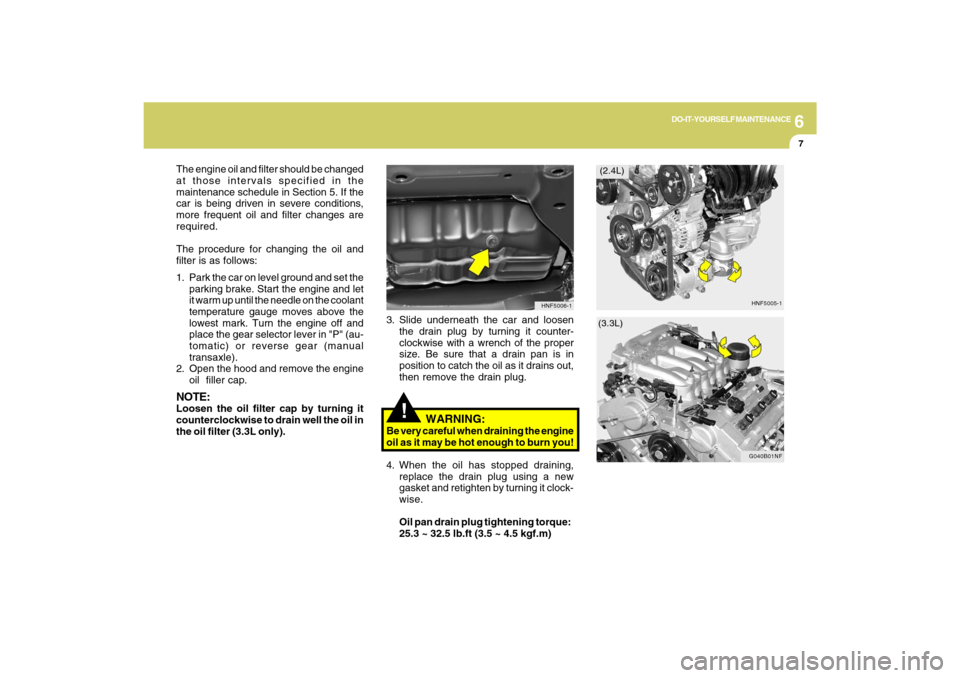
3. Slide underneath the car and loosen
the drain plug by turning it counter-
clockwise with a wrench of the proper
size. Be sure that a drain pan is in
position to catch the oil as it drains out,
then remove the drain plug.
4. When the oil has stopped draining,
replace the drain plug using a new
gasket and retighten by turning it clock-
wise.
Oil pan drain plug tightening torque:
25.3 ~ 32.5 lb.ft (3.5 ~ 4.5 kgf.m)
HNF5006-1
(2.4L)
(3.3L)
The engine oil and filter should be changed
at those intervals specified in the
maintenance schedule in Section 5. If the
car is being driven in severe conditions,
more frequent oil and filter changes are
required.
The procedure for changing the oil and
filter is as follows:
1. Park the car on level ground and set the
parking brake. Start the engine and let
it warm up until the needle on the coolant
temperature gauge moves above the
lowest mark. Turn the engine off and
place the gear selector lever in "P" (au-
tomatic) or reverse gear (manual
transaxle).
2. Open the hood and remove the engine
oil filler cap.NOTE:Loosen the oil filter cap by turning it
counterclockwise to drain well the oil in
the oil filter (3.3L only).
WARNING:
Be very careful when draining the engine
oil as it may be hot enough to burn you!
HNF5005-1
G040B01NF
Page 224 of 286
6
DO-IT-YOURSELF MAINTENANCE
9
G050B01A-AATRecommended Engine CoolantUse a high quality ethylene-glycol coolant
in a 50/50 mix with water. The engine
coolant should be compatible with
aluminum engine parts. Additional
corrosion inhibitors or additives should
not be used. The cooling system must be
maintained with the correct concentration
and type of engine coolant to prevent
freezing and corrosion. Never allow the
concentration of antifreeze to exceed the
60% level or go below the 35% level, or
damage to the cooling system may result.
For proper concentration when adding or
replacing the engine coolant, refer to the
following table.
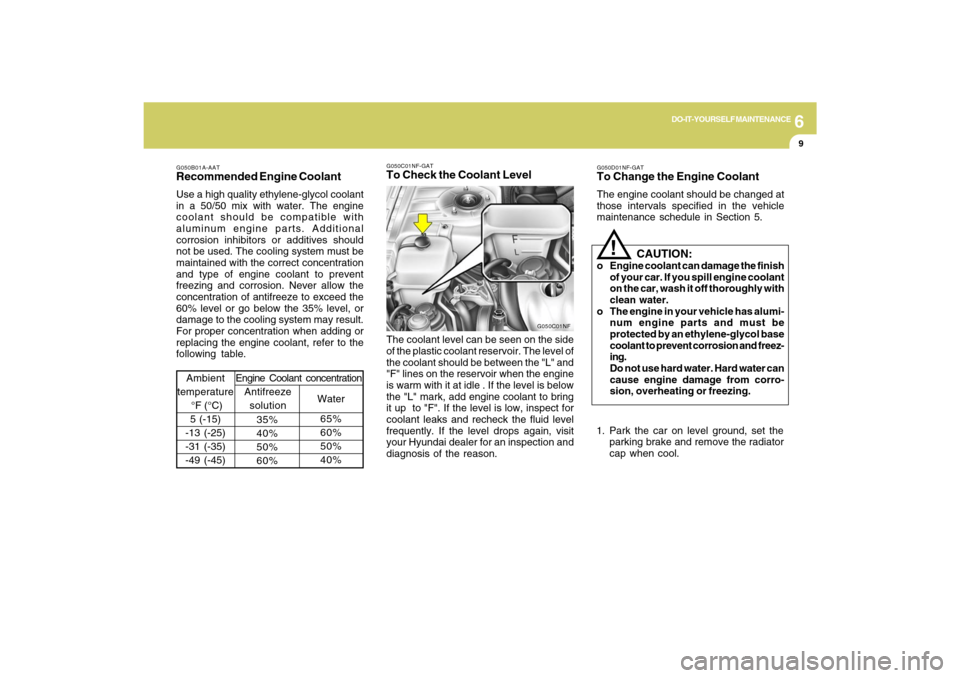
G050C01NF-GATTo Check the Coolant LevelThe coolant level can be seen on the side
of the plastic coolant reservoir. The level of
the coolant should be between the "L" and
"F" lines on the reservoir when the engine
is warm with it at idle . If the level is below
the "L" mark, add engine coolant to bring
it up to "F". If the level is low, inspect for
coolant leaks and recheck the fluid level
frequently. If the level drops again, visit
your Hyundai dealer for an inspection and
diagnosis of the reason.
G050C01NFG050D01NF-GAT
To Change the Engine CoolantThe engine coolant should be changed at
those intervals specified in the vehicle
maintenance schedule in Section 5.
CAUTION:
o Engine coolant can damage the finish
of your car. If you spill engine coolant
on the car, wash it off thoroughly with
clean water.
o The engine in your vehicle has alumi-
num engine parts and must be
protected by an ethylene-glycol base
coolant to prevent corrosion and freez-
ing.
Do not use hard water. Hard water can
cause engine damage from corro-
sion, overheating or freezing.
!
1. Park the car on level ground, set the
parking brake and remove the radiator
cap when cool. Ambient
temperature
°F (°C)
5 (-15)
-13 (-25)
-31 (-35)
-49 (-45)
65%
60%
50%
40% 35%
40%
50%
60%Water Antifreeze
solution Engine Coolant concentration
Page 231 of 286
6
DO-IT-YOURSELF MAINTENANCE
16
2. After the transaxle is warmed up
sufficiently (fluid temperature 70~80°C
(158~176°F), for example by 10 minutes
usual driving, move the shift lever
through all positions then place the
selector lever in “N (Neutral) or P (Park)”
position.
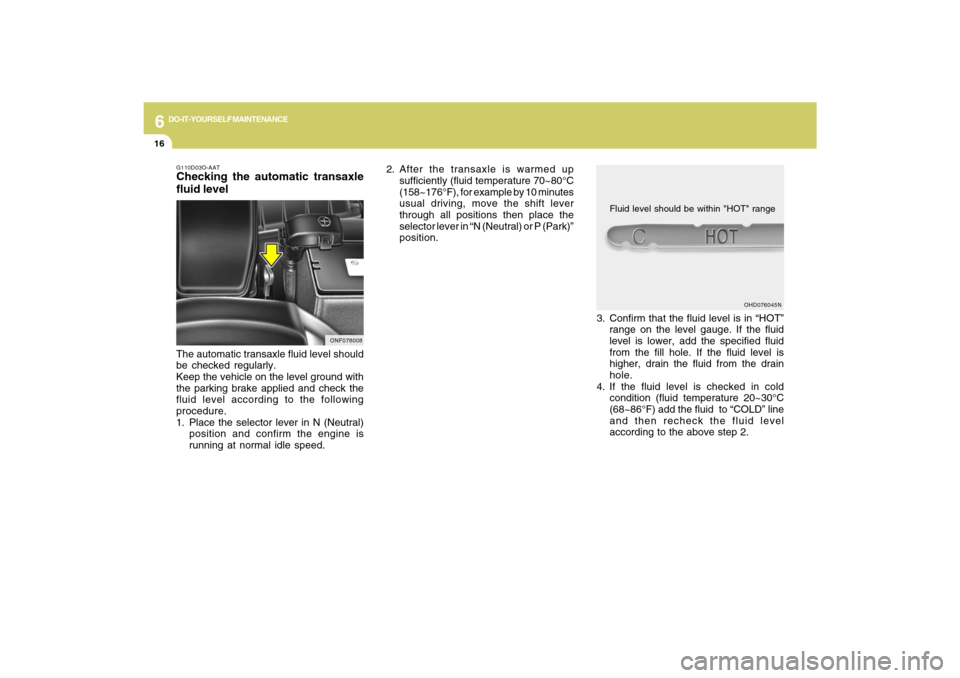
G110D03O-AATChecking the automatic transaxle
fluid levelThe automatic transaxle fluid level should
be checked regularly.
Keep the vehicle on the level ground with
the parking brake applied and check the
fluid level according to the following
procedure.
1. Place the selector lever in N (Neutral)
position and confirm the engine is
running at normal idle speed.
ONF078008
OHD076045N
Fluid level should be within "HOT" range
3. Confirm that the fluid level is in “HOT”
range on the level gauge. If the fluid
level is lower, add the specified fluid
from the fill hole. If the fluid level is
higher, drain the fluid from the drain
hole.
4. If the fluid level is checked in cold
condition (fluid temperature 20~30°C
(68~86°F) add the fluid to “COLD” line
and then recheck the fluid level
according to the above step 2.
Page 232 of 286
6
DO-IT-YOURSELF MAINTENANCE
17
CHECKING THE BRAKES!
G120B01A-AATChecking the Brake Fluid Level
WARNING:Use caution when handling brake fluid. It
can damage your vision if it gets into
your eyes. It will also damage your
vehicle's paint if spilled on it and not
removed immediately.
!
WARNING:
The cooling fan is controlled by engine
coolant temperature and may
sometimes operate even when the
engine is not running. Use extreme
caution when working near the blades of
the cooling fan so that you are not injured
by a rotating fan blade. As the engine
coolant temperature decreases, the fan
will automatically shut off. This is a
normal condition.
G120A01A-AAT
CAUTION:
Because brakes are essential to the
safe operation of the car, it is suggested
that they be checked and inspected by
your Hyundai dealer. The brakes should
be checked and inspected for wear at
those intervals specified in the vehicle
maintenance schedule in Section 5.
!
G120D01A-AATTo Check the Fluid LevelThe fluid level in the brake fluid reservoir
should be checked periodically. The level
should be between the "MIN" and "MAX"
marks on the side of the reservoir. If the
level is at or below the "MIN" mark, carefully
add fluid to bring it up to "MAX". Do not
overfill.G120C02A-AATRecommended Brake FluidUse only hydraulic brake fluid conforming
to DOT 3 or DOT 4 specifications in your
braking system. Follow the instructions
printed on the container.
Page 233 of 286
6
DO-IT-YOURSELF MAINTENANCE
18
G140C01A-AATLubricationTo lubricate the compressor and the seals
in the system, the air conditioning should
be run for at least 10 minutes each week.
This is particularly important during cool
weather when the air conditioning system
is not otherwise in use.
!
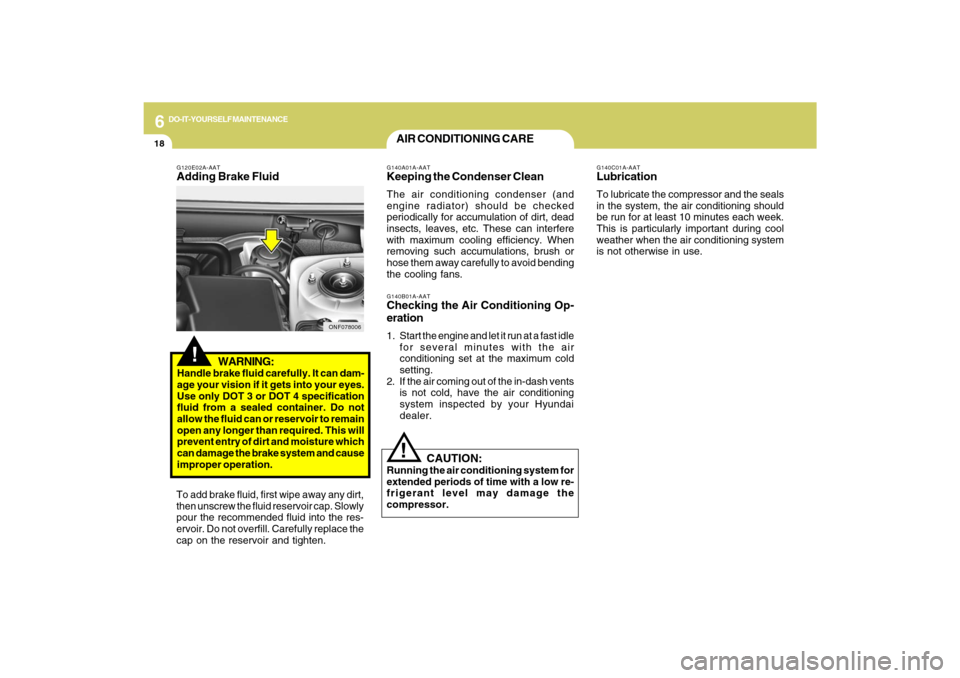
G120E02A-AATAdding Brake Fluid
WARNING:Handle brake fluid carefully. It can dam-
age your vision if it gets into your eyes.
Use only DOT 3 or DOT 4 specification
fluid from a sealed container. Do not
allow the fluid can or reservoir to remain
open any longer than required. This will
prevent entry of dirt and moisture which
can damage the brake system and cause
improper operation.
To add brake fluid, first wipe away any dirt,
then unscrew the fluid reservoir cap. Slowly
pour the recommended fluid into the res-
ervoir. Do not overfill. Carefully replace the
cap on the reservoir and tighten.
AIR CONDITIONING CARE!
G140A01A-AATKeeping the Condenser CleanThe air conditioning condenser (and
engine radiator) should be checked
periodically for accumulation of dirt, dead
insects, leaves, etc. These can interfere
with maximum cooling efficiency. When
removing such accumulations, brush or
hose them away carefully to avoid bending
the cooling fans.G140B01A-AATChecking the Air Conditioning Op-
eration1. Start the engine and let it run at a fast idle
for several minutes with the air
conditioning set at the maximum cold
setting.
2. If the air coming out of the in-dash vents
is not cold, have the air conditioning
system inspected by your Hyundai
dealer.
CAUTION:
Running the air conditioning system for
extended periods of time with a low re-
frigerant level may damage the
compressor.
ONF078006
Page 236 of 286
6
DO-IT-YOURSELF MAINTENANCE
21
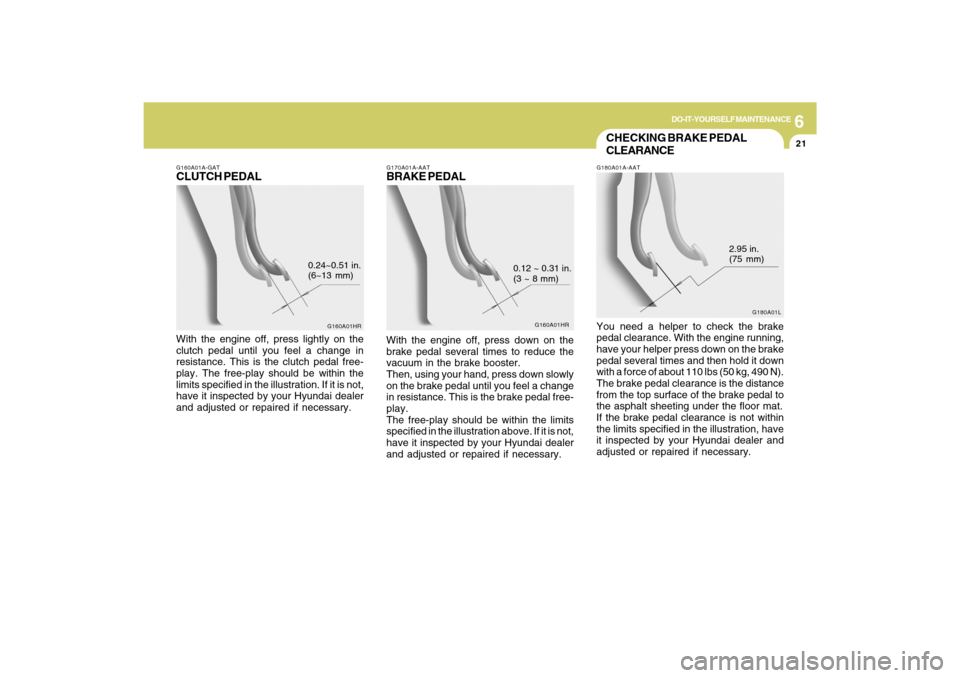
G170A01A-AATBRAKE PEDALWith the engine off, press down on the
brake pedal several times to reduce the
vacuum in the brake booster.
Then, using your hand, press down slowly
on the brake pedal until you feel a change
in resistance. This is the brake pedal free-
play.
The free-play should be within the limits
specified in the illustration above. If it is not,
have it inspected by your Hyundai dealer
and adjusted or repaired if necessary.
G160A01HR
0.12 ~ 0.31 in.
(3 ~ 8 mm)
CHECKING BRAKE PEDAL
CLEARANCEG180A01A-AATYou need a helper to check the brake
pedal clearance. With the engine running,
have your helper press down on the brake
pedal several times and then hold it down
with a force of about 110 lbs (50 kg, 490 N).
The brake pedal clearance is the distance
from the top surface of the brake pedal to
the asphalt sheeting under the floor mat.
If the brake pedal clearance is not within
the limits specified in the illustration, have
it inspected by your Hyundai dealer and
adjusted or repaired if necessary.
G180A01L
2.95 in.
(75 mm)
G160A01A-GATCLUTCH PEDALWith the engine off, press lightly on the
clutch pedal until you feel a change in
resistance. This is the clutch pedal free-
play. The free-play should be within the
limits specified in the illustration. If it is not,
have it inspected by your Hyundai dealer
and adjusted or repaired if necessary.
G160A01HR
0.24~0.51 in.
(6~13 mm)
Page 277 of 286
9
VEHICLE SPECIFICATIONS2
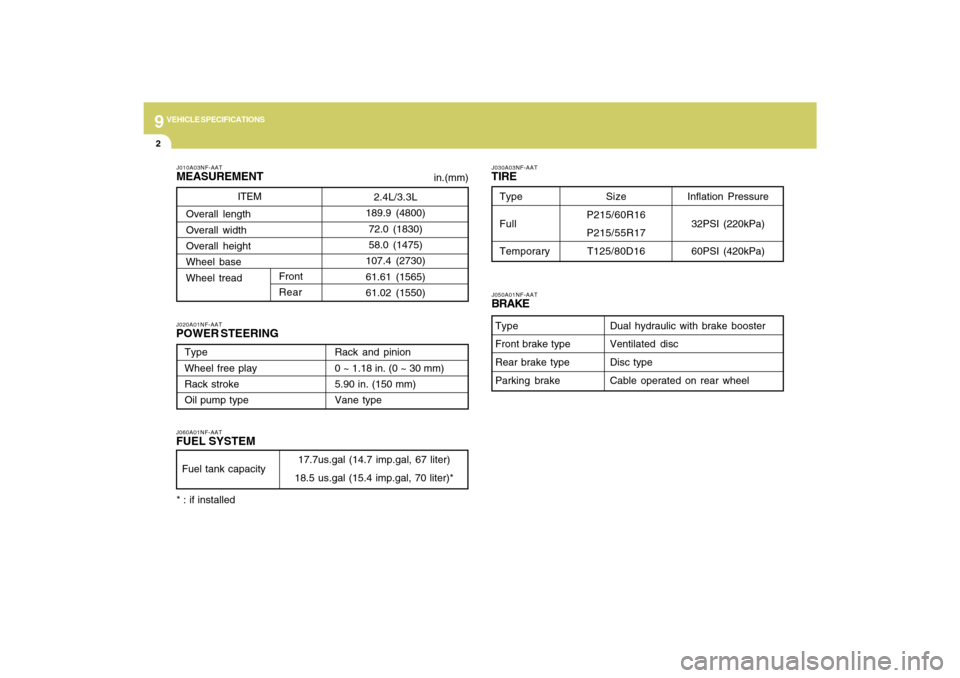
J010A03NF-AATMEASUREMENTJ060A01NF-AATFUEL SYSTEMJ020A01NF-AATPOWER STEERING
J030A03NF-AATTIRE
in.(mm)
Fuel tank capacity
17.7us.gal (14.7 imp.gal, 67 liter)
18.5 us.gal (15.4 imp.gal, 70 liter)* ITEM
J050A01NF-AATBRAKE
Dual hydraulic with brake booster
Ventilated disc
Disc type
Cable operated on rear wheel Type
Front brake type
Rear brake type
Parking brake
Type
Wheel free play
Rack stroke
Oil pump typeRack and pinion
0 ~ 1.18 in. (0 ~ 30 mm)
5.90 in. (150 mm)
Vane type
2.4L/3.3L
189.9 (4800)
72.0 (1830)
58.0 (1475)
107.4 (2730)
61.61 (1565)
61.02 (1550) Overall length
Overall width
Overall height
Wheel base
Wheel tread
Front
Rear
Inflation Pressure
32PSI (220kPa)
60PSI (420kPa)
Type
Full
TemporarySize
P215/60R16
P215/55R17
T125/80D16
* : if installed
Page 279 of 286
9
VEHICLE SPECIFICATIONS4
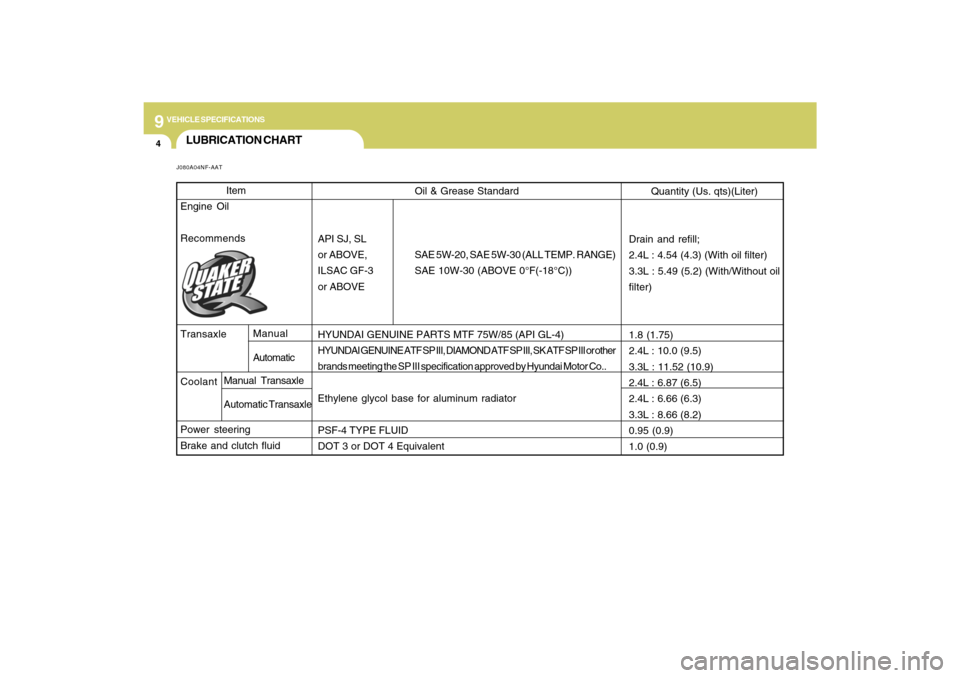
Oil & Grease Standard
API SJ, SL
or ABOVE,SAE 5W-20, SAE 5W-30 (ALL TEMP. RANGE)
ILSAC GF-3 SAE 10W-30 (ABOVE 0°F(-18°C))
or ABOVE
HYUNDAI GENUINE PARTS MTF 75W/85 (API GL-4)
HYUNDAI GENUINE ATF SP III, DIAMOND ATF SP III, SK ATF SP III or other
brands meeting the SP III specification approved by Hyundai Motor Co..Ethylene glycol base for aluminum radiator
PSF-4 TYPE FLUID
DOT 3 or DOT 4 Equivalent
LUBRICATION CHARTJ080A04NF-AAT
Quantity (Us. qts)(Liter)
Drain and refill;
2.4L : 4.54 (4.3) (With oil filter)
3.3L : 5.49 (5.2) (With/Without oil
filter)
1.8 (1.75)
2.4L : 10.0 (9.5)
3.3L : 11.52 (10.9)
2.4L : 6.87 (6.5)
2.4L : 6.66 (6.3)
3.3L : 8.66 (8.2)
0.95 (0.9)
1.0 (0.9) Item
Engine Oil
Recommends
Transaxle
Coolant
Power steering
Brake and clutch fluid
Manual Transaxle
Automatic Transaxle
Manual
Automatic