warning Hyundai Sonata
[x] Cancel search | Manufacturer: HYUNDAI, Model Year: , Model line: , Model:Pages: 340, PDF Size: 18.45 MB
Page 31 of 340
Safety features of your vehicle
22
3
C020400AUN-EA Care of seat belts
Seat belt systems should never be disas-
sembled or modified. In addition, care
should be taken to assure that seat belts
and belt hardware are not damaged by
seat hinges, doors or other abuse.Maintenance of seat belts
When cleaning the seat belts, as recom-
mended, avoid getting solutions into the
buckle where they may attack the lubri-
cant or cause corrosion. Do not attempt
to bleach or re-dye belts, as this may
affect the webbing strength.
✽✽
NOTICE
Do not attempt any form of modifica-
tions or repairs to seat belt components.
If the retractor or other components do
not operate correctly, call an authorised
HYUNDAI dealer, who will take the
necessary corrective action. Your autho-
rised dealer will inspect all seat belt
components at regular intervals and
advise if replacement is required.Between these inspections you should
make regular checks to ensure that for-
eign objects are not preventing completebuckle engagement.
C020401AEN
Periodic inspection
All seat belts should be inspected peri-
odically for wear or damage of any kind.
Any damaged parts should be replaced
as soon as possible.
C020402AUN
Keep belts clean and dry
Seat belts should be kept clean and dry.
If belts become dirty, they can be
cleaned by using a mild soap solution
and warm water. Bleach, dye, strong
detergents or abrasives should not be
used because they may damage and
weaken the fabric. C020403AFD-EA
When to replace seat belts
If the vehicle has been involved in an
accident all seat belt in use at that time,
or belts where the pre-tensioner device
has been deployed must be replaced.
This should be done even if no damage
is visible. Additional questions concern-
ing seat belt operation should be directed
to an authorised HYUNDAI dealer.
WARNING
When you return the rear seatback to its upright position after the rear
seatback was folded down, be care-
ful not to damage the seat belt web-
bing or buckle. Be sure that the
webbing or buckle does not get
caught or pinched in the rear seat.
A seat belt with damaged webbing
or buckle will not be as strong and
could possibly fail during a colli-
sion or sudden stop, resulting in
serious injury.
Page 32 of 340
323
Safety features of your vehicle
CHILD RESTRAINT SYSTEM
C030000BUN-EA
Children riding in the car should sit in the
rear seat and must always be properly
restrained to minimise the risk of injury inan accident, a sudden stop or a sudden
manoeuvre. According to accident statis-
tics, children are safer when properly
restrained in the rear seats than in the
front seat. Larger children not in a child
restraint should use one of the seat belts
provided. If the child is old enough to sit alone and the car is not equipped with a proper
child or infant seat, the child should be
placed in the rear seat and restrainedwith a lap/sash belt.
You should be aware of the specific
requirements in your country. Child and/or
infant safety seats must be properly
placed and installed in the rear seat. You
must use a commercially available child
restraint system that meets the re quire-
ments of the Safety Standards of your
country.
Child restraint systems are designed to be
secured in vehicle seats by lap belts or the
lap belt portion of a lap/shoulder belt, or
by a tether anchor and/or ISOFIX anchors(if equipped). Children could be injured or killed in a
crash if their restraints are not properly
secured. For small children and babies, a
child seat or infant seat must be used. Before buying a particular child restraint
system, make sure it fits your car seat
and seat belts, and fits your child. Follow
all the instructions provided by the man-
ufacturer when installing the child
restraint system.
WARNING
A child restraint system must be placed in the rear seat. Never
install a child or infant seat on the
front passenger's seat. Should anaccident occur and cause the
passenger side air bag to deploy,
it could severely injure or kill an
infant or child seated in an infant
or child seat. Thus only use a
child restraint in the rear seat of
your vehicle.
A seat belt or child restraint sys- tem can become very hot if it is
left in a closed vehicle on a sunny
day, even if the outside tempera-
ture does not feel hot. Be sure to
check the seat cover and buckles
before placing a child there.
When the child restraint system is not in use, store it in the lug-
gage area or fasten it with a seat
belt so that it will not be thrown
forward in the case of a suddenstop or an accident.
(Continued)
(Continued)
A child restraint system shouldbe placed in the vehicle's rear seat since this can make an
important contribution to safety.
Unrestrained children should not be carried in the car. Holding a
child in your arms is not a satis-
factory substitute for a child
restraint system. A child held inthis manner can be crushed
between your body and the interi-
or of the car.
Children may be seriously injured or killed by an inflating air bag.
All children, even those too large
for child restraints, must ride inthe rear seat.
Before installing Child Restraint System to vehicles fitted with
Curtain Airbags, always refer to
safety notices for Curtain Airbag
systems on this manual.
Whenever installing child
restraints, use only approved
devices and refer to "ChildRestraint System" to ensure cor-rect installation and occupant
protection is maximised.
Page 33 of 340
Safety features of your vehicle
24
3
(Continued)
Never leave children unattended
in a vehicle – not even for a short
time. The car can heat up very
quickly, resulting in serious
injuries to children inside. Even
very young children may inadver-
tently cause the vehicle to move,entangle themselves in the win-
dows, or lock themselves or oth-
ers inside the vehicle.
Never allow two children, or any two persons, to use the sameseat belt.
Children often squirm and repo- sition themselves improperly.
Never let a child ride with theshoulder belt under their arm or
behind their back. Always prop-
erly position and secure childrenin rear seat.
Never allow a child to stand-up or kneel on the seat or floorboard of
a moving vehicle. During a colli-
sion or a sudden stop, the child
can be violently thrown against
the vehicles interior, resulting in
serious injury.
(Continued)(Continued)
Never use an infant carrier or achild safety seat that "hooks"
over a seatback, it may not pro-vide adequate security in an acci-dent.
Under all circumstances the attaching bolt must be engagedat least 5 full threads in the
anchorage. If you are in doubt
with any aspect of this installa-tion please contact an authorised
HYUNDAI dealer.
Seat belts can become very hot, especially when the car is parked
in direct sunlight. Always check
seat belt buckles before fasten-
ing them over a child.
Always store or secure a child seat, even when it is not in use.
During a collision or a sudden
stop, the child seat could be
thrown inside the vehicle.WARNING
To reduce the chance or serious or fatal injuries:
Children of all ages are safer when restrained in the rear seat.
A child riding in the front passen-
ger seat can be forcefully struck
by an inflating air bag resulting inserious or fatal injuries.
Always follow the instructions for installation and use of the child
restraint manufacturer.
Always make sure the child seat is secured properly in the car and
your child is securely restrained
in the child seat.
Never hold a child in your arms or lap when riding in a vehicle. The
violent forces created during a
crash will tear the child from your
arms and throw the child against
the car’s interior.
Never put a seat belt over your- self and a child. During a crash,the belt could press deep into the
child causing serious internalinjuries.
(Continued)
Page 34 of 340
325
Safety features of your vehicle
C030100AEN-EA
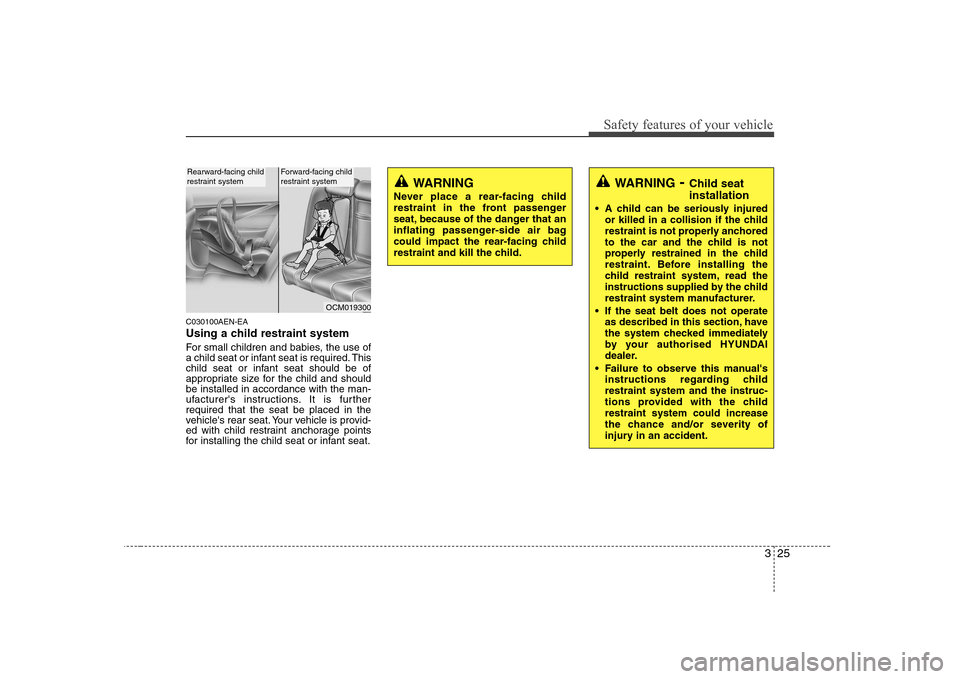
Using a child restraint system
For small children and babies, the use of
a child seat or infant seat is required. This
child seat or infant seat should be of
appropriate size for the child and shouldbe installed in accordance with the man-
ufacturer's instructions. It is furtherrequired that the seat be placed in the
vehicle's rear seat. Your vehicle is provid-
ed with child restraint anchorage points
for installing the child seat or infant seat.
WARNING- Child seat installation
A child can be seriously injured or killed in a collision if the child
restraint is not properly anchored
to the car and the child is not
properly restrained in the child
restraint. Before installing the
child restraint system, read the
instructions supplied by the child
restraint system manufacturer.
If the seat belt does not operate as described in this section, have
the system checked immediately
by your authorised HYUNDAI
dealer.
Failure to observe this manual's instructions regarding childrestraint system and the instruc-
tions provided with the childrestraint system could increase
the chance and/or severity of
injury in an accident.WARNING
Never place a rear-facing child
restraint in the front passenger
seat, because of the danger that an
inflating passenger-side air bag
could impact the rear-facing child
restraint and kill the child.
OCM019300
Rearward-facing child
restraint systemForward-facing child
restraint system
Page 37 of 340
Safety features of your vehicle
28
3
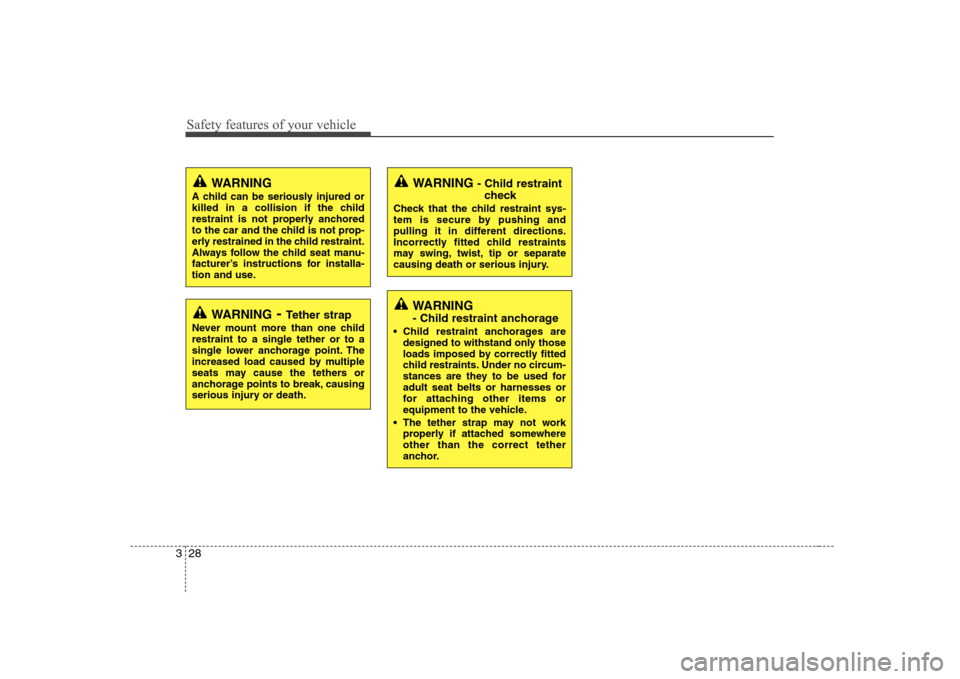
WARNING - Child restraint
check
Check that the child restraint sys-
tem is secure by pushing and
pulling it in different directions.
Incorrectly fitted child restraints
may swing, twist, tip or separate
causing death or serious injury.
WARNING
- Child restraint anchorage
Child restraint anchorages are designed to withstand only those
loads imposed by correctly fitted
child restraints. Under no circum-
stances are they to be used foradult seat belts or harnesses or
for attaching other items or
equipment to the vehicle.
The tether strap may not work properly if attached somewhereother than the correct tether
anchor.WARNING - Tether strap
Never mount more than one child restraint to a single tether or to a
single lower anchorage point. The
increased load caused by multiple
seats may cause the tethers or
anchorage points to break, causing
serious injury or death.
WARNING
A child can be seriously injured or
killed in a collision if the child
restraint is not properly anchored
to the car and the child is not prop-
erly restrained in the child restraint.
Always follow the child seat manu-
facturer’s instructions for installa-
tion and use.
Page 38 of 340
329
Safety features of your vehicle
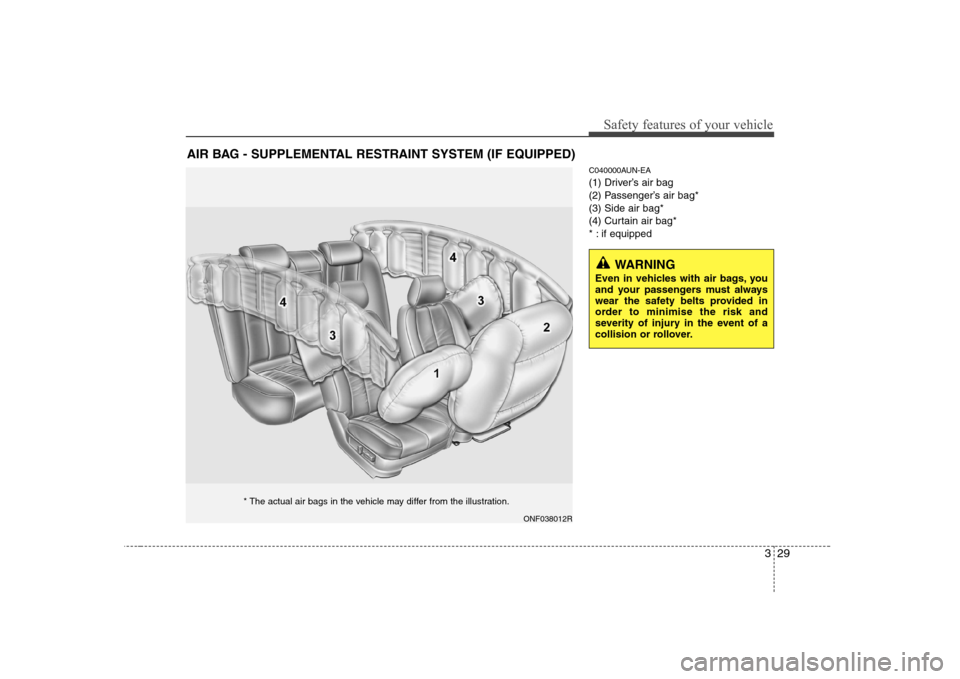
C040000AUN-EA
(1) Driver’s air bag
(2) Passenger’s air bag*(3) Side air bag*
(4) Curtain air bag*
* : if equipped
AIR BAG - SUPPLEMENTAL RESTRAINT SYSTEM (IF EQUIPPED)
ONF038012R
* The actual air bags in the vehicle may differ from the illustration.
WARNING
Even in vehicles with air bags, you
and your passengers must always
wear the safety belts provided in
order to minimise the risk and
severity of injury in the event of a
collision or rollover.
Page 39 of 340
Safety features of your vehicle
30
3
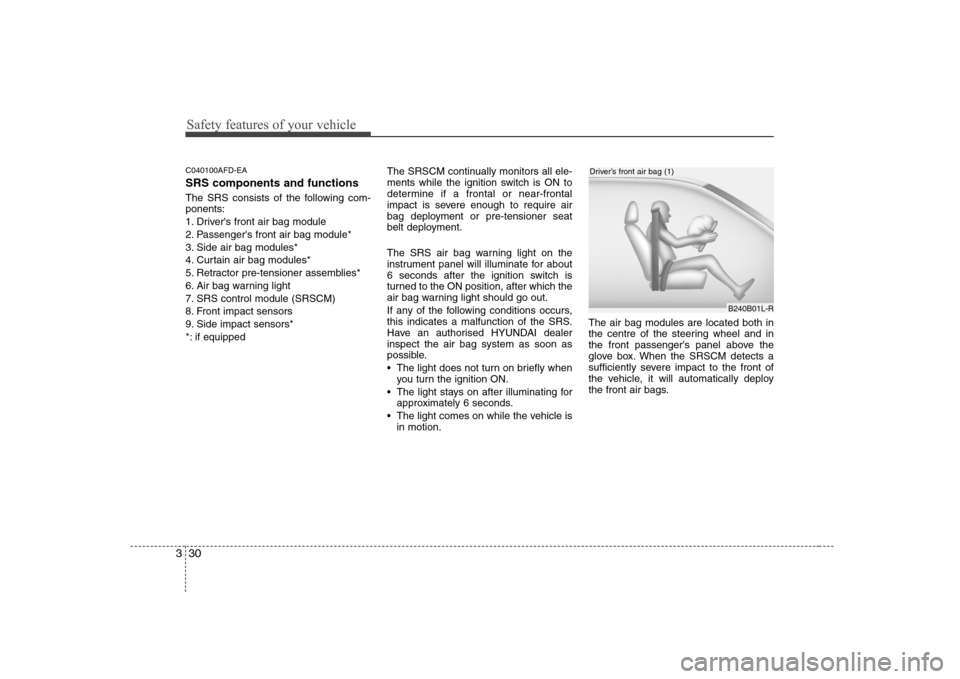
C040100AFD-EA SRS components and functions
The SRS consists of the following com- ponents:
1. Driver's front air bag module
2. Passenger's front air bag module*
3. Side air bag modules*
4. Curtain air bag modules*
5. Retractor pre-tensioner assemblies*
6. Air bag warning light
7. SRS control module (SRSCM)
8. Front impact sensors
9. Side impact sensors*
*: if equipped The SRSCM continually monitors all ele-
ments while the ignition switch is ON to
determine if a frontal or near-frontal
impact is severe enough to require air
bag deployment or pre-tensioner seat
belt deployment.
The SRS air bag warning light on the
instrument panel will illuminate for about
6 seconds after the ignition switch is
turned to the ON position, after which the
air bag warning light should go out.
If any of the following conditions occurs,
this indicates a malfunction of the SRS.
Have an authorised HYUNDAI dealerinspect the air bag system as soon as
possible.
The light does not turn on briefly when
you turn the ignition ON.
The light stays on after illuminating for approximately 6 seconds.
The light comes on while the vehicle is in motion. The air bag modules are located both in
the centre of the steering wheel and in
the front passenger's panel above the
glove box. When the SRSCM detects a
sufficiently severe impact to the front of
the vehicle, it will automatically deploy
the front air bags.
B240B01L-R
Driver’s front air bag (1)
Page 40 of 340
331
Safety features of your vehicle
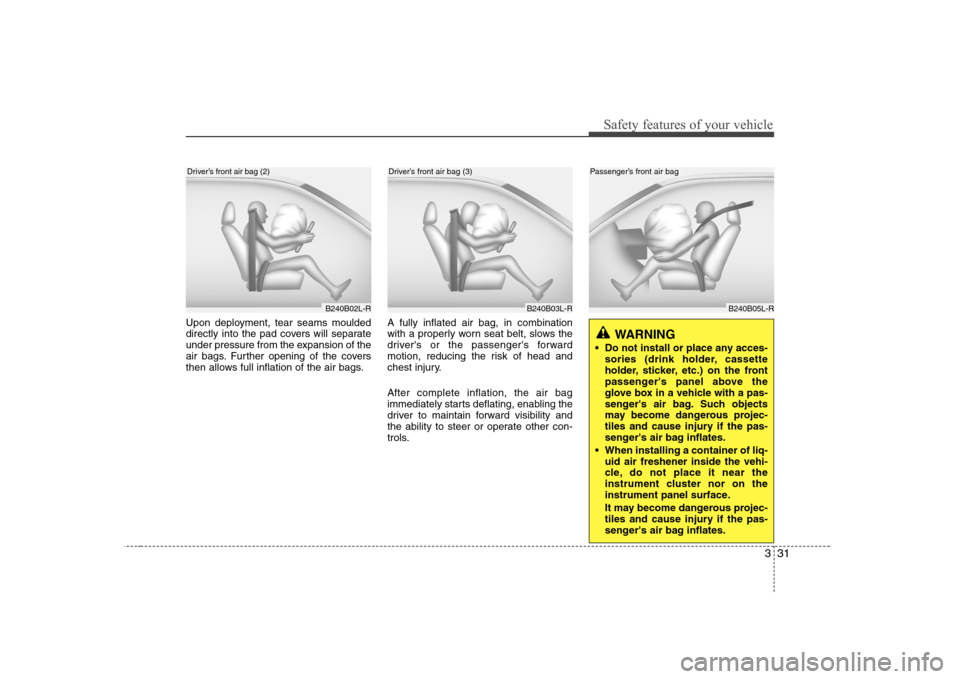
Upon deployment, tear seams moulded
directly into the pad covers will separate
under pressure from the expansion of the
air bags. Further opening of the covers
then allows full inflation of the air bags.A fully inflated air bag, in combination
with a properly worn seat belt, slows the
driver's or the passenger's forward
motion, reducing the risk of head and
chest injury. After complete inflation, the air bag
immediately starts deflating, enabling the
driver to maintain forward visibility and
the ability to steer or operate other con-
trols.
B240B02L-RB240B03L-R
Driver’s front air bag (2)Driver’s front air bag (3)
WARNING
Do not install or place any acces- sories (drink holder, cassette
holder, sticker, etc.) on the front
passenger's panel above the
glove box in a vehicle with a pas-
senger's air bag. Such objects
may become dangerous projec-
tiles and cause injury if the pas-
senger's air bag inflates.
When installing a container of liq- uid air freshener inside the vehi-
cle, do not place it near the
instrument cluster nor on the
instrument panel surface.
It may become dangerous projec-
tiles and cause injury if the pas-
senger's air bag inflates.
B240B05L-R
Passenger’s front air bag
Page 41 of 340
Safety features of your vehicle
32
3
C040400BFD-EA
Driver's and passenger's front air
bag (if equipped)
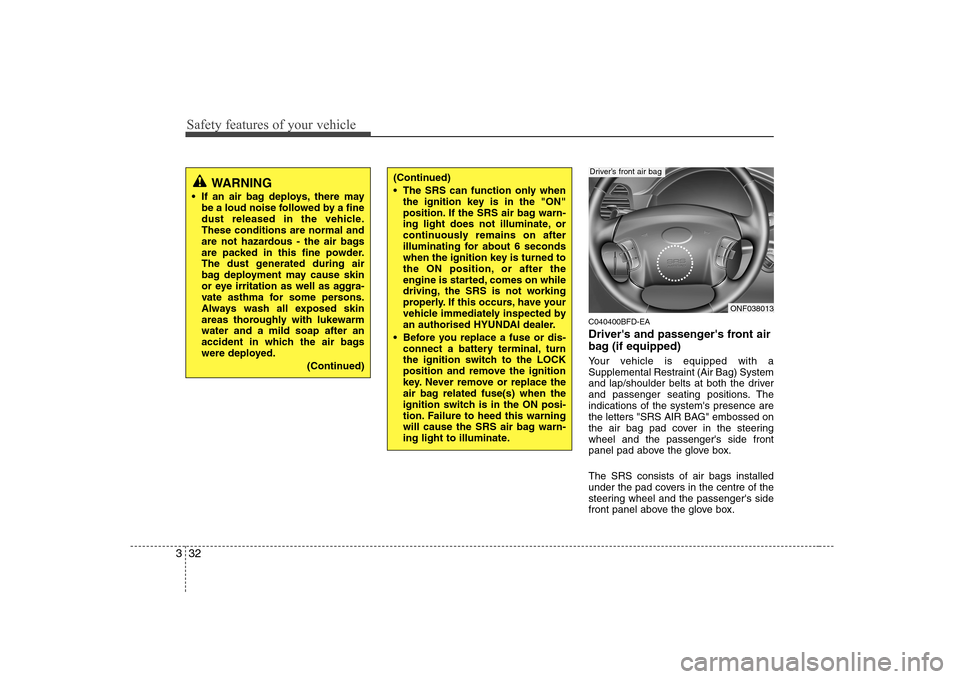
Your vehicle is equipped with a
Supplemental Restraint (Air Bag) System
and lap/shoulder belts at both the driver
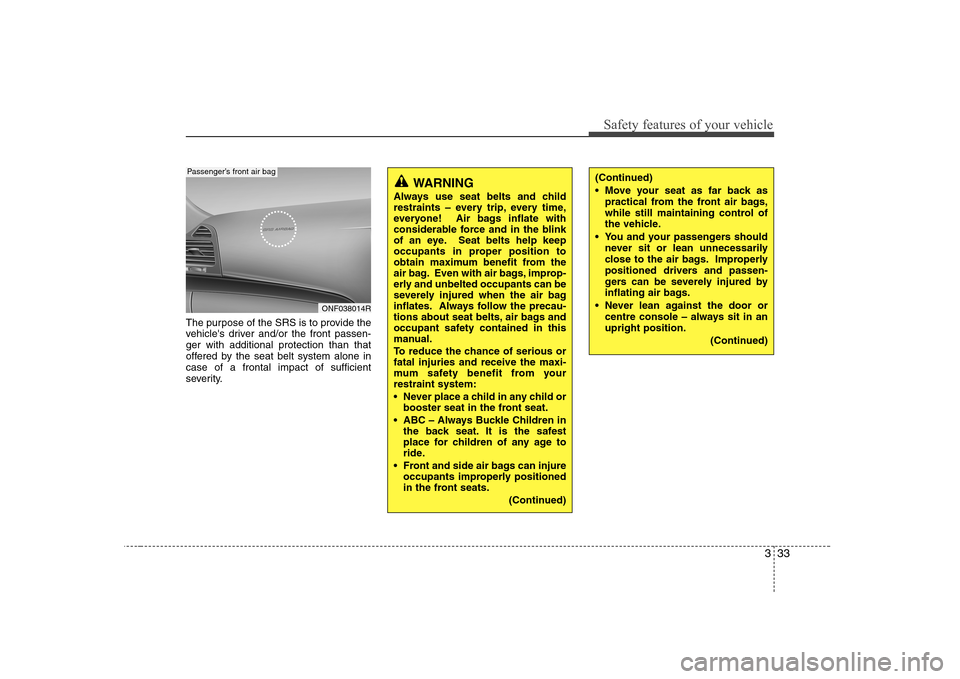
and passenger seating positions. Theindications of the system's presence are
the letters "SRS AIR BAG" embossed on
the air bag pad cover in the steeringwheel and the passenger's side front
panel pad above the glove box. The SRS consists of air bags installed
under the pad covers in the centre of the
steering wheel and the passenger's side
front panel above the glove box.
WARNING
If an air bag deploys, there may be a loud noise followed by a fine
dust released in the vehicle.These conditions are normal and
are not hazardous - the air bags
are packed in this fine powder.
The dust generated during air
bag deployment may cause skin
or eye irritation as well as aggra-
vate asthma for some persons.
Always wash all exposed skin
areas thoroughly with lukewarmwater and a mild soap after an
accident in which the air bags
were deployed.
(Continued)(Continued)
The SRS can function only whenthe ignition key is in the "ON"
position. If the SRS air bag warn-
ing light does not illuminate, or
continuously remains on after
illuminating for about 6 seconds
when the ignition key is turned to
the ON position, or after the
engine is started, comes on while
driving, the SRS is not working
properly. If this occurs, have your
vehicle immediately inspected by
an authorised HYUNDAI dealer.
Before you replace a fuse or dis- connect a battery terminal, turn
the ignition switch to the LOCK
position and remove the ignition
key. Never remove or replace the
air bag related fuse(s) when the
ignition switch is in the ON posi-
tion. Failure to heed this warning
will cause the SRS air bag warn-
ing light to illuminate.
ONF038013
Driver’s front air bag
Page 42 of 340
333
Safety features of your vehicle
The purpose of the SRS is to provide the
vehicle's driver and/or the front passen-ger with additional protection than that
offered by the seat belt system alone incase of a frontal impact of sufficient
severity.
(Continued)
Move your seat as far back aspractical from the front air bags,
while still maintaining control of
the vehicle.
You and your passengers should never sit or lean unnecessarily
close to the air bags. Improperly
positioned drivers and passen-
gers can be severely injured by
inflating air bags.
Never lean against the door or centre console – always sit in anupright position.
(Continued)WARNING
Always use seat belts and child
restraints – every trip, every time,
everyone! Air bags inflate with
considerable force and in the blink
of an eye. Seat belts help keep
occupants in proper position to
obtain maximum benefit from the
air bag. Even with air bags, improp-
erly and unbelted occupants can be
severely injured when the air bag
inflates. Always follow the precau-
tions about seat belts, air bags and
occupant safety contained in this
manual.
To reduce the chance of serious or fatal injuries and receive the maxi-
mum safety benefit from yourrestraint system:
Never place a child in any child or booster seat in the front seat.
ABC – Always Buckle Children in the back seat. It is the safest
place for children of any age to
ride.
Front and side air bags can injure occupants improperly positioned
in the front seats.
(Continued)
ONF038014R
Passenger’s front air bag