oil viscosity Hyundai Sonata
[x] Cancel search | Manufacturer: HYUNDAI, Model Year: , Model line: , Model:Pages: 340, PDF Size: 18.45 MB
Page 217 of 340
Driving your vehicle
40
5
E120200AUN
Use high quality ethylene glycol coolant
Your vehicle is delivered with high quality
ethylene glycol coolant in the cooling
system. It is the only type of coolant that
should be used because it helps prevent
corrosion in the cooling system, lubri-
cates the water pump and prevents
freezing. Be sure to replace or replenish
your coolant in accordance with themaintenance schedule in section 7.
Before winter, have your coolant tested toassure that its freezing point is sufficient
for the temperatures anticipated during
the winter. E120300AFD-EA
Check battery and cables
Winter puts additional burdens on the
battery system. Visually inspect the bat-
tery and cables as described in section
7. The level of charge in your battery can
be checked by an authorised HYUNDAI
dealer or a service station. E120400AFD-EA
Change to "winter weight" oil if
necessary In some climates it is recommended that
a lower viscosity "winter weight" oil be
used during cold weather. See section 9
for recommendations. If you aren't sure
what weight oil you should use, consult
an authorised HYUNDAI dealer.
E120500AUN
Check spark plugs and ignition system
Inspect your spark plugs as described in
section 7 and replace them if necessary.
Also check all ignition wiring and compo-
nents to be sure they are not cracked,
worn or damaged in any way.
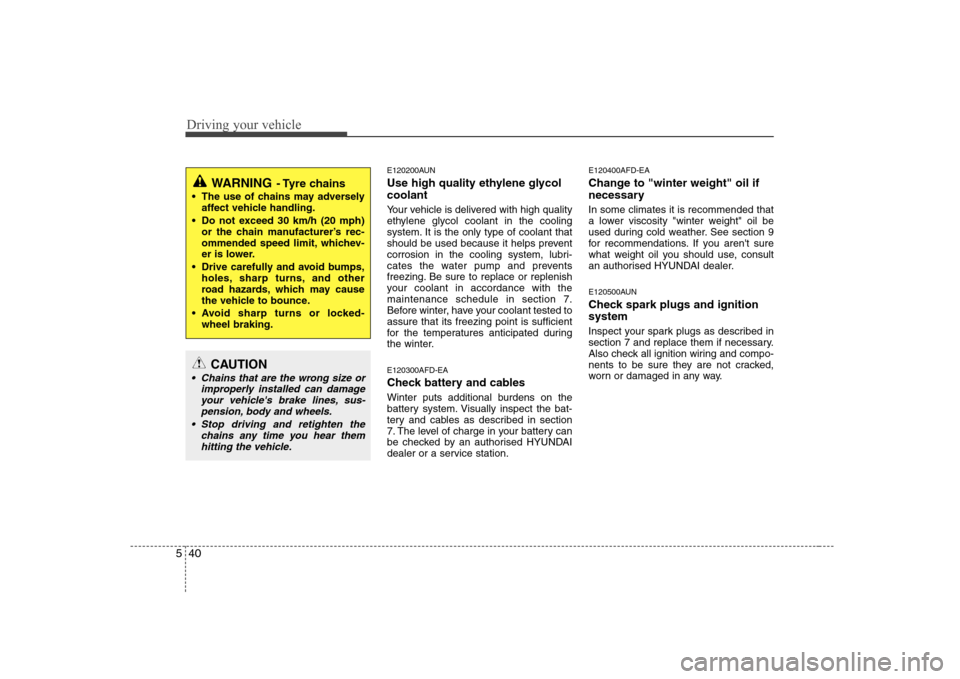
CAUTION
Chains that are the wrong size or
improperly installed can damageyour vehicle's brake lines, sus-pension, body and wheels.
Stop driving and retighten the chains any time you hear themhitting the vehicle.
WARNING - Tyre chains
The use of chains may adversely affect vehicle handling.
Do not exceed 30 km/h (20 mph) or the chain manufacturer’s rec-
ommended speed limit, whichev-
er is lower.
Drive carefully and avoid bumps, holes, sharp turns, and other
road hazards, which may cause
the vehicle to bounce.
Avoid sharp turns or locked- wheel braking.
Page 328 of 340
Specifications
4
9
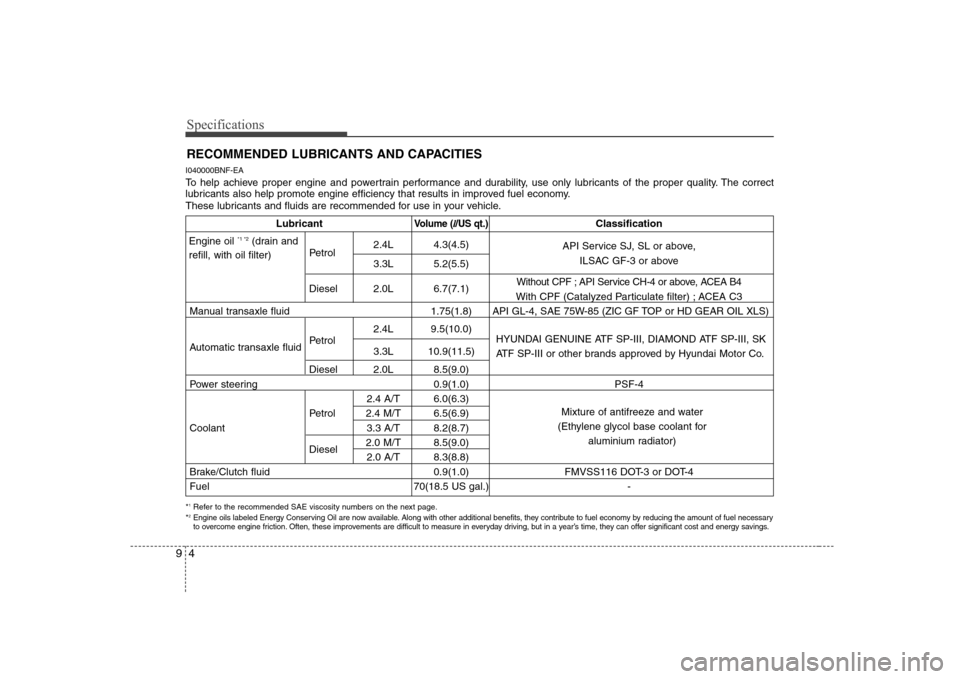
RECOMMENDED LUBRICANTS AND CAPACITIES
I040000BNF-EA
To help achieve proper engine and powertrain performance and durability, use only lubricants of the proper quality. The correct
lubricants also help promote engine efficiency that results in improved fuel economy.
These lubricants and fluids are recommended for use in your vehicle.
LubricantVolume ( l/US qt.)Classification
API Service SJ, SL or above,
Petrol 2.4L 4.3(4.5)
ILSAC GF-3 or above
3.3L 5.2(5.5)
Diesel 2.0L 6.7(7.1)
Without CPF ; API Service CH-4 or above, ACEA B4
With CPF (Catalyzed Particulate filter) ; ACEA C3
Manual transaxle fluid 1.75(1.8) API GL-4, SAE 75W-85 (ZIC GF TOP or HD GEAR OIL XLS)
Automatic transaxle fluid Petrol2.4L 9.5(10.0)
3.3L 10.9(11.5)
Diesel 2.0L 8.5(9.0)
Power steering 0.9(1.0) PSF-4
2.4 A/T 6.0(6.3)
Petrol 2.4 M/T 6.5(6.9)
Coolant 3.3 A/T 8.2(8.7)
Diesel2.0 M/T 8.5(9.0)
2.0 A/T 8.3(8.8)
Brake/Clutch fluid 0.9(1.0) FMVSS116 DOT-3 or DOT-4 Fuel 70(18.5 US gal.) -
Engine oil *1 *2
(drain and
refill, with oil filter)
HYUNDAI GENUINE ATF SP-III, DIAMOND ATF SP-III, SK
ATF SP-III or other brands approved by Hyundai Motor Co.
Mixture of antifreeze and water
(Ethylene glycol base coolant for aluminium radiator)
* 1
Refer to the recommended SAE viscosity numbers on the next page.
* 2
Engine oils labeled Energy Conserving Oil are now available. Along with other additional benefits, they contribute to fuel econo
my by reducing the amount of fuel necessary
to overcome engine friction. Often, these improvements are difficult to measure in everyday driving, but in a year’s time, they can offer significant cost and energy savings.
Page 329 of 340
95
Specifications
I040100ANF-EA Recommended SAE viscosity
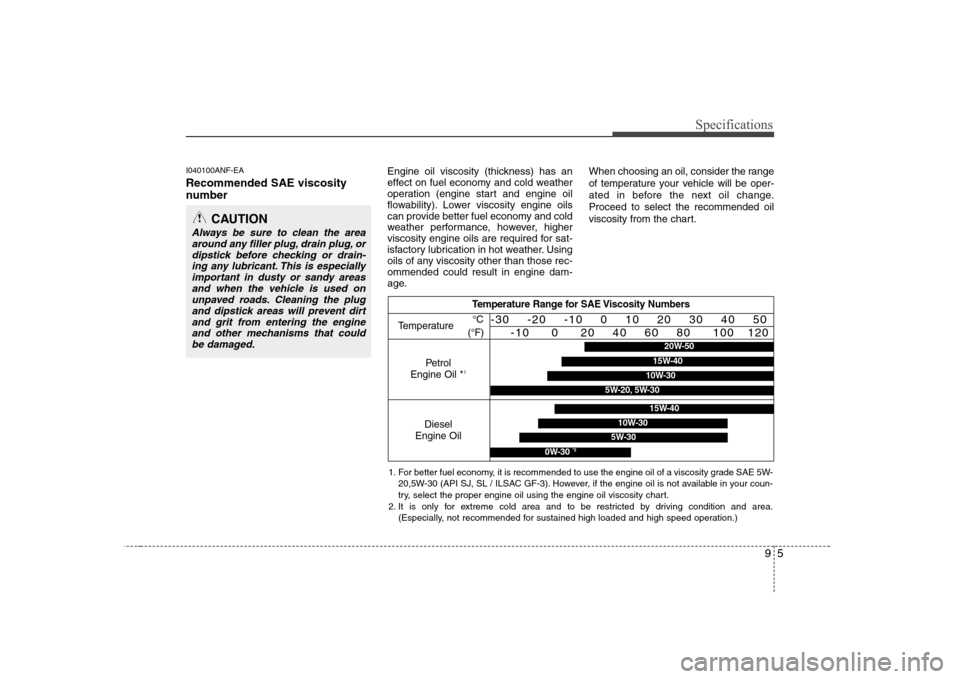
number Engine oil viscosity (thickness) has an
effect on fuel economy and cold weather
operation (engine start and engine oil
flowability). Lower viscosity engine oils
can provide better fuel economy and cold
weather performance, however, higher
viscosity engine oils are required for sat-
isfactory lubrication in hot weather. Using
oils of any viscosity other than those rec-ommended could result in engine dam-
age.When choosing an oil, consider the range
of temperature your vehicle will be oper-
ated in before the next oil change.Proceed to select the recommended oil
viscosity from the chart.
CAUTION
Always be sure to clean the area
around any filler plug, drain plug, ordipstick before checking or drain-
ing any lubricant. This is especiallyimportant in dusty or sandy areas and when the vehicle is used onunpaved roads. Cleaning the plug
and dipstick areas will prevent dirtand grit from entering the engineand other mechanisms that could
be damaged.
Temperature Range for SAE Viscosity Numbers
Temperature
Petrol
Engine Oil *
1
°C
(°F)-30 -20 -10 0 10 20 30 40 50 -10 0 20 40 60 80 100 120
Diesel
Engine Oil
5W-30
15W-40
10W-30
0W-30 *2
1. For better fuel economy, it is recommended to use the engine oil of a viscosity grade SAE 5W-
20,5W-30 (API SJ, SL / ILSAC GF-3). However, if the engine oil is not available in your coun-
try, select the proper engine oil using the engine oil viscosity chart.
2. It is only for extreme cold area and to be restricted by driving condition and area. (Especially, not recommended for sustained high loaded and high speed operation.)
20W-50
10W-30
15W-40
5W-20, 5W-30