lock Hyundai Sonata 2005 Owner's Guide
[x] Cancel search | Manufacturer: HYUNDAI, Model Year: 2005, Model line: Sonata, Model: Hyundai Sonata 2005Pages: 271, PDF Size: 12.44 MB
Page 39 of 271
1FEATURES OF YOUR HYUNDAI26
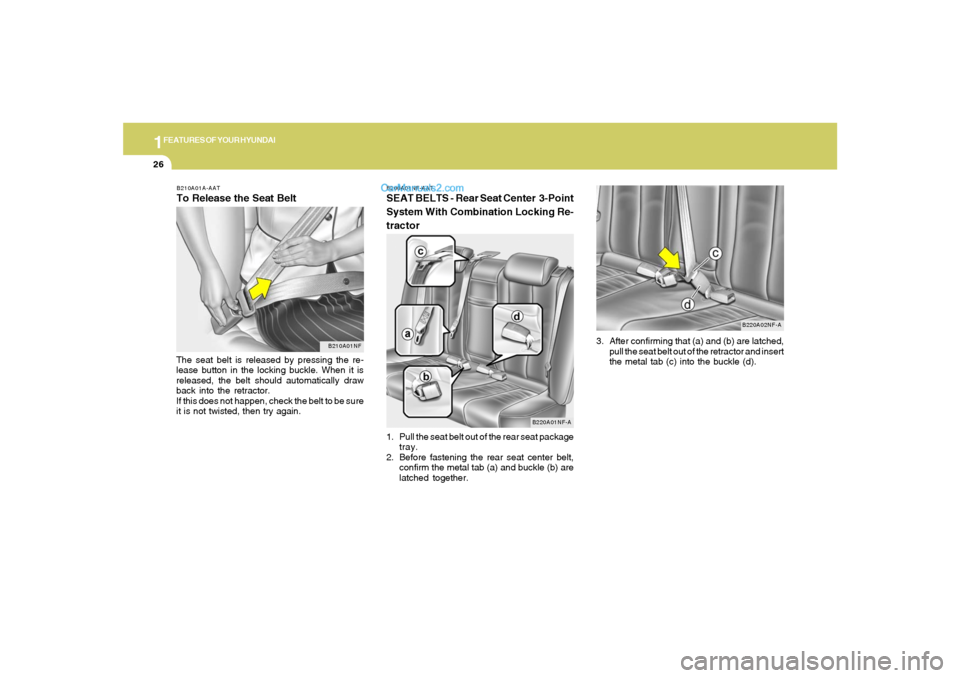
3. After confirming that (a) and (b) are latched,
pull the seat belt out of the retractor and insert
the metal tab (c) into the buckle (d).
B220A02NF-A B200A01NF-AAT
SEAT BELTS - Rear Seat Center 3-Point
System With Combination Locking Re-
tractor1. Pull the seat belt out of the rear seat package
tray.
2. Before fastening the rear seat center belt,
confirm the metal tab (a) and buckle (b) are
latched together.
B220A01NF-A
The seat belt is released by pressing the re-
lease button in the locking buckle. When it is
released, the belt should automatically draw
back into the retractor.
If this does not happen, check the belt to be sure
it is not twisted, then try again.B210A01A-AATTo Release the Seat Belt
B210A01NF
Page 40 of 271
1
FEATURES OF YOUR HYUNDAI
27
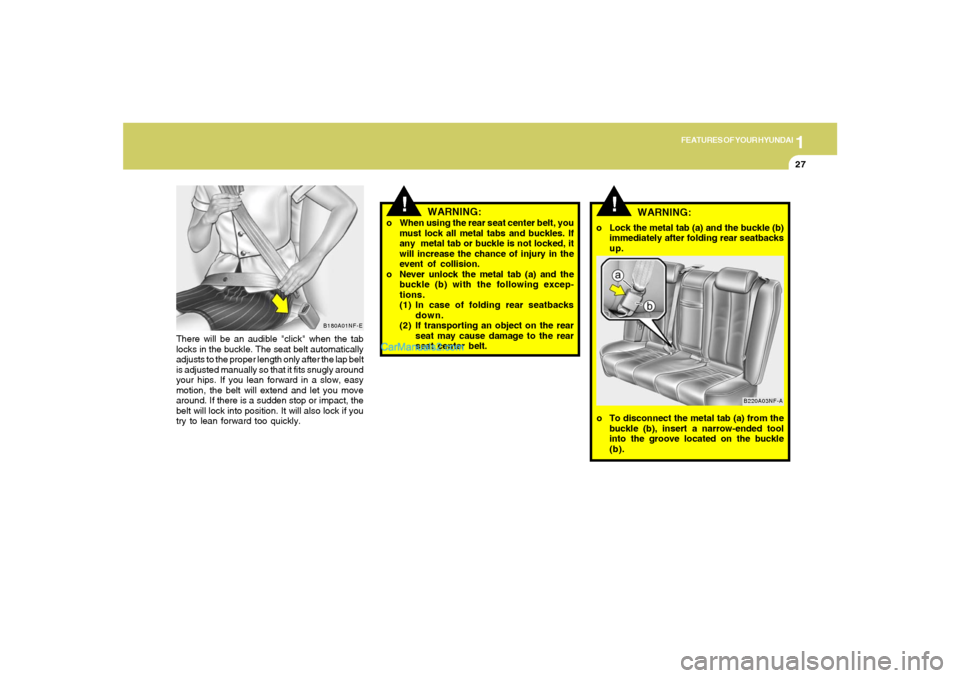
There will be an audible "click" when the tab
locks in the buckle. The seat belt automatically
adjusts to the proper length only after the lap belt
is adjusted manually so that it fits snugly around
your hips. If you lean forward in a slow, easy
motion, the belt will extend and let you move
around. If there is a sudden stop or impact, the
belt will lock into position. It will also lock if you
try to lean forward too quickly.
!
WARNING:
o When using the rear seat center belt, you
must lock all metal tabs and buckles. If
any metal tab or buckle is not locked, it
will increase the chance of injury in the
event of collision.
o Never unlock the metal tab (a) and the
buckle (b) with the following excep-
tions.
(1) In case of folding rear seatbacks
down.
(2) If transporting an object on the rear
seat may cause damage to the rear
seat center belt.
B180A01NF-E
!
o Lock the metal tab (a) and the buckle (b)
immediately after folding rear seatbacks
up.
B220A03NF-A
WARNING:
o To disconnect the metal tab (a) from the
buckle (b), insert a narrow-ended tool
into the groove located on the buckle
(b).
Page 41 of 271
1FEATURES OF YOUR HYUNDAI28
!
WARNING:
o A child restraint system must be placed
in the rear seat. Never install a child or
infant seat on the front passenger's seat.
Should an accident occur and cause the
passenger side airbag to deploy, it could
severely injure or kill an infant or child
seated in an infant or child seat. Thus
only use a child restraint in the rear seat
of your vehicle.
o A safety belt or child restraint system
can become very hot if it is left in a closed
vehicle on a sunny day, even if the out-
side temperature does not feel hot. Be
sure to check the seat cover and buckles
before placing a child there.
o When the child restraint system is not in
use, store it in the trunk or fasten it with
a safety belt so that it will not be thrown
forward in the case of a sudden stop or
an accident.
o Children who are too large to be in a child
restraint should sit in the rear seat and be
restrained with the available lap/shoul-
der belts. Never allow children to ride in
the front passenger seat.
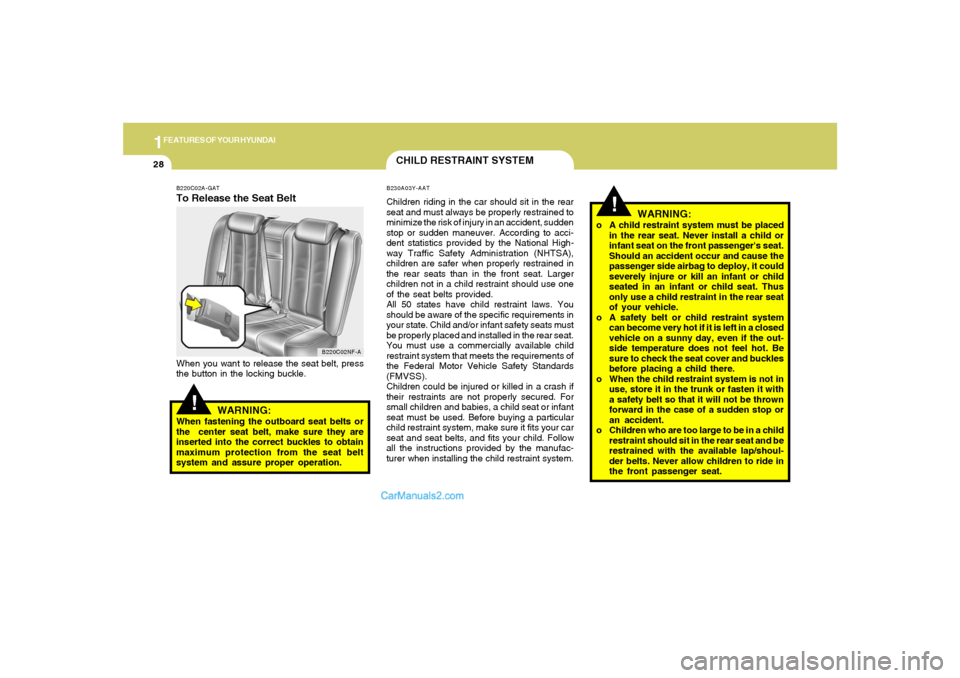
B220C02A-GATTo Release the Seat BeltWhen you want to release the seat belt, press
the button in the locking buckle.
!
WARNING:
When fastening the outboard seat belts or
the center seat belt, make sure they are
inserted into the correct buckles to obtain
maximum protection from the seat belt
system and assure proper operation.
CHILD RESTRAINT SYSTEMB230A03Y-AATChildren riding in the car should sit in the rear
seat and must always be properly restrained to
minimize the risk of injury in an accident, sudden
stop or sudden maneuver. According to acci-
dent statistics provided by the National High-
way Traffic Safety Administration (NHTSA),
children are safer when properly restrained in
the rear seats than in the front seat. Larger
children not in a child restraint should use one
of the seat belts provided.
All 50 states have child restraint laws. You
should be aware of the specific requirements in
your state. Child and/or infant safety seats must
be properly placed and installed in the rear seat.
You must use a commercially available child
restraint system that meets the requirements of
the Federal Motor Vehicle Safety Standards
(FMVSS).
Children could be injured or killed in a crash if
their restraints are not properly secured. For
small children and babies, a child seat or infant
seat must be used. Before buying a particular
child restraint system, make sure it fits your car
seat and seat belts, and fits your child. Follow
all the instructions provided by the manufac-
turer when installing the child restraint system.
B220C02NF-A
Page 45 of 271
1FEATURES OF YOUR HYUNDAI32
B230G03Y-AATInstallation on Rear Seats
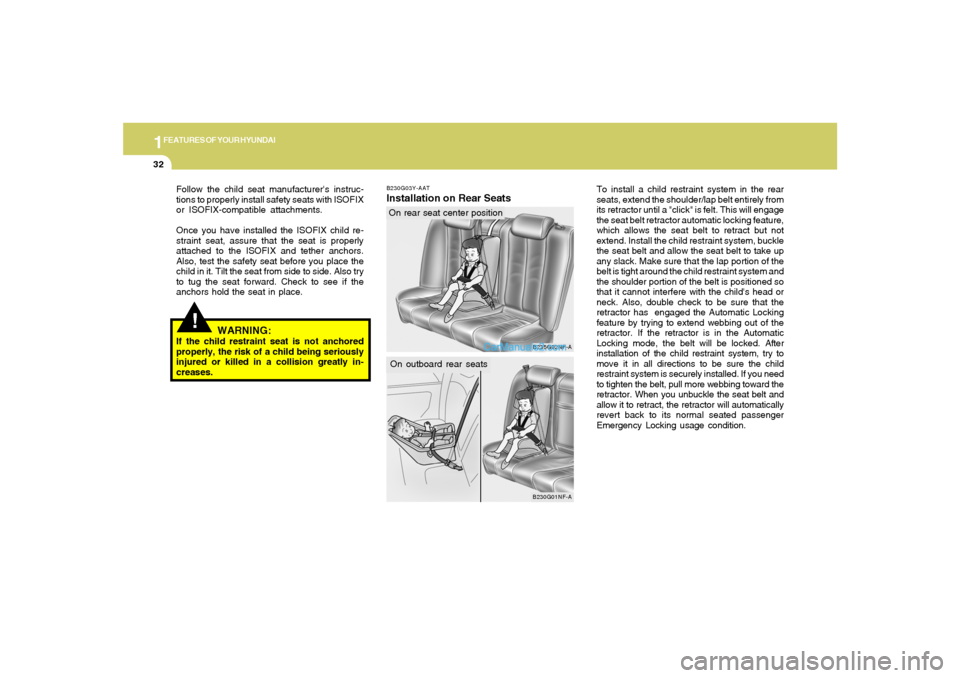
To install a child restraint system in the rear
seats, extend the shoulder/lap belt entirely from
its retractor until a "click" is felt. This will engage
the seat belt retractor automatic locking feature,
which allows the seat belt to retract but not
extend. Install the child restraint system, buckle
the seat belt and allow the seat belt to take up
any slack. Make sure that the lap portion of the
belt is tight around the child restraint system and
the shoulder portion of the belt is positioned so
that it cannot interfere with the child's head or
neck. Also, double check to be sure that the
retractor has engaged the Automatic Locking
feature by trying to extend webbing out of the
retractor. If the retractor is in the Automatic
Locking mode, the belt will be locked. After
installation of the child restraint system, try to
move it in all directions to be sure the child
restraint system is securely installed. If you need
to tighten the belt, pull more webbing toward the
retractor. When you unbuckle the seat belt and
allow it to retract, the retractor will automatically
revert back to its normal seated passenger
Emergency Locking usage condition.
B230G01NF-A
On outboard rear seats
!
WARNING:
If the child restraint seat is not anchored
properly, the risk of a child being seriously
injured or killed in a collision greatly in-
creases. Follow the child seat manufacturer's instruc-
tions to properly install safety seats with ISOFIX
or ISOFIX-compatible attachments.
Once you have installed the ISOFIX child re-
straint seat, assure that the seat is properly
attached to the ISOFIX and tether anchors.
Also, test the safety seat before you place the
child in it. Tilt the seat from side to side. Also try
to tug the seat forward. Check to see if the
anchors hold the seat in place.
B235G02NF-A
On rear seat center position
Page 46 of 271
1
FEATURES OF YOUR HYUNDAI
33
!
WARNING:
o If the retractor is not in the Automatic
Locking mode, the child restraint sys-
tem can move when your vehicle turns or
stops abruptly.
o Do not install any child restraint system
in the front passenger seat. Should an
accident occur and cause the passenger
side airbag to deploy, it could severely
injure or kill an infant or child seated in
an infant or child seat. Therefore, only
use a child restraint system in the rear
seat of your vehicle.NOTE:o Before installing the child restraint sys-
tem in any seating position, read the
instructions supplied by the child re-
straint system manufacturer.
o If the seat belt does not operate as de-
scribed, have the system checked imme-
diately by your authorized Hyundai dealer.
!
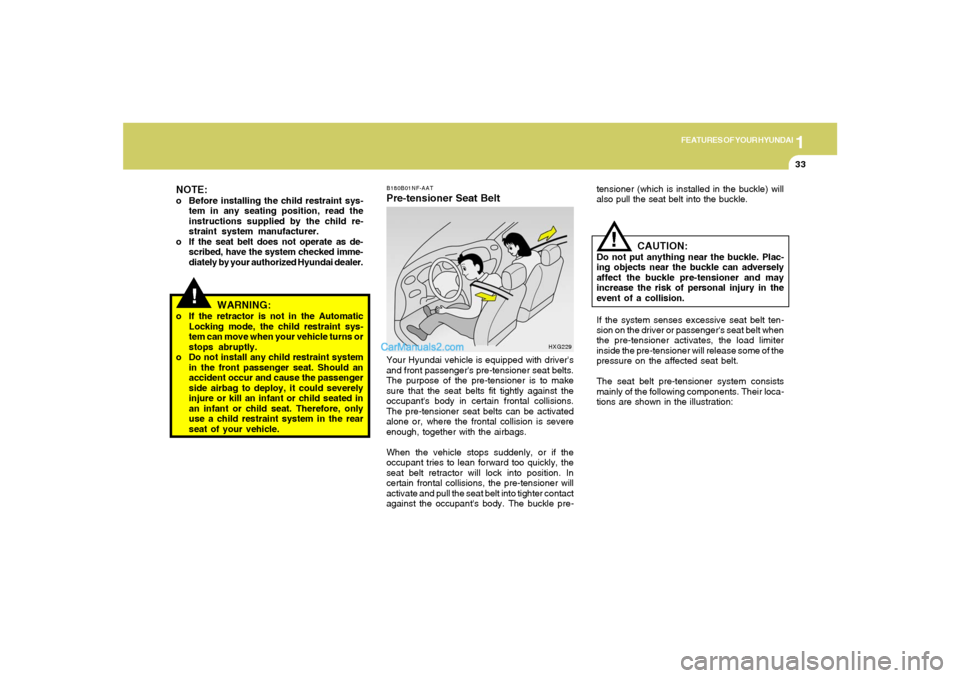
B180B01NF-AATPre-tensioner Seat BeltYour Hyundai vehicle is equipped with driver's
and front passenger's pre-tensioner seat belts.
The purpose of the pre-tensioner is to make
sure that the seat belts fit tightly against the
occupant's body in certain frontal collisions.
The pre-tensioner seat belts can be activated
alone or, where the frontal collision is severe
enough, together with the airbags.
When the vehicle stops suddenly, or if the
occupant tries to lean forward too quickly, the
seat belt retractor will lock into position. In
certain frontal collisions, the pre-tensioner will
activate and pull the seat belt into tighter contact
against the occupant's body. The buckle pre-
HXG229
CAUTION:
Do not put anything near the buckle. Plac-
ing objects near the buckle can adversely
affect the buckle pre-tensioner and may
increase the risk of personal injury in the
event of a collision.
If the system senses excessive seat belt ten-
sion on the driver or passenger's seat belt when
the pre-tensioner activates, the load limiter
inside the pre-tensioner will release some of the
pressure on the affected seat belt.
The seat belt pre-tensioner system consists
mainly of the following components. Their loca-
tions are shown in the illustration: tensioner (which is installed in the buckle) will
also pull the seat belt into the buckle.
Page 54 of 271
1
FEATURES OF YOUR HYUNDAI
41
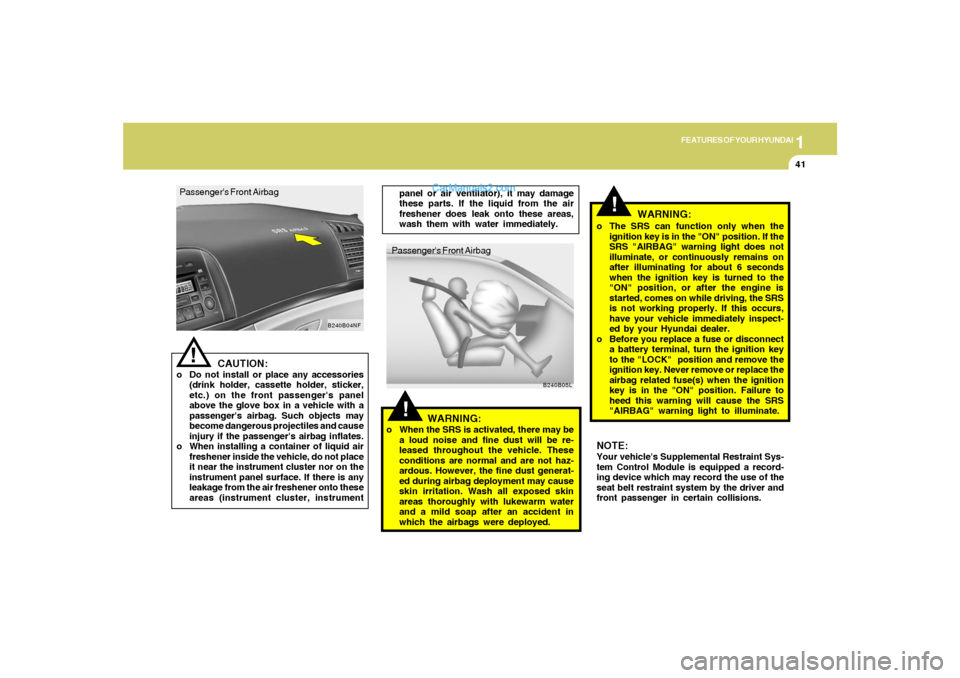
!Passenger's Front Airbag
B240B05L
!
o The SRS can function only when the
ignition key is in the "ON" position. If the
SRS "AIRBAG" warning light does not
illuminate, or continuously remains on
after illuminating for about 6 seconds
when the ignition key is turned to the
"ON" position, or after the engine is
started, comes on while driving, the SRS
is not working properly. If this occurs,
have your vehicle immediately inspect-
ed by your Hyundai dealer.
o Before you replace a fuse or disconnect
a battery terminal, turn the ignition key
to the "LOCK" position and remove the
ignition key. Never remove or replace the
airbag related fuse(s) when the ignition
key is in the "ON" position. Failure to
heed this warning will cause the SRS
"AIRBAG" warning light to illuminate. Passenger's Front Airbag
CAUTION:
o Do not install or place any accessories
(drink holder, cassette holder, sticker,
etc.) on the front passenger's panel
above the glove box in a vehicle with a
passenger's airbag. Such objects may
become dangerous projectiles and cause
injury if the passenger's airbag inflates.
o When installing a container of liquid air
freshener inside the vehicle, do not place
it near the instrument cluster nor on the
instrument panel surface. If there is any
leakage from the air freshener onto these
areas (instrument cluster, instrument
!
B240B04NF
panel or air ventilator), it may damage
these parts. If the liquid from the air
freshener does leak onto these areas,
wash them with water immediately.
WARNING:
o When the SRS is activated, there may be
a loud noise and fine dust will be re-
leased throughout the vehicle. These
conditions are normal and are not haz-
ardous. However, the fine dust generat-
ed during airbag deployment may cause
skin irritation. Wash all exposed skin
areas thoroughly with lukewarm water
and a mild soap after an accident in
which the airbags were deployed.
WARNING:
NOTE:
Your vehicle's Supplemental Restraint Sys-
tem Control Module is equipped a record-
ing device which may record the use of the
seat belt restraint system by the driver and
front passenger in certain collisions.
Page 57 of 271
1FEATURES OF YOUR HYUNDAI44
!
NOTE:The "PASSENGER AIR BAG OFF" indicator
illuminates for about 6 seconds after the
ignition key is turned to the "ON" position
or after the engine is started. If the front
passenger seat is occupied, the occupant
classification sensor will then classify the
front passenger within approximately 10
seconds after the ignition is turned on.
CAUTION:
If the occupant classification system is not
working properly, the SRS airbag warning
light on the instrument panel will
illuminate because the passenger's front
airbags are connected with the occupant
classification system. If there is a malfunc-
tion of the occupant classification system,
the "PASSENGER AIR BAG OFF" indicator
will not illuminate and the passenger's front
airbags will inflate in frontal impact crashes
even if there is no occupant in the front
passenger's seat. If the SRS airbag warning
light does not illuminate when the ignition
key is turned to the "ON" position, remains
illuminated after approximately 6 seconds
when the ignition key is turned to the "ON"
position, or if it illuminates while the vehicle
is being driven, have an authorized Hyundai
dealer inspect the occupant classification
system and the SRS airbag system as soon
as possible.
!
WARNING:
o Even though your vehicle is equipped
with the occupant classification sys-
tem, do not install a child restraint sys-
tem in the front passenger's seat. A child
restraint system must never be placed in
the front seat. Children who are too large
for child restraint systems should al-
ways occupy the rear seat and use the
available lap/shoulder belts. Children are
afforded the most safety in the event of
an accident when they are restrained by
a proper restraint system in the rear seat.
o If the "PASSENGER AIR BAG OFF" indi-
cator is illuminated when the front
passenger's seat is occupied by an adult
and he/she sits properly (sitting upright
with the seatback in an upright position,
centered on the seat cushion with their
seat belt on, legs comfortably extended
and their feet on the floor), have that
person sit in the rear seat.
o If you change the weight on the front
passenger seat just after sit-in or restart
of the engine, the "PASSENGER AIR
BAG OFF" indicator may be turned on or
off for a few seconds, disabling or en-
abling the passenger airbags. After the
initial stage of about 30 seconds, the
"PASSENGER AIR BAG OFF" indicator
will not toggle.
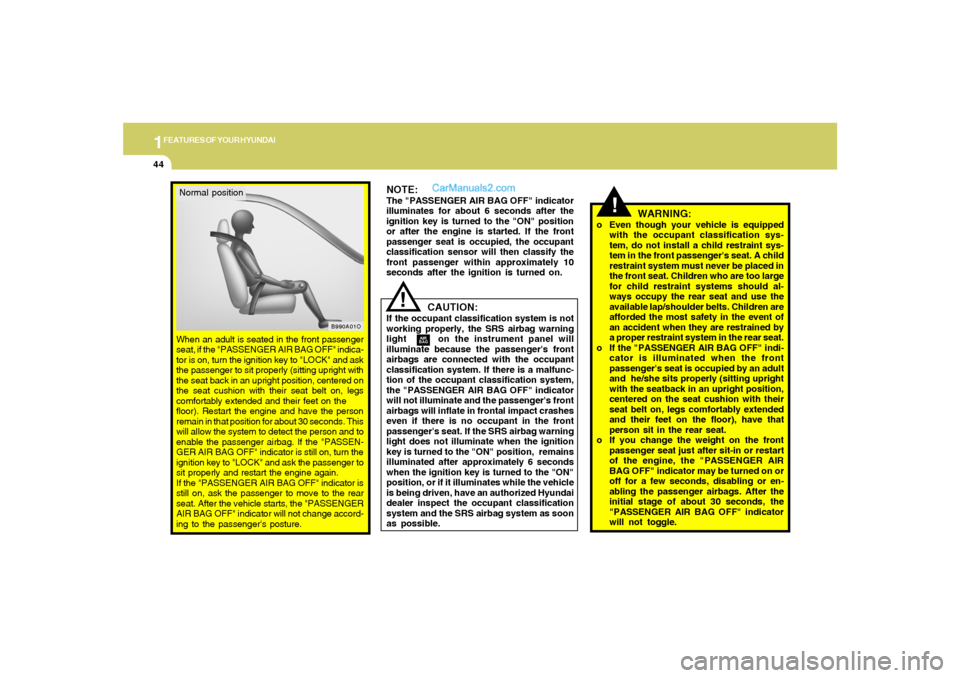
When an adult is seated in the front passenger
seat, if the "PASSENGER AIR BAG OFF" indica-
tor is on, turn the ignition key to "LOCK" and ask
the passenger to sit properly (sitting upright with
the seat back in an upright position, centered on
the seat cushion with their seat belt on, legs
comfortably extended and their feet on the
floor). Restart the engine and have the person
remain in that position for about 30 seconds. This
will allow the system to detect the person and to
enable the passenger airbag. If the "PASSEN-
GER AIR BAG OFF" indicator is still on, turn the
ignition key to "LOCK" and ask the passenger to
sit properly and restart the engine again.
If the "PASSENGER AIR BAG OFF" indicator is
still on, ask the passenger to move to the rear
seat. After the vehicle starts, the "PASSENGER
AIR BAG OFF" indicator will not change accord-
ing to the passenger's posture.Normal position
B990A01O
Page 67 of 271
1FEATURES OF YOUR HYUNDAI54
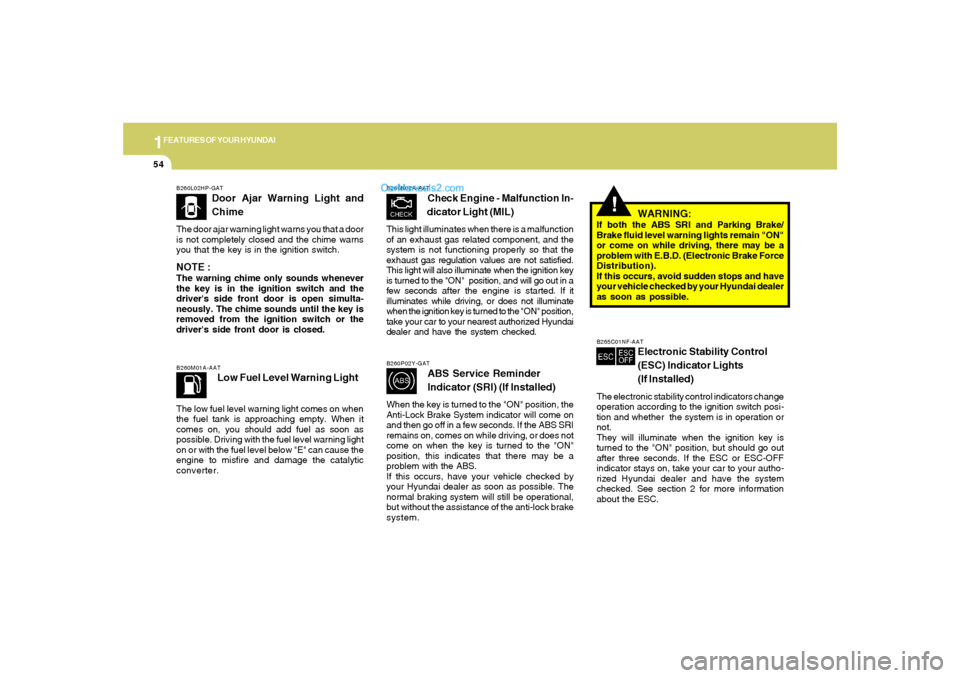
B260L02HP-GAT
Door Ajar Warning Light and
Chime
The door ajar warning light warns you that a door
is not completely closed and the chime warns
you that the key is in the ignition switch.NOTE :The warning chime only sounds whenever
the key is in the ignition switch and the
driver's side front door is open simulta-
neously. The chime sounds until the key is
removed from the ignition switch or the
driver's side front door is closed.
!
B260M01A-AAT
Low Fuel Level Warning Light
The low fuel level warning light comes on when
the fuel tank is approaching empty. When it
comes on, you should add fuel as soon as
possible. Driving with the fuel level warning light
on or with the fuel level below "E" can cause the
engine to misfire and damage the catalytic
converter.
B260P02Y-GAT
ABS Service Reminder
Indicator (SRI) (If Installed)
When the key is turned to the "ON" position, the
Anti-Lock Brake System indicator will come on
and then go off in a few seconds. If the ABS SRI
remains on, comes on while driving, or does not
come on when the key is turned to the "ON"
position, this indicates that there may be a
problem with the ABS.
If this occurs, have your vehicle checked by
your Hyundai dealer as soon as possible. The
normal braking system will still be operational,
but without the assistance of the anti-lock brake
system.
WARNING:
If both the ABS SRI and Parking Brake/
Brake fluid level warning lights remain "ON"
or come on while driving, there may be a
problem with E.B.D. (Electronic Brake Force
Distribution).
If this occurs, avoid sudden stops and have
your vehicle checked by your Hyundai dealer
as soon as possible.
B260N02A-AAT
Check Engine - Malfunction In-
dicator Light (MIL)
This light illuminates when there is a malfunction
of an exhaust gas related component, and the
system is not functioning properly so that the
exhaust gas regulation values are not satisfied.
This light will also illuminate when the ignition key
is turned to the "ON" position, and will go out in a
few seconds after the engine is started. If it
illuminates while driving, or does not illuminate
when the ignition key is turned to the "ON" position,
take your car to your nearest authorized Hyundai
dealer and have the system checked.
B265C01NF-AAT
Electronic Stability Control
(ESC) Indicator Lights
(If Installed)
The electronic stability control indicators change
operation according to the ignition switch posi-
tion and whether the system is in operation or
not.
They will illuminate when the ignition key is
turned to the "ON" position, but should go out
after three seconds. If the ESC or ESC-OFF
indicator stays on, take your car to your autho-
rized Hyundai dealer and have the system
checked. See section 2 for more information
about the ESC.
Page 79 of 271
1FEATURES OF YOUR HYUNDAI66
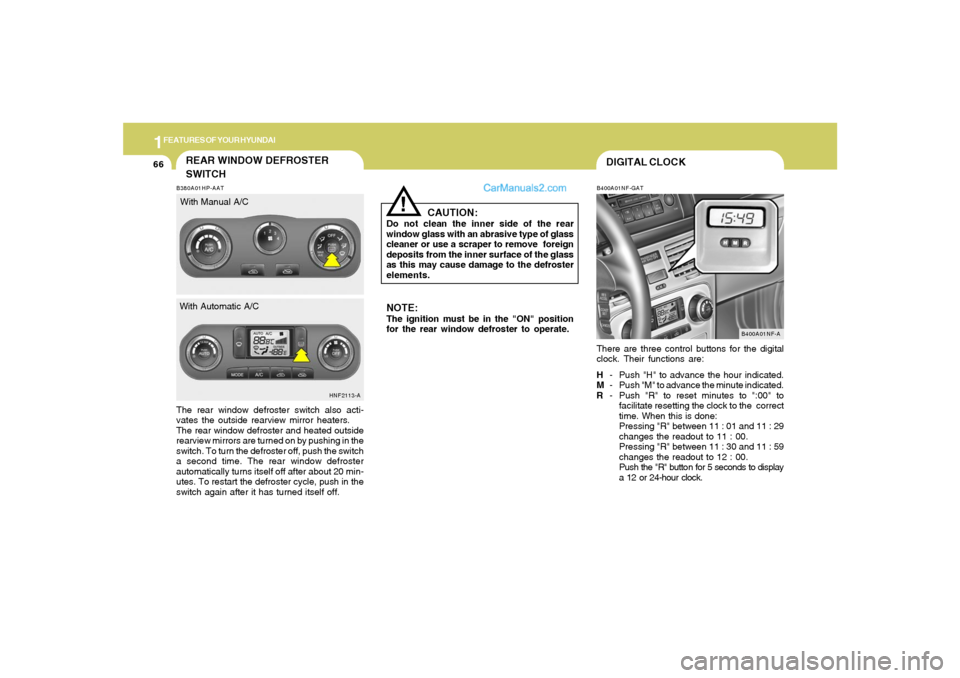
DIGITAL CLOCKB400A01NF-GATThere are three control buttons for the digital
clock. Their functions are:
H- Push "H" to advance the hour indicated.
M- Push "M" to advance the minute indicated.
R- Push "R" to reset minutes to ":00" to
facilitate resetting the clock to the correct
time. When this is done:
Pressing "R" between 11 : 01 and 11 : 29
changes the readout to 11 : 00.
Pressing "R" between 11 : 30 and 11 : 59
changes the readout to 12 : 00.
Push the "R" button for 5 seconds to display
a 12 or 24-hour clock.
B400A01NF-A
NOTE:The ignition must be in the "ON" position
for the rear window defroster to operate.
CAUTION:
Do not clean the inner side of the rear
window glass with an abrasive type of glass
cleaner or use a scraper to remove foreign
deposits from the inner surface of the glass
as this may cause damage to the defroster
elements.
!
B380A01HP-AATThe rear window defroster switch also acti-
vates the outside rearview mirror heaters.
The rear window defroster and heated outside
rearview mirrors are turned on by pushing in the
switch. To turn the defroster off, push the switch
a second time. The rear window defroster
automatically turns itself off after about 20 min-
utes. To restart the defroster cycle, push in the
switch again after it has turned itself off.
HNF2113-A
REAR WINDOW DEFROSTER
SWITCHWith Manual A/C
With Automatic A/C
Page 83 of 271
1FEATURES OF YOUR HYUNDAI70
!SUNROOFB460A02Y-AAT(If Installed)
Sun Shade
B460A01NF
Your HYUNDAI is equipped with a sliding sun-
shade which you can manually adjust to let in
light with the sunroof closed, or to block sunlight.
WARNING:
Never adjust the sunshade while driving.
This could result in loss of control and an
accident that may cause death, serious
injury, or property damage.
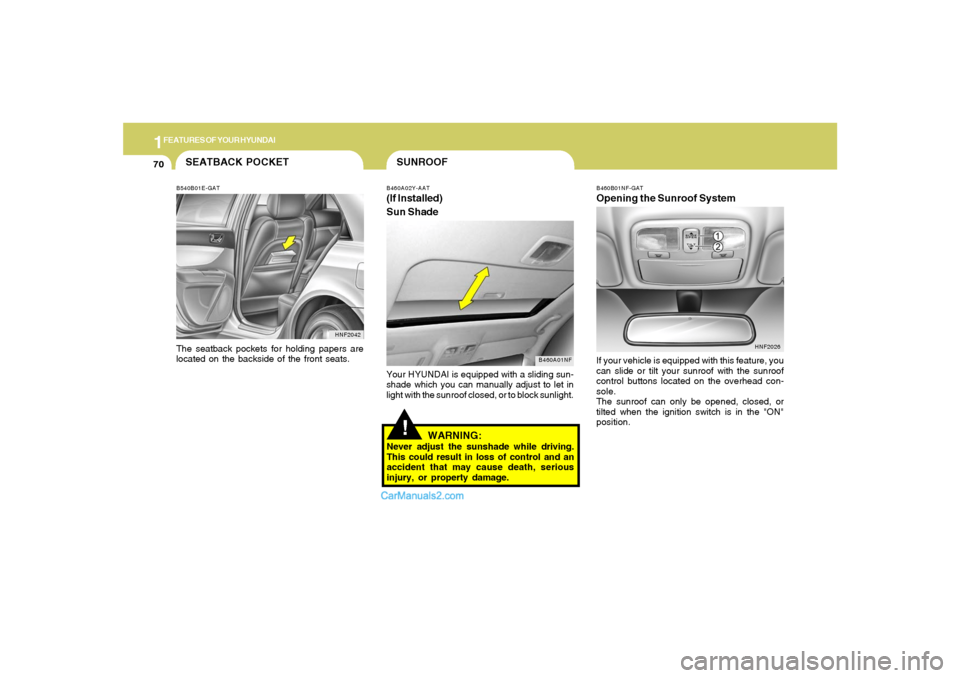
B460B01NF-GATOpening the Sunroof SystemIf your vehicle is equipped with this feature, you
can slide or tilt your sunroof with the sunroof
control buttons located on the overhead con-
sole.
The sunroof can only be opened, closed, or
tilted when the ignition switch is in the "ON"
position.
HNF2026
SEATBACK POCKETB540B01E-GAT
HNF2042The seatback pockets for holding papers are
located on the backside of the front seats.