fan Hyundai Sonata 2006 Owner's Manual
[x] Cancel search | Manufacturer: HYUNDAI, Model Year: 2006, Model line: Sonata, Model: Hyundai Sonata 2006Pages: 276, PDF Size: 12.9 MB
Page 8 of 276
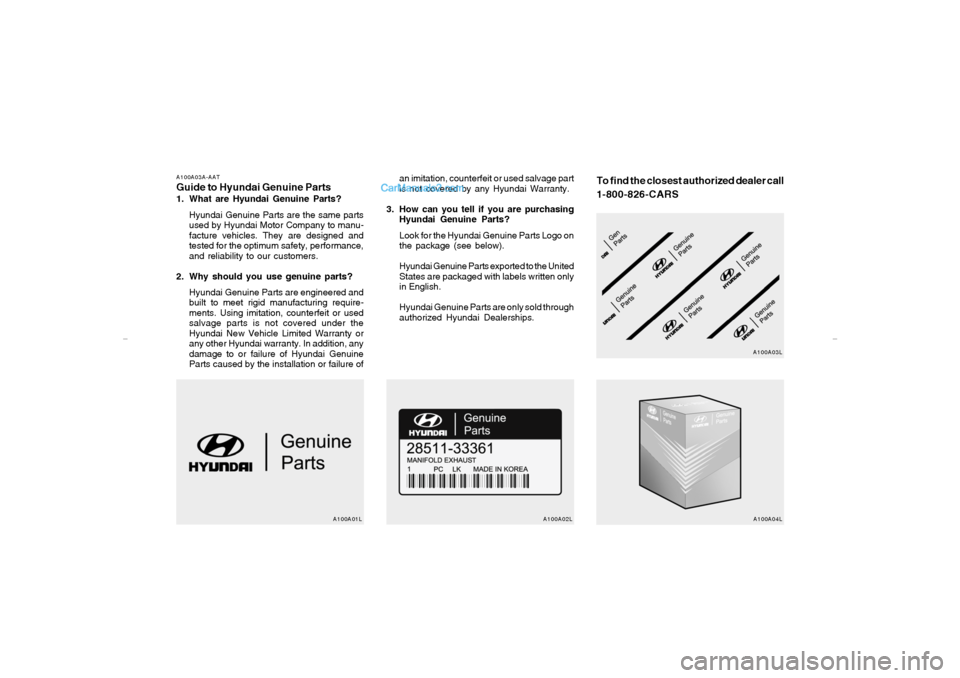
A100A03A-AATGuide to Hyundai Genuine Parts1. What are Hyundai Genuine Parts?
Hyundai Genuine Parts are the same parts
used by Hyundai Motor Company to manu-
facture vehicles. They are designed and
tested for the optimum safety, performance,
and reliability to our customers.
2. Why should you use genuine parts?
Hyundai Genuine Parts are engineered and
built to meet rigid manufacturing require-
ments. Using imitation, counterfeit or used
salvage parts is not covered under the
Hyundai New Vehicle Limited Warranty or
any other Hyundai warranty. In addition, any
damage to or failure of Hyundai Genuine
Parts caused by the installation or failure ofan imitation, counterfeit or used salvage part
is not covered by any Hyundai Warranty.
3. How can you tell if you are purchasing
Hyundai Genuine Parts?
Look for the Hyundai Genuine Parts Logo on
the package (see below).
Hyundai Genuine Parts exported to the United
States are packaged with labels written only
in English.
Hyundai Genuine Parts are only sold through
authorized Hyundai Dealerships.
To find the closest authorized dealer call
1-800-826-CARS
A100A01L A100A02L A100A04LA100A03L
nfhma-0.p659/16/2005, 10:39 AM 8
Page 35 of 276
1
FEATURES OF YOUR HYUNDAI
21
!
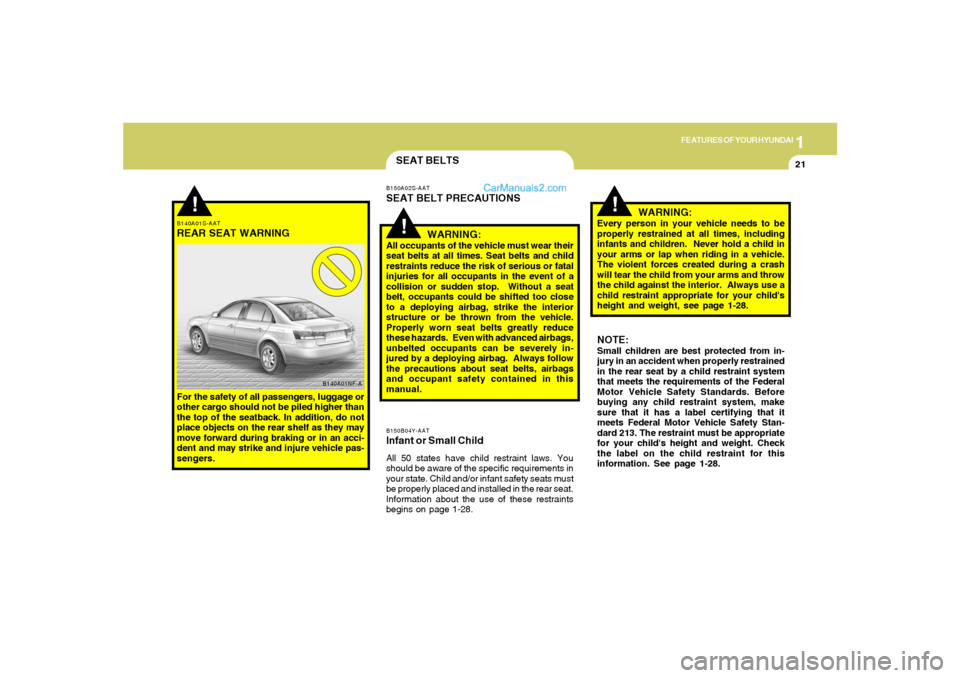
B140A01S-AATREAR SEAT WARNINGFor the safety of all passengers, luggage or
other cargo should not be piled higher than
the top of the seatback. In addition, do not
place objects on the rear shelf as they may
move forward during braking or in an acci-
dent and may strike and injure vehicle pas-
sengers.
B140A01NF-A
SEAT BELTSB150B04Y-AATInfant or Small ChildAll 50 states have child restraint laws. You
should be aware of the specific requirements in
your state. Child and/or infant safety seats must
be properly placed and installed in the rear seat.
Information about the use of these restraints
begins on page 1-28.
!
B150A02S-AATSEAT BELT PRECAUTIONS
WARNING:All occupants of the vehicle must wear their
seat belts at all times. Seat belts and child
restraints reduce the risk of serious or fatal
injuries for all occupants in the event of a
collision or sudden stop. Without a seat
belt, occupants could be shifted too close
to a deploying airbag, strike the interior
structure or be thrown from the vehicle.
Properly worn seat belts greatly reduce
these hazards. Even with advanced airbags,
unbelted occupants can be severely in-
jured by a deploying airbag. Always follow
the precautions about seat belts, airbags
and occupant safety contained in this
manual.
!
WARNING:
Every person in your vehicle needs to be
properly restrained at all times, including
infants and children. Never hold a child in
your arms or lap when riding in a vehicle.
The violent forces created during a crash
will tear the child from your arms and throw
the child against the interior. Always use a
child restraint appropriate for your child's
height and weight, see page 1-28.NOTE:Small children are best protected from in-
jury in an accident when properly restrained
in the rear seat by a child restraint system
that meets the requirements of the Federal
Motor Vehicle Safety Standards. Before
buying any child restraint system, make
sure that it has a label certifying that it
meets Federal Motor Vehicle Safety Stan-
dard 213. The restraint must be appropriate
for your child's height and weight. Check
the label on the child restraint for this
information. See page 1-28.
Page 39 of 276
1
FEATURES OF YOUR HYUNDAI
25
B190A02NF-AATSEAT BELTS-Front Passenger and Rear
Seat 3-Point System with Combination
Locking Retractor
To Fasten Your BeltCombination retractor type seat belts are in-
stalled in the rear seat positions to help accom-
modate the installation of child restraint systems.
Although a combination retractor is also installed
in the front passenger seat position, Hyundai
strongly recommends that children always be
seated in the rear seat. NEVER place any infant
restraint system in the front seat of the vehicle.
This type of seat belt combines the features of
both an emergency locking retractor seat belt
and an automatic locking retractor seat belt. To
fasten your seat belt, pull it out of the retractor
and insert the metal tab into the buckle. There
will be an audible "click" when the tab locks into
the buckle. When not securing a child restraint,
the seat belt operates in the same way as the
driver's seat belt (Emergency Locking Retrac-
tor Type). It automatically adjusts to the proper
length only after the lap belt portion of the seat
belt is adjusted manually so that it fits snugly
around your hips. When the seat belt is fully
extended from the retractor to allow the instal-
lation of a child restraint system, the seat belt
operation changes to allow the belt to retract, but
not to extend (Automatic Locking Retractor
Type). See page 1-32.
NOTE:o Although the combination retractor pro-
vides the same level of protection for
seated passengers in either emergency
or automatic locking modes, it is recom-
mended that seated passengers use the
emergency locking feature for improved
convenience. The automatic locking
function is intended to facilitate child
restraint installation. To convert from
the automatic locking feature to the
emergency locking operation mode, al-
low the unbuckled seat belt to fully re-
tract.
o The front passenger's seat belt warning
light on the center fascia panel blinks
until the front passenger's seat belt is
fastened to remind the front passenger
to fasten the front passenger's seat belt,
when the ignition key is turned from the
"OFF" position to "the "ON" or "START"
position.
WARNING:
o For maximum restraint system protec-
tion, the seat belts must always be used
whenever the car is moving.
o Seat belts are most effective when
seatbacks are in the upright position.
o Children age 12 and younger must al-
ways be properly restrained in the rear
seat. Never allow children to ride in the
front passenger seat. If a child over 13
must be seated in the front seat, he/she
must be properly belted and the seat
should be moved as far back as possible.
o Never wear the shoulder belt under your
arm or behind your back. An improperly
positioned shoulder belt can cause se-
rious injuries in a crash. The shoulder
belt should be positioned midway over
your shoulder across your collarbone.
o Avoid wearing twisted seat belts. A
twisted belt can't do its job as well. In a
collision, it could even cut into you. Be
sure the belt webbing is straight and not
twisted.
o Be careful not to damage the belt web-
bing or hardware. If the belt webbing or
hardware is damaged, replace it.
!
Page 42 of 276
1FEATURES OF YOUR HYUNDAI28
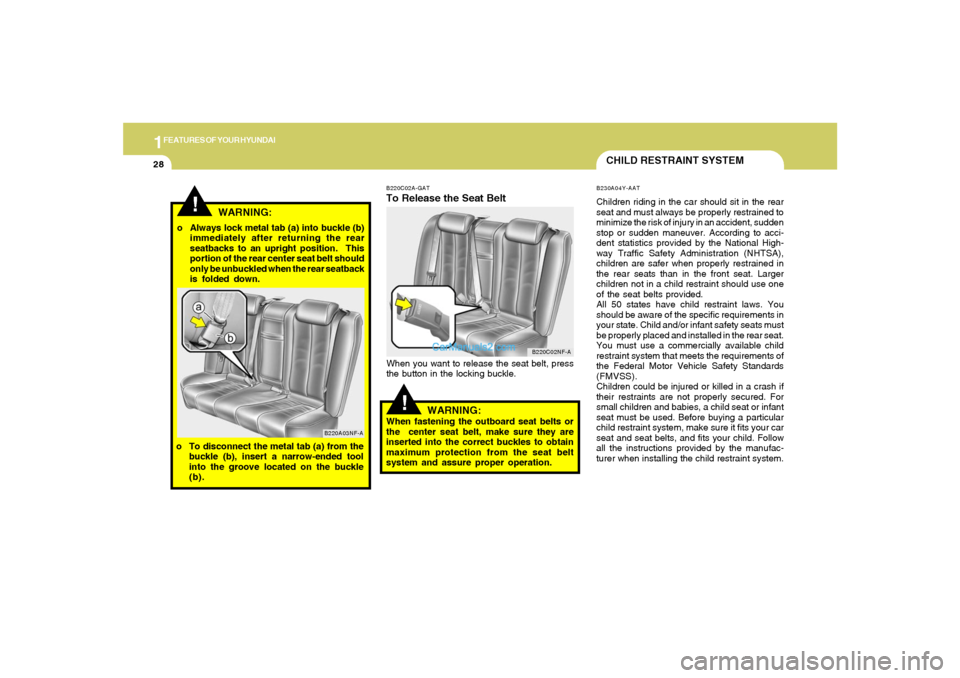
B220C02A-GATTo Release the Seat BeltWhen you want to release the seat belt, press
the button in the locking buckle.
!
WARNING:
When fastening the outboard seat belts or
the center seat belt, make sure they are
inserted into the correct buckles to obtain
maximum protection from the seat belt
system and assure proper operation.
CHILD RESTRAINT SYSTEMB230A04Y-AATChildren riding in the car should sit in the rear
seat and must always be properly restrained to
minimize the risk of injury in an accident, sudden
stop or sudden maneuver. According to acci-
dent statistics provided by the National High-
way Traffic Safety Administration (NHTSA),
children are safer when properly restrained in
the rear seats than in the front seat. Larger
children not in a child restraint should use one
of the seat belts provided.
All 50 states have child restraint laws. You
should be aware of the specific requirements in
your state. Child and/or infant safety seats must
be properly placed and installed in the rear seat.
You must use a commercially available child
restraint system that meets the requirements of
the Federal Motor Vehicle Safety Standards
(FMVSS).
Children could be injured or killed in a crash if
their restraints are not properly secured. For
small children and babies, a child seat or infant
seat must be used. Before buying a particular
child restraint system, make sure it fits your car
seat and seat belts, and fits your child. Follow
all the instructions provided by the manufac-
turer when installing the child restraint system.
B220C02NF-A
!
o Always lock metal tab (a) into buckle (b)
immediately after returning the rear
seatbacks to an upright position. This
portion of the rear center seat belt should
only be unbuckled when the rear seatback
is folded down.
B220A03NF-A
WARNING:
o To disconnect the metal tab (a) from the
buckle (b), insert a narrow-ended tool
into the groove located on the buckle
(b).
Page 43 of 276
1
FEATURES OF YOUR HYUNDAI
29
!
WARNING:
o A child restraint system must be placed
in the rear seat. Never install a child or
infant seat on the front passenger's seat.
Should an accident occur and cause the
passenger side airbag to deploy, it could
severely injure or kill an infant or child
seated in an infant or child seat. Thus
only use a child restraint in the rear seat
of your vehicle.
o A safety belt or child restraint system
can become very hot if it is left in a closed
vehicle on a sunny day, even if the out-
side temperature does not feel hot. Be
sure to check the seat cover and buckles
before placing a child there.
o When the child restraint system is not in
use, store it in the trunk or fasten it with
a safety belt so that it will not be thrown
forward in the case of a sudden stop or
an accident.
o Children may be seriously injured or
killed by an inflating airbag. All children,
even those too large for child restraints,
must ride in the rear seat.
!
WARNING:
To reduce the chance or serious or fatal
injuries:
o Children of all ages are safer when re-
strained in the rear seat. A child riding in
the front passenger seat can be force-
fully struck by an inflating airbag result-
ing in serious or fatal injuries.
o Always follow the instructions for in-
stallation and use of the child restraint
maker.
o Always make sure the child seat is se-
cured properly in the car and your child
is securely restrained in the child seat.
o Never hold a child in your arms or lap
when riding in a vehicle. The violent
forces created during a crash will tear the
child from your arms and throw the child
against the car’s interior.
o Never put a seat belt over yourself and a
child. During a crash, the belt could
press deep into the child causing seri-
ous internal injuries.
o Never leave children unattended in a
vehicle – not even for a short time. The
car can heat up very quickly, resulting in
serious injuries to children inside. Even
very young children may inadvertently
cause the vehicle to move, entangle them-
selves in the windows, or lock them-
selves or others inside the vehicle.o Never allow two children, or any two
persons, to use the same seat belt.
o Children often squirm and reposition
themselves improperly. Never let a child
ride with the shoulder belt under their
arm or behind their back. Always prop-
erly position and secure children in rear
seat.
o Never allow a child to stand-up or kneel
on the seat or floorboard of a moving
vehicle. During a collision or sudden
stop, the child can be violently thrown
against the vehicles interior, resulting in
serious injury.
o Never use an infant carrier or a child
safety seat that "hooks" over a seatback,
it may not provide adequate security in
an accident.
o Seat belts can become very hot, espe-
cially when the car is parked in direct
sunlight. Always check seat belt buck-
les before fastening them over a child.
o Always store or secure a child seat, even
when it is not in use. During a collision
or sudden stop, the child seat could be
thrown inside the vehicle.
!
WARNING:
Page 44 of 276
1FEATURES OF YOUR HYUNDAI30
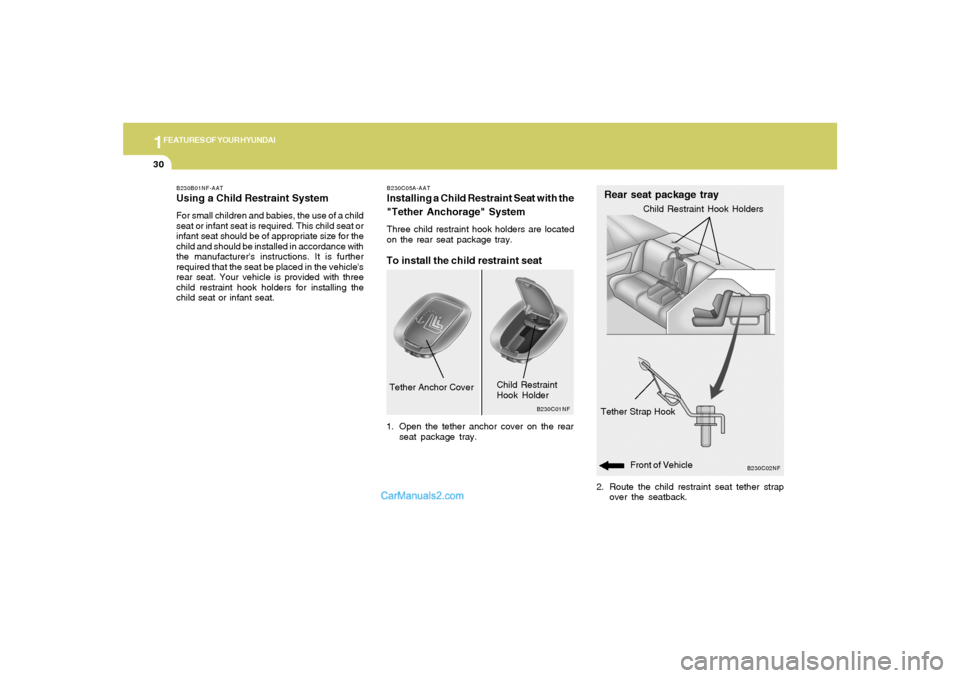
2. Route the child restraint seat tether strap
over the seatback.
B230C02NF
Rear seat package trayTether Strap Hook
Child Restraint Hook Holders
B230C05A-AATInstalling a Child Restraint Seat with the
"Tether Anchorage" SystemThree child restraint hook holders are located
on the rear seat package tray.To install the child restraint seat1. Open the tether anchor cover on the rear
seat package tray.
B230C01NF
Tether Anchor Cover
Child Restraint
Hook Holder
Front of Vehicle
B230B01NF-AATUsing a Child Restraint SystemFor small children and babies, the use of a child
seat or infant seat is required. This child seat or
infant seat should be of appropriate size for the
child and should be installed in accordance with
the manufacturer's instructions. It is further
required that the seat be placed in the vehicle's
rear seat. Your vehicle is provided with three
child restraint hook holders for installing the
child seat or infant seat.
Page 47 of 276
1
FEATURES OF YOUR HYUNDAI
33
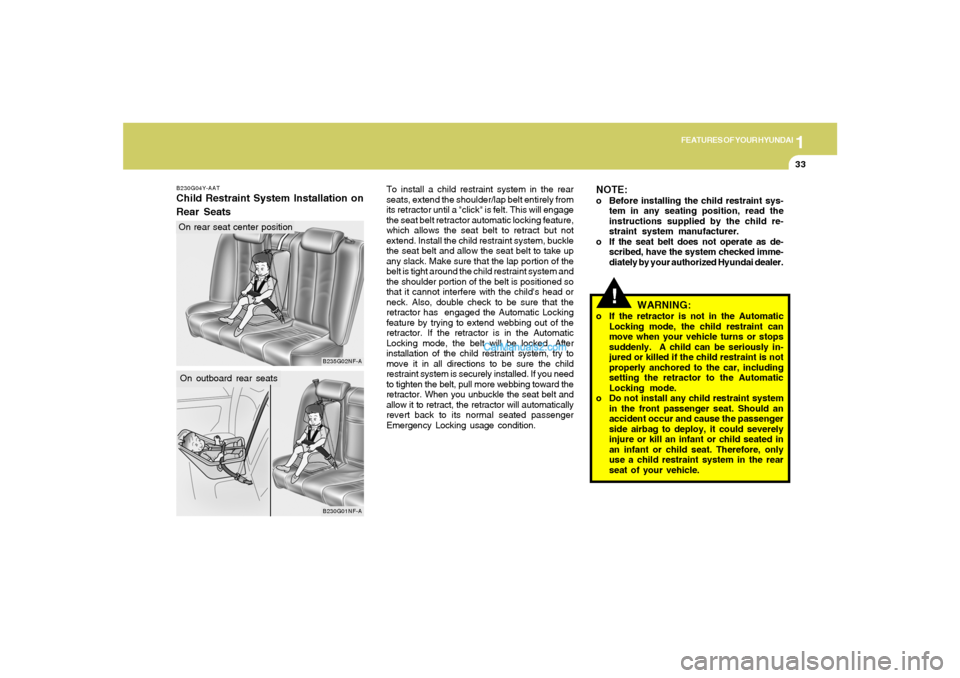
B230G04Y-AATChild Restraint System Installation on
Rear Seats
B230G01NF-A
On outboard rear seats
B235G02NF-A
On rear seat center positionTo install a child restraint system in the rear
seats, extend the shoulder/lap belt entirely from
its retractor until a "click" is felt. This will engage
the seat belt retractor automatic locking feature,
which allows the seat belt to retract but not
extend. Install the child restraint system, buckle
the seat belt and allow the seat belt to take up
any slack. Make sure that the lap portion of the
belt is tight around the child restraint system and
the shoulder portion of the belt is positioned so
that it cannot interfere with the child's head or
neck. Also, double check to be sure that the
retractor has engaged the Automatic Locking
feature by trying to extend webbing out of the
retractor. If the retractor is in the Automatic
Locking mode, the belt will be locked. After
installation of the child restraint system, try to
move it in all directions to be sure the child
restraint system is securely installed. If you need
to tighten the belt, pull more webbing toward the
retractor. When you unbuckle the seat belt and
allow it to retract, the retractor will automatically
revert back to its normal seated passenger
Emergency Locking usage condition.
!
WARNING:
o If the retractor is not in the Automatic
Locking mode, the child restraint can
move when your vehicle turns or stops
suddenly. A child can be seriously in-
jured or killed if the child restraint is not
properly anchored to the car, including
setting the retractor to the Automatic
Locking mode.
o Do not install any child restraint system
in the front passenger seat. Should an
accident occur and cause the passenger
side airbag to deploy, it could severely
injure or kill an infant or child seated in
an infant or child seat. Therefore, only
use a child restraint system in the rear
seat of your vehicle.NOTE:o Before installing the child restraint sys-
tem in any seating position, read the
instructions supplied by the child re-
straint system manufacturer.
o If the seat belt does not operate as de-
scribed, have the system checked imme-
diately by your authorized Hyundai dealer.
Page 53 of 276
1
FEATURES OF YOUR HYUNDAI
39
!
WARNING:
o Move your seat as far back as practical
from the front airbags, while still main-
taining control of the vehicle. You and
your passengers should never sit or lean
unnecessarily close to the airbags. Im-
properly positioned drivers and passen-
gers can be severely injured by inflating
airbags.
o No objects should be placed over or near
the airbag modules on the steering
wheel, instrument panel, and the front
passenger's panel above the glove box,
because any such object could cause
harm if the vehicle is in a crash severe
enough to cause the airbags to deploy.
o If the airbags deploy, they must be re-
placed by an authorized Hyundai dealer.
Deployed airbags WILL NOT inflate again
and will provide no protection in subse-
quent collisions.
o Do not tamper with or disconnect SRS
wiring or other components of the SRS
system. Doing so could result in injury,
due to accidental deployment of the
airbags or by rendering the SRS inopera-
tive.
!
WARNING:
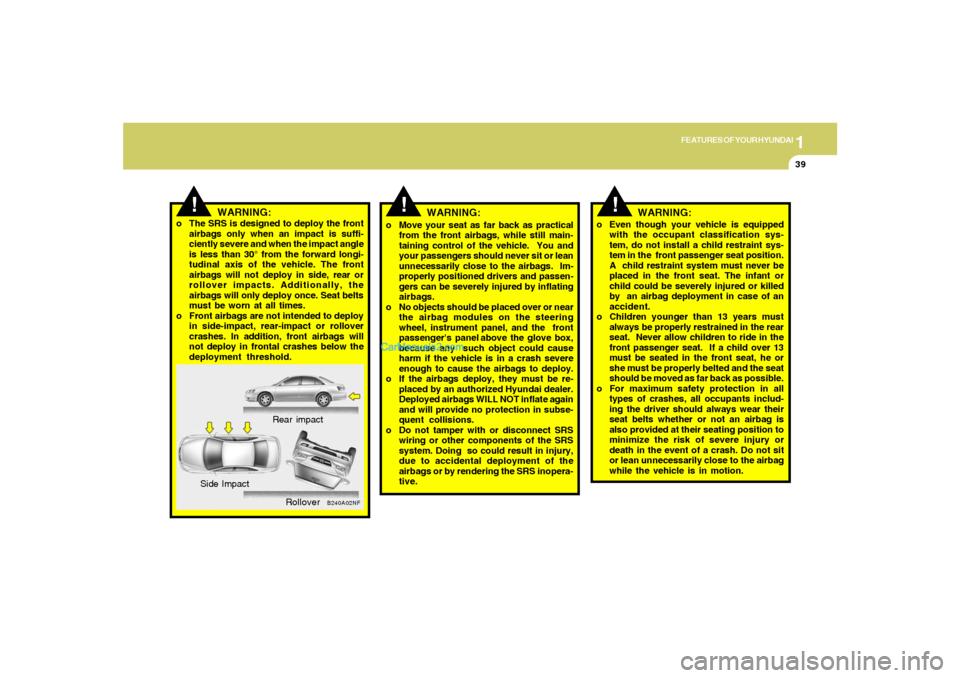
o The SRS is designed to deploy the front
airbags only when an impact is suffi-
ciently severe and when the impact angle
is less than 30° from the forward longi-
tudinal axis of the vehicle. The front
airbags will not deploy in side, rear or
rollover impacts. Additionally, the
airbags will only deploy once. Seat belts
must be worn at all times.
o Front airbags are not intended to deploy
in side-impact, rear-impact or rollover
crashes. In addition, front airbags will
not deploy in frontal crashes below the
deployment threshold.
B240A02NF
Rear impact
Side Impact
Rollover
!
WARNING:
o Even though your vehicle is equipped
with the occupant classification sys-
tem, do not install a child restraint sys-
tem in the front passenger seat position.
A child restraint system must never be
placed in the front seat. The infant or
child could be severely injured or killed
by an airbag deployment in case of an
accident.
o Children younger than 13 years must
always be properly restrained in the rear
seat. Never allow children to ride in the
front passenger seat. If a child over 13
must be seated in the front seat, he or
she must be properly belted and the seat
should be moved as far back as possible.
o For maximum safety protection in all
types of crashes, all occupants includ-
ing the driver should always wear their
seat belts whether or not an airbag is
also provided at their seating position to
minimize the risk of severe injury or
death in the event of a crash. Do not sit
or lean unnecessarily close to the airbag
while the vehicle is in motion.
Page 60 of 276
1FEATURES OF YOUR HYUNDAI46
!
WARNING:
o Do not modify or replace the front pas-
senger seat. Don't place anything on or
attach anything such as a blanket or
after market seat heater to the front
passenger seat. This can adversely af-
fect the occupant classification system.
o Do not sit on sharp objects such as tools
when occupying the front passenger
seat. This can adversely affect the occu-
pant classification system.
o Do not use accessory seat covers on the
front seats.
o Accident statistics show that children
are safer if they are restrained in the rear,
as opposed to the front seat. It is recom-
mended that child restraints be secured
in a rear seat, including an infant riding
in a rear-facing infant seat, a child riding
in a forward-facing child seat and an
older child riding in a booster seat.
o Airbags can only be used once – have an
authorized Hyundai dealer replace the
airbag immediately after deployment.
!
WARNING:
o A smaller-stature adult who is not seated
correctly (for example: seat excessively
reclined, leaning on the center console,
or hips shifted forward in the seat) can
cause a condition where the advanced
frontal airbag system senses less weight
than if the occupant were seated prop-
erly (sitting upright with the seatback in
an upright position, centered on the seat
cushion with their seat belt on, legs
comfortably extended and their feet on
the floor). This condition can result in an
adult potentially being misclassified and
illumination of the "PASSENGER AIR
BAG OFF" indicator.
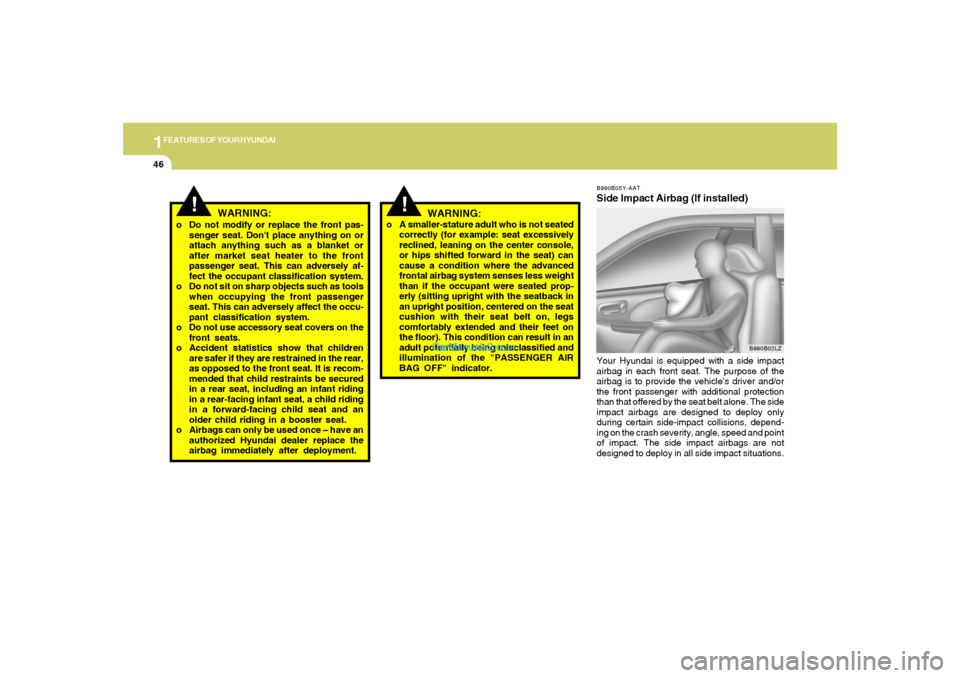
B990B05Y-AATSide Impact Airbag (If installed)Your Hyundai is equipped with a side impact
airbag in each front seat. The purpose of the
airbag is to provide the vehicle's driver and/or
the front passenger with additional protection
than that offered by the seat belt alone. The side
impact airbags are designed to deploy only
during certain side-impact collisions, depend-
ing on the crash severity, angle, speed and point
of impact. The side impact airbags are not
designed to deploy in all side impact situations.
B990B02LZ
Page 62 of 276
1FEATURES OF YOUR HYUNDAI48
o If the airbags inflate, they must be re-
placed by an authorized Hyundai dealer.
o Do not tamper with or disconnect SRS
wiring, or other components of the SRS
system. Doing so could result in injury,
due to accidental inflation of the airbags
or by rendering the SRS inoperative.
o If components of the airbag system must
be discarded, or if the vehicle must be
scrapped, certain safety precautions
must be observed. Your Hyundai dealer
knows these precautions and can give
you the necessary information. Failure
to follow these precautions and proce-
dures could increase the risk of personal
injury.
o If your car was flooded and has soaked
carpeting or water on flooring, you
shouldn't try to start the engine; have
the car towed to an authorized Hyundai
dealer.
!
WARNING:
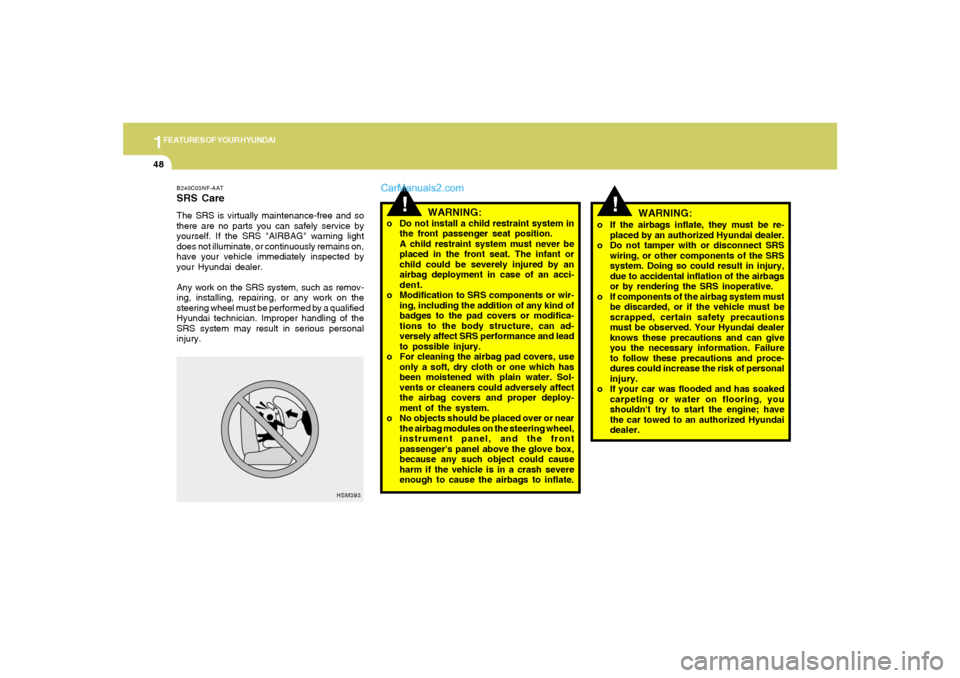
B240C03NF-AATSRS CareThe SRS is virtually maintenance-free and so
there are no parts you can safely service by
yourself. If the SRS "AIRBAG" warning light
does not illuminate, or continuously remains on,
have your vehicle immediately inspected by
your Hyundai dealer.
Any work on the SRS system, such as remov-
ing, installing, repairing, or any work on the
steering wheel must be performed by a qualified
Hyundai technician. Improper handling of the
SRS system may result in serious personal
injury.
WARNING:
o Do not install a child restraint system in
the front passenger seat position.
A child restraint system must never be
placed in the front seat. The infant or
child could be severely injured by an
airbag deployment in case of an acci-
dent.
o Modification to SRS components or wir-
ing, including the addition of any kind of
badges to the pad covers or modifica-
tions to the body structure, can ad-
versely affect SRS performance and lead
to possible injury.
o For cleaning the airbag pad covers, use
only a soft, dry cloth or one which has
been moistened with plain water. Sol-
vents or cleaners could adversely affect
the airbag covers and proper deploy-
ment of the system.
o No objects should be placed over or near
the airbag modules on the steering wheel,
instrument panel, and the front
passenger's panel above the glove box,
because any such object could cause
harm if the vehicle is in a crash severe
enough to cause the airbags to inflate.
!
HSM393