eco Hyundai Sonata 2013 Owner's Manual
[x] Cancel search | Manufacturer: HYUNDAI, Model Year: 2013, Model line: Sonata, Model: Hyundai Sonata 2013Pages: 410, PDF Size: 35.93 MB
Page 305 of 410
611
What to do in an emergency
You may not be able identify a low
tire by simply looking at it. Always
use a good quality tire pressure
gauge to measure the tire's inflation
pressure. Please note that a tire that
is hot (from being driven) will have a
higher pressure measurement than a
tire that is cold.
A cold tire means the vehicle has
been sitting for 3 hours and driven for
less than 1 mile (1.6 km) in that 3
hour period.
Allow the tire to cool before measur-
ing the inflation pressure. Always be
sure the tire is cold before inflating to
the recommended pressure.This device complies with Part 15
of the FCC rules.
Operation is subject to the following
two conditions:
1.This device may not cause harmful
interference, and
2.This device must accept any inter-
ference received, including inter-
ference that may cause undesired
operation.
CAUTION
Do not use any tire sealant if
your vehicle is equipped with a
Tire Pressure Monitoring
System. The liquid sealant can
damage the tire pressure sen-
sors.
WARNING
- Protecting
TPMS
Tampering with, modifying, or
disabling the Tire Pressure
Monitoring System (TPMS) com-
ponents may interfere with the
system's ability to warn the driv-
er of low tire pressure condi-
tions and/or TPMS malfunctions.
Tampering with, modifying, or
disabling the Tire Pressure
Monitoring System (TPMS) com-
ponents may void the warranty
for that portion of the vehicle.
WARNING
- TPMS
The TPMS cannot alert you to
severe and sudden tire dam-
age caused by external fac-
tors such as nails or road
debris.
If you feel any vehicle instabil-
ity, immediately take your foot
off the accelerator, apply the
brakes gradually and with
light force, and slowly move to
a safe position off the road.
WARNING
Changes or modifications not
expressly approved by the party
responsible for compliance
could void the user’s authority
to operate the equipment.
YF HMA 6.QXP 11/25/2009 1:58 PM Page 11
Page 308 of 410
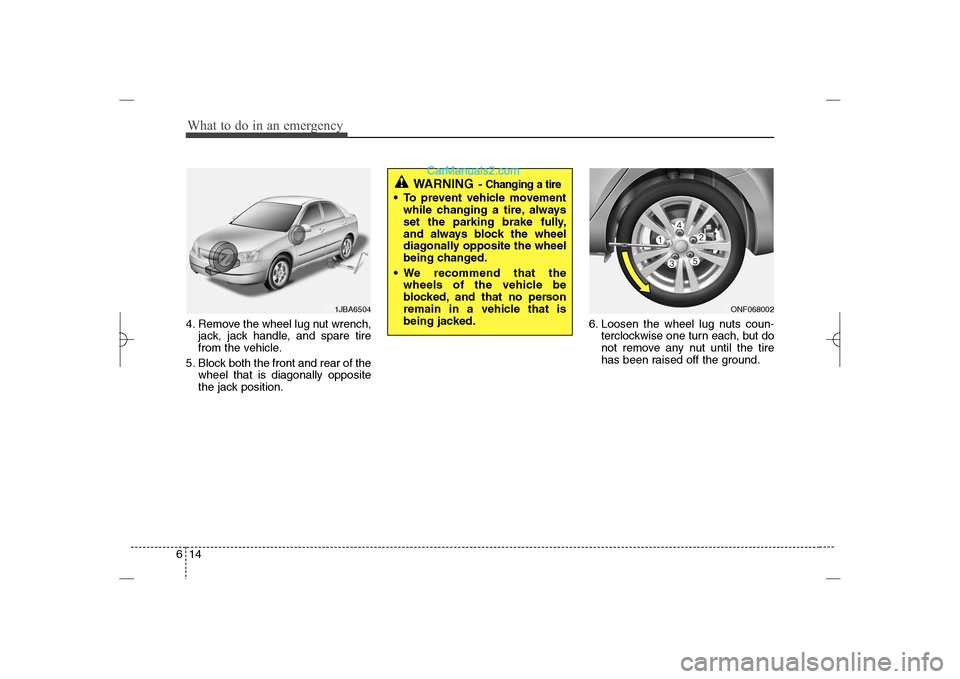
What to do in an emergency14 64. Remove the wheel lug nut wrench,
jack, jack handle, and spare tire
from the vehicle.
5. Block both the front and rear of the
wheel that is diagonally opposite
the jack position.6. Loosen the wheel lug nuts coun-
terclockwise one turn each, but do
not remove any nut until the tire
has been raised off the ground.
1JBA6504
WARNING
- Changing a tire
To prevent vehicle movement
while changing a tire, always
set the parking brake fully,
and always block the wheel
diagonally opposite the wheel
being changed.
We recommend that the
wheels of the vehicle be
blocked, and that no person
remain in a vehicle that is
being jacked.
ONF068002
YF HMA 6.QXP 11/25/2009 1:58 PM Page 14
Page 311 of 410
617
What to do in an emergency
If you have a tire gauge, remove the
valve cap and check the air pressure.
If the pressure is lower than recom-
mended, drive slowly to the nearest
service station and inflate to the cor-
rect pressure. If it is too high, adjust
it until it is correct. Always reinstall
the valve cap after checking or
adjusting tire pressure. If the cap is
not replaced, air may leak from the
tire. If you lose a valve cap, buy
another and install it as soon as pos-
sible.
After you have changed wheels,
always secure the flat tire in its place
and return the jack and tools to their
proper storage locations.To prevent the jack, jack handle,
wheel lug nut wrench and spare tire
from rattling while the vehicle is in
motion, store them properly.
CAUTION
Your vehicle has metric threads
on the wheel studs and nuts.
Make certain during wheel
removal that the same nuts that
were removed are reinstalled -
or, if replaced, that nuts with
metric threads and the same
chamfer configuration are used.
Installation of a non-metric
thread nut on a metric stud or
vice-versa will not secure the
wheel to the hub properly and
will damage the stud so that it
must be replaced.
Note that most lug nuts do not
have metric threads. Be sure to
use extreme care in checking
for thread style before installing
aftermarket lug nuts or wheels.
If in doubt, consult an author-
ized HYUNDAI dealer.
WARNING
- Wheel studs
If the studs are damaged, they
may lose their ability to retain
the wheel. This could lead to the
loss of the wheel and a collision
resulting in serious injuries.
WARNING -
Inadequate
spare tire pressure
Check the inflation pressures as
soon as possible after installing
the spare tire. Adjust it to the
specified pressure, if necessary.
Refer to “Tires and wheels” sec-
tion 8.
YF HMA 6.QXP 11/25/2009 1:59 PM Page 17
Page 312 of 410
What to do in an emergency18 6Important - use of compact spare tireYour vehicle is equipped with a com-
pact spare tire. This compact spare
tire takes up less space than a regu-
lar-size tire. This tire is smaller than a
conventional tire and is designed for
temporary use only.
The compact spare should be inflat-
ed to 60 psi (420 kPa).
✽ ✽
NOTICECheck the inflation pressure after
installing the spare tire. Adjust it to
the specified pressure, as necessary.
When using a compact spare tire,
observe the following precautions:
Under no circumstances should
you exceed 50 mph (80 km/h); a
higher speed could damage the
tire.
Ensure that you drive slowly
enough for the road conditions to
avoid all hazards. Any road hazard,
such as a pothole or debris, could
seriously damage the compact
spare.
Any continuous road use of this tire
could result in tire failure, loss of
vehicle control, and possible per-
sonal injury.
Do not exceed the vehicle’s maxi-
mum load rating or the load-carry-
ing capacity shown on the sidewall
of the compact spare tire.
Avoid driving over obstacles. The
compact spare tire diameter is
smaller than the diameter of a con-
ventional tire and reduces the
ground clearance approximately 1
inch (25 mm), which could result in
damage to the vehicle.
WARNING
The compact spare tire is for
emergency use only. Do not
operate your vehicle on this
compact spare at speeds over
50 mph (80 km/h). The original
tire should be repaired or
replaced as soon as is possible
to avoid failure of the spare
possibly leading to personal
injury or death.
CAUTION
You should drive carefully
when the compact spare is in
use. The compact spare
should be replaced by the
proper conventional tire and
rim at the first opportunity.
The operation of this vehicle
is not recommended with
more than one compact spare
tire in use at the same time.
YF HMA 6.QXP 11/25/2009 1:59 PM Page 18
Page 314 of 410
What to do in an emergency20 6
HXD02HXD03
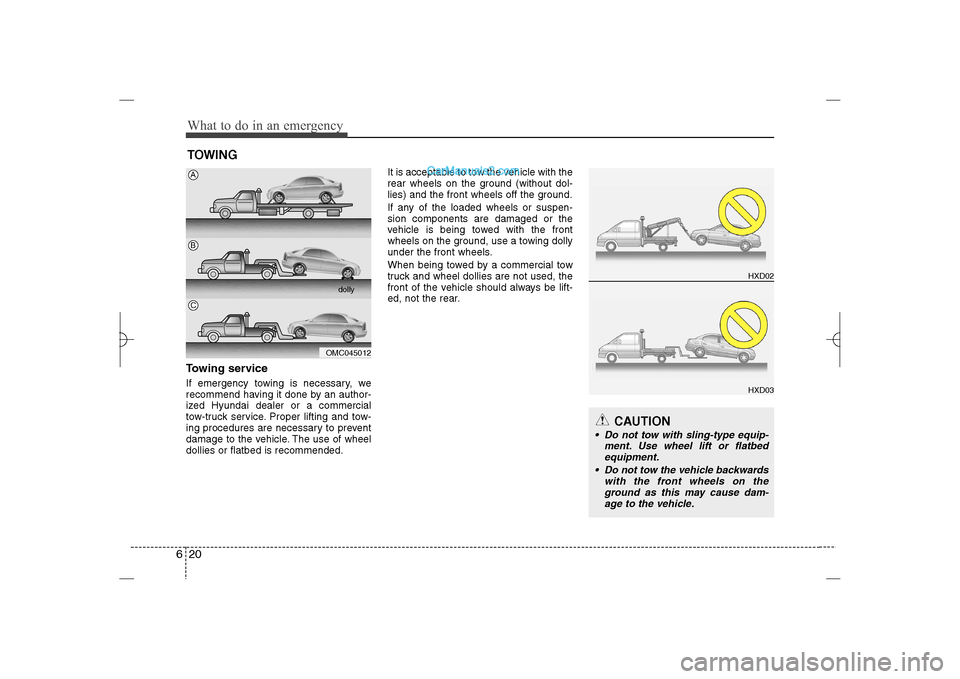
TOWINGTowing serviceIf emergency towing is necessary, we
recommend having it done by an author-
ized Hyundai dealer or a commercial
tow-truck service. Proper lifting and tow-
ing procedures are necessary to prevent
damage to the vehicle. The use of wheel
dollies or flatbed is recommended.It is acceptable to tow the vehicle with the
rear wheels on the ground (without dol-
lies) and the front wheels off the ground.
If any of the loaded wheels or suspen-
sion components are damaged or the
vehicle is being towed with the front
wheels on the ground, use a towing dolly
under the front wheels.
When being towed by a commercial tow
truck and wheel dollies are not used, the
front of the vehicle should always be lift-
ed, not the rear.
OMC045012dolly
ABC
CAUTION
Do not tow with sling-type equip-
ment. Use wheel lift or flatbed
equipment.
Do not tow the vehicle backwards
with the front wheels on the
ground as this may cause dam-
age to the vehicle.
YF HMA 6.QXP 11/25/2009 1:59 PM Page 20
Page 319 of 410
Maintenance4 7MAINTENANCE SERVICESYou should exercise the utmost care to
prevent damage to your vehicle and
injury to yourself whenever performing
any maintenance or inspection proce-
dures.
Should you have any doubts concerning
the inspection or servicing of your vehi-
cle, we strongly recommend that you
have an authorized HYUNDAI dealer
perform this work.
An authorized HYUNDAI dealer has fac-
tory-trained technicians and genuine
HYUNDAI parts to service your vehicle
properly. For expert advice and quality
service, see an authorized HYUNDAI
dealer.
Inadequate, incomplete or insufficient
servicing may result in operational prob-
lems with your vehicle that could lead to
vehicle damage, an accident, or person-
al injury.
Owner’s responsibility ✽ ✽
NOTICEMaintenance Service and Record
Retention are the owner's responsibility. You should retain documents that show
proper maintenance has been performed
on your vehicle in accordance with the
scheduled maintenance service charts
shown on the following pages. You need
this information to establish your compli-
ance with the servicing and maintenance
requirements of your vehicle warranties.
Detailed warranty information is provided
in your Owner’s Handbook & Warranty
Information booklet.
Repairs and adjustments required as a
result of improper maintenance or a lack
of required maintenance are not covered.
We recommend you have your vehicle
maintained and repaired by an author-
ized HYUNDAI dealer. An authorized
HYUNDAI dealer meets HYUNDAI’s high
service quality standards and receives
technical support from HYUNDAI in
order to provide you with a high level of
service satisfaction.
Owner maintenance precautions Improper or incomplete service may
result in problems. This section gives
instructions only for the maintenance
items that are easy to perform.
As explained earlier in this section, sev-
eral procedures can be done only by an
authorized HYUNDAI dealer with special
tools.✽ ✽
NOTICEImproper owner maintenance during
the warranty period may affect warran-
ty coverage. For details, read the sepa-
rate Owner’s Handbook & Warranty
Information booklet provided with the
vehicle. If you're unsure about any serv-
icing or maintenance procedure, have it
done by an authorized HYUNDAI deal-
er.
YF HMA 7.qxp 1/16/2012 6:18 PM Page 4
Page 320 of 410
75
Maintenance
The following lists are vehicle checks and
inspections that should be performed by
the owner or an authorized HYUNDAI
dealer at the frequencies indicated to
help ensure safe, dependable operation
of your vehicle.
Any adverse conditions should be
brought to the attention of your dealer as
soon as possible.
These Owner Maintenance Checks are
generally not covered by warranties and
you may be charged for labor, parts and
lubricants used.
Owner maintenance schedule When you stop for fuel: Check the engine oil level.
Check coolant level in coolant reser-
voir.
Check the windshield washer fluid
level.
Look for low or under-inflated tires.
WARNING
- Maintenance
work
Performing maintenance work on
a vehicle can be dangerous. You
can be seriously injured while
performing some maintenance
procedures. If you lack sufficient
knowledge and experience or the
proper tools and equipment to do
the work, have it done by an
authorized HYUNDAI dealer.
Working under the hood with the
engine running is dangerous. It
becomes even more dangerous
when you wear jewelry or loose
clothing. These can become
entangled in moving parts and
result in injury. Therefore, if you
must run the engine while work-
ing under the hood, make certain
that you remove all jewelry (espe-
cially rings, bracelets, watches,
and necklaces) and all neckties,
scarves, and similar loose cloth-
ing before getting near the
engine or cooling fans.
OWNER MAINTENANCE
WARNING
Be careful when checking your
engine coolant level when the
engine is hot. Scalding hot coolant
and steam may blow out under
pressure. This could cause burns
or other serious injury.
YF HMA 7.qxp 1/16/2012 6:18 PM Page 5
Page 324 of 410
79
Maintenance
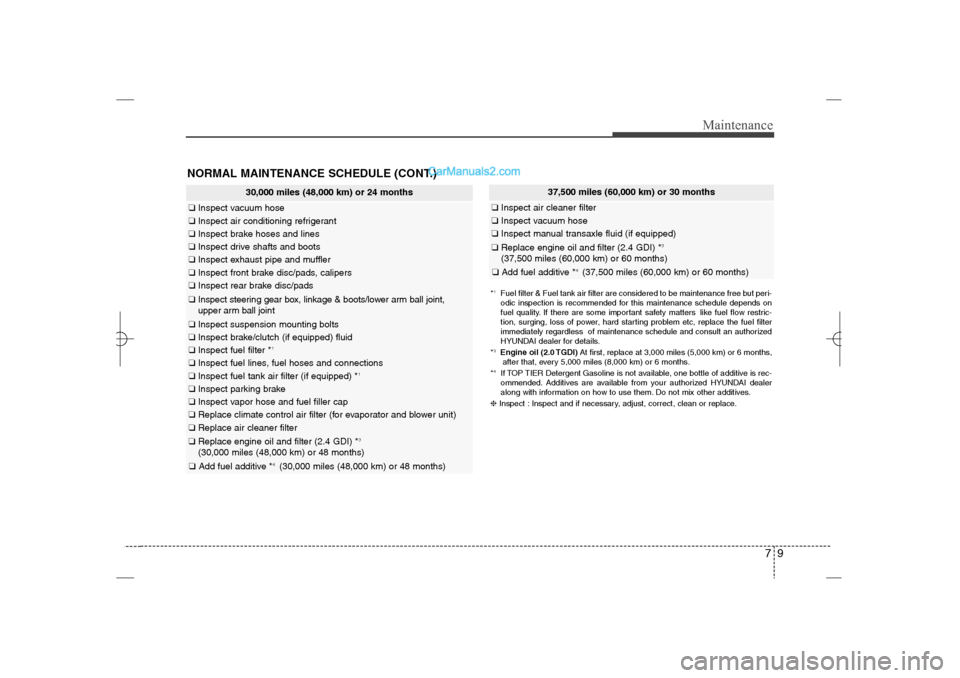
NORMAL MAINTENANCE SCHEDULE (CONT.)
37,500 miles (60,000 km) or 30 months
❑Inspect air cleaner filter❑Inspect vacuum hose❑Inspect manual transaxle fluid (if equipped)❑Replace engine oil and filter (2.4 GDI) *
3
(37,500 miles (60,000 km) or 60 months)❑Add fuel additive *
4 (37,500 miles (60,000 km) or 60 months)
*1Fuel filter & Fuel tank air filter are considered to be maintenance free but peri-
odic inspection is recommended for this maintenance schedule depends on
fuel quality. If there are some important safety matters like fuel flow restric-
tion, surging, loss of power, hard starting problem etc, replace the fuel filter
immediately regardless of maintenance schedule and consult an authorized
HYUNDAI dealer for details.
*3Engine oil (2.0 TGDI)At first, replace at 3,000 miles (5,000 km) or 6 months,
after that, every 5,000 miles (8,000 km) or 6 months.
*4If TOP TIER Detergent Gasoline is not available, one bottle of additive is rec-
ommended. Additives are available from your authorized HYUNDAI dealer
along with information on how to use them. Do not mix other additives.
❈Inspect : Inspect and if necessary, adjust, correct, clean or replace.
30,000 miles (48,000 km) or 24 months
❑Inspect vacuum hose❑Inspect air conditioning refrigerant❑Inspect brake hoses and lines❑Inspect drive shafts and boots❑Inspect exhaust pipe and muffler❑Inspect front brake disc/pads, calipers❑Inspect rear brake disc/pads❑Inspect steering gear box, linkage & boots/lower arm ball joint,
upper arm ball joint❑Inspect suspension mounting bolts❑Inspect brake/clutch (if equipped) fluid ❑Inspect fuel filter *
1
❑Inspect fuel lines, fuel hoses and connections❑Inspect fuel tank air filter (if equipped) *
1
❑Inspect parking brake❑Inspect vapor hose and fuel filler cap❑Replace climate control air filter (for evaporator and blower unit)❑Replace air cleaner filter❑Replace engine oil and filter (2.4 GDI) *
3
(30,000 miles (48,000 km) or 48 months)❑Add fuel additive *
4 (30,000 miles (48,000 km) or 48 months)
YF HMA 7.qxp 1/16/2012 6:18 PM Page 9
Page 326 of 410
711
Maintenance
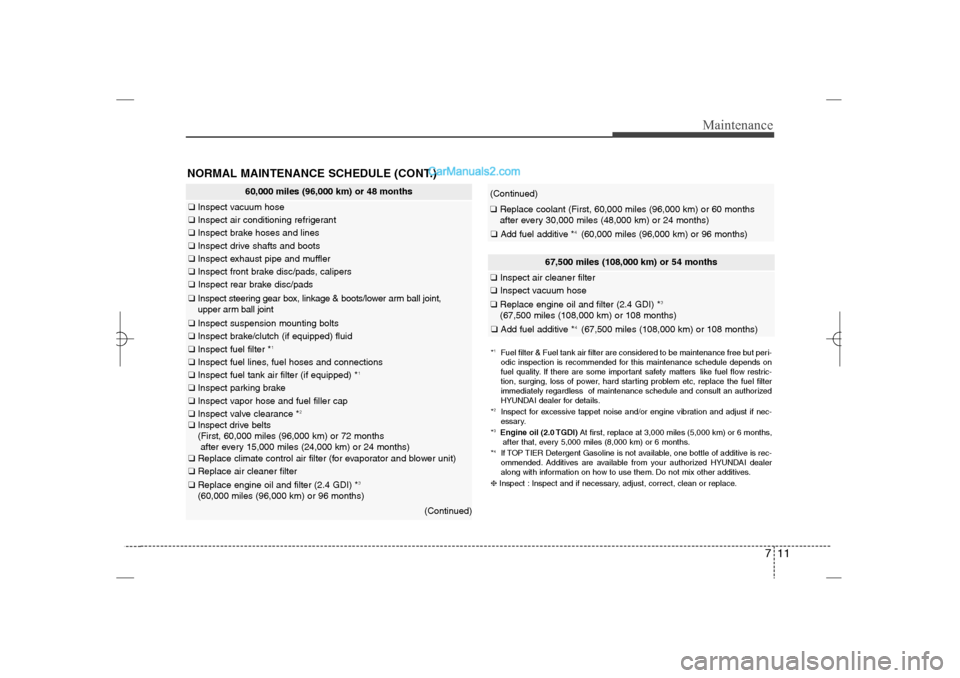
60,000 miles (96,000 km) or 48 months
❑Inspect vacuum hose❑Inspect air conditioning refrigerant❑Inspect brake hoses and lines❑Inspect drive shafts and boots❑Inspect exhaust pipe and muffler❑Inspect front brake disc/pads, calipers❑Inspect rear brake disc/pads❑Inspect steering gear box, linkage & boots/lower arm ball joint,
upper arm ball joint❑Inspect suspension mounting bolts❑Inspect brake/clutch (if equipped) fluid ❑Inspect fuel filter *
1
❑Inspect fuel lines, fuel hoses and connections❑Inspect fuel tank air filter (if equipped) *
1
❑Inspect parking brake❑Inspect vapor hose and fuel filler cap❑Inspect valve clearance *
2
❑Inspect drive belts
(First, 60,000 miles (96,000 km) or 72 months
after every 15,000 miles (24,000 km) or 24 months)❑Replace climate control air filter (for evaporator and blower unit)❑Replace air cleaner filter❑Replace engine oil and filter (2.4 GDI) *
3
(60,000 miles (96,000 km) or 96 months)
(Continued)
67,500 miles (108,000 km) or 54 months
❑Inspect air cleaner filter❑Inspect vacuum hose❑Replace engine oil and filter (2.4 GDI) *
3
(67,500 miles (108,000 km) or 108 months)❑Add fuel additive *
4 (67,500 miles (108,000 km) or 108 months)
NORMAL MAINTENANCE SCHEDULE (CONT.)
*1Fuel filter & Fuel tank air filter are considered to be maintenance free but peri-
odic inspection is recommended for this maintenance schedule depends on
fuel quality. If there are some important safety matters like fuel flow restric-
tion, surging, loss of power, hard starting problem etc, replace the fuel filter
immediately regardless of maintenance schedule and consult an authorized
HYUNDAI dealer for details.
*2Inspect for excessive tappet noise and/or engine vibration and adjust if nec-
essary.
*3Engine oil (2.0 TGDI)At first, replace at 3,000 miles (5,000 km) or 6 months,
after that, every 5,000 miles (8,000 km) or 6 months.
*4If TOP TIER Detergent Gasoline is not available, one bottle of additive is rec-
ommended. Additives are available from your authorized HYUNDAI dealer
along with information on how to use them. Do not mix other additives.
❈Inspect : Inspect and if necessary, adjust, correct, clean or replace.(Continued)❑Replace coolant (First, 60,000 miles (96,000 km) or 60 months
after every 30,000 miles (48,000 km) or 24 months)❑Add fuel additive *
4 (60,000 miles (96,000 km) or 96 months)
YF HMA 7.qxp 1/16/2012 6:18 PM Page 11
Page 328 of 410
713
Maintenance
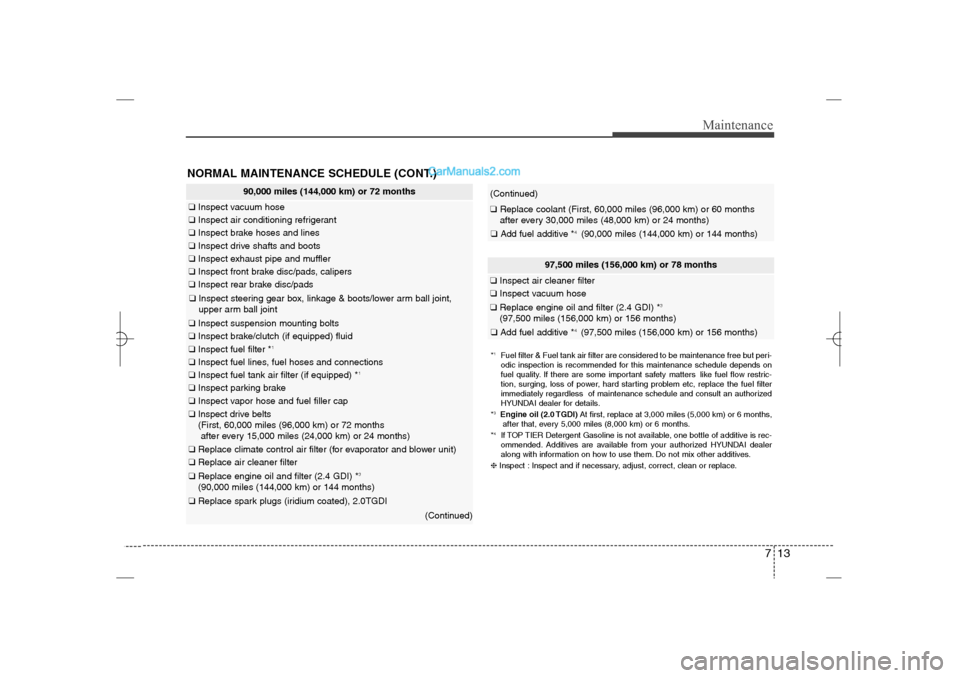
NORMAL MAINTENANCE SCHEDULE (CONT.)
97,500 miles (156,000 km) or 78 months
❑Inspect air cleaner filter❑Inspect vacuum hose❑Replace engine oil and filter (2.4 GDI) *
3
(97,500 miles (156,000 km) or 156 months)❑Add fuel additive *
4 (97,500 miles (156,000 km) or 156 months)
90,000 miles (144,000 km) or 72 months
❑Inspect vacuum hose❑Inspect air conditioning refrigerant❑Inspect brake hoses and lines❑Inspect drive shafts and boots❑Inspect exhaust pipe and muffler❑Inspect front brake disc/pads, calipers❑Inspect rear brake disc/pads❑Inspect steering gear box, linkage & boots/lower arm ball joint,
upper arm ball joint❑Inspect suspension mounting bolts❑Inspect brake/clutch (if equipped) fluid ❑Inspect fuel filter *
1
❑Inspect fuel lines, fuel hoses and connections❑Inspect fuel tank air filter (if equipped) *
1
❑Inspect parking brake❑Inspect vapor hose and fuel filler cap❑Inspect drive belts
(First, 60,000 miles (96,000 km) or 72 months
after every 15,000 miles (24,000 km) or 24 months)❑Replace climate control air filter (for evaporator and blower unit)❑Replace air cleaner filter❑Replace engine oil and filter (2.4 GDI) *
3
(90,000 miles (144,000 km) or 144 months)❑Replace spark plugs (iridium coated), 2.0TGDI
(Continued)
*1Fuel filter & Fuel tank air filter are considered to be maintenance free but peri-
odic inspection is recommended for this maintenance schedule depends on
fuel quality. If there are some important safety matters like fuel flow restric-
tion, surging, loss of power, hard starting problem etc, replace the fuel filter
immediately regardless of maintenance schedule and consult an authorized
HYUNDAI dealer for details.
*3Engine oil (2.0 TGDI)At first, replace at 3,000 miles (5,000 km) or 6 months,
after that, every 5,000 miles (8,000 km) or 6 months.
*4If TOP TIER Detergent Gasoline is not available, one bottle of additive is rec-
ommended. Additives are available from your authorized HYUNDAI dealer
along with information on how to use them. Do not mix other additives.
❈Inspect : Inspect and if necessary, adjust, correct, clean or replace.(Continued)❑Replace coolant (First, 60,000 miles (96,000 km) or 60 months
after every 30,000 miles (48,000 km) or 24 months)❑Add fuel additive *
4 (90,000 miles (144,000 km) or 144 months)
YF HMA 7.qxp 1/16/2012 6:18 PM Page 13