eco Hyundai Sonata 2013 Owner's Manual
[x] Cancel search | Manufacturer: HYUNDAI, Model Year: 2013, Model line: Sonata, Model: Hyundai Sonata 2013Pages: 410, PDF Size: 35.93 MB
Page 330 of 410
715
Maintenance
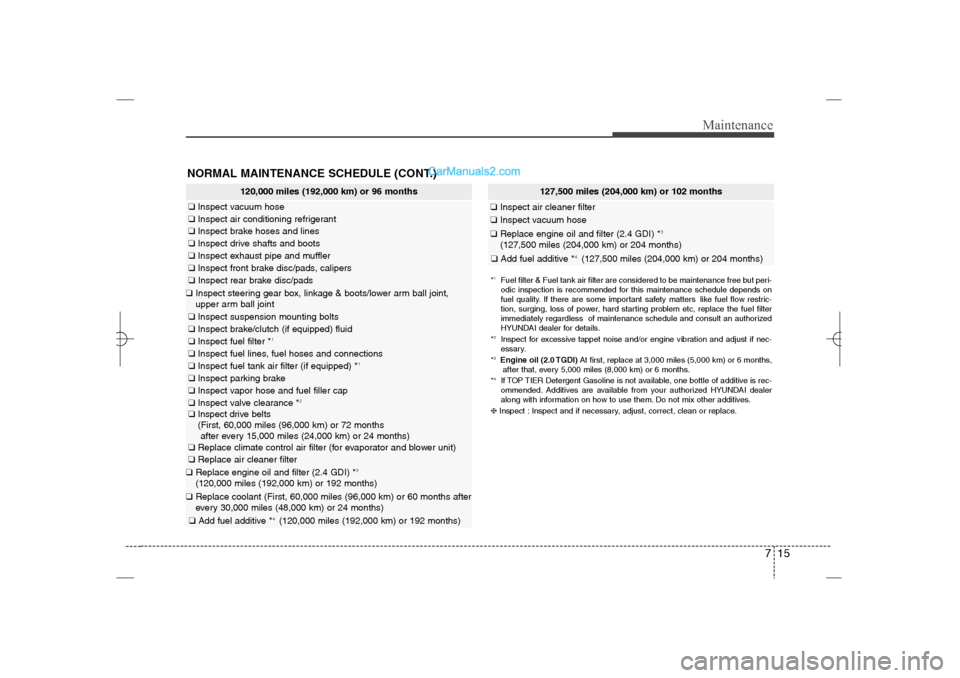
NORMAL MAINTENANCE SCHEDULE (CONT.)
120,000 miles (192,000 km) or 96 months
❑Inspect vacuum hose❑Inspect air conditioning refrigerant❑Inspect brake hoses and lines❑Inspect drive shafts and boots❑Inspect exhaust pipe and muffler❑Inspect front brake disc/pads, calipers❑Inspect rear brake disc/pads❑Inspect steering gear box, linkage & boots/lower arm ball joint,
upper arm ball joint❑Inspect suspension mounting bolts❑Inspect brake/clutch (if equipped) fluid ❑Inspect fuel filter *
1
❑Inspect fuel lines, fuel hoses and connections❑Inspect fuel tank air filter (if equipped) *
1
❑Inspect parking brake❑Inspect vapor hose and fuel filler cap❑Inspect valve clearance *
2
❑Inspect drive belts
(First, 60,000 miles (96,000 km) or 72 months
after every 15,000 miles (24,000 km) or 24 months)❑Replace climate control air filter (for evaporator and blower unit)❑Replace air cleaner filter❑Replace engine oil and filter (2.4 GDI) *
3
(120,000 miles (192,000 km) or 192 months)❑Replace coolant (First, 60,000 miles (96,000 km) or 60 months after
every 30,000 miles (48,000 km) or 24 months)❑Add fuel additive *
4 (120,000 miles (192,000 km) or 192 months)
*1Fuel filter & Fuel tank air filter are considered to be maintenance free but peri-
odic inspection is recommended for this maintenance schedule depends on
fuel quality. If there are some important safety matters like fuel flow restric-
tion, surging, loss of power, hard starting problem etc, replace the fuel filter
immediately regardless of maintenance schedule and consult an authorized
HYUNDAI dealer for details.
*2Inspect for excessive tappet noise and/or engine vibration and adjust if nec-
essary.
*3Engine oil (2.0 TGDI)At first, replace at 3,000 miles (5,000 km) or 6 months,
after that, every 5,000 miles (8,000 km) or 6 months.
*4If TOP TIER Detergent Gasoline is not available, one bottle of additive is rec-
ommended. Additives are available from your authorized HYUNDAI dealer
along with information on how to use them. Do not mix other additives.
❈Inspect : Inspect and if necessary, adjust, correct, clean or replace.
127,500 miles (204,000 km) or 102 months
❑Inspect air cleaner filter❑Inspect vacuum hose❑Replace engine oil and filter (2.4 GDI) *
3
(127,500 miles (204,000 km) or 204 months)❑Add fuel additive *
4 (127,500 miles (204,000 km) or 204 months)
YF HMA 7.qxp 1/16/2012 6:18 PM Page 15
Page 332 of 410
717
Maintenance
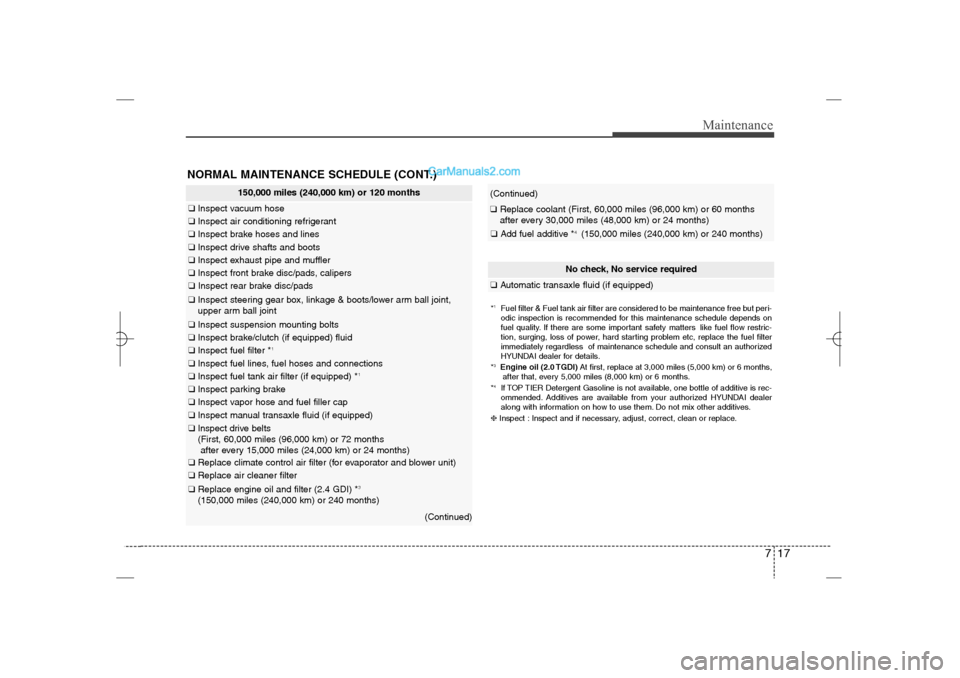
150,000 miles (240,000 km) or 120 months
❑Inspect vacuum hose❑Inspect air conditioning refrigerant❑Inspect brake hoses and lines❑Inspect drive shafts and boots❑Inspect exhaust pipe and muffler❑Inspect front brake disc/pads, calipers❑Inspect rear brake disc/pads❑Inspect steering gear box, linkage & boots/lower arm ball joint,
upper arm ball joint❑Inspect suspension mounting bolts❑Inspect brake/clutch (if equipped) fluid ❑Inspect fuel filter *
1
❑Inspect fuel lines, fuel hoses and connections❑Inspect fuel tank air filter (if equipped) *
1
❑Inspect parking brake❑Inspect vapor hose and fuel filler cap❑Inspect manual transaxle fluid (if equipped)❑Inspect drive belts
(First, 60,000 miles (96,000 km) or 72 months
after every 15,000 miles (24,000 km) or 24 months)❑Replace climate control air filter (for evaporator and blower unit)❑Replace air cleaner filter❑Replace engine oil and filter (2.4 GDI) *
3
(150,000 miles (240,000 km) or 240 months)
(Continued)
(Continued)❑Replace coolant (First, 60,000 miles (96,000 km) or 60 months
after every 30,000 miles (48,000 km) or 24 months)❑Add fuel additive *
4 (150,000 miles (240,000 km) or 240 months)
NORMAL MAINTENANCE SCHEDULE (CONT.)
No check, No service required
❑Automatic transaxle fluid (if equipped)*1Fuel filter & Fuel tank air filter are considered to be maintenance free but peri-
odic inspection is recommended for this maintenance schedule depends on
fuel quality. If there are some important safety matters like fuel flow restric-
tion, surging, loss of power, hard starting problem etc, replace the fuel filter
immediately regardless of maintenance schedule and consult an authorized
HYUNDAI dealer for details.
*3Engine oil (2.0 TGDI)At first, replace at 3,000 miles (5,000 km) or 6 months,
after that, every 5,000 miles (8,000 km) or 6 months.
*4If TOP TIER Detergent Gasoline is not available, one bottle of additive is rec-
ommended. Additives are available from your authorized HYUNDAI dealer
along with information on how to use them. Do not mix other additives.
❈Inspect : Inspect and if necessary, adjust, correct, clean or replace.
YF HMA 7.qxp 1/16/2012 6:18 PM Page 17
Page 335 of 410
Maintenance20 7Air cleaner filterA Genuine HYUNDAI air cleaner filter is
recommended when the filter is
replaced.Spark plugsMake sure to install new spark plugs of
the correct heat range.Valve clearance Inspect excessive valve noise and/or
engine vibration and adjust if necessary.
An authorized HYUNDAI dealer should
perform the operation.Cooling systemCheck cooling system components, such
as radiator, coolant reservoir, hoses and
connections for leakage and damage.
Replace any damaged parts.
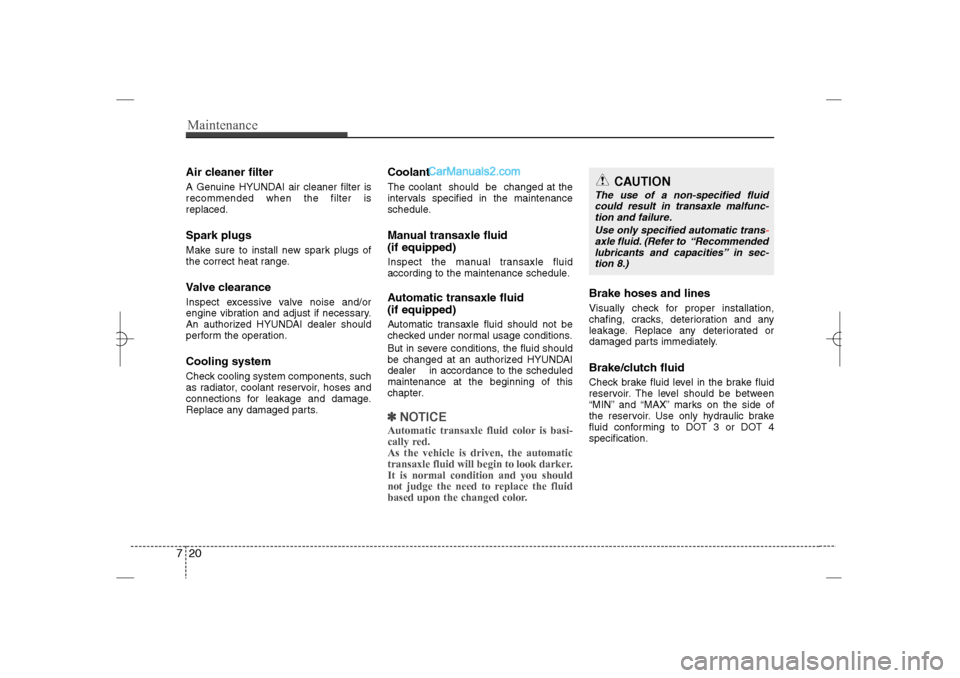
CoolantThe coolant should be changed at the
intervals specified in the maintenance
schedule.Manual transaxle fluid
(if equipped)Inspect the manual transaxle fluid
according to the maintenance schedule.Automatic transaxle fluid
(if equipped)Automatic transaxle fluid should not be
checked under normal usage conditions.
But in severe conditions, the fluid should
be changed at an authorized HYUNDAI
dealer in accordance to the scheduled
maintenance at the beginning of this
chapter.✽ ✽
NOTICEAutomatic transaxle fluid color is basi-
cally red.
As the vehicle is driven, the automatic
transaxle fluid will begin to look darker.
It is normal condition and you should
not judge the need to replace the fluid
based upon the changed color.
Brake hoses and linesVisually check for proper installation,
chafing, cracks, deterioration and any
leakage. Replace any deteriorated or
damaged parts immediately.Brake/clutch fluidCheck brake fluid level in the brake fluid
reservoir. The level should be between
“MIN” and “MAX” marks on the side of
the reservoir. Use only hydraulic brake
fluid conforming to DOT 3 or DOT 4
specification.
CAUTION
The use of a non-specified fluid
could result in transaxle malfunc-
tion and failure.
Use only specified automatic trans-
axle fluid. (Refer to “Recommended
lubricants and capacities” in sec-
tion 8.)
YF HMA 7.qxp 1/16/2012 6:18 PM Page 20
Page 337 of 410
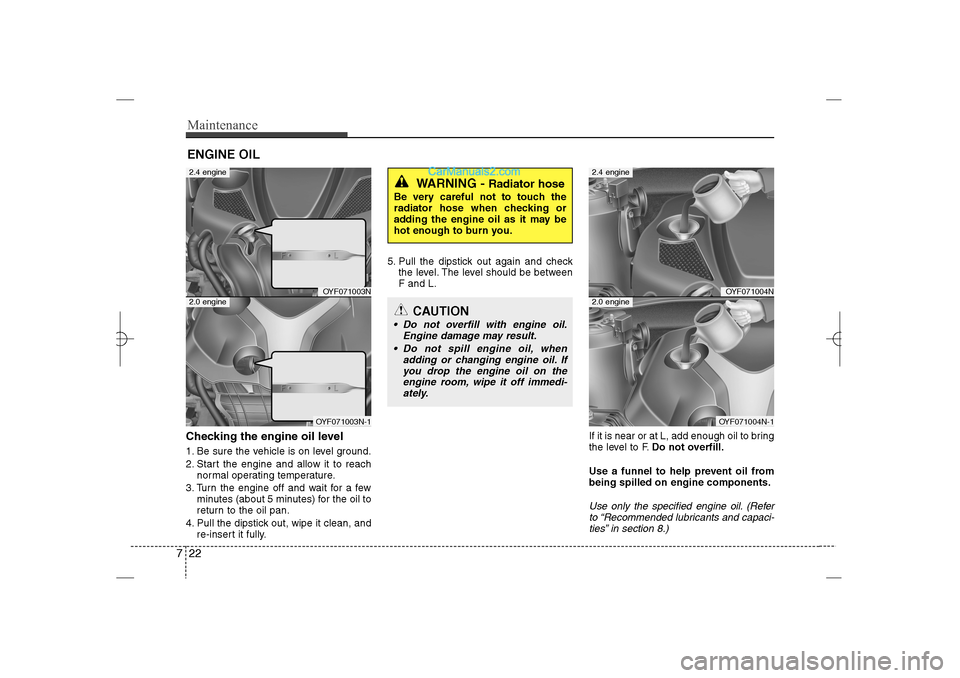
Maintenance22 7ENGINE OILChecking the engine oil level 1. Be sure the vehicle is on level ground.
2. Start the engine and allow it to reach
normal operating temperature.
3. Turn the engine off and wait for a few
minutes (about 5 minutes) for the oil to
return to the oil pan.
4. Pull the dipstick out, wipe it clean, and
re-insert it fully.5. Pull the dipstick out again and check
the level. The level should be between
F and L.
If it is near or at L, add enough oil to bring
the level to F.Do not overfill.
Use a funnel to help prevent oil from
being spilled on engine components.
Use only the specified engine oil. (Refer
to “Recommended lubricants and capaci-
ties” in section 8.)
WARNING -
Radiator hose
Be very careful not to touch the
radiator hose when checking or
adding the engine oil as it may be
hot enough to burn you.
OYF071003NOYF071003N-1
2.4 engine2.0 engine
OYF071004NOYF071004N-1
2.4 engine2.0 engine
CAUTION
Do not overfill with engine oil.
Engine damage may result.
Do not spill engine oil, when
adding or changing engine oil. If
you drop the engine oil on the
engine room, wipe it off immedi-
ately.
YF HMA 7.qxp 1/16/2012 6:18 PM Page 22
Page 340 of 410
725
Maintenance
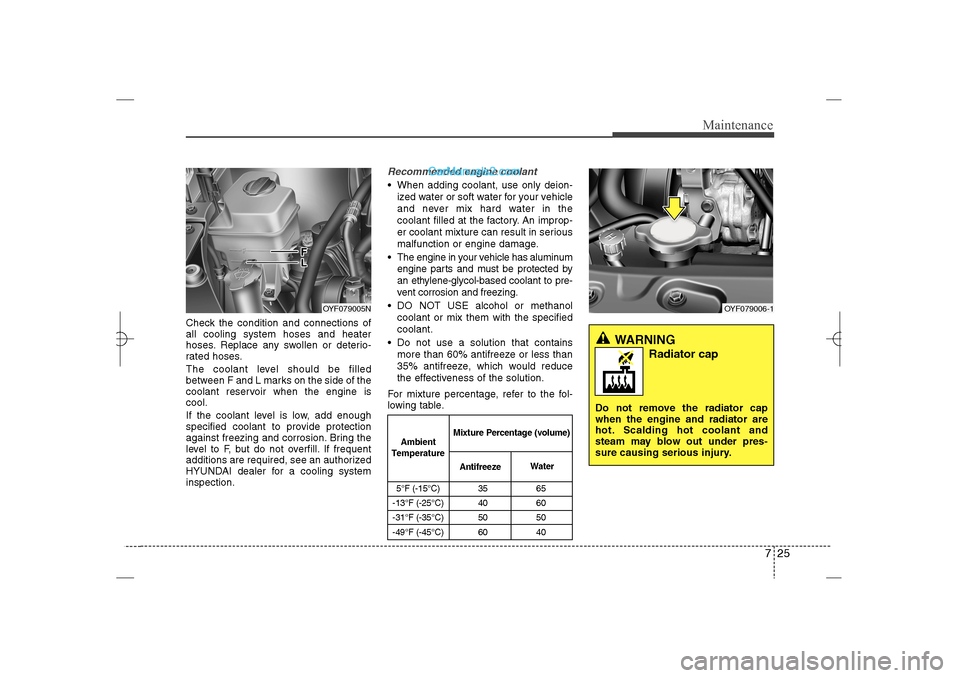
Check the condition and connections of
all cooling system hoses and heater
hoses. Replace any swollen or deterio-
rated hoses.
The coolant level should be filled
between F and L marks on the side of the
coolant reservoir when the engine is
cool.
If the coolant level is low, add enough
specified coolant to provide protection
against freezing and corrosion. Bring the
level to F, but do not overfill. If frequent
additions are required, see an authorized
HYUNDAI dealer for a cooling system
inspection.
Recommended engine coolant When adding coolant, use only deion-
ized water or soft water for your vehicle
and never mix hard water in the
coolant filled at the factory. An improp-
er coolant mixture can result in serious
malfunction or engine damage.
The engine in your vehicle has aluminum
engine parts and must be protected by
an ethylene-glycol-based coolant to pre-
vent corrosion and freezing.
DO NOT USE alcohol or methanol
coolant or mix them with the specified
coolant.
Do not use a solution that contains
more than 60% antifreeze or less than
35% antifreeze, which would reduce
the effectiveness of the solution.
For mixture percentage, refer to the fol-
lowing table.
WARNING
Radiator cap
Do not remove the radiator cap
when the engine and radiator are
hot. Scalding hot coolant and
steam may blow out under pres-
sure causing serious injury.
5°F (-15°C) 35 65
-13°F (-25°C) 40 60
-31°F (-35°C) 50 50
-49°F (-45°C) 60 40Ambient
TemperatureMixture Percentage (volume)
AntifreezeWater
OYF079006-1
OYF079005N
YF HMA 7.qxp 1/16/2012 6:18 PM Page 25
Page 342 of 410
727
Maintenance
Use only the specified brake fluid. (Refer
to “Recommended lubricants or capaci-
ties” in section 8.)
Never mix different types of fluid.
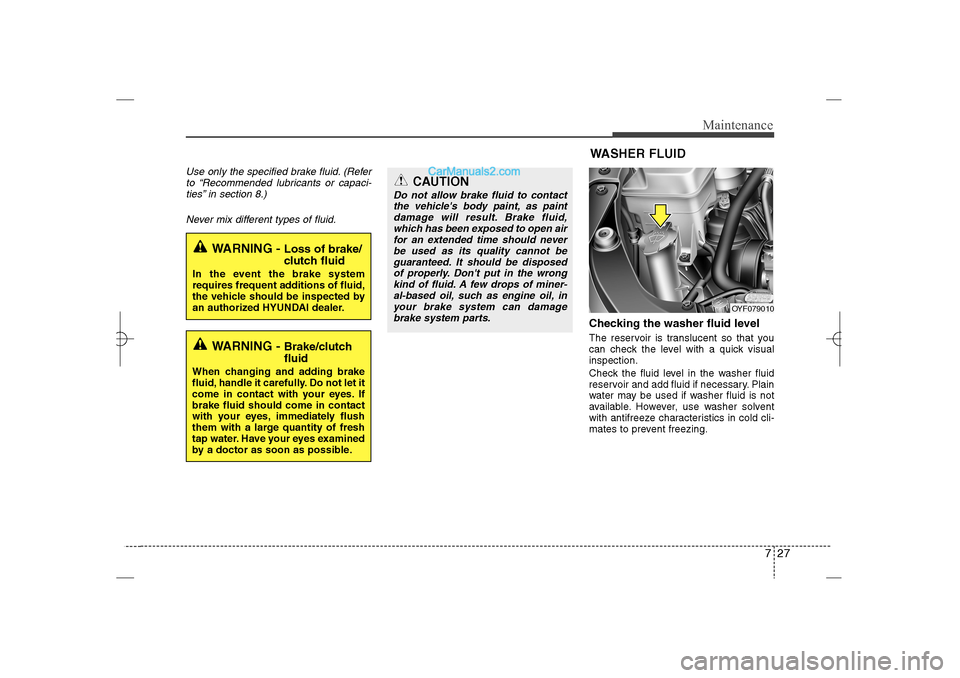
Checking the washer fluid level The reservoir is translucent so that you
can check the level with a quick visual
inspection.
Check the fluid level in the washer fluid
reservoir and add fluid if necessary. Plain
water may be used if washer fluid is not
available. However, use washer solvent
with antifreeze characteristics in cold cli-
mates to prevent freezing.
OYF079010
WARNING -
Brake/clutch
fluid
When changing and adding brake
fluid, handle it carefully. Do not let it
come in contact with your eyes. If
brake fluid should come in contact
with your eyes, immediately flush
them with a large quantity of fresh
tap water. Have your eyes examined
by a doctor as soon as possible.
WARNING -
Loss of brake/
clutch fluid
In the event the brake system
requires frequent additions of fluid,
the vehicle should be inspected by
an authorized HYUNDAI dealer.
CAUTION
Do not allow brake fluid to contact
the vehicle's body paint, as paint
damage will result. Brake fluid,
which has been exposed to open air
for an extended time should never
be used as its quality cannot be
guaranteed. It should be disposed
of properly. Don't put in the wrong
kind of fluid. A few drops of miner-
al-based oil, such as engine oil, in
your brake system can damage
brake system parts.
WASHER FLUID
YF HMA 7.qxp 1/16/2012 6:18 PM Page 27
Page 345 of 410
Maintenance30 7Replace the filter according to the
Maintenance Schedule.If the vehicle is operated in extremely
dusty or sandy areas, replace the ele-
ment more often than the usual recom-
mended intervals. (Refer to
“Maintenance under severe usage condi-
tions” in this section.)
Filter inspectionThe climate control air filter should be
replaced according to the Maintenance
Schedule. If the vehicle is operated in
severely air-polluted cities or on dusty
rough roads for a long period, it should
be inspected more frequently and
replaced earlier. When you replace the
climate control air filter, replace it per-
forming the following procedure, and be
careful to avoid damaging other compo-
nents.
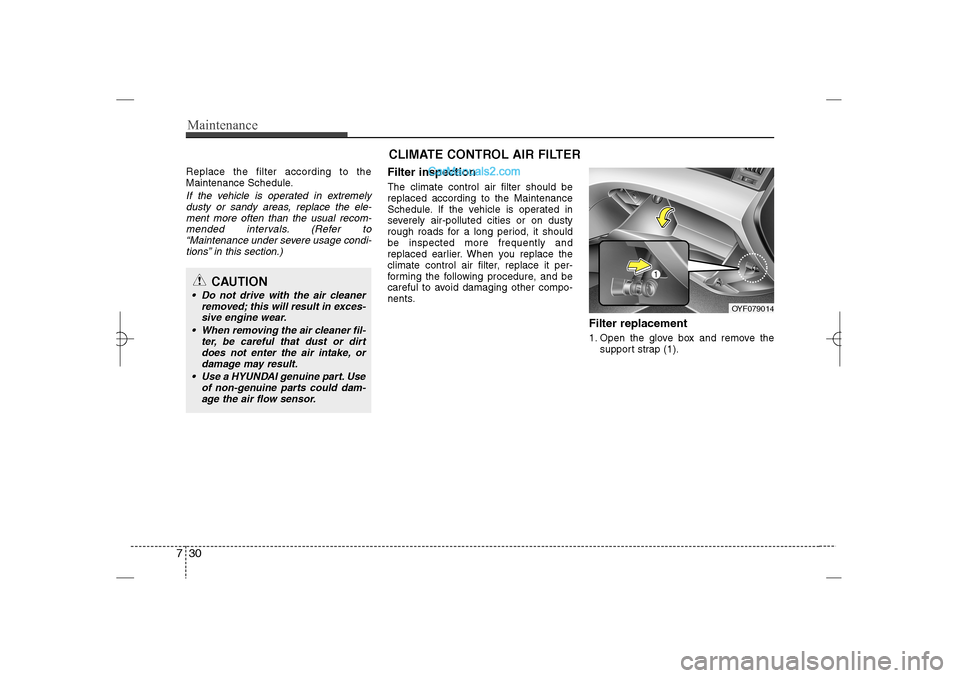
Filter replacement1. Open the glove box and remove the
support strap (1).
CAUTION
Do not drive with the air cleaner
removed; this will result in exces-
sive engine wear.
When removing the air cleaner fil-
ter, be careful that dust or dirt
does not enter the air intake, or
damage may result.
Use a HYUNDAI genuine part. Use
of non-genuine parts could dam-
age the air flow sensor.
CLIMATE CONTROL AIR FILTER
OYF079014
YF HMA 7.qxp 1/16/2012 6:18 PM Page 30
Page 347 of 410
Maintenance32 7WIPER BLADES Blade inspection✽
✽
NOTICECommercial hot waxes applied by auto-
matic car washes have been known to
make the windshield difficult to clean.
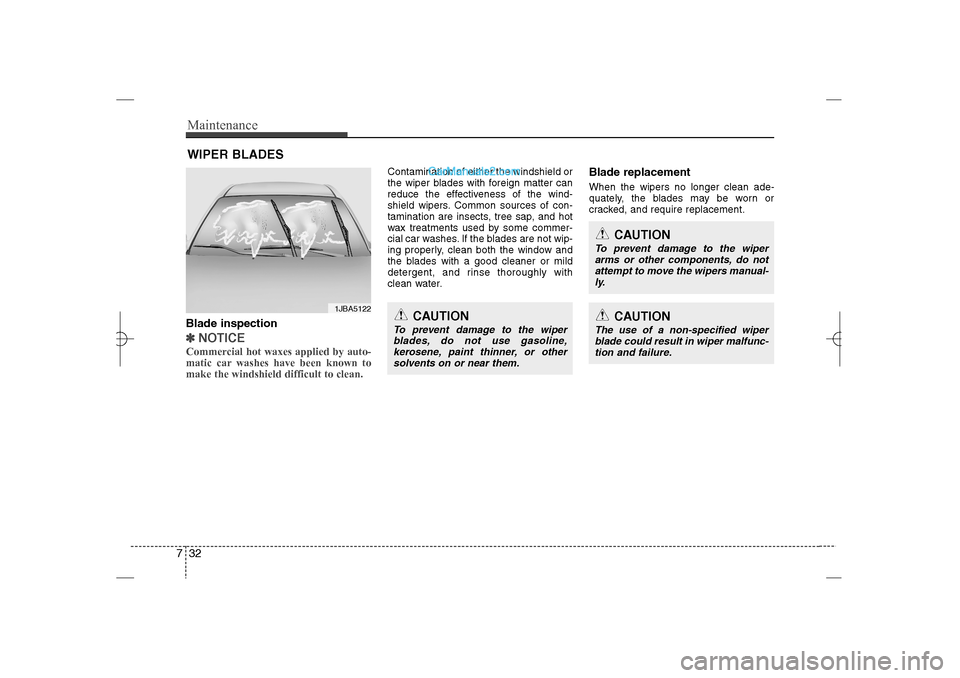
Contamination of either the windshield or
the wiper blades with foreign matter can
reduce the effectiveness of the wind-
shield wipers. Common sources of con-
tamination are insects, tree sap, and hot
wax treatments used by some commer-
cial car washes. If the blades are not wip-
ing properly, clean both the window and
the blades with a good cleaner or mild
detergent, and rinse thoroughly with
clean water.
Blade replacement When the wipers no longer clean ade-
quately, the blades may be worn or
cracked, and require replacement.
1JBA5122
CAUTION
To prevent damage to the wiper
blades, do not use gasoline,
kerosene, paint thinner, or other
solvents on or near them.
CAUTION
To prevent damage to the wiper
arms or other components, do not
attempt to move the wipers manual-
ly.
CAUTION
The use of a non-specified wiper
blade could result in wiper malfunc-
tion and failure.
YF HMA 7.qxp 1/16/2012 6:18 PM Page 32
Page 350 of 410
735
Maintenance
Battery recharging Your vehicle has a maintenance-free,
calcium-based battery.
If the battery becomes discharged in a
short time (because, for example, the
headlights or interior lights were left on
while the vehicle was not in use),
recharge it by slow charging (trickle)
for 10 hours.
If the battery gradually discharges
because of high electric load while the
vehicle is being used, recharge it at 20-
30A for two hours.
CALIFORNIA
PROPOSI-
TION 65 WARNING
Battery posts, terminals, and relat-
ed accessories contain lead and
lead compounds, chemicals known
to the State of California to cause
cancer, birth defects and reproduc-
tive harm. Batteries also contain
other chemicals known to the State
of California to cause cancer. Wash
hands after handling.
CAUTION
When you don’t use the vehicle
for a long time in the low temper-
ature, remove the battery and
store it indoors.
Always charge the battery fully to
prevent the battery case dam-
aged in low temperatures.
If you connect unauthorized elec-
tronic devices to the battery, the
battery may be discharged. Never
use unauthorized devices.
(Continued)
The electrical ignition system
works with high voltage. Never
touch these components with the
engine running or the ignition
switched on.
Failure to follow the above warn-
ings can result in serious bodily
injury or death.
YF HMA 7.qxp 1/16/2012 6:19 PM Page 35
Page 352 of 410
737
Maintenance
CAUTION
Underinflation also results in
excessive wear, poor handling
and reduced fuel economy.
Wheel deformation also is
possible. Keep your tire pres-
sures at the proper levels. If a
tire frequently needs refilling,
have it checked by an author-
ized HYUNDAI dealer.
Overinflation produces a
harsh ride, excessive wear at
the center of the tire tread, and
a greater possibility of dam-
age from road hazards.
TIRES AND WHEELS Tire care
For proper maintenance, safety, and
maximum fuel economy, you must
always maintain recommended tire
inflation pressures and stay within
the load limits and weight distribution
recommended for your vehicle.
Recommended cold tire inflation
pressures
All tire pressures (including the
spare) should be checked when the
tires are cold. “Cold Tires” means the
vehicle has not been driven for at
least three hours or driven less than
one mile (1.6 km).
Recommended pressures must be
maintained for the best ride, vehicle
handling, and minimum tire wear.
For recommended inflation pressure,
refer to “Tire and wheels” in section
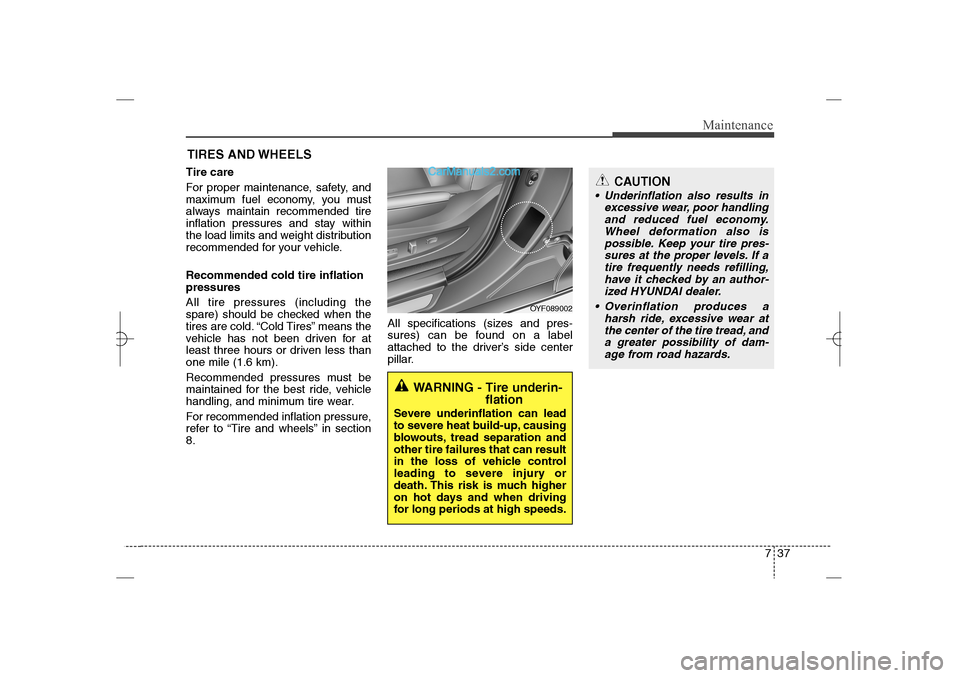
8.All specifications (sizes and pres-
sures) can be found on a label
attached to the driver’s side center
pillar.
WARNING - Tire underin-
flation
Severe underinflation can lead
to severe heat build-up, causing
blowouts, tread separation and
other tire failures that can result
in the loss of vehicle control
leading to severe injury or
death. This risk is much higher
on hot days and when driving
for long periods at high speeds.
OYF089002
YF HMA 7.qxp 1/16/2012 6:19 PM Page 37