maintenance schedule Hyundai Sonata 2016 - RHD (UK, Australia) User Guide
[x] Cancel search | Manufacturer: HYUNDAI, Model Year: 2016, Model line: Sonata, Model: Hyundai Sonata 2016Pages: 504, PDF Size: 12.45 MB
Page 421 of 504
Maintenance
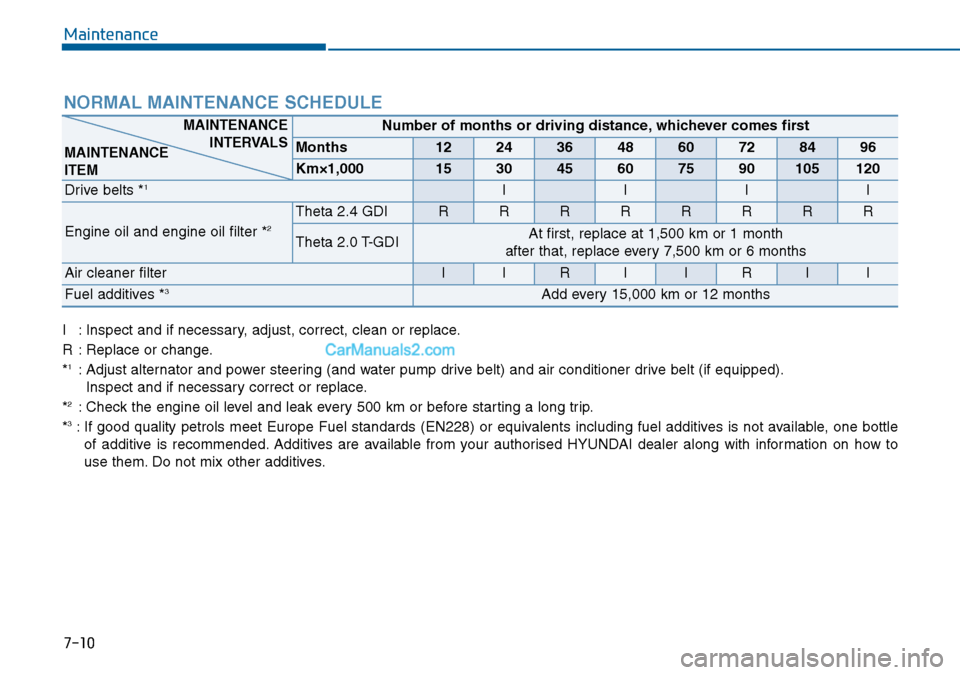
7-10 I : Inspect and if necessary, adjust, correct, clean or replace.
R : Replace or change.
*
1: Adjust alternator and power steering (and water pump drive belt) and air conditioner drive belt (if equipped).
Inspect and if necessary correct or replace.
*
2: Check the engine oil level and leak every 500 km or before starting a long trip.
*3: If good quality petrols meet Europe Fuel standards (EN228) or equivalents including fuel additives is not available, one bottle
of additive is recommended. Additives are available from your authorised HYUNDAI dealer along with information on how to
use them. Do not mix other additives.
NORMAL MAINTENANCE SCHEDULE
Number of months or driving distance, whichever comes first
Months1224364860728496
Km×1,000153045607590105120
Drive belts *1IIII
Engine oil and engine oil filter *2Theta 2.4 GDI RRRRRRRR
Theta 2.0 T-GDI At first, replace at 1,500 km or 1 month
after that, replace every 7,500 km or 6 months
Air cleaner filterIIRIIRII
Fuel additives *3Add every 15,000 km or 12 months
MAINTENANCE
INTERVALS
MAINTENANCE
ITEM
Page 422 of 504
7-11
7
Maintenance
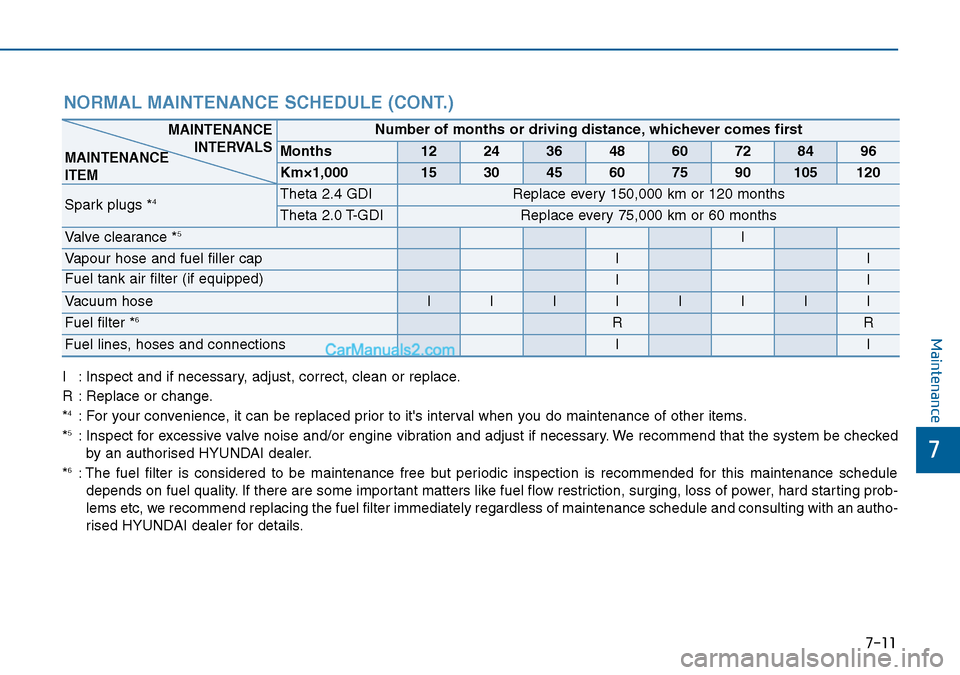
NORMAL MAINTENANCE SCHEDULE (CONT.)
I : Inspect and if necessary, adjust, correct, clean or replace.
R : Replace or change.
*
4: For your convenience, it can be replaced prior to it's interval when you do maintenance of other items.
*5: Inspect for excessive valve noise and/or engine vibration and adjust if necessary. We recommend that the system be checked
by an authorised HYUNDAI dealer.
*
6: The fuel filter is considered to be maintenance free but periodic inspection is recommended for this maintenance schedule
depends on fuel quality. If there are some important matters like fuel flow restriction, surging, loss of power, hard starting prob-
lems etc, we recommend replacing the fuel filter immediately regardless of maintenance schedule and consulting with an autho-
rised HYUNDAI dealer for details.
Number of months or driving distance, whichever comes first
Months1224364860728496
Km×1,000153045607590105120
Spark plugs *4Theta 2.4 GDIReplace every 150,000 km or 120 months
Theta 2.0 T-GDIReplace every 75,000 km or 60 months
Valve clearance *5I
Vapour hose and fuel filler capII
Fuel tank air filter (if equipped)II
Vacuum hoseIIIIIIII
Fuel filter *6RR
Fuel lines, hoses and connectionsII
MAINTENANCE
INTERVALS
MAINTENANCE
ITEM
Page 423 of 504
Maintenance
7-12
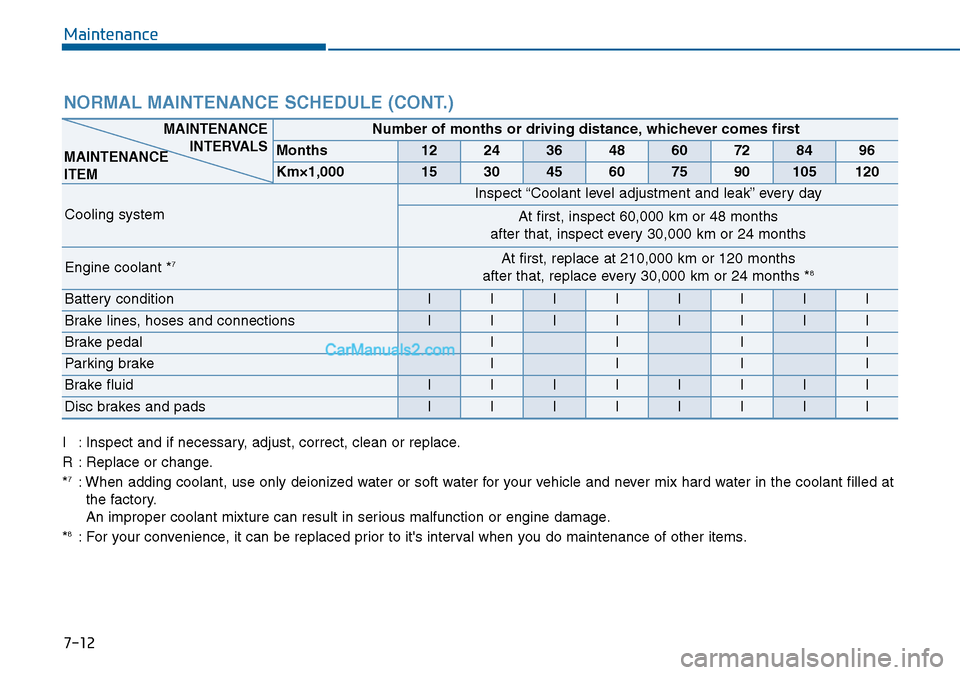
NORMAL MAINTENANCE SCHEDULE (CONT.)
I : Inspect and if necessary, adjust, correct, clean or replace.
R : Replace or change.
*
7: When adding coolant, use only deionized water or soft water for your vehicle and never mix hard water in the coolant filled at
the factory.
An improper coolant mixture can result in serious malfunction or engine damage.
*
8: For your convenience, it can be replaced prior to it's interval when you do maintenance of other items.
Number of months or driving distance, whichever comes first
Months1224364860728496
Km×1,000153045607590105120
Cooling system
Inspect “Coolant level adjustment and leak” every day
At first, inspect 60,000 km or 48 months
after that, inspect every 30,000 km or 24 months
Engine coolant *7At first, replace at 210,000 km or 120 months
after that, replace every 30,000 km or 24 months *8
Battery conditionIIIIIIII
Brake lines, hoses and connectionsIIIIIIII
Brake pedalIIII
Parking brakeIIII
Brake fluidIIIIIIII
Disc brakes and padsIIIIIIII
MAINTENANCE
INTERVALS
MAINTENANCE
ITEM
Page 424 of 504
7-13
7
Maintenance
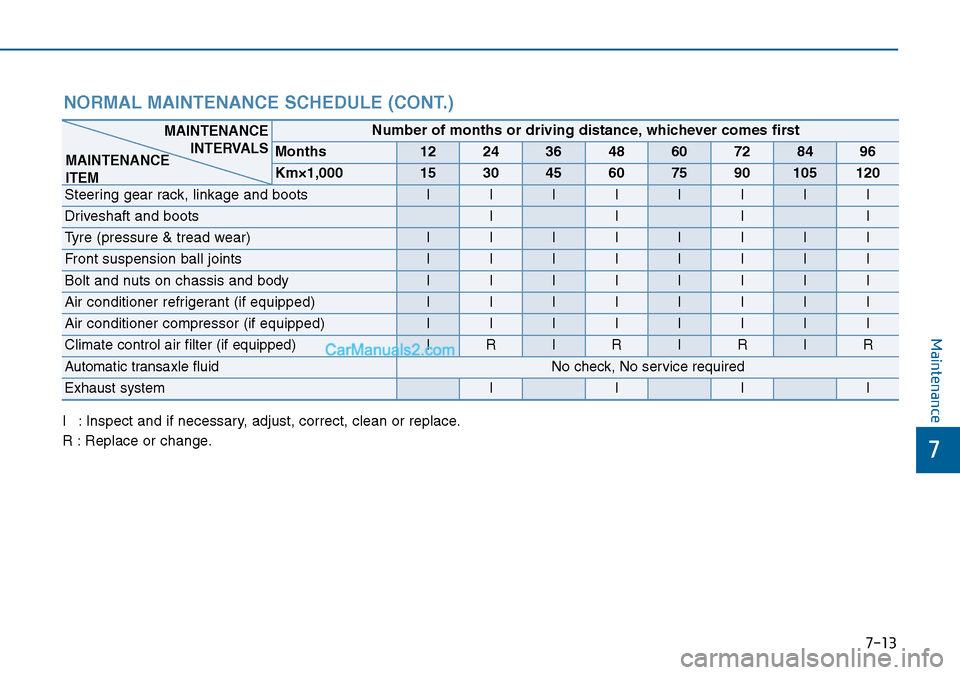
NORMAL MAINTENANCE SCHEDULE (CONT.)
I : Inspect and if necessary, adjust, correct, clean or replace.
R : Replace or change.
Number of months or driving distance, whichever comes first
Months1224364860728496
Km×1,000153045607590105120
Steering gear rack, linkage and bootsIIIIIIII
Driveshaft and bootsIIII
Tyre (pressure & tread wear) IIIIIIII
Front suspension ball jointsIIIIIIII
Bolt and nuts on chassis and bodyIIIIIIII
Air conditioner refrigerant (if equipped)IIIIIIII
Air conditioner compressor (if equipped)IIIIIIII
Climate control air filter (if equipped)IRIRIRIR
Automatic transaxle fluidNo check, No service required
Exhaust systemIIII
MAINTENANCE
INTERVALS
MAINTENANCE
ITEM
Page 427 of 504
7-16
Maintenance
EXPLANATION OF SCHEDULED MAINTENANCE ITEMS
Engine oil and filter
The engine oil and filter should be
changed at the intervals specified in
the maintenance schedule. If the
vehicle is being driven in severe con-
ditions, more frequent oil and filter
changes are required.
Drive belts
Inspect all drive belts for evidence of
cuts, cracks, excessive wear or oil
saturation and replace if necessary.
Drive belts should be checked peri-
odically for proper tension and
adjusted as necessary.
Fuel filter (cartridge)
A clogged filter can limit the speed at
which the vehicle may be driven,
damage the emission system and
cause multiple issues such as hard
starting. If an excessive amount of
foreign matter accumulates in the
fuel tank, the filter may require
replacement more frequently.
After installing a new filter, run the
engine for several minutes, and
check for leaks at the connections.
We recommend that the fuel filter be
replaced by an authorised HYUNDAI
dealer.
Fuel lines, fuel hoses and con-
nections
Check the fuel lines, fuel hoses and
connections for leakage and dam-
age. We recommend that the fuel
lines, fuel hoses and connections be
replaced by an authorised HYUNDAI
dealer.
Vapour hose and fuel filler cap
The vapour hose and fuel filler cap
should be inspected at those inter-
vals specified in the maintenance
schedule. Make sure that a new
vapour hose or fuel filler cap is cor-
rectly replaced.
When you are inspecting the
belt, place the ignition switch to
the LOCK/OFF or ACC position.
CAUTION
Page 428 of 504
7-17
7
Maintenance
Vacuum crankcase ventilation
hoses (if equipped)
Inspect the surface of hoses for evi-
dence of heat and/or mechanical
damage. Hard and brittle rubber,
cracking, tears, cuts, abrasions, and
excessive swelling indicate deterio-
ration. Particular attention should be
paid to examine those hose surfaces
nearest to high heat sources, such
as the exhaust manifold.
Inspect the hose routing to assure
that the hoses do not come in con-
tact with any heat source, sharp
edges or moving component which
might cause heat damage or mechan-
ical wear. Inspect all hose connec-
tions, such as clamps and couplings,
to make sure they are secure, and that
no leaks are present. Hoses should be
replaced immediately if there is any
evidence of deterioration or damage.
Air cleaner filter
We recommend that the air cleaner
filter be replaced by an authorised
HYUNDAI dealer.
Spark plugs
Make sure to install new spark plugs
of the correct heat range.
Valve clearance (Theta Engine)
Inspect excessive valve noise and/or
engine vibration and adjust if neces-
sary. We recommend that the system
be serviced by an authorised
HYUNDAI dealer.
Cooling system
Check the cooling system parts,
such as radiator, coolant reservoir,
hoses and connections for leakage
and damage. Replace any damaged
parts.
Coolant
The coolant should be changed at
the intervals specified in the mainte-
nance schedule. Do not disconnect and inspect
spark plugs when the engine is
hot. You may burn yourself.
WARNING
Page 429 of 504
7-18
Maintenance
Automatic transaxle fluid
Automatic transaxle fluid should not
be checked under normal usage
conditions.
We recommend that the automatic
transaxle fluid be changed by an
authorised HYUNDAI dealer accord-
ing to the maintenance schedule.
Automatic transaxle fluid colour is
basically red.
As the vehicle is driven, the auto-
matic transaxle fluid will begin to
look darker.
This is a normal condition and
does not need to be replaced
based on the colour change.
Brake hoses and lines
Visually check for proper installation,
chafing, cracks, deterioration and
any leakage. Replace any deteriorat-
ed or damaged parts immediately.
Brake fluid
Check brake fluid level in the brake
fluid reservoir. The level should be
between “MIN” and “MAX” marks on
the side of the reservoir. Use only
hydraulic brake fluid conforming to
DOT 3 or DOT 4 specification.
Parking brake
Inspect the parking brake system
including the parking brake lever (or
pedal) and cables.
NOTICE
The use of a non-specified fluid
could result in transaxle mal-
function and failure.
Use only specified automatic
transaxle fluid. (Refer to
“Recommended lubricants and
capacities” in section 8.)
CAUTION
Page 441 of 504
7-30
Maintenance
CLIMATE CONTROL AIR FILTER
Filter inspection
If the vehicle is operated in severely
air-polluted cities or on dusty rough
roads for a long period, it should be
inspected more frequently and
replaced earlier. When you, the
owner, replace the climate control air
filter, replace it performing the follow-
ing procedure, and be careful to
avoid damaging other components.
Replace the filter according to the
Maintenance Schedule.
Install a new climate control air fil-
ter in the correct direction with the
arrow symbol (
↓) facing down-
wards.
Otherwise, the climate control
effects may decrease, possibly
with a noise.
Filter replacement
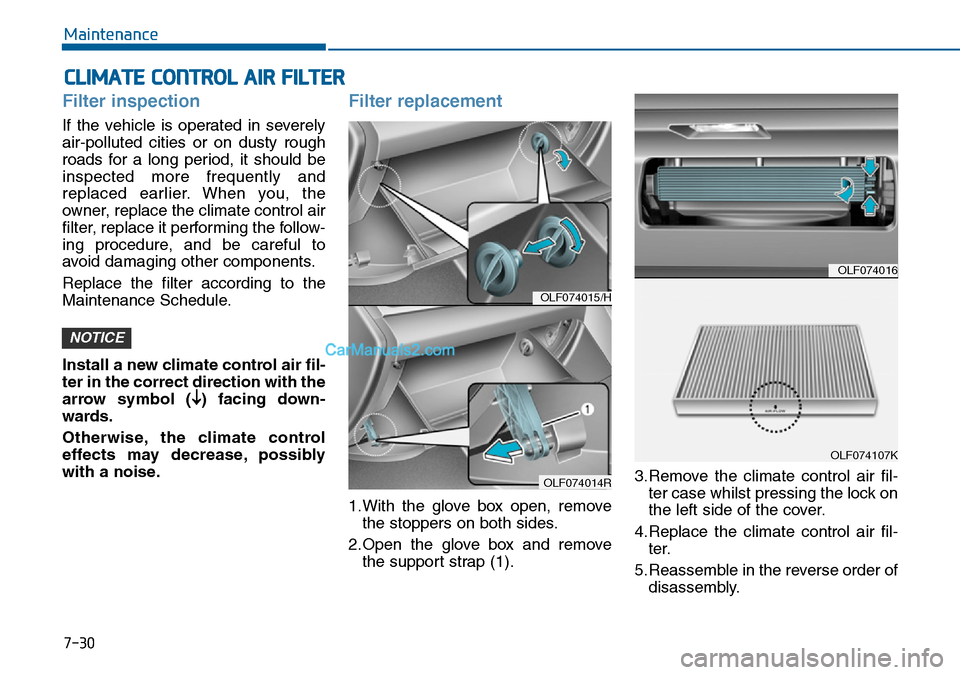
1.With the glove box open, remove
the stoppers on both sides.
2.Open the glove box and remove
the support strap (1).3.Remove the climate control air fil-
ter case whilst pressing the lock on
the left side of the cover.
4.Replace the climate control air fil-
ter.
5.Reassemble in the reverse order of
disassembly.
NOTICE
OLF074015/H
OLF074014R
OLF074016
OLF074107K
Page 492 of 504
7-81
7
Maintenance
EMISSION CONTROL SYSTEM
The emission control system of your
vehicle is covered by a written limited
warranty. Please see the warranty
information contained in the Service
Passport in your vehicle.
Your vehicle is equipped with an
emission control system to meet all
Australian Design Rules (ADR)
requirements.
There are three emission control
systems which are as follows.
(1) Crankcase emission control sys-
tem
(2) Evaporative emission control sys-
tem
(3) Exhaust emission control system
In order to ensure the proper func-
tion of the emission control systems,
it is recommended that you have
your vehicle inspected and main-
tained by an authorised HYUNDAI
dealer in accordance with the main-
tenance schedule in this manual.1. Crankcase emission control
system
The positive crankcase ventilation
system is employed to prevent air
pollution caused by blow-by gases
being emitted from the crankcase.
This system supplies fresh filtered air
to the crankcase through the air
intake hose. Inside the crankcase,
the fresh air mixes with blow-by
gases, which then pass through the
PCV valve into the induction system.
2. Evaporative emission con-
trol system
The Evaporative Emission Control
System is designed to prevent fuel
vapours from escaping into the
atmosphere. For the Inspection and
Maintenance Test (With Electronic
Stability Control (ESC) system)
•To prevent the vehicle from
misfiring during dynamome-
ter testing, turn the Electronic
Stability Control (ESC) sys-
tem off by pressing the ESC
switch.
•After dynamometer testing is
completed, turn the ESC sys-
tem back on by pressing the
ESC switch again.
CAUTION