power steering Hyundai Sonata 2017 User Guide
[x] Cancel search | Manufacturer: HYUNDAI, Model Year: 2017, Model line: Sonata, Model: Hyundai Sonata 2017Pages: 563, PDF Size: 17.7 MB
Page 357 of 563
5-49
Driving your vehicle
5
When Active ECO is activated:
The acceleration response may beslightly reduced as the accelerator
pedal is depressed moderately.
The air conditioner performance may be limited.
The shift pattern of the automatic transmission may change.
The above situations are normal
conditions when the Active ECO sys-
tem is activated to improve fuel effi-
ciency. Limitation of Active ECO opera-
tion:
If the following conditions occur while
Active ECO is operating, the system
operation is limited even though
there is no change in the ECO indi-
cator.
When the coolant temperature is
low:
The system will be limited until
engine performance becomes nor-
mal.
When driving up a hill: The system will be limited to gain
power when driving uphill because
engine torque is restricted.
When using the automatic trans- mission Manual shift mode:
The system will be limited accord-
ing to the shift location.SPORT mode
SPORT mode focuses ondynamic driving by auto-
matically controlling the
steering wheel, engine
and transmission system.
When the DRIVE MODE switch is pressed and the SPORT mode is
selected, the SPORT indicator
(yellow) will illuminate.
When the SPORT mode is activat- ed, and the engine is turned off
and on it will change to NORMAL
mode. To turn on the SPORT
mode, press the DRIVE MODE
switch again.
If the system is activated: - After accelerating and releasingthe accelerator pedal, the gear
and engine speed RPM may not
drop as soon as in NORMAL
mode.
- Up-shifting is delayed.
Information
In SPORT mode, the fuel efficiency
may decrease.
i
SPORT
Page 393 of 563
5-85
Driving your vehicle
5
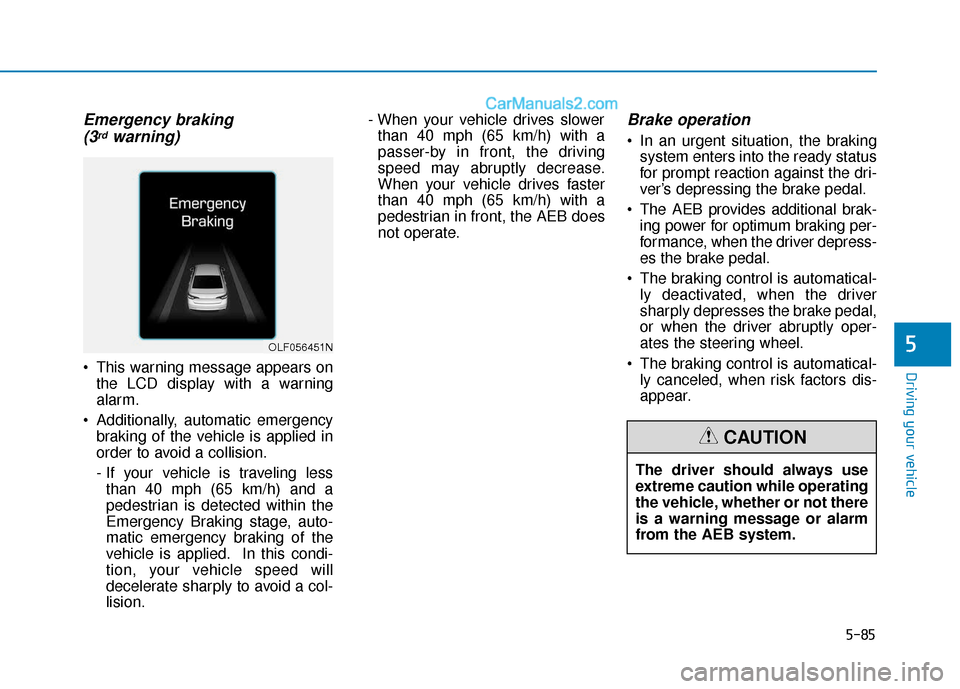
Emergency braking (3rdwarning)
This warning message appears on
the LCD display with a warning
alarm.
Additionally, automatic emergency braking of the vehicle is applied in
order to avoid a collision.
- If your vehicle is traveling lessthan 40 mph (65 km/h) and a
pedestrian is detected within the
Emergency Braking stage, auto-
matic emergency braking of the
vehicle is applied. In this condi-
tion, your vehicle speed will
decelerate sharply to avoid a col-
lision. - When your vehicle drives slower
than 40 mph (65 km/h) with a
passer-by in front, the driving
speed may abruptly decrease.
When your vehicle drives faster
than 40 mph (65 km/h) with a
pedestrian in front, the AEB does
not operate.
Brake operation
In an urgent situation, the braking system enters into the ready status
for prompt reaction against the dri-
ver’s depressing the brake pedal.
The AEB provides additional brak- ing power for optimum braking per-
formance, when the driver depress-
es the brake pedal.
The braking control is automatical- ly deactivated, when the driver
sharply depresses the brake pedal,
or when the driver abruptly oper-
ates the steering wheel.
The braking control is automatical- ly canceled, when risk factors dis-
appear.
OLF056451N
The driver should always use
extreme caution while operating
the vehicle, whether or not there
is a warning message or alarm
from the AEB system.
CAUTION
Page 444 of 563
6-31
What to do in an emergency
6
When towing your vehicle in an
emergency without wheel dollies :
1. Place the ignition switch in theACC position.
2. Place the shift lever in N (Neutral).
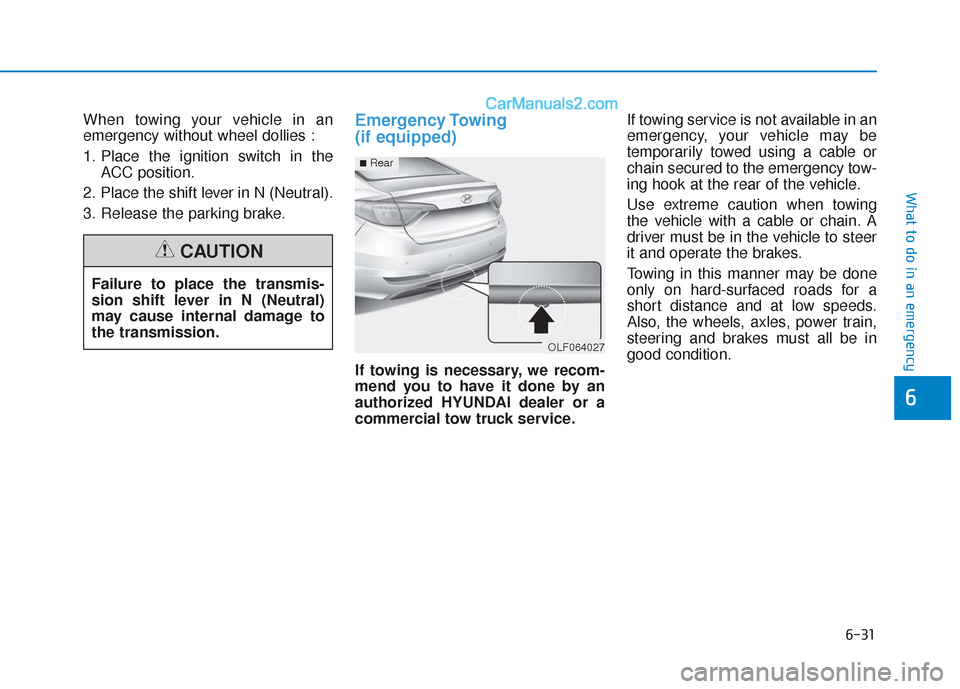
3. Release the parking brake.Emergency Towing
(if equipped)
If towing is necessary, we recom-
mend you to have it done by an
authorized HYUNDAI dealer or a
commercial tow truck service. If towing service is not available in an
emergency, your vehicle may be
temporarily towed using a cable or
chain secured to the emergency tow-
ing hook at the rear of the vehicle.
Use extreme caution when towing
the vehicle with a cable or chain. A
driver must be in the vehicle to steer
it and operate the brakes.
Towing in this manner may be done
only on hard-surfaced roads for a
short distance and at low speeds.
Also, the wheels, axles, power train,
steering and brakes must all be in
good condition.
Failure to place the transmis-
sion shift lever in N (Neutral)
may cause internal damage to
the transmission.
CAUTION
OLF064027
■Rear
Page 445 of 563
6-32
What to do in an emergency
Always follow these emergency tow-
ing precautions:
Place the ignition switch in the ACC position so the steering
wheel is not locked.
Place the shift lever in N (Neutral).
Release the parking brake.
Depress the brake pedal with more force than normal since you will
have reduced braking perform-
ance.
More steering effort will be required because the power steer-
ing system will be disabled.
Use a vehicle heavier than your own to tow your vehicle.
The drivers of both vehicles should communicate with each other fre-
quently.
Before emergency towing, check that the hook is not broken or dam-
aged.
Fasten the towing cable or chain securely to the hook.
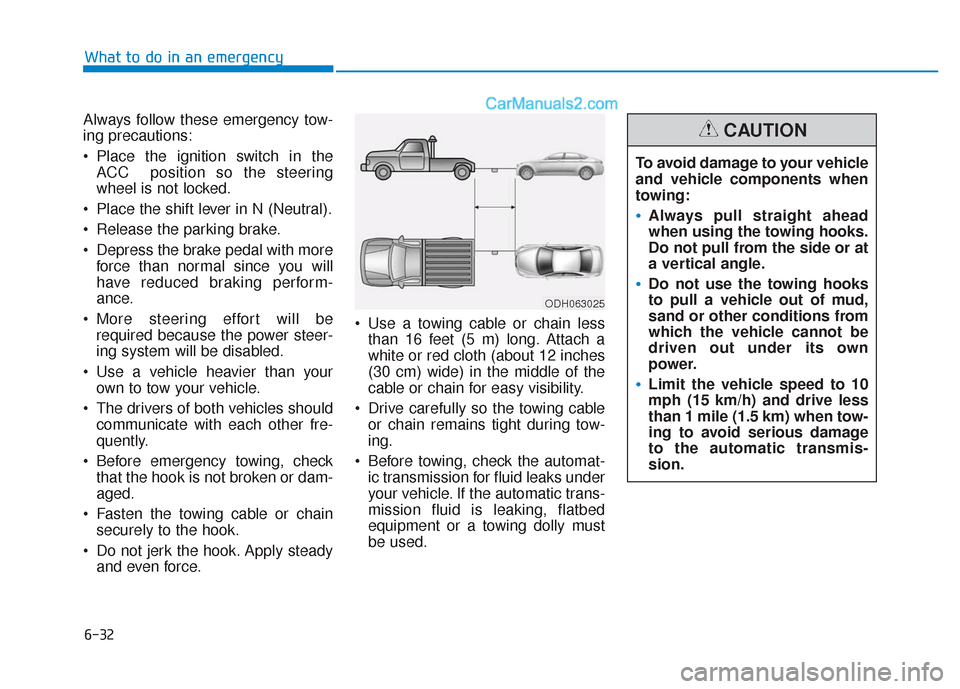
Do not jerk the hook. Apply steady and even force. Use a towing cable or chain less
than 16 feet (5 m) long. Attach a
white or red cloth (about 12 inches
(30 cm) wide) in the middle of the
cable or chain for easy visibility.
Drive carefully so the towing cable or chain remains tight during tow-
ing.
Before towing, check the automat- ic transmission for fluid leaks under
your vehicle. If the automatic trans-
mission fluid is leaking, flatbed
equipment or a towing dolly must
be used.
ODH063025
To avoid damage to your vehicle
and vehicle components when
towing:
Always pull straight ahead
when using the towing hooks.
Do not pull from the side or at
a vertical angle.
Do not use the towing hooks
to pull a vehicle out of mud,
sand or other conditions from
which the vehicle cannot be
driven out under its own
power.
Limit the vehicle speed to 10
mph (15 km/h) and drive less
than 1 mile (1.5 km) when tow-
ing to avoid serious damage
to the automatic transmis-
sion.
CAUTION
Page 456 of 563
7
Maintenance
7-11
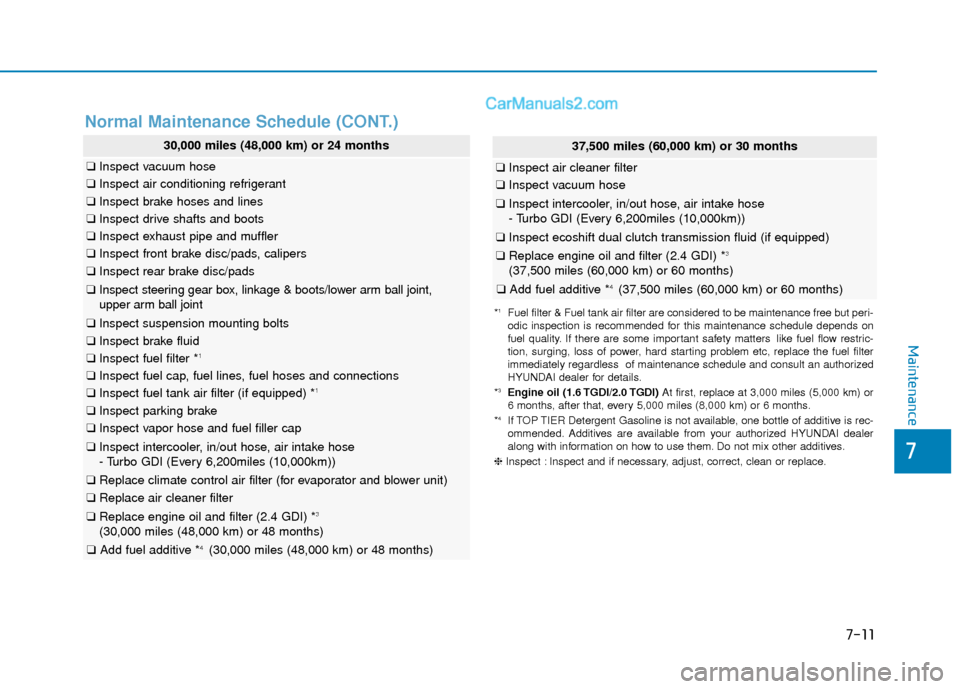
Normal Maintenance Schedule (CONT.)
37,500 miles (60,000 km) or 30 months
❑Inspect air cleaner filter
❑Inspect vacuum hose
❑Inspect intercooler, in/out hose, air intake hose
- Turbo GDI (Every 6,200miles (10,000km))
❑Inspect ecoshift dual clutch transmission fluid (if equipped)
❑Replace engine oil and filter (2.4 GDI) *3
(37,500 miles (60,000 km) or 60 months)
❑ Add fuel additive *4 (37,500 miles (60,000 km) or 60 months)
*1Fuel filter & Fuel tank air filter are considered to be maintenance free\
but peri-
odic inspection is recommended for this maintenance schedule depends on
fuel quality. If there are some important safety matters like fuel flow restric-
tion, surging, loss of power, hard starting problem etc, replace the fuel filter
immediately regardless of maintenance schedule and consult an authorized
HYUNDAI dealer for details.
*
3Engine oil (1.6 TGDI/2.0 TGDI) At first, replace at 3,000 miles (5,000 km) or
6 months, after that, every 5,000 miles (8,000 km) or 6 months.
*
4If TOP TIER Detergent Gasoline is not available, one bottle of additive is rec-
ommended. Additives are available from your authorized HYUNDAI dealer
along with information on how to use them. Do not mix other additives.
❈ Inspect : Inspect and if necessary, adjust, correct, clean or replace.
30,000 miles (48,000 km) or 24 months
❑Inspect vacuum hose
❑Inspect air conditioning refrigerant
❑Inspect brake hoses and lines
❑Inspect drive shafts and boots
❑Inspect exhaust pipe and muffler
❑Inspect front brake disc/pads, calipers
❑Inspect rear brake disc/pads
❑Inspect steering gear box, linkage & boots/lower arm ball joint,
upper arm ball joint
❑Inspect suspension mounting bolts
❑Inspect brake fluid
❑Inspect fuel filter *1
❑Inspect fuel cap, fuel lines, fuel hoses and connections
❑Inspect fuel tank air filter (if equipped) *1
❑Inspect parking brake
❑Inspect vapor hose and fuel filler cap
❑Inspect intercooler, in/out hose, air intake hose
- Turbo GDI (Every 6,200miles (10,000km))
❑ Replace climate control air filter (for evaporator and blower unit)
❑Replace air cleaner filter
❑Replace engine oil and filter (2.4 GDI) *3
(30,000 miles (48,000 km) or 48 months)
❑ Add fuel additive *4 (30,000 miles (48,000 km) or 48 months)
Page 458 of 563
7
Maintenance
7-13
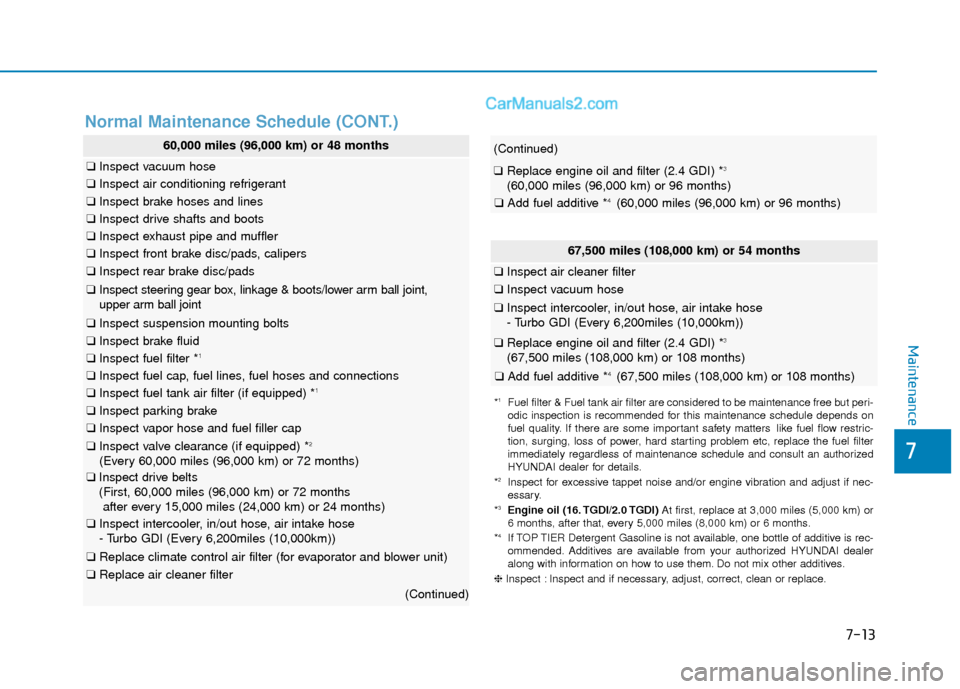
60,000 miles (96,000 km) or 48 months
❑Inspect vacuum hose
❑Inspect air conditioning refrigerant
❑Inspect brake hoses and lines
❑Inspect drive shafts and boots
❑Inspect exhaust pipe and muffler
❑Inspect front brake disc/pads, calipers
❑Inspect rear brake disc/pads
❑Inspect steering gear box, linkage & boots/lower arm ball joint,
upper arm ball joint
❑ Inspect suspension mounting bolts
❑Inspect brake fluid
❑Inspect fuel filter *1
❑Inspect fuel cap, fuel lines, fuel hoses and connections
❑Inspect fuel tank air filter (if equipped) *1
❑Inspect parking brake
❑Inspect vapor hose and fuel filler cap
❑Inspect valve clearance (if equipped) *2
(Every 60,000 miles (96,000 km) or 72 months)
❑Inspect drive belts
(First, 60,000 miles (96,000 km) or 72 months
after every 15,000 miles (24,000 km) or 24 months)
❑ Inspect intercooler, in/out hose, air intake hose
- Turbo GDI (Every 6,200miles (10,000km))
❑ Replace climate control air filter (for evaporator and blower unit)
❑Replace air cleaner filter
(Continued)
67,500 miles (108,000 km) or 54 months
❑Inspect air cleaner filter
❑Inspect vacuum hose
❑Inspect intercooler, in/out hose, air intake hose
- Turbo GDI (Every 6,200miles (10,000km))
❑Replace engine oil and filter (2.4 GDI) *3
(67,500 miles (108,000 km) or 108 months)
❑ Add fuel additive *4 (67,500 miles (108,000 km) or 108 months)
Normal Maintenance Schedule (CONT.)
*1Fuel filter & Fuel tank air filter are considered to be maintenance free\
but peri-
odic inspection is recommended for this maintenance schedule depends on
fuel quality. If there are some important safety matters like fuel flow restric-
tion, surging, loss of power, hard starting problem etc, replace the fuel filter
immediately regardless of maintenance schedule and consult an authorized
HYUNDAI dealer for details.
*
2Inspect for excessive tappet noise and/or engine vibration and adjust if nec-
essary.
*
3Engine oil (16. TGDI/2.0 TGDI) At first, replace at 3,000 miles (5,000 km) or
6 months, after that, every 5,000 miles (8,000 km) or 6 months.
*
4If TOP TIER Detergent Gasoline is not available, one bottle of additive is rec-
ommended. Additives are available from your authorized HYUNDAI dealer
along with information on how to use them. Do not mix other additives.
❈ Inspect : Inspect and if necessary, adjust, correct, clean or replace.
(Continued)
❑Replace engine oil and filter (2.4 GDI) *3
(60,000 miles (96,000 km) or 96 months)
❑ Add fuel additive *4 (60,000 miles (96,000 km) or 96 months)
Page 460 of 563
7
Maintenance
7-15
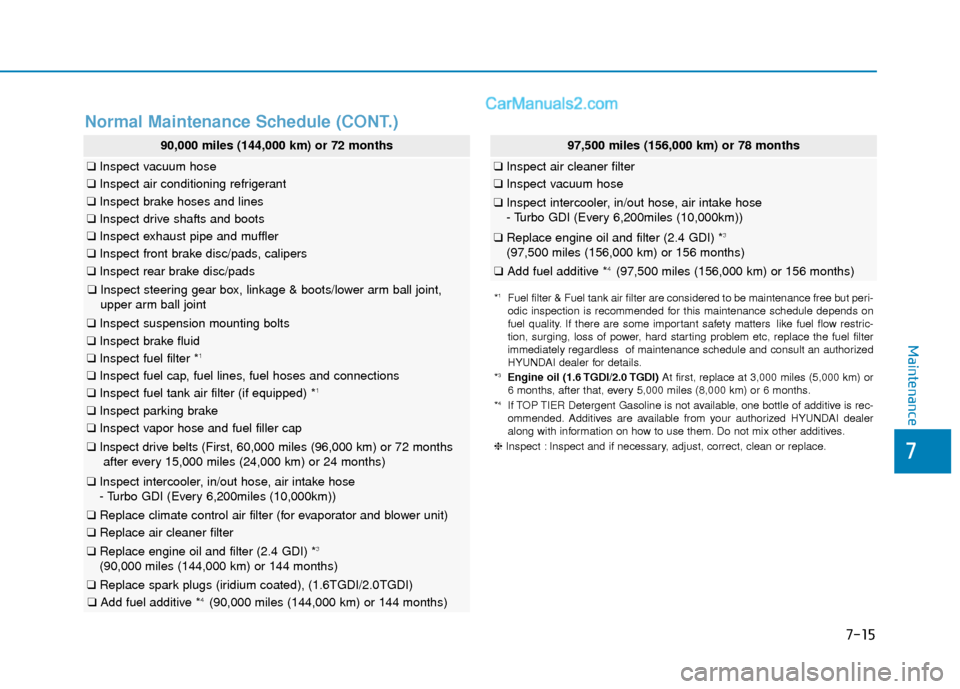
Normal Maintenance Schedule (CONT.)
97,500 miles (156,000 km) or 78 months
❑Inspect air cleaner filter
❑Inspect vacuum hose
❑Inspect intercooler, in/out hose, air intake hose
- Turbo GDI (Every 6,200miles (10,000km))
❑Replace engine oil and filter (2.4 GDI) *3
(97,500 miles (156,000 km) or 156 months)
❑ Add fuel additive *4 (97,500 miles (156,000 km) or 156 months)
90,000 miles (144,000 km) or 72 months
❑Inspect vacuum hose
❑Inspect air conditioning refrigerant
❑Inspect brake hoses and lines
❑Inspect drive shafts and boots
❑Inspect exhaust pipe and muffler
❑Inspect front brake disc/pads, calipers
❑Inspect rear brake disc/pads
❑Inspect steering gear box, linkage & boots/lower arm ball joint,
upper arm ball joint
❑ Inspect suspension mounting bolts
❑Inspect brake fluid
❑Inspect fuel filter *1
❑Inspect fuel cap, fuel lines, fuel hoses and connections
❑Inspect fuel tank air filter (if equipped) *1
❑Inspect parking brake
❑Inspect vapor hose and fuel filler cap
❑Inspect drive belts (First, 60,000 miles (96,000 km) or 72 months
after every 15,000 miles (24,000 km) or 24 months)
❑ Inspect intercooler, in/out hose, air intake hose
- Turbo GDI (Every 6,200miles (10,000km))
❑ Replace climate control air filter (for evaporator and blower unit)
❑Replace air cleaner filter
❑Replace engine oil and filter (2.4 GDI) *3
(90,000 miles (144,000 km) or 144 months)
❑Replace spark plugs (iridium coated), (1.6TGDI/2.0TGDI)
❑ Add fuel additive *4 (90,000 miles (144,000 km) or 144 months)
*1Fuel filter & Fuel tank air filter are considered to be maintenance free\
but peri-
odic inspection is recommended for this maintenance schedule depends on
fuel quality. If there are some important safety matters like fuel flow restric-
tion, surging, loss of power, hard starting problem etc, replace the fuel filter
immediately regardless of maintenance schedule and consult an authorized
HYUNDAI dealer for details.
*
3Engine oil (1.6 TGDI/2.0 TGDI) At first, replace at 3,000 miles (5,000 km) or
6 months, after that, every 5,000 miles (8,000 km) or 6 months.
*
4If TOP TIER Detergent Gasoline is not available, one bottle of additive is rec-
ommended. Additives are available from your authorized HYUNDAI dealer
along with information on how to use them. Do not mix other additives.
❈ Inspect : Inspect and if necessary, adjust, correct, clean or replace.
Page 462 of 563
7
Maintenance
7-17
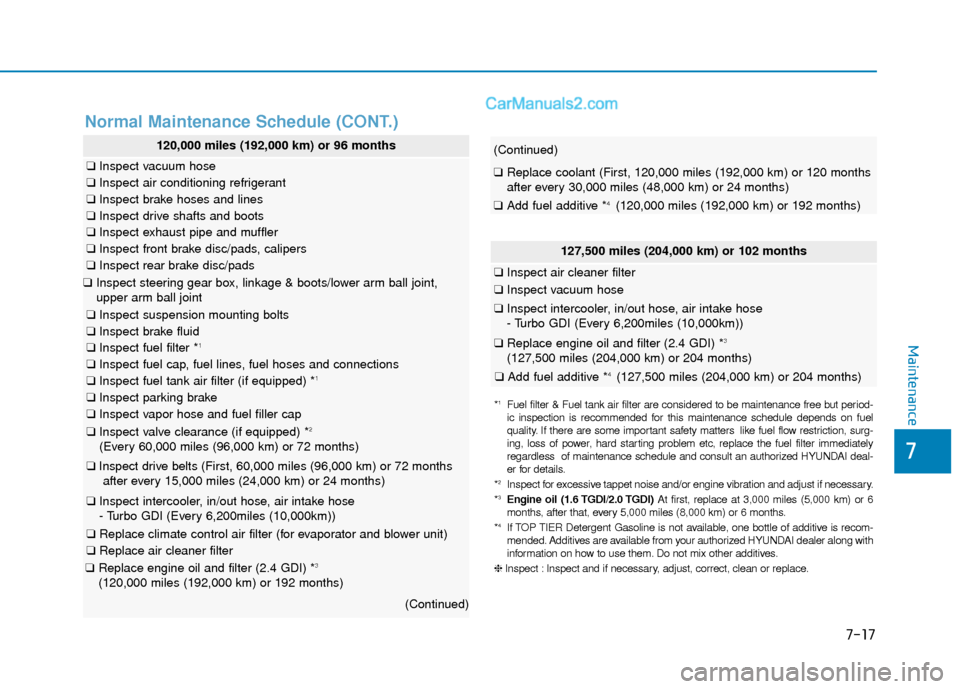
Normal Maintenance Schedule (CONT.)
120,000 miles (192,000 km) or 96 months
❑Inspect vacuum hose
❑Inspect air conditioning refrigerant
❑Inspect brake hoses and lines
❑Inspect drive shafts and boots
❑Inspect exhaust pipe and muffler
❑Inspect front brake disc/pads, calipers
❑Inspect rear brake disc/pads
❑Inspect steering gear box, linkage & boots/lower arm ball joint,
upper arm ball joint
❑ Inspect suspension mounting bolts
❑Inspect brake fluid
❑Inspect fuel filter *1
❑Inspect fuel cap, fuel lines, fuel hoses and connections
❑Inspect fuel tank air filter (if equipped) *1
❑Inspect parking brake
❑Inspect vapor hose and fuel filler cap
❑Inspect valve clearance (if equipped) *2
(Every 60,000 miles (96,000 km) or 72 months)
❑Inspect drive belts (First, 60,000 miles (96,000 km) or 72 months
after every 15,000 miles (24,000 km) or 24 months)
❑ Inspect intercooler, in/out hose, air intake hose
- Turbo GDI (Every 6,200miles (10,000km))
❑ Replace climate control air filter (for evaporator and blower unit)
❑Replace air cleaner filter
❑Replace engine oil and filter (2.4 GDI) *3
(120,000 miles (192,000 km) or 192 months)
(Continued)
*1Fuel filter & Fuel tank air filter are considered to be maintenance free\
but period-
ic inspection is recommended for this maintenance schedule depends on fuel
quality. If there are some important safety matters like fuel flow restriction, surg-
ing, loss of power, hard starting problem etc, replace the fuel filter immediately
regardless of maintenance schedule and consult an authorized HYUNDAI deal-
er for details.
*
2Inspect for excessive tappet noise and/or engine vibration and adjust if necessary.
*3Engine oil (1.6 TGDI/2.0 TGDI) At first, replace at 3,000 miles (5,000 km) or 6
months, after that, every 5,000 miles (8,000 km) or 6 months.
*
4If TOP TIER Detergent Gasoline is not available, one bottle of additive is recom-
mended. Additives are available from your authorized HYUNDAI dealer along with
information on how to use them. Do not mix other additives.
❈ Inspect : Inspect and if necessary, adjust, correct, clean or replace.
127,500 miles (204,000 km) or 102 months
❑ Inspect air cleaner filter
❑Inspect vacuum hose
❑Inspect intercooler, in/out hose, air intake hose
- Turbo GDI (Every 6,200miles (10,000km))
❑Replace engine oil and filter (2.4 GDI) *3
(127,500 miles (204,000 km) or 204 months)
❑ Add fuel additive *4 (127,500 miles (204,000 km) or 204 months)
(Continued)
❑Replace coolant (First, 120,000 miles (192,000 km) or 120 months
after every 30,000 miles (48,000 km) or 24 months)
❑ Add fuel additive *4 (120,000 miles (192,000 km) or 192 months)
Page 464 of 563

7
Maintenance
7-19
150,000 miles (240,000 km) or 120 months
❑Inspect vacuum hose
❑Inspect air conditioning refrigerant
❑Inspect brake hoses and lines
❑Inspect drive shafts and boots
❑Inspect exhaust pipe and muffler
❑Inspect front brake disc/pads, calipers
❑Inspect rear brake disc/pads
❑Inspect steering gear box, linkage & boots/lower arm ball joint,
upper arm ball joint
❑ Inspect suspension mounting bolts
❑Inspect brake fluid
❑Inspect fuel filter *1
❑Inspect fuel lines, fuel hoses and connections
❑Inspect fuel tank air filter (if equipped) *1
❑Inspect parking brake
❑Inspect vapor hose and fuel filler cap
❑Inspect drive belts
(First, 60,000 miles (96,000 km) or 72 months
after every 15,000 miles (24,000 km) or 24 months)
❑ Inspect intercooler, in/out hose, air intake hose
- Turbo GDI (Every 6,200miles (10,000km))
❑Inspect ecoshift dual clutch transmission fluid (if equipped)
❑ Replace climate control air filter (for evaporator and blower unit)
❑Replace air cleaner filter
(Continued)
(Continued)
❑Replace engine oil and filter (2.4 GDI) *3
(150,000 miles (240,000 km) or 240 months)
❑Replace coolant (First, 120,000 miles (192,000 km) or 120 months
after every 30,000 miles (48,000 km) or 24 months)
❑ Add fuel additive *4 (150,000 miles (240,000 km) or 240 months)
Normal Maintenance Schedule (CONT.)
No check, No service required
❑Automatic transmission fluid (if equipped)
*1Fuel filter & Fuel tank air filter are considered to be maintenance free\
but peri-
odic inspection is recommended for this maintenance schedule depends on
fuel quality. If there are some important safety matters like fuel flow restric-
tion, surging, loss of power, hard starting problem etc, replace the fuel filter
immediately regardless of maintenance schedule and consult an authorized
HYUNDAI dealer for details.
*
3Engine oil (1.6 TGDI/2.0 TGDI) At first, replace at 3,000 miles (5,000 km) or
6 months, after that, every 5,000 miles (8,000 km) or 6 months.
*
4If TOP TIER Detergent Gasoline is not available, one bottle of additive is rec-
ommended. Additives are available from your authorized HYUNDAI dealer
along with information on how to use them. Do not mix other additives.
❈ Inspect : Inspect and if necessary, adjust, correct, clean or replace.
Page 556 of 563
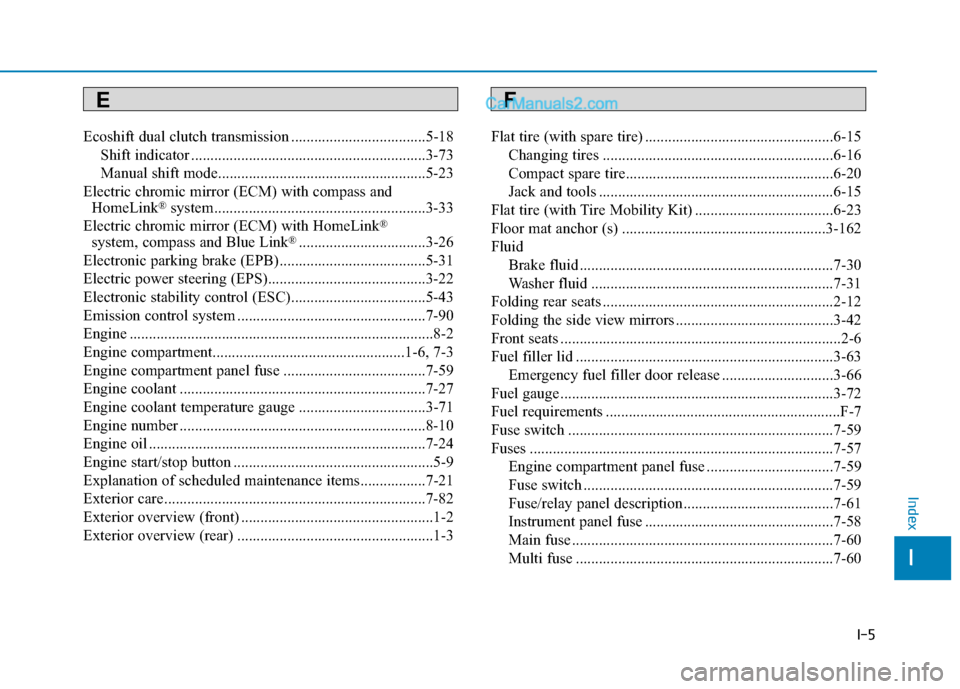
I-5
Ecoshift dual clutch transmission ...................................5-18Shift indicator .............................................................3-73
Manual shift mode......................................................5-23
Electric chromic mirror (ECM) with compass and HomeLink
®system.......................................................3-33
Electric chromic mirror (ECM) with HomeLink®
system, compass and Blue Link®.................................3-26
Electronic parking brake (EPB) ......................................5-31
Electric power steering (EPS).........................................3-22
Electronic stability control (ESC)...................................5-43
Emission control system .................................................7-90
Engine ........................................................................\
.......8-2
Engine compartment..................................................1-6, 7-3
Engine compartment panel fuse .....................................7-59
Engine coolant ................................................................7-27
Engine coolant temperature gauge .................................3-71
Engine number ................................................................8-10
Engine oil ........................................................................\
7-24
Engine start/stop button ....................................................5-9
Explanation of scheduled maintenance items.................7-21
Exterior care....................................................................7-82\
Exterior overview (front) ..................................................1-2
Exterior overview (rear) ...................................................1-3 Flat tire (with spare tire) .................................................6-15
Changing tires ............................................................6-16
Compact spare tire......................................................6-20
Jack and tools .............................................................6-15
Flat tire (with Tire Mobility Kit) ....................................6-23
Floor mat anchor (s) .....................................................3-162
Fluid Brake fluid ..................................................................7-30
Washer fluid ...............................................................7-31
Folding rear seats ............................................................2-12
Folding the side view mirrors .........................................3-42
Front seats ........................................................................\
.2-6
Fuel filler lid ...................................................................3-63 Emergency fuel filler door release .............................3-66
Fuel gauge .......................................................................3\
-72
Fuel requirements .............................................................F-7
Fuse switch .....................................................................7-5\
9
Fuses ........................................................................\
.......7-57 Engine compartment panel fuse .................................7-59
Fuse switch .................................................................7-59
Fuse/relay panel description .......................................7-61
Instrument panel fuse .................................................7-58
Main fuse ....................................................................7-60\
Multi fuse ...................................................................7-60
I
Index
FE