Led Hyundai Sonata 2020 Owner's Manual
[x] Cancel search | Manufacturer: HYUNDAI, Model Year: 2020, Model line: Sonata, Model: Hyundai Sonata 2020Pages: 537, PDF Size: 14.54 MB
Page 2 of 537
F2
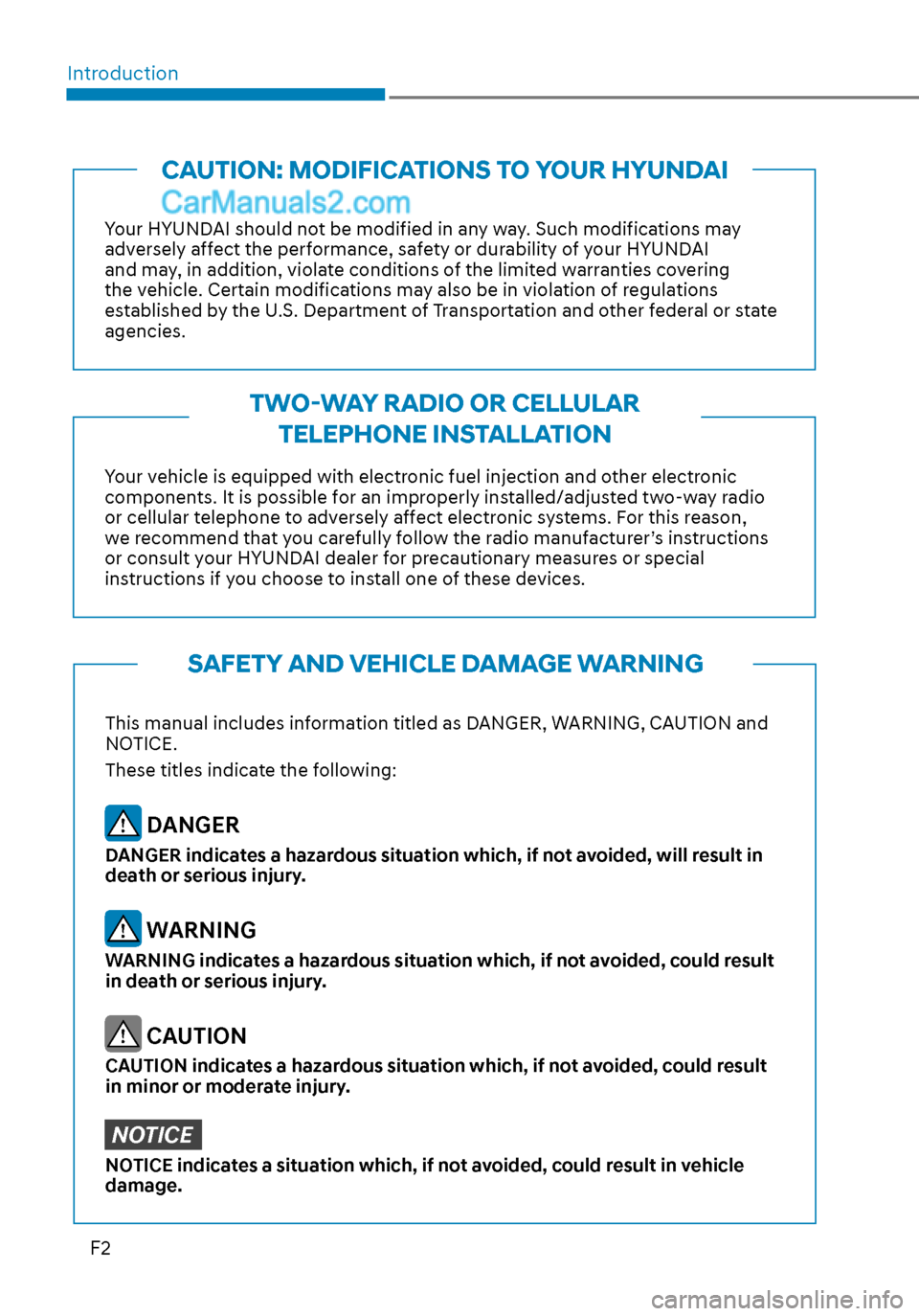
Your HYUNDAI should not be modified in any way. Such modifications may
adversely affect the performance, safety or durability of your HYUNDAI
and may, in addition, violate conditions of the limited warranties covering
the vehicle. Certain modifications may also be in violation of regulations
established by the U.S. Department of Transportation and other federal or state
agencies.
Your vehicle is equipped with electronic fuel injection and other electronic
components. It is possible for an improperly installed/adjusted two-way radio
or cellular telephone to adversely affect electronic systems. For this reason,
we recommend that you carefully follow the radio manufacturer’s instructions
or consult your HYUNDAI dealer for precautionary measures or special
instructions if you choose to install one of these devices.
CAUTION: MODIFICATIONS TO YOUR HYUNDAI
TWO-WAY RADIO OR CELLULAR TELEPHONE INSTALLATION
This manual includes information titled as DANGER, WARNING, CAUTION and
NOTICE.
These titles indicate the following:
DANGER
DANGER indicates a hazardous situation which, if not avoided, will result in
death or serious injury.
WARNING
WARNING indicates a hazardous situation which, if not avoided, could result
in death or serious injury.
CAUTION
CAUTION indicates a hazardous situation which, if not avoided, could result
in minor or moderate injury.
NOTICE
NOTICE indicates a situation which, if not avoided, could result in vehicle
damage.
SAFETY AND VEHICLE DAMAGE WARNING
Introduction
Page 9 of 537
Foreword
1-4
We want to help you get the greatest
possible driving pleasure from your
vehicle. Your Owner’s Manual can assist
you in many ways. To gain an overview
of the contents of your Owner’s Manual,
use the Table of Contents in the front
of the manual. The first page of each
Chapter includes a detailed Table of
Contents of the topics in that Chapter.
To quickly locate information about your
vehicle, use the Index in the back of the
manual. It is an alphabetical list of what
is in this manual and the page number
where it can be found.
For your convenience, we have
incorporated tabs on the right-hand
page edges. These tabs are coded with
the Chapter titles to assist you with
navigating through the manual.Your safety, and the safety of others,
is very important. This Owner’s
Manual provides you with many safety
precautions and operating procedures.
This information alerts you to potential
hazards that may hurt you or others, as
well as cause damage to your vehicle.
Safety messages found on vehicle
labels and in this manual describe these
hazards and what to do to avoid or
reduce the risks.
Warnings and instructions contained in
this manual are for your safety. Failure to
follow safety warnings and instructions
can lead to serious injury or death.
HOW TO USE THIS MANUAL
SAFETY MESSAGES
Page 10 of 537
01
1-5
Your new vehicle is designed to obtain
maximum performance with UNLEADED
FUEL, as well as minimize exhaust
emissions and spark plug fouling.
Your new vehicle is designed to use only
unleaded fuel having an octane number
((R+M)/2) of 87 (Research Octane
Number 91) or higher. (Do not use
methanol blended fuels)
NOTICE
To prevent damage to the engine and
engine components, never add any fuel
system cleaning agents to the fuel tank
other than what has been specified.
Consult an authorized HYUNDAI dealer
for additional information.
WARNING
• Do not “top off” after the nozzle
automatically shuts off when
refueling.
• Always check that the fuel cap is
installed securely to prevent fuel
spillage in the event of an accident.
FUEL REQUIREMENTS
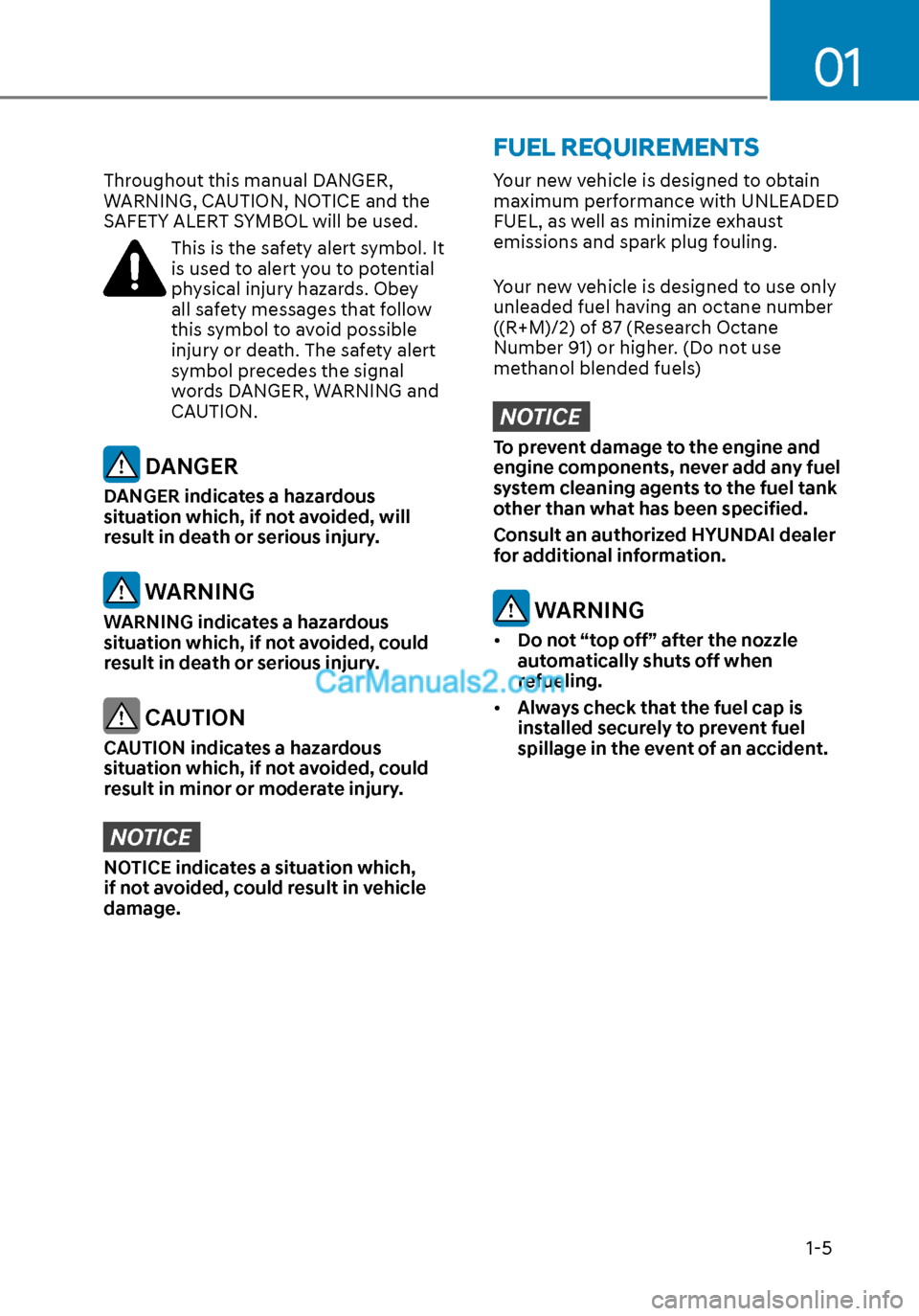
Throughout this manual DANGER,
WARNING, CAUTION, NOTICE and the
SAFETY ALERT SYMBOL will be used.
This is the safety alert symbol. It is used to alert you to potential
physical injury hazards. Obey
all safety messages that follow
this symbol to avoid possible
injury or death. The safety alert
symbol precedes the signal
words DANGER, WARNING and
CAUTION.
DANGER
DANGER indicates a hazardous
situation which, if not avoided, will
result in death or serious injury.
WARNING
WARNING indicates a hazardous
situation which, if not avoided, could
result in death or serious injury.
CAUTION
CAUTION indicates a hazardous
situation which, if not avoided, could
result in minor or moderate injury.
NOTICE
NOTICE indicates a situation which,
if not avoided, could result in vehicle
damage.
Page 13 of 537
Foreword
1-8
VEHICLE DATA COLLECTION
AND EVENT DATA
RECORDERS
This vehicle is equipped with an event
data recorder (EDR). The main purpose
of an EDR is to record, in certain crash
or near crash-like situations, such as
an air bag deployment or hitting a
road obstacle, data that will assist in
understanding how a vehicle’s systems
performed. The EDR is designed to
record data related to vehicle dynamics
and safety systems for a short period of
time, typically 30 seconds or less. The
EDR in this vehicle is designed to record
such data as:
• How various systems in your vehicle
were operating;
• Whether or not the driver and
passenger safety belts were buckled/
fastened;
• How far (if at all) the driver was
depressing the accelerator and/or
brake pedal; and,
• How fast the vehicle was traveling.
This data can help provide a better
understanding of the circumstances in
which crashes and injuries occur. NOTE:
EDR data is recorded by your vehicle
only if a non-trivial crash situation
occurs; no data is recorded by the EDR
under normal driving conditions and
no personal data (e.g., name, gender,
age, and crash location) are recorded.
However, other parties, such as law
enforcement, could combine the
EDR data with the type of personally
identifying data routinely acquired
during a crash investigation.
To read data recorded by an EDR,
special equipment is required, and
access to the vehicle or the EDR is
needed. In addition to the vehicle
manufacturer, other parties, such as
law enforcement, that have the special
equipment, can read the information if
they have access to the vehicle or the
EDR.
WARNING
CALIFORNIA PROPOSITION 65
WARNING
Items contained in motor vehicles or
emitted from them are known to the
State of California to cause cancer and
birth defects or reproductive harm.
These include:
• Gasoline and its vapors
• Engine exhaust
• Used engine oil
• Interior passenger compartment
components and materials
• Component parts which are subject
to heat and wear
In addition, battery posts, terminals and
related accessories contain lead, lead
compounds and other chemicals known
to the State of California to cause
cancer and reproductive harm.
For more information go to
https://www.p65warnings.ca.gov/
passenger-vehicle
Page 21 of 537
Vehicle Information
2-8
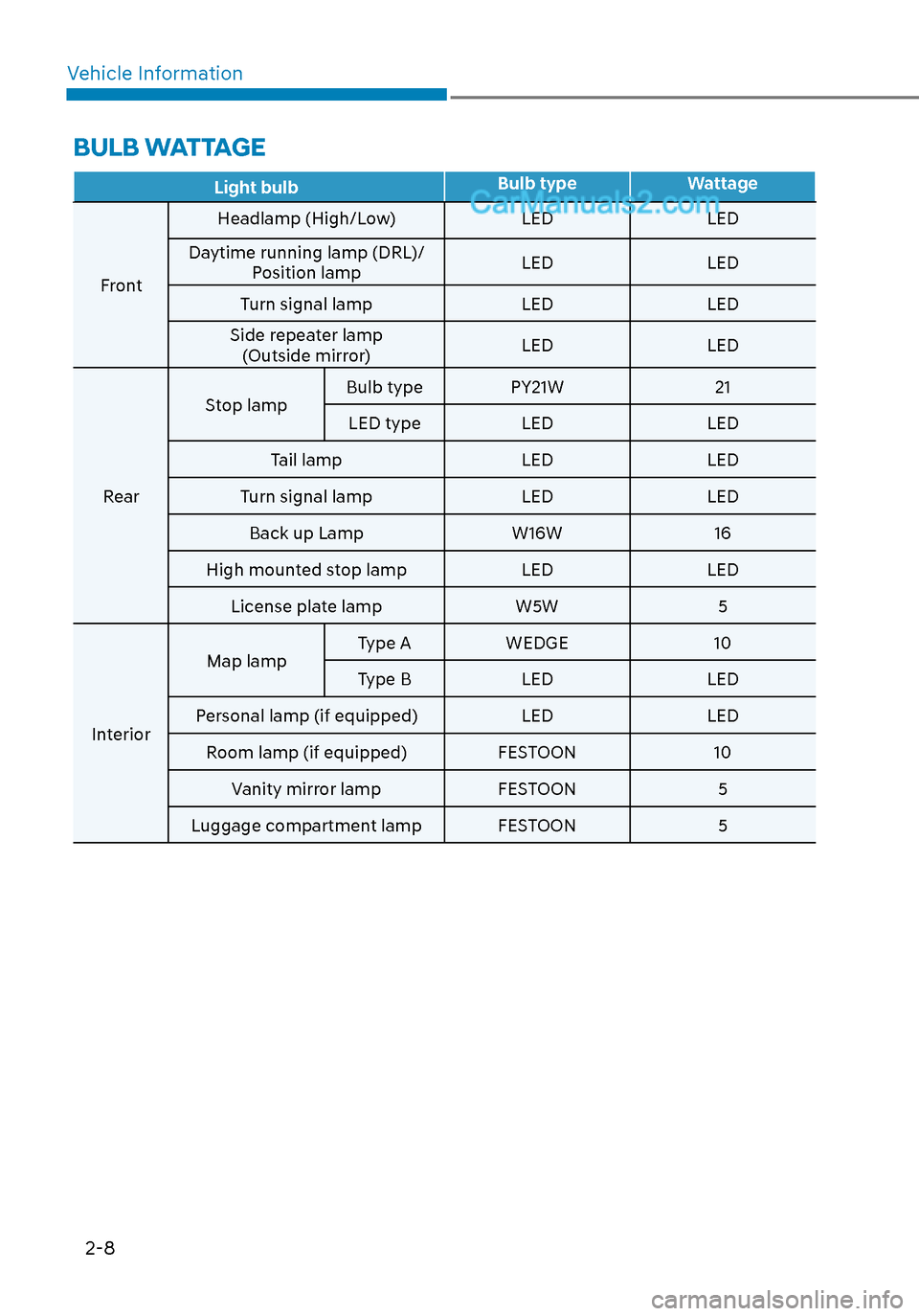
BULB WATTAGE
Light bulbBulb type
Wattage
Front Headlamp (High/Low)
LEDLED
Daytime running lamp (DRL)/ Position lamp LED
LED
Turn signal lamp LEDLED
Side repeater lamp (Outside mirror) LED
LED
Rear Stop lamp
Bulb type
PY21W 21
LED type LED LED
Tail lamp LEDLED
Turn signal lamp LEDLED
Back up Lamp W16W16
High mounted stop lamp LEDLED
License plate lamp W5W5
Interior Map lamp
Type A
WEDGE 10
Type B LED LED
Personal lamp (if equipped) LEDLED
Room lamp (if equipped) FESTOON10
Vanity mirror lamp FESTOON5
Luggage compartment lamp FESTOON5
Page 24 of 537

02
2-11
RECOMMENDED LUBRICANTS AND CAPACITIES
To help achieve proper engine and powertrain performance and durability, use only
lubricants of the proper quality. The correct lubricants also help promote engine
efficiency that results in improved fuel economy.
These lubricants and fluids are recommended for use in your vehicle.
LubricantVolumeClassification
Engine oil
*1 *2
(drain and refill) Smartstream
G1.6 T-GDi 4.76 US qt. (4.5 ℓ)
API Lastest (SN PLUS) *3
Smartstream G2.5 GDi5.49 US qt. (5.2 ℓ)
API Lastest (SN PLUS) *3
Automatic transmission fluid 6.89 US qt. (6.5ℓ)MICHANG ATF SP-IV, SK ATF SP IV,
NOCA ATF SP-IV, S-oil ATF SP-IV
HYUNDAI genuine ATF SP-IV
or other brands meeting the
above specification approved by
HYUNDAI Motor Co.
Coolant Smartstream
G1.6 T-GDi 4.76 US qt. (4.5 ℓ)
Mixture of antifreeze and distilled
water (Ethylene glycol base
coolant for aluminum radiator)
Smartstream
G2.5 GDi 5.49 US qt. (5.2 ℓ)
Brake fluid
*40.74 ~ 0.85 US qt. (0.7 ~ 0.8 ℓ) DOT-4
Fuel 15.85 US gal. (60 ℓ)
14.79 US gal. (56 ℓ) (for ECO package model) Refer to “Fuel requirements” in
chapter 1.
*1 : Refer to the recommended SAE viscosity numbers on page 12.
*2 : Engine oils labeled Energy Conserving Oil are now available. Along with other additional
benefits, they contribute to fuel economy by reducing the amount of fuel necessary
to overcome engine friction. Often, these improvements are difficult to measure in
everyday driving, but in a year’s time, they can offer significant cost and energy savings.
*3 : If the recommended engine oil is not available in your country, you are able to use API
SL/ILSAC GF-3 or ACEA A3.
*4 : To maintain the best braking performance and ABS/ESC performance, we recommend
that you use genuine brake fluid that conform to specifications. (Standard : SAE J1704
DOT-4 LV, ISO4925 CLASS-6 and FMVSS 116 DOT-4)
Page 30 of 537
Seats & Safety System3-2
You will find many safety precautions
and recommendations throughout this
section, and throughout this manual.
The safety precautions in this section are
among the most important.
Always Wear Your Seat Belt
A seat belt is your best protection in all
types of accidents. Air bags are designed
to supplement seat belts, not replace
them. So even though your vehicle is
equipped with air bags, ALWAYS make
sure you and your passengers wear your
seat belts, and wear them properly.
Restrain All Children
All children under age 13 should ride
in your vehicle properly restrained in a
rear seat, not the front seat. Infants and
small children should be restrained in
an appropriate child restraint. Larger
children should use a booster seat with
the lap/shoulder belt until they can use
the seat belt properly without a booster
seat.
Air Bag Hazards
While air bags can save lives, they can
also cause serious or fatal injuries to
occupants who sit too close to them, or
who are not properly restrained. Infants,
young children, and shorter adults are at
the greatest risk of being injured by an
inflating air bag. Follow all instructions
and warnings in this manual.
Driver Distraction
Driver distraction presents a serious and
potentially deadly danger, especially for
inexperienced drivers. Safety should be
the first concern when behind the wheel,
and drivers need to be aware of the wide
array of potential distractions, such as
drowsiness, reaching for objects, eating,
personal grooming, other passengers,
and using cellular phones. Drivers can become distracted when
they take their eyes and attention off
the road or their hands off the wheel to
focus on activities other than driving. To
reduce your risk of distraction or getting
into an accident:
• ALWAYS set up your mobile devices
(i.e., MP3 players, phones, navigation
units, etc.) when your vehicle is
parked or safely stopped.
• ONLY use your mobile device when allowed by laws and when conditions
permit safe use. NEVER text or email
while driving. Most states have laws
prohibiting drivers from texting. Some
states and cities also prohibit drivers
from using handheld phones.
• NEVER let the use of a mobile device distract you from driving. You have a
responsibility to your passengers and
others on the road to always drive
safely, with your hands on the wheel
as well as your eyes and attention on
the road.
Control Your Speed
Excessive speed is a major factor in crash
injuries and deaths. Generally, the higher
the speed, the greater the risk, but
serious injuries can also occur at lower
speeds. Never drive faster than is safe
for current conditions, regardless of the
maximum speed posted.
Keep Your Vehicle in Safe
Condition
Having a tire blowout or a mechanical
failure can be extremely hazardous. To
reduce the possibility of such problems,
check your tire pressures and condition
frequently, and perform all regularly
scheduled maintenance.
IMPORTANT SAFETY PRECAUTIONS
Page 34 of 537
Seats & Safety System3-6
ODN8039003ODN8039003
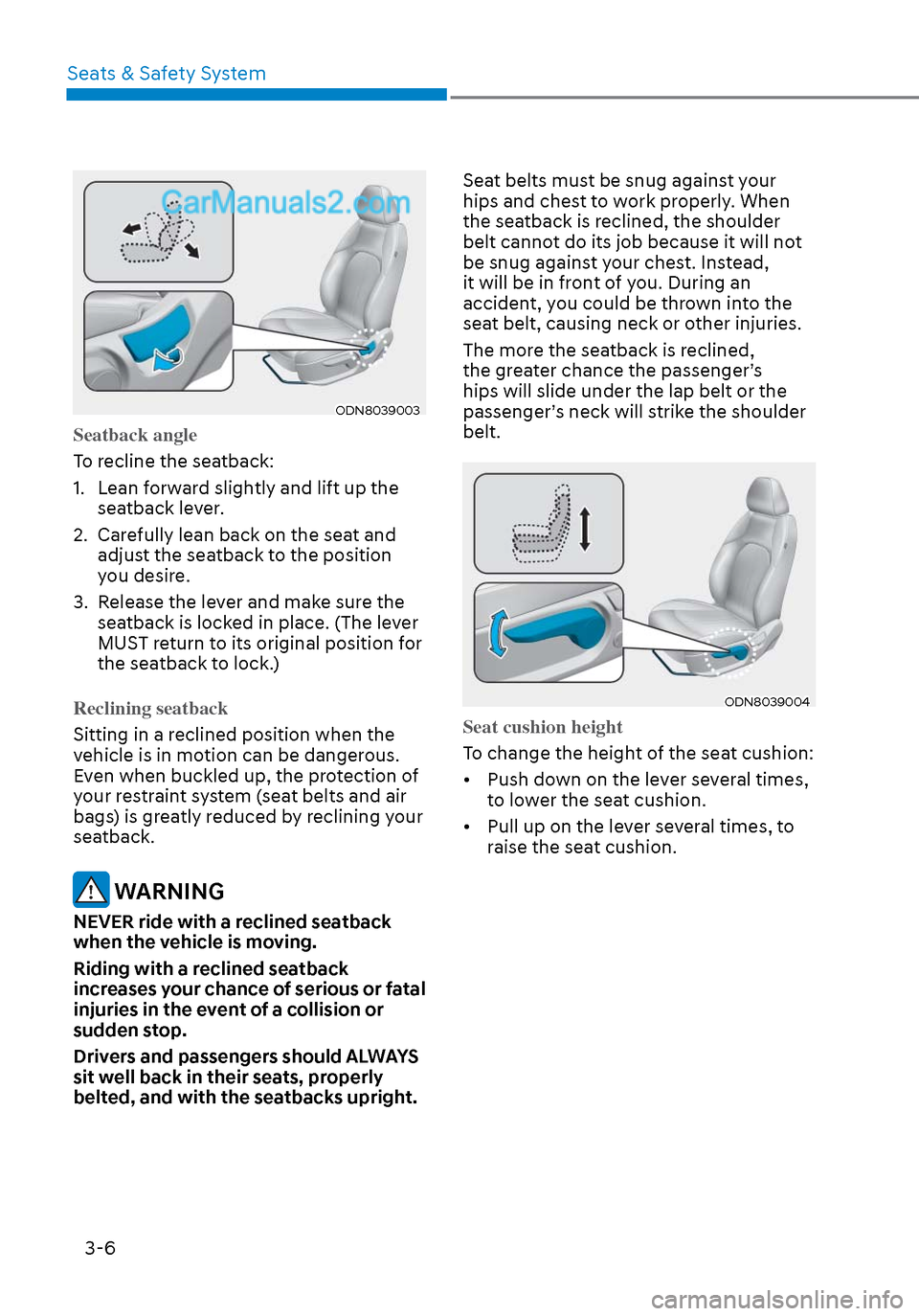
Seatback angle
To recline the seatback:
1.
Lean forward slightly and lift up the
seatback lever.
2. Carefully lean back on the seat and adjust the seatback to the position
you desire.
3. Release the lever and make sure the seatback is locked in place. (The lever
MUST return to its original position for
the seatback to lock.)
Reclining seatback
Sitting in a reclined position when the
v
ehicle is in motion can be dangerous.
Even when buckled up, the protection of
your restraint system (seat belts and air
bags) is greatly reduced by reclining your
seatback.
WARNING
NEVER ride with a reclined seatback
when the vehicle is moving.
Riding with a reclined seatback
increases your chance of serious or fatal
injuries in the event of a collision or
sudden stop.
Drivers and passengers should ALWAYS
sit well back in their seats, properly
belted, and with the seatbacks upright. Seat belts must be snug against your
hips and chest to work properly. When
the seatback is reclined, the shoulder
belt cannot do its job because it will not
be snug against your chest. Instead,
it will be in front of you. During an
accident, you could be thrown into the
seat belt, causing neck or other injuries.
The more the seatback is reclined,
the greater chance the passenger’s
hips will slide under the lap belt or the
passenger’s neck will strike the shoulder
belt.
ODN8039004ODN8039004
Seat cushion height
To change the height of the seat cushion:
•
Push down on the lever several times,
to lower the seat cushion.
• Pull up on the lever several times, to raise the seat cushion.
Page 36 of 537
Seats & Safety System3-8
Reclining seatback
Sitting in a reclined position when the
vehicle is in motion can be dangerous.
Even when buckled up, the protection of
your restraint system (seat belts and air
bags) is greatly reduced by reclining your
seatback.
WARNING
NEVER ride with a reclined seatback
when the vehicle is moving. Riding
with a reclined seatback increases your
chance of serious or fatal injuries in
the event of a collision or sudden stop.
Driver and passengers should ALWAYS
sit well back in their seats, properly
belted, and with the seatbacks upright.
Seat belts must be snug against your hips
and chest to work properly. When the
seatback is reclined, the shoulder belt
cannot do its job because it will not be
snug against your chest. Instead, it will
be in front of you. During an accident,
you could be thrown into the seat belt,
causing neck or other injuries. The more
the seatback is reclined, the greater
chance the passenger’s hips will slide
under the lap belt or the passenger’s
neck will strike the shoulder belt.ODN8039007ODN8039007
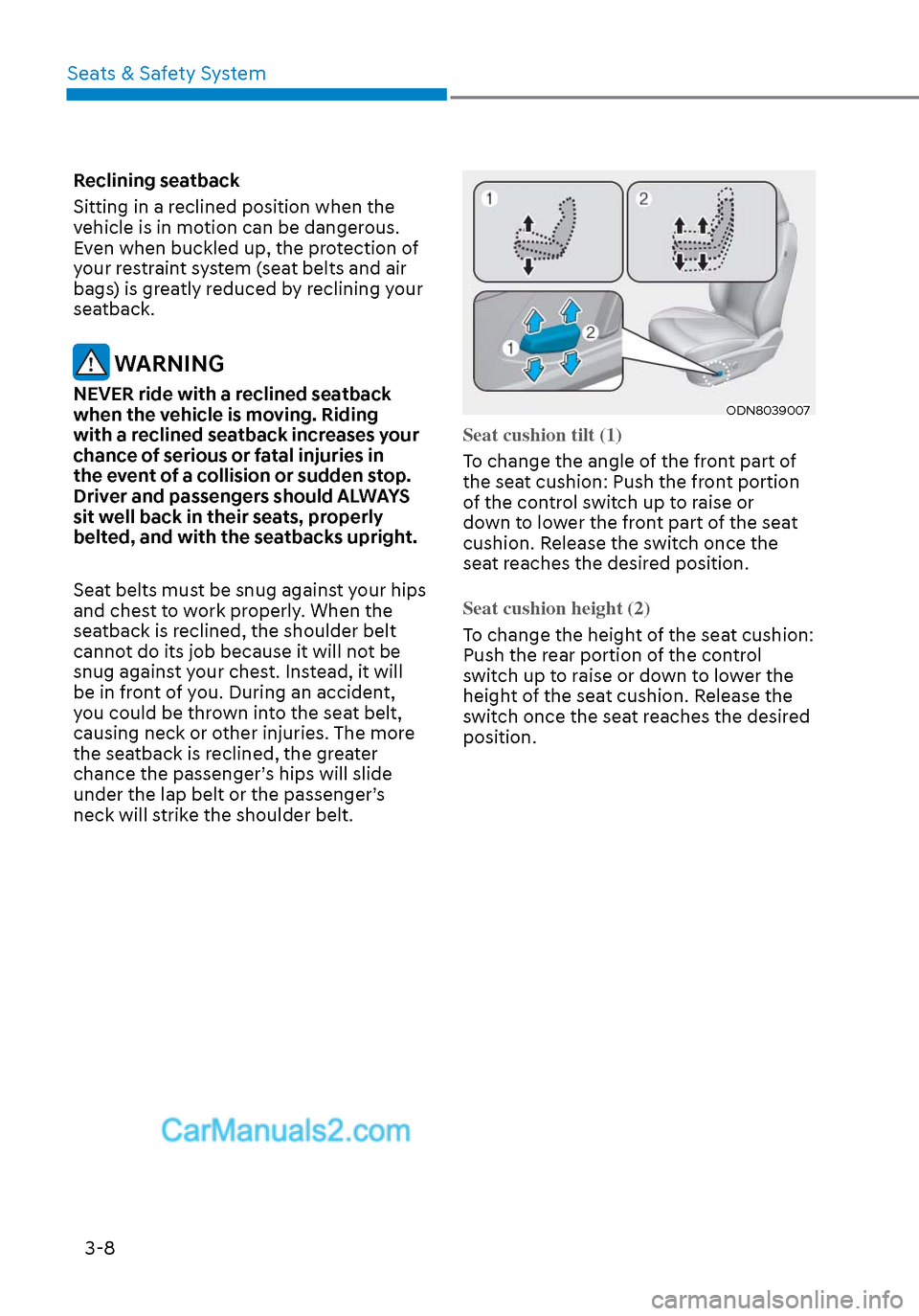
Seat cushion tilt (1)
To change the angle of the front part of
the sea
t cushion: Push the front portion
of the control switch up to raise or
down to lower the front part of the seat
cushion. Release the switch once the
seat reaches the desired position.
Seat cushion height (2)
To change the height of the seat cushion:
Push the r
ear portion of the control
switch up to raise or down to lower the
height of the seat cushion. Release the
switch once the seat reaches the desired
position.
Page 43 of 537
03
3-15
Seat Warmers and Air Ventilation
Seats
Front seat warmers (if equipped)
Seat warmers are provided to warm the
seats during cold weather.
WARNING
The seat warmers can cause a SERIOUS
BURN, even at low temperatures and
especially if used for long periods of
time.
Passengers must be able to feel if the
seat is becoming too warm so they can
turn it off, if needed.
People who cannot detect temperature
change or pain to the skin should
use extreme caution, especially the
following types of passengers:
• Infants, children, elderly or disabled
persons, or hospital outpatients.
• People with sensitive skin or who
burn easily.
• Fatigued individuals.
• Intoxicated individuals.
• People taking medication that can
cause drowsiness or sleepiness.
WARNING
NEVER place anything on the seat
that insulates against heat when the
seat warmer is in operation, such as a
blanket or seat cushion. This may cause
the seat warmer to overheat, causing a
burn or damage to the seat.
NOTICE
To prevent damage to the seat warmers
and seats:
Never use a solvent such as paint
thinner, benzene, alcohol or gasoline to
clean the seats.
Do not place heavy or sharp objects on
seats equipped with seat warmers.
Do not change the seat cover. It
may damage the seat warmer or air
ventilation system.