warning HYUNDAI SONATA HYBRID 2019 Owner's Manual
[x] Cancel search | Manufacturer: HYUNDAI, Model Year: 2019, Model line: SONATA HYBRID, Model: HYUNDAI SONATA HYBRID 2019Pages: 546, PDF Size: 78.75 MB
Page 56 of 546
H45
Information
Gradual capacity reduction of the
high voltage battery.
The high voltage Battery capacity
gradually reduces with time and use.
This is natural characteristic of the
high voltage batteries. The extent at
which capacity is reduced changes
drastically depending on the environ-
ment(ambient temperature, etc.) and
usage conditions such as how the vehi-
cle is driven and how the high voltage
battery is charged. Reduction of the
high voltage battery capacity is not
covered under warranty.
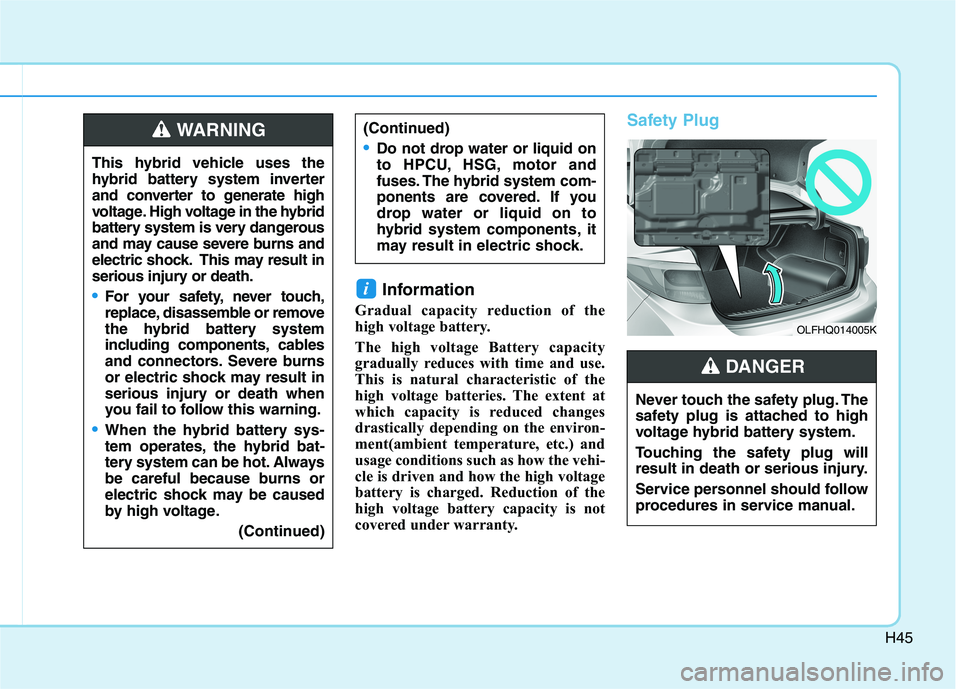
Safety Plug
i
OLFHQ014005K
Never touch the safety plug. The
safety plug is attached to high
voltage hybrid battery system.
Touching the safety plug will
result in death or serious injury.
Service personnel should follow
procedures in service manual.
DANGER
(Continued)
Do not drop water or liquid on
to HPCU, HSG, motor and
fuses. The hybrid system com-
ponents are covered. If you
drop water or liquid on to
hybrid system compone nts, it
may result in electric shock.This hybrid vehicle uses the
hybrid battery system inverter
and converter to generate high
voltage. High voltage in the hybrid
battery system is very dangerous
and may cause severe burns and
electric shock. This may result in
serious injury or death.
For your safety, never touch,
replace, disassemble or remove
the hybrid battery system
including components, cables
and connectors. Severe burns
or electric shock may result in
serious injury or death when
you fail to follow this warning.
When the hybrid battery sys-
tem operates, the hybrid bat-
tery system can be hot. Always
be careful because burns or
electric shock may be caused
by high voltage.
(Continued)
WARNING
Page 57 of 546
H46
SSAA FFEE TT YY PP RR EECCAA UU TTIIOO NNSS FF OO RR HH YY BBRRIIDD SS YY SSTT EEMM (( CC OO NNTT..))
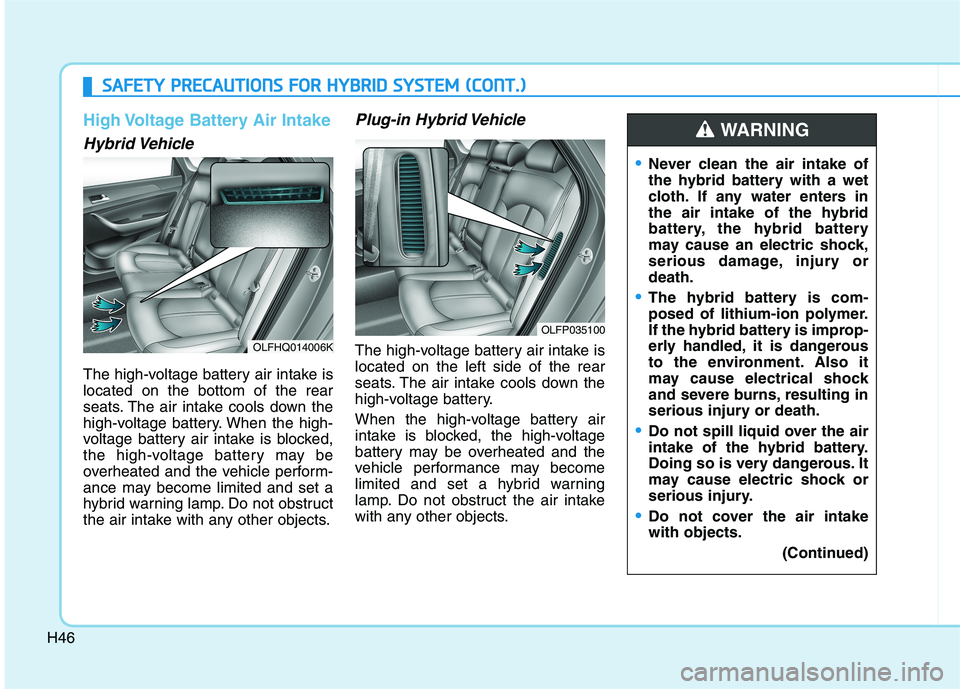
High Voltage Battery Air Intake
Hybrid Vehicle
The high-voltage battery air intake is located on the bottom of the rear
seats. The air intake cools down the
high-voltage battery. When the high-
voltage battery air intake is blocked,
the high-voltage battery may be
overheated and the vehicle perform-
ance may become limited and set a
hybrid warning lamp. Do not obstruct
the air intake with any other objects.
Plug-in Hybrid Vehicle
The high-voltage battery air intake islocated on the left side of the rear
seats. The air intake cools down the
high-voltage battery.
When the high-voltage battery air
intake is blocked, the high-voltage
battery may be overheated and the
vehicle performance may become
limited and set a hybrid warning
lamp. Do not obstruct the air intake
with any other objects.
OLFP035100
Never clean the air intake of
the hybrid battery with a wet
cloth. If any water enters in
the air intake of the hybrid
battery, the hybrid battery
may cause an electric shock,
serious damage, injury ordeath.
The hybrid battery is com-
posed of lithium-ion polymer.
If the hybrid battery is improp-
erly handled, it is dangerous
to the environment. Also it
may cause electrical shock
and severe burns, resulting in
serious injury or death.
Do not spill liquid over the air
intake of the hybrid battery.
Doing so is very dangerous. It
may cause electric shock or
serious injury.
Do not cover the air intake with objects.
(Continued)
WARNING
OLFHQ014006K
Page 58 of 546
H47
Information
Clean the air intake for the hybrid
battery with a dry cloth on a regular
basis.If an accident occursi
For your safety, do not touch
high voltage cables, connec-
tors and package modules.
High voltage components are
orange in color.
Exposed cables or wires may
be visible inside or outside of
the vehicle. Never touch the
wires or cables, because it
can cause an electrical shock,
injury or death may occur.
Any gas or electrolyte leakage
from your vehicle is not only
poisonous but also flamma-
ble. Upon witnessing one of
those, open the windows, and
remain a safe distance from
the vehicle out of the road.
Immediately contact an author-
ized HYUNDAI dealer and advise
them that a hybrid vehicle is
involved.
(Continued)
WARNING
(Continued)
Do not put any objects into
the air intake of the hybrid
battery. Doing so may cause
loss of air-intake volume to
the hybrid battery. When the
air intake is blocked with any
objects, immediately contact
your HYUNDAI dealer.
Never place a container of liq-
uid on or near the air intake. If
the liquid spills, the hybrid
battery located in the trunk
may be damaged.
Secure all loads in the trunk
to prevent them from being
tossed about before driving. If
a sharp or heavy loads
impacts or pierce the interior
trunk wall, the hybrid battery
system may be damaged,
deteriorating its performance.
Page 59 of 546
H48
SSAA FFEE TT YY PP RR EECCAA UU TTIIOO NNSS FF OO RR HH YY BBRRIIDD SS YY SSTT EEMM (( CC OO NNTT..))
(Continued)
When the vehicle is severely
damaged, remain a safe dis-
tance of 15 meter (50 feet) or
more between your vehicle and
other vehicles/flammables.When a submersion in water
occurs:
When your vehicle is flooded in
water, a high-voltage battery
may cause shock or fires. Thus,
turn the hybrid system OFF, take
the key in your possession and
escape to a safe place. Never
attempt physical contact with
your flooded vehicle.
Immediately contact an author-
ized HYUNDAI dealer and advise
them that a hybrid vehicle is
involved.
WARNING
If a small scale fire occurs, use
a fire extinguisher (ABC, BC)
that is meant for electrical fires.
If it is impossible to extinguish
the fire in the early stage,
remain a safe distance from the
vehicle and immediately call
911. Also, advise them that a
hybrid vehicle is involved. If the fire spreads to the high
voltage battery, large amount ofwater is needed to put out the
fire. Using small amount of
water or fire extinguishers not
meant for electrical fires could
cause serious injury or death
from electrical shocks.
WARNING
Page 60 of 546
H49
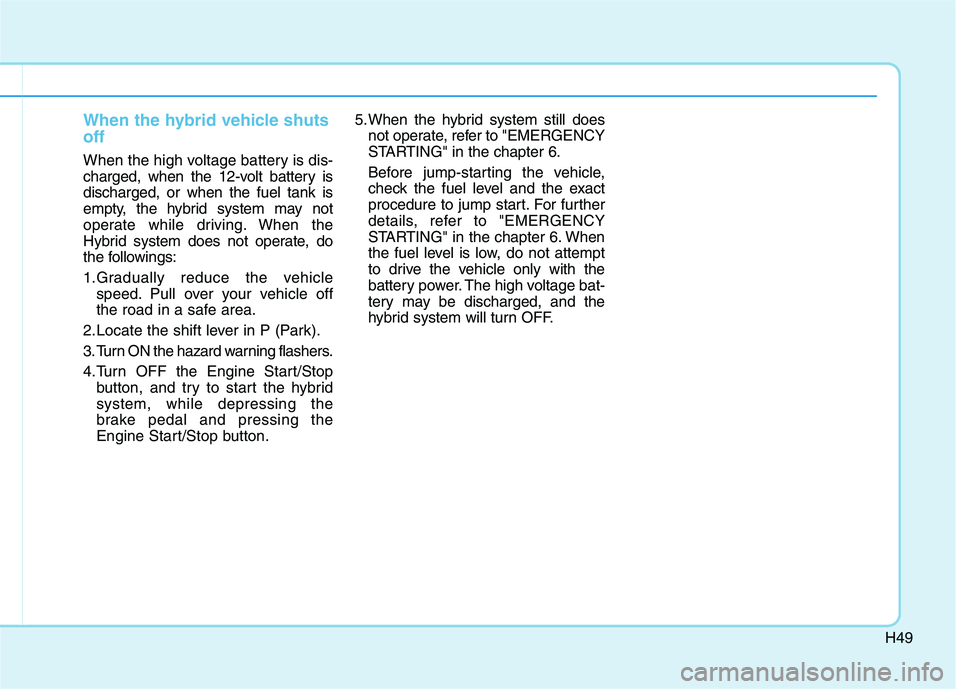
When the hybrid vehicle shuts off
When the high voltage battery is dis-
charged, when the 12-volt battery isdischarged, or when the fuel tank is
empty, the hybrid system may not
operate while driving. When the
Hybrid system does not operate, do
the followings:
1.Gradually reduce the vehiclespeed. Pull over your vehicle off
the road in a safe area.
2.Locate the shift lever in P (Park).
3. Turn ON the hazard warning flashers.
4.Turn OFF the Engine Start/Stop button, and try to start the hybrid system, while depressing the
brake pedal and pressing the
Engine Start/Stop button. 5.When the hybrid system still does
not operate, refer to "EMERGENCY
STARTING" in the chapter 6.
Before jump-starting the vehicle,
check the fuel level and the exact
procedure to jump start. For further
details, refer to "EMERGENCY
STARTING" in the chapter 6. When
the fuel level is low, do not attempt
to drive the vehicle only with the
battery power. The high voltage bat-
tery may be discharged, and the
hybrid system will turn OFF.
Page 67 of 546
Safety system of your vehicle
Important safety precautions...............................2-2Always Wear Your Seat Belt ..........................................2-2
Restrain All Children .........................................................2-2
Air Bag Hazards .................................................................2-2
Driver Distraction ..............................................................2-2
Control Your Speed ...........................................................2-3
Keep Your Vehicle in Safe Condition ............................2-3
Seats ........................................................................2-4 Safety Precautions ...........................................................2-5
Front Seats .........................................................................2-6
Rear Seats.........................................................................2-12
Head Restraints ...............................................................2-16
Seat Warmers and Air Ventilation Seats ...................2-20
Seat belts ..............................................................2-24 Seat Belt Safety Precautions .......................................2-24
Seat Belt Warning Light ................................................2-25
Seat Belt Restraint System...........................................2-26
Additional Seat Belt Safety Precautions ...................2-32
Care of Seat Belts...........................................................2-35 Child restraint system (CRS) ..............................2-36
Children Always in the Rear .........................................2-36
Selecting a Child Restraint System (CRS) .................2-37
Installing a Child Restraint System (CRS)..................2-39
Air bag -
advanced supplemental restraint system .........2-47 Where Are the Air Bags? ..............................................2-49
How Does the Air Bag System Operate?..................2-53
What to Expect After an Air Bag Inflates ................2-57
Occupant Classification System (OCS).......................2-58
Why Didn't My Air Bag Go Off in a Collision? ........2-63
SRS Care ............................................................................2-68
Additional Safety Precautions .....................................2-69
Air Bag Warning Labels .................................................2-70
This chapter provides you with important information about how to protect yourself and your passengers.
It explains how to properly use your seats and seat belts, and how your air bags work.
Additionally, this chapter explains how to properly restrain infants and children in your vehicle.
2
Page 68 of 546
2-2
You will find many safety precautions and recommendations throughoutthis section, and throughout this man-
ual. The safety precautions in this sec-
tion are among the most important.
Always Wear Your Seat Belt
A seat belt is your best protection in
all types of accidents. Air bags are
designed to supplement seat belts,
not replace them. So even though
your vehicle is equipped with air bags,
ALWAYS make sure you and your
passengers wear your seat belts, and
wear them properly.
Restrain All Children
All children under age 13 should ride
in your vehicle properly restrained in
a rear seat, not the front seat. Infantsand small children should be
restrained in an appropriate child
restraint. Larger children should usea booster seat with the lap/shoulder
belt until they can use the seat belt
properly without a booster seat.
Air Bag Hazards
While air bags can save lives, they
can also cause serious or fatal
injuries to occupants who sit tooclose to them, or who are not prop-
erly restrained. Infants, young chil-
dren, and shorter adults are at the
greatest risk of being injured by an
inflating air bag. Follow all instruc-
tions and warnings in this manual.
Driver Distraction
Driver distraction presents a serious
and potentially deadly danger, espe-
cially for inexperienced drivers. Safety
should be the first concern when
behind the wheel and drivers need to
be aware of the wide array of potential
distractions, such as drowsiness,
reaching for objects, eating, personal
grooming, other passengers, and
using cellular phones.
Drivers can become distracted when
they take their eyes and attention offthe road or their hands off the wheel
to focus on activities other than driv-
ing. To reduce your risk of distractionor getting into an accident:
II
MM PPOO RRTTAA NN TT SS AA FFEE TT YY PP RR EECCAA UU TTIIOO NNSS
Safety system of your vehicle
Page 71 of 546
Safety Precautions
Adjusting the seats so that you are sit-
ting in a safe, comfortable position
plays an important role in driver and
passenger safety together with theseat belts and air bags in an accident.
Air bags
You can take steps to reduce the risk
of being injured by an inflating air
bag. Sitting too close to an air bag
greatly increases the risk of injury in
the event the air bag inflates.
Move your seat as far back as possi-
ble from front air bags, while still
maintaining control of the vehicle.
Seat belts
Always fasten your seat belt before
starting any trip.
At all times, passengers should sit
upright and be properly restrained.
Infants and small children must be
restrained in appropriate child restraint
systems. Children who have outgrown
a booster seat and adults must be
restrained using the seat belts.
Do not use a cushion thatreduces friction between the seat
and the passenger. The passen-
ger's hips may slide under the
lap portion of the seat belt during
an accident or a sudden stop.Serious or fatal internal injuriescould result because the seat
belt cannot operate properly.
WARNING
To reduce the risk of serious
injury or death from an inflating
air bag, take the following pre-cautions:
•Adjust the driver’s seat as far
to the rear as possible whilemaintaining the ability to
maintain full control of the
vehicle.
Adjust the front passenger seat as far to the rear as pos-
sible.
Hold the steering wheel by the
rim with hands at the 9 o’clock
and 3 o’clock positions to
minimize the risk of injuries to
your hands and arms.
NEVER place anything or any- one between the steering
wheel and the air bag.
Do not allow the front passen-
ger to place feet or legs on the
dashboard to minimize therisk of leg injuries.
WARNING
2-5
Safety system of your vehicle
2
Page 72 of 546
2-6
Safety system of your vehicle
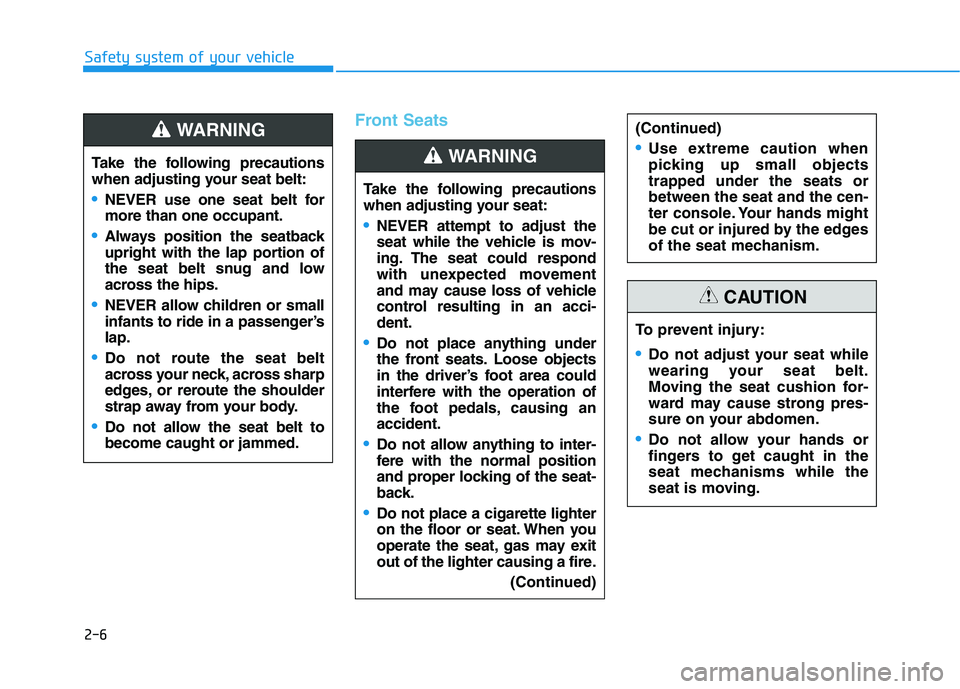
Front Seats
Take the following precautions
when adjusting your seat belt:
NEVER use one seat belt for more than one occupant.
Always position the seatback
upright with the lap portion of
the seat belt snug and low
across the hips.
NEVER allow children or small
infants to ride in a passenger’slap.
Do not route the seat belt
across your neck, across sharp
edges, or reroute the shoulder
strap away from your body.
Do not allow the seat belt to become caught or jammed.
WARNING
Take the following precautions
when adjusting your seat:
NEVER attempt to adjust the
seat while the vehicle is mov-
ing. The seat could respond
with unexpected movement
and may cause loss of vehicle
control resulting in an acci-dent.
Do not place anything under
the front seats. Loose objects
in the driver’s foot area could
interfere with the operation of
the foot pedals, causing anaccident.
Do not allow anything to inter-
fere with the normal position
and proper locking of the seat-
back.
Do not place a cigarette lighter
on the floor or seat. When you
operate the seat, gas may exit
out of the lighter causing a fire.(Continued)
WARNING
To prevent injury:
Do not adjust your seat while
wearing your seat belt.
Moving the seat cushion for-
ward may cause strong pres-
sure on your abdomen.
Do not allow your hands or
fingers to get caught in the
seat mechanisms while the
seat is moving.
CAUTION
(Continued)
Use extreme caution when
picking up small objectstrapped under the seats orbetween the seat and the cen-
ter console. Your hands might
be cut or injured by the edges
of the seat mechanism.
Page 73 of 546
2-7
Safety system of your vehicle
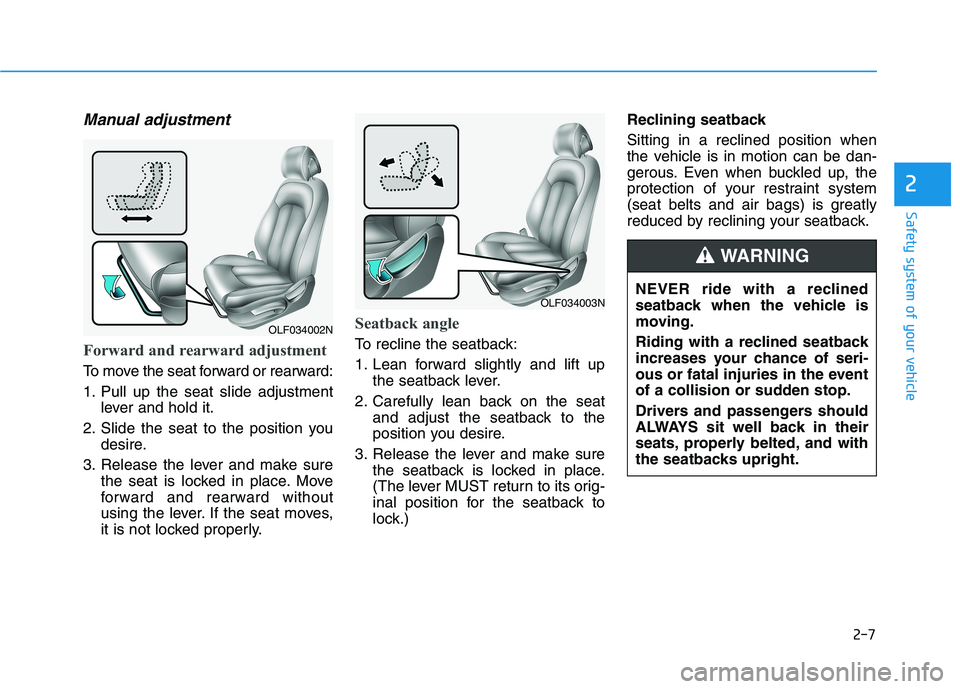
Manual adjustment
Forward and rearward adjustment
To move the seat forward or rearward:
1. Pull up the seat slide adjustmentlever and hold it.
2. Slide the seat to the position you desire.
3. Release the lever and make sure the seat is locked in place. Move
forward and rearward without
using the lever. If the seat moves,
it is not locked properly.
Seatback angle
To recline the seatback:
1. Lean forward slightly and lift upthe seatback lever.
2. Carefully lean back on the seat and adjust the seatback to the
position you desire.
3. Release the lever and make sure the seatback is locked in place.
(The lever MUST return to its orig-
inal position for the seatback to
lock.) Reclining seatback Sitting in a reclined position when
the vehicle is in motion can be dan-
gerous. Even when buckled up, the
protection of your restraint system
(seat belts and air bags) is greatly
reduced by reclining your seatback.
2
OLF034003N
OLF034002N
NEVER ride with a reclined
seatback when the vehicle is
moving.
Riding with a reclined seatback
increases your chance of seri-
ous or fatal injuries in the event
of a collision or sudden stop.
Drivers and passengers should
ALWAYS sit well back in their
seats, properly belted, and with
the seatbacks upright.
WARNING